Pulmonary hypertension can present at any age from infancy to adulthood. This disease can be idiopathic, familial, or associated with a number of medical conditions including connective tissue diseases, CHDs, portal hypertension, human immunodeficiency virus infection, and exposure to toxins and drugs such as appetite suppressants.Reference Ivy, Abman and Barst 1 – Reference Simonneau, Gatzoulis and Adatia 3
Registry studies all over the world indicate that the most common types of pulmonary hypertension in children are idiopathic pulmonary hypertension and pulmonary hypertension associated with CHDs. An evaluation of the Tracking Outcomes and Practice in Pediatric Pulmonary Hypertension Registry and the Registry to Evaluate Early and Long-Term Pulmonary Hypertension Disease Management has shown that 57% of the children with pulmonary hypertension had either idiopathic or familial disease and 36% had an underlying CHD.Reference Berger, Beghetti and Humpl 4 , Reference Barst, McGoon, Elliott, Foreman, Miller and Ivy 5 The incidence of pulmonary hypertension in female children was found to be approximately twice that of male children. Race or ethnicity was not identified as a risk factor for paediatric pulmonary hypertension.Reference Berger, Beghetti and Humpl 4 – Reference Fraisse, Jais and Schleich 9
Since the late 1990s, there has been increasing interest in the causes, consequences, and treatment of paediatric pulmonary hypertension. Rapid accumulation of knowledge in this field has prompted the need for the establishment of properly maintained registries that would provide the foundation of knowledge upon which epidemiological studies might be constructed.Reference McGoon, Benza and Escribano-Subias 10 , Reference Cerro Marín, Sabaté Rotés and Rodriguez Ogando 11
Turkey is a developing Eurasian country, but there is still a lack of nation-wide medical registry system that would be only devoted to collecting data about children with pulmonary hypertension. This study aims to evaluate the epidemiological characteristics of paediatric pulmonary hypertension within the entire Turkish population over a period of 5 years using the registry of the National Health Insurance System.
Materials and methods
The present study was approved by the Ethical Committee and Institutional Review Board of Afyon Kocatepe University (grant no: 2014/05-128). This study was conducted from 1 January, 2009 to 31 December, 2013.
The present study specifically examines the data obtained from the National Health Insurance System of Turkey. This validated data set captures and records all hospital admissions and discharges in Turkey on an individual basis. The term hospital discharge includes both live and fatal discharges. These data are linked to the information held by the Turkish Ministry of Health relating to all deaths, and records are maintained using a unique identifier for each patient. Any re-admission or death – and its cause – can be identified for each individual who is admitted to a Turkish hospital. Each hospital record provides information concerning the age of the patient, sex of the patient, residential address, date of admission, duration of hospital stay, and type of hospital unit.Reference Sahin 12 After 1996, the 10th revision of the World Health Organization International Statistical Classification of Diseases and Related Health Problems (ICD-10) has been used to code hospital admissions and discharges in Turkey. 13
The National Health Insurance System is responsible for the diagnosis and treatment of all individuals aged <18 years in Turkey.Reference Sahin 12 , Reference Atun, Aydın, Aran, Gürol, Chakraborty and Akdag 14 All individuals aged <18 years who were admitted to a Turkish hospital for the first time during the 5-year period (2009–2013) with a discharge diagnosis of primary pulmonary hypertension (ICD-10 code I27.0) and secondary pulmonary hypertension (ICD-10 code I27.2) were identified.
In order to delineate the primary and secondary forms of pulmonary hypertension captured by these data, the combination of concurrently recorded diagnoses and coding data from any previous admissions was used. Using these data, a series of filters, with a hierarchical order of priority, was applied to categorise each patient according to the latest classification system published in 2013.Reference Simonneau, Gatzoulis and Adatia 3 In order to further increase the probability that a diagnosis of pulmonary hypertension was based on a series of clinical investigations with determination of concurrent disease states, the present analyses were confined to children aged <18 years.
All patients in whom an isolated coding of pulmonary hypertension was recorded in the absence of any explanatory concurrent diagnoses from previous hospitalisations were designated as having primary pulmonary hypertension. All patients with a past or concurrent diagnosis of congenital systemic-to-pulmonary shunts (ICD-10 code Q25.79), systemic connective tissue disorders (ICD-10 codes M30–M36), left-sided heart failure or valvular disease (ICD-9 code I50.9), chronic respiratory disease (ICD-10 codes J00-J99), and thromboembolic disease (ICD-10 code I26) were denoted as having secondary pulmonary hypertension.
The data related with the population of Turkey during the study were acquired from the website of Turkish Institute of Statistics (http://www.tuik.gov.tr).
Sub-group analysis was carried out based on the year of admission, clinical classification of paediatric pulmonary hypertension, and the age and sex of the patient. A cut-off value of 2 was used for the sub-group analysis based on the patient’s age. The reason is that high pulmonary vascular resistance is usually established by the age of 2 years in children diagnosed with CHDs.Reference Krishnan and Rosenzweig 15
Statistical analysis
Collected data were analysed using Statistical Package for Social Sciences version 18.0 (SPSS Inc., Chicago, Illinois, United States of America). Graphs were drawn using Graphpad Prism 6.01 (GraphPad Software Inc., La Jolla, CA, USA). Continuous variables were expressed as numbers or percentages where appropriate. The Mann–Whitney U-test and χ2 tests were used for the comparisons; two-tailed p values<0.05 were accepted to be statistically significant.
Results
A total of 4352 individuals aged <18 years were discharged from Turkish hospitals with a first-ever diagnosis of idiopathic pulmonary hypertension from 2009 to 2013. A total of 3549 patients aged <18 years were discharged from Turkish hospitals with a first-ever diagnosis of secondary pulmonary hypertension during the same period.
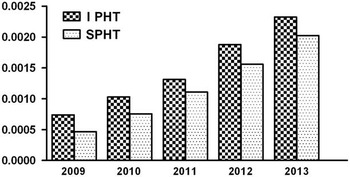
The overall annual incidence of idiopathic pulmonary hypertension at childhood was 11.7 cases/million. The annual incidence of idiopathic pulmonary hypertension increased gradually and significantly during the 5-year study period (p=0.001) (Fig 1).
Annual prevalence of primary and secondary pulmonary hypertension during the study period. PPHT=primary pulmonary hypertension; SPHT=secondary pulmonary hypertension.

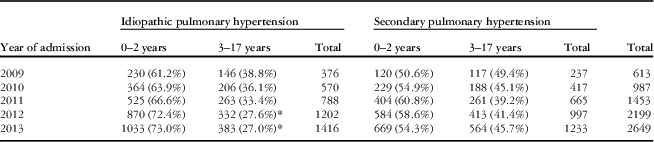
Approximately 69.4% of the children diagnosed with idiopathic pulmonary hypertension (3022 out of 4352) were aged <2 years. In the years 2012 and 2013, idiopathic pulmonary hypertension was significantly more frequent in children aged <2 years compared with children aged over 2 years (p=0.002 for both) (Table 1). The children diagnosed with idiopathic pulmonary hypertension included 2388 boys (54.9%) and 1964 girls (45.1%). The male to female ratio was 1.2:1. The frequency of idiopathic pulmonary hypertension was statistically similar in boys and girls during all admission years of the study period.
Distribution of paediatric pulmonary hypertension cases according to diagnostic classification, admission year, and age.

* Idiopathic pulmonary hypertension was significantly more frequent in children aged <2 years (p=0.002)
The overall annual incidence of paediatric secondary pulmonary hypertension was 9.5 cases/million. There was a significant and gradual increase in the annual incidence of secondary pulmonary hypertension during the 5-year study period (p=0.001) (Fig 1). As for the sub-categories of secondary pulmonary hypertension, the overall annual prevalences of congenital systemic-to-pulmonary shunts, systemic connective tissue disorders, left-sided heart failure or valvular diseases, chronic respiratory diseases, and thromboembolic diseases were 4.5 cases/million, 0.5 cases/million, 4.0 cases/million, 0.3 cases/million, and 0.2 cases/million, respectively. Approximately 56.5% of the secondary pulmonary hypertension cases (2006 out of 3549) were aged <2 years. The frequency of secondary pulmonary hypertension was statistically similar in patient age groups at each admission year (Table 1).
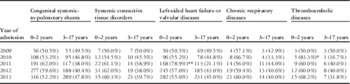
In the year of 2010, pulmonary hypertension associated with thromboembolic disease was significantly more frequent in children aged <2 years (p=0.001). In the year of 2011, pulmonary hypertension associated with left-sided heart failure or valvular disease was significantly more frequent in children aged <2 years (p=0.001) (Table 2).
Distribution of children with secondary pulmonary hypertension according to underlying diagnosis, admission year, and age.

* Pulmonary hypertension associated with thromboembolic disease was significantly more frequent in children aged <2 years (p=0.001)
** Pulmonary hypertension associated with left-sided heart failure or valvular disease was significantly more frequent in children aged <2 years (p=0.001)
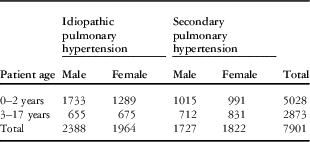
The children with secondary pulmonary hypertension included 1727 boys (48.7%) and 1822 girls (51.3%). The female to male ratio was 1.1:1. The frequency of secondary pulmonary hypertension was statistically similar in boys and girls during all admission years of the study period. Likewise, the frequencies of underlying diagnoses were statistically similar in boys and girls with secondary pulmonary hypertension during the admission years of 2009, 2010, 2011, 2012, and 2013. Moreover, the distributions of patient age and sex were statistically similar among the children with primary and secondary pulmonary hypertension (Table 3).
Distribution of paediatric pulmonary hypertension cases according to diagnostic classification, age, and sex.

Discussion
Pulmonary hypertension can occur in both the paediatric and the adult populations.Reference Haworth and Hislop 16 , Reference Takatsuki, Soep, Calderbank and Ivy 17 The incidence of idiopathic pulmonary hypertension in children has been assigned as 0.48/1,000,000 in the United KingdomReference Moledina, Hislop, Foster, Schulze-Neick and Haworth 6 and 0.7/1,000,000 in the Netherlands.Reference van Loon, Roofthooft and Hillege 7 Similarly, the prevalence of idiopathic pulmonary hypertension during childhood is 2.1/1,000,000 in the United KingdomReference Moledina, Hislop, Foster, Schulze-Neick and Haworth 6 and 4.4/1,000,000 in the Netherlands.Reference van Loon, Roofthooft and Hillege 7 As for Turkey, the overall annual incidence of idiopathic pulmonary hypertension in childhood was 11.7 cases/million. These numbers point out a relatively higher incidence of paediatric pulmonary hypertension in Turkey than those reported for the Western populations.
A female predominance has been noted for childhood pulmonary hypertension – for instance, nearly 65% of the children with idiopathic pulmonary hypertension were female, and the female to male ratio was found to be 1.7:1 in a British study.Reference Moledina, Hislop, Foster, Schulze-Neick and Haworth 6 Similarly, 60% of the paediatric pulmonary hypertension cases and children with idiopathic pulmonary hypertension were females, and the female to male ratio was 1.4:1 in another registry study.Reference Berger, Beghetti and Humpl 4 Much alike, 60% of the American children with idiopathic pulmonary hypertension were females, and 70% of the American children with CHD related pulmonary hypertension were females.Reference Barst, McGoon, Elliott, Foreman, Miller and Ivy 5 On the contrary, only 47% of the children with idiopathic pulmonary hypertension were females in a Dutch study;Reference van Loon, Roofthooft and Hillege 7 however, no female predominance could be noted for Turkish children with pulmonary hypertension.
These contradictory findings about the epidemiology of paediatric pulmonary hypertension in Turkey should be interpreted carefully because of the limiting factors that can be attributed to the differences in the study design, study cohort, timing of the study, and nomenclature.
First of all, this study was not a prospective review of specific registry systems in which only children diagnosed with pulmonary hypertension would be registered. Rather, it is a retrospective evaluation of a nation-wide registry. As this registry, which is used to identify children with pulmonary hypertension, was not specifically designed to characterise the type of pulmonary hypertension according to the current clinical classification, no uniform criteria for assigning codes were defined previously. Moreover, this registry lacks detailed data including race, symptoms at diagnosis, haemodynamic data, and survival.
Second, represented data belong to the years between 2009 and 2013. Such an interval corresponds to a more recent period during which the awareness about paediatric pulmonary hypertension has become particularly prominent and the understanding of paediatric pulmonary hypertension has been improved. It is possible that the expansion in both medical and surgical options as well as the increased awareness about pulmonary hypertension may have directed the specialised treatment centres and tertiary-care hospitals to take an initiative for the management of a greater number of children with this condition.Reference McLaughlin, Presberg and Doyle 18 , Reference Galie, Seeger, Naeije, Simmoneau and Rubin 19 This may be the reason for the seemingly significant rise in the prevalence of paediatric pulmonary hypertension throughout the study period. Third, only ICD-10 codes were used to define the paediatric pulmonary hypertension cases in this study, whereas both ICD-9 and ICD-10 codes were utilised to identify the affected children in previously published studies. Another issue is the overestimation of the prevalence of pulmonary hypertension due to non-expert registries.Reference McGoon, Benza and Escribano-Subias 10 A previous study suggested that 21% of children who are judged to have pulmonary hypertension – and are frequently treated for this disorder – do not indeed meet the haemodynamic criteria for such a diagnosis, despite most of them having right-heart catheterisation.Reference Berger, Beghetti and Humpl 4
The last factor is the delayed diagnosis of CHD related pulmonary hypertension in children. The persistence of increased pulmonary blood flow and pressures in untreated children with CHDs may contribute to the development of advanced pulmonary hypertension.Reference Wu, Zhang and Jing 20 In 2008, a law was passed so that the government bore all the financial responsibility of healthcare delivery to all Turkish citizens aged <18 years. This article allowed free examination and treatment of previously uncared children in state hospitals. 13 Such a compensation for previously neglected cases may account for the significant rise in the incidence of paediatric pulmonary hypertension during the study period.
In conclusion, this nation-wide epidemiological study suggests that the incidence of paediatric pulmonary hypertension in Turkey may be higher than that of paediatric pulmonary hypertension in Western countries. Further research is warranted to clarify the epidemiology of paediatric pulmonary hypertension in Turkey.
Acknowledgement
The authors thank the staff of the National Health Insurance Foundation of the Republic of Turkey for their valuable contributions.
Financial Support
This research received no specific grant from any funding agency, commercial, or not-for-profit sectors.
Conflicts of Interest
None.
Ethical Standards
The authors assert that all procedures contributing to this work comply with the ethical standards of the national guidelines on human experimentation (Iyi Klinik Uygulamalar Kılavuzu, 2014) and with the Helsinki Declaration of 1975, as revised in 2008, and has been approved by the Ethical Committee and Institutional Review Board of Afyon Kocatepe University.