Introduction
Childhood maltreatment has consistently been associated with significantly increased risk for concurrent and future internalizing and externalizing psychiatric disorders (Gilbert et al., Reference Gilbert, Widom, Browne, Fergusson, Webb and Janson2009). Recent studies have investigated the potential neurocognitive mechanisms contributing to elevated psychiatric risk in children who have experienced maltreatment (McCrory et al., Reference McCrory, Gerin and Viding2017a, Reference McCrory, Puetz, Maguire, Mechelli, Palmer, Gerin and Viding2017b; Puetz et al., Reference Puetz, Viding, Palmer, Kelly, Lickley, Koutoufa and McCrory2016). These studies have documented altered functioning in a range of neurocognitive domains that have also been shown to characterize individuals presenting with frank psychiatric disorder, including threat processing, reward processing, emotion regulation, and, most recently, autobiographical memory (ABM) functioning (Johnson, Greenhoot, Glisky, & McCloskey, Reference Johnson, Greenhoot, Glisky and McCloskey2005; Lawson et al., Reference Lawson, Valentino, Speidel, McDonnell and Cummings2020; McCrory et al., Reference McCrory, De Brito, Sebastian, Mechelli, Bird, Kelly and Viding2011, Reference McCrory, Gerin and Viding2017a, Reference McCrory, Puetz, Maguire, Mechelli, Palmer, Gerin and Viding2017b; Puetz et al., Reference Puetz, Viding, Palmer, Kelly, Lickley, Koutoufa and McCrory2016; Valentino, Toth, Cicchetti, Reference Valentino, Toth and Cicchetti2009). However, there has been a dearth of longitudinal studies that have included measures of brain function or psychological processes (see Dennison et al. (Reference Dennison, Sheridan, Busso, Jenness, Peverill, Rosen and McLaughlin2016) for one exception). In an attempt to address this gap, we here conducted one of the first longitudinal functional imaging studies of children experiencing documented maltreatment. The theory of latent vulnerability postulates that an array of neurocognitive systems adapt to early adverse or neglectful environments in line with the notion of experiential canalization (Blair & Raver, Reference Blair and Raver2012; McCrory & Viding, Reference McCrory and Viding2015). Such adaptations are thought to confer short-term functional advantages in atypical early environments but compromise the ability of the individual to negotiate more normative contexts as well as future stressor events. Moreover, such adaptations may also increase the likelihood that future stressful life events will occur (“stress generation” (McCrory, Ogle, Gerin & Viding, Reference McCrory, Ogle, Gerin and Viding2019)). A longitudinal design is necessary to truly interrogate any latent vulnerability construct.
ABM retrieval refers to the process by which an individual retrieves personally experienced events. The accurate and successful retrieval of autobiographical events is thought to play a critical role in scaffolding our sense of self (self-coherence (Conway & Pleydell-Pearce, Reference Conway and Pleydell-Pearce2000)), the development and maintenance of social bonds (social function) (Alea & Bluck, Reference Alea and Bluck2003), and planning of present and prospective actions (directive function) (Pillemer, Reference Pillemer2003). These functions are interdependent and it is argued that by using our past experiences to construct representations of others, attribute mental states to others (theory of mind), and subsequently predict other's future thoughts and actions, ABM is an essential component of adaptive human social behavior (Alea & Bluck, Reference Alea and Bluck2003; Nelson, Reference Nelson1993). This close relationship between ABM and (pro)social functioning is consistent with the finding that there is substantial overlap in brain areas engaged in social cognition and ABM processing (Spreng, Mar & Kim, Reference Spreng, Mar and Kim2009).
One way in which ABM functioning can be measured is by analyzing recalled memories for specificity and level of detail (Williams et al., Reference Williams, Ellis, Tyers, Healy, Rose and MacLeod1996). An ABM style that is more categorical and involves a less detailed recollection of personal events, known as overgeneral memory (OGM), compromises successful processing and regulation of emotions, interferes with self-reflection or self-projection in future scenarios and impedes social functioning by limiting social problem solving skills (Dalgleish et al., Reference Dalgleish, Williams, Golden, Perkins, Barrett, Barnard and Watkins2007; Goddard, Dritschel & Burton, Reference Goddard, Dritschel and Burton1996; Raes, Hermans, de Decker, Eelen & Williams, Reference Raes, Hermans, de Decker, Eelen and Williams2003; Rawal & Rice, Reference Rawal and Rice2012). According to the affect regulation hypotheses, recalling less vivid and detailed representations of traumatic or negatively valenced memories may serve to minimize negative affect, and thus have an adaptive short-term function (Williams et al., Reference Williams, Ellis, Tyers, Healy, Rose and MacLeod1996). However, if generalized to everyday memories, such an OGM style may become maladaptive in the longer term by limiting access to prior successful strategies to navigate intrapersonal or interpersonal stress (Raes et al., Reference Raes, Hermans, de Decker, Eelen and Williams2003; Williams et al., Reference Williams, Ellis, Tyers, Healy, Rose and MacLeod1996). Consistent with this view, OGM has been shown to be associated with, and can predict risk for, the onset of depressive disorder in adolescents (Hipwell, Sapotichne, Klostermann, Battista & Keenan, Reference Hipwell, Sapotichne, Klostermann, Battista and Keenan2011; Rawal & Rice, Reference Rawal and Rice2012), in at-risk adults (Brittlebank, Scott, Williams & Ferrier, Reference Brittlebank, Scott, Williams and Ferrier1993; Gibbs & Rude, Reference Gibbs and Rude2004) and even non-clinical samples (Anderson, Goddard & Powell, Reference Anderson, Goddard and Powell2010). In addition to the established relationship between OGM and depression, OGM has also consistently been associated with poorer social problem-solving skills, (Goddardet al., Reference Goddard, Dritschel and Burton1996), which predicts difficulty in the formation and maintenance of social relationships (Pillemer, Reference Pillemer, Winograd and Neisser1992). However, more recent studies provide a more nuanced picture, such as Gutenbrunner, Salmon, and Jose (Reference Gutenbrunner, Salmon and Jose2018), who showed that prospective associations between OGM and psychopathology emerged only among adolescents “at risk,” that is, who reported elevated, and increasing patterns of rumination over time. With regards to the present investigation, it is important to note that among individuals at risk, young people who experienced maltreatment have been shown consistently to present with OGM (e.g., Johnson et al., Reference Johnson, Greenhoot, Glisky and McCloskey2005; Lawson et al., Reference Lawson, Valentino, Speidel, McDonnell and Cummings2020; Valentino et al., Reference Valentino, Toth and Cicchetti2009).
In light of the above findings it is plausible that OGM may represent one candidate ABM mechanism that serves to index latent vulnerability to psychiatric disorder and poorer social functioning following maltreatment (McCrory & Viding, Reference McCrory and Viding2015). We recently investigated OGM behaviorally and ABM functioning at the neural level using functional magnetic resonance imaging (fMRI) in 34 children with maltreatment and 33 matched controls (McCrory et al., Reference McCrory, Puetz, Maguire, Mechelli, Palmer, Gerin and Viding2017b). In line with previous findings, maltreatment status was associated with elevated OGM. At the neural level, maltreatment experience was associated with reduced hippocampal and increased parahippocampal activation during positive (vs. negative) ABM recall relative to their nonmaltreated peers. Conversely, during negative ABM recall, children with maltreatment experiences exhibited increased activation in the amygdala as well as greater connectivity with other regions implicated in processing salient information. These findings are consistent with the view that altered ABM processing following maltreatment may index latent vulnerability to future maladaptive outcomes. It is important to note that the brain activation paradigm was not designed to investigate OGM processes. Rather, in line with other studies, it entailed a task that involved successful recall of detailed events with affective content. Research in clinical and nonclinical adult samples without maltreatment histories have provided the strongest evidence to date supporting a link between overgeneral ABM retrieval (behaviorally) and depression and social functioning (Alea & Bluck, Reference Alea and Bluck2003; Dalgleish et al., Reference Dalgleish, Williams, Golden, Perkins, Barrett, Barnard and Watkins2007; Gino & Desai, Reference Gino and Desai2012; Goddard et al., Reference Goddard, Dritschel and Burton1996; Williams et al., Reference Williams, Ellis, Tyers, Healy, Rose and MacLeod1996). Neuroimaging findings indicate that the brain regions associated with altered ABM processing of specific memories in children who have experienced childhood maltreatment, namely the amygdala, the middle temporal gyrus (MTG), parahippocampal gyrus, and hippocampus (Young, Bellgowan, Bodurka & Drevets, Reference Young, Bellgowan, Bodurka and Drevets2014) are also implicated in altered ABM processing of specific memories in depression (Young et al., Reference Young, Bellgowan, Bodurka and Drevets2014; Young, Siegle, Bodurka & Drevets, Reference Young, Siegle, Bodurka and Drevets2016). These neural differences are consistent with a relative privileging of negative versus positive memories during ABM processing.
However, the degree to which a tendency to recall autobiographical memories in an overgeneral way predicts future depression and reduced prosocial functioning has not yet been investigated in a maltreated sample. That is, OGM as a latent vulnerability factor following maltreatment experience has not been assessed to date within a longitudinal framework. In addition, the degree to which atypical neural processing associated with intact ABM recall predicts future vulnerability to depression and reduced prosocial functioning has also not been investigated. The primary aim of the current study was to address these outstanding questions in the literature and conduct one of the first longitudinal functional imaging studies of children experiencing documented maltreatment. Based on the extant evidence demonstrating that OGM predicts future depressive symptoms in at-risk samples (Guttenberg et al., 2018; Hipwell et al., Reference Hipwell, Sapotichne, Klostermann, Battista and Keenan2011; Rawal & Rice, Reference Rawal and Rice2012), we hypothesized that a similar pattern would be observed in adolescents with maltreatment histories. We also hypothesized that OGM would predict future prosocial functioning, in the light of the established association between OGM and social functioning in nonclinical samples (Alea & Bluck, Reference Alea and Bluck2003; Dalgleish et al., Reference Dalgleish, Williams, Golden, Perkins, Barrett, Barnard and Watkins2007; Gino & Desai, Reference Gino and Desai2012; Goddard et al., Reference Goddard, Dritschel and Burton1996; Williams et al., Reference Williams, Ellis, Tyers, Healy, Rose and MacLeod1996). In addition, we tested the hypothesis that the brain areas associated with atypical neural activation during ABM recall of specific valenced memories (MTG, hippocampus and amygdala) (McCrory et al., Reference McCrory, Puetz, Maguire, Mechelli, Palmer, Gerin and Viding2017b) were related to higher levels of depression and lower levels of prosocial behavior.
Method
Participants
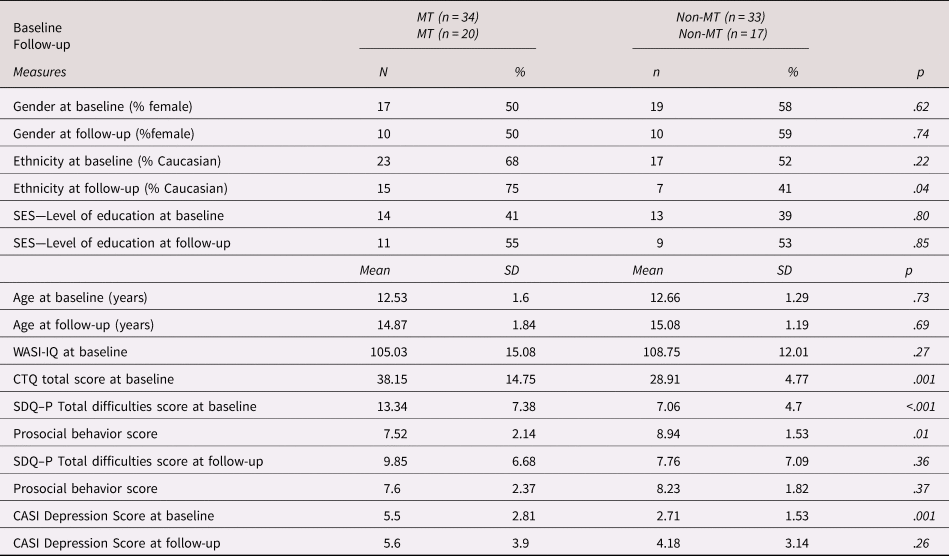
Participants had been part of an earlier study on ABM processing in children with and without maltreatment experiences (McCrory et al., Reference McCrory, Puetz, Maguire, Mechelli, Palmer, Gerin and Viding2017b). At baseline n = 77 children (n = 34 maltreatment group [MT]; n = 33 nonmaltreatment group [NMT]) underwent the Autobiographical Memory Test (AMT; see McCrory et al., Reference McCrory, Puetz, Maguire, Mechelli, Palmer, Gerin and Viding2017b for study details). From the initial sample of n = 77, we retained a sample of n = 39 (n = 19 MT; n = 20 NMT; mean age of 14.83 ± 1.53 years; range 10.15–14.92 years in the control sample to 9.95–14.82 years in the MT sample) who had complete and usable data from the baseline assessment and complete data at follow-up for the measurement of depressive symptoms and prosocial behavior (see below) and returned for a second assessment two years later. The main reason for drop-out at follow-up was the difficulty in maintaining and reestablishing contact with the children in the maltreatment group due to placement and social-worker changes. Children in the follow-up sample (n = 53 before exclusions due to e.g., missing data) and those who did not return for follow-up (n = 9 MT and n = 5 NMT, p = .26) were comparable in terms of age (p = .68), gender (p = .55), IQ (p = .50), ethnicity (p = .22), socioeconomic status (SES) (p = .37), maltreatment severity (p = .24) as well as OGM: (p = .48) and depressive symptoms T1 (p = .16) or prosocial behavior (p = .16). Exclusion criteria were: pervasive developmental disorder, neurological abnormalities, standard MRI contraindications and IQ < 70. Groups were closely matched on key demographics such as age, gender, SES, at baseline (see McCrory et al., Reference McCrory, Puetz, Maguire, Mechelli, Palmer, Gerin and Viding2017b for details) and remained matched on these parameters at follow-up except for ethnicity (see Table 1).
Background data for the maltreated and non-maltreated groups

Abbreviations: CASI, Child and Adolescent Symptom Inventory; CTQ, Childhood Trauma Questionnaire; MT, maltreated group; Non-MT, nonmaltreated group; SDQ-P, Strength and Difficulties Questionnaire—Parent report; SES, socioeconomic status; WASI-IQ, 2-subscale IQ derived from the Wechsler Abbreviated Scales of Intelligence (Wechsler, Reference Wechsler1999)
The average time interval between baseline and follow-up was 27.18 ± 4.82 months, and between group analyses showed that groups were comparable on time interval between baseline and follow-up (p > .05).
Children's legal guardians gave written informed consent, while verbal and written assent was obtained from the children themselves. Verbal consent was witnessed and formally recorded.
The authors assert that all procedures contributing to this work comply with the ethical standards of the relevant national and institutional committees on human experimentation and with the Helsinki Declaration of 1975, as revised in 2008. All procedures involving human subjects/patients were approved by UCL Research Ethics Committee (0895/002).
Measures
Maltreatment history
Children in the maltreatment group had experienced a level of maltreatment requiring Social Services referral at baseline. Severity of neglect, emotional, sexual, and physical abuse as well as intimate partner violence, were rated by the child's social worker or adoptive parent on the basis of Social Service's file information. Ratings from zero (not present) to four (severe) were applied to each category (Kaufman, Jones, Stieglitz, Vitulano & Mannarino, Reference Kaufman, Jones, Stieglitz, Vitulano and Mannarino1994). The majority of children had been exposed to neglect, emotional abuse and intimate partner violence. Additionally, children completed the Childhood Trauma Questionnaire (CTQ) (Bernstein & Fink, Reference Bernstein and Fink1998). For details regarding maltreatment type, onset, duration and severity at baseline assessment, see Table 1 DS1 in McCrory et al. (Reference McCrory, Puetz, Maguire, Mechelli, Palmer, Gerin and Viding2017b).
Cognitive ability
Cognitive ability was assessed at baseline using two subscales of the Wechsler Abbreviated Scales of Intelligence (Wechsler, Reference Wechsler1999), the word reading subscale of the Wide Range Achievement Test (WRAT 4) (Wilkinson & Robertson, Reference Wilkinson and Robertson2006), and two subtests of the CogState battery pertaining to visual and verbal episodic memory (see McCrory et al., Reference McCrory, Puetz, Maguire, Mechelli, Palmer, Gerin and Viding2017b for details).
Psychiatric symptomatology
The depression symptom subscale of the Child and Adolescent Symptom Inventory (CASI) (Lavigne, Cromley, Sprafkin & Gadow, Reference Lavigne, Cromley, Sprafkin and Gadow2009) and the Strengths and Difficulties Questionnaire subscale assessing prosocial behavior (SDQ, parent-rated) (Goodman, Reference Goodman1997) were used to characterize depression symptoms and social functioning. We have selected this common, well-standardized measure of prosocial behavior as one index of social functioning. These subscales were also chosen for analyses due to the established relationship between OGM and depression and social functioning (Dalgleish et al., Reference Dalgleish, Williams, Golden, Perkins, Barrett, Barnard and Watkins2007; Goddard et al., Reference Goddard, Dritschel and Burton1996; Raes et al., Reference Raes, Hermans, de Decker, Eelen and Williams2003; Rawal & Rice, Reference Rawal and Rice2012) and altered neural ABM functioning in patients with depression and at risk for depression (Young et al., Reference Young, Bellgowan, Bodurka and Drevets2014, Reference Young, Siegle, Bodurka and Drevets2016). The hyperactivity subscale of the SDQ (parent-rated) (Goodman, Reference Goodman1997) as well as the Inattention and Hyperactivity subscales of the CASI (Lavigne et al., Reference Lavigne, Cromley, Sprafkin and Gadow2009) were included in order to rule out the possibility that OGM and atypical ABM functioning at the neural level were associated with increased risk of psychopathology more generally.
Autobiographical Memory Test (AMT) and fMRI stimulus generation
The AMT (Williams & Broadbent, Reference Williams and Broadbent1986), a standard measure of OGM, was administered to all participants in a session 1–3 weeks before scanning at baseline. Participants generated specific memories in response to ten positive (e.g., achieve, caring) and ten negative cue words (e.g., mistake, lonely). OGMs were defined as “memories that did not contain at least one specific detail that identifies an event as a distinct episode” (Valentino et al., Reference Valentino, Toth and Cicchetti2009; Williams & Broadbent, Reference Williams and Broadbent1986). Correlational analyses showed that positive and negative OGMs were correlated in each group (MT: rOGMpos_neg = .50, p = 004; non-MT: rOGMpos_neg = .65, p = .000). Correlations between .30 and .70 are considered as “moderate” and we therefore collated performance across conditions into one overall measure of OGM (OGM total) to reduce the amount of comparisons. Stimuli for the fMRI task included specific memories generated from the AMT and specific memories generated from supplemental valenced cue words, administered to ensure a full set of 20 specific memories were generated (10 positive ABMs, 10 negative ABMs) for the imaging component, in line with prior fMRI studies (Summerfield, Hassabis & Maguire, Reference Summerfield, Hassabis and Maguire2009). These memories were rephrased by the participants in 3–4 words to prompt recall during the scanning session. In line with prior studies in adults (Summerfield et al., Reference Summerfield, Hassabis and Maguire2009), a control task was employed in which participants were presented with pictures and brief descriptions of ten everyday objects. Participants were given 20 s to memorize each object. As with the ABMs, key features were captured in brief sentence cues for presentation during fMRI. The memories were coded by a trained member of the research team in the lab and double rated by a second, independent member of staff on 10% of the memories. Inter-rater agreement was high (average agreement k > .82).
MRI scanning session
There were three memory conditions: Positive ABM recall, Negative ABM recall and Object recall. The fMRI task consisted of two runs of 15 trials, each comprising five positive ABMs, five negative ABMs and five object memories presented in a pseudorandomized order, which prevented the consecutive presentation of a stimulus category. Each trial began with a sentence cue and elaborate phase lasting 20 s. Participants indicated successful or unsuccessful memory retrieval (silent) via a self-paced button press. The text cue then disappeared and the word “Elaborate” was presented for 8 s during which time the participants recalled the memory or object. The elaboration period was followed by an audio tone (1 s), then a 5-point Likert scale rating recall difficulty, vividness and remoteness of memory. The two rating periods lasted 4.5 s each and were followed by a 2 s inter-trial interval (ITI). Postscanning, ABMs were rated on emotional salience, remoteness, and agency. These ratings were used to ensure the phases were comparable across participants. Analyses of vividness, recall difficulty, and remoteness did not yield significant differences between the groups, confirming that cue phrases and corresponding memories were comparable between groups (all Ps > .19). Average recall success of cued ABMs was very high, with no significant differences in number of non-retrieved memories between the groups (MT: 1.75 ± 1.52 memories, non-MT: 1.97 ± 1.17 memories, p = .62).
fMRI data acquisition
Data were acquired on a 1.5 tesla Siemens (Siemens Medical Systems, Erlangen, Germany) Avanto MRI scanner with a 32-channel head coil during two runs of approximately 9 min each. During each run, a total of 181 T2* weighted echo-planar (EPI) volumes were acquired, covering the whole brain with the following acquisition parameters: slice thickness: 2 mm; TR: 85 ms; TE: 50 ms; FOV: 192 mm × 192 mm2; 35 slices per volume, gap between slices: 1 mm; flip angle: 90°). A high-resolution, three-dimensional T1-weighted structural scan was acquired with a magnetization prepared rapid gradient echo sequence. Imaging parameters were: 176 slices; slice thickness = 1 mm; gap between slices = 0.5 mm; echo time = 2730 msec; repetition time = 3.57 msec; field of view = 256 mm × 256 mm2; matrix size = 256 × 256; voxel size = 1 × 1×1 mm resolution.
Analyses
OGM as a behavioral predictor
Hierarchical linear regression models were conducted to predict follow-up depressive symptoms (CASI) and prosocial behavior (SDQ) using the baseline total OGM score from the AMT as the independent variable, controlling for baseline depression symptoms and baseline prosocial behavior by entering baseline symptoms into the model as a covariate in SPSS version 24 (IBM Corp. 2012). We conducted an a priori power calculation based on our planned sample size and desired power (80% at α = 5%) to show that with 20 and 17 subjects respectively in each group we had 80% power to detect a “medium” effect size of d = 0.52 at α = .05 (one-tailed) in any of our behavioral measures, an effect size commensurate with effect sizes typically reported in this field (e.g., Valentino et al., Reference Valentino, Toth and Cicchetti2009), indicating sufficient power. The use of one-tailed power calculation was justified as we had a clear expectation regarding the direction of effect, given the established literature on OGM and depression (Dalgleish et al., Reference Dalgleish, Williams, Golden, Perkins, Barrett, Barnard and Watkins2007; Goddard et al., Reference Goddard, Dritschel and Burton1996; Hipwell et al., Reference Hipwell, Sapotichne, Klostermann, Battista and Keenan2011; Raes et al., Reference Raes, Hermans, de Decker, Eelen and Williams2003; Rawal & Rice, Reference Rawal and Rice2012; Rawal & Rice, Reference Rawal and Rice2012).
Brain–behavior relationships
Pre-processing
Data analyses were conducted using the software package SPM8 (www.fil.ion.ucl.ac.uk/spm/software/spm8) implemented in MathWorks (2015). After discarding the first three volumes of each run to allow for T1 equilibration effects, data were realigned; initially within each run and then across the two runs to the first image of the first run. Data were normalized into MNI space using deformation fields from T1 scan segmentation at a voxel size of 3 × 3 × 3 mm. The resulting images were smoothed with a 6 mm Gaussian filter and high-pass filtered at 128 Hz. Fixed-effects statistics for each individual were calculated by convolving boxcar functions modelling the four conditions (positive ABM, negative ABM, object recall, and rating) with a canonical hemodynamic response function (HRF).
Additionally, the six motion parameters were added to the model as regressors of no interest. In order to further minimize movement-related artefacts, images corrupted due to head motion greater than 1.5 mm were removed and replaced by interpolations of adjacent images (<7% of each participant's data). For these participants, we included an additional regressor of no interest to model the interpolated scans. Individual participants’ SPMs containing the parameter estimates of the four conditions were then entered as fixed-effects factors into a repeated measures mixed-effects analysis of variance (ANOVA) containing a “subject” factor for random effects for group analyses.
fMRI Analyses
Contrast estimates were extracted from the peak voxels of clusters showing significant group differences in the contrast positive ABM recall versus negative ABM recall in the previous study at baseline. These regional clusters were (a) right middle temporal gyrus, (b) right hippocampus, and (c) right amygdala and were extracted with MarsBaR Toolbox (Brett, Anton, Valabregue, & Poline, Reference Brett, Anton, Valabregue and Poline2004). Except for the amygdala, all parameter estimates were retrieved from whole brain analyses that were corrected using cluster-size thresholding (Monte-Carlo Simulation via 3D ClusterSim) (Ward, Reference Ward2000) of voxel-wise p < .005, ke = 75, which corresponds to p = .05, family-wise error (FWE). The amygdala was retrieved via region of interest (ROI) analyses (anatomically defined using the Automated Anatomical Labelling (AAL) atlas as implemented on WFU-PickAtlas software) and small volume corrected for multiple comparisons at p < .05. The data from the subset of participants who came back for a second assessment and are included in the present study mirrored the data from the larger set of participants included at the first timepoint with regard to the hippocampus (p = .006), MTG (p = .005), but failed to reach significance in the amygdala (p = .21). Comparison of the sample that was retained versus the sample that was not retained showed no significant differences in any of these regions.
As with OGM score, hierarchical linear regression models were conducted to predict follow-up depressive symptoms (CASI) and prosocial behavior (SDQ) using the baseline ABM-related brain activity in the: (a) right hippocampus, (b) right MTG, and (c) right amygdala as independent variables. All regression models controlled for baseline depression symptoms and baseline prosocial behavior by entering baseline symptoms into the model as a covariate. Analyses were conducted using SPSS version 24 (IBM Corp. 2012).
Results
Table 1 presents demographic data at baseline and follow up.
OGM as a behavioral predictor of depressive symptoms and prosocial behavior
OGM and depressive symptoms
Relationships between OGM at baseline and depressive symptoms at follow-up were assessed by means of a linear regression model using the depressive symptom score at follow-up as the dependent variable and OGM as the predictor while controlling for levels of depressive symptoms at baseline. Baseline OGM was not found to be associated with elevated depressive symptoms at follow-up in the MT group (ß = .65, p = .15; total model: R2 = .22, F(2,16) = .81, p = .51), when correcting for severity of maltreatment and baseline levels of depressive symptoms. In the NMT group, the only significant predictor of depressive symptoms at follow-up was level of depressive symptoms at baseline (ß = −.54, p = .012; Total model: R2 = .38, F(2,19) = 5.41, p = .015), while OGM was non-significant (ß = .23, p = .25). We ran an additional regression analysis that includes group as the independent variable to evaluates the group × OGM interaction term for significance, which mirrored the results of the separate models.
OGM and prosocial behavior
Hierarchical linear regression analyses were conducted in each group to investigate the effect of OGM at baseline on indices of prosocial behavior (derived from the SDQ subscale). In the MT group, OGM significantly predicted prosocial behavior (R2 = .26, F(2,19) = 6.2, p = .023), controlling for severity of maltreatment and prosocial behavior at baseline. Higher OGM was significantly associated with reduced prosocial behavior measured at follow-up (ß = −.520, p = .023; Bonferroni corrected). No relationship between OGM and prosocial behavior was found in the non-MT group (OGM: R2 = .01, F(2,16) = .04, p = .96).
Analyses of the slopes of prosocial behavior and depressive symptoms yielded no significant differences between the groups (tprosocial(33) = .19; (tdepressive(26) = .60).
OGM and symptoms of attention deficit hyperactivity disorder (control analyses)
In order to test if the association between OGM and socio-emotional functioning (depressive symptoms and prosocial behavior) is specific, we ran control analyses testing the association between OGM and symptoms typically associated with maltreatment experiences, that is, hyperactivity (SDQ subscale) and inattention (CASI-subscale). OGM did not predict symptoms of attention-deficit-hyperactivity disorder (hyperactivity: R2 = .01, F(2,19) = .32, p = .72; inattention: R2 = .11, F(2,16) = .77, p = .55).
Atypical brain activity associated with specific ABM recall as a predictor of depressive symptoms and prosocial behavior
Hippocampus / MTG / amygdala activity during ABM recall (positive vs. negative contrast) and depressive symptoms
No significant relationship was found between activity in either hippocampus, MTG or amygdala during positive versus negative ABM recall at baseline and depressive symptoms at follow-up in either group (all Ps > .56).
Hippocampus / MTG / amygdala activity during ABM recall (positive vs. negative contrast) and prosocial behavior
Controlling for prosocial behavior at baseline, we did not find a significant relationship between activity in the hippocampus, MTG or amygdala during positive versus negative ABM recall at baseline and prosocial behavior at follow-up in either group (all Ps > .26).
Discussion
Here we investigated whether levels of OGM and neural indices of ABM functioning predicted future socio-affective functioning in adolescents with documented experiences of maltreatment. This is the first study to examine ABM functioning as a candidate mechanism for understanding future psychiatric vulnerability in individuals who have experienced childhood maltreatment. Greater levels of OGM at baseline were found to significantly predict lower levels of prosocial behavior two years later in children who had experienced maltreatment. A similar pattern was also evident in relation to future depression symptoms but only at trend level. Analyses indicated that altered patterns of neural functioning associated with maltreatment experience (hippocampus, MTG, amygdala) were not related to either depressive symptoms or prosocial behavior two years later, at least using the measures employed in this study.
ABM plays a crucial role in social functioning (Alea & Bluck, Reference Alea and Bluck2003) and may serve to strengthen social relationships through the process of sharing past experiences with one another (Bauer, Stennes & Haight, Reference Bauer, Stennes and Haight2003). Specifically, a pattern of overgeneral ABM may lead to impaired social problem-solving (Gino & Desai, Reference Gino and Desai2012; Goddard et al., Reference Goddard, Dritschel and Burton1996). Prior studies have shown that individuals with maltreatment experience are more likely to present with social difficulties, particularly increased risk of re-victimization (such as bullying) (Benedini, Fagan & Gibson, Reference Benedini, Fagan and Gibson2016; Widom, Czaja & Dutton, Reference Widom, Czaja and Dutton2008) and reduced levels of social support in adulthood (Sperry & Widom, Reference Sperry and Widom2013). Here, we found that adolescents with greater OGM presented with less prosocial behavior two years later, suggesting that OGM may be one factor that impacts the ability to engage in adaptive social behavior.
Given this impact on social functioning, overgeneral autobiographical memory may be understood to increase latent vulnerability to future psychiatric disorder in two ways. First, it might have a “direct” effect on online social processing, increasing the likelihood of stressful events occurring. If an individual is less able to draw on past experience to mitigate potential problems through adaptive social problem solving, then these problems may be more likely to escalate into a crisis (e.g., relationship breakdown), a phenomenon that has been referred to as “stress generation” (McCrory et al., Reference McCrory, Ogle, Gerin and Viding2019). Second, it might have an “indirect” effect, cumulatively impacting an individual's social ecology, as poorer adaptive social problem solving may reduce the likelihood that they can effectively elicit, cultivate, and sustain protective social relationships. If an individual is less able to build a stable network that provides social support they will be more susceptible and vulnerable to stress.
Our analyses were inconclusive with regard to OGM as a latent vulnerability factor for depression in adolescents with maltreatment histories. A relationship between OGM and depression has been observed in samples of depressed children and adults (Brittlebank et al., Reference Brittlebank, Scott, Williams and Ferrier1993; Peeters, Wessel, Merckelbach & Boon-Vermeeren, Reference Peeters, Wessel, Merckelbach and Boon-Vermeeren2002; Vrielynck, Deplus & Philippot, Reference Vrielynck, Deplus and Philippot2007). However, more recent research provides a more nuanced picture and show that prospective associations between OGM and psychopathology emerged only among adolescents “at risk,” that is, who reported elevated, and increasing patterns of rumination over time, while OGM did not predict psychopathology in adolescents without rumination (Gutenbrunner et al., Reference Gutenbrunner, Salmon and Jose2018). Furthermore, some studies seem to suggest that the relationship between OGM and depressive symptoms is valence dependent, sometimes emerging to negative cue words compared to positive (Woody, Burkhouse, & Gibb, Reference Woody, Burkhouse and Gibb2015) and sometimes emerging to positive but not negative cues (Hipwell et al. Reference Hipwell, Sapotichne, Klostermann, Battista and Keenan2011). The finding that OGM is evident even in individuals where depression has remitted and predicts future depression in at-risk individuals suggests that OGM is not simply a state-like marker of depression, but a trait-like marker that is implicated in the pathogenesis of the disorder (Medsker, Forno, Simha, Juan & Sciences, Reference Medsker, Forno, Simhan, Juan and Sciences2016; Rawal & Rice, Reference Rawal and Rice2012). The nature of this association remains unclear. One possibility is that an increase in depression symptomatology is driven by poorer social problem solving that can result from OGM (McCrory et al., Reference McCrory, Gerin and Viding2017a, Reference McCrory, Puetz, Maguire, Mechelli, Palmer, Gerin and Viding2017b). OGM may also increase vulnerability to depression by limiting access to strategies to reduce negative affects that have previously been successful (Williams et al., Reference Williams, Ellis, Tyers, Healy, Rose and MacLeod1996). Studies with larger samples and longer follow-up periods are needed to conclusively evaluate the potential role of OGM as a latent vulnerability factor for depression in children with experiences of childhood maltreatment.
Finally, in contrast to the significant findings observed for the behavioral index of OGM, no such relationship was found between the neural correlates of ABM and subsequent psychological and behavioral functioning. It is important to note that the brain activation was associated with a task that required retrieval of specific memories, and therefore did not index the neural correlates of OGM. Rather, it elucidated differences in how everyday positive and negative memories engaged a neural network of regions implicated in memory specification and salience. There are several possible explanations for this finding. First, while fMRI may be effective in indexing reliable group differences, different fMRI paradigms are likely to vary in how robust they are for reliably indexing individual differences (Nord, Valton, Wood & Roiser, Reference Nord, Valton, Wood and Roiser2017) and it may be that the signal generated by each individual in this task might not be sufficiently reliable to predict psychopathology. A second related possibility is that what was measured by fMRI (which related to affective content of successfully retrieved detailed memories) did not capture the aspect of information processing that indexes risk of reduced prosocial functioning and increased depression.
A number of limitations of the current study should be noted. First, due to the attrition over the two years in our sample, our sample was potentially not large enough to detect more subtle effects, such as group differences in the amygdala or sex differences. Previous research indicates that there may be some differential mental health outcomes for boys and girls exposed to early adversity and also that ABM processes can be different between the sexes (Reese, Haden & Fivush, Reference Reese, Haden and Fivush1996). It is important to note that power limitations arising from the smaller sample potentially influenced our ability to detect an effect for OGM and neural ABM processing on the development of depression. However, albeit smaller, our follow-up sample was comparable in terms of demographics, psychopathology, and brain activation (except amygdala) to the full baseline sample. Second, a longer follow-up after the mean age indexed here (14 years old) would increase the likelihood of symptom development and sample size, which would increase power to detect associations with the development of mental health problems. Finally, in this study we used prosocial behavior as a proxy measure for social functioning. In order to characterize more fully the impact of OGM on social behavior it will be helpful for future studies to include other measures, including, for example, a measure of social problem solving and Theory of Mind.
The current study is among the first to investigate whether alterations in neurocognitive processing shown to be associated with maltreatment experience predict future psychosocial functioning and mental health. We have shown that altered ABM processing in the form of increased OGM predicts reduced prosocial behavior later in development, and may also predate risk for depression, in individuals with maltreatment histories. OGM may therefore represent a marker of latent vulnerability to poorer psychosocial functioning and mental health. The current findings also highlight the OGM as a potential therapeutic target for a preventative approach that would aim to reduce risk of decreased pro-social behavior and depression emerging in adolescents with prior histories of maltreatment. Such an approach would need to be complemented by a careful understanding of how OGM memory impacts social functioning in ways that potentiate risk.
Acknowledgments
The authors thank the children, parents, carers, and social workers who generously participated in this research.
Financial support
This work was funded by a grant to E.J.M. (PI) and E.V. from the UK Economic and Social Research Council (ES/K005723/1). E.A.M. is supported by a Wellcome Principal Research Fellowship (210567/Z/18/Z).