Introduction
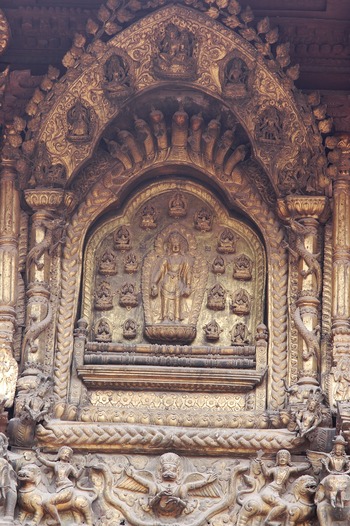
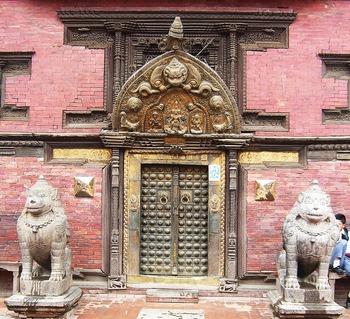
One of the major attractions in the city of Patan (Nepal) is the Golden Window (luṃjhyāḥ, Newari) above the Golden Door (known as sunḍhokā in Nepali) of Caukoṭ Darbār, a building on the western side of the (former) Royal Palace complex, the Patan Darbār (Figure 1). The window is an important work because of its prestigious location and its unique design. The gilt window panel, which is hinged horizontally along the top and swings back inside vertically (dhīkhāpā, New.), features a representation of a Bodhisattva flanked on two sides by miniature images of Hindu divinities (Figure 2). The sides, base and tympanum of the window likewise display Hindu divinities.
(Colour online) Front view of Caukoṭ Darbār with the Golden Window above the Golden Door, Royal Palace, Patan (Photo courtesy of Rupert Steiner)

(Colour online) The Golden Window of Caukoṭ Darbār (Photo courtesy of Manik Bajracharya)

The construction of the window and its complex configuration of divinities has been ascribed to different kings of the late Malla period (1483–1768). However, as I hope to show, there is no evidence for such an early dating of the window. In the first part of this paper, I will deal with the identification of the divinities on the window. I will then examine textual and visual sources that shed light on the date of the window's construction, including the inscriptions above and at the sides of the Golden Door. I will conclude with some thoughts on the possible significance of the peculiar configuration of divinities surrounding the Bodhisattva on the window.
The divinities of the Golden Window and the window's design
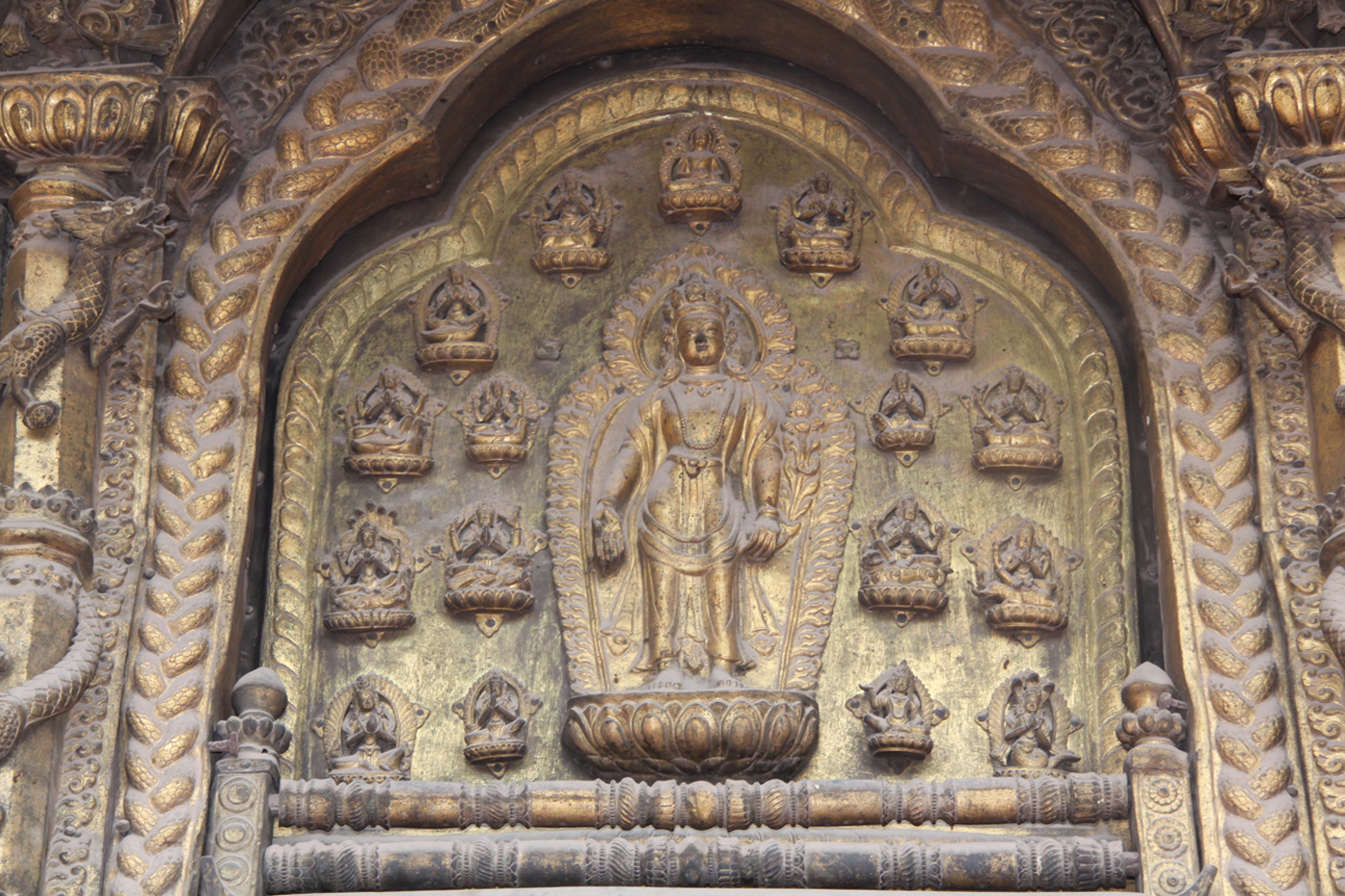
The centre of the window features a two-armed standing figure holding a lotus in his left hand and displaying the wish-granting gesture with his right (Figure 2a). The iconography corresponds to that of Padmapāṇi, a form of the Bodhisattva Avalokiteśvara. Above his head is a miniature of Amitābha, to whose Buddha family he belongs. The figures on both sides of the Bodhisattva are hard to identify, not only because they are small but also because the artist did not make much effort to differentiate between some of them; three look almost identical. Fourteen seated Hindu divinities flank the Bodhisattva, some arranged in double columns. In addition, there are two smaller figures close to the Bodhisattva's feet. Mainly on the basis of comparable iconographic representations in Newar art, I take them to be divine Buddhist attendants.
(Colour online) Detail of the Golden Window, showing Avalokiteśvara, with Amitābha above, Hindu divinities at the sides and Buddhist attendants next to his feet (Photo courtesy of Niels Gutschow)
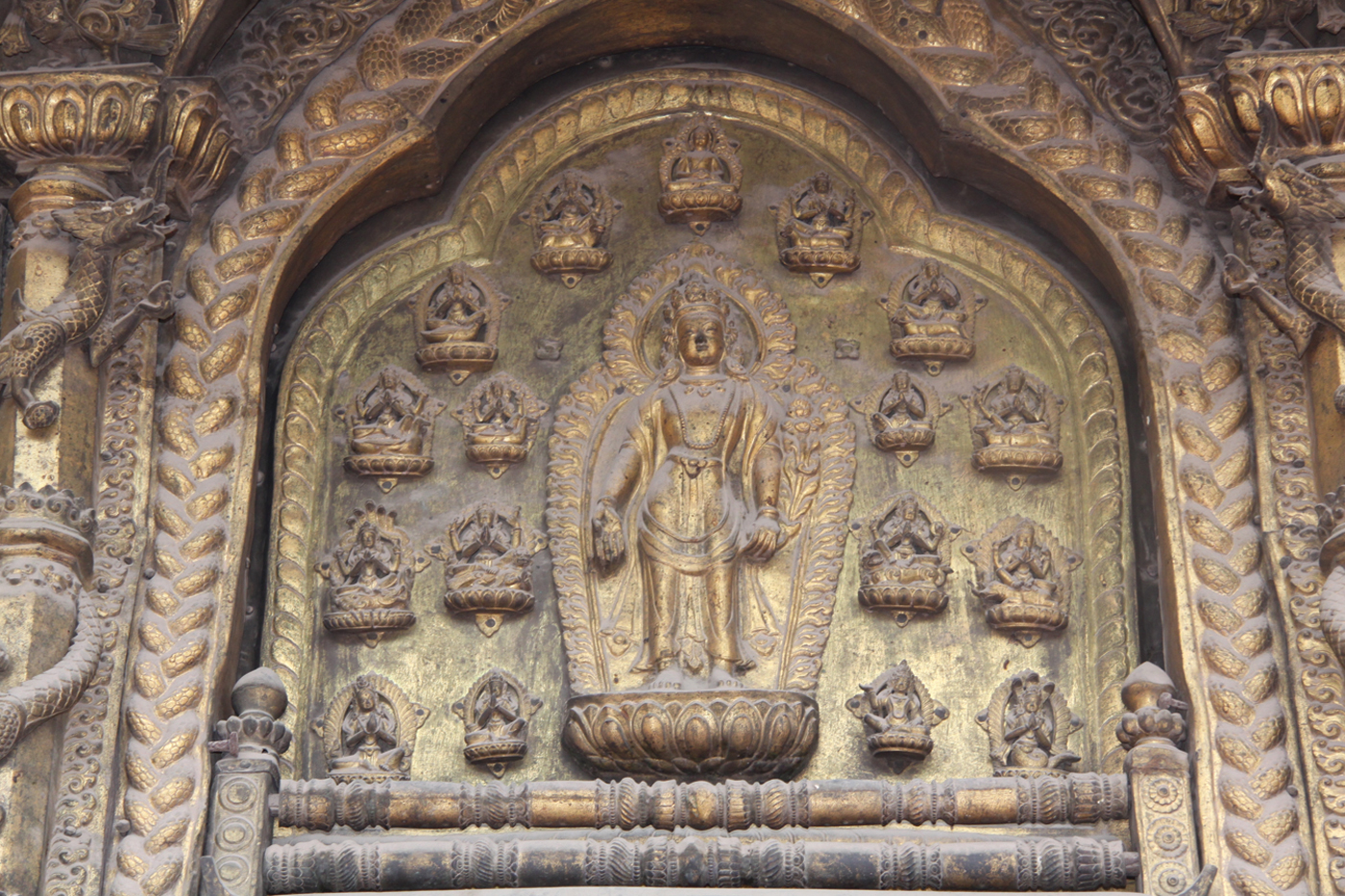
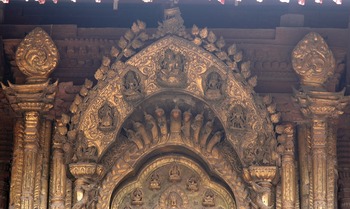
(Colour online) Detail of the Golden Window, showing the divinities on the tympanum (Photo courtesy of Manik Bajracharya)

The pair of Hindu gods flanking but slightly below Amitābha, from the viewer's left to right, are seen to be a four-armed Maheśvara seated on a bull and a four-armed Agni on a ram. The row below features Candra on a goose and Sūrya on a horse. In the next row, on the left, is a four-armed Sarasvatī on a goose and a four-headed, four-armed Brahmā, also seated on a goose. The bearded figure on the right who has joined both hands in the gesture of reverence (añjalimudrā) may be Kubera. He is without an animal mount and has just two arms, and is regularly included in similar iconographic representations. Next to him is a four-armed Vāyu on a gazelle. The row below features, on the left, a four-armed Varuṇa – adorned with a snake's five hoods seated on a mythological sea monster (makara) – and a four-armed Viṣṇu on Garuḍa. To the right are a four-armed Lakṣmī on a lion and a four-armed Indra mounted on an elephant. The iconography of Lakṣmī, whose mount is often a tortoise in Nepal, appears here to be inspired by that of the mother goddess (mātṛkā) Mahālakṣmī, who rides a lion.Footnote 2 In the row below, to the far left, appears a goddess who has joined both hands in the añjali gesture. She can be identified as the Earth Goddess only on the basis of comparable iconographic representations in which she occupies the same position. On the far right is a serpent deity (nāga) whose features are half-serpent and half-human, and who is very probably the serpent king Śeṣanāga.
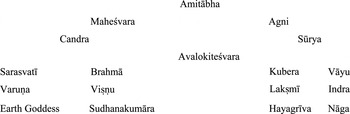
The Buddhist attendant close to the Avalokiteśvara's right foot is smaller in size than the figure of the Earth Goddess but of somewhat similar appearance. He can be identified as the Bodhisattva Sudhanakumāra, but again only on the basis of comparable iconographic representations where he appears in this position as an attendant next to Avalokiteśvara's right foot, and with both hands in añjalimudrā. Near the Bodhisattva's left foot is Hayagrīva. He is recognizable by the small head of a horse on his own head and the characteristic gesture of veneration he displays with his right hand. Sudhanakumāra and Hayagrīva are common attendants of Avalokiteśvara. The arrangement of the figures on the gilt window panel is shown in Figure 3.
The arrangement of the figures on the gilt window panel

The representation of this form of Avalokiteśvara with Hindu divinities – elsewhere called SṛṣṭikartāFootnote 3 (creator) Lokeśvara – corresponds with descriptions in two Sanskrit texts. The account of the creation of the Hindu divinities from Avalokiteśvara's body appears in chapter 4 of recensions of the Kāraṇḍavyūha, a Mahāyāna Sūtra with a complex textual history.Footnote 4 It next appears in the Guṇakāraṇḍavyūha, a Nepalese reworking of a version of the text, perhaps from the fifteenth century. According to the description (p. 265, 1–3) in chapter 4, titled Candrādyutpatti, in the version of the Kāraṇḍavyūha published by Vaidya, Avalokiteśvara emanated nine divinities from different parts of his body, in the following sequence:
According to the Guṇakāraṇḍavyūha, whose “creation account” reached a wider public through translations into Newari from the middle of the nineteenth century (Tuladhar-Douglas Reference Tuladhar-Douglas2006: 12), Avalokiteśvara emanated twelve Hindu divinities. Chapter 4 (entitled Śrīmaheśvarādidevasamutpādana) of the metrical version of this textFootnote 5 lists the emanations in the same sequence as the Kāraṇḍavyūha, with the addition of the following three (p. 40, 1–10):
The text continues with the remark that “in this way other (unspecified) divinities also emanated”. This statement leaves open the number of possible emanations. The Golden Window features Indra and the serpent king in addition to the twelve divinities listed in the Guṇakāraṇḍavyūha. I will discuss later the significance of the fact that the window features fourteen emanations.
Let us now examine the remaining parts of the window. On the window panel, Avalokiteśvara appears in a frame consisting of the body of a twisted nine-headed snake. The snake's hoods protrude from behind its head. The window is flanked on either side by a pillar, each resting on a crouching elephant and featuring two dragons along its length, the whole supporting a tympanum (Figure 2). Each pillar is in turn flanked by two further pillars. On the lower part of the middle pillars, the river goddesses Gagā, on a mythological sea monster (makara) (to the viewer's left), and Yamunā, on a tortoise (to the viewer's right), are visible. The outer pillars, much taller than the inner ones, are crowned by oval-shaped symbols. The Golden Window is the centre of a row of three windows that share a common frame (svapājhyāḥ, New.). The two side windows are simple wooden windows. Their tympanums feature a form of Kālī/Cāmuṇḍā seated on seven skulls. The decorative base, shared by the Golden Window and the two adjacent wooden windows, displays the Garuḍa bird in the centre flanked on either side by a figure on a lion, a winged figure wearing a hat mounted on an elephant and a lion standing upright on two legs. Again, the tympanum features Hindu divinities (Figure 2b). Apparently misled by the Garuḍa figure, David Gellner took the group of divinities on the tympanum for forms of Viṣṇu and assumed that their presence was intended to suggest “that the principal Buddhist bodhisattva is a form of Viṣṇu” (Gellner Reference Gellner1996: 140). A decade before Gellner's publication, Heimo Rau suggested that the tympanum shows Śiva with Pārvatī, Gaṇeśa and Kārttikeya (Rau Reference Rau1984: 256). I agree that the centre more likely features Śiva with his consort seated on his left thigh, both supported by their bull and lion mounts. Below and to the viewer's left is Gaṇeśa, seated on a rat. To the viewer's right is a figure playing a lute, who is seated on a bird that resembles a peacock. Rau identified the figure as Kārttikeya, but the lute indicates that we have here a representation of the goddess Sarasvatī, whose vehicle, the goose, in later iconography often resembles a peacock. Further below, to the viewer's right, is perhaps Śiva's attendant Bhṛgin, clothed in a tiger skin and playing a drum. The dancing figure to the left is unidentified, but it could be Śiva's devotee, Nandin. At the very bottom, atop each of the pillars which flank the window, appears a celestial being, half human and half bird (kinnara, also known to Newars as an “aquatic man”, jalamānuṣa).
The arrangement of the deities on the tympanum is thus:

Interpreting the configuration of divinities
Gellner notes a similarity between the representation of the Bodhisattva flanked by the Hindu divinities on the Golden Window and “Nārāyaṇa or Ardhanārīśvara surrounded by the ten avatāras”, and suggests that the representation of the Bodhisattva is “a clear copy” of the latter and “deliberately ambivalent” (1992: 94). I am not convinced that this is actually the case. Texts specify the body parts of the Lokeśvara from which the Hindu deities emanate. In art, the divinities are therefore often depicted as attached to the body parts by thin threads. It is only to be expected that an artist would show the emanated Hindu divinities on both sides of the Bodhisattva. Grouping emanations or subordinate deities as miniature images around a main figure is a familiar artistic convention in Nepal. Artists, who commonly worked for both Buddhist and Śaiva patrons, followed it frequently. Examples of a main figure surrounded by subordinate ones include the statue of Nārāyaṇa encircled by miniature images of the avatāras in the small Nārāyaṇa shrine in Asan (Kathmandu) and the stone sculpture of Lakṣmīnārāyaṇa surrounded by Hindu deities in Nakabahī (Patan).Footnote 6 One could easily imagine that, from afar and without thorough knowledge of the iconography, the sculptures could be mistaken for representations of Sṛṣṭikartā Lokeśvara emanating Hindu divinities. As an example of supposedly deliberate ambiguity Gellner refers to the statue of Sṛṣṭikartā Lokeśvara at Śakhamūl Ghat (Patan), which his informant identified as Nārāyaṇa. However, such misidentifications are simply based on ignorance of the religious iconography and do not prove the intention of the artist.
The complex configuration of divinities surrounding the Avalokiteśvara on the Golden Window has been said to illustrate the Malla kings' tolerant attitude towards Buddhism and their support for the Buddhist practices of their subjects, while providing a Hindu interpretative framework for such practices. Gellner notes that “[t]he central figure [of the Lokeśvara] is thus an expression of Buddhist superiority to Hinduism; but this is encapsulated in a frame which suggests that Buddhism is a form of Hinduism. This complex iconography is to be related to the Malla kings' policy (and especially to Shri Nivasa's policy) of supporting the predominantly Buddhist cults of their subjects in Lalitpur, while simultaneously encouraging a Hindu interpretation of those cults and requiring their subjects to conform to Hindu social norms” (Gellner Reference Gellner and Hutt1994: 150).
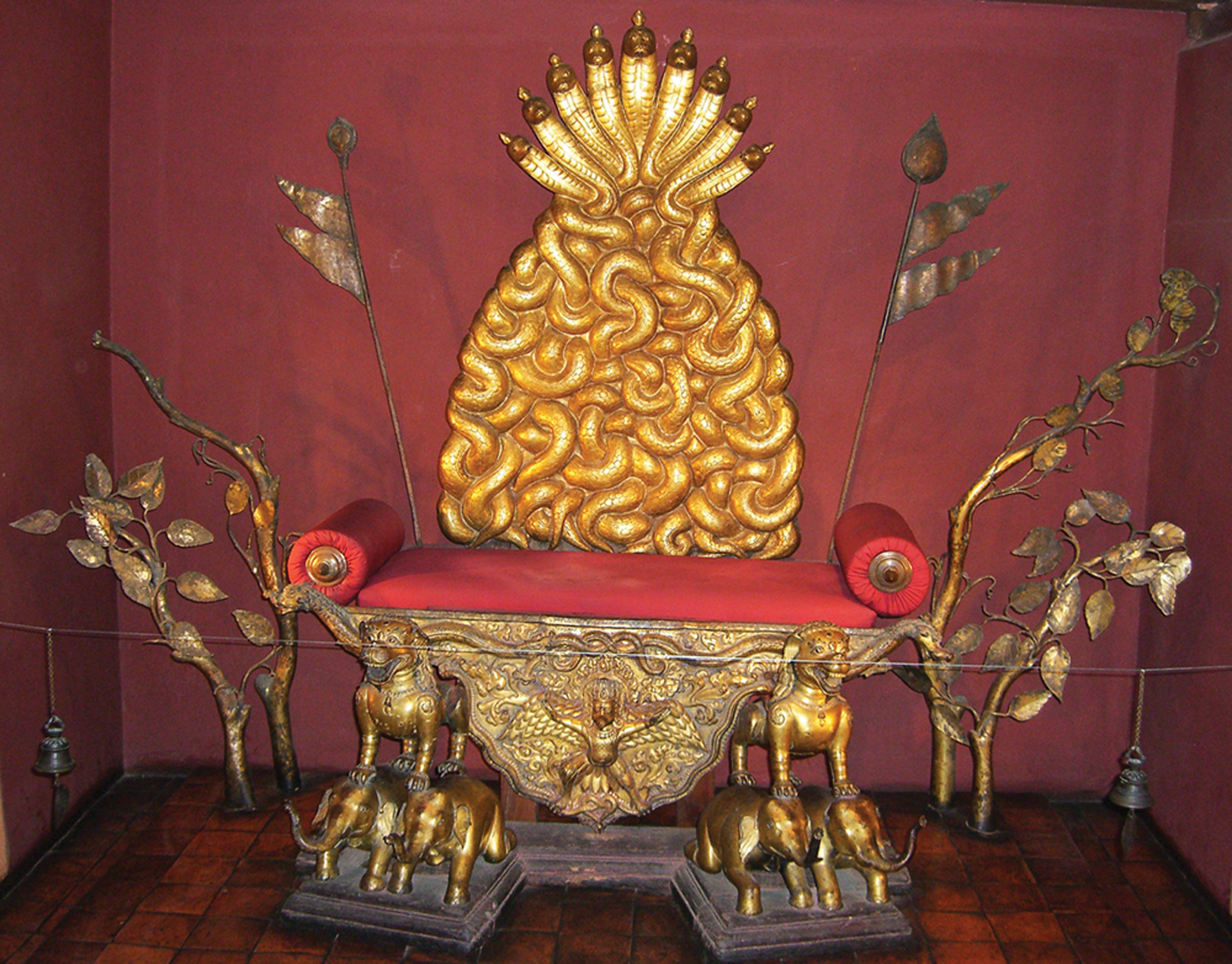
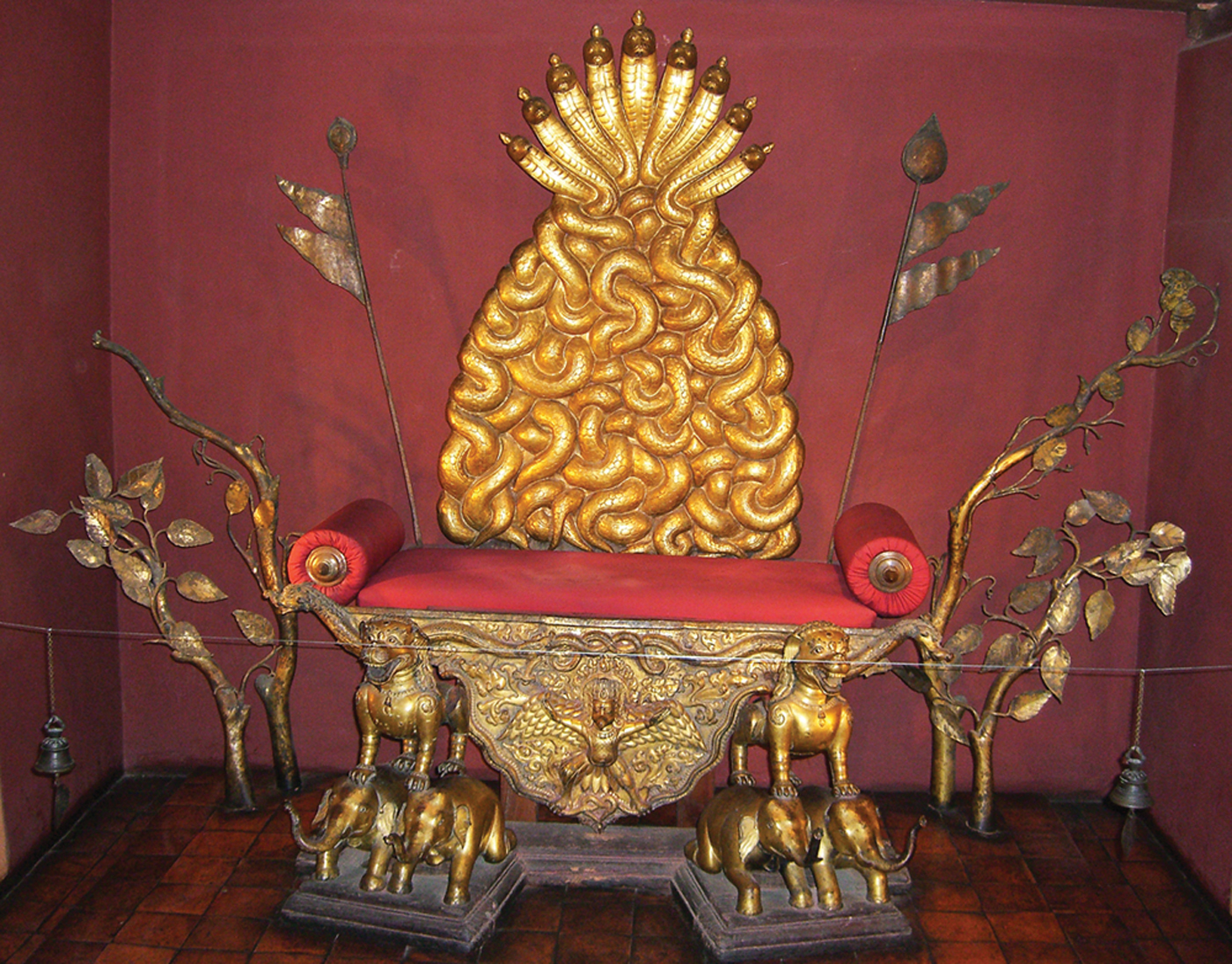
To those looking up from outside, an individual standing inside the open window would appear as if he were just below Avalokiteśvara's head. Scholars assume that the peculiar configuration of divinities on and around the window was meant to suggest an identification of a (Malla) king (who, they say, appeared at the window on special occasions) with Avalokiteśvara (in his form as Sṛṣṭikartā Lokeśvara) and Viṣṇu (Wiesner Reference Wiesner1976: 89; Rau Reference Rau1984: 256) or with either of the two (Gellner Reference Gellner1996: 140–41; Tuladhar-Douglas Reference Tuladhar-Douglas2006: 174). Obviously, when the window was open the individual appearing at the window would take the place otherwise occupied by the Buddhist image of Avalokiteśvara. The Śiva group would be visible on the tympanum above his head, along with Gagā and Yamunā respectively to his right and left. The individual would also be framed as Viṣṇu by the Garuḍa throne below and the nine hoods of a snake appearing above his head. A similar identification with Viṣṇu is suggested by the throne of the kings of Patan (Figure 4). The throne, presented to King Śrīnivāsamalla of Patan (r. 1661–84) and dating from 1666, features Viṣṇu's Garuḍa bird beneath the seat and the twisted body of a snake with nine hoods as the seat's backrest. This imagery reinforces the common Nepalese belief that the kings of Nepal are incarnations of Viṣṇu. But for all that, it is unlikely that the individual appearing at the Golden Window on special occasions was ever a Malla king.
(Colour online) The throne of the kings of Patan, Nepal, 1666. Gilt copper, wood, modern upholstery. Size 188 cm. The Patan Museum (Photo courtesy of Gudrun Bühnemann)
Speculations on the date of construction of the Golden Window
It is often said that the Golden Window was made at the time of Śrīnivāsamalla of Patan. Thus Gellner Reference Gellner1996: 141 (crediting Nutan Sharma in note 19, p. 153) specifies that “[a]pparently the unpublished inscription on the window shows that it was given by a Śākya or Vajrācārya goldsmith to the king [i.e. Śrīnivāsamalla]”.Footnote 7 This reference has turned out to be baseless since such an inscription does not exist. Nutandhar Sharma (Patan), who is cited in Gellner Reference Gellner1996, could not provide any information about it when requestedFootnote 8 and does not refer it in his MA dissertation. Inscriptional evidence shows merely a general connection between Śrīnivāsamalla and Avalokiteśvara's worship. Several legends associate the king with Avalokiteśvara, and even make him his son. According to one such legend, recorded in Dīp Reference Dīp1977: 67, Śrīnivāsamalla used the proceeds from selling the ornaments of one of his younger queens (who wished to return the jewellery the king had given her upon her request) for the construction of the Golden Window. The construction of the window has also been ascribed to other Malla kings, such as Siddhinarasiṃhamalla (r. 1619–61) (A.K. Vajracharya, referred to in Gellner Reference Gellner1996: 153, note 19), Śrīnivāsamalla's son Yoganarendramalla (r. 1684–1705) (Hemarāj Śākya, referred to in Shrestha Reference Shrestha2005: 59) and Jayaprakāśamalla (r. 1760–62) (Ācārya Reference Ācārya1967: 377). Guṇānanda's Vaṃśāvalī (Wright Reference Wright1972: 249) reports that Viṣṇumalla of Patan (r. 1729–1745) had the Golden Window installed. This version of events is reiterated in Wiesner Reference Wiesner1976: 87. However, there is no reliable record specifying the date of construction, and all the evidence we possess suggests that the window is not likely to date back to the Malla period. There have been considerable renovations and additions to the Patan Royal Palace over the centuries. It seems that Caukoṭ Darbār last underwent major restoration in 1734, but the date of its original construction is not known. The chronicle Bhāṣāvaṃśāvalī (part 2, p. 76, 3–4) states that the palace was dismantled and rebuilt in 1734 within a period of three months. This text, written in the nineteenth century, chronicles events up to 1768. It was very probably compiled before the installation of the Golden Window, since it does not mention the Golden Window at all. Slusser (Reference Slusser1982, vol. 2, caption to plate 140) notes that the Golden Door (with its tympanum) and the Golden Window were added to the original palace design in the nineteenth century, but she does not provide any evidence, or indeed discuss the matter further. We know that Prime Minister Jag Bahādur Kuṃbara Rāṇā visited England between 1850 and 1851. A chronicle on the history of Nepal,Footnote 9 compiled in the late nineteenth century in Nepali, reports that he realized the need to renovate the royal palaces of Patan and Bhaktapur, and in 1853 requested his brothers, General Jagatśamśer and General Dhīrśamśer respectively, to oversee the work in these two cities.
Evidence provided by the Golden Door
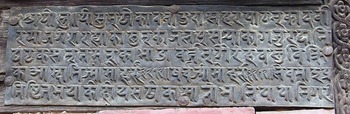
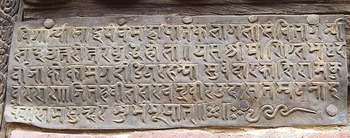
I would now like to consider evidence provided by the Golden Door (Figure 5), which is located below the window and now serves as the entrance to the Patan Museum. A copperplate inscription above the door (Figure 5a) specifies its date of construction but makes no mention of the Golden Window. However, the door and the window are the same colour and appear to be a match, suggesting that they were created around the same time. According to this inscription, which is transcribed and translated in the Appendix, the door was made and installed by General Jagatśamśer Jag Kuṃbara Rāṇā following instructions from Prime Minister Jag Bahādur Kuṃbara Rāṇā, on Wednesday, the eighth day of the bright half of the month of Pauṣa in V.S. 1911. This date corresponds to 27 December 1854.Footnote 10 A second inscription on the far left (Figure 5b) and right sides (Figure 5c) of the door records that the project was financed from the proceeds of the sale of unused metals found in the palace, and mentions the names of the three individuals involved in the construction. The inscriptions call the door the Māṇiglabhaṭṭa Door (darvājā) and Golden Door (sunḍhokā).
(Colour online) The Golden Door of Caukoṭ Darbār (Photo courtesy of Gudrun Bühnemann)

(Colour online) Inscription 1, located above the Golden Door (Photo courtesy of Gudrun Bühnemann)

(Colour online) Inscription 2, on the far left side of the Golden Door (Photo courtesy of Gudrun Bühnemann)

(Colour online) Inscription 2, on the far right side of the Golden Door (Photo courtesy of Gudrun Bühnemann)

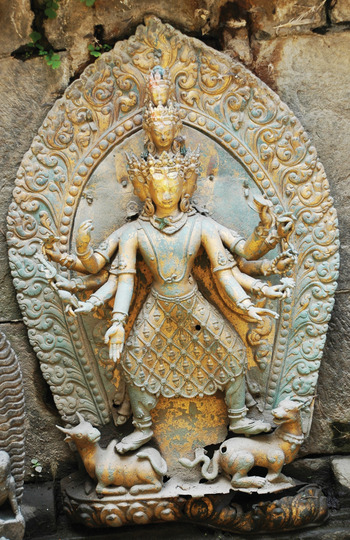
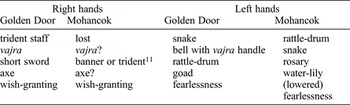
The predominantly Śaiva imagery above the Golden Door matches that of the Golden Window. The tympanum of the Golden Door features a five-headed ten-armed bisexual (ardhanārī) form of Śiva, with one foot on a bull and the other on a lion, flanked by Gaṇeśa and Kumāra (Figure 6). In this late work of art the deity's bisexual form can only be inferred from the two animal mounts. The unidentified androgynous form of Śiva is similar to a gold-plated bronze statue in a fountain (hiti) in Mohancok in Kathmandu's Hanumānḍhokā Royal Palace (Figure 7). There one hand-held attribute is lost and some attributes have been placed in different hands. They are only loosely inserted in the hands. The fountain, which houses mostly stone sculptures, was built under King Pratāpamalla in 1652, but the statue (without attendants) might have come from a tympanum in the palace and been placed in the fountain at a later time. The attributes in the hands of the two Śiva statues are shown in Table 1. The statue in Mohancok is less refined and could possibly predate the one on the tympanum of the Golden Window by 200 years.
(Colour online) The divinities on the tympanum of the Golden Door (Photo courtesy of Rajan Shrestha)

(Colour online) A form of Śiva; the fountain in Mohancok of the Hanumānḍhokā Royal Palace, Kathmandu (Photo courtesy of the Department of Archaeology, Kathmandu)

The attributes in the hands of the Śiva statues

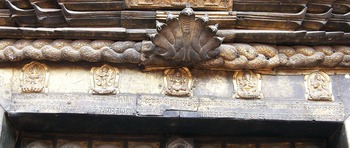
Below the Śiva image on the tympanum of the Golden Door we find three small plaques, featuring the flute-playing Kṛṣṇa in the centre, flanked by a cāmara-bearing female and a woman holding a fan in her hand. Further below are five gold-plated plaques, apparently forming a group of five deities with Śiva at the centre (śivapañcāyatana). The deities, from left to right (as seen by the observer), are Sūrya (on a chariot), a standing figure – possibly Devī – and the seated figures of Śiva, Gaṇeśa and Viṣṇu. Śiva, in the centre, appears just beneath the seven hoods of a snake whose twisted body frames the door. Just over the door is the above-mentioned inscription containing the date of construction, and at the sides there are gold-plated plaques featuring a standing four-armed Gaṇeśa, who has one foot placed on a mouse, and a four-armed Kumāra accompanied by a peacock. To the sides of the door are the eight auspicious symbols (magala): to the viewer's left appear four magala symbols plus the sun, and to the right, the moon plus the remaining four magala symbols. To the far left we find the first part of the other inscription and to the far right, its second part.
Additional sources bearing on the date of the Golden Window
Extracts from an undated document in manuscript form, in the Newari language, which describes a series of events (ghaṭanāvalī) pertaining to the Red Matsyendranātha of Patan, contain a brief note that the eaves over the Golden Window were damaged in a major earthquake in Patan in 1833.Footnote 12 It is possible that this note is a later insertion by another hand, however; or the reference may be to the original wooden window. It conflicts with a drawing of Patan's Royal Palace executed c. 1843–46 by an anonymous Nepalese artist,Footnote 13 in which the Golden Window is not visible at all. We will examine this drawing later. The chronicle compiled by Amṛtānanda's relative Guṇānanda, published by Wright, which dates from the last quarter of the nineteenth century, is the only other textual source that refers to the Golden Window (see Wright Reference Wright1972: 249); other chronicles make no mention of it. The chronicle attributes the construction of the window to King Viṣṇumalla in the first part of the eighteenth century.
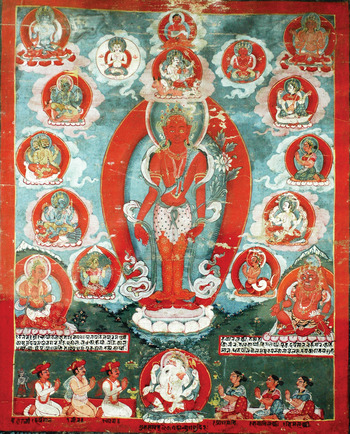
The myth of Avalokiteśvara emanating Hindu divinities in the Kāraṇḍavyūha and Guṇakāraṇḍavyūha predates the artistic representations by several centuries. The earliest representation of this form of Avalokiteśvara is as a subsidiary figure, on a paubhā showing the eleven-headed Avalokiteśvara accompanied by several other Lokeśvaras. The paubhā's date corresponds to 22 August 1779.Footnote 14 Avalokiteśvara emanates eleven divinities. One of the earliest paubhās that shows this form of Avalokiteśvara as an independent main figure is found in the collection of the Rubin Museum of Art (no. 100038) and dates from 1818. There Avalokiteśvara emanates thirteen divinities. Artistic representations did not become popular until the nineteenth century and may have been based on summaries or translations of the Guṇakāraṇḍavyūha's account in the Newari language – mixed with legendary material from other sources – which appear from the nineteenth century on. Such representations regularly show the serpent deity (often specified as Śeṣanāga) as one of the Bodhisattva's emanations, although there is no textual basis for this in the Kāraṇḍavyūha or Guṇakāraṇḍavyūha. The earliest extant representations of Avalokiteśvara emanating Hindu divinities in art date only from the end of the eighteenth century. They include a painting from 1837, preserved in the National Museum of Nepal in Kathmandu, which shows Avalokiteśvara emanating eleven deities, including the serpent king (Figure 8). Like the Bodhisattva on the Golden Window, Avalokiteśvara is here accompanied by Sudhanakumāra (to the viewer's far left) and Hayagrīva (to the viewer's far right). Other representations of this form of Avalokiteśvara are in the Tibetan style, created by Newar artists in Tibet. In inscribed paintings from the earlier part of the nineteenth century, such as the one in the National Museum, the Bodhisattva is merely identified as Avalokiteśvara. The earliest dated mention of the name Sṛṣṭikartā Lokeśvara, by which this specific form of Avalokiteśvara is now commonly known, is in a painting dating from 1871, now in the collection of the Rubin Museum of Art (no. 65564). In the last quarter of the nineteenth century or at the latest at the beginning of the twentieth century, the Bodhisattva began to be included as a member of various groups of 108 Lokeśvaras. At the present state of research it is difficult to say whether the name Sṛṣṭikartā Lokeśvara, which usually appears in the corrupt form Sṛṣṭikāntā Lokeśvara or variants of it, circulated prior to the Lokeśvara's inclusion in groups. If the name was not already used earlier, one can assume that the inclusion of this form of Avalokiteśvara as one member of groups of Lokeśvaras made a specific designation necessary, to distinguish him from the other Lokeśvaras.
(Colour online) Avalokiteśvara (attended by Sudhanakumāra and Hayagrīva) emanating eleven Hindu divinities, 1837. Paubhā, painting on cloth. Height 79 cm, width 55 cm. The National Museum, Kathmandu (S. No. 327) (Photo courtesy of Manik Bajracharya)

In early-to-mid-nineteenth-century paintings, the number of emanated Hindu divinities was not fixed and ranged from eleven to thirteen. In later paintings and line drawings, however, the number became standardized at fourteen. The Avalokiteśvara on the Golden Window is of the type that emanates fourteen Hindu divinities, including the serpent king. This suggests a later date for the representation, but there is more evidence to consider first.
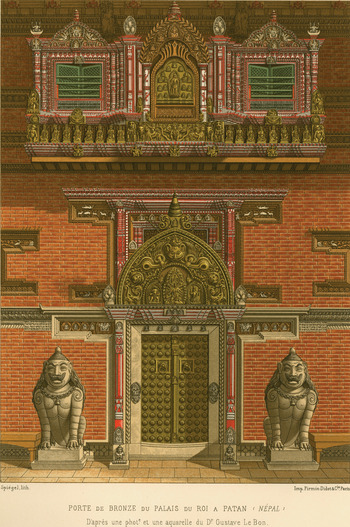
The drawing of Patan's Royal Palace mentioned above shows a row of three simple windows in the place where we now find the Golden Window with its gilded tympanum and a wooden window at each side. There is of course some doubt about the accuracy of the drawing, and its usefulness is limited, since all the windows are depicted in an open position. One cannot discern tympana above the three windows in the drawing because the roof hides these details. As noted above, this drawing also contradicts the above-mentioned manuscript, which briefly states that the eaves over the Golden Window were damaged in the major earthquake of 1833. Prince Waldemar of Prussia, who visited Patan's Royal Palace on 10 February 1845, reported that it was already dilapidated. In the vicinity of the palace he noticed destroyed homes and reported that after the Gorkhas' invasion the rich families had been killed and exterminated.Footnote 15 The Golden Window and the Golden Door are discernible in a photograph taken c. 1862–65,Footnote 16 although the details are not clear. A photograph taken by Johnston and Hoffmann in 1880 or 1894Footnote 17 also shows the Golden Window and the tympanum above the door, but the details are blurred. The oldest photograph of the Golden Window and the Golden Door to show their details clearly dates from 1885 and was taken by Gustave Le Bon (1841–1931). A lithograph published in 1887 after the photograph, and a watercolour by Gustave Le Bon, is reproduced in Figure 9 (see Le Bon Reference Le Bon1887, frontispiece). A comparison of the lithograph with the current condition of the door shows that after 1885 further renovations were made to the pillars to the side of it.Footnote 18 Considering the extant textual and visual material, it seems likely that the Golden Window was constructed some time in the nineteenth century. Prime Minister Jag Bahādur Kuṃbara Rāṇā, according to whose instructions the Golden Door was installed in 1854, may have been involved in the project. Given its late date of execution, which falls in either the Śāh period (1769–1846) or, more likely, the Rāṇā period (1846–1951), the representation of the Avalokiteśvara on the Golden Window cannot be taken as an example illustrative of the Malla kings' religious policy. In fact, the idea of a Malla king or another major king appearing at the Golden Window and being framed as a deity is anachronistic. After Pṛthvīnārāyaṇa Śāh conquered Patan and the last Malla king vacated the palace in 1768, it was inhabited mostly by regional administrators.
(Colour online) Front view of Caukoṭ Darbār with the Golden Window above the Golden Door. Royal Palace, Patan, c. 1885–87. Lithograph (After Le Bon, frontispiece)

Conclusion
The suggested nineteenth-century date of the representation of the Bodhisattva on the Golden Window coincides with the rise in popularity of this form of Avalokiteśvara in Newar art. But while the paintings simply show Avalokiteśvara with emanated Hindu divinities, the unique feature of the representation on the Golden Window is that it is embedded in an elaborate framework of Hindu divinities. One might interpret their function as that of devotees who enhance the status of the Bodhisattva on the window. But it is more likely that this framework, which visually integrates the Bodhisattva into a Hindu context, illustrates a phenomenon that Paul Hacker has termed “inclusivism”,Footnote 19 here seen from a Hindu perspective, and was an attempt to appropriate a Buddhist image: rather than an indication of religious tolerance, the configuration of divinities may have been a nineteenth-century Hindu response to representations of Avalokiteśvara emanating Hindu divinities that were popularized by Newar Buddhists at that time, possibly to counter what they saw as threats from an encroaching Hinduism. The latter explanation is more convincing, since a straightforward representation of the Buddhist Sṛṣṭikartā Lokeśvara emanating Hindu divinities would hardly have been placed in such a prominent location on the outer façade of a building of the royal palace of Hindu rulers. There are no Buddhist monuments to be found anywhere on the Patan Darbār Square.
Appendix: Text and translation of the two inscriptions above and at the sides of the Golden Door by Kashinath TamotFootnote 20
Inscription 1 (located above the Golden Door) (See Figure 5a)
Line 1: [siddhi sign] svasti śrī3śivaśaktiprītyartha[ṃ] śrīvikramasamvat 1911 pauṣa sudi 8 roja 4 śrīmadrājakumārakumārātmaja śrīprāimminiṣṭara yān kamyāṃḍar in cipha jānarala jaṃga bahādura ku-
Line 2: vara rāṇājībāṭa pharmāi śrījanarala jagatsamsera jaṃga kuvara rāṇāji mārphata śrīmā[ṇiglabhaṭṭada]rbājā banāi sthāpanā bhayo yas kāmkā taiyārī garnyā kaptān samsersiṃ | subā dhansu[n]dar subham
‘(Siddhi sign) Hail! For the propitiation of the thrice-venerable Śiva and Śakti, on Wednesday, the 8th of the bright half of the month of Pauṣa in 1911 V.S. [1854 ce], as instructed by the Rājakumārakumārātmaja, Prime Minister and Commander-in-Chief, General Jaṃga Bahādura Ku[ṃ]vara Rānā, the illustrious Mā[ṇiglabhaṭṭa] door was made and installed by the honourable General Jagatsamsera Jaṃga Ku[ṃ]vara Rāṇā. Preparations for this work were made by Captain Samsersiṃ [and] Subā Dhansu[n]dar. Auspiciousness.’
Inscription 2 (located on the left and right sides of the Golden Door)
(Text on the far left side) (See Figure 5b)
Line 1: [siddhi sign] śrayo stu || yo sunḍhokā banaudā sahara pāṭankā darvā-
Line 2: ramā jagerā rahyākā sunkā jalap saryākā gajura chāni
Line 3: ghaṃṭa kasantamankā bhāḍābarttan gairaha vastu vikri
Line 4: kā āmdāni jmāṃ moharrū 3212 || ṣarca jmāṃ moharrū 3212 || le banāi pra-
Line 5: tiṣṭita bhayāko ho yasa ḍhokāmā lobhāni pāpānī garī
(Text continuing on the far right side) (See Figure 5c)
Line 1: bigārnyālāi paṃca mahāpātaka lāgalā saṃcitā garnyā
Line 2: lāi uttarottaravṛddhi holā || yasa śrīmāṇiglabhaṭṭada-
Line 3: rbājāko kāma gardā diṭhā rahanyā suvedāra kāśirāma ku-
Line 4: vara rāṇāji tahabīladāra candravīra udāsa tamraṭa nāi-
Line 5: kyā rāmasundara śubhaṃ bhūyāt || ||
‘(Siddhi sign) May there be welfare. There were some extra pinnacles (gajura), whose gilt had deteriorated, bells, [unused] pots and pans and other materials in the palace of Patan city. This Golden Door was installed, after being made from the total amount (collected) from their sale, Mohar Rs. 3,212, [the same amount of] Mohar Rs. 3,212 having been spent. If this door is damaged out of greed or with [other] evil [intent], [the perpetrator] will be held guilty of the five great offences, while [he] who takes care [of the door] will prosper day by day. The persons working on this blessed Māṇiglabhaṭṭa door were the judge (diṭhā) Suvedāra Kāśirām Ku[ṃ]vara Rāṇā, the cashier (tahabīladāra) Candravīra Udāsa and head coppersmith Rāmasundara. May it be auspicious.’