Introduction
The need for characterization of livestock breeds is a cornerstone for understanding their uniqueness and ability to thrive under various agro climates. The “phenotype” of an animal is the resultant of the genetics and its peerless blending with the environment where it thrives. The phenotype is further subjected to the social and aesthetic relationships of the owners and the aim for which they were developed (Boettcher, Ajmone-Marsan and Lenstra, Reference Boettcher, Ajmone-Marsan and Lenstra2010). Phenotypic characterization is all the more important for livestock that can thrive well under changing climatic conditions and in unfavourable places (FAO, 2015). “Phenotypic characterization of livestock generally refers to the process of identifying distinct breed populations and describing their external and production characteristics within a given production environment”, FAO (2012). In many developing nations there is a lack of information on the population fragmentation, sub populations and geographically isolated populations. Generally such populations/breeds/types are generally reported to as non-descript/ traditional, as information on the inventories of these population are by and large non-existent. However, over the years new breeds are being identified (e.g. Banerjee and Banerjee, Reference Banerjee and Banerjee2004, Wuletaw et al., Reference Wuletaw, Ayalew and Soelkner2008). Thus, in such regions it becomes necessary to phenotypically characterize the livestock before applying advanced characterization techniques (FAO, 2012). Such evolutions are generally based on several criteria viz. the reasons for their domestication, migrations, genetic and geographical isolations, uniqueness of their products, selective breeding's and admixture of populations. The attempts to phenotypically classify the sheep population have been made in the past in India, however the animals were limited to single populations (Yadav et al., Reference Yadav, Jain, Kulkarni, Govindaiah, Aswathnarayan and Sadana2013). The sheep breeds reared in the area are colloquially known as Desi bhada (native sheep). The conservation efforts of Bengal sheep has to be initiated as the breeding tract of sheep adjoins with that of the Dumka (Chottanagpuri) sheep reared in the adjoining state of Jharkhand and hence there are chances of the breed losing its niches because of the crossing with the Dumka sheep. Trading of Dumka sheep (to be further sold for mutton to the metros) takes place in large numbers in the studied districts. Thus, breeding between Bengal and Chottanagpuri sheep breeds cannot be ruled out however the respondents are well aware of the phenotypic attributes of the two types.
The study was thus, conducted to phenotypically characterize the Bengal breed of sheep. The Bengal sheep is reared primarily as a mutton sheep with very little value being given to its coarse fleece. Phenotypic as well as genetic characterization of Bengal sheep has yet to be carried out and the breed is not mentioned in the list of Indian sheep breeds. Furthermore the data was used to calculate some important morphometrical indices besides studying some important reproductive and wool quality parameters of the sheep.
Materials and Methods
The state of West Bengal is situated between 85° 50′ and 89° 50′ E longitude and 21° 38′ and 27° 10′ N latitude in the eastern part of India. Although, the state has varied agro climatic conditions, the breeding tract of Bengal sheep is by and large hot and humid. There are two distinct sheep breeds reared in the state viz. Garole and Bengal, while two more sheep breeds Sahabadi and Dumka have their breeding tract which extends from the adjacent states of Bihar and Jharkhand to the bordering districts of West Bengal. Garole sheep is reared in the coastal districts of 24 Parganas (South), Midnapur (East), some parts of 24 Parganas (North), and northern districts of Jalpaiguri and Cooch Behar, Banerjee, Galloway and Davis (Reference Banerjee, Galloway and Davis2011). The breeding tract of Bengal sheep extends from the districts of Uttar Dinajpur (25°11′ N to 26°49′ N latitude and 87°49′ E to 90°00′ E longitude), DakshinDinajpur (26°35′ 15″ N to 25°10′ 55″ N latitude and 89°00′30″ E to 87°48′ 37″ E longitude) Malda (24°40′20″ N to 25° 32′08″ N latitude and 88°28′10″ E to 87°45′50″ E longitude), Murshidabad (24° 50′20″ N to 23°43′30″ N latitude and 88° 46′00″ E to 87° 49′17″ E longitude) and Nadia (22°53″ and 24°11″ N latitude and 88°09″ and 88°48″ E longitude) and adjoining districts of Bangladesh. The present study was initiated to characterize the Bengal breed of sheep from diverse populations reared in two districts (Murshidabad and Nadia) of the state of West Bengal.
The study was conducted in some purposively selected villages of Murshidabad and Nadia districts of West Bengal, (Table 1). The villages were selected based on the population of the Bengal sheep they have, the respondents too were selected purposively, villagers who had been rearing sheep for more than 5 years were identified, and later 50 percent of the identified villagers were randomly selected for the study. Prior to the study the villagers were made to understand the purpose of the study in local language. A semi structured questionnaire was prepared which was later pretested on a few respondents and modified accordingly. The questioner was then translated to Bengali (the local language spoken in the area) for their better understanding. The questions were asked to all the family members who are engaged in ovine husbandry. The numbers of households surveyed per village are presented in Table 1. Separate questionnaire was also developed, pretested and translated in Bengali for those engaged in trading of the sheep and fleece collectors. The numbers of traders and fleece collectors at Beldanga (Murshidabad) and Nakashipara (Nadia) livestock markets were 17; 11 and 14; 9, respectively.
Some geographical parameters of the studied locations and the sheep population of the area.

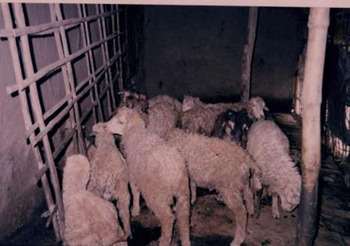
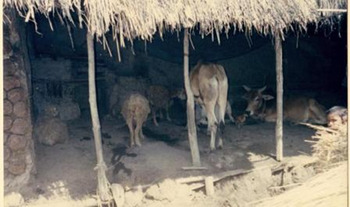
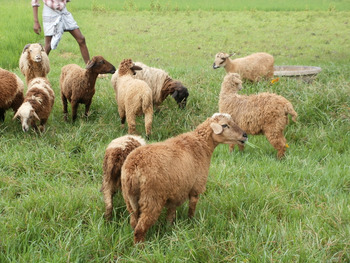
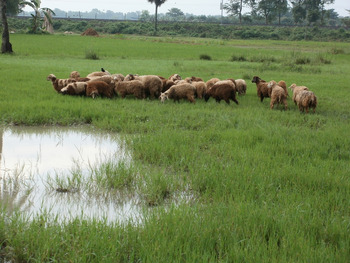
The sheep in the study area are housed in makeshift houses often made of bamboo and mud while in some places the sheep are housed in the verandas adjoining the houses of their owners; this is done in order to minimize predatory and theft related losses (Figure 1). Some of the respondents also rear the sheep along with other livestock, this is done especially when the flock size is diverse and moderately large (Figure 2). The Bengal sheep are reared under semi-intensive system of management and are rarely provided any supplementary feed. These sheep are often seen grazing in marshy lands (Figure 3).The most common grasses on the natural pastures are Cynodon dactylon, Urochloa mutica while the farmers at times may provide leaves of Artocarpus heterophyllus, Musa paradisiacal, Leucaena leucocephala, Magnifera indica and Bambusa tulda. The leaves are provided when there is lack of grazing facilities or when the sheep are unable to go for grazing which is common during the heavy monsoon rains. Vegetable peels and rice gruel are at times provided to the ewes with lambs at foot that are unable to go for grazing or those nursing many lambs.
Sheep housed in a veranda.

Sheep housed with cattle.

Bengal sheep grazing on marshy lands.

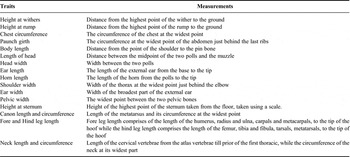
The sheep droppings are used to manure kitchen gardens. The day to day husbandry activities (cleaning the house, caring for the lambs) of the sheep are carried out by the females and children of the household. The morphometrical measurements considered in the study were, Height at withers (HW), Height at rump (HR), Chest circumference (CC) , Paunch girth (PG), Oblique body length (OL), Head length (HDL), Head width (HDW), Ear length (EL), Horn length(HoL), Shoulder width (SW), Ear width (EW), Pelvic width (PW), Canon length (CL), Length of the fore leg (FL), Length of the hind leg (HL), Abdomen girth (AG), Fore canon circumference (CAC), Neck circumference (NC), Neck length (NL) and Body weight, (BW, assessed using a suspended balance with an error margin of ±100 g). The methods used for the measurements were carried out according to the procedures reported by Macjowski and Zieba (Reference Macjowski and Zieba1982) and presented in Table 2. The age of the sheep was estimated using their dentition (Charray, Humbert and Leif, Reference Charray, Humbert and Leif1992) and also the respondents recall method although the study encompassed only adult sheep (aged more than 1 year). The morphometric indices, were calculated from the phenotypic measurements (Table 3). The wool quality parameters (staple length, crimp, percentage of fibre and average fibre diameter (hairy, hetero and wooly), scouring yield and wool wax were assessed according to the methods suggested by Dagur (Reference Dagur1996), von Bergen (Reference von Bergen1963) and Bureau of Indian Standard (BIS, 1989). The fibres were collected according to the methods suggested by Pokhrana et al. (Reference Pokhrana, Arora, Chatterjee and Ramamurthy1974). The fibre diameter was assessed using ocular micrometre using a magnification of 40X through a monocular microscope.
Method of assessing different morphometrical measurements.

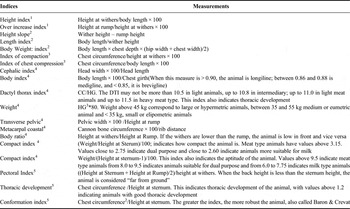
Methods of calculating the structural indices.

1 Alderson, Reference Alderson1999.
2 Szabolcs et al. (Reference Szabolcs, Nagy, Nagy, Kiss, Polgár and Szabó2007).
3 Marković, Marković and Radonjić (Reference Marković, Marković and Radonjić2012).
4 Edilberto et al. (Reference Edilberto, Fernando, Francisco, Samuel, Eliecer and Concepta2011).
The data were analysed statistically using SPSS v 12 (2003) (for Windows). The data were analysed using descriptive statistics (Mean ± SD) and the means were compared using Duncan's Multiple Range test, the values were considered significant (P < 0.05).
Results and Discussions
General husbandry practices
The results of the study indicated that average flock size was 4.5 ± 2.5 heads, respondents having flocks as large as 25 heads in the area. Most of the rearers were small and marginal farmers besides; some landless labourers too were among the respondents. The average flock size are in consonance with the findings of Bose, Duttagupta and Maitra (Reference Bose, Duttagupta and Maitra1999) and Banerjee (Reference Banerjee2003), Biswas (Reference Biswas2010) for sheep flocks reared in Sunderban region of West Bengal.
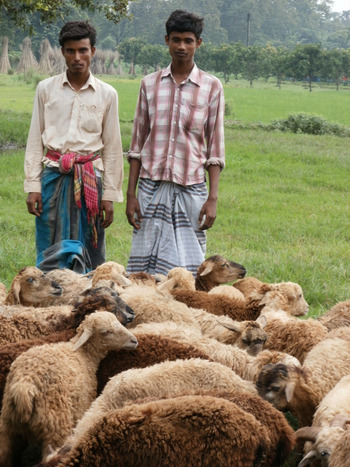
The Bengal sheep seem to be quite tolerant towards fleece and foot rot as they are often seen grazing in the marshy land unsuitable for agricultural operations (Figure 3). The trait is similar to that of Garole sheep as has been reported by Banerjee and Banerjee (Reference Banerjee and Banerjee2000), Banerjee et al. (Reference Banerjee, Galloway and Davis2011). Children and family elders (who are unable to participate in agricultural operations) are traditionally entrusted to overlook the grazing of the sheep; the findings are in agreement with the observations of Saddullah (Reference Saddullah2000). However, now a days professional grazers locally known as “rakhals” (Figure 4), are employed by most of the farmers to take care of the grazing. The respondents reported that the body condition and productivity of the sheep can improve substantially if they are provided with some sort of supplementary feed. The rearers however are generally not able to provide them with the necessary supplements owing to lack of financial resources. Salim et al. (Reference Salim, Sahahjalal, Tareque and Kabir2002) too indicated that native sheep of Bangladesh responded well to concentrate supplement which helped in improving both their productive and reproductive traits. It has also been observed that many of the sheep in the study areas suffer from mineral and vitamin deficiencies as has been reported earlier by Banerjee and Banerjee (Reference Banerjee and Banerjee2004) and Banerjee (Reference Banerjee, Sonali, Uday Bahnu and Soma2005) who reported zinc and also copper deficiency in sheep reared in Nadia district of West Bengal.
Professional grazers with sheep.

The respondents also indicated that the most commonly occurring diseases in the area are diarrhoea (in the summer and monsoon season) followed by respiratory distress (of unknown origin). These diseases occur mostly among the lambs (during the monsoon and winter seasons) leading to high mortality. Helminth infestation too is common, infected sheep usually become weak and debilitated, the observations are in accordance with the findings of Bose et al. (Reference Bose, Duttagupta and Maitra1999) and Hassan and Talukder (Reference Hassan and Talukder2011).
The rearers mostly rely on ethno veterinary medicines (77.5 percent of the respondents) which are locally available and relatively cheap. When the sheep are too sick they prefer to sell them to the butchers at a relatively cheap price. It was also observed that few respondents avail the services of the veterinary clinics; the primary reason was the high cost and non-availability of the medicines. Hence, the rearers mostly use ethno veterinary medicines; the use of ethno veterinary medicines have also been reported by Amin et al. (Reference Amin, Mostofa, Islam and Asgar2010) and Ghosh (Reference Ghosh2008). The respondents reported that if the sheep are allowed to graze on natural pastures they rarely fall ill. The sheep are able to graze on the naturally growing medicinal herbs. The respondents also reported that the livestock often fall ill when their normal grazing schedule is disturbed which often corresponds to the monsoon season. The findings are in accordance with those of Banerjee and Banerjee (Reference Banerjee and Banerjee2004), Villalba et al. (Reference Villalba, Provenza, Hall and Lisonbee2010) and Villalba and Landau (Reference Villalba and Landau2012) who reported that if provided a choice livestock occasionally consume medicinal plants which grow along with the pasture grasses. The medicinal plants which were once commonly available are now rarely seen in the grazing areas. The natural pastures are mostly degraded and overgrazed or have been overrun by many invasive species of grasses; the observations are in accordance with those of Erenstein et al. (Reference Erenstein, Thorpe, Singh and Varma2007) and Dixit et al. (Reference Dixit, Singh, Reddy and Singh2013). One of the reasons for high incidences of helminth infestation can be attributed to consumption of water from stagnant pools and other water bodies (Figure 5).
Watering point for Bengal sheep.

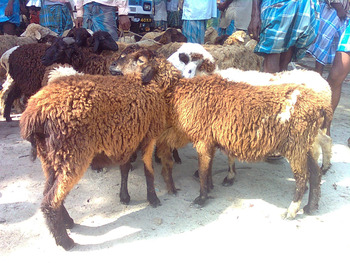
The respondents indicated that the sheep are sold only when they are sick, barren, old or when the family is in need of cash. The respondents also indicated that they prefer not to sell the lambs until they are 6 months old. The price of a ram is decided by the family head who usually sell them directly to the weekly market locally known as “haat”. The sheep passes through several hands by the time it reaches the butchers. However, there are instances when the primary collectors (middlemen) purchase the animals at the farm gate; in such instances the price paid is usually lower than that of the markets. The middlemen collect anything from three to 20 rams (Figure 6) and sell to the nearby livestock markets from where the traders further purchase the sheep to be transported to metros like Kolkata; the observations are in accordance with the findings of Bose et al. (Reference Bose, Duttagupta and Maitra1999). The study also indicated that unlike the bucks the rams are rarely castrated. The sheep change hand three to four times before they are ultimately sold to the butchers, the transportation of the animals are not only stressful but also at times lead to mortality, this in turn affects the quality of the carcass (meat) and skin; the observations are in accordance with the reports of Sagar and Biswas (Reference Sagar and Biswas2008), Viroji Rao, Thammi Raju, and Ravindra Reddy (Reference Viroji Rao, Thammi Raju and Ravindra Reddy2008), SA PPLPP (2011).
Sheep collected by middlemen for sale.

The price of the sheep is decided by visual assessment of its body weight and mutual consent of the seller and the buyer. The average price of a yearling ram (body weight (BW) 14.5 ± 1.5 kg) of the rams of Bengal breed at Beldanga and Nakashipara livestock market as on August 2014 was estimated to be Rs. 1 950 (US$1 = Rs. 60.00) while the farmers generally receive Rs. 1 570, respectively. The price of ewes is generally less (15–20 percent) compared with that of the rams. The prices of the sheep fluctuate erratically between seasons and are significantly influenced by festivals and disease outbreak; the findings are in accordance with that of Saddullah (Reference Saddullah2000).
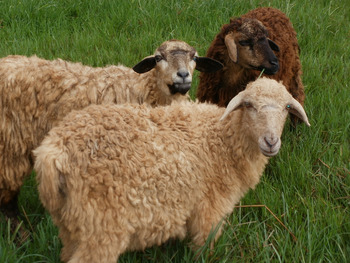
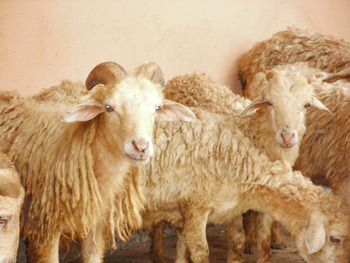
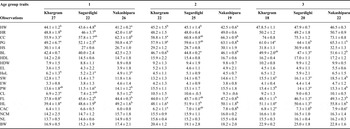
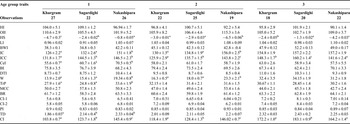
The predominant coat colour of Bengal sheep (Figures 7 and 8) are cream, brown, mixed (brown/ black and cream) and black. Around 65 percent of the sheep had cream coat colour. The observations are in accordance with the reports of Pervage et al. (Reference Pervage, Ershaduzzaman, Talukder, Hasan and Khandoker2009) for Barind sheep from Bangladesh. The Bengal sheep is of thin and short tailed type, the tail length varies from 8.5 to 10.2 cm averaging around 9.2 cm for both ewes and rams. The tail length values are in close agreement with the findings of Sharma et al. (Reference Sharma, Arora, Narula and Singh1999), Banerjee (Reference Banerjee2003) for Garole sheep and to those reported by Hassan and Talukder (Reference Hassan and Talukder2011) for Barind sheep of Bangladesh. The average HW of rams (Table 4) are similar to that of the Garole sheep (Banerjee and Banerjee, Reference Banerjee and Banerjee2000, Sahana, Gupta and Nivsarkar, Reference Sahana, Gupta and Nivsarkar2001 and Banerjee, Reference Banerjee2003) and Barind sheep of Bangladesh Pervage et al. (Reference Pervage, Ershaduzzaman, Talukder, Hasan and Khandoker2009). The results indicated there was a variation (P < 0.05) between locations. The rams reared in Nakashipara (N) had significantly lower values (r age groups 1 and 2) when compared with those reared at Khargram (K) and Sagardighi (S). While the HR values were higher among the rams reared at K and S for the same age groups.. The CG was lower (P < 0.05), among the rams reared at K in comparison with those reared in N. The PG was lower in rams reared in K and N (age group1) and in K (age groups 2 and 3). The HdL, HdW, EL of the rams did not vary (P < 0.05) across the locations studied. The BL was lowest in the rams reared in S (age groups 2 and 3). The HW, CC, PG and BL values find consonance with the observations of Barind sheep (Pervage et al., Reference Pervage, Ershaduzzaman, Talukder, Hasan and Khandoker2009 and Hassan and Talukder, Reference Hassan and Talukder2011) and Garole sheep (Banerjee, Reference Banerjee2003). The horn length (HoL) was lower (P < 0.05) for the rams reared in N and S (age group1) while lower (P < 0.05) values were observed in rams reared in K and S (age group 3). The SW was lower (P < 0.05) among the rams reared in K and S (age group 3). The PW too varied (P < 0.05) among the rams (age group 1 and 3) with lower values observed among those reared in S. The CL was lower (P < 0.05) among the rams (age group 1) and reared in S, while it did not vary significantly across the locations for rams of other age groups. The fore leg length (FL) too varied (P < 0.05) among the rams reared in the different locations and also across age groups, the values were lowest (age group 1 and 2) among the rams reared in K while it was lowest for those reared in S for age group 3. The hind leg length (HL) too varied (P < 0.05) among the rams reared at the different locations; it was lower (P < 0.05) among those reared at K, across all the age groups. The BW of the rams did not vary (P < 0.05) across the different locations (within a particular age category). The BW of the rams are in close accordance with those reported by Pervage et al. (Reference Pervage, Ershaduzzaman, Talukder, Hasan and Khandoker2009) for Barind sheep of Bangladesh but lower than those reported by Hassan and Talukder (Reference Hassan and Talukder2011).
Coat colours of Bengal sheep.

Ram and ewe of Bengal breed.

Values (Mean ± SD) of some morphometrical measurements of rams of Bengal breed across the various locations and age groups.

a,b,cvalues across rows in a particular age groups are significantly different (P < 0.05), (>1 but <2 years, 1), (>2 but <3 years, 2) and (>3 but <4 years, 3).
HW, height at withers; HR, height at rump; CC, chest circumference; PG, paunch girth; BL, body length; HDL, head length; HDW, head width; EL, ear length; HoL, horn length; SW, shoulder width; EW, ear width; PW, pelvic width; CL, canon length; FL, length of the fore leg; HL, length of the hind leg; CAC, fore canon circumference, NCM, neck circumference, NL, neck length; BW, body weight; All values in cms and BW (kgs).
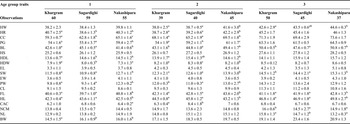
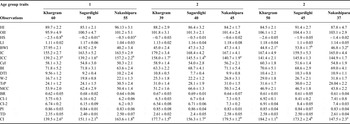
The results pertaining to the morphometrical traits of the ewes are presented in Table 5. The results indicated that the HW did not vary among the ewes reared in the three locations (age group 1), while it varied (P < 0.05) across the locations. The ewes reared at K and S had lower values (age group 2) while it was lower among the ewes reared at K (age group 3). The HR varied among the ewes reared in the three locations and across the different age groups. Lower values were observed among the ewes reared in K (age group 1) and in K and S (age groups 2 and 3), respectively. The CC and PG too varied across the study areas, lower values were observed among the ewes reared at K (age groups 1 and 2). The BL too varied (P < 0.05), across the three locations and also across the age groups. The ewes at K had lower values (age group 1), while for age groups 2 and 3 it was lower among the ewes reared in S. The HDL and HDW too varied (P < 0.05), across the study areas and among the age groups. The BL was lower among the ewes reared in K (age groups 1 and 2). The SW too indicated variation (P < 0.05) across locations and also across different age groups. It was lower among the ewes raised in K (age groups 1 and 2) and in S (age group 3). The PW too varied (P < 0.05), across locations and also among age groups .The values being lower among ewes reared at K and S (age groups 1 and 2). The FL and HL were lower (P < 0.05) among the ewes reared at K and S. The NCM and NL too varied (P < 0.05) among the ewes of age group 3. The NCM being lower for those reared at S and N. The NL was lower among the ewes raised at K and N, respectively.
Values (Mean ± SD) of some morphometrical measurements of ewes of Bengal breed across the various locations and age groups.

a,b,c values across rows in a particular age age groups are significantly different (P < 0.05), (>1 but <2 years, 1), (>2 but <3 years, 2) and (>3 but <4 years, 3).
HW, height at withers; HR, height at rump; CC, chest circumference; PG, paunch girth; BL, body length; HDL, head length; HDW, head width; EL, ear length; HL, horn Length; SW, shoulder width; EW, ear width; PW, pelvic width; CL, canon length; FL, length of the fore leg; HL, length of the hind leg; CAC, fore canon circumference; NCM, neck circumference; NL, neck length; BW, body weight. All values in cms and BW (kgs).
It was observed that 9.2 percent of the sheep had rudimentary earlobes. Similar observations too have been reported by Bose et al. (Reference Bose, Duttagupta and Maitra1999), Banerjee and Banerjee (Reference Banerjee and Banerjee2000) and Banerjee (Reference Banerjee2003) in Garole sheep. The rams are horned while the ewes are polled. The horns are oriented upward, and backward, the whorl is open type, the average HoL are similar to those reported by Pervage et al. (Reference Pervage, Ershaduzzaman, Talukder, Hasan and Khandoker2009) for Barindsheep.
The results of the structural indices were calculated from the morphometrical traits with an aim to assess the functionalities of relationship that is attributed to some of the morphomerical traits. The values pertaining to the structural indices are presented in Table 6. It can be inferred from the results of the height index (HI) that the HW irrespective of the sexes is more or less similar to their BL. The results from the over increase index (Oll) indicates that the hind region are higher than the front. Thus, it can be inferred that the breed is not unbalanced. Studies by Edilberto et al. (Reference Edilberto, Fernando, Francisco, Samuel, Eliecer and Concepta2011) indicate that a balanced animal is known to have better production and health especially in uneven terrains.
Values (Mean ± SE) of morphometrical indices of rams of Bengal breed across different locations and age groups.

a,b,cvalues across rows of a particular age group are significantly different (P < 0.05), (>1 but < 2 years, 1), (>2 but <3 years,2) and (>3 but <4 years, 3).
HI, height index; OII, over increase index; HS, height slope; LI, length index; BWI, body weight index; IC, index of compaction. ICC, index of chest compression; Cel, cephalic index; BI, body index; DTI, dactyl thorax index; W, weight; TrP, transverse pelvic; MCC, metacarpal coastal; BR, body ratio; CI-1, compact index-1; CI-2, compact index-2; PI, pectoral index; TD, thoracic development; CI, conformation index.
The length index (LI) indicates that the sheep is longiline (>0.9) type, Edilberto et al. (Reference Edilberto, Fernando, Francisco, Samuel, Eliecer and Concepta2011). The height slope (HS) indicate that the slope is forward aligned. The body weight index (BWI) indicates that the sheep is mostly eumetric i.e. medium type of animals Edilberto et al. (Reference Edilberto, Fernando, Francisco, Samuel, Eliecer and Concepta2011). The index of compaction (IC) values is lower than those reported by Marković, Marković and Radonjić (Reference Marković, Marković and Radonjić2012) for Sora sheep. The IC values differed between sexes with values lower among the rams the difference may be attributed to higher CC in the ewes. The index of chest compaction (ICC) indicated that the body is more compact as the CC values are higher than the BL in both the sexes, indicating short but deep and rectangular shaped animals. The cephalic index (Cel) indicates the braquicephalic tendency in the breed. The body index (BI) indicates that the breed is breviline and sublongiline type. The dactyl thorax index (DTI) indicates that the breed is of intermediate to light type Edilberto et al. (Reference Edilberto, Fernando, Francisco, Samuel, Eliecer and Concepta2011). The BW of the rams and ewes indicate that the breed is of small orelipometric type as the values are mostly below 35 kg, Edilberto et al. (Reference Edilberto, Fernando, Francisco, Samuel, Eliecer and Concepta2011). The transverse pelvic (TrP) values indicate that the PW is less than the HR indicating that the ewes will have less chance of dystocia. The metacarpal coastal (MCC) are similar to those reported by Edilberto et al. (Reference Edilberto, Fernando, Francisco, Samuel, Eliecer and Concepta2011) for Creole goats. The body ratio (BR) indicates that the Bengal sheep is low in the front. The results for the compact index (CI-1) indicate that the Bengal sheep is primarily suited for meat type as the value for the trait is above 3.15, Edilberto et al. (Reference Edilberto, Fernando, Francisco, Samuel, Eliecer and Concepta2011). However, the results of the CI-2 indicate that the aptitude of the sheep and it is more of a dual type breed. The thoracic development (TD) values indicate that the Bengal sheep has a well-developed thoracic area while the conformation index values (CI) indicates that the Bengal sheep is a robust animal.
The HS varied between the locations and among the rams of the different age groups, the rams reared at N had lower values (age group 1), while higher values were observed among those reared at N (age group 3). The ICC too varied across the rams of different age groups and across the locations. The IC values too varied (P < 0.05), across the locations and across the age groups (1 and 2). Lower values were observed among the rams reared at K and S; the trend was similar for other traits viz. weight (W), TrP and relative body index (RBI). The TD values too differed for P < 0.05, across the study areas (age group 1), the rams reared at K having lower values. The result pertaining to CI too varied with P < 0.05 among the rams of all the age groups and was lowest among those reared at K.
The results pertaining to the structural index values of the ewes presented in Table 7 indicate that the HS values varied among the ewes of age group 1 the values were lower (P < 0.05) among those raised at S and N. The length index (LI) was lower (P < 0.05) among the ewes reared in K and N (age group 3). The CI indicates that the trait too varied (P < 0.05) among the ewes reared at the different locations and was lower among those raised at K, S and N for age groups 1, 2 and 3, respectively.
Values (Mean ± SE) of morphometrical indices of rams of Bengal breed across different locations and age groups.

a,b,cValues across rows of a particular age group are significantly different (P < 0.05), (>1 but < 2 years, 1), (>2 but <3 years,2) and (>3 but <4 years, 3).
HI, height index; OII, over increase index; HS, height slope; LI, length index; BWI, body weight index; IC, index of compaction; ICC, index of chest compression; Cel, cephalic index; BI, body index; DTI, dactyl thorax index; W, weight; TrP, transverse pelvic; MCC, metacarpal coastal; BR, body ratio; CI-1, compact index-1; CI-2, compact index-2; PI, pectoral index; TD, thoracic development; CI, conformation index.
The fleece quality parameters (Mean ± SD) were assessed from 75 sheep and from both the sexes. The average staple length (SL) of the fleece was observed to be 7.4 ± 1.3 cms, finding consonance with the observations of Banerjee (Reference Banerjee2003, Reference Banerjee2009; Garole sheep), Arora and Garg (Reference Arora and Garg1997; Jaisalmeri, Patanwadi, Hissardale, Deccani, Nali, Rampur Bushair and Pugal sheep), Gopalakrishnan and Morleymohanlal (Reference Gopalakrishnan and Morleymohanlal1985; Magra sheep), Hassan and Talukder (Reference Hassan and Talukder2011; Barind sheep). The SL was higher than those reported by Pan and Sahoo (Reference Pan and Sahoo2003) in Garole sheep. The average numbers of crimp (3.3 ± 1.5/inch) finds similarity with the observations of Banerjee (Reference Banerjee2003, Reference Banerjee2009), Hassan and Talukder (Reference Hassan and Talukder2011). The fleece is predominantly of hairy distantly followed by wooly and hetero types, respectively, (72.2 ± 1.8; 18.3 ± 1.2 and 9.5 ± 2.0) percent the findings are close to the reports of Hassan and Talukder (Reference Hassan and Talukder2011) for Jamuna, Barind and Coastal sheep breeds, respectively. The average hairy, hetero and wooly fibre diameters were 122.5 ± 10.2, 65.3 ± 32.1 and 49.7 ± 10.2 μm, respectively, similar values were reported by Banerjee (Reference Banerjee2003, Reference Banerjee2009) in Garole sheep.
The scouring yield and wax content were assessed as 70.2 ± 5.5 and 2.9 ± 0.2 percent, respectively, the values were similar to those reported by Banerjee (Reference Banerjee2003, Reference Banerjee2009). The fleece is traded for making coarse blankets and durries by some traders in the region. The price per clipping from an adult sheep is Rs. 25 (US$ = Rs. 60.00). The average clipping yield is estimated to vary between 350 and 500 g averaging to about 435 ± 50.2 g. The findings are in accordance with the findings of Banerjee (Reference Banerjee2003), Pan and Sahoo (Reference Pan and Sahoo2003), Pan et al. (Reference Pan, Sahoo, Tantia and Ahlawat2004), Hassan and Talukder (Reference Hassan and Talukder2011) and Banerjee et al. (Reference Banerjee, Mandal, Bose, Banerjee and Manna2009). The variation in quality parameters may be attributed to genetic and non-genetic parameters, viz. nutrition and climate, the findings are in accordance with those of Smith and Purvis (Reference Smith and Purvis2009), Sohail, Muhammad and Muhammad (Reference Sohail, Muhammad and Muhammad2010) and Muhammad et al. (Reference Muhammad, Asad, Mazhar, Muhammad, Muhammad and Majid2012).
Reproductive parameters of Bengal sheep
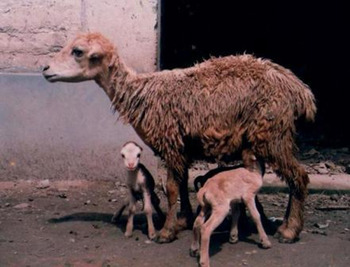
The results pertaining to some reproductive traits of Bengal sheep indicated that the age at first service (AFS) was 295 days among the ewes and 252 days among the rams. The age at first lambing (AFL) was 425 days. The average age at first lambing was similar to that reported by Pervage et al. (Reference Pervage, Ershaduzzaman, Talukder, Hasan and Khandoker2009). Bengal breed are low to moderately prolific (Figure 9) and the questionnaire results indicated that nearly 40 percent of the ewes had history of twinning, however the survivability of the lambs was also low which can be attributed to poor nutrition of the ewe and also due to prevailing diseases. The rams mature earlier than the ewes which in accordance with the reports of Taylor (Reference Taylor1968).The age at sexual maturity (days) and lambing interval for the ewes are higher than those reported by Hassan and Talukder (Reference Hassan and Talukder2011) but lower than those reported by Pervage et al. (Reference Pervage, Ershaduzzaman, Talukder, Hasan and Khandoker2009) The variation may be attributed to management and the type of nutrition available to the ewes, reproductive parameters are influenced of both intrinsic and extrinsic factors while the former relates to the genotype the latter is influenced by the non-genetic (environmental factors), Bronson (Reference Bronson1989), Rosa and Bryant (Reference Rosa and Bryant2003) and Ungerfeld and Bielli (Reference Ungerfeld, Bielli, González-Bulnes and Astiz2012). The reproductive parameters are also influenced by temperature, nutrition, social influences, lambing date and lactation period, Forcada and Abecia (Reference Forcada and Abecia2006) and Scaramuzzi and Martin (Reference Scaramuzzi and Martin2008). The respondents indicated that the ewe's lamb thrice in 2 years is similar to those of Garole sheep (Banerjee, Reference Banerjee2003).
A ewe with her triplets.

Conclusion
The results indicate that Bengal sheep play an important role in the rural economy and a large section of the population is dependent on the husbandry and trade of these breeds. The sheep are reared as a source of savings by the small, marginal and landless farmers, the findings are inconsonance with the reports of Saddullah (Reference Saddullah2000) and SA PPLPP (2011). The demand of mutton is on a rise while the numbers of sheep reared per household have lessened, this is primarily because of lack of grazing land, intensification of agriculture and migration of the working hands (Banerjee, Reference Banerjee2009). As regards the wool, the farmers are unaware of its use and hence lose an opportunity of value addition and thereby earning some extra income.
There is panmectic breeding between the breeds thus the breed purity is being compromised in the areas of the present study. Hence, immediate steps are to be taken for the conservation of Bengal sheep.
Acknowledgement
The author acknowledges the encouragement received from his parents (Lt. Col. (Retd.) M.K. Banerjee, Mrs. Gopa Banerjee), Dr (Mrs) Soma Banerjee and our daughter Ms. Shristi Banerjee. I am thankful to Mr. Sadesh Ranjan Bhowmick, Mr. Gyasuddin Mondol the Directors and staff of Biodiverse Farming Pvt. Ltd., Kokata for their assistance. I also appreciate the encouragement received from my colleagues of School of Animal and Range Sciences, Hawassa University.