Interest in copper (Cu) formulations on high-touch patient room surfaces and hospital equipment is increasing in an effort to reduce healthcare-associated infections. However, questions remain regarding their impact and durability. Moreover, at least 3 clinical trials have suggested that copper surfaces reduce the rate of healthcare-associated infections or colonization: a cross-over study on an acute-care medical ward, a randomized control trial in 3 American intensive care units (ICUs), and a nonrandomized, unmasked, controlled clinical trial in a pediatric ICU.Reference Salgado, Sepkowitz and John1–Reference Prado, Duran and Crestto7 The potential utility of copper as a self-sanitizing surface has resulted in the development of different copper formulations for healthcare use. These can be classified into 3 categories according to how the copper has been applied: (1) integral copper applications in which copper is the primary material (ie, metallic copper or copper alloys); (2) spray applications that cover a device or furnishing surface (ie, copper-containing coatings that may include metallic copper or oxides of copper); and (3) composite applications in which metallic copper or copper oxides are part of a multiphase solid, normally involving a polymeric matrix (ie, polymer–Cu alloy composites).
The decision to invest in self-sanitizing surfaces requires considerations regarding the impact on hospital-acquired infections (HAIs), feasibility for design and engineering, long-term impact, and durability. The latter features include resistance to wear, corrosion, and compatibility with hospital-grade disinfectants. Answering these fundamental questions will not only assist decision makers in selecting the appropriate materials for high-touch surfaces but will also inform future studies assessing the role of copper surfaces in the reduction in HAIs.Reference Sharpe and Schmidt8
In this study, we assessed the durability and antimicrobial efficacy of different copper surfaces over 1 year of use in 2 settings where frequency and compliance with cleaning vary: patient care areas, where daily cleaning and disinfection should occur, and medical microbiology work benches, where meticulous cleaning and disinfection occurs at least 3 times daily. Three formulations of copper and stainless-steel controls were embedded as coupons in removable gaskets affixed to clinical carts on inpatient units (including emergency and maternity units) and onto microbiology laboratory bench work spaces at 4 hospitals. Herein, we detail the assessment of antimicrobial efficacy, development of copper resistance, surface wear, corrosion, and material compatibility with advanced hydrogen peroxide (AHP) cleaning and disinfection over 1 year of use.
Methods
Sampling
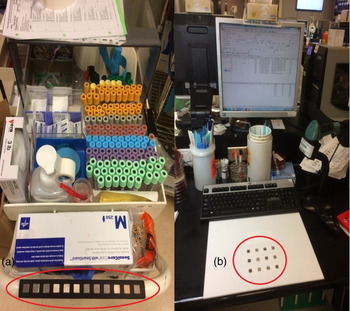
In total, 4 hospitals participated in this study: BC Children’s and BC Women’s Hospitals (BCCH), North York General Hospital (NYGH), Toronto Mount Sinai Hospital (MSH), and Vancouver General Hospital (VGH). We assessed 3 previously characterized copper formulationsReference Bryce, Velapatino and Akbari Khorami9: (1) a spray-on 80% Cu–20% Ni product (Aereus Technologies, Rosemont, ON, Canada), (2) integral 80% Cu–20% Ni alloy (Trimco, Oceanside, CA), and (3) a copper-impregnated surface (CIS) containing 16% Cu oxide product embedded in polymer (EOSCU, Norfolk, VA). Surgical-grade 316 stainless steel was used as the control. The formulations of copper and the stainless-steel controls were cut as coupons (10 mm × 10 mm × 3.12 mm thickness), and each coupon was engraved with a unique identifier on the back for purposes of tracking and randomization. Coupons from each copper formulation and stainless-steel controls were randomly embedded in triplicate in cleanable strip gaskets (20 mm × 190 mm, 1/8-inch Santoprene 90D with 12 square holes, Custom Gaskets, Vancouver, BC, Canada). In addition, 10 strip gaskets containing 12 coupons each were affixed to phlebotomy cart handles, laundry carts, computer stations on wheels, and mobile weighing-scale handles. Coupons were also embedded in triplicate in cleanable gaskets (40.64 cm2 3.17-mm Teflon pads with 12 holes 10 mm × 10 mm), and 5 gaskets containing 12 coupons each were affixed to the specimen work benches in the medical microbiology laboratory at each hospital (Fig. 1). Gaskets were subjected to several iterations to ensure user comfort and were placed centrally on handles to encourage contact with hands. Their placement on laboratory benches was dictated by the users who decided where the highest contact areas were. The biosafety committee reviewed the gasket for its ability to be adequately cleaned.
Examples of (A) cart gasket affixed to a phlebotomy cart handle on a clinical unit and (B) medical microbiology laboratory bench gasket. All gaskets contained stainless-steel and copper-formulation coupons (1 cm2) in triplicate (red circles).

All clinical units used AHP with microfiber cloths to clean and disinfect surfaces daily. Cleaning and disinfection with AHP wipes or liquid was performed at least 3 times daily in the microbiology laboratories according to biosafety procedures.10 No attempt was made to monitor or alter cleaning and disinfection practices. Every 3 months, the gaskets were removed, and the copper-containing and stainless-steel coupons were assessed for microbial bioburden. They were also assessed for resistance to wear, corrosion, and material compatibility with AHP by the UBC Department of Materials Engineering. Coupons were replaced in their same position in the gaskets at each hospital within 5 days of assessment.
Assessment of microbial bioburden
At each hospital site, coupons were placed in a sterile 15-mL tube, covered with 2 mL Dey-Engley neutralizing broth (HiMedia, India), and either sonicated for 5 minutes or mixed in a vortex mixer for 30 seconds, after which 1 mL was plated onto 5% sheep’s blood agar plates (Oxoid, Nepean, ON, Canada). Plates were incubated for 48 hours at 37°C, and colony counts were then performed. Individual bacterial isolates were collected onto Eswab transport media (Copan Diagnostics, Murrieta, CA) for overnight shipping to the Vancouver General Hospital Medical Microbiology laboratory, where identification was performed using matrix-assisted laser desorption/ionization time of flight assay (MALDI-TOF) (Bruker, Milton, ON, Canada). Bacteria were then frozen at −70°C for further analysis. Coupons were sterilized in 95% ethanol for 10 minutes and sent to UBC Department of Materials Engineering for durability testing before being reinstalled.
Screening for copper-resistant strains
The large number of gram-positive bacteria collected from the copper coupons necessitated stratified screening for copper resistance to obtain proportional representation of bacteria from all hospitals. All the Staphylococcus aureus isolates, gram-negative organisms and yeast, and 20% of other gram-positive bacteria from each hospital (selected randomly from the freezer list for each site) were screened. Frozen samples were retrieved from storage and were subcultured twice onto 5% sheep blood agar plates. Three colonies were then suspended in 0.85% NaCl, adjusted to a McFarland of 0.5 and 20 µL (˜106 CFU/mL) subcultured onto Muller-Hinton agar (Sigma-Aldrich, Oakville, ON, Canada) containing 0, 2, 4, 6, 8, 10, 12, or 14 mM of CuCl2 (Fisher Scientific, Waltham, MA). For some isolates, embedded 6-mm disks (Fisher Scientific, Burnaby, BC, Canada) containing 500 mM of CuCl2 were also used to identify the inhibition zone diameter. Plates were incubated for 48 hours at 37°C and were then examined for growth. Salmonella enteriditis S9, S19, and S20 strains with a minimal inhibitory concentration (MIC) of 12 mM and a Kirby-Bauer zone <10 mm (obtained from Dr. Sadhana Ravishankar, University of Arizona) were used as copper-resistant controls.
Materials characterization
All measurements were done before, during, and after 1 year of use according to methods described by Bryce et al.Reference Bryce, Velapatino and Akbari Khorami9 Mass loss analysis was used to determine the abrasion-corrosion rate using the ASTM G1–03 standard.11 All coupons (45 of each formulation from benches and carts) were weighed before, during, and after 1 year using an analytical balance. After 1 year of use, copper coupons were soaked 1–3 minutes in an aqueous solution of 50% v/v hydrochloric acid (HCl, specific gravity 1.19) and stainless-steel coupons were soaked for 1–3 minutes in an aqueous solution of 10% volume/volume nitric acid (HNO3, specific gravity 1.42) to remove their corrosion products before they were reweighed to calculate final mass loss. Energy-dispersive spectroscopy (EDS) was performed in spot analysis mode to monitor any chemical composition alteration of the near surface before and after 1 year of use. Thereafter, 4 coupons for each formulation were analyzed, and at least 10 spots on each coupon were measured.
Data analysis
Data were analyzed using standard descriptive methods with Prism software (GraphPad, San Diego, CA). Normal distributions within each stainless-steel control and copper-formulation coupon groups were assessed using the D’Agostino and Pearson normality tests. Kruskal-Wallis and Dunn post-tests were used to compare the median (CFU/cm2) variation between groups. Wilcoxon signed-rank tests were used to compare the median bioburden of each formulation against the recommended standard for surface-level cleanliness. This recommendation states that the total aerobic colony counts should not exceed < 2.5 to 5 CFU/cm2 from hand-touch sites; for this study, the standard was set at 2.5 CFU/cm accordingly.Reference Dancer12,Reference Montero, Arellano and Pardo13 Mass change and abrasion-corrosion rate were analyzed using repeated measure of ANOVA as appropriate.
Results
In total, 720 coupons were installed at the 4 hospitals: 480 in clinical areas (120 of each stainless-steel control and copper formulation) and 240 in laboratory benches (60 of each stainless-steel control and copper formulations). Over the course of 1 year, 104 coupons (21.7%) were lost from clinical areas: 24 stainless steel, 28 integral copper, 25 spray-on, and 27 CIS coupons (36 at NYGH, 27 at MSH, 27 at BCCH, and 14 at VGH). Also, 1 integral copper coupon (0.4%) was lost from the laboratory bench at BCCH. All hospitals used AHP disinfectants, but some had different compositions. At NYGH, Preempt (SKU 100906585 Virox Technologies, ON, Canada) was used on laboratory benches, and Virox 5 RTU wipes (SKU 53810, Virox Technologies, ON, Canada) with dodecylbenzene sulfonic acid (pH.1.75) were used to clean carts. At MSH, Accel PREVention wipes (SKU 100906722, Diversy Canada, ON, Canada) with dodecylbenzene sulfonic acid (pH.1.75) were used on laboratory benches and carts. At BCCH, both the laboratory benches and carts were cleaned using Accel PREVention wipes. At VGH, liquid Virox 5 RTU (SKU 53808) containing hydroxyethylidene diphosphonic acid and dodecylbenzene sulfonic acid (pH 1.75) was used on laboratory benches, and either Accel PREVention wipes or INTERVention wipes (SKU 100906585) with benzyl alcohol, potassium citrate, and dodecylbenzene sulfonic acid (pH 3) were used to clean carts.
Microorganism burden and identification
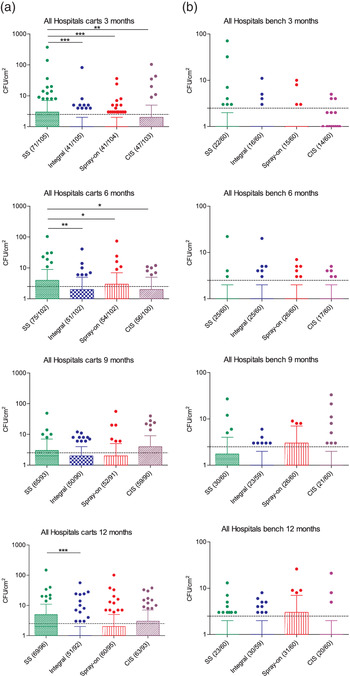
The CFU/cm2 values in the stainless-steel control and the copper coupons were not normally distributed. The nonparametric test Kruskal-Wallis 1-way analysis of variance showed significant variation of the medians of the microorganism burden between all formulations at all hospitals at 3 months (P < .0001), 6 months (P = .0026), and 12 months (P = .0006). Statistically significant differences were detected only at BCCH (P = .0244) and at VGH (P = .0005) at 9 months, but there were no variations overall (P = .16622). The Dunn multiple-comparison post-tests showed that the microorganism burden (CFU/cm2) in the 3 copper formulations were significantly lower than those of the stainless-steel control coupons for the initial 3 and 6 months at all hospitals. At month 12, the integral copper product maintained significantly fewer CFU/cm2 (median, 1; range, 0–56) compared to stainless steel (median, 2; range, 0–148). Spray-on and CIS copper formulations had lower CFU/cm2 (median, 1; range, 0–101 and median, 1; range, 0–38), but these were not statistically significant. The Wilcoxon signed-rank test was used to compare the median bacterial bioburden of each copper formulation or stainless steel against the standardReference Dancer12 acceptable for bioburden threshold after cleaning (ie, 2.5 CFU/cm2). All of the copper formulations (P < .0001) were significantly lower than the set value at months 3 and 6 (P = .0452, P = .0430). At month 12, integral copper (P < .0001) and spray-on (P = .0020) formulations but not stainless steel (P = .8396) or CIS (P = .0625) bacterial bioburdens were significantly below the set value (Fig 2a) (Table 1). Microbial burden percentage reduction was observed in all copper formulations at all time points (Table 1). Importantly, copper formulations installed in the microbiology laboratory benches at all hospitals showed no significant difference in colony counts per coupon compared to stainless-steel controls. The colony counts in the laboratory were consistently below 2.5 CFU/cm2 (P < .0001), likely reflecting the increased frequency of cleaning and compliance with cleaning procedures (Fig 2b) (Table 2).
Colony-forming units (CFU) per coupon (cm2) comparing stainless steel (SS) and 3 copper formulations: integral copper, spray-on copper, and copper-impregnated surface (CIS) collected every 3 months during 1 year on (A) carts and (B) microbiology laboratory benches in 4 hospitals. Box plot represent the values of stainless steel control and copper. Horizontal line in box is the median, boxes extremities 1–4 quartiles, whiskers 25%–75% percentiles. *P < .05, **P < .01, and ***P < .001. Dashed lines indicate a 2.5 CFU/cm2 bioburden threshold, which is considered an acceptable value after cleaning.

Stainless Steel and Copper Formulations Growing Bacteria (CFU/cm2) Over 1 Year in Use in 4 Hospitals Installed on Carts

Note. CFU, colony-forming units; CIS, composite impregnated surface; SS, stainless steel; ns, no significant difference between stainless steel versus copper formulations.
a Difference in rank sum was calculated using the Dunn multiple comparison post-test.
b Wilcoxon signed-rank test P values comparing the median of each stainless steel or copper formulations against the standard for surface-level cleanliness subsequent to terminal cleaning 2.5 CFU/cm2.
c Percentage (%) reduction was calculated using the following formula: (SS mean − copper formulation mean/stainless-steel mean) ×100.
d Median variation as calculated by Kruskal-Wallis test.
*P < .05, **P < .01, ***P < .001 significant difference between of stainless steel versus copper formulations.
Stainless Steel and Copper Formulation Growing Bacteria (CFU/cm2) Over 1 Year in Use in 4 Hospitals Installed on Laboratory Benches

Note. CFU, colony-forming units; CIS, composite impregnated surface; SS, stainless steel; ns, no significant difference between stainless steel versus copper formulations.
a Difference in rank sum was calculated using the Dunn multiple comparison post-test.
b Wilcoxon signed-rank P values comparing the median of each stainless-steel or copper formulations against the standard for surface-level cleanliness subsequent to terminal cleaning 2.5 CFU/cm2.
c Percentage (%) reduction was calculated as follows: (SS mean − copper formulation mean/stainless steel mean) ×100.
d Median variation as calculated by Kruskal-Wallis test.
The total bacteria recovered (6,192) were largely normal skin flora; 5,928 (95.7%) were gram-positive organisms, including coagulase-negative Staphylococcus, Bacillus, and Micrococcus spp. Only 156 (2.5%) were gram-negative organisms, and 8 isolates (0.1%) were yeast. Potentially clinically significant isolates included 19 S. aureus isolated from all the formulations from bench and carts at NYGH and MSH, 1 Streptococcus pneumoniae from a laboratory bench at VGH, and 1 Pseudomonas aeruginosa at NYGH recovered from a stainless-steel coupon.
Copper susceptibility test
In total, 442 (38%) of 1,165 isolates were tested against varying concentrations of CuCl2 on solidified media (n = 371) and embedded disks (n = 71) containing CuCl2. Only 4 isolates had a MIC > 12 mM: 1 Kocuria kristinae recovered from a CIS coupon on a cart, 2 Candida parapsilosis recovered from stainless steel coupons from a bench and a cart and 1 Cryptococcus diffluens from an integral copper coupon on a cart (Table 3). All 19 S. aureus isolates were susceptible to copper.
Susceptibility to CuCl2: Stainless Steel and Copper Formulations

Note. MIC, minimum inhibitory concentration; CNS, coagulase-negative staphylococci; GP, gram positive; GN, gram negative.
a MIC results represent a stratified sample: 16.7% CNS all Staphylococcus aureus, 24% GP cocci, 46.7% GP rod spore forming, 59% GP rod non–spore forming, 82% GN cocci and all GN rods. An additional 71 isolates were evaluated using the disc diffusion method (18 CNS and 53 GP rod spore forming) were all susceptible.
Mass change and abrasion-corrosion rate
All copper formulation and stainless-steel control coupons changed in mass over 1 year (Table 4). With the exception of the integral copper product on the MSH carts, all products experienced mass changes, either positive or negative, of <6% of their initial mass. Overall, the spray-on copper formulations had the largest mass change across all hospitals (a mass loss for NYGH and MSH and a mass gain at BCCH and VGH). The abrasion-corrosion rates were calculated after 1 year of use; the spray-on and integral copper formulations showed significantly different rates than stainless steel at all hospital sites (Table 5).
Percentage (%) Mass Change During 1 Year of Use

Note. SD, standard deviation; CIS, copper-impregnated surface; BCCH, BC Children’s and BC Women’s Hospitals; NYGH, North York General Hospital; MSH, Toronto Mount Sinai Hospital; VGH, Vancouver General Hospital.
a Percentage mass change (%) was calculated: mass (at time point) − mass (initial)/mass (initial) ×100. The 12-month time point presented here is for cleaned samples (after removal of corrosion). Initial mass (g) mean for stainless steel, 2.43 (SD, 0.01); mean for integral copper: 2.66 (SD 0.0); mean for spray-on, 2.54 (SD, 0.05); and mean for CIS, 0.56 (SD, 0.0). Data represent individual measurements up to 15 coupons from benches and 27 from carts for each metal.
Average Abrasion-Corrosion Rate (mm/y) After 1 Year of Use

Note. CIS, copper-impregnated surface; SD, standard deviation. BCCH, BC Children’s and BC Women’s Hospitals; NYGH, North York General Hospital; MSH, Toronto Mount Sinai Hospital; VGH, Vancouver General Hospital.
a Abrasion-corrosion rate after 1 year (mm/y) of use of stainless steel and 3 copper formulations: integral copper, spray-on and CIS coupons (1 cm × 1 cm × 0.312 cm) installed in laboratory benches and carts in 4 hospitals across Canada. Data represent individual measurements up to 15 coupons from benches and 27 from carts for each metal. The abrasion-corrosion rate was calculated using the following formula11: Corrosion rate (mm/y) = (K × W)/ (A × t × D) where: K is a constant equal to 8.76 × 10⁴, t is the exposure time in hours (ie, 365 d × 24 h = 8,760 h), A is the geometrical surface area in cm2 (1 cm × 1 cm) that was exposed to the corrosive environment (ie, disinfectant solutions, bacteria), W is the mass loss in g, and D is density in g/cm3. Density was calculated as initial sample mass divided by initial sample volume (1 cm × 1 cm × 0.312 cm). Densities for the spray-on and CIS materials were assumed to be a uniform physical property, and no special consideration of the porosity or coating thickness was attempted. Data represent individual measurements up to 15 coupons from benches and 27 from carts for each metal.*P < .05, **P < .01, and ***P < .001 significant difference between copper formulations versus stainless steel control as measured by 1-way analysis of variance with the Dunnett multiple comparisons test.
Energy-dispersive x-ray spectroscopy
EDS was performed to monitor alterations in the chemical composition after 1 year. The integral copper and spray-on formulations had copper content as the main element, and this did not change significantly over the year. However, for oxygen content, we detected a decreasing trend at the Toronto hospitals (NYGH and MSH) and an increasing trend at the Vancouver hospitals (BCCH and VGH). For the CIS product, copper content was variable in all coupons due to the multiphasic nature of the materialReference Bryce, Velapatino and Akbari Khorami9 (Supplementary Table 1 online).
Discussion
Self-sanitizing surfaces are a potential mitigation strategy to reduce environmental contamination, and copper formulations in particular are being promoted. However, little has been done to assess microbial bioburden or durability in the face of repeated exposure to cleaners and disinfectants from time zero of use. Guidance regarding the best application of these materials is sparse, and most articles suggest only that it be applied to high-touch surfaces.Reference Montero, Arellano and Pardo13–Reference Schmidt, Attaway and Fairey16
Medical microbiology laboratory benches and clinical carts were specifically chosen for this evaluation because they reflect different levels of bioburden (laboratory benches having the potential for much higher concentrations of organisms), compliance with cleaning and disinfection procedures (ie, laboratories clean the benches before each break and the end of each shift as a minimum), and physical wear and tear. All of the hospitals used AHP, and the laboratories used the same biosafety protocols. Notably, although AHP 0.5% was the main ingredient, the different brands had additional components and variable pH values that might have impacted on the copper and stainless-steel surfaces. The laboratory coupons that were frequently and thoroughly cleaned and disinfected showed no difference in bacterial burden between the stainless-steel controls and the copper formulations, suggesting that copper installation had little additional benefit. Conversely, copper reduced bacterial bioburden significantly on the coupons installed in clinical areas, suggesting that it could be a useful mitigation strategy in areas where compliance with daily cleaning and disinfection may be suboptimal. This is an important distinction, and although othersReference Montero, Arellano and Pardo13,Reference Weber, Rutala and Sickbert-Bennett14,Reference Schmidt, von Dessauer and Benavente17 have demonstrated reduction in contamination on room surfaces by 1–2 logs, they have not indicated where copper-formulation surfaces should be placed for optimum benefit. At the end of 1 year, we observed that the integral copper product conferred the greatest benefit in reducing bacterial burden in clinical areas.
Environmental hospital cultures of high-touch surfaces have reported gram-negative isolation rates between 18.7% and 29.1% of total organisms.Reference Ahmed, Hassan, El-Sherbiny and Soliman18,Reference Bhatta, Hamal and Shrestha19 Gram-positive organisms are more resistant to the bactericidal effect of copper because of their thicker peptidoglycan wall and resistance to immediate membrane depolarizationReference Warnes, Caves and Keevil20 and the predominance of these microorganism in sampling reflects this survival advantage. Our results confirm that copper exerts its antimicrobial activity best in gram-negative organisms because only 2.5% of the isolate samples were gram negative. Copper surfaces might best be used in areas where both cleaning is a challenge and gram-negative organisms are more problematic or common, such as patient washrooms, endoscopy suites, and intensive care units.
Resistance to copper was infrequent, with 1 yeast on the integral copper product and 1 K. kristinae from a CIS coupon. These results are likely spurious; 2 stainless-steel coupons also revealed 2 C. parapsilosis isolates with high MICs. Copper exhibits multiple mechanisms of bacterial killing,Reference Solioz and Solioz21 minimizing the likelihood of the development of resistance. The lack of observed resistance over 1 year in the 4 hospital environments (particularly the laboratory benches where exposure to resistant organisms is frequent) was reassuring.
The observed mass changes and corrosion rates were all quite low. With the exception of the integral copper product on MSH carts, all 1-year mass changes were within 6% of the initial mass. The corrosion rates, as a result, were correspondingly low and not exceeding 0.4 mm/y. This is an acceptable corrosion rate by engineering standards and is certainly acceptable for surfaces that are not structurally or mechanically important. The variations observed in terms of mass gain (at BCCH and VGH) versus mass loss (at NYGH and MSH) were likely due to different cleaning procedures or different environmental conditions that would have resulted in slight variations in the extent of surface oxidation and, thus, the amount of oxygen associated with the corroded surface. This hypothesis is corroborated by the increased oxygen concentration (Supplementary Table 1 online) for the British Columbia hospitals versus the Ontario hospitals. Products with higher copper corrosion rates might perform well as bactericidal surfaces,Reference Elguindi, Moffitt and Hasman22 which was supported by the low bioburden found in the integral copper and spray-on formulations. Although AHP was the only cleaner and disinfectant used in this study, hospitals need to consider the effect of other cleaning and disinfectant products.Reference Bryce, Velapatino and Akbari Khorami9
This study has several limitations. We did not control for variables such as the number of individuals touching the gaskets, the use of gloves, the different AHP formulations, the daily location of the ward carts and rooms visited. All of these factors could have affected the colony counts. The 1-year duration and 4 hospital design hopefully minimized these variables and others that could affect colony counts, such as temperature and relative humidity. Further studies that consider these variables and the economic impact of copper installation would be helpful.
Copper formulation subjected to 1 year of clinical use demonstrated different degrees of antimicrobial activity, although corrosion rates and mass changes were acceptable. Clinical areas that might be suboptimally cleaned and/or areas where gram-negative bacteria are predominant may yield the greatest benefits.
Supplementary material
To view supplementary material for this article, please visit https://doi.org/10.1017/ice.2021.52
Acknowledgments
The authors would like thank to the medical microbiology and hospital workers for their support and collaboration with this study.
Financial support
This study was funded by Teck Resources Limited through the Vancouver General Hospital and University of British Columbia Hospital Foundation. All copper formulations were purchased at their cost with full knowledge of the manufacturers regarding the intent of this study.
Conflicts of interest
All authors report no conflicts of interest relevant to this article.