Introduction
Bipolar disorder (BD) is a common condition, ranked among the top 10 causes of global disability among adults by the World Health Organization (Murray & Lopez, Reference Murray and Lopez1997; McIntyre & Konarski, Reference McIntyre and Konarski2004). A major factor contributing to the burden of disease is the substantial delay between the first experience of symptoms and the initiation of treatment, which can be as long as 8–9 years (Baldessarini et al. Reference Baldessarini, Tondo, Hennen and Floris1999; Highet et al. Reference Highet, McNair, Thompson, Davenport and Hickie2004; McIntyre & Konarski, Reference McIntyre and Konarski2004). Delays in initiating treatment for BD are associated with greater subsequent morbidity (Franchini et al. Reference Franchini, Zanardi, Smeraldi and Gasperini1999; Baldessarini et al. Reference Baldessarini, Tondo and Hennen2003), and the response to mood stabilizer treatment is better earlier in the course of the disorder (Swann et al. Reference Swann, Bowden, Calabrese, Dilsaver and Morris1999).
The association between early treatment initiation and better outcome suggests that the early identification of BD may be useful (Mrazek & Mrazek, Reference Mrazek, Mrazek, Sadock and Sadock2004). There is an increasing movement towards early intervention in psychiatric illnesses (McGorry et al. Reference McGorry, Yung and Phillips2003). One component of this approach is to identify, and offer intervention to, individuals who are in the prodromal phase that precedes the onset of frank illness (Yung & McGorry, Reference Yung and McGorry1996; McGorry et al. Reference McGorry, Yung and Phillips2003).
The prodrome, by definition, can only be determined in retrospect. It constitutes a period of disturbance characterized by distinct features/symptoms leading up to the development of the full-blown disorder (Conus et al. Reference Conus, Ward, Hallam, Lucas, Macneil, McGorry and Berk2008). Prodromal features can, however, be used to identify individuals prospectively; although their clinical utility will depend on how specific they are to the illness in question.
The availability of specific treatments for BD and evidence that early intervention in BD is associated with a better outcome (Mrazek & Mrazek, Reference Mrazek, Mrazek, Sadock and Sadock2004; Bauer et al. Reference Bauer, Juckel, Correll, Leopold and Pfennig2008) suggest that prevention could be effective in BD. However, it is not yet clear whether a specific prodromal phase for BD can be identified. This comprehensive review provides a summary of the evidence evaluating the putative bipolar prodrome and addresses two key questions: Is there a bipolar prodrome? And if so, what are its characteristic features and how long does it last?
We review studies of symptoms/clinical features prior to the first manic or hypomanic episode because it is at this point that the diagnosis for BD can be first made. Features linked to the subsequent development of BD in patients with other diagnoses are beyond the scope of this review and have been addressed elsewhere (Berk et al. Reference Berk, Malhi, Mitchell, Cahill, Carman, Hadzi-Pavlovic, Hawkins and Tohen2004; Calabrese et al. Reference Calabrese, Muzina, Kemp, Sachs, Frye, Thompson, Klingman, Reed and Hirschfeld2006; Henin et al. Reference Henin, Biederman, Mick, Hirshfeld-Becker, Sachs, Wu, Yan, Ogutha and Nierenberg2007).
Method
Search strategy
The PubMed, Medline, EMBASE, EMBASE Classic and PsycINFO databases were electronically searched to identify relevant studies (see Supplementary methods, available online, for further details). The abstracts of the papers identified by the search were screened by O.D.H., S.L. and G.T. to identify papers meeting the selection criteria set out below. The papers identified through this process were then reviewed in full to identify those that met the selection criteria.
Selection criteria
The inclusion criterion was: studies of clinical features preceding the onset of the first manic or hypomanic episode. The exclusion criteria were: studies that did not report specific clinical signs or symptoms; studies purely of diagnoses preceding the development of BD; and reviews and other papers not reporting original data.
Data extraction
Data were extracted independently by S.L. and G.T. and agreement confirmed by O.D.H. For each study the following variables were recorded: (a) the year of publication, (b) study design, (c) sample characteristics, (d) measurement scales used, (e) frequency of putative prodromal features, (f) criteria used to diagnose BD and (g) time period from onset of putatively prodromal features to the onset of BD.
Method of analysis
It was not possible to combine the results for statistical analysis as the studies used different scales to assess putative prodromal features, and reported findings in a variety of ways. Instead we appraise and synthesize the data to address the key questions and calculate the sensitivity and specificity of putatively prodromal features for BD (see Supplementary methods).
Results
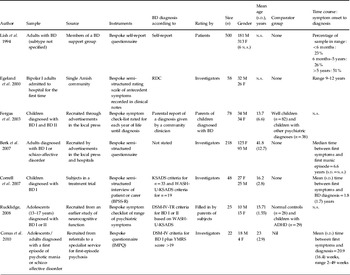
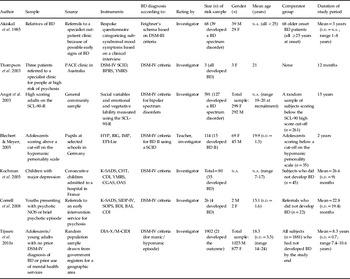
Three hundred and eighteen studies were identified by the searches. The screening process is described in the Supplementary methods and shown in Supplementary Fig. 1. Following screening, 14 studies were identified for inclusion in the review. These were divided according to methodology into retrospective and prospective studies and are summarized in Tables 1 and 2 respectively.
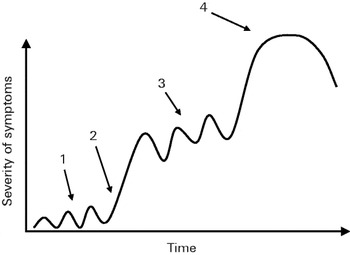
Model illustrating the possible development of bipolar disorder over time. Potential points for preventive intervention are identified by arrows 1, 2 and 3. 1=fluctuating mood representing underlying cyclothymia or at-risk mental state. 2=life events precipitating transition to 3=prodromal phase and 4=first manic episode.

Retrospective studies

BD, Bipolar disorder; M, male; F, female; K-SADS, Schedule for Affective Disorders and Schizophrenia for School Age Children; WASH-U-KSADS, Washington University in St Louis Schedule for Affective Disorders and Schizophrenia; BPSS-R, Bipolar Prodrome Symptom Scale-Retrospective; RDC, Research Diagnostic Criteria; IMPQ, Initial Mania Prodrome Questionnaire; YMRS, Young Mania Rating Scale; ADHD, attention deficit/hyperactivity disorder; s.d., standard deviation; n.a., not applicable.
Prospective studies
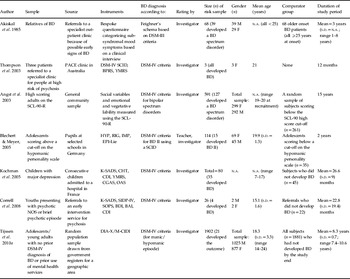
BD, Bipolar disorder; M, male; F, female; BAI, Beck Anxiety Inventory; PACE, Personal Assessment and Crisis Evaluation; BDI, Beck Depression Inventory; CDI, Children's Depression Inventory; CHT, Cyclothymic-Hypersensitive Questionnaire; CGAS, Clinical Global Assessment Scale; EPI-lie, lie scale of the Eysenck Personality Inventory; HYP, Hypomanic Personality scale; IMP, Impulsive nonconformity scale; K-SADS, Schedule for Affective Disorders and Schizophrenia for School Age Children; NOS, not otherwise specified; OAS, Overt Aggression Scale; RIG, rigidity subscale of the Munich Personality Test; SCL-90-R, Symptom Checklist-90-R; SIDP-IV, Structured Interview for DSM-IV Personality; SOPS, Scale of Prodromal Symptoms; YMRS, Young Mania Rating Scale; DIA-X/M-CIDI, Munich Composite International Diagnostic Interview; s.d., standard deviation; n.a., not applicable.
Is there a prodrome to bipolar disorder?
The seven retrospective studies used a variety of methodologies to collect data from bipolar individuals and/or their carers about clinical features that predated the onset of the disorder (Lish et al. Reference Lish, Dime-Meenan, Whybrow, Price and Hirschfeld1994; Egeland et al. Reference Egeland, Hostetter, Pauls and Sussex2000; Fergus et al. Reference Fergus, Miller, Luckenbaugh, Leverich, Findling, Speer and Post2003; Berk et al. Reference Berk, Dodd, Callaly, Berk, Fitzgerald, de Castella, Filia, Filia, Tahtalian, Biffin, Kelin, Smith, Montgomery and Kulkarni2007; Correll et al. Reference Correll, Penzner, Frederickson, Richter, Auther, Smith, Kane and Cornblatt2007; Rucklidge, Reference Rucklidge2008; Conus et al. Reference Conus, Ward, Lucas, Cotton, Yung, Berk and McGorry2010). These studies clearly indicate that there are symptoms that commonly precede the onset of frank BD in many patients. However, they have several methodological limitations, in particular the possibility that recall bias has influenced the findings and, in three studies, the lack of a validated assessment to determine the diagnosis (Lish et al. Reference Lish, Dime-Meenan, Whybrow, Price and Hirschfeld1994; Fergus et al. Reference Fergus, Miller, Luckenbaugh, Leverich, Findling, Speer and Post2003; Berk et al. Reference Berk, Dodd, Callaly, Berk, Fitzgerald, de Castella, Filia, Filia, Tahtalian, Biffin, Kelin, Smith, Montgomery and Kulkarni2007).
The seven prospective studies are less susceptible to recall bias and all use validated diagnostic assessments, indicating that they are likely to be more reliable sources of evidence. The case series by Thompson et al. (Reference Thompson, Conus, Ward, Phillips, Koutsogiannis, Leicester and McGorry2003) describes the prospective assessment of cases using validated diagnostic instruments and rating scales. Consequently, we can be confident that the patients in this small case series did not meet diagnostic criteria for BD at the initial assessment, and that the symptoms reported were not influenced by recall bias.
Three studies examined high-risk clinical groups: either children/adolescents with unipolar depressive (Kochman et al. Reference Kochman, Hantouche, Ferrari, Lancrenon, Bayart and Akiskal2005), youths with brief psychotic episodes (Correll et al. Reference Bauer, Juckel, Correll, Leopold and Pfennig2008), or the relatives of individuals diagnosed with BD who were referred to a specialist clinic with suspected early signs of the condition (Akiskal et al. Reference Akiskal, Downs, Jordan, Watson, Daugherty and Pruitt1985). All three studies report clinical features preceding the onset of BD, providing clear evidence of symptoms/clinical features preceding the onset of BD. However, these studies and the case series by Thompson et al. (Reference Thompson, Conus, Ward, Phillips, Koutsogiannis, Leicester and McGorry2003) are in select samples, and so the findings may not be representative of the general population.
Data on putatively prodromal features of BD in general population community samples are provided in three studies (Angst et al. Reference Angst, Gamma and Endrass2003; Blechert & Meyer, Reference Blechert and Meyer2005; Tijssen et al. Reference Tijssen, van Os, Wittchen, Lieb, Beesdo, Mengelers, Krabbendam and Wichers2010a). Of these, the outcome in the study by Blechert & Meyer (Reference Blechert and Meyer2005) was a manic symptom dimension rather than a diagnosis of BD, and so, although informative, it is less specific to the prodrome of BD than the other studies. The studies by Angst et al. (Reference Angst, Gamma and Endrass2003) and Tijssen et al. (Reference Tijssen, van Os, Wittchen, Lieb, Beesdo, Mengelers, Krabbendam and Wichers2010a) are noteworthy in recruiting large community samples and in conducting follow-up assessments for up to 15 and 10 years respectively. The outcome in Angst et al. (Reference Angst, Gamma and Endrass2003) was bipolar spectrum disorder or BD II, rather than a BD I diagnosis. Angst et al. (Reference Angst, Gamma and Endrass2003) enriched their sample by identifying high-risk subjects (those with high scores on the Symptom Checklist-90R, whom they hypothesized would be more likely to subsequently develop BD) and, importantly, included as a control group a random sample of average scorers on the same checklist. The study by Tijssen et al. (Reference Tijssen, van Os, Wittchen, Lieb, Beesdo, Mengelers, Krabbendam and Wichers2010a) recruited its sample of adolescents/young adults at random from the population register for the Munich area so the sample is likely to be representative of the general population. Other strengths of this study are the exclusion of symptoms that were directly attributed to alcohol or drug use, and the exclusion of subjects with a past or current diagnosis of BD at baseline. Subjects were assessed at two intermediate time points before the final assessment so the persistence of symptoms over time could also be evaluated. Both studies provide evidence of clinical features/symptoms preceding the onset of BD. Tijssen et al. (Reference Tijssen, van Os, Wittchen, Lieb, Beesdo, Mengelers, Krabbendam and Wichers2010a) report that over 70% of the subjects who subsequently developed BD had previously experienced at least two manic/hypomanic and/or depressive symptoms, whereas Angst et al. (Reference Angst, Gamma and Endrass2003) found that over 40% of subjects who developed BD II had previously experienced mood lability.
Characteristics of the putatively prodromal features
Frequency and form of clinical features
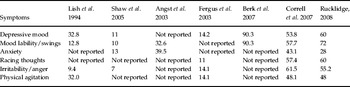
Seven studies report the frequency of specific symptoms occurring within the putative bipolar prodrome, summarized in Table 3. The most commonly reported putatively prodromal features were mood lability/swings and depressive mood. In the study by Angst et al. (Reference Angst, Gamma and Endrass2003), one of the most methodologically sound studies, mood lability was the strongest risk factor for the subsequent diagnosis of a bipolar spectrum disorder [odds ratio (OR) 14], greater even than a family history of mania (OR 7). Depressive mood was reported in five of the seven studies (jointly with mood swings in one study). However, even these relatively common features were not seen in all subjects. In addition, such symptoms were also reported to a lesser degree in control samples. Thus, depressed mood was reported in 5.8% of controls by Angst et al. (Reference Angst, Gamma and Endrass2003) and in 9% of controls by Egeland et al. (Reference Egeland, Shaw, Endicott, Pauls, Allen, Hostetter and Sussex2003).
Frequency (%) of specific symptoms preceding bipolar disorder

Although data for individual symptoms are not reported in the study by Tijssen et al. (Reference Tijssen, van Os, Wittchen, Lieb, Beesdo, Mengelers, Krabbendam and Wichers2010a), they did find that the combination of greater persistence and greater number of symptoms was associated with the greatest risk of subsequent transition to BD. Thus, symptom load may be more important than specific symptoms.
Many of the putatively prodromal symptoms (see Table 3) are seen in established BD, and are probably attenuated forms of symptoms seen in the frank illness, whereas others are also features of other psychiatric disorders (APA, 2000), and so may show relatively low specificity for BD.
In seven studies cyclothymic features were identified as a precursor of BD (Akiskal et al. Reference Akiskal, Downs, Jordan, Watson, Daugherty and Pruitt1985; Egeland et al. Reference Egeland, Hostetter, Pauls and Sussex2000; Angst et al. Reference Angst, Gamma and Endrass2003; Fergus et al. Reference Fergus, Miller, Luckenbaugh, Leverich, Findling, Speer and Post2003; Kochman et al. Reference Kochman, Hantouche, Ferrari, Lancrenon, Bayart and Akiskal2005; Berk et al. Reference Berk, Dodd, Callaly, Berk, Fitzgerald, de Castella, Filia, Filia, Tahtalian, Biffin, Kelin, Smith, Montgomery and Kulkarni2007; Rucklidge, Reference Rucklidge2008). However, these features are also seen in the well relatives of people with BD (Findling et al. Reference Findling, Youngstrom, McNamara, Stansbrey, Demeter, Bedoya, Kahana and Calabrese2005; Jones et al. Reference Jones, Tai, Evershed, Knowles and Bentall2006), so it is not clear whether these features could be a correlate of risk status also seen in some relatives who do not go on to develop BD. Furthermore, it remains to be determined whether these features reflect pre-morbid personality characteristics or are part of a distinct prodrome to BD, an issue that could be usefully addressed in future research.
Only one report, by Fergus et al. (Reference Fergus, Miller, Luckenbaugh, Leverich, Findling, Speer and Post2003), included an analysis of the degree to which individual symptoms clustered together. The principal component analysis revealed four symptom dimensions associated with the later diagnosis of BD: depression, irritability/dyscontrol, mania and psychosis/suicidality. Together these explained about 50% of the variance.
Sensitivity and specificity of putative prodromal features
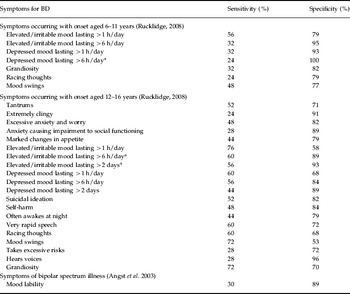
None of the studies give the sensitivity or specificity of the putatively prodromal symptoms for BD, and only two provided sufficient data to calculate these. We have calculated the sensitivity and specificity for the symptoms that were significantly associated with BD in these two studies (Table 4).
Sensitivity and specificity of symptoms for bipolar disorder (BD) compared to a healthy control group

a Incidence of symptoms differed significantly between subjects with BD and subjects with attention deficit/hyperactivity disorder (ADHD) and controls.
Time course of putatively prodromal symptoms
Four studies provide data on the time lag between the onset of putatively prodromal features and the subsequent development of BD (see Tables 1 and 2), although the mean duration of the prodrome to BD is only reported in two studies. It was 1.7 (s.d.=1.8) years in patients who developed psychotic mania, and 1.9 (s.d.=1.5) years in those who developed non-psychotic mania (Correll et al. Reference Correll, Penzner, Frederickson, Richter, Auther, Smith, Kane and Cornblatt2007), whereas in the other study, which was of patients with psychotic mania and schizo-affective disorder, it was 20.9 (s.d.=16.4) weeks (Conus et al. Reference Conus, Ward, Lucas, Cotton, Yung, Berk and McGorry2010).
There are also indications that distinguishing features may be present from very early on in development (Fergus et al. Reference Fergus, Miller, Luckenbaugh, Leverich, Findling, Speer and Post2003; Shaw et al. Reference Shaw, Egeland, Endicott, Allen and Hostetter2005). Fergus et al. (Reference Fergus, Miller, Luckenbaugh, Leverich, Findling, Speer and Post2003) report when the incidence of the symptoms within each of the dimensions they examined was 10% greater in the BD children than in the comparator groups by age. The striking finding from this fine-grained analysis was that the irritability/dyscontrol symptom cluster differentiated the BD children from the comparator groups from age 1 onwards, a decade before the onset of BD. Symptoms from the other clusters differentiated the BD children from around age 8, 4 years on average before the onset of BD. The main caveat with this study is that the diagnosis of BD was not operationalized and is likely to have included children with a broad version of childhood BD, which favors the inclusion of subjects with marked irritability, rather than euphoria (Baroni et al. Reference Baroni, Lunsford, Luckenbaugh, Towbin and Leibenluft2009).
Discussion
The existence of symptoms predating the onset of BD is a consistent finding across retrospective and prospective studies, and symptoms may be present in many patients for months to years before a definitive diagnosis of BD is made. This suggests that there may be a relatively prolonged prodrome to BD, contrary to previous ideas that it is brief (Kraepelin, Reference Kraepelin1921). We have identified several features that may comprise a putative prodromal phase of BD. These include attenuated affective symptoms, such as depressive mood and mood swings, and symptoms common to several disorders, such as higher levels of anger, irritability and dyscontrol. Thus, it may be possible to identify people with the prodromal signs of BD well in advance of the onset of the disorder. However, the extent to which people experiencing putatively prodromal symptoms of BD present to services requesting help is unclear. This highlights the need for further large-scale population studies in this area.
Limitations of the evidence
Our review has highlighted several methodological factors that limit the interpretation of the findings and the comparison across studies. Retrospective studies are useful in highlighting features that may be significant. However, such studies are limited by the possibility that subjects met diagnostic criteria for BD at an earlier stage, and that the results may be significantly affected by recall biases. The more methodologically robust prospective studies have in the main recruited subjects from selected populations, limiting generalizability and comparison across studies. However, two prospective studies recruited from general community samples (Angst et al. Reference Angst, Gamma and Endrass2003; Tijssen et al. Reference Tijssen, van Os, Wittchen, Lieb, Beesdo, Mengelers, Krabbendam and Wichers2010a). A further issue is that some of the studies were of childhood-onset BD and/or use a broad definition of BD; conclusions based on studies of childhood-onset BD may not be applicable to adult-onset BD, and vice versa. Differential diagnosis is controversial in childhood-onset BD, but a more narrow definition of BD may be more appropriate (Baroni et al. Reference Baroni, Lunsford, Luckenbaugh, Towbin and Leibenluft2009). Future studies comparing putatively prodromal symptoms in childhood- and adult-onset BD would help to address this issue.
Specificity and sensitivity
Although the literature has identified several putatively prodromal features, it is striking that none of the studies reviewed provided both their specificity and sensitivity, and only two (one a relatively small retrospective study) gave sufficient data to allow these to be calculated. This highlights the need for future studies to include specificity and sensitivity. Where we were able to calculate these variables, our key finding was that, although the specificity of many of the prodromal symptoms is high, their sensitivity is relatively low. However, the balance between the competing needs for specificity and sensitivity depends on the risks associated with false-negative or false-positive cases. In the case of the bipolar prodrome, high specificity may be useful if the risk of a false positive is considered substantial; in this case the risks are those associated with initiating treatments such as mood stabilizers in people who are unlikely to benefit from them. However, other potential interventions, such a psycho-education or lifestyle advice, are likely to be associated with a lower risk of adverse events, in which case sensitivity may be considered relatively more important than specificity. Nevertheless, the high specificity of some of the features indicates that they may have potential to identify patients in the prodrome to BD.
Future directions
As no single prodromal feature has been identified in all subjects, the BD prodrome may be best defined by a cluster of features. One approach for future studies would be to evaluate which combination of the symptoms listed in Table 4 provides the highest predictive accuracy for a subsequent diagnosis of BD.
An alternative strategy is to focus on other risk factors, such as family history or personality traits, possibly in combination with the putatively prodromal symptoms, as used in the criteria for the prodrome to psychosis (Yung et al. Reference Yung, Yuen, McGorry, Phillips, Kelly, Dell'Olio, Francey, Cosgrave, Killackey, Stanford, Godfrey and Buckby2005). The high rate of BD spectrum disorders in people with cyclothymia suggests that this is a promising candidate risk feature to be included. The two approaches may be combined to complement each other. This combinatorial approach was used in the study (by Akiskal et al. Reference Akiskal, Downs, Jordan, Watson, Daugherty and Pruitt1985) that showed the highest proportion of subjects who subsequently developed BD, suggesting that this approach might be most useful in clinical practice. Focusing on youths/young adults is likely to give the highest yield as this is the peak period for onset of BD; the risk of developing a first manic/hypomanic episode may decrease sharply after age 21 (Tijssen et al. Reference Tijssen, van Os, Wittchen, Lieb, Beesdo, Mengelers and Wichers2010b).
Studies that included a psychiatric comparator group indicated that many of the putatively BD prodromal features may also be seen in other psychiatric disorders (Angst et al. Reference Angst, Gamma and Endrass2003; Fergus et al. Reference Fergus, Miller, Luckenbaugh, Leverich, Findling, Speer and Post2003; Rucklidge, Reference Rucklidge2008). One key outstanding question is thus whether the putative prodrome to BD can be reliably identified in a distinct, stable enough form to permit specific intervention, as seems to be the case in psychosis, or whether it is manifest as an ‘at-risk mental state’ that gradually develops into one of several possible disorders, including BD. The specificity of putative BD prodromal features needs to be determined with respect to the prodrome of other psychiatric conditions, particularly schizophrenia and recurrent unipolar depression. Furthermore, the existence of childhood traits, such as cyclothymia, and also the later development of frank symptoms suggest that there may be ‘early’ and ‘late’ prodromal features, as has been described for the prodrome of schizophrenia (Hambrecht et al. Reference Hambrecht, Lammertink, Klosterkotter, Matuschek and Pukrop2002).
Finally, it is also evident from our review that there has been little investigation of the neurobiology of the BD prodromal phase, beyond a study of its relationship to alterations in sleep (Jones et al. Reference Jones, Hare and Evershed2005). Neurobiological markers may be used in people at risk on the basis of clinical features to enhance sensitivity and specificity of identifying the prodrome, an approach that has been tried in psychosis (McGuire et al. Reference McGuire, Howes, Stone and Fusar-Poli2008).
Proposed model of the development of BD
Overall, our findings suggest key differences in the trajectory to BD from models of the prodrome to psychotic illnesses (Yung & McGorry, Reference Yung and McGorry1996). In particular, BD is a fluctuating condition and, as shown in Tables 3 and 4, many of the symptoms potentially predating it have a fluctuating nature. Moreover, the first manic episode may have been preceded by a major depressive episode, and the clinical picture may be further complicated by treatment for depression. This contrasts with psychotic illnesses such as schizophrenia, where the diagnosis can be made on the basis of the first episode of frank illness alone. The prodrome to BD is therefore more difficult to define than that to psychosis, as there may have been a prodrome to the first affective episode and residual symptoms from that episode. We have constructed an illustrative model (Fig. 1) that encapsulates the features of the putative trajectory to BD based on our reading of the evidence in this review. This model is intended to highlight likely key aspects of the prodrome to BD that need to be considered by future studies. It will undoubtedly need to be revised in the light of future evidence. The model has three components. First, features such as cyclothymic traits and/or manic/hypomanic symptoms may be apparent many years before the development of the frank illness (Fergus et al. Reference Fergus, Miller, Luckenbaugh, Leverich, Findling, Speer and Post2003; Tijssen et al. Reference Tijssen, van Os, Wittchen, Lieb, Beesdo, Mengelers, Krabbendam and Wichers2010a), in a pre-prodromal phase (arrow 1). Second, over time, and possibly triggered by life events or other factors (Mathew et al. Reference Mathew, Chandrasekaran and Sivakumar1994; Johnson et al. Reference Johnson, Andersson-Lundman, Aberg-Wistedt and Mathe2000) (arrow 2), persisting and worsening symptoms become apparent that indicate a prodrome to BD (arrow 3), leading on to, third, the first manic episode (arrow 4). Some patients will receive intervention for depression in the prodromal phase, although it may not be designed to prevent the later onset of BD and many BD patients do not receive intervention at this point (McIntyre & Konarski, Reference McIntyre and Konarski2004). The figure indicates that there are several potential points when preventive intervention could occur: primary intervention could be instituted during the period marked by arrow 1, and secondary prevention during the periods marked by arrows 2 and 3. Furthermore, it is likely that intervention will need to be tailored to the phase; for example, psychosocial interventions with proven benefit in BD (Sachs, Reference Sachs2008) could be beneficial in the pre-prodromal phase, whereas targeted cognitive behavioral therapy and/or medication may be used later, once prodromal features are apparent.
Conclusions
Symptoms predating the onset of BD have been identified in several studies, but further work is required to determine whether these represent a distinct prodrome to BD. These putatively prodromal features can be grouped as attenuated symptoms of BD, general psychopathological features, and cyclothymic traits. The specificity and sensitivity of these features to the putative prodrome of BD remain to be established, and will require longitudinal studies that include appropriate psychiatric controls to determine whether a prodrome to BD can be reliably identified. We have proposed a model of the trajectory to BD based on our reading of the evidence reviewed to illustrate the points at which it may be possible to intervene clinically. However, further work is required before it is possible to determine the full potential for early and preventive intervention for BD.
Note
Supplementary material accompanies this paper on the Journal's website (http://journals.cambridge.org/psm).
Declaration of Interest
None.