INTRODUCTION
False memories, the belief that items or events have been experienced before when they have not, occur across the lifespan, increase in normal aging, and are further exacerbated by neurocognitive disorders such as Alzheimer’s disease (LaVoie, Willoughby, & Faulkner, Reference LaVoie, Willoughby and Faulkner2005; Parkin, Bindschaedler, Harsent, & Metzler, Reference Parkin, Bindschaedler, Harsent and Metzler1996; Schacter, Curran, Galluccio, Milberg, & Bates, Reference Schacter, Curran, Galluccio, Milberg and Bates1996). Whereas some false memories are innocuous, such as believing the groceries that you just bought are on the kitchen table when they are actually still in the car, others can be dangerous, such as thinking that you had turned off the stove when you had not.
Correctly recognizing information as having been previously experienced is thought to be based on two forms of information: item-specific recollection and gist memory (Reyna & Brainerd, Reference Reyna and Brainerd1995; Schacter, Norman, & Koutstaal, Reference Schacter, Norman and Koutstaal1998). Item-specific recollection involves retrieval of specific, contextualized details of a prior experience with a particular item, whereas gist memory is general knowledge conveyed by a collection of items or experiences (Reyna & Brainerd, Reference Reyna and Brainerd1995; Schacter et al., Reference Schacter, Norman and Koutstaal1998). Item-specific recollection is primarily reliant on the hippocampus, whereas gist memory has been shown to depend upon the entorhinal cortex (Souchay & Moulin, Reference Souchay and Moulin2009).
The prototypical cognitive profile of Alzheimer’s disease dementia is characterized by impairments in episodic memory that result in reduced encoding, rapid forgetting of new information, and increased false memories (Hildebrandt, Haldenwanger, & Eling, Reference Hildebrandt, Haldenwanger and Eling2009; Weintraub, Wicklund, & Salmon, Reference Weintraub, Wicklund and Salmon2012). Early hippocampal involvement by Alzheimer’s disease pathology leads to impairment in item-specific recollection, leaving gist memory relatively spared in these earlier disease stages (Braak, Alafuzoff, Arzberger, Kretzschmar, & Del Tredici, Reference Braak, Alafuzoff, Arzberger, Kretzschmar and Del Tredici2006; Budson, Daffner, Desikan, & Schacter, Reference Budson, Daffner, Desikan and Schacter2000). Increased false memories in Alzheimer’s disease are thought to result from both an over-reliance on gist memory as well as an impaired ability to monitor and inhibit memory decisions (Abe et al., Reference Abe, Fujii, Nishio, Iizuka, Kanno, Kikuchi and Mori2011; Budson, Todman, & Schacter, Reference Budson, Todman and Schacter2006).
False memories have been studied experimentally using the categorized word list (CWL) paradigms (Tat et al., Reference Tat, Soonsawat, Nagle, Deason, O’Connor and Budson2016). In this paradigm, a participant is presented with a series of words belonging to taxonomic categories; however, one or more prototypical members of the category are absent during study. For example, a participant may be presented with a series of related words (e.g. “pine,” “dogwood,” “willow,” and “redwood”). In a later recognition memory test, the participant may be presented with words studied previously (e.g. “pine” and “willow”), prototypical items not seen before (e.g. “oak” and “birch”), and unrelated new items (e.g. “boat” and “classical”).
Participants with Alzheimer’s disease show elevated rates of false recognition in CWL paradigms, likely due to their reliance on gist memory (Budson et al., Reference Budson, Daffner, Desikan and Schacter2000; Budson, Todman, & Schacter, Reference Budson, Todman and Schacter2006; Tat et al., Reference Tat, Soonsawat, Nagle, Deason, O’Connor and Budson2016). In addition, individuals with Alzheimer’s disease have been found to respond “old” to unrelated words much more frequently than do healthy older adults, suggesting a liberal response bias (Budson, Wolk, Chong, & Waring, Reference Budson, Wolk, Chong and Waring2006). Cognitive strategies to compensate for increased false memories and other memory impairments resulting from Alzheimer’s disease have taken on increased importance given the lack of available disease-modifying medications (Yiannopoulou & Papageorgiou, Reference Yiannopoulou and Papageorgiou2013). These cognitive strategies have typically aimed to either enhance item-specific recollection or gist memory (Budson, Sitarski, Daffner, & Schacter, Reference Budson, Sitarski, Daffner and Schacter2002; Malone et al., Reference Malone, Deason, Palumbo, Heyworth, Tat and Budson2019; McCabe, Presmanes, Robertson, & Smith, Reference McCabe, Presmanes, Robertson and Smith2004).
Item-specific encoding is an elaborative, deep encoding process, whereby a participant generates one or more distinctive qualities of the study item to improve semantic, contextual, and salient information (i.e., quality of item-specific recollection) for the item (Tat et al., Reference Tat, Soonsawat, Nagle, Deason, O’Connor and Budson2016). Item-specific encoding will be referred to as deep encoding throughout the remainder of this manuscript. Deep encoding has been found to be effective in improving the quality of item-specific recollection in healthy older controls and participants with mild cognitive impairment but not among participants with Alzheimer’s disease, potentially due to their impairments in item-specific recollection (Tat et al., Reference Tat, Soonsawat, Nagle, Deason, O’Connor and Budson2016).
Conservative responding is a memory heuristic in which a participant endorses an item as previously encountered only if they are certain of their decision (Waring, Chong, Wolk, & Budson, Reference Waring, Chong, Wolk and Budson2008). Conservative responding has been found to reduce the degree of false recognition in word list paradigms by shifting the metamemorial information that participants employ when making memory decisions (Deason et al., Reference Deason, Tat, Flannery, Mithal, Hussey, Crehan and Budson2017; Waring et al., Reference Waring, Chong, Wolk and Budson2008). Use of conservative responding has also been found to shift the response criterion of participants with Alzheimer’s disease, although it has not previously been found to meaningfully improve their discrimination of true and false information (Deason et al., Reference Deason, Tat, Flannery, Mithal, Hussey, Crehan and Budson2017; Waring et al., Reference Waring, Chong, Wolk and Budson2008). Although healthy older controls and participants with mild cognitive impairment due to Alzheimer’s disease have been found to apply cognitive strategies to reduce false memory in categorized list paradigms (Brueckner & Moritz, Reference Brueckner and Moritz2009; Deason et al., Reference Deason, Tat, Flannery, Mithal, Hussey, Crehan and Budson2017; Tat et al., Reference Tat, Soonsawat, Nagle, Deason, O’Connor and Budson2016), individuals with Alzheimer’s disease dementia have been found to either be ineffective or inconsistent in their application of cognitive strategies (Abe et al., Reference Abe, Fujii, Nishio, Iizuka, Kanno, Kikuchi and Mori2011; Budson, Dodson, Daffner, & Schacter, Reference Budson, Dodson, Daffner and Schacter2005; Budson et al., Reference Budson, Sitarski, Daffner and Schacter2002; Pierce, Waring, Schacter, & Budson, Reference Pierce, Waring, Schacter and Budson2008). Further, the effectiveness of combining strategies to reduce false memories in participants with Alzheimer’s disease at either the mild cognitive impairment or mild dementia stage remains unexplored.
Cognitive abilities in addition to memory are critical in the use of cognitive strategies among aging and individuals with Alzheimer’s disease dementia (Buckner, Reference Buckner2004). Executive function is conceptualized as higher order cognitive functions responsible for monitoring, shifting, manipulating information, and directing attention (Logue & Gould, Reference Logue and Gould2014). Executive function has been associated with use of cognitive strategies in healthy older adults (Bouazzaoui et al., Reference Bouazzaoui, Isingrini, Fay, Angel, Vanneste, Clarys and Taconnat2010; Troyer, Graves, & Cullum, Reference Troyer, Graves and Cullum1994). Experimental paradigms show evidence of impaired inhibitory and monitoring abilities (two aspects of executive function) in individuals with Alzheimer’s disease (Budson, Sullivan, et al., Reference Budson, Sullivan, Mayer, Daffner, Black and Schacter2002; Flanagan et al., Reference Flanagan, Wong, Dutt, Tu, Bertoux, Irish and Hornberger2016). Nonetheless, clear associations between performance on measures of executive function and use of memory strategies have not yet been observed among individuals with Alzheimer’s disease (Budson, Wolk, Chong, et al., Reference Budson, Wolk, Chong and Waring2006; Deason et al., Reference Deason, Hussey, Ally and Budson2012). Because executive function is such a broad category (Logue & Gould, Reference Logue and Gould2014), we speculated that this prior lack of association was likely related to which measures of executive function were included in the testing battery. We believe that looking for such associations is important, as a more comprehensive understanding of the relationship between executive functioning and use of cognitive strategies may inform recommendations and interventions for individuals with Alzheimer’s and related diseases.
In this study, we examined the effectiveness of two strategies, conservative responding and deep encoding, alone and in combination, to reduce false memory in a CWL paradigm among participants with mild Alzheimer’s disease dementia (AD), participants with amnestic single-domain mild cognitive impairment (MCI), and healthy age-matched controls (OC). A comprehensive battery of neuropsychological measures was also administered to elucidate which cognitive functions are associated with the use of strategies to reduce false memories. We hypothesized that the performance of participants on measures of executive function would be positively related to the effective use of cognitive strategies. We further hypothesized that each participant group would be able to use strategies, alone and in combination, to reduce false memories. Lastly, we hypothesized that the MCI group would be less able than the OC group to use these strategies to reduce false memories, and the AD group would be less able than the MCI group to use these strategies to reduce false memories.
METHOD
Participants
Sixteen participants with a diagnosis of mild Alzheimer’s disease dementia (AD), sixteen participants with a diagnosis of amnestic single-domain mild cognitive impairment (MCI), and sixteen healthy age-, education-, and sex-matched healthy older controls (OC) were recruited (Table 1). Participants with AD and MCI were recruited from VA Boston Healthcare System, the Boston University Alzheimer’s Disease Center, and the surrounding community clinics, and diagnosed by a neurologist (AEB) based on the 2011 NIA-AA diagnostic criteria for Alzheimer’s disease dementia and mild cognitive impairment (Albert et al., Reference Albert, DeKosky, Dickson, Dubois, Feldman, Fox and Phelps2011; McKhann et al., Reference McKhann, Knopman, Chertkow, Hyman, Jack, Kawas and Phelps2011). All participants with MCI were identified as amnestic, single domain, subtype. Exclusion criteria included: clinically significant depression, alcohol or drug use, cerebrovascular disease, or traumatic brain injury. Participants were also excluded if English was not their primary language or their Mini Mental State Examination (MMSE) score was below 21. In addition, older adults were excluded if they had a history of dementia or any neurodegenerative disorder in themselves or their immediate family. All participants had normal or corrected-to-normal vision and hearing. Written informed consent was obtained from all participants. This study was approved by the Institutional Review Board of the VA Boston Healthcare System. This study was completed in accordance with the Helsinki Declaration. Participants were compensated $10.00 per hour for their participation.
Demographic attributes

Note: AD = mild Alzheimer’s disease dementia group; MCI = mild cognitive impairment due to Alzheimer’s disease group; OC = healthy age-matched control group.
Data values reported as: age: mean in years (standard deviation); sex: the percentage male of each group; years of education: mean in years (standard deviation).
Materials and Testing
All participants were tested individually either at their home or the VA Boston Healthcare System. Each participant completed four sessions, one session for each of the conditions. Sessions lasted for approximately one hour and involved three phases in the following order: a study phase of the word lists presented on a laptop computer, a recognition memory test of the study words with additional related and unrelated unstudied words interspersed as described below, and administration of between one and six neuropsychological tests of estimated IQ, memory, processing speed, language, and executive function. Neuropsychological measures of executive function were selected due to their emphasis on monitoring, set shifting, and manipulating information as well as the ability to easily record and identify participant scores to facilitate correlational analysis (Delis, Kaplan, Kramer, & Corporation, Reference Delis, Kaplan, Kramer and Corporation2001; Logue & Gould, Reference Logue and Gould2014). The schedule for the neuropsychological tests was as follows:
-
Session 1: Consortium to Establish a Registry for Alzheimer’s Disease Word List (CERAD, Becker, Becker, Giacobini, Barton, & Brown, Reference Becker, Becker, Giacobini, Barton and Brown1997), Trail Making Test Parts A and B (Strauss, Sherman, Spreen, & Spreen, Reference Strauss, Sherman, Spreen and Spreen2006), MMSE (Pangman, Sloan, & Guse, Reference Pangman, Sloan and Guse2000), Boston Naming Test Short Form (Mack et al., Reference Mack, Freed, Williams and Henderson1992), Verbal Fluency (Phonemic (F,A,S), Semantic (Animals, Fruits, Vegetables); Mitrushina, Reference Mitrushina2005), and Wechsler Adult Intelligence Scale-Third Edition: Digit Span (WAIS-III Digit Span; Wechsler, Reference Wechsler1997);
-
Session 2: D-KEFS Color Word Interference Test [Kaplan Executive Function System (D-KEFS); Delis, Kaplan, Kramer, & Corporation, Reference Delis, Kaplan, Kramer and Corporation2001] and Repeatable Battery for the Assessment of Neuropsychological Status Digit Symbol Coding (Randolph, Tierney, Mohr, & Chase, Reference Randolph, Tierney, Mohr and Chase1998);
-
Session 3: D-KEFS Sorting Test (Card Set 1 only) and D-KEFS Verbal Fluency Category Switching;
-
Session 4: D-KEFS Twenty Questions.
The computerized word list memory task was programmed using E-Prime 2.0 and was presented on a laptop computer (Dell Precision M 6700 Core i7 processor, Windows 7, 17.3-inch screen 1920 × 1080 resolution). Stimuli words were drawn from a previously published set of normed categorized word list stimuli (Battig & Montague, Reference Battig and Montague1969; Van Overschelde, Rawson, & Dunlosky, Reference Van Overschelde, Rawson and Dunlosky2004). Words were presented in Arial Unicode MS font size 48 in black font for 3.5 s with an inter-stimulus interval of 0.5 s between items of the same list. An inter-stimulus interval of 5 s was used between study lists. In each condition, participants studied seven lists of 15 taxonomically related English nouns and were tested on 42 total words with two correct items and two related lures drawn from each of the seven study lists as well as 14 new words which had no significant lexical relationship to any of the study lists.
Instructions for the computer task were read aloud by study personnel, and a small display card was placed below the keyboard with printed instructions in the conservative responding, deep encoding, and combined conditions. The instructions in the no strategy condition at study were: “Read each word out loud” and at test were: “How confident are you that this word is ‘old’ or ‘new’? Is this word ‘old’ or ‘new’?”. In the deep encoding and combined conditions, the study instructions were changed to: “Read each word out loud. What is one unique characteristic of this item or personal experience that differentiates it from other words in this list?”. In the conservative responding and combined conditions, the test instructions were changed to: “How confident are you that this word is ‘old’ or ‘new’? Is this word ‘old’ or ‘new’? Only say OLD if your confidence was ‘(6) Certain it is OLD’ otherwise say NEW.” Participants completed a simple maze as a brief distractor task between study and test phases. Study staff recorded the responses of the participant during the testing phase by pressing corresponding keyboard buttons. The experimental condition and study stimuli lists were counterbalanced across all participants and groups.
Results
Neuropsychological Testing
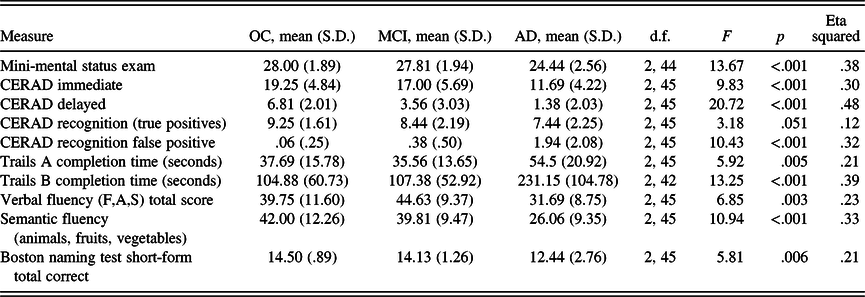
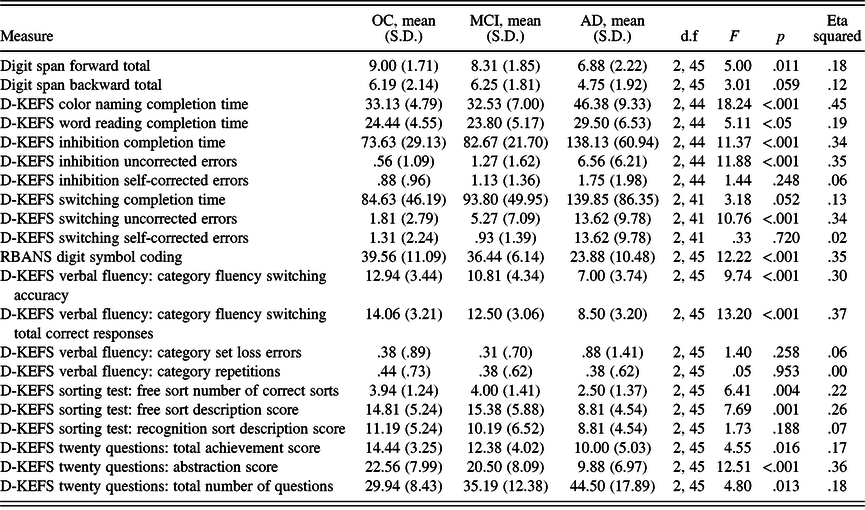
Measures used to assess overall cognitive function were administered to all participants during session 1. The results of this battery as well as demographic characteristics by group are presented in Tables 1 and 2. One OC participant did not complete the MMSE at time of testing but had received a score of 30 on the Montreal Cognitive Assessment within 6 months of the first session. Three participants with AD were unable to complete Trails B and the administration of this task was discontinued. These results broadly revealed that OCs performed in the normal range, participants with MCI performed similarly to the OCs with the exception of CERAD delayed recall, and the AD group showed impairment in comparison to both the MCI and OC groups (Table 2 and Supplementary Table 1). Analysis of variances (ANOVAs) comparing group performances on neuropsychological measures of executive functions revealed that the MCI group either performed similarly to the OC group or was slightly impaired, whereas the AD group showed impairments compared to both the OC and MCI groups (Table 3 and Supplementary Table 1).
Neuropsychological battery results

Note: AD = mild Alzheimer’s disease dementia group; CERAD = Consortium to Establish a Registry for Alzheimer’s Disease Word List Memory Test; MCI = mild cognitive impairment due to Alzheimer’s disease group; OC = healthy age-matched control group.
Data values reported as: mean of total score (standard deviation) for all measures except for Trails A and Trails B which are reported as: mean of total completion time in seconds (standard deviation). Please see Supplementary Table 1 for the results of multiple-comparison post hoc analyses.
Executive function neuropsychological testing performance

Note: AD = mild Alzheimer’s disease dementia group; D-KEFS = Delis-Kaplan Executive Function System; MCI = Mild cognitive impairment due to Alzheimer’s disease group; OC = Healthy age-matched control group; RBANS = Repeatable Battery for the Assessment of Neuropsychological Status.
Some measures were not completed which resulted in differing degrees of freedom in these analyses.
Data values reported as: mean of total score (standard deviation) for all measures except for the following D-KEFS measures: Color Naming Completion Time, Word Reading Completion Time, Inhibition Completion Time, and Switching Completion Time, which are reported as: mean of total completion time in seconds (standard deviation). Please see Supplementary Table 1 for the results of multiple-comparison post hoc analyses.
Statistical Approach
Repeated-measures ANOVAs were conducted for (1) hits, false alarms to related lures, and false alarms to unrelated lures, (2) d’ for gist and item-specific recollection, and (3) C for gist and item-specific recollection with group (AD, MCI, and OC) as a between-subject factor and condition (no strategy, conservative responding, deep encoding, and combined) as a within-subject factor. Post hoc comparisons were performed using the Tukey HSD.
Hits
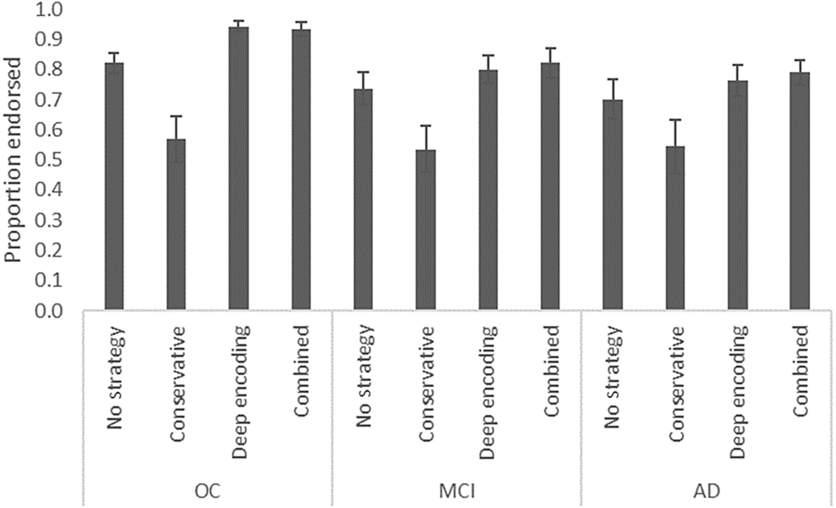
All participants endorsed a lower proportion of true items in the conservative condition (main effect of condition: F (3,135) = 24.14; p < .001, η 2 = .350; M = .55, SE = .05) compared to the no strategy (M = .75, SE = .03; p < .001), deep encoding (M = .83, SE = .02; p < .001), and combined (M = .85, SE = .02; p < .001) conditions (Figure 1). No main effect of group (F (2,45) = 2.68; p = .080, η 2 = .11) and no interaction between group and condition (F (6,135) = .50; p = .809, η 2 = .02) was found.
Proportion of true items endorsed in CWL paradigm by condition and group. Note the error bars reflect the standard error of the mean. AD = mild Alzheimer’s disease dementia group; MCI = mild cognitive impairment due to Alzheimer’s disease group; OC = healthy age-matched control group.

False Alarms to Related Lures
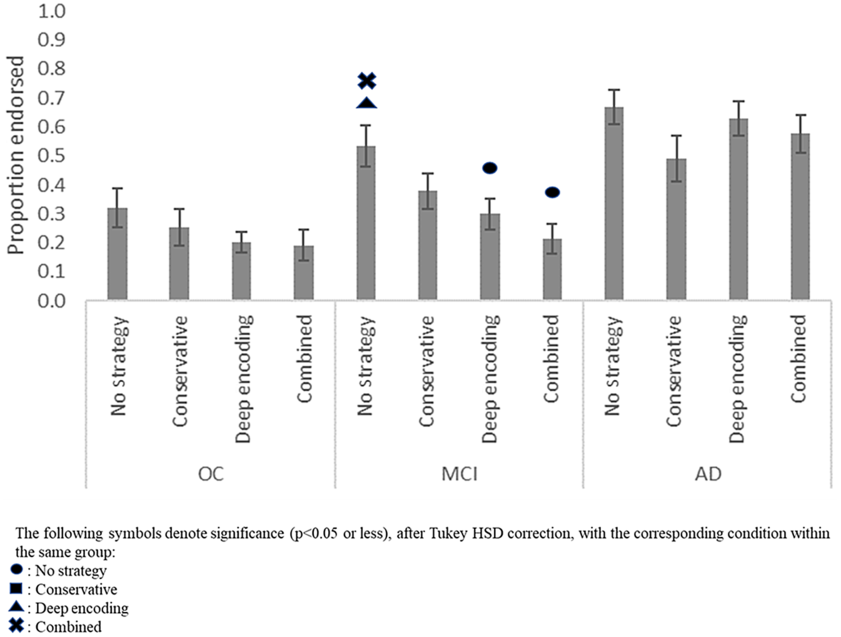
The AD group showed a higher proportion of false alarms to related lures (main effect of group: F (2,45) = 13.81; p < .001, η 2 = .38; M = .59, SE = .05) compared to the OC (M = .25, SE = .05; p < .001) and MCI (M = .36, SE = .05; p = .002) groups across all conditions. No difference in false alarms to related lures was found between the MCI (M = .36, SE = .05) and OC (M = .25, SE = .05; p = .502) groups. Collapsed across groups, there was a higher proportion of false alarms to related lures in the no strategy condition (main effect of condition: F (3,135) = 9.82; p < .001, η 2 = .18; M = .51, SE = .04) compared to the conservative (M = .37, SE = .04; p < .001), deep encoding (M = .38, SE = .03; p < .001), and combined (M = .33, SE = .03; p < .001) conditions. An interaction between group and condition was also found (F (6,135) = 2.68; p < .001, η 2 = .11) (Figure 2). After conducting a Tukey HSD test, no significant differences in endorsing-related lures were found across conditions in each of the OC and AD groups. MCI participants showed a higher proportion of false alarms to related lures in the no strategy condition (M = .54, SE = .07) compared to the deep encoding (M = .30, SE = .05; p < .001), and combined (M = .21, SE = .06; p < .001) conditions.
Proportion of related lure items endorsed in CWL paradigm by condition and group. Note that the error bars reflect the standard error of the mean. AD = mild Alzheimer’s disease dementia group; MCI = mild cognitive impairment due to Alzheimer’s disease group; OC = healthy age-matched control group.

False Alarms to Unrelated Lures
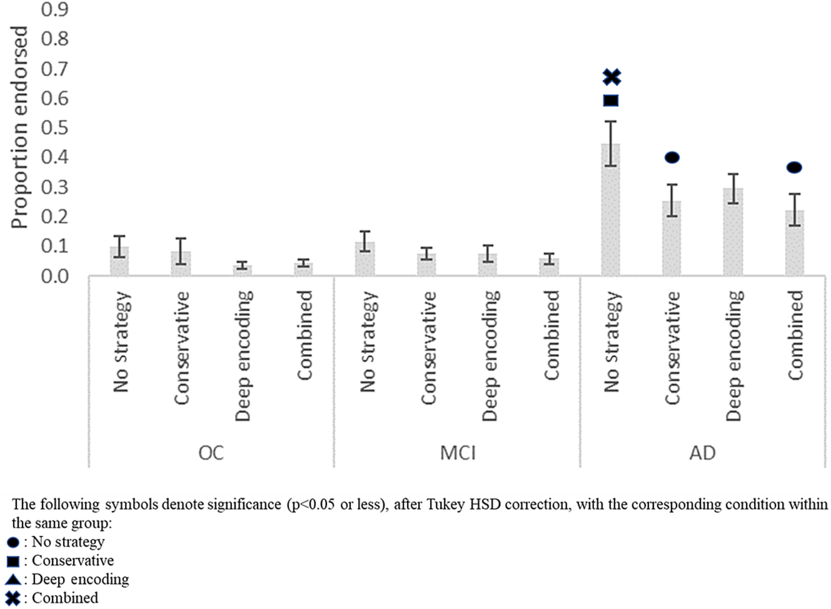
AD participants showed a higher proportion of false alarms to unrelated lures (main effect of group: F (2,45) = 19.24; p < .001, η 2 = .46; M = .30, SE = .03) compared to OC (M = .07, SE = .03; p < .001) and MCI (M = .08, SE = .03; p = .004) participants; OC and MCI did not differ. Collapsed across group, there was a higher proportion of false alarms to unrelated lures in the no strategy condition (main effect of condition (F (3,135) = 7.34; p < .001, η 2 = .14; M = .22, SE = .03) compared to the combined (M = .11, SE = .02; p < .001) condition. When analyzing the interaction between group and condition (F (6,135) = 2.26; p = .041, η 2 = .09) with Tukey HSD, AD participants showed a higher proportion of false alarms to unrelated lures in the no strategy condition (M = .45, SE = .05) compared to the conservative (M = .25, SE = .04; p = .032) and combined (M = .22, SE = .03; p = .002) conditions (Figure 3).
Proportion of unrelated lure items endorsed in CWL paradigm by condition and group. Note that the error bars reflect the standard error of the mean. AD = mild Alzheimer’s disease dementia group; MCI = mild cognitive impairment due to Alzheimer’s disease group; OC = healthy age-matched control group.

d’ and C
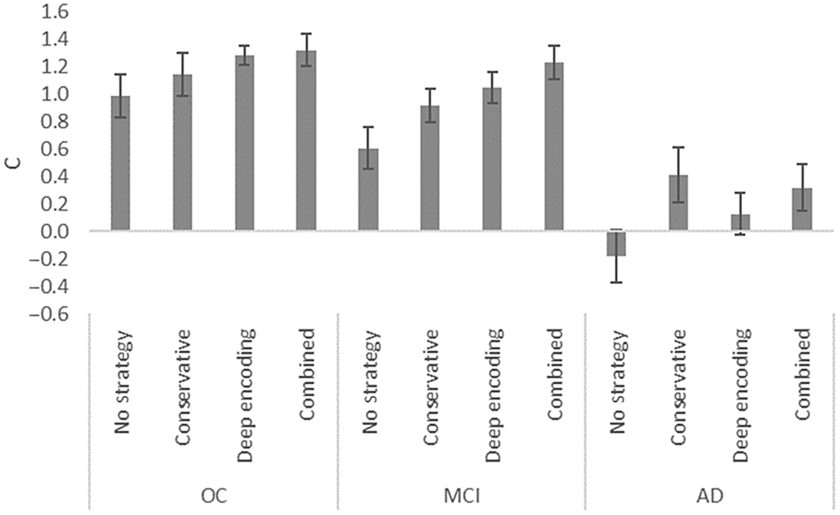
d’ and C statistics were computed to estimate the discrimination and response bias within each condition, respectively. Discrimination estimates were computed for both gist memory (d’ gist equals the proportion of endorsed true items minus the proportion of endorsed unrelated new items) and item-specific recollection (d’ item-specific recollection equals the proportion of endorsed true items minus the proportion of endorsed related lures) (Figures 4 and 5). Response bias (C) by condition was computed with positive values of C representing conservative response bias and negative values signify a liberal responding bias (Figures 6 and 7). These measures were computed according to the formula provided by Macmillan and Creelman (Reference Macmillan and Creelman2005), and these data were adjusted when the proportion of responses equaled 1 or 0 with the correction factor ± ½N with N representing the total number of possible false alarm responses.
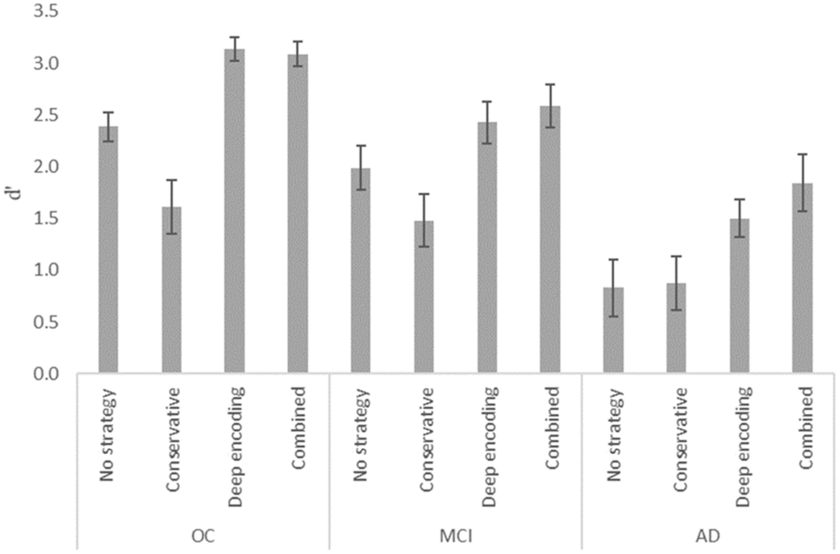
d’ Estimates of gist memory. Note that the error bars reflect the standard error of the mean. The y-axis reflects the number of endorsed true items minus the number of endorsed unrelated new items. AD = mild Alzheimer’s disease dementia group; MCI = mild cognitive impairment due to Alzheimer’s disease group; OC = healthy age-matched control group.

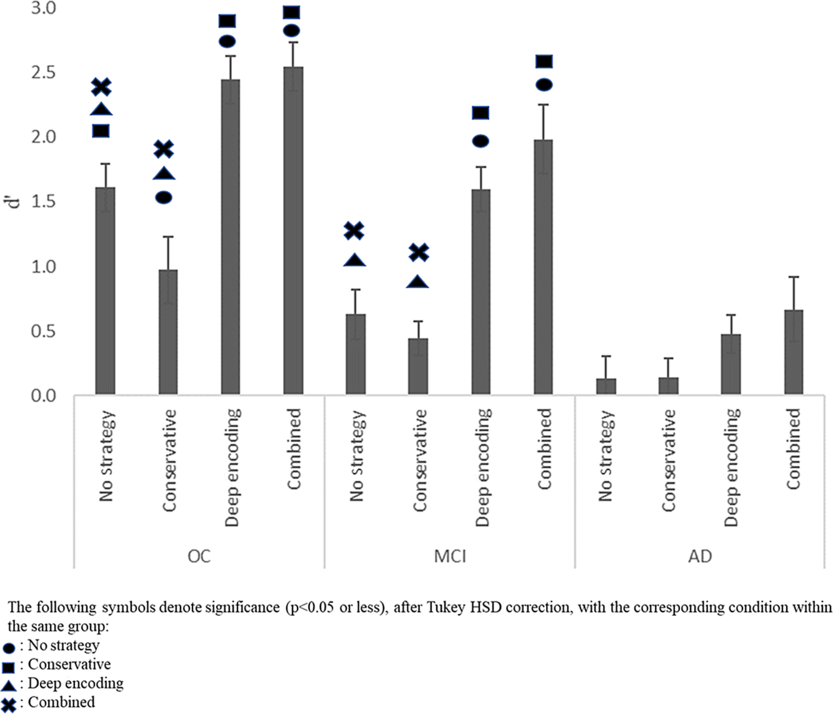
d’ Estimates of item-specific recollection. Note that the error bars reflect the standard error of the mean. The y-axis reflects the number of endorsed true items minus the number of endorsed related lures. AD = mild Alzheimer’s disease dementia group; MCI = mild cognitive impairment due to Alzheimer’s disease group; OC = healthy age-matched control group.

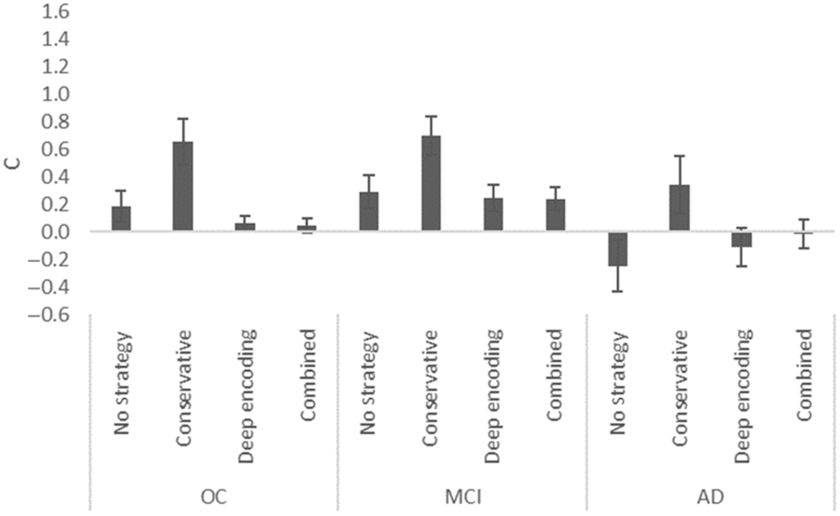
Gist memory response bias (C statistic). Note that the error bars reflect the standard error of the mean. AD = mild Alzheimer’s disease dementia group; MCI = mild cognitive impairment due to Alzheimer’s disease group; OC = healthy age-matched control group.

Item-specific memory response bias (C statistic). Note that the error bars reflect the standard error of the mean. AD = mild Alzheimer’s disease dementia group; MCI = mild cognitive impairment due to Alzheimer’s disease group; OC = healthy age-matched control group.

d’ Gist
The AD group demonstrated lower levels of discrimination for gist information than the MCI group, who, in turn, demonstrated lower levels of gist information than the OC group (main effect of group: F (2, 45) = 22.59, p < .001, η 2 = .50; OC: M = 2.55, SE = .14; MCI: M = 2.12, SE = .14; AD: M = 1.26, SE = .14 (OC-MCI p = .005; OC-AD p < .001, MCI-AD p < .001)). Regarding the effect of condition (main effect of condition: F (3, 135) = 24.84, p < .001, η 2 = .36), post hoc analysis revealed that participants showed higher discrimination in the deep encoding (M = 2.35, SE = .10) and combined (M = 2.50, SE = .12) conditions compared to the no strategy (M = 1.73, SE = .12; p < .001; p < .001, respectively) and conservative ((M = 1.32, SE = .15); p < .001, p < .001, respectively) conditions. No difference was found between the deep encoding and combined conditions (p = .772). No interaction between condition and group was found in the analyses of discrimination for gist information (F (6, 135) = 1.27, p = .274, η 2 = .05) (Figure 4).
d’ Item-Specific Recollection
Differences in discrimination for item-specific information were found across all groups: lowest in the AD group, better in the MCI group, and the best in the OC group (main effect of group F (2, 45) = 29.82, p < .001, η 2 = .57; OC: M = 1.89, SE = .14; MCI: M = 1.16, SE = .14; AD: M = .35, SE = .14 (OC-MCI p = .005; OC-AD p < .001; MCI-AD p < .001)) (Figure 5). Across all conditions, participants showed higher discrimination in the deep encoding (main effect of condition: F (3, 135) = 40.41, p < .001, η 2 = .47; M = 1.50, SE = .10), and combined (M = 1.73, SE = .14) conditions compared to the no strategy condition (M = .79, SE = .11; p < .001, p < .001, respectively). Furthermore, participants showed higher discrimination in the deep encoding and combined conditions compared to the conservative condition (M = .52, SE = .10; p < .001, p < .001, respectively). No difference was found between deep encoding and combined conditions (p = .078).
In terms of discrimination for item-specific recollection, a close examination of the interaction between condition and group (F (6, 135) = 3.77, p = .002, η 2 = .14) revealed that OC and MCI participants showed greater discrimination in the deep encoding (OC: M = 2.44, SE = .17; MCI: M = 1.60, SE = .17) and combined (OC: M = 2.54, SE = .24; MCI: M = 1.98, SE = .24) conditions compared to the no strategy (OC: M = 1.61, SE = .18; p < .001, p < .001, respectively; MCI: M = .63, SE = .18; p < .001, p < .001, respectively)) and conservative conditions (OC: M = .97, SE = .19; p < .001, p < .001, respectively; MCI: M = .44, SE = .19; p < .001, p < .001, respectively). Interestingly, OC participants showed higher discrimination in the no strategy condition compared to the conservative condition (p < .005), while MCI participants did not (p = .397). No difference was found between deep encoding and combined conditions (OC: p = .646; MCI: p = .083).
Participants in the AD group showed trends toward higher item-specific recollection discrimination in the combined condition (M = .66, SE = .24) compared to the no strategy (M = .13, SE = .18, p = .054) and conservative conditions (M = .15, SE = .19; p = .074), although these did not reach statistical significance after post hoc adjustment. No differences were found when comparing the no strategy to conservative (p = .948) and combined conditions (p = .121). No difference was found between the deep encoding (M = .48, SE = .17) and combined conditions (p = .388).
Response Bias Gist
The AD group showed a more liberal response bias for gist information (main effect of group: F (2, 45) = 4.11, p < .001, η 2 = .15; M = -.01, SE = .09) than the MCI group (M = .37, SE = .09; p < .001). No difference in response bias was found when comparing OC (M = .24, SE = .09) to MCI (p = .590) and AD (p = .168) groups. Across all groups, participants showed a more conservative response bias for gist information in the conservative condition (main effect of condition: F (3, 135) = 15.92, p < .001, η 2 = .26; M = .56, SE = .10) compared to the no strategy (M = .08, SE = .08; p < .001), deep encoding (M = .07, SE = .06; p < .001), and combined (M = .09, SE = .05; p < .001) conditions. No interaction between condition and group for gist memory was found (F (6, 135) = .68, p = .666, η 2 = .03).
Response Bias Item-Specific Recollection
The AD group also demonstrated a more liberal response bias for item-specific information (main effect of group: F (2, 45) = 20.74, p < .001, η 2 = .48; M = .17, SE = .12) compared to the OC (M = 1.18, SE = .12; p < .001), and MCI (M = .95, SE = .12; p < .001) groups. No difference in response biases was found between the OC and MCI groups (p = .342). Collapsed across groups, participants showed a more liberal response bias for item-specific information in the no strategy condition (main effect of condition: F (3, 135) = 11.91, p < .001, η 2 = .21; M = .47, SE = .10) compared to conservative (M = .82, SE = .09; p < .001), deep encoding (M = .81, SE = .07; p < .001), and combined (M = .96, SE = .08; p < .001) conditions. No interaction between condition and group was found (F (6, 135) = 1.42, p = .212, η 2 = .06).
Correlations of Neuropsychological Tasks and Memorial Discrimination
No clear pattern of correlations between performance on neuropsychological tests and effective use of cognitive strategies was found. The Benjamini–Hochberg correction ((i/m)Q) was applied in order to control for false discoveries resulting from multiple comparisons (Supplementary Table 2).
Discussion
The results of this experiment revealed that use of cognitive strategies impacted the performance of all three groups. The increased information conferred by either deep encoding alone or the combined strategies improved discrimination for gist information in all three groups (Figure 4). Furthermore, in the OC and MCI groups, both the deep encoding and combined strategies also improved discrimination for item-specific recollection; by contrast, the AD group did not show strategic benefit for item-specific recollection (Figure 5). Lastly, the AD group demonstrated a liberal responding bias consistent with past research (Budson, Wolk, et al., Reference Budson, Wolk, Chong and Waring2006), and all participants adopted a more conservative bias using the conservative responding strategy alone (Deason et al., Reference Deason, Tat, Flannery, Mithal, Hussey, Crehan and Budson2017; Waring et al., Reference Waring, Chong, Wolk and Budson2008).
In the present study, the results of combined strategies did not differ from that of deep encoding alone. Thus, it is likely that all the beneficial strategic effects observed in this study were driven by deep encoding. It is therefore worth pausing to consider how it is that deep, item-specific encoding is able to boost not only item-specific recollection but also gist memory—particularly in the AD group.
As mentioned in the Introduction, gist memory is general knowledge conveyed by a collection of items or experiences (Reyna & Brainerd, Reference Reyna and Brainerd1995; Schacter et al., Reference Schacter, Norman and Koutstaal1998). When subjects study categorized word lists, the encoding of individual items triggers semantically related activations (Reyna & Brainerd, Reference Reyna and Brainerd1995). Thus, studying robin, blue jay, crow, and canary activates not only nodes specific to those items but also other birds such as cardinal, chickadee, and dove—as well as the superordinate category, bird. However, these semantic networks will be more strongly activated when encoding is deep and semantically based compared to when it is shallow and perceptually based. The more strongly activated the networks are, the stronger the gist memory will be. Future research should explore the use of deep encoding in memory paradigms using unrelated words, as these unrelated stimuli would not be expected to generate a strong sense of gist information.
The present study therefore suggests that when patients with AD are not given a particular encoding strategy, they do not deeply encode items as much as they could and, therefore, they do not fully activate their semantic networks related to those items. In this study, we demonstrate that patients with AD can successfully adopt a deep encoding strategy that likely provides greater semantic activation, thereby strengthening gist memory in AD. Overall performance of participants in the AD group suggests reliance upon gist memory, an expected finding based on prior literature demonstrating relatively intact gist memory in the early symptomatic stages of Alzheimer’s disease dementia (Budson et al., Reference Budson, Daffner, Desikan and Schacter2000). The deep encoding strategy was able to boost gist memory, a novel finding of the present study as past research has not clearly supported the effectiveness of cognitive strategies in this population (Abe et al., Reference Abe, Fujii, Nishio, Iizuka, Kanno, Kikuchi and Mori2011; Simmons-Stern et al., Reference Simmons-Stern, Deason, Brandler, Frustace, O’Connor, Ally and Budson2012; Tat et al., Reference Tat, Soonsawat, Nagle, Deason, O’Connor and Budson2016; Waring et al., Reference Waring, Chong, Wolk and Budson2008).
Also worth considering is why, in the OC group, the conservative responding strategy alone reduced item-specific recollection relative to no strategy, but it did not reduce item-specific recollection when combined with deep encoding. Although further studies will be need to answer this interesting question, we speculate that, without deep encoding, our OC participants did not experience vivid enough recollections to allow them to endorse previously seen items. To put it more simply, in the conservative responding condition, they stopped engaging in the guesses they did in the no strategy condition, many of which were correct! However, use of the deep item-specific strategy at encoding must have helped to provide vivid, item-specific recollections at retrieval, such that conservative responding in the combined condition was preferentially applied to the non-studied items.
Whereas past studies have suggested that frontal executive abilities may be a critical factor in the effective use of cognitive strategies (Plancher, Guyard, Nicolas, & Piolino, Reference Plancher, Guyard, Nicolas and Piolino2009), we found no evidence of a relationship between performance on frontal executive neuropsychological measures and the use of such strategies in the present study. The MCI and OC groups performed similarly on measures of frontal executive functioning, whereas the AD group performed at much lower levels than both other groups. Although past research suggested that Alzheimer’s disease pathology impacts executive functioning abilities (Budson et al., Reference Budson, Sitarski, Daffner and Schacter2002; Kirova, Bays, & Lagalwar, Reference Kirova, Bays and Lagalwar2015; Marshall et al., Reference Marshall, Rentz, Frey, Locascio, Johnson and Sperling2011), there was no evidence in the present study that a certain level of executive functioning was necessary to apply the strategies effectively.
The present study is not without limitations. The relatively small groups used in this study may have increased the risk of false negative errors. It is also possible that participants may have used a previously taught strategy in a later study session thus potentially obscuring the effectiveness of the strategies. However, the present study design incorporated precautions such as counterbalancing the conditions and requiring a minimum of week between sessions to mitigate this risk. Lastly, the participants were all solicited from a relatively small geographic area, potentially undermining the generalizability of these results.
Despite these limitations, this study demonstrates that individuals with mild AD dementia or amnestic single-domain MCI are able to apply a deep encoding strategy to improve their discrimination for gist information despite impaired memory and executive functioning. However, these results also demonstrate the limits of cognitive strategies in AD as the AD group was found to reduce only the most severe form of memory distortions—unrelated errors—whereas individuals with more preserved cognitive functions (i.e., MCI group) were able to correct more subtle memory distortions—related errors. Additional research into the ecological effectiveness of these strategies to improve daily functioning for individuals with mild cognitive impairment and mild Alzheimer’s disease dementia is warranted—especially when these results are viewed in the context of the lack of disease-modifying treatments. Lastly, we would argue that the results of this study add to a growing body of literature which suggests that it is important to not only enhance true memories but also to reduce false memories when designing interventions to delay functional impairment and improve the quality of life for individuals with mild cognitive impairment and Alzheimer’s disease dementia (Devitt & Schacter, Reference Devitt and Schacter2016; Silverberg et al., Reference Silverberg, Ryan, Carrillo, Sperling, Petersen, Posner and Ferman2011; Turk et al., Reference Turk, Palumbo, Deason, Marin, Elshaar, Gosselin and Budson2020).
Acknowledgements
No authors hold any interests or investments (financial or otherwise) which may construe a potential conflict of interest. This work was supported by the National Institutes of Health and National Institute on Aging (A.E.B., P30-AG013846) and by the Department of Veterans Affairs (A.E.B., CX 001698).
Conflict of Interest
The authors have nothing to disclose.
Supplementary material
To view supplementary material for this article, please visit https://doi.org/10.1017/S1355617720000715