Introduction
Pelibuey sheep are a hair breed (i.e. wool-less, and consequently well adapted to hot and humid environments) that are widely distributed throughout Central America, where they are used as a maternal line due to their prolificacy and lack of reproductive seasonality (Chay-Canul et al., Reference Chay-Canul, Aguilar-Urquizo, Parra-Bracamonte, Piñeiro-Vazquez, Sanginés-García, Magaña-Monforte, García-Herrera and López-Villalobos2019). These sheep are used as a meat breed, and farmers are interested in greater lamb weaning weights per ewe, however little attention is paid to milk yield (MY) as the morphometry of teats (short, thin) makes hand or machine milking difficult (Chay-Canul et al., Reference Chay-Canul, Aguilar-Urquizo, Parra-Bracamonte, Piñeiro-Vazquez, Sanginés-García, Magaña-Monforte, García-Herrera and López-Villalobos2019). The evaluation of the MY from this breed of lactating ewes is necessary, because the survival of the lambs and pre-weaning growth rate depend largely on the quantity and quality of milk available. As a consequence, an indirect method that could be applied to estimate MY from udder size is needed (Ferro et al., Reference Ferro, Tedeschi and Atzori2017; Pourlis, Reference Pourlis2020).
Several studies have demonstrated relationships between mammary morphology traits and MY in sheep other than hair sheep (Emediato et al., Reference Emediato, Siqueira, Stradiotto, Maestá and Fernandes2008) and the udder volume (UV) has shown to have the best relationship with MY in lactating ewes. UV has often been determined through mathematical models, and this method only approximates the true value of the measurement. In hair sheep, given the udder size, the UV can be measured with a simple, precise and direct method involving a technique of making moulds with aluminium foil. This method has not been evaluated in Pelibuey breed ewes, however, a study in cows reported an association close to one (r = 0.97) between MY and UV prior to milking using this technique (Magaña-Sevilla and Sandoval-Castro, Reference Magaña-Sevilla and Sandoval-Castro2003). Therefore, it seems that this aluminium foil mould technique is simple and direct and can determine the UV with great accuracy. Therefore, we hypothesized that the UV obtained by the aluminium foil mould technique would have good utility for the development of a predictive model for MY in Pelibuey lactating ewes.
Materials and methods
Animals and management
All animals were managed in compliance with the guidelines and regulations for ethical animal experimentation of the División Académica de Ciencias Agropecuarias, Universidad Juárez Autónoma de Tabasco. The experiment was carried out at the Sheep Integration Center of the Southeastern (Centro de Integración Ovina del Sureste [CIOS]), located in the state of Tabasco, Mexico. The study was conducted with 36 Pelibuey multiparous ewes, which had an initial body weight (BW) of 36.34 ± 4.90 kg, body condition score (BCS) of 1.50 ± 0.50 points, age of 2 to 3 years, and between 5 and 10 d postpartum. At lambing, ewes were housed with their offspring in raised floor pens (6 × 4 m) with capacity of 8 animals, where they remained until weaning. The ewe nutrition consisted of a diet formulated from African star grass hay (Cynodon nlemfuensis), ground corn, soybean meal, sugarcane molasses and minerals, which met the nutritional requirements of dairy ewes that had an average BW and MY of 45 kg and 1.74 kg/d, respectively (metabolizable energy = 12 MJ/kg dry matter and 15% crude protein). The amount of feed offered per pen was adjusted weekly to guarantee at least a 10% refusal. Water was available ad libitum, and health status was checked visually every day.
A total of 280 data points of daily MY and UV pre- and post-milking were collected between the second and seventh week post-lambing. The daily MY was measured by hand milking after 12 h of separation from the mother's lambs. Milk ejection was stimulated by injecting 3.0 IU of oxytocin (Pisa, Mexico) intramuscularly two minutes prior to milking. Finally, the amount of milk collected per ewe was weighed, and that milk weight was multiplied by two to calculate daily MY.
Moreover, the UV was determined by modifying the aluminium foil technique described by Magaña-Sevilla and Sandoval-Castro (Reference Magaña-Sevilla and Sandoval-Castro2003). The udder was covered with aluminium foil to make a mould of the mammary gland, which was then lined with a plastic bag allowing the mould to be filled to be filled with water (see online Supplementary Fig. S1). The volume of water added in the mould was measured using a graduated cylinder and this represented the UV. The UV was measured prior (UVBM) and following milking (UVAM) to calculate the difference (UVD) between UVBM and UVAM.
Statistical analyses
All statistical analyses used to develop the model were conducted with the SAS Software (SAS Inst. Inc., Cary, NC, 2010). A descriptive statistical analysis was applied using the PROC MEANS procedure, while the correlation analysis among variables was completed with the PROC CORR procedure. The prediction model was developed through a stepwise regression using the PROC REG procedure. Data were removed if their studentized residual value was outside the range of −2.5 to 2.5.
Model adequacy
Following the methodology of Tedeschi (Reference Tedeschi2006), several statistics were used to assess the predictability of the equations, including the coefficients of determination (r 2), mean square error (MSE), standard deviation (sd), mean squared error of prediction (MSEP) and root of the MSEP (RMSEP), in order to account for the difference between predicted and observed values. The mean bias (MB) was used as a representation of the average inaccuracy of the model. The modelling efficiency statistic (MEF), which represents the proportion of variation explained by the line Y = X, was used as an indicator of goodness of fit. The coefficient of determination (CD) was used to assess variance in the predicted data. The bias correction factor (Cb), a component of the concordance correlation coefficient (CCC), was used as an indicator of deviation from the identity line, while CCCs were used as a reproducibility index to define accuracy and precision (high >0.80 and low <0.50). All calculations were obtained using the Model Evaluation System (Tedeschi, Reference Tedeschi2006).
Results
Mean values for MY, UVBM, UVAM and UVD were 0.34 ± 0.14 kg/d, 731 ± 303 cm3, 427 ± 188 cm3 and 304 ± 232 cm3, respectively. Overall, all study variables showed high variation among ewes (Table 1). The Pearson correlation analysis evidenced that MY had a high correlation (P < 0.01; r = 0.78) with UVBM, but moderate (P < 0.01; 0.58 ≤ r ≤ 0.63) with UVAM and UVD (online Supplementary Table S1). Although all UV measurements could theoretically be used to predict MY, the variation observed in MY was best explained (r 2 = 0.62) by the model developed with UVBM as predictor. In this case, milk yield was explained by the equation MY (kg/d) = 0.087 (±0.013***) + 0.0003 (±0.0001***) × UVBM (r 2 = 0.62; MSE = 0.007; RSD = 0.09; P < 0.001; n = 280).
Descriptive statistics for udder volume and milk yield in Pelibuey ewes (n = 280)

sd, Standard deviation.
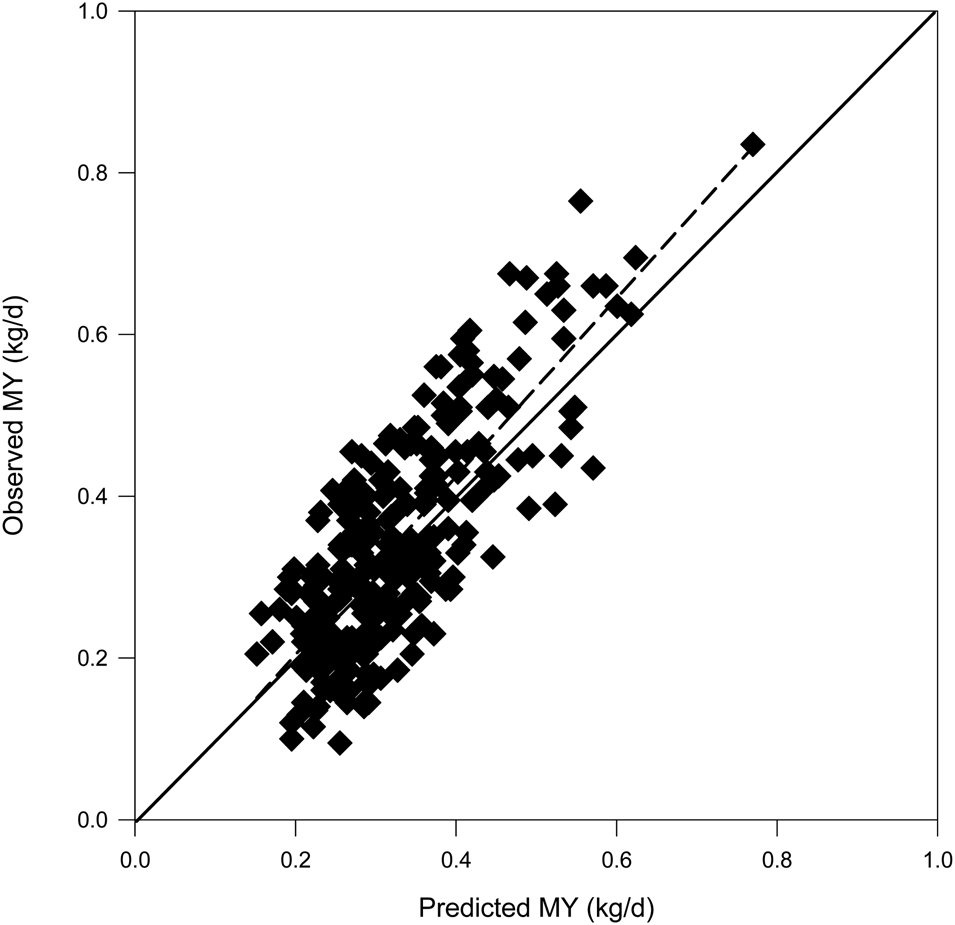
The prediction equations using UVBM presented moderate precision (r 2 = 0.61) but high accuracy (Cb = 0.94, online Supplementary Table S2), confirming a moderate reproducibility index (CCC = 0.73) to predict MY (Fig. 1). Overall, there was high variability in the predicted data (CD = 1.91) by which the equation was evaluated with moderate efficiency of prediction (MEF = 0.59). The main component of MSEP was random error (94.90%). Finally, the null hypothesis (intercept = 0 and slope = 1) was accepted.
Relationship between observed and predicted values of milk yield in Pelibuey ewes using the aluminium foil technique. The solid line is Y = X, and the dotted line is the linear regression.

Discussion
Data are scarce for hair sheep breeds, such as the Pelibuey and their crosses, although milk yields of around 1.1–1.74 kg/d have been reported (Chay-Canul et al., Reference Chay-Canul, Aguilar-Urquizo, Parra-Bracamonte, Piñeiro-Vazquez, Sanginés-García, Magaña-Monforte, García-Herrera and López-Villalobos2019). It has been reported that UV measurements are useful to assess the pattern of mammary development in cows, goats and sheep, because repeated measurements can be made in the same animals over time (Davis, Reference Davis2017). In this sense, several authors have reported various approaches to determinate UV in ruminants; the casting and water displacement methods produced estimates of UV in goats that were highly correlated with udder weight (Linzell, Reference Linzell1966). In cows, UV was assessed by several moulding methods including polyurethane (Knight and Dewhurst, Reference Knight and Dewhurst R1994) and aluminium foil (Magaña-Sevilla and Sandoval-Castro, Reference Magaña-Sevilla and Sandoval-Castro2003), in the latter case to demonstrate a relationship with MY. Alternatively, in cows and small ruminants, the UV can be calculated from udder measurements (height, length, and average width of the udder) and using mathematical models (Emediato et al., Reference Emediato, Siqueira, Stradiotto, Maestá and Fernandes2008). Davis et al. (Reference Davis, Hughson, Farquar and Rattray1980), using a water displacement technique, found a linear relationship between the peak milk and UV post-milking (r = 0.69). In goats, Linzell (Reference Linzell1966) demonstrated high correlation between empty UV and MY.
A previous study reported that UVD was closely associated (r = 0.97, P < 0.01) with MY in cows (Magaña-Sevilla and Sandoval-Castro, Reference Magaña-Sevilla and Sandoval-Castro2003) and here we showed a moderate correlation. A high correlation was found between UVBM and MY (r = 0.78, P < 0.01), so the UVBM was used to predict observed MY. In the selection of variables to predict MY, the UVBM accounted for 62% of the variation (RMSE = 0.09 kg). The equation developed had moderate precision (r 2 = 0.61) and high accuracy (Cb = 0.94), but moderate reproducibility (CCC = 0.73). Results of MEF (MEF = 0.59) indicated moderate concordance between observed and predicted values. The evaluation of the model suggests that the proposed model is able to predict MY in Pelibuey ewes with moderate precision and good accuracy.
In conclusion, udder morphology is a basic factor to consider in the optimization of milk production and milkability in small ruminants, as well as its inclusion in genetic improvement programmes for dairy sheep breeds (Pourlis, Reference Pourlis2020). We have shown that UV obtained by the aluminium foil mould method could be used as a way of predicting MY in Pelibuey ewes, specifically when UV is measured prior to milking. The method was easy to apply and reliable.
Supplementary material
The supplementary material for this article can be found at https://doi.org/10.1017/S002202992000076X.
Acknowledgements
The authors are very grateful for the assistance of engineer Walter Lanz Villegas, who granted access to the facilities of the Centro de Integracion Ovina del Sureste (CIOS). They also thank J. Mezo-Solis, E. Bautista-Diaz, A. Sosa-Solá and R. I. Narváez-Ballesteros for their assistance.