Vocabulary knowledge plays an essential role in reading comprehension and academic success (e.g., Lesaux & Kieffer, Reference Lesaux and Kieffer2010; Ouellette, Reference Ouellette2006; Ouellette & Beers, Reference Ouellette and Beers2010). With students entering upper elementary grades, direct instruction is not sufficient to meet their increasing demand to comprehend unfamiliar words in the text (Nagy et al., Reference Nagy, Anderson and Herman1987), and lexical inferencing has become crucial for vocabulary learning (e.g., Mori & Nagy, Reference Mori and Nagy1999; Shu et al., Reference Shu, Anderson and Zhang1995; Zhang & Koda, Reference Zhang and Koda2012). Lexical inferencing, also known as “word meaning inferencing”, refers to “making informed guesses as to the meaning of a word, in light of all available linguistic cues in combination with the learners’ general knowledge of the world, her awareness of context and her relevant linguistic knowledge” (Hasstrup, Reference Haastrup1991, p. 40).
Two strategies have shown to be important to lexical inferencing: context strategy and internal word strategy (morphology strategy). Natural reading is understood as an important source of vocabulary growth because students can interpret the meanings of unfamiliar words from context (Mori & Nagy, Reference Mori and Nagy1999; Nagy et al., Reference Nagy, Anderson and Herman1987; Shu et al., Reference Shu, Anderson and Zhang1995; Zhang & Koda, Reference Zhang and Koda2012). To utilize contextual information, readers need to comprehend the surrounding context and check the guess of word meanings from context (Nassaji, Reference Nassaji2003; Raudszus et al., Reference Raudszus, Segers and Verhoeven2021). Another strategy is inferring the meanings of unfamiliar words by analyzing the morphological structure of words (Hasstrup, Reference Haastrup1991). To use the morphological information, readers need to be aware of constituent morphemes (morphological awareness) and process morphemes (morphological analysis) to understand word meanings (Goodwin & Ahn, Reference Goodwin and Ahn2013; Zhang et al., Reference Zhang, Lin, Liu and Nagy2020). For example, when students encounter an unfamiliar word disagreement, they can decompose the word into three familiar morphemes: the prefix dis-, the stem agree, and the suffix -ment. With morpheme knowledge, students will be able to guess the meaning of the word from known morphemes.
However, the role of these two lexical inferencing strategies has often been investigated separately in reading literature (e.g., Crosson & McKeown; Ke & Koda, Reference Ke and Koda2019; Zhang et al., Reference Zhang, Lin, Liu and Nagy2020; Zhang & Koda, Reference Zhang and Koda2012). A few studies have suggested that two strategies provide different sources of information, and readers who can integrate multiple sources of information make more correct guesses about word meanings in adult learners (Fang & Jiang, Reference Fang and Jiang2012; Hamada, Reference Hamada2014; Mori & Nagy, Reference Mori and Nagy1999; Xu & Zhang, Reference Xu and Zhang2020), but how children integrate lexical inferencing strategies is less understood. Most previous research on incidental word learning from context involves morphologically complex words in passage or sentence reading, but provides little insights into how children use different lexical inferencing strategies (i.e., morphology, context, or integrated) and how the word or context characteristics and student characteristics influence the success rate of lexical inferencing. This kind of research is even more scarce in Chinese, a nonalphabetic language.
In contrast to English, Chinese is a morphosyllabic language. The basic graphic unit in Chinese is the character that represents a morpheme. Word formation is different in English and Chinese. Derivational words are most productive in English, whereas Chinese words are formed mostly by compounding two or more morphemes. According to Chen (Reference Chen2019), about 70–80% of Chinese words are compound words. Therefore, the ability to infer the meanings of compound words plays an important role in learning Chinese words. For example, in Chinese, the compound word 电视 (television) is composed of 电(tele) and 视(vision). If readers understand the meaning of the individual characters, the meaning of the compound word can be easily inferred. In a cross-language study of incidental word learning in Chinese and American children (Shu et al., Reference Shu, Anderson and Zhang1995), the results suggested that similar to English-speaking children, Chinese students in third and fifth grades could figure out the meanings of unfamiliar words during natural reading; however, the research offers little insight into the specific lexical inferencing strategies. Other studies have investigated students’ ability to infer the meanings of unfamiliar words presented in isolation. In another cross-language study of morphological awareness in Chinese and American second, fourth and sixth graders, Ku and Anderson (Reference Ku and Anderson2003) found that students with higher reading skills could better select the most appropriate interpretations of low-frequency derivatives and compounds composed of high-frequency parts, indicating the use of morphological strategy in lexical inferencing when words are presented in isolation without context. Despite these findings, the likelihood of using context strategy, morphology strategy, or integration strategy in lexical inferencing has been less explored in the literature. Furthermore, less is understood about whether the word presentation condition (i.e., whether the unfamiliar word is presented with or without context) affects the likelihood of using a particular lexical inferencing strategy. The current study sought to address this research gap.
Another purpose of this study is to investigate how individual differences in vocabulary and reading comprehension contribute to lexical inferencing ability. Previous research has indicated the close association between lexical inferencing and vocabulary knowledge or reading comprehension (e.g., Nagy et al., Reference Nagy, Anderson and Herman1987; Raudszus et al., Reference Raudszus, Segers and Verhoeven2021; Zhang & Koda, Reference Zhang and Koda2012; Zhang & Shulley, Reference Zhang and Shulley2017); however, lexical inferencing has often been narrowly operationalized as morphological analysis skills, the ability to decompose complex words into morphemes to derive word meanings, and context and integration strategies are overlooked in prior studies. For example, when lexical inferencing was measured by the ability to interpret word meanings without context, Zhang and Koda (Reference Zhang and Koda2012) found the direct and indirect contribution of lexical inferencing ability to reading comprehension among adult L2 English learners above and beyond vocabulary knowledge. In other studies, morphologically complex words are embedded in neutral sentence context so that students are forced to use morphological analysis strategy. For example, Zhang and Shulley (Reference Zhang and Shulley2017) suggested that poor comprehenders were less likely to use morphological analysis to determine the meanings of unfamiliar words while reading neutral sentences. Taken together, previous studies have not differentiated the use of different lexical inferencing strategies (morphology strategy, context strategy, and integration strategy).
The current study aimed to better understand the precursors of successful use of different lexical inferencing strategies. The connection between vocabulary/reading comprehension and lexical inferencing can be well supported by the word-to-text integration in the reading systems framework proposed by Perfetti and Stafura (Reference Perfetti and Stafura2014). According to this framework, readers with a high level of decoding, vocabulary, and grammar knowledge are better able to infer the meaning of unknown words than readers with lower language and reading proficiency. The available evidence suggests the role of vocabulary and reading comprehension skills in the use of context strategy and morphology strategy to infer the meanings of unfamiliar words presented in text context (Raudszus et al., Reference Raudszus, Segers and Verhoeven2021; Zhang & Koda, Reference Zhang and Koda2018). Understanding the word presentation conditions and linguistic determinants of lexical inferencing strategies will help to identify sources of reading comprehension difficulties and implications for reading instruction.
In the next sections, we will review the literature on lexical inferencing based on morphological cues, context cues, integrated strategy, and how individual differences in vocabulary and reading comprehension influence each type of lexical inferencing strategy.
Lexical inferencing based on morphological cues
A growing body of research points to the crucial role of morphological awareness in inferring unfamiliar word meanings in both English and Chinese (e.g., Crosson & McKeown, Reference Crosson and McKeown2016; Dressler et al., Reference Dressler, Carlo, Snow, August and White2011; Ke & Koda, Reference Ke and Koda2019; McCutchen & Logan, Reference McCutchen and Logan2011; Rams et al., Reference Ram, Marinellie, Benigno and McCarthy2013; Zhang et al., Reference Zhang, Lin, Liu and Nagy2020; Zhang & Koda, Reference Zhang and Koda2018). Recent research suggests that when sentences are neutral and do not provide salient semantic support for the unfamiliar words, students can use morphological cues to infer the meanings of morphologically complex words. Specifically, the meanings of morphologically complex words with morphological cues (e.g., horrific) are better accessed than simple words without morphological cues (e.g., vile) for both native English speakers (McCutchen & Logan, Reference McCutchen and Logan2011) and English language learners (Zhang et al., Reference Zhang, Lin, Liu and Nagy2020). In a dynamic assessment task (Rams et al., Reference Ram, Marinellie, Benigno and McCarthy2013), when provided with graduated prompts for morphological cues, English-speaking students as early as Grade 3 could use morphology strategy to explain word meanings. Furthermore, some intervention studies have shown that explicit instruction of morphological awareness is beneficial for word meaning inferencing (e.g., Bowers & Kirby, Reference Bowers and Kirby2010; Carlisle, Reference Carlisle2000; Dressler et al., Reference Dressler, Carlo, Snow, August and White2011).
Studies in Chinese reading have also demonstrated a significant role of morphological awareness in inferring the meanings of words presented either in isolation (Zhang & Koda Reference Zhang and Koda2018) or within short sentences in adult Chinese L2 learners (Ke & Koda, Reference Ke and Koda2019; Zhang, Reference Zhang2015) and school-age children (Ku & Anderson, Reference Ku and Anderson2003). Although these studies have revealed a significant contribution of morphological awareness to lexical inferencing ability, lexical inferencing was measured differently across studies and the specific strategies students used to infer the unfamiliar word meanings were not clearly identified. An increasing number of studies have indicated that morphological information alone is not sufficient to make successful lexical inferencing. The use of morphological strategy in lexical inferencing is influenced by word semantical transparency (Chen Reference Chen2019; Chen et al., Reference Chen, Koda and Wiener2020). Word semantic transparency refers to the extent to which the mean of the compound word can be inferred from an individual morpheme (Chen, Reference Chen2019). For semitransparent words where the morpheme only provides the partial meaning of the overall words’ meaning, for instance, 鼻祖(originator) consists of 鼻(nose) and 祖(ancestor), compared to transparent words such as 马车(horsecar) consists of 马 (horse) and 车(car), and opaque words such as 东西 (thing, stuff) where neither of the meaning 东(north) and 西(west) is related to the meaning of the compound word, it is difficult to interpret their meanings without the knowledge of their associations with other words and contextual information. In Chen’s (Reference Chen2019) study with adult Chinese L2 learners, lexical inferencing skills were measured by interpreting meanings of three types of words without context: transparent words, semitransparent words, and opaque words. The findings showed that morphological awareness made a significant contribution to understanding meanings of semantic transparent and semi-transparent words, whereas no contribution was found for semantic opaque words. Given the ineffectiveness of morphological cues in learning opaque words, and the meanings of transparent words can be easily obtained from morphological cues, in this study, we selected only semitransparent words as our target words. Since semitransparent words provide the partial meaning of the word, it will help us distinguish the role of morphology and context.
In this study, we aimed to investigate to what extent word and context presentation versus absence conditions, student vocabulary and reading comprehension influence student correct use of morphology strategy in lexical inferencing. Prior research has studied the relationship between morphology-based lexical inferencing strategies (i.e., morphological awareness, morphological analysis) and reading comprehension (e.g., MacKay et al., Reference MacKay, Levesque and Deacon2017; McCutchen & Logan, Reference McCutchen and Logan2011). There is evidence that vocabulary and reading comprehension are precursors of lexical inferencing in both English L1 and L2 learners (e.g., Deacon et al., Reference Deacon, Tong and Francis2017; MacKay et al., Reference MacKay, Levesque and Deacon2017; McCutchen & Logan, Reference McCutchen and Logan2011; Zhang & Shulley, Reference Zhang and Shulley2017). The precursors of lexical inferencing have rarely been examined in Chinese learners. Given the strong relationship between morphological awareness, vocabulary knowledge, lexical inferencing, and reading comprehension (Li et al., Reference Li, Dronjic, Chen, Li, Cheng and Wu2017; Ku & Anderson, Reference Ku and Anderson2003; Tong et al., Reference Tong, McBride, Shu and Ho2018), it stands to reason that vocabulary knowledge and reading comprehension influence lexical inferencing strategies among Chinese native speakers.
Lexical inferencing based on contextual cues
Incidental word learning from context has been widely documented in the literature, indicating that students can acquire the meanings of new words through reading context (Jenkins et al., Reference Jenkins, Stein and Wysocki1984; Nagy et al., Reference Nagy, Anderson and Herman1987; Nassaji, Reference Nassaji2003; Shu et al., Reference Shu, Anderson and Zhang1995). For example, Nagy et al. (Reference Nagy, Anderson and Herman1987) examined lexical inferencing in English-speaking children in grades 3, 5, and 7. Small vocabulary gains were found after students read passages from their grade-level books. In a cross-language study of incidental word learning, Shu et al. (Reference Shu, Anderson and Zhang1995) asked both Chinese and American children to read stories and checked their understanding of target words. The findings suggested both groups of students were able to learn new words from story reading regardless of their reading abilities. Although students demonstrated vocabulary growth through natural reading in those studies, the strategies used to infer the meanings of unfamiliar words were not investigated explicitly. Since students were presented with both words and context, it is difficult to tease apart the role of morphology and context in interpreting word meanings. Whether learning from context serves as a primary source of vocabulary growth is not without debate. Some researchers posit that using contextual information alone may not be reliable and vocabulary is best acquired through explicit instruction (Beck et al., Reference Beck, McKeown and Kucan2002). Context provides broad clues to the meanings that fit the context, but not necessarily the exact meanings of target words (Xu & Zhang, Reference Xu and Zhang2020), especially for a neutral sentence where limited semantic support is available.
Regarding the precursors of lexical inferencing via context strategy, empirical research evidence is available indicating the role of reading skills in children’s ability to use contextual cues to infer the meaning of words encountered in texts. Cain et al. (Reference Cain, Oakhill and Lemmon2004) studied the ability to use contextual information in stories to infer the meanings of novel vocabulary encountered in narrative contexts by 9- to 10-year-olds with good and poor reading comprehension. Children with poor reading comprehension were less likely to use contextual information in the text to define the meanings of nonwords. In a recent eye-tracking study, Joseph and Nation (Reference Joseph and Nation2018) found that 10- to 11-year-olds with better comprehension skills were better able to learn about the meaning of novel verbs from sentence contexts through repeated exposure. Similarly, Ricketts et al. (Reference Ricketts, Bishop, Pimperton and Nation2011) found that 7- to 8-year-old children’s ability to infer the meaning of novel words encountered in informative surrounding context was predicted by their oral vocabulary and text reading accuracy. These studies have provided direct evidence that context strategy use is related to reading comprehension skills.
Lexical inferencing based on integration of morphological and contextual cues
Limited research is available regarding the integration of morphological and contextual sources in lexical inferencing (Baumann et al., Reference Baumann, Edwards, Font, Tereshinski, Kame’enui and Olejnik2002; Brusnighan & Folk, Reference Brusnighan and Folk2012; Hamada, Reference Hamada2014; Mori & Nagy, Reference Mori and Nagy1999; Raudszus et al., Reference Raudszus, Segers and Verhoeven2021). Mori and Nagy (Reference Mori and Nagy1999) were the first to examine the integration strategy in interpreting Japanese words. In their study, adult Japanese L2 learners were asked to choose meanings of unfamiliar kanji compound words in three conditions: Word Only, Context Only, and Both Word and Context. In the Word Only condition, students were presented with the target word without context (e.g., 月食, a lunar eclipse). In the Context Only condition, students were presented with a sentence without target word (e.g., 今日の夜、_________が ある よ。よく見えるように山の上に行こう。Tonight we will have ______. Let’s go to the top of the hill so we can see well). In the Both Word and Context condition, students were presented with both target words and sentences (e.g., 今日の夜、 月食が ある よ。よく見えるように山の上に行こう。Tonight we will have a lunar eclipse. Let’s go to the top of the hill so we can see well). Four types of English answers were also provided: (a) Kanji Distracter, an answer that derived from morphological cues but did not fit the context (e.g., a monthly meal ticket); (b) Context Distracter, an answer that fit into the context but was not related to morphological cues (e.g., fireworks); (c) Integrated Answer, an answer that matched both the meaning of component morphemes and the context (e.g., a lunar eclipse); (d) Anomalous Answer, an answer that was unrelated to both morphological and contextual cues (e.g. a traffic light). The study found that learners who used an integration strategy (i.e., combining morphological information and contextual information) were more likely to acquire accurate word meanings, and the use of integration strategy was associated with reading proficiency.
Hamada (Reference Hamada2014) confirmed Mori and Nagy’s (Reference Mori and Nagy1999) findings and further explored the integration strategy in English L2 learners. A total of 107 adult English L2 learners were categorized into four proficiency groups and were asked to guess pseudo compound word meanings in two conditions: Morphology Reliable condition, where morphological information provided by target words and context were consistent. Morphology Unreliable condition, where morphology information of target words had no relation to context. Significant group differences were found in Morphology unreliable condition, indicating students’ choice of strategies was influenced by their reading proficiency. They suggested that beginning learners relied mainly on morphological information, whereas high, intermediate, and advanced learners were more likely to integrate contextual information to extract word meanings.
To date, only a few studies have made attempts to investigate the use of integrated lexical inferencing strategies among younger learners. Baumann et al. (Reference Baumann, Edwards, Font, Tereshinski, Kame’enui and Olejnik2002) implemented an intervention of combined morphemic analysis and contextual analysis with English-speaking fifth graders. Students were randomly assigned to a morphemic-only, context-only, or combined morphemic-context experimental group or to a control group. After 50-minute lessons, students were tested on meanings recall of taught words and untaught (transfer) words. Results showed that the combined morphemic and contextual analysis instruction was as effective as morphemic-only or context-only instruction provided separately. The nonaddictive effect of combined morphemic and contextual analysis may be explained by the superfluous context when semantically transparent words appear in rich context. Similarly, in a study with third- and fifth-grade English-speaking children (Ram et al., Reference Ram, Marinellie, Benigno and McCarthy2013), only a small number of fifth-graders were able to combine morphological analysis with contextual information to interpret word meanings, and none of the third graders were able to use the integration strategy.
In a recent study, Raudszus et al. (Reference Raudszus, Segers and Verhoeven2021) compared Dutch as L1 or L2 speakers’ understanding of pseudowords in four conditions: (1) words without morphological cues only; (2) words without morphological cues in a meaningful sentence; (3) words with morphological cues only; (4) words with morphological cues in a meaningful sentence. The findings showed that children were able to use either morphological cues or contextual cues when only one source was available. When both morphological and contextual information were available, L1 and L2 learners in Grade 5 demonstrated the ability to integrate sources. Raudszus et al. (Reference Raudszus, Segers and Verhoeven2021) also suggested that contextual inferencing is a high-order ability, and basic reading comprehension and inference skills are necessary for learners to take advantage of contextual information, given the evidence that contextual information was less used by L2 learners than L1 learners. Results also indicated that to access morphological information, decoding is crucial, whereas, for contextual inferencing, a minimum of linguistic competence is needed, which makes it more challenging for L2 readers.
The present study
To our knowledge, no studies have examined different lexical inferencing strategies among native Chinese speakers and little is known about the linguistic precursors of lexical inference strategy used in Chinese children. Given the sharp contrast between alphabetic language and the morphosyllabic nature of Chinese, it is not reasonable to generalize the results from reading research conducted in alphabetic languages to Chinese. The current study aimed to separate three lexical inference strategies and assess how vocabulary and reading comprehension contribute to the successful use of each lexical inference strategy: morphology, context, and integration in Chinese fourth graders. Fourth graders were targeted because they have acquired basic decoding skills and upper elementary school is a critical stage of vocabulary and reading development and morphologically complex words are abundant in increasingly challenging texts.
Going beyond previous research, the present study aimed to investigate strategies used in inferring unfamiliar Chinese compound words by manipulating the availability of word and context information to students. Semitransparent words and neutral sentences were selected to ensure that the meaning of the word cannot be easily inferred by using a single source of information. Students need to integrate information to understand word meanings. The present study was guided by the following research questions:
-
(1) To what extent do Chinese fourth graders use multiple lexical inferencing strategies (morphology, context, and integration) to infer the meanings of unfamiliar words when exposed to word alone, context alone, and both word and contextual information?
-
(2) To what extent do item characteristics (word and context present vs. absence conditions) and student-level characteristics (vocabulary and reading comprehension) influence students’ successful use of morphological and contextual information in lexical inferencing? Are there any cross-level interactions?
Based on prior literature, we hypothesized that the availability of sources of information and individual differences in vocabulary knowledge and reading comprehension would affect the likelihood of using context-based or morpheme-based lexical inferencing strategy in Chinese fourth graders.
Method
Participants
A total of 104 students in fourth grade (43 boys and 61 girls, M age = 10.97 years, SD = 0.46) from one elementary school in Beijing participated in the study. They all spoke Mandarin as their native language. As indicated by their teachers and school records, these children were normally developing children without documented mental health issues or learning disabilities.
Measures
All participants completed a lexical inferencing experiment and two group tasks: vocabulary knowledge and reading comprehension.
Lexical inferencing experiment
The lexical inferencing experiment was adapted from Mori and Nagy (Reference Mori and Nagy1999) to investigate strategies used by students to infer the meanings of unfamiliar words. Each student was asked to complete a multiple-choice task to infer the meanings of 36 unfamiliar semi-transparent compound words presented in three conditions: Word Only, Context Only, Both Word, and Context. One point was awarded for one question. The maximum score of the task was 36.
Thirty-six unfamiliar two-character compound words with familiar characters were carefully selected by researchers. Because there are no available Chinese corpora of children, the familiarity of the individual characters and the compound words was determined based on Chinese textbooks and corpus-based Age of Acquisition (AOA) and frequency information. Given that a few target compound words contained the same characters, we had 68 characters in total, and all of them were taught before the third grade according to Chinese textbooks. The average grade of these characters appearing in textbooks was 1.41 (the first semester of the second grade, SD = 0.88); therefore, those characters were considered familiar characters.
The familiarity of the target compound words was further confirmed by examining their AOA and frequencies information. Twelve of the target words’ AOA information was available in the corpus (Xu et al., Reference Xu, Li and Guo2021), which contains 19,716 simple two-character words. The mean was 12.66-year-old (SD=1.91), whereas the average age of our participants was 10.97. Additionally, we categorized words into four levels according to the Word Frequency List in Compulsory Education (Department of Language Information Management of Ministry of Education of the PRC, 2019), which includes 15,115 commonly and frequently used words, and Compulsory Education Chinese Curriculum Standards: 2021 version (Ministry of Education of the PRC, 2021). Level 1 corresponded with Grades 1 and 2, level 2 corresponded with Grades 3 and 4, level 3 corresponded with Grades 5 and 6, and level four corresponded with Grades 7–9. Results showed that four of the target words were in level 3 (corresponds with Grade 5-6), eight were in level 4 (corresponds with Grades 7–9), and the rest of 24 words were not included in the word list. Since our participants were fourth graders, the 36 target words were considered unfamiliar words.
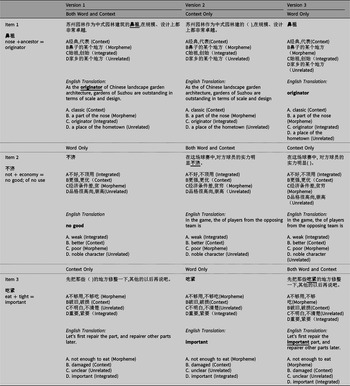
For each compound word, two or three sentences were developed. Sentences were adapted from Corpus Online (http://corpus.zhonghuayuwen.org/) developed by the Institute of Applied Linguististics Ministry of Education and Peking University CCL Corpus (http://ccl.pku.edu.cn:8080/ccl_corpus/) developed by the Center for Chinese Linguistics at Peking University and evaluated by four psychology-majored undergraduate students to make sure they were appropriate and comprehensive to the participants. Because the task aimed to investigate students’ ability to use multiple strategies to interpret the meaning of unknown words, sentences were carefully prepared to provide only a general sense of the meaning of the targeted words, allowing more than one word to fit into the sentence (e.g., 苏州园林作为中式园林建筑的鼻祖 , 在规模、设计上都非常卓越。As the originator of Chinese landscape garden architecture, gardens of Suzhou are outstanding in terms of scale and design.). Four undergraduate students reviewed the sentences without the target words and were asked to fill in the blank with a word that best fits into the sentence. The sentences were not selected when students provided target words correctly to control the contextural support. A total of 36 sentences were included, one for each target word.
Student performance in three conditions was compared: (a) Both Word and Context condition where students saw target words in sentences; 苏州园林作为中式园林建筑的鼻祖, 在规模、设计上都非常卓越; (b) Context Only condition where students saw sentences without target words; 苏州园林作为中式园林建筑的 ( ),在规模、设计上都非常卓越; and (c) Word Only condition in which target words were presented without sentences; 鼻祖.
The same four types of answers were provided for each condition. For the target word 鼻祖 originator, one answer choice fit into the context but was not related to the morpheme meaning of the target words (Context Answer, e.g., 经典 classic), one was related to the morpheme meaning of the target words but not fit into the context (Morpheme Answer, e.g., 鼻子的某个地方 a part of the nose), one was congruent with both context and the meaning of the target words (Integration Answer, e.g., 始祖 originator), and one was unrelated distractors (Unrelated Answer, e.g., 家乡的某个地方 a place of the hometown). To ensure the Integration answers that were consistent with the meaning of the target words also matched the context, 33 undergraduate students rated the appropriateness of the Integration answers and the sentences on a 5-point scale, where 1 = very bad and 5 = very good. The sentences for which the majority of the students chose Integration answers, and the appropriateness was above 3 were selected. A total of 36 words and sentences were finally selected for the lexical inferencing experiment. The experiment used a within-item and within-subject design. Three versions of the task were counterbalanced across three conditions with all participants seeing 12 items in each condition, 36 items in total. The task design and sample items are shown in Table 1.
Sample Items and Design of Lexical Inferencing Experiment

Vocabulary knowledge
Children heard a word presented only orally twice and were asked to identify the correct meaning out of four choices. For instance, 成全 (fulfill) was followed by four choices: (a) 成就, 获得成功 (achievement, be successful), (b) 逐渐变得完整 (gradually become complete), (c) 全部的, 所有的 (everything), and (d) 帮助别人实现愿望 (help others fulfill their dreams). The choices were presented both orally and visually. The task consisted of 1 practice item and 40 formal items with graded difficulty. One point was given to the correct answer, and the max score was 40. Internal consistency reliability was .88.
Reading comprehension
There were 3 passages and 10 multiple-choice items for each passage (Su et al., Reference Su, Peyre, Song, McBride, Tardif, Li, Zhang, Liang, Zhang, Ramus and Shu2017). Children were asked to read these passages silently and answer the following multiple-choice questions. The number of characters for each passage was 419, 375, and 392, respectively. The max score was 30. Internal consistency reliability was .79.
Procedure
The lexical inferencing experiment and measures of vocabulary and reading comprehension were administrated to participants in a group setting. In the first week, students were randomly assigned one version of the lexical inferencing experiment. During the experiment, a multiple-choice test was administrated to students. They were instructed to read the sentences or words and select the most plausible answer from four choices. The selected answer should fit best in the sentence context in the Context Only condition or provide the most plausible meaning of the target word in the other two conditions. The experiment lasted about 40 minutes. Vocabulary knowledge and reading comprehension were tested in the second week, which lasted 15 minutes and 40 minutes, respectively.
Results
Use of lexical inferencing strategies
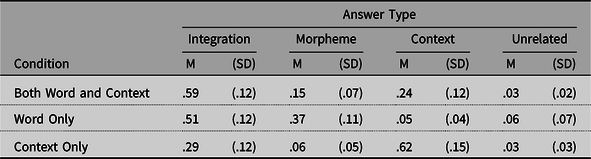
Table 2 presents descriptive statistics of the proportion of four answer types in each condition. A one-way analysis of variance (ANOVA) indicated a statistically significant effect of Condition on the proportion of Integrated answers chosen by students, F (2, 206) = 119.97, p < .001. Tukey–Kramer honestly significant difference test confirmed that the mean proportion of Integrated answers was significantly higher in Both Word and Context condition (.59) than Word Only condition (.51) and Context Only condition (.29), ps < .05, suggesting that students were able to combine morphology and contextual information to infer meanings of words.
Means (SD) of Proportions of the Four Answer Types Across Three Conditions

In the Word Only condition, both the Integrated answers and the Morpheme answers were morphologically correct. The proportion of the two answers was .88, larger than .74 in the Both Word and Context condition, and .35 in the Context Only condition, indicating students tended to use morphology information to determine word meanings when contextual information was absent. Similarly, in Context Only condition, both the Integrated answers and the Context answers were contextually correct. The proportion of the two answers was .91, larger than .83 in the Both Word and Context condition, and .56 in the Word Only condition, suggesting that students relied on context information when word information was not provided.
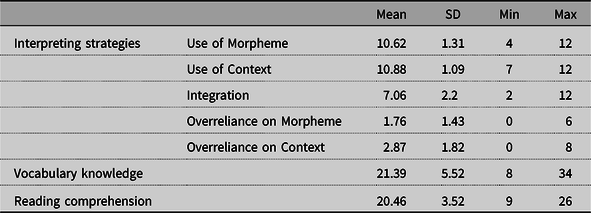
According to students’ selected answers presented in Table 2, five types of lexical inferencing strategies were identified based on Mori and Nagy (Reference Mori and Nagy1999): (a) Use of Morpheme, the number of Integrated answers, and Morpheme answers (e.g., originator and a part of the nose) in the Word Only condition. The variable stands for students’ ability to obtain word meanings from morphological cues; (b) Use of Context, the number of Integrated answers and Context answers (e.g., originator and classic) in the Context Only condition. The variable shows students’ ability to obtain word meanings from contextual cues; (c) Integration, the number of Integrated answers (e.g., originator) in the Both Word and Context condition. The variable represents students’ ability to integrate multiple sources of information; (d) Overreliance on Morpheme, the number of Morpheme answers (e.g., a part of the nose) in the Both Word and Context condition. The variable represents that students over-rely on morphological information and are unable to make use of contextual information to interpret word meanings. Although both sources are presented in the condition, students’ choices are based only on morphological information; and (e) Overreliance on Context, the number of Context answers (e.g., classic) in the Both Word and Context condition. The variable shows students’ insensitivity to morphological cues. When both sources are available, students only make use of contextual cues. Both Overreliance on Morpheme strategy and Overreliance on Context strategy represent that students are not able to integrate multiple sources of information in deriving words meanings, and the two strategies will prevent students from making correct guesses of word meanings during reading. The descriptive statistics of students’ use of lexical inferencing strategies, vocabulary, and reading comprehension are shown in Table 3.
Descriptive Statistics of Lexical Inferencing Strategies, Vocabulary and Reading Comprehension

Note. (1) Use of Morpheme: the number of Morpheme Answer and Integrated Answer in the Word Only condition; (2) Use of Context: the number of Integrated Answer and Context Answer in the Context Only condition; (3) Integration: the number of Integrated Answer in the Both Word and Context condition; (4) Overreliance on Morpheme: the number of Context Answer in the Both Word and Context condition; (5) Overreliance on Context: the number of Context Answer in the Both Word and Context condition.
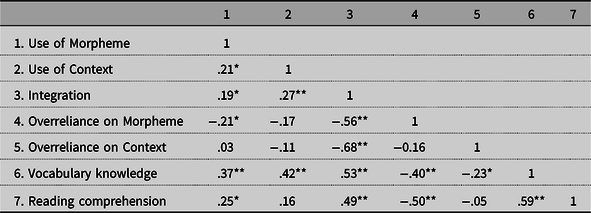
Table 4 presents bivariate correlations between the five lexical inferencing strategies and vocabulary knowledge and reading comprehension. The results showed that Use of Morpheme was significantly correlated with Use of Context (r = .21, p < .05), suggesting students who were able to make use of morphology information in the Word Only condition tended to use contextual information more in the Context Only condition. Significant correlations between Integration and Use of Morpheme (r = .19, p < .05) and Use of Context (r = .27, p < .01) were observed, indicating students who were able to combine two sources of information were sensitive to contextual and morphology cues. However, Integration strategy was negatively correlated with Overreliance on Morpheme strategy and Overreliance on Context strategy, indicating that overuse of morphology or contextual strategy impeded integrating information while reading.
Pearson Correlations Among All Variables

Note. *p < .05; **p < .01
As shown in Table 4, vocabulary knowledge was positively associated with Use of Morpheme (r = .37, p < .01), Use of Context (r = .42, p < .01) and Integration (r = .53, p < .01), whereas it was negatively associated with Overreliance on Morpheme (r = −.40, p < .01) and Overreliance on Context (r = −.23, p < .05). Our analysis also observed that reading comprehension was positively associated with Use of Morpheme (r = .25, p < .05) and Integration (r = .49, p < .01), suggesting students who had good reading comprehension skills were more likely to use morphological information and to integrate information. However, reading comprehension was not correlated to Use of Context (r = .16, p > .05). In addition, reading comprehension was negatively associated with Overreliance on morpheme (r = −.50, p < .01), whereas it was not correlated with Overreliance on context (r = −.05, p > .05).
Predicting the use of morpheme-based and context-based lexical inference: Precursors and condition effects
Results from research question one (see Table 2) suggested that morphology and context provided different sources of information, and successful use of both cues was essential for Integration strategy. We then conducted generalized linear mixed effects (GLMEs) models to further understand factors that influenced the use of morphological and contextual information, in particular, lexical cue conditions (word and context present vs. absence conditions) and individual differences in vocabulary and reading comprehension. Two item-level outcome variables were the use of morphological information represented by derived-morphological correctness and the use of contextual information represented by contextual correctness.Footnote 1 Morphological correctness was coded as 1 if Morpheme Answer or Integration Answer was chosen, and 0 otherwise. Contextual correctness was coded as 1 if Context Answer or Integration Answer was chosen, and 0 otherwise. The item-level predictors were condition of context (present vs. absent) and condition of word (present vs. absent). Both Word and Context condition was coded as context present and word present (1,1);Context Only condition was coded as context present and word absent (1,0); Word Only condition was coded as context absent and word present (0,1). The person-level predictors were vocabulary and reading comprehension.
All models in this study were fit with the lme4 package (version 1.1–27.1; Bates et al., Reference Bates, Maechler, Bolker, Walker, Christensen, Singmann and Green2021) in R (version 4.1.1; R Development Core Team, 2016). In model summaries, we reported estimated coefficients (and SEs) of hypothesized effects along with p values obtained using the lmerTest package (version 3.1–3; Kuznetsova et al., Reference Kuznetsova, Brockhoff and Christensen2020). In all models, the fixed effects were condition of context (present vs. absent), condition of word (present vs. absent), vocabulary knowledge, and reading comprehension, and the random effects were participant ID and item ID. We were interested in the interaction between word and context conditions (present vs. absent), and students’ vocabulary knowledge and reading comprehension. To avoid multicollinearity, all variables were centralized before analysis. Significant interaction effects were plotted by the ggplot2 package (version 3.3.5; Wickham et al., Reference Wickham, Chang, Henry, Pedersen, Takahashi, Wilke and Dunnington2021).
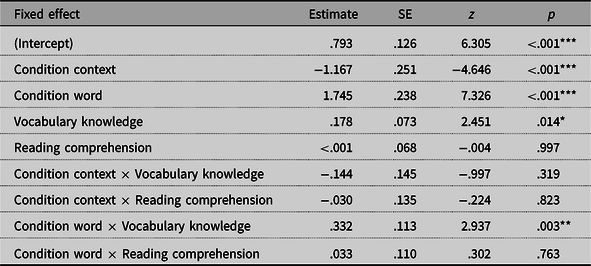
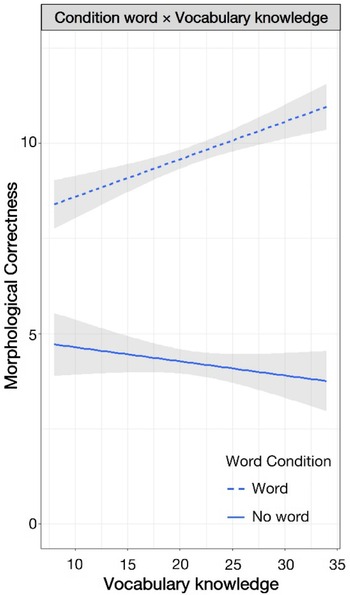
We constructed the first mixed-effects model with morphological correctness as the outcome variable representing students’ use of morphological cues. We examined the fixed effects of lexical cue condition (word and context present vs. absent), as well as interactions between conditions and vocabulary knowledge and reading comprehension. All fixed effects estimates for this model are illustrated in Table 5. There was a significant positive effect of word availability, OR = 1.75, SE = .24, p < .001, and a significant negative effect of context availability, OR = −1.17, SE = .25, p < .001. A significant interaction between word availability and vocabulary knowledge was observed, OR = 0.33, SE = .11, p < .01. The effect of word availability was larger for the students with higher vocabulary knowledge (see Figure 1).
Fixed Effect Coefficients for the Mixed Model with Morphological Correctness of the Chosen Answer as Outcome Variable

Note. Both Morpheme Anwer and Integrated Answer were coded as Morphological Correctness Answer.
Interaction effect of word availability and vocabulary knowledge on use of morphological cues.

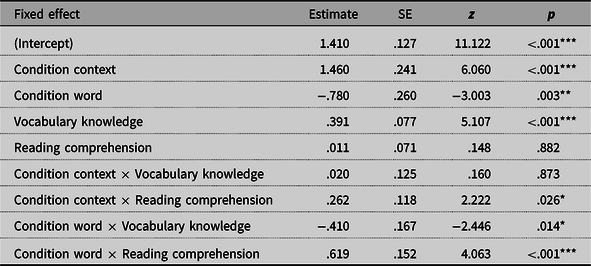
The second mixed-effects model was conducted with contextual correctness as the outcome variable representing students’ use of context strategy. All fixed effects estimates for this model are illustrated in Table 6. There was a significant positive effect of context availability, OR = 1.46, SE = .24, p < .001. The effect of word availability was negatively significant, OR = −.78, SE = .26, p < .01.
Fixed Effect Coefficients for the Mixed Model with Contextual Correctness of the Chosen Answer as Outcome Variable

Note. Both Context Anwer and Integrated Answer were coded as Contextual Correctness Answer.
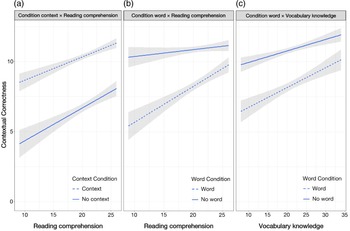
There were three significant interactions between conditions and precursor skills: context availability and reading comprehension, OR = .26, SE = .12, p < .05, word availability and vocabulary knowledge, OR = −.41, SE = .17, p < .05, and word availability and reading comprehension, OR = .62, SE = .15, p = <.001. Figure 2 (a) shows the interaction between context availability and reading comprehension. The effect of reading comprehension was larger when context was not present, compared to the present context condition. Figure 2 (b) illustrates the interaction between word availability and reading comprehension. In the presence of words, students with higher reading comprehension were more likely to use contextual information than students with lower reading comprehension. Figure 2 (c) illustrates the interaction between word availability and vocabulary knowledge. In the presence of words, the effect of vocabulary knowledge was larger, and students with higher vocabulary knowledge were more likely to choose the contextually correct answer than students with lower vocabulary knowledge.
Interaction effect of word availability and vocabulary knowledge on use of contextual cues.

Discussion
In this study, we sought to understand how Chinese children make use of morphological information and contextual information to infer meanings of unfamiliar compound words and how these processes are related to linguistic precursors (i.e., vocabulary and reading comprehension) and the presentation condition of target words (Word Only, Context Only, and Both Word and Context). Most of the previous studies did not distinguish the role of morphology and context in lexical inferencing (McCutchen & Logan, Reference McCutchen and Logan2011; Shu et al., Reference Shu, Anderson and Zhang1995; Zhang & Shulley, Reference Zhang and Shulley2017). By manipulating the lexical cue conditions (Word Only vs. Context Only vs. Both Word and Context), our findings revealed that students used different strategies to infer the meanings of unfamiliar words, and the likelihood of using a particular lexical inferencing strategy was not only influenced by the availability of sources of information, but also by vocabulary knowledge and reading comprehension of students.
First, the results from the lexical inferencing experiment showed that Chinese fourth graders were able to use Integration strategy to infer word meanings when both morphological information and contextual information were presented, and their chances of obtaining the correct meaning of words increased considerably compared to the Word or Context alone conditions. The finding is consistent with previous studies on adult Japanese L2 learners (Mori & Nagy, Reference Mori and Nagy1999), and Chinese L2 learners (Fang & Jiang, Reference Fang and Jiang2012). The current study extended the previous studies by demonstrating that Chinese learners in Grade 4, particularly those with higher reading comprehension, can integrate multiple sources of information to derive the meanings of unfamiliar words.
Second, the current findings underscored the importance of vocabulary knowledge and reading comprehension in predicting lexical inferencing. The correlation results indicated that vocabulary knowledge was positively correlated with Use of Morpheme, Use of Context, and Integration strategies, whereas it was negatively correlated with Overreliance on Morphology and Overreliance on Context strategies. Our research confirmed findings from the previous studies that children with better vocabulary knowledge were more aware of word-internal information and were able to take advantage of the information in word parts to interpret word meanings (Ku & Anderson, Reference Ku and Anderson2003; McCutchen & Logan, Reference McCutchen and Logan2011). Students with higher vocabulary knowledge were not only better at utilizing one source of information, but were also better at integrating morphological and contextual information. The GLMEs model results showed that interactions between the availability of sources of information and vocabulary knowledge predicted using sources of information. When words were present (in Word Only or Both Word and Context conditions), students with higher vocabulary knowledge were more likely to use morphological information to interpret the meanings of words than students with lower vocabulary knowledge. However, missing words (in Context Only condition) had a more adverse impact on students with higher vocabulary knowledge. One plausible interpretation is that when morphological information was not available, students relied more on contextual information to derive word meanings. This interpretation was evident in the model results of using the contextually correct answers as the outcome. When words were present (in Word Only or Both Word and Context conditions), the advantage of using contextual information was more obvious for students with higher vocabulary knowledge, compared to when words were absent (in Context Only condition). The results provided further evidence that students with higher vocabulary knowledge were more likely to use multiple sources of information.
Similarly, we found that reading comprehension was positively associated with Use of Morpheme and Integration strategies, whereas negatively associated with Overreliance on Morphology strategy. The results are in line with previous studies indicating that alphabetical language learners with higher reading comprehension skills were better at lexical inferencing from morphological cues (McCutchen & Logan, Reference McCutchen and Logan2011; Zhang & Shulley, Reference Zhang and Shulley2017) and integrated sources (Hamada, Reference Hamada2014; Raudszus et al., Reference Raudszus, Segers and Verhoeven2021). Furthermore, we observed from correlation results that students with lower reading comprehension skills tended to overly rely on morphological information even when multiple sources of information were presented.
However, no correlations were demonstrated between Use of Context strategy and reading comprehension, or between Overreliance on Context and reading comprehension in this study. One explanation for the lack of correlations between contextual inferencing and reading comprehension may be ascribed to the neutral sentences used in the experiment. The Use of Context strategy was coded as the number of Integrated Answers and Context Answers chosen in sentences without words; however, the neutral sentences did not provide informative context for students to comprehend the target word. Our GLMEs model suggested that the role of reading comprehension in using contextual information was strongly influenced by word availability. In the presence of words (in Word Only or Both Word and Context conditions), children with better reading comprehension ability were more likely to use contextual information. It is possible that children with better reading comprehension ability, after analyzing the morphological information, also looked for contextual information to confirm the possible word meanings. Combined with correlation results, this study suggested that good reading comprehension ability allows children to combine multiple sources of information to interpret word meanings.
Taken together, the current study demonstrated that vocabulary knowledge and reading comprehension are crucial precursors of lexical inferencing for Chinese children. This finding provided empirical evidence to the reading systems framework (Perfetti & Stafura, Reference Perfetti and Stafura2014) that a high level of decoding, vocabulary, and grammar knowledge contributes to inferring the meaning of unknown words. The findings are also in line with research from young English as L2 learners (Raudszus et al., Reference Raudszus, Segers and Verhoeven2021) and adult learners (Hamada, Reference Hamada2014; Mori & Nagy Reference Mori and Nagy1999).
More importantly, our findings have extended the beneficial effect of vocabulary knowledge and reading comprehension from morphology-based lexical inferencing (McCutchen & Logan; Zhang & Shulley, Reference Zhang and Shulley2017) to integration-based lexical inferencing. Given the relatively large number of semi-transparent compound words (Li, Reference Li2011), the ability to access morphological information is not sufficient to infer meanings of unknown Chinese meanings. Our results clearly showed that children with higher vocabulary knowledge and reading comprehension ability were more sensitive to word internal and contextual information, and had more experience to synthesize multiple sources of information to narrow down possible meanings of unknown words. On the contrary, children with lower vocabulary knowledge and reading comprehension ability showed difficulties in integrating multiple sources of information and tended to overly rely on morphological information.
Limitations and implications
The current study has several limitations. First, we only investigated two precursor skills in the study. Other skills such as IQ, morphological awareness, decoding, and working memory that are reported as influencing factors were not measured. Future studies should include more cognitive and linguistic measures to better understand the mechanism underlying students’ use of influencing strategies. Second, the number of target items in the current lexical inferencing experiment is limited. Future studies can examine more items to better understand lexical inferencing strategies.
The findings of the current study have implications for vocabulary instruction in elementary Chinese students. First of all, the crucial role of morphological information and contextual information in lexical inferencing suggests that teachers should instruct students to take advantage of different sources of information. Instead of teaching words in isolation, contextual information should also be provided to encourage students to combine multiple sources of information. There is also a need to teach students to make guesses from one source of information and narrow down their guesses from other information to achieve the meanings of unfamiliar words. Second, the findings call for attention to context instruction. While there is a need to teach morphological knowledge, students need instruction in contextual analysis as well. Sensitivity to context cues can avoid over-generalization of morphology strategy, which can be problematic to interpret semantically opaque words. Finally, the present findings underscore the intertwined relationships among lexical inferencing, vocabulary knowledge, and reading comprehension for upper elementary students.
Acknowledgements
This research was funded by grants from the Ministry of Education of the People’s Republic of China [17YJA190009] to the corresponding author. We would like to thank the participating school, students and parents.
Conflict of Interest
The authors declare none.