Introduction
Textile production was important in most ancient economies, and yarn spinning is an essential step in making most textiles. Spinning involves drafting fibres out of a bundle by drawing or stretching and twisting them into yarn, which can be done in various ways (e.g. Keith Reference Keith1998). The earliest-documented human attempts with twisted fibres date to c. 30 kya (Dolní Vĕstonice, Czech Republic: Adovasio et al. Reference Adovasio, Soffer and Kléma1996; Dzudzuana Cave, Georgia: Kvavadze et al. Reference Kvavadze, Bar-Yosef, Belfer-Cohen, Boaretto, Jakeli, Matskevich and Meshveliani2009; but see Bergfjord et al. Reference Bergfjord, Karg, Rast-Eicher, Nosch, Mannering, Allaby and Holst2010). The earliest flax textiles are from Levantine desert caves, where very low humidity allowed woven material to survive in an organic state, e.g. textile fragments from the Pre-Pottery Neolithic B Nahal Hemar Cave (Schick Reference Schick1988), numerous Late Chalcolithic linen fragments from the ‘Cave of the Treasure’ in Nahal Mishmar (Bar-Adon Reference Bar-Adon1980; Shamir Reference Shamir, Brandel, Saban and Master2014), and extraordinary remains from the ‘Cave of the Warrior’ dated to the transition from the Late Chalcolithic to the Early Bronze Age (Schick Reference Schick1998). Such impressive textile assemblages have not been recovered in contexts from the succeeding Early Bronze Age. Evidently, the Levantine Chalcolithic population had advanced textile production skills; very little is known, however, about the actual spinning process. In the absence of implements such as spindles and distaffs, arguments for particular spinning techniques have relied on secondary analyses of whorl types and wear patterns.
The Late Chalcolithic spindles (one still with a logged lead whorl) and the suggested distaffs presented here are the first Near Eastern examples of their kind, shedding new light on the Levantine Chalcolithic textile industry.
Spinning implements: techniques and preservation
The first evidence for mechanical spinning aids is dated to the Neolithic, with the appearance of crude ‘whorls’, indicating that ‘spindles’ were already in use—given that they function together as one unit. The spindle is a rotating shaft, providing a stable base onto which the whorl is ‘logged’, and is also the receptacle for the newly formed yarn (Raven Reference Raven1987). The whorl, in its basic form, is a roundish object with a central perforation, intended to prolong the duration of the initial spin (Carrington-Smith Reference Carrington-Smith1975: 45), and to provide additional weight to ensure that the yarn produced is held under tension (Crewe Reference Crewe1998: 5). The interrelated variables of the shaft and the whorl in terms of material, size, weight and shape are determined, inter alia, by the spinning technique (e.g. Crewe Reference Crewe1998).
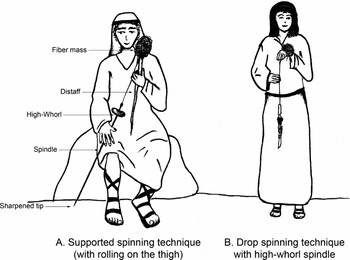
Two primary ancient spinning methods are known from the Near East: ‘supported spinning’ and ‘drop (suspended) spinning’ (Figure 1). The latter is the most advanced pre-mechanised spinning technique (Crowfoot Reference Crowfoot1931: 8; Hochberg Reference Hochberg1980: 63) and is recorded worldwide (Kissell Reference Kissell1918: 29–36). The spindle hangs freely in the air; yarn is produced more quickly by this technique than by supported spinning, and is longer and more even, and hence stronger (e.g. Kissell Reference Kissell1918: 29–36; Levy & Gilead Reference Levy and Gilead2012). Drop spinning is not, however, suitable for either short (e.g. short wool, cotton) or delicate fibres, as the weight of the spindle may strain or break them; a lighter spindle is necessary for such work (Barber Reference Barber1991). Spinners also prefer a lighter spindle to make fine thread and a heavier one for thick thread. A heavy spindle is also preferable for plying: the process of twisting strands to create a strong, balanced yarn (Barber Reference Barber1991).
Possible reconstructions of the use of the spinning implements described in this study: a) Qina Cave; b) Ashalim Cave.

Two variations are known for the supported spinning technique: (i) spinning is done with the tip of a relatively short spindle shaft resting in a small bowl or on a flat surface; and (ii) the spindle, usually long, is rolled on the thigh with one hand in order to rotate it (Crowfoot Reference Crowfoot1931: 8, 17). Both methods provide great control over the spinning process. Supported spindles allow the spinning of fine threads, usually from short fibre (e.g. wool) because the thread does not have to bear the weight of the spindle and whorl.
When the whorl is attached near the top of the shaft, the implement is termed a ‘high-whorl spindle’; when attached at the base, it is a ‘low-whorl spindle’ (e.g. Crewe Reference Crewe1998: fig. 8.4). In both types, the shaft may be supported or hang from the thread (drop-spindle), but the position of the whorl is usually culturally determined (Crowfoot Reference Crowfoot1931: 34). Artistic representations of high-whorl spindles have been recorded in Mesopotamia and Anatolia since the mid fourth millennium BC (Barber Reference Barber1991; Keith Reference Keith1998), and in Egypt from the early third millennium BC (Barber Reference Barber1991: 56–58). The high-whorl technique requires the rotation to be set with the palm. Egyptians, even today, typically roll their high-whorl spindles up or down the thigh with one hand (Crowfoot Reference Crowfoot1931; Barber Reference Barber1991: 43). For low-whorl spindles, the rotational movement was induced by a flick of the thumb and fingers (Barber Reference Barber1991: 43). This technique is first attested in Bronze Age Anatolia, Cyprus and the Aegean (Barber Reference Barber1991: 54–5; Crewe Reference Crewe1998).
Evidence from ancient linen from Fayoum, Lahun and Amarna, and as derived from early Egyptian iconography, suggests that the Egyptians did not pay out the fibres continuously, as was the prevalent technique north of the Mediterranean (Barber Reference Barber1991: 48). Instead, they hand-spliced the flax before twisting (plying) it into a tighter, stronger thread using a high-whorl spindle (Barber Reference Barber1991; Granger-Taylor Reference Granger-Taylor and Quirke1998; Vogelsang-Eastwood Reference Vogelsang-Eastwood, Nicholson and Shaw2000; Kemp & Vogelsang-Eastwood Reference Kemp and Vogelsang-Eastwood2001). Spinners in most non-Egyptian cultures, however, practised ‘draft spinning’: long fibres such as flax were teased out and fed into the ‘drafting zone’ where each fibre slipped past its neighbour and became incorporated during free fall, twisting into the yarn (Barber Reference Barber1991: 47).
At some point, the ‘distaff’ was also introduced. Distaffs are rods on which raw fibres are held during spinning (e.g. Gleba Reference Gleba, Gleba and Horsnaes2011). The earliest artistic representations of possible distaffs are from mid-third-millennium BC Mesopotamia (Barber Reference Barber1991: 69; Keith Reference Keith1998). Two types are known: the long distaff, which was fixed in the belt (or special back-strap) or stuck into the ground, and used mainly for spinning long fibres, and the short, hand-held distaff, commonly used for short fibres (Barber Reference Barber1991; Gleba Reference Gleba, Gleba and Horsnaes2011). According to Barber (Reference Barber1991: 69), both forms are readily portable, yet experiments indicate that the hand-held distaff prevents mobility and requires much attention from the spinner (CTR n.d.).
As spindles and distaffs were commonly produced from perishable materials such as wood and reed, they are rarely preserved in the archaeological record. The chances of distaffs being identified within such archaeological assemblages are even lower than those of spindles, being merely sticks, which would not turn up as easily identifiable artefacts (Barber Reference Barber1991: 69). Therefore, our knowledge of distaffs mainly derives from luxury ivory or metal examples. Indeed, significant confusion exists in the literature regarding the functional identification of distaffs (Gleba Reference Gleba, Gleba and Horsnaes2011 and references therein): short, hand-held distaffs are commonly identified as spindles, while long distaffs have been labelled ‘symbolic staffs’.
Whorls, however, are more durable. Initially produced of stone and, later, largely of clay (but also of wood, ivory, bone and metal), they are often the only archaeologically recoverable artefacts indicative of spinning activities. They first appear in Levantine Neolithic sites, with a dramatic rise in their occurrence documented throughout the Near East during the Chalcolithic (Barber Reference Barber1991; Crewe Reference Crewe1998; Levy & Gilead Reference Levy and Gilead2012).
Spindles were commonly made of wood, due to its availability and ease of processing. In the Near East, the earliest wooden spindle, from Egypt, dates to the Middle Kingdom (c. 2000–1700 BC; Barber Reference Barber1991: 65); later examples were also found there (Völling Reference Völling2008: 240–59). Elsewhere, wooden spindles appear as early as the mid fourth millennium BC, e.g. in the waterlogged pile-dwellings of eastern Switzerland (Leuzinger & Rast-Eicher Reference Leuzinger and Rast-Eicher2011). The earliest Near Eastern evidence for non-wooden spindles comes from Anatolia (MacKay Reference MacKay1925: 168; Postgate & Moon Reference Postgate and Moon1982: 131, 134) and Cyprus (Webb Reference Webb2002), where copper examples dated to the mid third millennium BC probably represent elite status. Spindles were also made of ivory (Sauvage Reference Sauvage, Nosch and Harlow2014).
The simple wooden spindles and distaffs assumed to be in common use during the Neolithic, Chalcolithic and Early Bronze Age had not been found in the Near East prior to this study. The discovery presented here, of wooden spinning implements preserved in a desiccated and complete state in the inner sections of two desert caves in the northern Negev region (Qina and Ashalim Caves), dated to the Late Chalcolithic, sheds new light on the initial stages of implement-aided spinning in the Near East.
Qina and Ashalim Caves
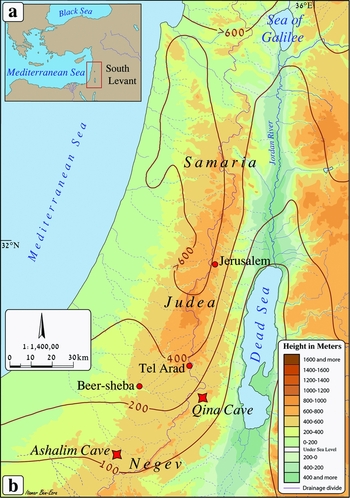
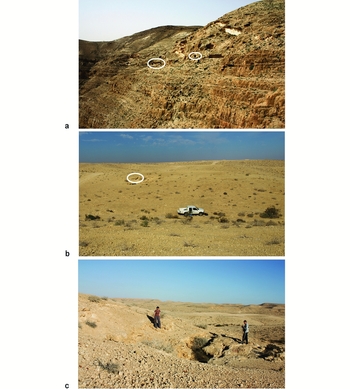
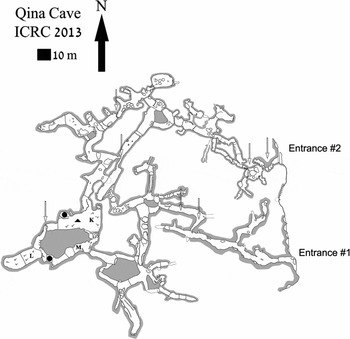
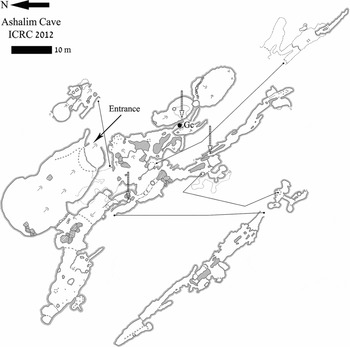
Qina and Ashalim Caves are located in the northern Negev Desert (southern Israel), south of the Beer-sheba–Arad basin that marks the southern boundary of permanent Late Chalcolithic settlements. Current regional average annual rainfall is 100–200mm (Figure 2), which supports sparse steppe and desert vegetation (Figure 3). The caves are among the largest formed within limestone rocks in this region, with their total length exceeding 0.5km. Two small openings in the steep slope of Qina canyon give way to the underground system of passages and large halls of Qina Cave (Figures 3a & 4); the entrance to the inner-sections of the system demands crawling and squeezing through very narrow passages (the most difficult of which are indicated on Figure 4). The sole entrance to Ashalim Cave is barely visible. It too gives way to a long, complex system of underground passages, albeit shorter than those of Qina Cave (Figures 3b–c & 5). The humidity inside both caves is low.
a) The southern Levant and its position in the Eastern Mediterranean; b) the location of Qina and Ashalim Caves in the northern Negev Desert, together with rainfall isohyets.

a) The location of the two small entrances to Qina Cave looking south-west (marked by circles); b) the entrance of Ashalim Cave (marked by a circle); c) a closer view of the Ashalim Cave entrance pit.

Map of Qina Cave; circles mark the location of the wooden shafts; a triangle marks the location of the spindle whorls; dashed arrows point to passages that are difficult to navigate through.

Only small sections of Qina and Ashalim Caves were archaeologically surveyed prior to 2012; their exterior sections yielded little material evidence of multi-period use (Cohen Reference Cohen1999; Eshel & Govrin Reference Eshel and Govrin2003). Recent fieldwork led by two of the authors (UD & MU) included the complete mapping and systematic surface surveys of the entire cave systems. Late Chalcolithic remains were found in the innermost, previously unexplored sections of both caves (Davidovich Reference Davidovich2013a & b). These included human skeletal remains (partly disturbed by post-depositional bio-perturbation, enhanced by the activities of hyenas and porcupines), in a clear association with artefacts including pottery vessels, tabular flint scrapers, an ivory ‘cup’ and shell objects. Qina Cave also yielded three basalt spindle whorls found grouped together in the centre of hall K, the largest hall in the cave (Figure 4). About 30m from this find-spot, in the boulder-strewn passage between halls L and M, three wooden shafts (numbers 126, 127 and 128) were found in close proximity to one another; a fourth shaft (157) was located in the north-west corner of hall K (Figure 4). In Ashalim Cave, on the floor of one of the innermost narrow passages (passage Gc in Figure 5), a single artefact comprising a wooden shaft (120) with a perforated lead object attached was found. These five wooden artefacts constitute the focus of our study and are proposed to be spinning implements.
Map of Ashalim Cave; the circle marks the location of the spindle; dashed arrows point to passages that are difficult to navigate.

Methods and results
Dating
Accelerator Mass Spectrometry (AMS) 14C age measurements were obtained (Table 1) for shaft 128 (Qina Cave) and shaft 120 (Ashalim Cave), both calibrated to the second half of the Late Chalcolithic period (c. 4500–3800 BC; e.g. Rowan & Golden Reference Rowan and Golden2009). Surveys of the inner sections of both caves produced only Late Chalcolithic Ghassulian culture objects (Davidovich Reference Davidovich2013a & b).
Results of radiocarbon dating, using the IntCal13 calibration curve (Reimer et al. Reference Reimer, Bard, Bayliss, Beck, Blackwell, Bronk Ramsey, Buck, Cheng, Edwards, Friedrich, Grootes, Guilderson, Haflidason, Hajdas, Hatté, Heaton, Hoffmann, Hogg, Hughen, Kaiser, Kromer, Manning, Niu, Reimer, Richards, Scott, Southon, Staff, Turney and van der Plicht2013).

The wooden shafts and the fibres
The five wooden shafts were visually examined for their morphology; microscopic analyses were then conducted in order to (i) extract and identify fibres attached to the shafts, and (ii) to identify the wood by its anatomy (see Table 2; for a detailed description of the methods used see the online supplementary material).
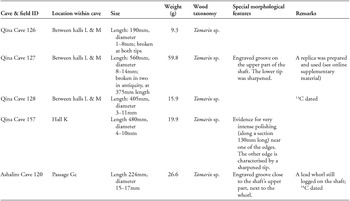
Measurements and characteristics of the wooden items*

* All small side branches were cut from the shafts.
All artefacts (or specimens) were fashioned from Tamarix (tamarisk) wood, a common genus in the Negev Desert. Anatomical features used for identification included distinct growth rings, mostly solitary vessels, simple perforation and large (commonly 4–10 seriate) and high (up to 20 cells or more) rays.
Five fibres attached to the wooden shafts from Qina Cave were identified as ‘bast’ fibres (also known as ‘phloem’ or ‘skin’ fibres), most probably flax (Linum, family Linaceae); others were too degraded for identification and could only be identified as plant material. All of the fibres extracted from the Ashalim implement were identified as of animal origin, but were too degraded for further identification; they may be in situ (raw material) fibres, or have been contaminated by animal activity within the cave. For these reasons, the Ashalim Cave fibres are not discussed further.
The spindle whorls
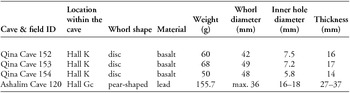
Three rounded, basalt spindle whorls were found in Qina Cave, about 30m from the group of three wooden shafts. Based on their narrow perforations (Table 3), it is clear that they did not belong to these shafts (Table 2). No use marks were identified on the whorls. The lead whorl discovered in the Ashalim Cave was still attached to shaft 120 (Figure 6).
Measurements and characteristics of the spindle whorls.

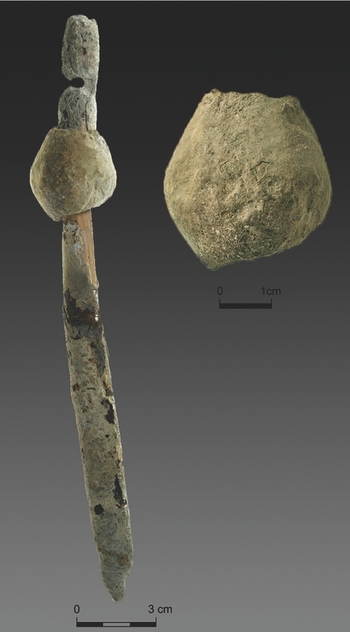
The Ashalim spindle and lead whorl; note that at the bottom of the lead whorl on the right, there is an abrasion that was probably caused by yarn movement.

Discussion
The Qina Cave spinning implements
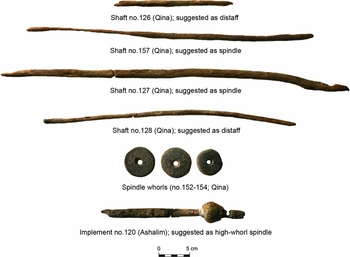
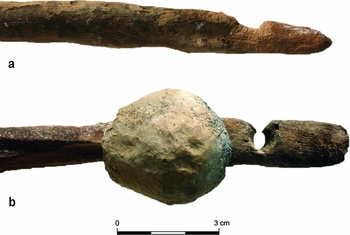
From their morphology, we argue that shafts 127 and 157 were used as spindles, while 126 and 128 may have been either spindles or distaffs (Figure 7). Shaft 127 is identified as a spindle by a distinctive groove near its apex (Figures 7 & 8); its lower tip was sharpened (Figures 1a & 7). Microscopic examination indicates that the groove had been carved. Such grooves were used to catch the yarn while the spindle was twirling. They were not essential, and knots (which probably preceded grooves) could be used instead (Raven Reference Raven1987: 21). Studies show that the yarn production rate increases by 30% when a hooked, slotted or grooved shaft is used (Hochberg Reference Hochberg1980: 40); spinning with a hooked or grooved stick is often the first method taught to students of spinning (Raven Reference Raven1987: 12).
The Late Chalcolithic spinning implements found in the innermost sections of Qina and Ashalim Caves; note the polished section on shaft 157 and the grooves on the upper sections of shafts 127 and 120.

A closer look at the grooves: a) Qina Cave (127); b) Ashalim Cave (120).

Shaft 157, also proposed to be a spindle, shows evidence of intense polishing, possibly the result of rolling the spindle on the thigh. In contemporary Egypt and Sudan, the spindle shaft is propelled down the thigh for spinning a single yarn and up for plied yarn (Crowfoot Reference Crowfoot1931: 19); in Jordan, Syria and Palestine, the shaft is rolled up the thigh for a single yarn and down for plied yarn (Crowfoot Reference Crowfoot1945: 38). In both the Judean Heights (Weir Reference Weir1970: 8) and Egypt, propelling along the thigh is invariably used when a tightly twisted, strong yarn or plied yarn is required (Crowfoot Reference Crowfoot1931: 36–38).
The relatively long lengths of shafts 127 and 157 (480 and 560mm respectively) may also indicate that they were rolled on the thigh (Figure 1a); length is a common feature in this variation of supported spinning (Kissell Reference Kissell1918). Shafts for drop spinning are commonly shorter and range from 230–380mm in length (Forbes Reference Forbes1964: 154). The sharpened tips on both shafts may also suggest supported spinning. Levy (Reference Levy2006: 36) describes in detail how the Beni Awad people (Sudan) effectively spun short goat-hair fibres on a long (500–600mm), slender stick using the supported technique with the spindle rolled on the thigh (see also Crowfoot Reference Crowfoot1931: pl. 14), although not necessarily using whorls.
There is no evidence that whorls were logged onto shafts 127 and 157. The three basalt whorls found approximately 30m away do not fit either these or the other two shafts from the cave; the diameter of their inner perforations is too small (Tables 2 & 3). These disc-shaped objects are typical of Late Chalcolithic whorls from nearby contemporary settlement sites (e.g. Arad: Amiran et al. Reference Amiran, Paran, Shiloh, Brown, Tsafrir and Ben-Tor1978: pl. 67: 10), and from mortuary contexts (e.g. Peqi'in: Shalem et al. Reference Shalem, Gal and Smithline2013: fig. 9.4: 1–5). They are symmetrical with undecorated surfaces and their bi-conical perforations were carefully drilled from both sides. Basalt was a common whorl material during the Late Chalcolithic (e.g. at Arad: Amiran et al. Reference Amiran, Paran, Shiloh, Brown, Tsafrir and Ben-Tor1978; at Ghassul: Lee Reference Lee1973).
The other two shafts from Qina Cave (126 and 128) lack special features such as grooves, intense polishing or use marks of whorls or knobs. As plant fibres were extracted from both shafts, we suggest that they may have been used as spindles or distaffs (Figures 1a & 7). The sharpened tip of shaft 126 can be a feature of both implements; for example, used to secure the distaff in the ground during spinning, especially in supported spinning. Shaft 128 is not straight and so was probably used as a distaff rather than a spindle, which needs to rotate evenly to enhance spinning efficiency. It is also possible, however, that this stick became curved due to desiccation. Barber (Reference Barber1991: 50) mentions that relatively long flax fibres are usually drafted with the use of a distaff rod to hold the fibre mass. Indeed, according to Gleba (Reference Gleba, Gleba and Horsnaes2011), long distaffs were used for spinning flax. Shaft 128 is just over 400mm long and therefore seems suited to holding the linen fibre mass during spinning. Given that no use marks of either whorls or knobs were found on shafts 126 and 128, it is also possible that the shafts were versatile and used either as spindles or distaffs. The idea of multi-purpose shafts in the textile industry is also suggested by Sauvage (Reference Sauvage, Nosch and Harlow2014: 222) for Late Bronze–Early Iron Age examples from the Eastern Mediterranean.
The Ashalim Cave spindle
This implement is the oldest Near Eastern spindle-whorl combination to survive intact and the oldest lead object ever recovered in the southern Levant (Figure 6). Chemical and isotopic analyses indicate that the whorl is made of metallic lead from Anatolia, probably from the Bolkardağ region of the Taurus range (Yahalom-Mack et al. Reference Yahalom-Mack, Langgut, Dvir, Tirosh, Eliyahu-Behar, Erel, Langford, Frumkin, Ullman and Davidovich2015). The spindle has a carved groove about 5mm below its apex; the lead whorl was fixed slightly below the groove. This implement is therefore suggested to be a high-whorl spindle. Ancient Egyptian paintings of spindles in use invariably show the whorl at the top of the shaft, and with a groove or hook near the tip (Barber Reference Barber1991).
Based on the archaeological record, the weight of the whorl at 155.75g defines it as a relatively heavy example, although whorls of up to 180g have been recorded from contemporary Cyprus (Crewe Reference Crewe1998). Ethnographic observations and the experience of modern revivalist spinners attest to a strong correlation between heavy whorls and long or coarse fibres, resulting in a thick yarn (Liu Reference Liu1978). Heavy whorls are also used for plying (Crowfoot Reference Crowfoot1931; Weir Reference Weir1970). The latter option seems more probable as textile remains found in the Late Chalcolithic Judean Desert sites indicate that fibres were spliced rather than spun into thread, and that the spindles were used for plying (Shamir Reference Shamir, Brandel, Saban and Master2014).
An abrasion on the lower part of the lead whorl (Figure 6) was probably caused by yarn movement. A similar phenomenon has been observed on other spindle whorls in the region (e.g. Middle Bronze Age bone whorls from Tel Beth Shean; Yahalom-Mack Reference Yahalom-Mack, Mazar and Mullins2009: 665).
There is also a slight resemblance between this lead whorl and some typical Late Chalcolithic maceheads, mostly made of copper, manufactured in a sophisticated lost-wax technique, and ceremonial in function (Bar-Adon Reference Bar-Adon1980). The occurrence of wood remains associated with the maceheads suggests that they were placed on wooden shafts. The size of the Ashalim lead whorl places it among the smallest ceremonial maceheads reported by Bar-Adon (Reference Bar-Adon1980: 130). It might therefore be suggested that the ‘whorl’ was originally a macehead (albeit unique due to its material and relatively small size), which had secondary use as a whorl for drop spinning. Based on Egyptian iconography, maceheads were placed at the top of the shaft (e.g. the Narmer macehead); the copper maceheads from the Cave of the Treasure were set a few centimetres below the upper tip of the copper shaft (Bar-Adon Reference Bar-Adon1980).
An advantage of the drop-spinning technique, apart from improved yarn quality, is its potential to be performed while standing, walking (Figure 1b) or indeed herding (Barber Reference Barber1991: 69). During the Late Chalcolithic, the latter was a primary subsistence economy (e.g. Rowan & Golden Reference Rowan and Golden2009), and Levy and Gilead (Reference Levy and Gilead2012) suggest that spinning, plying and herding were practised simultaneously.
The flax fibres
The fibres extracted from the Qina Cave spinning implements were identified as being most probably flax (linen); this fits with other evidence. Native to the Levant, flax is considered the first domesticated fibre plant of the Neolithic Near East (e.g. Lev-Yadun et al. Reference Lev-Yadun, Gopher and Abbo2000). Most Neolithic fabrics and Chalcolithic textiles from the southern Levant are linen-made (e.g. Shamir Reference Shamir, Brandel, Saban and Master2014), and flax remained the sole plant material for the manufacture of textiles until the Early Bronze Age (Shamir Reference Shamir, Brandel, Saban and Master2014 and references therein). Qina Cave is, however, located in the arid northern Negev, beyond the region of rain-fed flax growing, so the presence of flax here may point to the exchange of commodities with farmers from more humid parts of the southern Levant.
Although flax has high water requirements in cultivation (Levy & Gilead Reference Levy and Gilead2012) and high labour input in its production (Abbo et al. Reference Abbo, Zezak, Lev-Yadun, Shamir, Friedman and Gopher2015), it became and remained the preferred fibre in the semi-arid southern Levant until the advent of wool (e.g. Shamir Reference Shamir, Brandel, Saban and Master2014). Even though wool is considered, both economically and ecologically, a more efficient use of manpower and resources, linen production and use did not phase out even when woollen textiles became common (McCorriston 1997: 534).
Qina and Ashalim Caves are broadly contemporaneous with several nearby caves where woven linen remains were discovered, the most famous among them being the Cave of the Treasure and the Cave of the Warrior. Levy and Gilead (Reference Levy and Gilead2012) point out that all textiles, despite the vast range in the size of the implements used to make them, show considerable homogeneity in yarn characteristics and weaving techniques. They also suggested that the textiles produced during the Late Chalcolithic, including the 7 × 2m shroud from the Cave of the Warrior, were made within a domestic mode of production.
Archaeological implications
The inner sections of Qina and Ashalim Caves are very difficult to access and might not have been known to people in the region during most of the Holocene. The absence of artefacts from later periods indicates that the inner chambers have probably not been visited during the last six millennia. The caves were used solely during the Late Chalcolithic for the burial of a few individuals (Davidovich 2013a & b). These burials were accompanied by specially selected objects, possibly relating directly to the interred individuals. For some reason, the objects were sometimes placed away from the bodies, within the same spaces. While some may have been moved from their primary contexts by wild animal activity, the groupings of object classes (e.g. the wooden shafts and spindle whorls of Qina Cave) suggest that post-depositional processes were moderate. The occurrence of spinning implements in funerary contexts in both caves probably expressed the economic role of some of the buried individuals.
Our identification of the wooden shafts as spinning implements was possible due to a combination of several unique circumstances: (i) the dry desert environment that preserved the wood for around 6000 years; (ii) the unique location of the finds in difficult-to-access locations within large, complex cave systems; and (iii) multi-dimensional examination of these seemingly ordinary objects (particularly in the case of the distaffs). It is probable that in other cases, even well-preserved, wooden spinning implements were not identified as such due to their ‘natural’ appearance. Such potential implements may, indeed, have been uncovered in the Late Chalcolithic Cave of the Treasure, alongside more substantial ‘sticks’ that were interpreted as parts of a ground loom (Bar-Adon Reference Bar-Adon1980).
Conclusion
The Late Chalcolithic wooden spindles and distaffs described here, including the unique spindle/whorl combination, constitute the earliest wooden spinning implements revealed to date in the ancient Near East. Although whorls appear in the Neolithic period, intact implements are rarely encountered in the archaeological record, as they are commonly manufactured from perishable materials with a natural appearance. Such implements can easily be misinterpreted as unworked wood (e.g. firewood, particularly in the case of distaffs) or as other types of artefact (especially when fragmented). We would urge that similar wooden objects uncovered in archaeological contexts should be meticulously examined—both visually and microscopically—in order to avoid overlooking these valuable artefacts.
The types of spinning implements and techniques used during the Late Chalcolithic period in the southern Levant have previously been conjectured from indirect evidence, i.e. whorls and finished textiles. Here, we demonstrate that at least two spinning techniques—supported spinning and drop spinning—were in use simultaneously at this time, and that distaffs were first introduced no later than the Late Chalcolithic. It is well recognised ethnographically that several spinning techniques may be used within the same community, depending on individual preferences, the fibre spun, the intended quality of the textile, local traditions and practical needs.
The Ashalim high-whorl spindle is not only the oldest-known spindle/whorl combination to survive in the Near East, but also the oldest lead object found in the southern Levant. The lead isotope analysis and lack of lead ores in the southern Levant indicate that it originated in Anatolia. Whether the object was brought to the area in its current form, or locally produced from a rare, exotic metal, this raises the possibility that it may have been an item of prestige. The relatively heavy weight of the whorl suggests that it may have been used for plying.
The Late Chalcolithic period is marked by a range of technological improvements and innovations (e.g. metallurgy, the potter's wheel, ivory artefacts; Rowan & Golden Reference Rowan and Golden2009). We suggest that the multiple spinning techniques and long-distance import of rare materials encountered at Qina and Ashalim Caves constitute additional evidence for the skilled craftsmanship and technological sophistication of the people of the southern Levantine Late Chalcolithic. The decision to bury spinning implements alongside the deceased may express at least part of the economic role of some of these individuals within their community.
Acknowledgements
We should like to thank Amos Frumkin, head of the Israeli Cave Research Center (ICRC) as well as ICRC members Boaz Langford, Shemesh Ya'aran and Avi Baruch for their help in mapping, surveying and studying Ashalim and Qina Caves. Our thanks also go to the volunteers who assisted in the archaeological surveys of the caves (Israel Antiquities Authority licence numbers S-337/2012 and S-430/2013). Avner Rosengraten from the Israel Forensic Science Institute (Jerusalem) is acknowledged for fibre identification, and Shmuel and Marco for basalt identification. We are also grateful to Susan Lev-Yadun for editing assistance, and to Itamar Ben-Ezra, Yulia Gottlieb, Pavel Shrago and Naama Golan for their help with the preparation of the figures.
Supplementary material
To view supplementary material for this article, please visit http://dx.doi.org/10.15184/aqy.2016.99