Despite a growing emphasis on trauma-aware practice in schools, the role of the school counsellor in this work is inconsistent (Howell et al., Reference Howell, Thomas, Sweeney and Vanderhaar2019). To understand and enhance the important work of school counsellors in this area, it is necessary to identify the categories of practice in which they are involved and areas that they would prioritise, if they could. It is also important to identify supports required for school counsellors to overcome any barriers for them to do the work that they prioritise (Berger & Samuel, Reference Berger and Samuel2020). The purpose of this study is to draw from the words, experiences and insights of school counsellors, to distil a range of recommended elements of practice to support trauma-impacted learners. The following research questions were addressed:
-
(1) What areas of trauma-aware practice are part of the role of school counsellors?
-
(2) What areas of trauma-aware practice are prioritised by school counsellors?
-
(3) What do school counsellors need to engage effectively in the trauma-aware work that they prioritise?
Trauma-aware education practice is adopted to support learners in schools and early childhood education services who have experienced complex childhood trauma (including physical, sexual and/or emotional abuse, neglect and/or violence; Howard, Reference Howard2019; Perfect et al., Reference Perfect, Turley, Carlson, Yohanna and Saint Gilles2016). It is now understood that this type of trauma can lead to detrimental wellbeing and life outcomes if not addressed (Shonkoff et al., Reference Shonkoff, Boyce and McEwen2009). Trauma-aware education accepts that the malleability of developing nervous systems of children and young people increases their vulnerability to the neural impacts of complex trauma, which can lead to learning and behaviour challenges that can compromise the experience of education (Perfect et al., Reference Perfect, Turley, Carlson, Yohanna and Saint Gilles2016; Teicher et al., Reference Teicher, Anderson, Ohashi and Polcari2014). Trauma-aware education also acknowledges that neural repair is achievable through informed practice designed to address this harm and that this can enhance outcomes for not only trauma-impacted learners, but also their classmates and those practitioners who are working hard to educate them (Howard, Reference Howard2019). Ormiston et al. (Reference Ormiston, Nygaard and Heck2020) suggest that the process of educators becoming trauma-aware involves a shift in attitudes and beliefs resulting from the acknowledgment of the impact of complex trauma on child development and the education experience.
Although the research literature examining the role of the school counsellor in trauma-aware education is sparce, the literature that is available suggests the areas of trauma-aware work undertaken by school counsellors is diverse. Indeed, the title of counsellor in this context can be misleading, as much of the work of school counsellors extends far beyond the practice of counselling or even the individual support of trauma-impacted learners. In general, school counselling is understood as a ‘multifaceted profession that requires a unique skill set’ (Tang, Reference Tang2020, p. 1), which can involve the delivery of a diverse range of services within the school setting (Ormiston et al., Reference Ormiston, Nygaard and Heck2020). Work in trauma-aware education is no different, as school counsellors can be involved in a broad range of activities to address the needs and concerns of trauma-impacted learners (Costa, Reference Costa2017; Howell et al., Reference Howell, Thomas, Sweeney and Vanderhaar2019; Rumsey & Milsom, Reference Rumsey and Milsom2019). Some authors recommend that an array of activities should be planned and delivered within a multitiered framework that considers: (a) universal, whole-of-site staff training and processes (Tier One); (b) targeted supports and interventions (Tier Two); and (c) intensive interventions for individual learners (Tier Three; Berger, Reference Berger2019; Berger & Samuel Reference Berger and Samuel2020; Dorado et al., Reference Dorado, Martinez, McArthur and Leibovitz2016; Rawson, Reference Rawson2021; Reinbergs & Fefer, Reference Reinbergs and Fefer2018).
It is suggested that much of the trauma-aware work of school counsellors focuses on therapeutic work to prevent, minimise or address the impacts of complex trauma on the mental health and wellbeing of students, which can often present as complex behavioural concerns or threats to academic functioning (Allison & Ferreira, Reference Allison and Ferreira2017; O’Gorman, Reference O’Gorman2018). It is proposed that school counsellors are well qualified and skilled to do this work due to their specialised knowledge, training and experience, and that this work can sometimes extend to family-based therapies (Berger &Samuel, Reference Berger and Samuel2020; Costa, Reference Costa2017; O’Gorman, Reference O’Gorman2018). School counsellors also have a significant role in supporting the mental health and wellbeing and school functioning of students in the child protection system and who are living in out-of-home care (Martinez et al., Reference Martinez, Williams and Green2020).
It is also suggested that school counsellors are well qualified to support the personal, professional and mental wellbeing of their school colleagues who are working with trauma-impacted students. It is suggested that this work can prevent school personnel from experiencing professional burnout or vicarious trauma or address these when they do occur (Berger & Samuel, Reference Berger and Samuel2020; DuBois & Mistretta, Reference DuBois and Mistretta2020). However, supporting trauma-impacted students and colleagues can also have an impact on the personal and professional wellbeing of school counsellors themselves, and it is important that steps are taken by schools and schooling systems to address this (Berger & Samuel, Reference Berger and Samuel2020). The bulk of research exploring vicarious trauma tends to examine the experiences of nonschool professionals, including mental health and social workers, and there is a need for further investigation into the experiences of school counsellors to be protective of their personal, professional and mental wellbeing (Berger & Samuel, Reference Berger and Samuel2020: Parker & Henfield, Reference Parker and Henfield2012).
Other areas of trauma-aware work led by school counsellors are more focused on systemic influences that can enhance or hinder the education experiences of trauma-impacted students. School counsellors can collaborate with support organisations and community groups to enhance trauma-aware support of students. They can support development and implementation of trauma-aware policies and practices in education settings, and advocate for the support and inclusion of individual learners with trauma-related needs, particularly with regard to the ways that student discipline and student support are considered or applied (Rawson, Reference Rawson2021).
The present two-part, mixed-method study explored the school counsellor’s role regarding trauma-aware education practice. The study draws on the voices of practitioners to explore (a) areas of trauma-aware practice that are part of the school counsellor role, (b) areas of practice that are prioritised by school counsellors, and (c) ways to support school counsellors as they engage in the work that they prioritise.
Method
Approximately 150 school counsellors employed in Catholic schools in the Archdiocese of Brisbane were invited to participate. This Archdiocese is in the south-east corner of Queensland; it covers approximately 77,000 square kilometres and services 137 schools and over 70,000 learners. Potential participants were asked to identify whether they would participate in an online questionnaire and a focus group interview after questionnaire data had been analysed. A total of 26 school counsellors completed the questionnaire, a response rate of 17.3%. Eight participants who completed the questionnaire volunteered to participate in a focus group interview.
The questionnaire comprised 34 items, including 16 multiple-choice questions, 11 open-ended questions, and 7 rank-order questions. Six of the multiple-choice questions requested demographic data from participants. Most participants were female (88.5%) and most had up to 10 years of experience as a school counsellor (5–10 years 34.6%; less than five years 26.9%). Five participants were very experienced and had been working in the role for 16 to 25 years. Most worked at either primary (50%) or secondary schools (30.8%), with some working at combined campuses. Most suggested students at their schools came from mixed levels of advantage and disadvantage (76.9%); four (15.4%) suggested students were mostly from disadvantaged backgrounds, and two (7.7%) suggested students were mostly from advantaged backgrounds.
The remaining items in the questionnaire investigated participants’ views regarding trauma-aware education practice, and five categories of this work experienced by school counsellors, as identified in the literature. The first question asked each participant to rate their belief about the overall importance of trauma-aware practice in schools on a scale from 1 (extremely important) to 5 (not important). The questionnaire then explored the five categories of work (see Table 1).
Categories of trauma-aware education work experienced by school counsellors

Initially, participants were asked to rank their perceptions of the importance of each of these five categories of work. Then, for each category, participants were asked: (a) whether they had experienced working within this category; (b) to identify whether they believed that it was part of the school counsellor’s role to engage in work within this category and explain why they held this belief; (c) to describe the work in which they engaged within this category; and (d) to rate their level of perceived knowledge, confidence and skill to engage in the work within this category. The online questionnaire concluded with a rank-order question asking participants to prioritise the five categories of work from what they understood as most relevant to least relevant to their role, and an open question allowing participants to comment on other categories of trauma-aware work that were not yet investigated. Frequency analyses of the quantitative survey data were conducted in SPSS 25 (IBM, 2018) in addition to thematic analysis of extended answers.
Key findings from the questionnaire data were used to develop open-ended, focus group interview questions. Questionnaire findings were summarised into a PowerPoint presentation and shared with participants at the commencement of the interview. Participants were asked to reflect on the findings and then to describe any trauma-aware practice in which they would ideally like to be involved in their schools and in their education system. They were asked to identify the support they required from their schools and their education system to engage in this work. The focus group interview concluded with an open question allowing participants to discuss any further topics that they felt were not adequately covered in project data collection.
Results
Although the number of questionnaire participants was relatively small, there was variety in their professional contexts and in their years of experience in the role of school counsellor. Despite this variation, the majority (88.5%) agreed that trauma-aware practice in schools is extremely important.
Categories of Work Related to Trauma-Aware Education
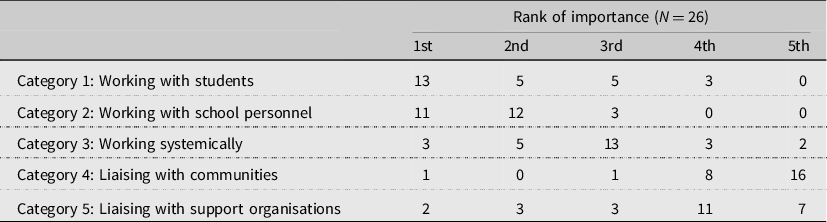
Participants’ perceptions of the importance of each of the five categories of trauma-aware work under investigation suggested that working with students and working with school personnel were the most prioritised, followed closely by working systemically. Liaising with support organisations was fourth on the list of five and liaising with communities was the least prioritised category of work (see Table 2).
Perceptions of importance of categories of trauma-aware education work

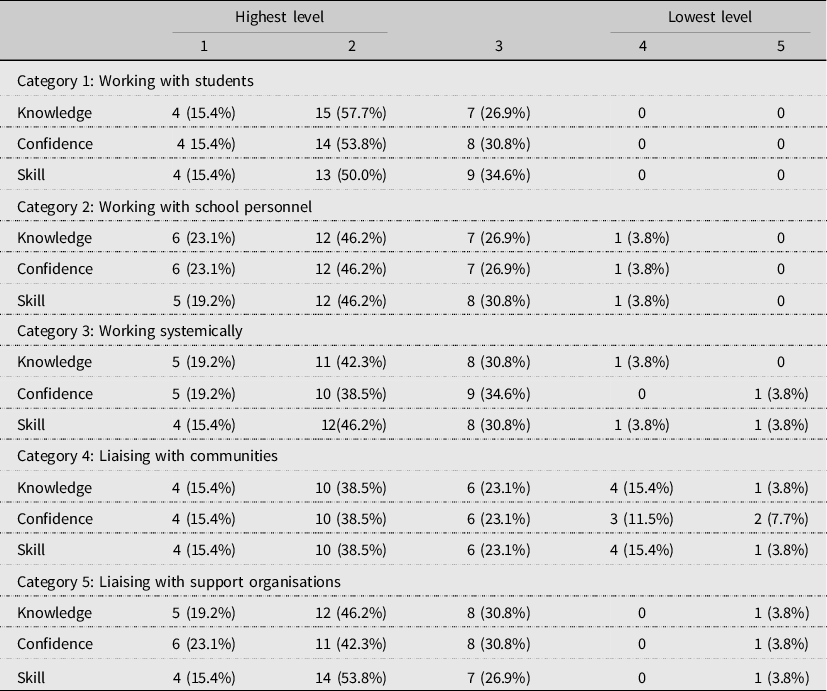
Questionnaire data illustrated participants’ perceived capacity (in terms of knowledge, confidence and skill) for each of the categories of work (see Table 3). Most participants rated all three areas of their capacity as quite strong across all categories. There was more variation in responses within working systemically than the previous two categories, with perceptions of knowledge, confidence and skill ranging across all levels and most participants reporting their capacities at level 2 (10, 38.5% to 12, 46.2%). For the category of liaising with support organisations, between four (15.4%) and six (23.1%) participants rated their knowledge, confidence and skill at the highest level; most participants (11, 42.3%, to 14, 53.8%) rated their capacities at level 2; between seven (26.9%) and eight (30.8%) reported average capacities; and one (3.8%) reported capacities for this category at the lowest level. Perceived capacities for liaising with communities were the lowest reported, with the greatest spread of responses. Four (15.4%) rated their perceived capacities for this work as very strong. However, most participants (10, 38.5%) reporting perceived capacities for all three areas to be at level 2 and a further six (23.1%) reported average capacities. There was more variation between participants’ ratings in levels 4 and 5. Four (15.4%) participants rated their knowledge and skill at level 4, and one (3.8%) rated their knowledge and skill at the lowest level. Three (11.5%) rated their confidence at level 4, and two (7.7%) rated their confidence at the lowest level. Compared to other categories, there were minimal comments made by respondents in the extended comments section of the questionnaire to explain work in this area. Qualitative questionnaire data and focus group interview data further explained participants’ experience with, and beliefs about, each of the five categories of work.
Knowledge, confidence, and skill for the five types of work

Category 1: Working with students
All questionnaire participants identified that they had worked directly with trauma-impacted students as school counsellors, and some identified that they had also experienced this in other roles. The majority (22, 84.6%) expressed that it was within their role to engage in this work. Participants’ descriptions of this work were broad ranging but mostly focused on providing a safe and supportive relationship for students, helping to develop students’ capacities for emotional regulation and relating to others, and crisis management. They suggested that this work can involve formal processes such as individual counselling, or more collaborative work, organising and enhancing supports for students, or even very informal processes such as ‘playing handball’ or ‘gardening’.
It was suggested during interviews that one-to-one counselling or support for students is important and that school counsellors are equipped and qualified to do this work. However, it was also suggested this is may not be the most effective support that a school counsellor can provide and that they should focus on other work, while referring to specialists for any individual counselling or support for students. One participant proposed that school counsellors are well placed to provide a physical and/or relational ‘safe space’ for students who are not coping well and that this is vital for students to feel comfortable and supported enough to make disclosures regarding child protection concerns. Participants discussed what might enhance or hinder their working directly with trauma-impacted students and mentioned that this is often dependent on whether this work was approved or prioritised by school leaders, that time is available for this work, and they have the required expertise or access to training to develop expertise for this work.
Category 2: Working with school personnel
All questionnaire participants suggested they had worked to support school personnel to enhance their capacities for trauma-aware practice. Most (25, 96.2%) felt this work was part of their roles. Some explained that due to school counsellors having a strong understanding of the complexities that drive trauma-impacted students’ emotions and behaviours, they can help to translate this understanding for school personnel. It was also expressed that school counsellors have the capability to deliver quality trainings for school personnel in this area.
When discussing staff capacity building, interview participants considered activity to enhance knowledge and skill and the personal and professional wellbeing of educators, and activity involving advocacy. Participants explained that school counsellors can provide individual support and group trainings for educators. One participant referred to this as ‘psychoeducation’, due to it involving their explaining the neuroscience underpinning complex trauma and trauma-aware responses. Participants suggested that staff professional development can involve discussion, modelling of practice, resource provision, and sharing of ideas for trauma-aware strategies for student learning and behaviour support. It was also explained that this work can include the co-development of student support plans with educators, coordination of case management processes, and debriefing sessions with school personnel after challenging events involving student behaviour. Participants discussed the importance of their upholding confidentiality when discussing students’ backgrounds and issues with educators, but also the importance of ensuring educators had enough information for them to respond effectively to students’ needs. They discussed sharing the importance of self-care with educators and offering tangible ways to avoid vicarious trauma.
Category 3: Working systemically
All but one (25, 96.2%) of the questionnaire participants suggested that whole-of-school work in trauma-aware practice should be within the role of a school counsellor, with the remaining participant being unsure. Only 57.7% (15) had experienced working at this systemic level as a counsellor but all suggested they had worked in this way when they were teachers, and three (11.5%) reported engaging in this work in a different role.
Interview participants shared examples of whole-of-school practice that they led or in which they participated. Participants referred to designing and delivering training and supports to enhance the knowledge and skill of all school personnel. However, some suggested they did not deliver the training themselves, but rather supported processes for agencies or specialists external to the school to do this work. One participant explained that they contribute to development and revision of policy and school responses to student behaviour and needs. Another described helping to develop ‘sensory spaces’ for trauma-impacted students within classrooms as well as a centralised ‘safe space’ for students to use. Participants agreed that it was usual for them to support crisis management processes, and this could include responding to serious incidents of student behaviour, restraint processes, and suicide prevention and postvention work.
Interview participants did share some frustrations regarding whole-of-school practice. It was mentioned that school counsellors struggle to find the time to develop good resources and that they would benefit from the provision of quality, readymade resources to use for this work. One suggested that their work in this area lacks structure and that they would appreciate guidance from supervising bodies regarding what is deemed important and how it should be delivered. Participants tended to agree that their work in this category can be hampered by this not being prioritised and/or approved by school leadership.
Category 4: Liaising with communities
Less than half of questionnaire participants (10; 38.5%) had included liaising with communities within their work as a school counsellor, but a greater number (16; 61.5%) believe that this work should be part of their role. Two (7.7%) participants suggested that this work was not part of their role and eight (30.8%) reported that they were unsure. Three (11.5%) had engaged in this work when they were teachers and four during their time in other roles. Seven participants (26.9%) identified that they had not been involved in this area of work at all. These data align with the findings summarised in Table 1, explaining that this category of work is far less prioritised by participants compared to others. One participant suggested that this work was needed only if it could directly support or enhance outcomes for students, and some participants expressed that they were unsure what this work might involve.
Interview participants agreed that liaising with local First Nation communities or community groups supporting refugee families or families from non-Australian or nondominant cultures was important. They described some of the activities that could be involved in this category of their work. Some examples included participation in meetings, email and phone contact, delivering training, sharing information from organisations with school personnel, informing and supporting culturally and contextually responsive practice in schools, advocacy for students and families from diverse backgrounds, and referral for students and their families to support services.
Category 5: Liaising with support organizations
Most questionnaire participants (17, 65.4%) had liaised with support organisations to support trauma-impacted students during their role as school counsellor. Most (21, 80.8%) felt that this category of work should be part of their role. Two (7.7%) had engaged in this work in their previous teaching role and four (15.4%) during their work with support agencies in other roles. Four (15.4%) were unsure whether this was part of their role and only one (3.8%) felt that this work was not part of their role. One participant commented that this work was important as ‘the external supports are often experts in this field’.
Interview participants explained that this work can involve multidisciplinary case management and liaising with child protection, health, and mental health organisations and specialists. It was explained that these collaborations aimed to address medical and mental health needs of students and to enhance student functioning and family or carer support. Some participants attended network meetings or facilitated links between specialists or organisations and teachers. Some helped to engage support organisations to provide psychoeducational or mental health assessments, counselling services, and training and consultancy.
Other Areas of Trauma-Aware Work for School Counsellors
Participants were invited to provide extended comments in the questionnaire and during interviews to explain other areas of work relevant for the role of a school counsellor. In short, responses included: (a) delivering mental health first-aid training, (b) moderating the requirements of external practitioners with the requirements of the school, (c) supporting change and helping school leadership to understand the need for change, (d) helping students to connect to other students through activities and groups, and (e) direct work with parents, carers and families.
What Supports do School Counsellors Need to do This Work?
Interview participants were asked to share their views on support they felt would be helpful for them to implement various categories of work to support trauma-aware practice in their role as school counsellor. Responses were analysed according to themes and are summarised below.
Support from leadership
Participants agreed that trauma-aware systemic processes and professional development should be supported by school and system leadership. It was suggested that mandatory professional development for school and system leaders in trauma awareness would enhance their commitment to this work. One participant suggested that systemwide trauma awareness would ensure that everybody, including leadership, is talking from a consistent (therapeutic) language.
Human resourcing
Participants recommended greater time allocations within their roles and greater staffing allocations of school counsellors to prioritise trauma-aware work. One reminded the researchers that school counsellors are very strategic regarding how they spend their days, but that they rarely can meet all the workload requirements due to the immensity and complexity of the role. Another mentioned that schools with high numbers of trauma-impacted students may require a differentiated allocation of the school counsellor resource as an inadequate allocation can prove risky for staff and students. It was suggested that it would be beneficial to establish a systemic model that identified and supported school counsellors who could specialise in and lead trauma-aware education work across schools within geographic areas. It was also suggested that this could allow for career progression for some practitioners who are identified as having strengths to lead this work.
Professional development
Participants suggested that training in trauma awareness should be part of the annual mandatory professional learning that occurs in all schools and for all school counsellors. It was recommended that more specific training be offered to school counsellors who are new to the profession or new to trauma-aware education and that this should include training in the most appropriate ways to counsel trauma-impacted students. Participants also recommended increased opportunities for counsellors and their supervisors to meet and learn from each other.
Material resourcing
Participants suggested that their work in trauma-aware education could be enhanced by greater access to material resources. They recommended access to quality, professional learning packages for teachers and ancillary staff in schools, rather than their having to develop these resources. One suggested the value of a train-the-trainer package, whereby trained senior supervisors could train school counsellors. Another explained that a professional library on trauma-aware education would be beneficial. Some suggested that a common framework for trauma-aware school counsellor practice would be helpful so that practitioners have a defined and shared understanding of how to work effectively.
Supervision
Participants recommended quality peer and individual supervision processes that are specific to trauma-aware education. One expressed appreciation for confidential debriefing sessions with clinical supervisors after challenging events that involve trauma-impacted students or emotionally dysregulated staff members. There was a suggestion, however, that some early career counsellors might need assistance to become confident enough to trust in the supervision process. It was also mentioned that school counsellors can be vulnerable to vicarious trauma, and supervision needs to mitigate this risk. Participants reflected on valuable opportunities for case discussions and sharing of ideas and practice by counsellor colleagues. One suggested that this type of support is vital to uphold the mental wellbeing of counsellors. Participants suggested that there is great capacity for more experienced practitioners to share and model good practice with those who have less experience.
A team approach
Participants described a team approach in which the school counsellor was part of a larger school team of members who encourage and support each other in their efforts for trauma-aware education. It was suggested that expecting the school counsellor to lead this work alone, due to their expertise or training in therapeutics, mental health and/or trauma-awareness, is likely to lead to burnout for counsellors and ineffective outcomes for students. It was deemed to be more effective to draw on the expertise of the school counsellor to inform team processes.
Self-care
Participants emphasised the importance of self-care, particularly when repeatedly exposed to stories of trauma experienced by students and to the emotional and behavioural dysregulation of students and school personnel. On the day of interview, one participant had experienced a very challenging day involving the support of a trauma-impacted student and disclosures of significant harm. She readily shared that this had had a significant emotional impact on her, but she also shared the advantages of her regime of self-care. She reflected that self-care is also important because of the onus of confidentiality on the school counsellor, limiting the capacity for a supportive debriefing with colleagues or friends.
Discussion
The purpose of the current study was to learn from the words, experiences and insights of practising school counsellors to identify how to better understand and support the role of school counsellors in trauma-aware education practice. The findings are rich and informative, have addressed the research questions, and clearly show that the work of the school counsellor is both important and diverse (Berger, Reference Berger2019; Berger & Samuel Reference Berger and Samuel2020; Rawson, Reference Rawson2021; Reinbergs & Fefer, Reference Reinbergs and Fefer2018). Listening to school counsellors can provide informed and helpful suggestions regarding ways to support and enhance trauma-aware education. If extrapolated, findings could suggest that school counsellors are both qualified and keen to engage in trauma-aware education practice, are generally a knowledgeable, confident and skilled group of practitioners to engage in this practice, and are usually already invested in this practice prior to commencing the counsellor role (Berger & Samuel, Reference Berger and Samuel2020; Costa, Reference Costa2017).
It is also clear that the categories of work in which individual counsellors are involved can be influenced by how they prioritise these categories. This process of prioritisation can, in turn, be influenced by the amount of counsellor experience in the various categories of work and their perceptions of their knowledge, skill and confidence for these categories of work. So, to support and continually enhance the work of school counsellors, there is an identified need to ensure that all counsellors, despite their experience or time in the role, have ongoing training and support for engaging in these important categories of work. There may be particular need to support school counsellors to develop capacities in trauma-aware counselling and the category of liaising with communities.
The present study identified that the trauma-aware work of school counsellors can be influenced by school and systemic factors that can either support or hinder their practice. A significant influence identified in the study was the need for school and system leadership to be trauma-aware and to support the trauma-aware practice of counsellors (Berger, Martin et al., Reference Berger, Martin and Phal2020). Other influential factors include the need for adequate resourcing, supportive peers, professional and clinical supervision, shared teamwork in and across schools (Balch & Balch, Reference Balch and Balch2019), and purposeful and planned strategies for self-care (Berger & Samuel, Reference Berger and Samuel2020; DuBois & Mistretta, Reference DuBois and Mistretta2020; Parker & Henfield, Reference Parker and Henfield2012).
Limitations and Directions for Future Research
This project commenced just prior to the start of the global pandemic and the introduction of social distancing, school closures, home-based education and online learning across Australia. It is noted that these events impacted this project by delaying data collection and minimising the numbers of participants. However, it must be acknowledged that due to the small sample size of self-selected participants and the fact that data was self-reported, the findings may not be generalisable to all school counsellors and must be interpreted with this in mind. Future research could investigate similar topics on a larger scale to further inform school counsellor practice in trauma-aware education. There is also a need for further investigation into the impact of vicarious trauma in this practitioner group.
Conclusion
Australian teachers readily acknowledge that they need more assistance to adequately respond to the needs of learners living with the outcomes of complex trauma (Berger, Bearsley et al., Reference Berger, Bearsley and Lever2020; Berger & Samuel, Reference Berger and Samuel2020; Brunzell et al., Reference Brunzell, Stokes and Waters2018; Howard, Reference Howard2019). Findings from this project clearly illustrate the potential for school counsellors to contribute to this work and do it well. The project examined five categories of work according to the findings from literature through questionnaire data and continued by analysing and discussing themes that arose from focus group interviews. This article summarises the project design and key findings from the project that could inform further research, discussion, planning, and decision-making regarding the important work of school counsellors in trauma-aware education. Findings also illustrate the benefits of listening to the voices of practising school counsellors to inform ways to contribute to and enhance trauma-aware education.
Financial support
This research was conducted with the support of Brisbane Catholic Education through a $10,000 research grant.
Conflicts of interest
None.
Ethics approval
QUT (1900000722) Human Research Ethics Committee.