Introduction
The livestock population of Ethiopia is believed to be one of the largest in Africa. The report of CSA (2013) indicates that goat population of Ethiopia is roughly 24.06 million head. Goats have wide acceptance and recognition worldwide because of their multiple benefits to human; some have high reproductive rate (Peacock, Reference Peacock2005), ability to produce milk and meat (Tilahun and Goestseh, Reference Tilahun and Goetsch2005), their milk and meat have higher digestibility and therapeutic values (Park, Reference Park1998), can inhabit a wide range of climates (Bagley, Reference Bagley2006) and have huge socioeconomic importance (FAO, 1999).
Understanding the diversity, distribution, basic characteristics, comparative performance and the current status of each country's animal genetic resources is essential for their efficient and sustainable use, development and conservation. Without such information, some breed populations and unique characteristics they contain may decline significantly, or be lost, before their values are recognized and measures are taken to conserve them (FAO, 2010).
Designing a suitable breeding scheme for smallholder livestock production system has remained a challenge hitherto. Until recently, livestock breeding in Ethiopia had adopted exclusively the conventional hierarchical breeding schemes (Gizaw et al., Reference Gizaw, Komen, Hanotte, van Arendonk, Kemp, Haile, Okeyo, Gizaw, Getachew, Edea, Mirkena, Duguma, Tibbo, Rischkowsky, Mwai, Dessie, Wurzinger, Solkner and Haile2013). The conventional hierarchical breeding schemes have several drawbacks (Gizaw and Getachew, Reference Gizaw and Getachew2009). The major shortcomings are they do not address fully the farmers’ preferences under low-input systems (Gizaw et al., 2011), they fail to consider the different intangible, socioeconomic and cultural roles that livestock play in each situation. This usually leads to the setting of wrong breeding objectives (Kosgey, Reference Kosgey2004). Therefore, the objectives of this study were to describe the production system and morphological characterization of Central Highland and Woyto-Guji goat breeds of Ethiopia for designing community-based breeding strategy.
Materials and methods
Environmental setting of the study locations and goat populations
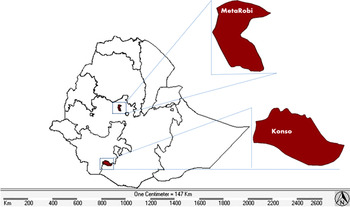
Sampling of Central Highland and Woyto-Guji breeds was done from Meta Robi and Konso districts, respectively (Figure 1). Data were collected from April to May 2013 in Meta Robi and March to April 2013 in Konso district. Meta Robi is one of the districts in the Oromia region and located 100 km northwest from the capital Addis Ababa in the West Shewa zone. The district lies in a hilly land scope at elevations from 1 200 to 2 900 m above sea level (a.s.l.) and located at 9°20′N latitude and 38°10′E longitude. The mean annual temperature and rain fall range from 23 to 31 °C and 750 to 1 100 mm, respectively. Over 95 percent of the population practices mixed crop–livestock production system (Emmenegger, Reference Emmenegger2012).
Map of Ethiopia and selected districts for the baseline survey and performance-monitoring studies.

Konso is located in the southwest of Ethiopia in the Segen Area Peoples’ Zone in the Southern Nations, Nationalities and People's Region. It is located 595 km away from Addis Ababa in the southwest of Ethiopia; it is located at 5°17′36″N latitude and 37°29′05″E longitude (www.google.earth.com) and lies between 600 and 2 100 m a.s.l. (Konso district agricultural office, 2008). The average total annual rainfall is 550 mm; the temperature ranges between 12 and 33 °C (Tesfaye, Reference Tesfaye2003). The annual rainfall variation is between 400 and 1 000 mm (Cheung, Senay and Singh, Reference Cheung, Senay and Singh2008). The production system is integrated crop–livestock system (Forch, Reference Forch2003).
Data collection
Description of production system
Districts and breeds for the implementation of the mega project “Harnessing Genetic Diversity for Improving Goat Productivity in Ethiopia”, of which this research activity is a component, were prior identified through project scoping visits during the project design phase. Criteria considered in selecting the districts were goat population size and relative significance of contribution of goats to the livelihood of communities.
Reconnaissance visits were made to the districts of Meta Robi and Konso for selection of villages. Discussions were held with teams of researchers and experts from the partner regional Agricultural Research Centers and District Agricultural offices in the respective districts. Four villages were accordingly selected from each district by considering goat population size (based on data from the respective district agricultural offices) and relative significance contribution of goats to the livelihood of communities.
Within selected villages, list of households who owned goats and also had good experience in goat rearing were identified in reference to data at the district level agricultural offices and in consultation with village agricultural Development Agents (DAs). Then from which 120 households were selected randomly for administration of the semi-structured questionnaire.
Phenotypic characterization
A total of 601 adult animals (4PPI) (32 males and 268 females central Highland and 38 males and 263 females Woyto-guji goats) were used for linear measurements and observations on the presence or absence of key characteristic features following FAO (2011) recommendations. Linear measurements for all variables except height at wither were taken using graduated plastic measuring tape in cm with a precision of 0.5 cm, while body weight was measured using suspended spring balance in kg with a precision of 0.2 kg. Wither height measurement (cm) was taken using calibrated metal caliper. All measurements were carried out by the same person in order to avoid between individual variations and also it was done early in the morning before the animals were taken to grazing and watering.
Data management and analysis
Questionnaire data
Data collected through questionnaire were coded and entered into Statistical Package for Social Sciences (SPSS for windows, release 14.0, 2006). For data involving frequencies, descriptive statistics were in use and χ 2 or t-test was employed when required to test independence of categories or to assess the statistical significance. Index was calculated for ranked variable (different kinds feed sources in different seasons) in reference to its formula: Index = Sum of (3 × number of household ranked first + 2 × number of household ranked second + 1 × number of household ranked third) given for an individual reason divided by the sum of (3 × number of household ranked first + 2 × number of household ranked second + 1 × number of household ranked third) for overall reasons.
Qualitative and body measurement data
Data from the body weight, linear measurements and morphological observations for the phenotypic characterization were analysed using Statistical Analysis System (SAS Version 9.2, 2008). Qualitative data from the observations were analysed separately for both sexes within each goat breed using the frequency procedures. χ 2 test was employed to test for independence between the categorical variables. The General Linear Model procedure (PROC GLM) of SAS was used to analyse body weight and other linear body measurements. For quantitative data of adult goats the data were analysed to determine the effects of class variable (breed). The effect of class variable were expressed as least-square mean (LSM) ± SE. Due to low number of male animals in each breed all quantitative analysis were carried out using only the females.
The statistical model used was:
 $$Y_{ij} = \mu + B_i + e_{ij}, $$
where Y ij is the observed body weight or linear measurements; μ is the overall mean; B i is the fixed effect of the ith breed (i = Woyto-Guji, Central Highland); e ij is the random error.
Results and discussion
General household characteristics
Majority of respondents (92.5 percent in Konso and 80.9 percent in Meta Robi) were more than 21 years old. Majority of the respondents (97.5 percent in Konso and 88.3 percent in Meta Robi) were male, while most of the households visited at both districts (98.3 percent in Konso and 88.3 percent in Meta Robi) were male headed. In Meta Robi, 12.4 percent of the goat keepers have attended either secondary or college education, while 41.7 percent among the remaining attended primary school. To the contrary, the proportion of respondents who attended primary schools at Konso was 18.1 percent with the remaining majority (81.9 percent) of respondents at Konso being illiterate. This may lead to a lot of bottle necks with regarding to rearing activity, veterinary care, health and hygiene, feeding strategies as well as marketing strategies. Average family size in visited households at Konso (8.52) was significantly (P < 0.01) higher than Meta Robi (7.34).
Livestock holding and goat flock structure
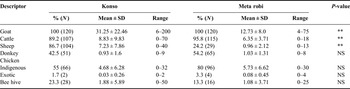
All respondents kept goat as a multispecies enterprise, while all livestock species kept were indigenous breeds. Respondents in Konso had significantly higher (P < 0.01) number of goat, cattle and sheep than Meta Robi. The average ± SD ownership per household of goat, cattle, sheep and donkey for Konso farmers were 31.25 ± 22.5, 8.83 ± 9.8, 7.23 ± 7.9 and 0.93 ± 1.6, respectively. The corresponding values for Meta Robi were 12.73 ± 8.0, 6.35 ± 3.71, 0.96 ± 2.12 and 1.03 ± 1.31, respectively (Table 1). FARM-Africa (1996) reported 11 goats per household for Woyto-Guji flock and ten goats per household for Central Highland flocks. On the other hand, flock size reported in Konso district was higher than the result reported in the same district by Tesfaye (Reference Tesfaye2003) that is oxen, cows and sheep ownership ranged from none to four, whereas the ownership of goats reached up to eight heads of animals per household.
Average flock size of the study areas.

**P < 0.01; NS, non-significant; N, number of households; SD, standard deviation.
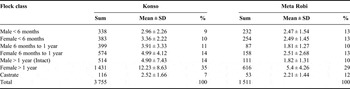
Goat flock structure across sex, age and district was summarized in Table 2. The total proportion of female and male (intact) greater than 1 year and between 6 months and 1 year is higher in Konso than Meta Robi, but the reverse is true regarding the proportion of female and male less than 6 months and castrate. The ratio of male more than 1 year and their female counterparts was about 1:3 in both the study areas. This is comparable with the inference of Endeshaw (Reference Endeshaw2007) in Sidamo zone (1:4), Grum (Reference Grum2010) around Dire Dawa (1:5). But the result is smaller when the proportion of buck to does compared with the previous findings of Nigatu (Reference Nigatu1994) and Workneh (Reference Workneh1992) in Ethiopia and Eritrean goats in pastoral flocks (1:19) and agro-pastoral society in South Ethiopia (1:11). Large proportion of breeding doe in both districts could imply the production of large number of kids which in turn might increase the intensity of bucks. However, the proportion of young bucks was very low in both districts. Lower proportion of young bucks compared with young does might be because of marketing of young bucks in the study areas.
Goat flock structures of the study areas.

SD, standard deviation.
Grazing practice and feed source
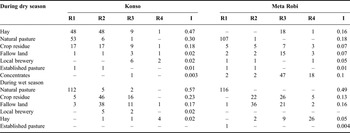
In Konso, natural pasture was the most frequently mentioned feed source during wet season, while hay was the most important feed source during dry season (Table 3). On the other hand, in Meta Robi, natural pasture was the most frequently mentioned feed source during wet and dry seasons. This observation is in agreement with previous studies of the country (Workneh, Reference Workneh1992; Grum, Reference Grum2010; Feki, Reference Feki2013).
Ranking feed resources of the study areas.

R1, R2, R3 and R4 = rank 1, 2, 3 and 4, respectively. I = index: Index = sum of (4 for rank 1 + 3 for rank 2 + 2 for rank 3 + 1 for rank 4) given for an individual reason (attribute) divided by the sum of (4 for rank 1 + 3 for rank 2 + 2 for rank 3 + 1 for rank 4) for overall reasons.
Feed conservation is commonly practiced in both study areas in the form of crop residues (cereal straws) and hay from native pasture. Crop residue, grazing on fallow land, local brewery byproducts and hay were mentioned as additional feed sources during wet and dry seasons in both the study areas. The importance of this feed sources and their seasonality was also reported in Adiya Kaka (Zewdu, Reference Zewdu2008).
Housing system
This study demonstrated that most (76.1 percent in Konso) and almost all (98.3 percent in Meta Robi) households do not mix goats with other species, but the remaining (23.9 percent in Konso and 1.7 percent in Meta Robi) mix goat with sheep during night. Majority (82.2 percent in konso and 76.7 percent in Meta Robi) of respondents kept kids separately during night. This result was in agreement with results of other studies elsewhere in Ethiopia (Grum, Reference Grum2010; Biruh, Reference Biruh2013; Feki, Reference Feki2013). In Konso, all respondents had kid's barn made with mud and wood that is tied with the house of the main flock; while in Meta Robi, kids were housed in the living house. Housing kids with adult goats as well as adult goats with large animals leads to physical injuries.
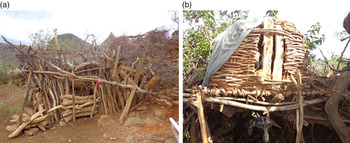
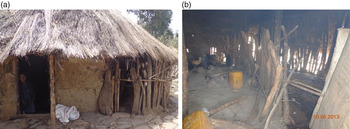
Different housing system was provided to goats by both district households. In Konso, majority (83.3 percent) of goat keepers kept their goats in yard or enclosed land in the night which all respondents made its wall with wood and its floor was mud, but it had no shed (Figure 2). The rest (16.7 percent) of respondents kept their goats in separated pen (75 percent), kept in veranda (20 percent) and in family house (5 percent) which was well roofed with grass (68.2 percent), with wood (27.3 percent) and with iron sheet (4.5 percent). Whereas as it is shown in Figure 3, in Meta Robi majority of respondents shared their family house (55 percent), kept in veranda (42 percent) and in separated pen (2.3 percent) which is well roofed (91.5 percent with grass or bush and 8.5 percent with iron sheet), its wall was majorly made with (95 percent wood and 4.2 percent grass or bush) and its floor mainly was 86.6 percent mud and 10.8 percent stone or bricks. This result contradicted with the report of Workneh, van Dorland and Rowlands (Reference Workneh, van Dorland and Rowlands2004) that reported use of kraal enclosures (88 percent) during the night for pastoralists in Oromia Region. Compared with Meta Robi, Konso's farmers housing management for goats were advanced. It might be due to the number of goats per household is larger and the livelihood mostly depends on goat production, so that the contribution of goats to the societies economy is well known.
Common types of goat housing in Konso: separate house for kids (right) and fence enclosure or adults (left).

Common types of goat housing for adults in Meta Robi: veranda (left) and within family house (right).

Household division of labour for management of goats
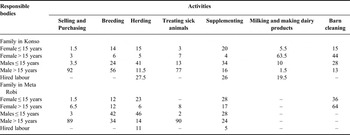
Tending goats is the responsibility of the whole family (Table 4). In both the study areas, mostly purchasing and selling (92 percent in Konso and 89 percent in Meta Robi), decision making regarding breeding (56 percent in Konso and 44 percent in Meta Robi), providing traditional and veterinary services for sick flock (77 percent in Konso and 90 percent in Meta Robi) were the responsibility of adult men particularly by head of a household. As such, the preferences of the household heads (almost all of whom were male) are likely to be of particular relevance to issues of participating in a breed improvement programme.
Responsibilities for goat production activities of households in percent.

Male children were involved mainly (41 percent for Konso and 46 percent for Meta Robi) in herding, while in Konso it was undertaken by hired male children (22 percent). Herdsman received remuneration in cash and kind (food and accommodation) for working the whole day. Women were particularly responsible with regard to milking and making dairy products (63.5 percent) only in Konso but cleaning of flock barns (34 percent for Konso and 36 percent for Meta Robi) in both the study areas. This study illustrated that women and children are involved in many goat production activities. This is in agreement with Sinn et al. (Reference Sinn, Ketzis and Chen1999) who reported that even when men and women farm side by side throughout the day planting and harvesting crops, herding and carrying for small livestock are typically the primary responsibility of women and children (Table 5).
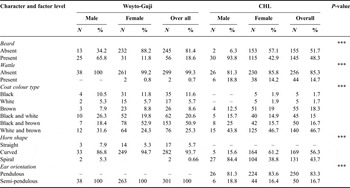
Summary of qualitative traits of indigenous breeds (Woyto-Guji and CHL) by sex.

CHL, Central Highland; N, number of households; ***P < 0.001.
Phenotypic characteristics
Qualitative descriptions
The χ2 test for assumption of equal proportion of categorical variables in Woyto-Guji and Central Highland goat breeds sample population revealed that among the variables considered in this study coat colour type, horn shape, ear orientation, wattle and beard were found significantly (P < 0.001) different.
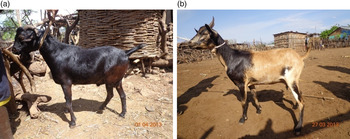
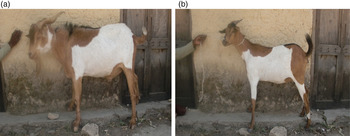
The study revealed that the two breeds have a wide range of coat colours. Majority (50.9 percent) of the Woyto-Guji goats showed a mixture of black and brown with patchy and spotted, while most of the Central Highland goats showed a mixture of white and brown coat colour with patchy and spotted. The apparent wide variation in coat colours within goat breed might be an indicative for the fact that the goat breeds has not yet undergone a strict selection procedure (Figures 4 and 5).
Male (left) and Female (right) of Weyto-Guji breed.

Overall, 81.4 percent of Woyto-Guji and 51.7 percent of Central Highland, 99.3 percent of Woyto-Guji and 85.3 percent of Central Highland, 93.7 percent of Woyto-Guji and 56.3 percent of Central Highland had beard, wattle and curved horn shape, respectively (Table 5). About 83 percent of Central Highland goats had semi-pendulous ear orientation, while all Woyto-Guji goats had pendulous. Most of the qualitative traits of Woyto-Guji goats reported in this research are in agreement with Biruh (Reference Biruh2013) and most traits from both the goat breeds had also agreed with FARM-AFRICA (1996).
Quantitative description
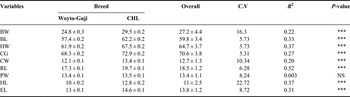
The results of least-squares analysis indicated that the breed has a significant effect (P < 0.001) on body weight and other body measurements except pelvic width (P > 0.05) (Table 6). Central Highland goats had significantly (P < 0.01) higher values for body weight, body length, height at wither, chest girth, chest width, ramp length, horn length and ear length than Woyto-Guji. This result is in agreement with FARM-AFRICA (1996) demonstrated that the Central Highland goat types were superior on body weight, height at wither, chest girth, ear length and horn length than Woyto-Guji.
Least-square means and standard error (LSM ± SE) for main effect of breed on body weight and linear measurements in adult female goats.

BW, body weight; BL, body length; HW, height at wither; CG, chest girth; CW, chest width; RL, ramp length; PW, pelvic width; HL, horn length; EL, ear length; CHL, Central Highland; NS, non-significant; ***P < 0.001.
According to Devendra and Bums (Reference Devendra and Bums1983), goats are classified as large when they weigh between 20 and 60 kg and with a height at withers above 65 cm. On this basis, the Central Highland goats observed in Meta Robi could be classified as large-sized breeds. Linear body measurements reflect breed characteristics and the management conditions under which the animals are kept. Therefore the significant (P < 0.01) differences in body length and height at withers observed in the indigenous goats in the different ecological zones could be attributable to the differences in genetic makeup of the animal, availability of feed resource base (in terms of quantity and quality), availability of natural grazing field and the management conditions which the animals were subjected to (Cam, Olfaz and Soydan, Reference Cam, Olfaz and Soydan2010).
Conclusion
The result revealed that the presence of wide qualitative and quantitative trait variations among two indigenous goat breeds in the various studied agro-ecological zones of Ethiopia. The goat populations in the studied areas have developed varied morphologically adaptable characteristics to be able to survive and reproduce in those environments. Among the unique qualitative traits were the type of coat colour and presence of wattle. Regarding quantitative traits such as body weight, body length, height at wither, chest girth, chest width, ramp length, horn length and ear length, Central Highland goats had significantly higher values than Woyto-Guji. The observed results could be complimented by molecular characterization and well-planned on-station reproduction and production performances evaluation for better management and conservation strategies of genetic resources for indigenous goats.
Male (left) and Female (right) of Central Highland breed.

Acknowledgement
Sincere appreciation is extended to the ILRI Project “Harnessing genetic diversity for improving goat productivity in Ethiopia” that provided the finance and necessary facilitation.