Methicillin-resistant Staphylococcus aureus (MRSA) and vancomycin-resistant Enterococci (VRE) are associated with significant patient morbidity and mortality. 1 MRSA and VRE have been found in retail foods, primarily animal products,Reference Gambarotto, Ploy, Dupron, Giangiobbe and Denis 2 – Reference Vojkovska, Myskova, Gelbicova, Skockova, Kolackova and Karpiskova 6 but the role of hospital food in MRSA and VRE transmission in healthcare facilities is unknown. The purpose of this study was to determine the prevalence of MRSA and VRE in hospital food, with an emphasis on foods consumed by hospital patients.
METHODS
This prospective cohort study was conducted at Barnes-Jewish Hospital, a 1,250 bed tertiary care center in St Louis, Missouri, from May 2011 through July 2012 in conjunction with a study of Clostridium difficile in hospital food.Reference Kwon, Lanzas and Reske 7 Our methods were described previously.Reference Kwon, Lanzas and Reske 7 , Reference Dubberke, Reske, Seiler, Hink, Kwon and Burnham 8 Briefly, patients on medical and surgical wards collected food samples from their meals in sterile specimen cups (1 cup per meal; ≥1 food item per cup) to ensure that the foods sampled were those consumed by patients. Food specimens were frozen at −30°C. Prior to culture, specimens were thawed, combined with 10 mL sterile water, and homogenized for 1 minute. A 1 mL volume of food homogenate was added to TSB broth with 6.5% NaCl; then the mixture was incubated overnight at 35°C. The broth was subcultured on sheep blood agar (Hardy Diagnostics, Santa Maria, CA), Spectra MRSA (Remel Diagnostics, Lenexa, KS), and chromID VRE (bioMèrieux, Marcy-l'Étoile, France). The Vitek matrix-assisted laser desorption/ionization time-of-flight mass spectroscopy (MALDI-TOF MS, bioMèrieux, Marcy-l'Étoile, France) method was utilized to identify S. aureus or Enterococcus spp. Susceptibility testing was performed using Kirby Bauer disk diffusion in accordance with CLSI standards, 9 and SCCmec typing was performed.Reference Boye, Bartels, Andersen, Moller and Westh 10
Data were collected from patient interviews, chart review, and medical informatics queries, including MRSA and VRE clinical laboratory results from 1 year before enrollment to 1 year after enrollment. Descriptive data analyses were performed using SPSS version 21 software (IBM, Armonk, NY). The Washington University Institutional Review Board approved the study.
RESULTS
In total, 149 patients were enrolled in the study and 910 food specimens were collected (median, 5 specimens per patient; range, 1–24 specimens). The median patient age was 55 years (range, 23–90 years); 80 patients (54%) were female. 8 patients (5%) had clinical cultures (infection and/or surveillance) positive for MRSA, and 7 patients (5%) had clinical cultures positive for VRE, in the year before enrollment.
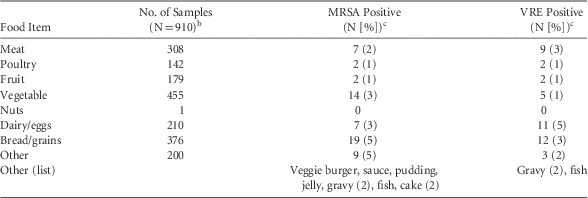
Overall, 1 or more food specimens from 17 patients (11%) were positive for MRSA, and 1 or more food specimens from 17 patients (11%) were positive for VRE. MRSA was cultured from 29 specimens (3.2%), and VRE was cultured from 22 specimens (2.4%); more than 1 positive specimen was collected from some patients. Of the 29 MRSA-positive isolates, 9 (31%) were SCCmec II, 2 (7%) were SCCmec III, and 18 (62%) were SCCmec IV. Notably, 7 SCCmec IV isolates came from a single patient (ie, 39% of SCCmec IV isolates). MRSA and VRE were cultured from every food category except nuts (Table 1). VRE was recovered from 5% of dairy or egg specimens and MRSA was recovered from 5% of bread or grain specimens and “other” specimens; for all other foods, the culture positivity rate was <5%.
Food Specimens Positive for Methicillin-Resistant Staphylococcus aureus (MRSA) and Vancomycin-Resistant Enterococci (VRE), by Food TypeFootnote a

a N=149 patients; 910 food specimens.
b More than 1 food item could be included in a sample.
c Percentages are number of positive specimens per total food items of that type.
Only 4 patients (3%) had a clinical culture positive for MRSA or VRE after having positive food without a previous clinical history of MRSA or VRE. MRSA was isolated from the urine of patient A 28 days after the positive food specimen (SCCmec IV) was collected. Patient B had 2 positive MRSA surveillance screens, 48 and 50 days after the positive food specimens were collected. MRSA was cultured from food specimens collected by this patient on 5 separate days, and 7 of the SCCmec IV isolates were obtained from specimens collected by this patient. Enterococcus faecalis was cultured from food collected by patient C 23 days before this patient had a positive VRE surveillance screen. Between the food and screen dates, patient C had 2 urine specimens positive for Enterococcus (1 vancomycin susceptible, the other unknown) and 1 blood culture positive for E. faecalis (vancomycin susceptible). Finally, 2 food specimens, positive for MRSA and E. faecalis, were collected by patient D on 2 separate days, and this patient had a positive VRE surveillance screen more than 3 months after the positive food specimens were collected.
DISCUSSION
To the best of our knowledge, ours is the first study to evaluate the presence of MRSA and VRE in the food of hospitalized patients. We previously found that food is unlikely to be a significant source of C. difficile acquisition for hospitalized patients.Reference Kwon, Lanzas and Reske 7 The prevalence of MRSA and VRE found in food in the current study (3.2% and 2.4%, respectively) was higher than the prevalence of C. difficile (0.2%), but the overall contamination rate was still low.
While this study was not designed to determine conclusively whether patients acquired MRSA or VRE from their hospital food, our results suggest that acquisition via food may be rare. Additionally, patients enrolled in this study collected their own food specimens; thus, the patients themselves may have been the source of the contamination. Of the 4 patients with positive MRSA or VRE clinical cultures after a positive food culture and no prior clinical history of MRSA or VRE, 2 patients had MRSA or VRE cultured from food specimens on more than 1 day. Because the overall food contamination rate was low, this pattern suggests patient contamination. Thus, prior clinical history or possible self-contamination may eliminate the possibility of food acquisition in all but 2 patients (1%).
While MRSA and VRE have been documented in retail food previously, the comparability of results prior to our study cannot be determined.Reference Gambarotto, Ploy, Dupron, Giangiobbe and Denis 2 , Reference Lopez, Saenz and Rojo-Bezares 3 , Reference de Boer, Zwartkruis-Nahuis and Wit 5 , Reference Vojkovska, Myskova, Gelbicova, Skockova, Kolackova and Karpiskova 6 The effect of food preparation on the bacterial burden in hospital food is unknown. Despite these limitations, our study indicates that MRSA and VRE can be present in the food of hospitalized patients, and the implications of this finding warrant additional study.
ACKNOWLEDGMENTS
Financial support: This study was supported by the National Institute of Diabetes and Digestive and Kidney Diseases (grant no. P30DK52574); and the Washington University Institute of Clinical and Translational Sciences (grant no. UL1TR000448, sub-award no KL2TR000450, from the National Center for Advancing Translational Sciences of the National Institutes of Health, to J.H.K.).
Potential conflicts of interest: C.A.B. reports grants from bioMerieux, Cepheid, Accelerate, Theravance, and Aperture Bio, and she has received personal fees from Accelerate, BD, Monsanto, and ThermoFisher, all unrelated to this study. All other authors report no conflicts of interest.