




Crossref Citations

This article has been cited by the following publications. This list is generated based on data provided by Crossref.
Tan, Tiffany
Chan, Sonia
Ind, Melissa
Pace, Georgia
Bailey, Jannine
Reed, Krista
Dutton, Teagan
Osuagwu, Uchechukwu Levi
and
Wong, Kam Cheong
2023.
Benefits and challenges of electronic prescribing for general practitioners and pharmacists in regional Australia.
Australian Journal of Rural Health,
Vol. 31,
Issue. 4,
p.
776.
Raeesi, Ahmad
Tara, Mahmood
and
Kiani, Behzad
2023.
Spatial accessibility to hospitals in Southeast Iran: an enhanced two-step floating catchment area method.
GeoJournal,
Vol. 88,
Issue. 5,
p.
5427.
Alipour, Jahanpour
Payandeh, Abolfazl
Hashemi, Aida
Aliabadi, Ali
and
Karimi, Afsaneh
2024.
Physicians' Perspectives with the E-prescribing System in Five Teaching Hospitals.
Applied Clinical Informatics,
Vol. 15,
Issue. 03,
p.
428.
Jebraeily, Mohamad
Naji, Shahryar
and
Nourani, Aynaz
2024.
Strengths, weaknesses, opportunities, and threats (SWOT) of the electronic prescribing systems executed in Iran from the physician’s viewpoint: a qualitative study.
BMC Medical Informatics and Decision Making,
Vol. 24,
Issue. 1,
Moghani, Neda Borhani
Hooshmand, Elahe
Zarqi, Marzie
and
Meraji, Marziyhe
2024.
Challenges and solutions in implementing electronic prescribing in Iran’s health system: a qualitative study.
BMC Medical Informatics and Decision Making,
Vol. 24,
Issue. 1,
Bouraghi, Hamid
Imani, Behzad
Saeedi, Abolfazl
Mohammadpour, Ali
Saeedi, Soheila
Khodaveisi, Taleb
and
Mehrabi, Tooba
2024.
Challenges and advantages of electronic prescribing system: a survey study and thematic analysis.
BMC Health Services Research,
Vol. 24,
Issue. 1,
Mohammadzadeh, Zahra
Nickfarjam, Ali Mohammad
Atoof, Fatemeh
Shakeri, Ali Akbar
Aghasizadeh, Fatemeh
Rasooli, Zahra
and
Miranzadeh, Yalda
2024.
Evaluating usability of computerized physician order entry systems: Insights from a developing nation.
Informatics in Medicine Unlocked,
Vol. 47,
Issue. ,
p.
101487.
Alshoumr, Bader
Alkhalaf, Abdullah
Alkwai, Hend
Alsowaida, Yazed S.
Alfehaid, Ghaliah
and
Alnasser, Badr
2025.
Exploring family physicians’ experiences with electronic prescribing platforms in primary healthcare centers in Hail, Saudi Arabia: a qualitative study.
BMC Health Services Research,
Vol. 25,
Issue. 1,
Raeesi, Ahmad
Hashtarkhani, Soheil
Tara, Mahmood
Sargolzaei, Narjes
and
Kiani, Behzad
2025.
Empowering access: unveiling an overall composite spatial accessibility index to healthcare services in Southeastern Iran.
International Journal for Equity in Health,
Vol. 24,
Issue. 1,
Karimi, Shokoufeh
Jahani, Yunes
and
Ahmadian, Leila
2025.
The effect of electronic prescription systems on pharmacy performance through evaluation of existing infrastructure in Kerman Iran.
Scientific Reports,
Vol. 15,
Issue. 1,
Ghaderi, Amene
Shirdel, Bahar
and
Shakerian, Sareh
2026.
Strategic analysis of electronic prescriptions in Iran: a qualitative study.
BMJ Open,
Vol. 16,
Issue. 6,
p.
e101872.
Aldhafeeri, Fahad
Wilson, Andrew
and
Larkin, Shaun
2026.
Transforming quality use of medicines in Saudi Arabia: physician perspectives on electronic prescribing systems.
Frontiers in Digital Health,
Vol. 8,
Issue. ,
Background
Nowadays, healthcare centers are using multiple types of health information systems to collect, store, process, manage, and interoperate information with a wide array of purposes. One of the systems currently used in healthcare centers is the electronic prescribing system. The electronic prescribing system uses computerized communication networks to store and transfer physician orders to the pharmacy at the point of care (1;Reference Palappallil and Pinheiro2). Previous studies (Reference Palappallil and Pinheiro2–Reference Dreischulte, Donnan, Grant, Hapca, McCowan and Guthrie9) have shown that using the electronic prescribing system enhances the efficiency of care providers, improves patient safety, reduces medical costs, increases the effectiveness of services provided, enables access to the patient's medication history and the monitoring of medication interactions, improves medical outcomes, and reduces healthcare expenses.
In the southeast of Iran, insurance coverage and access to healthcare services are lower than other areas (Reference Amini Rarani, Rafiye and Khedmati Morasae10). In this area due to the small number of physicians in proportion to the population, the number of visits to hospitals and clinics affiliated to the Social Security Organization (SSO) is high, and the time spent by the physician on each patient is, therefore, limited. According to the results obtained in some studies (Reference Devine, Hollingworth, Hansen, Lawless, Wilson-Norton and Martin11–Reference Lim, HSS, Ng, John Jasudass, Sararaks and Vengadasalam13), electronic prescriptions take more time to write compared with paper prescriptions. Also, about half of a physician's time is spent on recording data in the electronic health record (EHR) and documentation and more than 2 percent for electronic medication order entry (Reference Sinsky, Colligan, Li, Prgomet, Reynolds and Goeders14). Also, a large number of errors can occur in outpatient care (Reference Lim, HSS, Ng, John Jasudass, Sararaks and Vengadasalam13); however, previous studies have shown that these systems improve patient safety and reduce costs (Reference Porterfield, Engelbert and Coustasse8).
Efficiency means the expenditure of a certain amount of effort and resources to fully and properly achieve a goal and includes items such as time, costs, and ease of performing tasks (15;Reference Georgsson and Staggers16). Effectiveness means the full and proper achievement of a goal by the user and includes items such as patient safety and the system's influence on the quality of the provided services (15;Reference Georgsson and Staggers16). Considering that effectiveness can be used for measuring output, whereas efficiency can be used to assess the resources needed to achieve these goals (15), the system's status can, therefore, be measured by the concurrent evaluation of efficiency and effectiveness. Without considering users’ perspectives and their levels of satisfaction, the system will be abandoned. Accordingly, due to the high costs of developing systems, significant financial resources will be required to buy and implement an information system. Thus, it is necessary to evaluate their perspectives and their levels of satisfaction (Reference Khajouei and Abbasi17;Reference Khajouei, Peek, Wierenga, Kersten and Jaspers18). Physicians are the main users of the electronic prescribing system.
Many countries, especially low- and middle-income countries, still use manual traditional prescribing systems. Thus, applying the experiences of countries that used the electronic prescribing system can be helpful to understand the impact of this system on its users (Reference Samadbeik, Ahmadi, Sadoughi and Garavand19).
To our knowledge, no study has been carried out concurrently to evaluate the efficiency and effectiveness of the electronic prescribing system from the perspective of physicians despite the extensive use of this system. Efficiency and effectiveness have been evaluated in a few studies as the secondary objective (Reference Kannry20–Reference Kaushal, Barron and Abramson22). To achieve the goals of the successful implementation of the electronic prescribing system, the perspectives of physicians can be useful in understanding the efficiency and effectiveness of the system. The aim of this study was to evaluate physicians’ perspectives on the efficiency and effectiveness of the electronic prescribing system. This study may help attain the main goal of developing electronic prescribing systems, which is improving the quality of any services provided to patients in low- and middle-income countries.
Methods
The Electronic Prescribing System of the SSO
The Iranian social security organization has two big sections, namely insurance and medical care services. This organization is the largest health insurance organization that covers half of the country's population. Also, the SSO is the second largest provider of health services to patients after the ministry of health in Iran. All of the medical care services are provided free to patients in the healthcare centers affiliated to this organization.
The electronic prescribing system of the SSO's medical centers and hospitals is the most extensive and the only such system implemented countrywide in Iran. This system is developed by the Tamin ICT (Information and Communication Technologies) and management and consultancy services company affiliated with the SSO. This system is used in all medical centers affiliated to the SSO, including 70 hospitals and 279 general and specialized clinics throughout the country (23).
The electronic prescribing system of the SSO is used for inpatient and outpatient centers affiliated with the SSO and supports the entire electronic prescribing process. This system is the first experience of Iranian physicians to register their medications in an electronic format. However, this system has the following drawbacks: Only physicians who are working in the SSO-affiliated health centers have access to this system. The process of interoperating and integrating with other systems has not been implemented in many health information systems in Iran. Thus, healthcare centers are not able to exchange health data together.
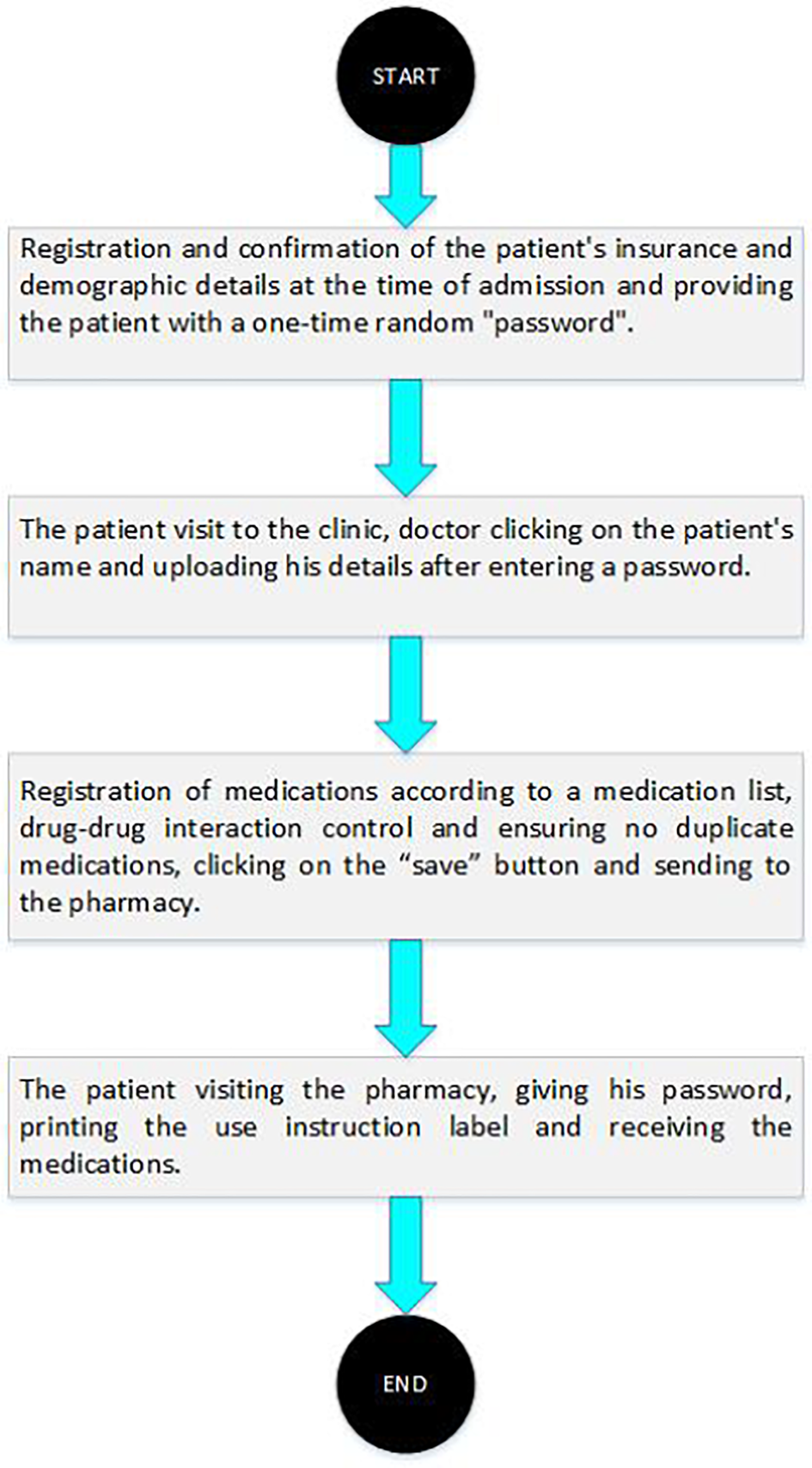
The electronic prescribing system implemented in SSO health centers and hospitals works as part of the hospital information system in hospitals and as a separate system in clinics for the registration of medications and paraclinical procedures by physicians and is only available to physicians in these centers. This prescribing system has not been integrated with the broader electronic health systems such as pharmacies or other hospitals in Iran yet. Each SSO healthcare center has a solely electronic prescribing system that is not integrated together. Figure 1 illustrates the functional process of using the electronic prescribing system. In this system, the availability of medications is based on the national formulary pharmacopoeia of Iran (24), but the physicians can only prescribe the medications that exist in the hospital's pharmacy. Otherwise, the system informs the physicians to prescribe an alternative medication. Medications can be selected and registered by the physician through both a search and from the list of medications registered as a package.
The process of working with the electronic prescribing system.
Using this system, physicians are able to do the following activities: select the intended medications and then register their order according to a medication list, and select the method of administration and dosage. Also, in this system, the directions of use, and the total quantity authorized to be dispensed, and communicating orders to the hospital pharmacy are provided. Medications are then automatically registered in the patient's medication history. Paraclinical measures, including tests, imaging, and other procedures, can also be registered. In addition to the registration of medications and procedures, the patient's vital signs, main complaint and current illness, disease history, physical examination results, diagnosis, and diagnosis explanation and treatment plan can also be registered in this system. The system warns physicians about any drug–drug interactions or if a certain medication has already been prescribed to the patient by other physicians in recent times. At present, this system only registers the medications available in the relevant health center and other medications not available in the same center are registered as paper prescriptions.
Study Design
This descriptive-analytical study was conducted in 2018 on all physicians using the electronic prescribing system of the SSO in Sistan and Baluchistan Province. Sistan and Baluchistan Province is one of the southeastern provinces of Iran. This province is the second widest province of Iran with a population of 2.8 million. Its provincial SSO has five general and specialized clinics and two hospitals, which provide medical services to approximately one-quarter of the province's population. This study was conducted a year after the implementation of the electronic prescribing system in this province. This study was approved by the ethics committee of Kerman University of Medical Sciences (IR.KMU.REC.1397.262).
Data Collection
Data were collected using a self-administered questionnaire based on the review of relevant scientific literature (Reference Palappallil and Pinheiro2;Reference Lapane, Rosen and Dubé4;Reference Porterfield, Engelbert and Coustasse8;Reference Hollingworth, Devine, Hansen, Lawless, Comstock and Wilson-Norton12;Reference Devine, Williams, Martin, Sittig, Tarczy-Hornoch and Payne25). The validity of this questionnaire was confirmed by two medical informatics experts and two health information management experts. The reliability of this questionnaire was tested on questionnaires completed by twenty random participants using Cronbach's alpha (α = 94%) (Reference Khajouei and Abbasi17).
The questionnaire consisted of three sections:
(1) Six items related to demographic data and clinical experience, computer skills, the use of computers per shift (based on hours), and the site of using the electronic prescribing system by the participant.
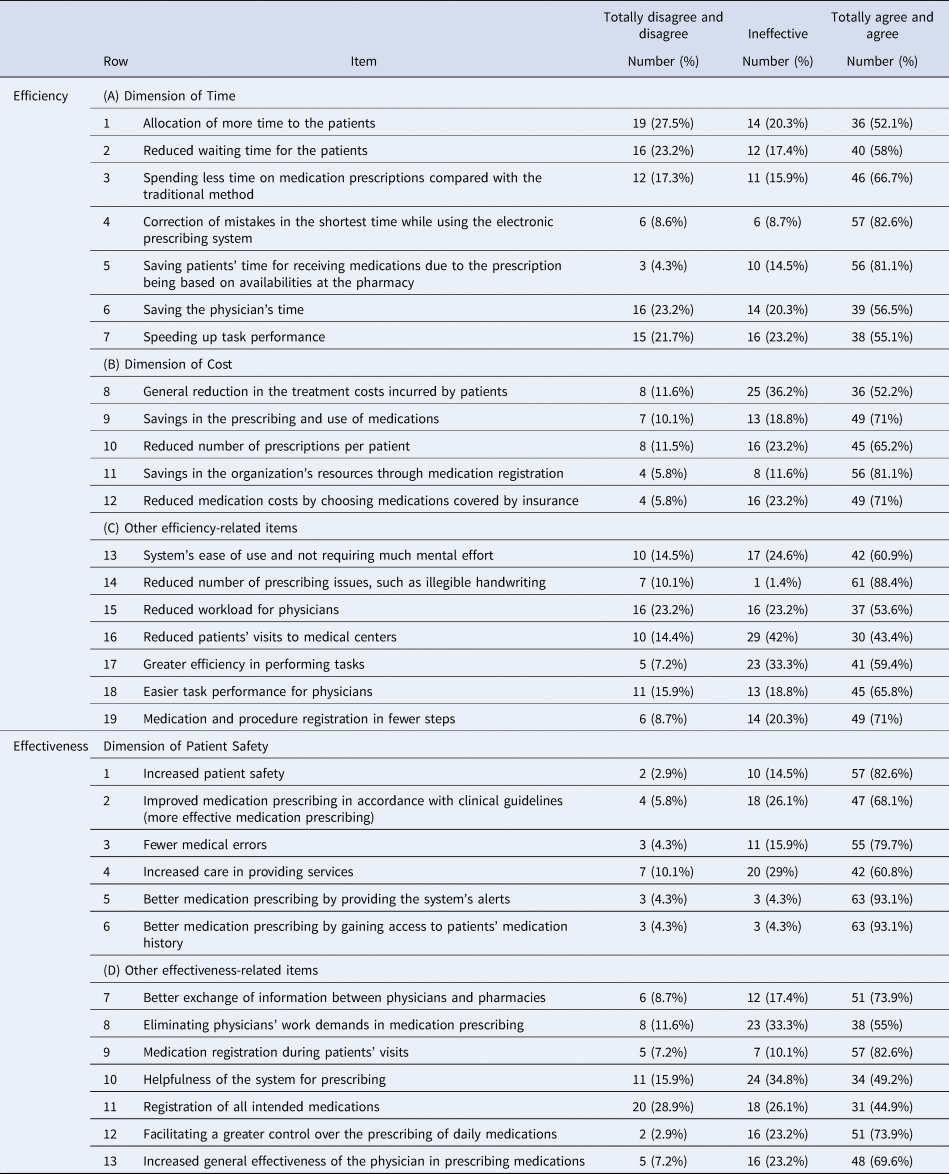
(2) Questions related to physicians’ perspectives on the efficiency (19 questions) and effectiveness (13 questions) of the electronic prescribing system. The efficiency was in three dimensions, time (7 questions), costs (5 questions), and other efficiency-related questions (7 questions). The effectiveness was in two dimensions, patient safety (6 questions) and other effectiveness-related items (7 questions). The items were answered based on a five-point Likert scale (“totally disagree,” “disagree,” “ineffective,” “agree,” and “totally agree”). The asked questions about the efficiency and effectiveness of the electronic prescribing system are available in Table 1.
(3) Two open-ended questions related to the most positive and negative aspects of the electronic prescribing system.
The frequency and frequency percentage of the items on the impact of the electronic prescribing system on efficiency and effectiveness
Data were collected by the researcher through a visit to the physicians' workplace while using the electronic prescribing system and asking them to complete the questionnaire. Before completing the questionnaire, the participants were briefed on the study and how to complete the questionnaire, and informed verbal consent was obtained from them; completing the questionnaire indicated the participant's consent.
Data Analysis
Data were analyzed using SPSS-18. Descriptive statistics were used to calculate the frequency and percentage of the responses. To calculate the frequency and frequency percentage of whether participants agree or disagree, we consider the “totally agree” and “agree” options reported together and the “disagree” and “totally disagree” options also reported together. For the analytical statistics, each option on the Likert scale was given a score from one (“totally disagree”) to five (“totally agree”), and their mean values were taken as the efficiency and effectiveness scores.
Normality was assessed using the Kolmogorov–Smirnov test. Given the normal distribution of the data, Pearson's analytical test was used to assess the relationship of age and work experience with efficiency and effectiveness, the relationship of the efficiency dimensions with the effectiveness dimensions, and also the relationship of efficiency with effectiveness. The analytical independent t-test was used to assess the relationship of gender, the site of using the electronic prescribing system, and specialization with efficiency and effectiveness. The relationship of computer skills with efficiency and effectiveness was also assessed using the ANOVA.
Results
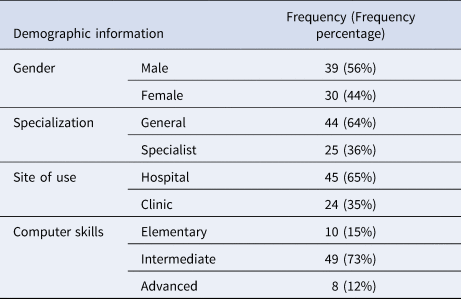
Of the eighty-two participants in the study, sixty-nine (84%) responded to the questionnaire. The mean and standard deviation of age and work experience of these participants were 42 ± 10 and 12 ± 8 years, respectively. All of the participants had one-year experience of using this system, and the educational background of all participants was medicine. The demographic information of the participants is given in Table 2. In total, 56 percent (n = 39) of the participants were male. The majority of physicians (73%) had a moderate level of computer skills.
Demographic information of the participants
The mean and standard deviation of the scores of the efficiency and effectiveness of the electronic prescribing system were 3.68 ± 0.67 and 3.84 ± 0.65 out of five, respectively. Among the effectiveness dimensions, “patient safety” had the highest mean score (4.0 ± 0.64) and the “other effectiveness-related items” the lowest mean score (3.68 ± 0.73). Among the efficiency dimensions, the highest mean score pertained to “costs” (3.79 ± 0.66) and the lowest to the “other efficiency-related items” (3.6 ± 0.70).
The impact of the electronic prescribing system on efficiency based on the physicians' perspective is shown in Table 1. In the dimension of time related to the efficiency of the electronic prescribing system, the physicians' highest agreement with the electronic prescribing system pertained to the “correction of mistakes in the shortest time while using the system” and “saving the patients’ time for receiving their medications due to the prescription being based on the pharmacy's availability list” with more than 80 percent (n = 56). The lowest agreement pertained to “allocating more time to the patients” with 52 percent (n = 36).
In the dimension of costs, 81 percent (n = 56) of the physicians believed that the greatest savings were due to the registration of the prescribed medications in the electronic prescribing system and the lowest agreement was obtained for the “reduced patients’ costs” with 52 percent (n = 36). In the dimension of “other efficiency-related items,” the greatest agreement among the physicians pertained to the “fewer prescribing issues such as illegible handwriting” with 81 percent (n = 61); also, 42 percent (n = 29) of the physicians believed that the electronic prescribing system has no effect on the patients’ visits to health centers.
Also, the impact of the electronic prescribing system on effectiveness based on the physicians’ perspective is shown in Table 1. In the dimension of “patient safety,” the physicians’ highest agreement with the electronic prescribing system (91%; n = 63) pertained to “better medication prescribing by providing system's alerts and access to patients’ medication history” and the least agreement pertained to “improvement in medication prescribing in accordance with clinical guidelines” (68%; n = 47).
In the dimension of “other effectiveness-related items,” the highest agreement among the physicians pertained to the “registration of medications during the patient's visits” with 82 percent (n = 57) and the lowest to the “registration of all the intended medications” with 45 percent (n = 31).
The results of the analytical statistics showed that the mean scores of efficiency and effectiveness had no significant relationship with gender, age, work experience, specialization, the site of using the system, or computer skills (p > .05). Also, there was a significant relationship and correlation coefficient between the mean scores of efficiency and effectiveness (r = +.866; p < .0001). In other words, with increasing the mean of efficiency, the mean of effectiveness also increased and vice versa. Also, there is a significant relationship and correlation coefficient between all of the efficiency's dimensions (time, costs, and other efficiency-related items) and effectiveness's dimensions (patient safety and other effectiveness-related items) (r > +.60; p < .0001). In other words, with increasing the mean of every efficiency's dimension, the mean of each effectiveness’ dimension also increased and vice versa.
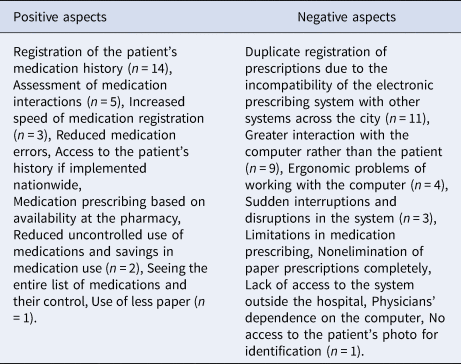
In response to the two open-ended questions, twenty participants reported positive aspects of the system and twenty-four participants reported negative aspects, as shown in Table 3. “Registration of the patient's medication history” (n = 14) and “Duplicate registration of prescriptions due to the incompatibility of the electronic prescribing system with other systems across the city” (n = 11) were the most important positive and negative aspects of the electronic prescribing system, respectively.
The positive and negative aspects of using the electronic prescribing system
Discussion
Core-Summary Findings
The majority of physicians believed that the electronic prescribing system of the SSO has a high level of efficiency and effectiveness. Most physicians agreed that the following items increased the efficiency and effectiveness of the electronic prescribing system: Enhanced patient safety, reduced medical errors, better medication prescribing by providing alerts and access to patients’ medication history, the registration of medications and the correction of mistakes in the shortest time and during the patient's visit, savings in the organization's resources through medication registration, savings in the patients’ time for receiving their medications due to prescriptions being based on pharmacies’ availability, and fewer prescription issues such as illegible handwriting.
Physicians believed that one of the issues that reduce the efficiency and effectiveness of the electronic prescribing system is the registration of all medications intended by the physician for the patient in the electronic prescribing system, because only medications available in the affiliated medical centers are registered through this system and any medications available outside the center are registered on paper, which leads to duplications in the case of referral to other centers. The proportion of medications recorded on paper to medications registered in the electronic prescribing system is approximately 5 percent.
This study was conducted a year after the implementation of the electronic prescribing system because all physicians had adopted this system and used it in their working time. Also, they received a good perception of the efficiency and effectiveness of this system.
There is no complete and accurate information before the implementation of the electronic prescribing systems in healthcare centers affiliated to the SSO. So, we cannot report accurately and metrically how much patient safety has increased in these centers. All physicians who participated in this study were working in these centers before and after the implementation of the electronic prescribing system. Thus, we could investigate only the subjective physicians’ perspective on the effect of the electronic prescribing systems on patient safety.
Comparisons with Existing Literature
Similar to this study, the results of previous studies demonstrated that the electronic prescribing system can enhance patient safety and reduce medical errors (Reference Lapane, Rosen and Dubé4;Reference Porterfield, Engelbert and Coustasse8;Reference Dreischulte, Donnan, Grant, Hapca, McCowan and Guthrie9;Reference Kaushal, Kern, Barrón, Quaresimo and Abramson26). The present findings confirm the results obtained in a study conducted by Lapane et al. (Reference Lapane, Rosen and Dubé4) to assess users’ perception of the efficiency and inefficiency of the electronic prescribing system, which showed that most participants considered the system highly efficient.
Based on the results of this study, more than half of the physicians believed that using this system leads to reduced costs and the number of prescriptions. Similarly, the results of two studies (Reference Weingart27;Reference Stenner, Chakravarthy, Johnson, Miller, Olson and Wickizer28) showed that using the electronic prescribing system and electronic medication exchange will reduce costs. The results obtained in McMullin et al. study (Reference McMullin, Lonergan and Rynearson29) also showed that implementing the electronic prescribing system leads to fewer prescriptions of expensive medications.
In this study, a small number of participants argued that using the electronic prescribing system only increases physicians’ interaction with the computer and reduces their interaction with the patients. Also, they believed that physicians spend a long time entering the medication data into the electronic prescribing system and will, therefore, have less time for a careful examination and eye contact with the patient. This finding concurs with the results obtained by Devine et al. (Reference Devine, Hollingworth, Hansen, Lawless, Wilson-Norton and Martin11) and Hollingworth et al. (Reference Hollingworth, Devine, Hansen, Lawless, Comstock and Wilson-Norton12).
In our study, the efficiency and effectiveness of the SSO electronic prescribing system had no significant relationship with gender, age, work experience, specialization, and computer skills. Likewise, previous studies (Reference Lee, Lee, Lin and Chang30–Reference Abbasi, Khajouei and Mirzaee33) showed that there was no relationship between age, gender, and working experience with computers of users with some electronic systems such as nursing information systems (NIS), electronic medical record system, and surgery information system. Contrary to the above results, in the two studies on the NIS and computerized physician order entry (Reference Khajouei, Wierenga, Hasman and Jaspers34;Reference Kim35), the age of users impacted their satisfaction levels, and it was found that older users were more satisfied than their younger counterparts. This difference in the result might be because of the different types of investigated systems or questionnaires used. In the Kim study (Reference Kim35), the satisfaction with the NIS, the degree of satisfaction with efficacy and effectiveness, and the degree of satisfaction with safety and security were assessed.
Our findings showed that there is a significant correlation between efficiency and effectiveness. Our results are in line with the results of a study concerning the correlation between satisfaction, effectiveness, and efficiency (Reference Frøkjær, Hertzum and Hornbæk36). Also, the results of two studies (Reference Georgsson and Staggers16;Reference Abbasi, Khajouei and Mirzaee33) showed that there is a significant correlation between the efficiency and effectiveness of the surgery information system and that of the diabetes mHealth system.
Many countries are at different levels and stages of implementation of the electronic prescribing system (Reference Samadbeik, Ahmadi, Sadoughi and Garavand19). There are some similarities or differences in their healthcare and insurance systems. The electronic prescribing system had started from SSO healthcare centers in Iran as a developing country. So, the results of this study might be generalized with some developing or low- and middle-income countries. Also, some countries that have not implemented an EHR can benefit from the use of an unintegrated and solely electronic prescribing system.
Given that some of the problems in this system are caused by its incompatibility with other systems, the infrastructure facilities needed for this system's compatibility with other systems are recommended to be further considered by policy makers. Some of the problems in this system may be related to its usability. Future studies are recommended to employ usability methods to assess the efficiency and effectiveness of the system by measuring the time and resources it uses up.
Study Limitations
This study had two limitations. First, because it was conducted in only one of the provinces of Iran, the limitation arose due to the small statistical population in proportion to the total population of the users of the electronic prescribing system across the country. Thus, the information obtained should be generalized with caution; however, because the structure of human resource distribution is the same in most health centers of the SSO, conducting this study in other centers seems to not produce different results. The second limitation is that subjectively physicians’ perspectives were used in this study to assess the efficiency and effectiveness of the electronic prescribing system, and the evaluation of users’ perspectives may not be as accurate as the employment of other methods such as timing, which is used to estimate the amount of time spent working with the system to perform a given task. Future studies can use more objective techniques to measure these two components.
Conclusion
The results of this study show that the electronic prescribing system improves the efficiency and effectiveness of prescribing by physicians. In particular, physicians believed that using this system improves patient safety and reduces costs. This study also highlighted some of the weaknesses of this system and the aspects that users required to be improved. Also, this study provided an insight into the problems and benefits of the efficiency and effectiveness of the electronic prescribing system. The electronic prescribing system is relatively new or in the early stages of its implementation in some developing countries and many of the efficiency and effectiveness problems in this system may have been resolved in developed countries. Thus, developing countries that have recently been involved in the design and implementation of the electronic prescribing system encounter the same problems that developed countries faced. So, the results of this study may be helpful for health policy makers and system developers of these countries.
Acknowledgments
The authors wish to express their gratitude to all the participating physicians for completing the questionnaire and also to the treatment director of the SSO of Sistan and Baluchistan Province for giving their permission to conduct the study.
Funding
This work was supported by Medical Informatics Research Center, Kerman University of Medical Science, grant number (IR.KMU.REC.1397.262). This funding source had no role in the design of the study and only the researchers were introduced in this way to the hospital for data collection.
Conflict of Interest
There are no conflicts of interest.