Introduction
Intrauterine growth restriction (IUGR), defined as a failure of the fetus to achieve its genetic growth potential,Reference Rosenberg 1 affects 6–12% of births globally.Reference Sharma, Shastri, Farahbakhsh and Sharma 2 In developed countries, the major cause of IUGR is placental insufficiency, which limits the supply of nutrients and oxygen to the developing fetus and thus restricts fetal growth.Reference Sankaran and Kyle 3 The majority of IUGR individuals undergo a period of accelerated or catch-up growth in the early postnatal period, and ‘catch-up’ in body weight to normally grown infants by 6 months to 2 years of age.Reference Tenovuo, Kero and Piekkala 4 , Reference Albertsson-Wikland and Karlberg 5 Markers of IUGR, such as small size at birth for gestational age (SGA), and accelerated neonatal growth are each independent predictors of poor cardiometabolic health outcomes, including diabetes, coronary heart disease, hypertension and obesity, in postnatal life.Reference Eriksson, Forsen and Tuomilehto 6 – Reference Ong, Ahmed, Emmett, Preece and Dunger 9
While the importance of catch-up growth for determining future metabolic health outcomes of the child is well established, the mechanisms which underlie catch-up growth remain poorly understood. There are suggestions, however, that increased appetite and food intake in the early neonatal period may play an important role. In a small clinical study, SGA infants consumed a greater volume of breast milk relative to their body weight in the early neonatal period, than infants who were of average or above average birth weight.Reference Ounsted and Sleigh 10 Studies in rodents and sheep have also provided indirect evidence of higher milk consumption during the neonatal period in growth-restricted offspring in comparison with their normally grown counterparts, based on more rapid neonatal growth rates and higher milk intakes post-weaning.Reference Greenwood, Hunt, Hermanson and Bell 11 , Reference Vickers, Breier, Cutfield, Hofman and Gluckman 12 Studies in small ruminants (goats) by Laporte-Broux et al. also reported that daily feed intake between birth and 2 months post-partum of kids artificially reared on milk was higher in female kids born to goats who were feed-restricted in late pregnancy compared with progeny of ad libitum-fed mothers.Reference Laporte-Broux, Roussel and Ponter 13 Interestingly, however, they saw no effect of maternal feed restriction on suckling behaviour or milk intake in male kids reared by their mothers.Reference Laporte-Broux, Roussel and Ponter 14 In our established sheep model of placental and fetal growth restriction,Reference Alexander 15 – Reference De Blasio, Gatford, McMillen, Robinson and Owens 17 we have previously demonstrated that during their active period of catch-up growth, 15-day-old lambs from placentally restricted (PR) ewes suckle for longer in the acute phase of weigh-suckle-weigh (WSW) tests than control (CON) lambs.Reference De Blasio, Gatford, Robinson and Owens 18 However, milk intake was not quantified in this previous study.
In addition to the volume consumed, milk composition is also an important determinant of offspring growth rate and body composition, and there is evidence from animal models that maternal milk composition may be altered after IUGR pregnancies. Induction of uteroplacental insufficiency by bilateral uterine vessel ligation in late gestation rat dams reduces milk yield and in lactose content on day 6 of lactation.Reference O’Dowd, Kent, Moseley and Wlodek 19 To date, however, effects on milk yield and composition of chronic PR throughout pregnancy, or of IUGR in a large animal model, have not been reported.
Therefore, the primary aims of the present study were to determine the effects of placental restriction and birth weight variation between twin littermates on milk intake and feeding behaviour of lambs during the first month of postnatal life, when the majority of catch-up growth occurs in this experimental model of IUGR.Reference De Blasio, Gatford, McMillen, Robinson and Owens 17 , Reference De Blasio, Gatford, Robinson and Owens 18 A secondary aim was to determine the impact of PR on the composition of the ewe’s milk during this same period.
Methods
Animals and surgery
All procedures were approved by the University of Adelaide Animal Ethics Committee (approval M-2013-231) and conducted in accordance with Australian Guidelines for the Ethical Conduct of Research in Animals. 20 Details of the animal cohort from which the animals in this study were derived have been published in detail previously.Reference Kaur, Wooldridge and Wilkes 21 Briefly, placental growth of Merino×Border Leicester ewes was restricted by surgical removal of all but four visible endometrial placental attachment sites (caruncles) from each uterine horn, at least 10 weeks before timed mating of PR and unoperated CON ewes.Reference Alexander 15 , Reference Robinson, Kingston, Jones and Thorburn 16 All ewes were multiparous and pregnancy was confirmed by ultrasound at 48–55 days after mating, and ewes scanned as pregnant with twins were selected for the present study. Ewes were housed indoors from day 110 of gestation until their spontaneously born lambs were weaned at 97.0±0.4 days of age. Throughout late gestation and lactation ewes were fed 1 kg Rumevite pellets daily (10.6 MJ metabolizable energy/kg dry matter; 12.3% crude protein; Ridley AgriProducts, St Arnaud, Australia), with ad libitum access to lucerne chaff and water. Gestational ages, lamb weights, and litter sizes were recorded at birth. Only lambs from the cohort that were reared as twins were included in the present study, consisting of 14 CON lambs (five male and nine female) from seven CON ewes and 12 PR lambs (seven male and five female) from six PR ewes. Three CON ewes gestated triplets, but all raised twins due to delivery of only two live lambs or removal of the third lamb from the ewe. Twins and triplets are subject to similar constraint in utero in this species, with similar fetal and placental weights in twins and triplets in late gestation ovine pregnancy,Reference Vonnahme, Arndt, Johnson, Borowicz and Reynolds 22 and twin and triplet lambs had similar birth weights within the larger cohort.Reference Kaur, Wooldridge and Wilkes 21
Lamb growth measures
Lambs were weighed daily until day 15 from birth and then at least weekly until at least day 30, corresponding to the major period of catch-up growth in PR lambs.Reference De Blasio, Gatford, McMillen, Robinson and Owens 17 , Reference De Blasio, Gatford, Robinson and Owens 18 Weights for days between measures and at day 30 were estimated by linear regression based on weights on adjacent days. Absolute (AGR) and fractional growth rates (FGR) from birth to day 30, and for the weeks of the WSW procedures (days 12–18 and days 20–26) were calculated by linear regression.Reference De Blasio, Gatford, McMillen, Robinson and Owens 17 FGR was calculated by dividing the AGR by the starting weight for each period.Reference De Blasio, Gatford, McMillen, Robinson and Owens 17 , Reference De Blasio, Gatford, Robinson and Owens 18
Milk intake and feeding behaviour
The milk intake and feeding behaviour of the lambs was measured at day 15±1 and day 23±0, using a modified WSW protocol as described previously.Reference Muhlhausler, Adam, Findlay, Duffield and McMillen 23 Briefly, lambs were fasted for 2 h, a disposable diaper was applied to prevent weight loss due to urination or defecation, and the lambs were then allowed to suckle freely for 2 h. The ewe’s feed trough was removed from the pen throughout the WSW experiment and lambs could not access the ewe’s water at the study ages due to height of the drinker trough. Milk samples (~10 ml) were collected from each ewe at the end of the 2 h feeding period by hand milking into plastic specimen containers and immediately placed on ice. Milk and plasma samples were stored at −20°C for later analysis. Total time spent at the teat, the number of suckling bouts (>2 s duration) and unsuccessful suckling attempts (<2 s duration), and the length of each successful feeding bout were also recorded for each lamb during continuous observation throughout the WSW.Reference Hinch 24 Numbers of feeding attempts were calculated as the sum of numbers of feeding bouts and unsuccessful attempts. Feeding behaviours were analysed for the entire WSW period and during the first 15 min, as we have previously observed increases in feeding duration in PR lambs during this acute post-fasting period.Reference De Blasio, Gatford, Robinson and Owens 18 All feeding experiments were conducted between 9 am and 12 pm. Lambs were weighed immediately before and after the 2 h suckling period and milk intake calculated as the change in weight during the WSW. The relative milk intake of each lamb was calculated by dividing milk intake by the lamb’s pre-feeding body weight and feeding efficiency was calculated as weight gain divided by the summed total time in all successful feeding bouts during the WSW period.Reference Muhlhausler, Adam, Findlay, Duffield and McMillen 23 The total and relative intake of each macronutrient was determined by multiplying total or relative milk intake of each lamb by the concentration of the respective macronutrient in their mother’s milk.
Milk composition analysis
The fat, protein, lactose, fat solids and non-fat solids content of ewe milk samples was determined using an automated milk composition analyser validated for use with sheep milk (MilkoscanTM Minor; Foss Analytical, Hillerød, Denmark). All samples were thawed at room temperature before analysis, and were analysed in a single assay. Repeatability for the concentrations of each milk component was <5% in analysis of five aliquots of commercial dairy products (cream, whole and skim cow’s milk). Logarithmic standard curves were generated for dilution of a sheep milk quality control sample in distilled water, and were used to calculate concentrations of each macronutrient for two milk samples that required dilution for analysis due to insufficient milk volume.
Statistical analysis
The milk intake and feeding behaviour data of four CON and one PR lambs at day 15 and two CON and three PR lambs at day 23 were excluded from the analysis due to either physiologically implausible data (weight loss during the 2 h feeding period) or loss/leakage of the diaper being observed during the feeding period. Growth data was excluded for one PR lamb [higher birth weight (HBW) of twin pair] that was removed from the study shortly after the second WSW due to poor body condition (maternal rejection). The effect of treatment on milk composition was determined using a generalized linear mixed model with each lactation day (days 15 and 23) assessed separately due to limited animal numbers and the need to exclude specific animals as described above. The effects of sex and treatment (CON v. PR) or birth weight within each twin pair (HBW v. LBW) on continuously distributed outcomes were determined by generalized linear mixed models, including the dam as a random factor to correct for maternal effects. The effects of sex and treatment or birth weight within each twin pair on suckling count measures were determined by generalized linear mixed models using a Poisson distribution with log link, and also including the dam as a random factor to correct for maternal effects. Relationships between neonatal feeding and growth outcomes for individual lambs, and between within-twin pair differences in birth weight and WSW outcomes were assessed by two-sided Pearson’s correlation. All analyses were performed using IBM SPSS v 22 (SPSS, Chicago, IL, USA). All data are presented as actual mean±s.e.m., and P<0.05 was accepted as statistically significant.
Results
Size at birth and neonatal growth
Effects of treatment
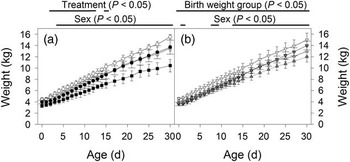
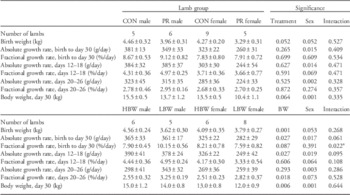
Birth weight tended to be lower in PR than CON lambs in both males and females (−15%, Table 1, P=0.052) and PR lambs remained lighter than CON lambs throughout most of the first 2 weeks after birth (Fig. 1a). AGR and FGR did not differ between PR and CON lambs from birth to day 30 or during WSW weeks in either male or female lambs (Table 1, each P>0.25). Weight from birth to day 30 increased with age (Fig. 1a, P<0.001), tended to be higher in CON than PR (P=0.057) and was higher in males than in females (P=0.049). The change in weight with age differed between treatments (P=0.001) and sexes (P<0.001). Body weight tended (P=0.064) to be lower in PR than CON lambs at day 30 (Table 1). Independent of treatment, male lambs tended (P=0.052) to be heavier at birth, had a greater absolute (P=0.015), but not fractional (P=0.61), growth rate from birth to 30 days and were significantly (P=0.001) heavier than female lambs at 30 days of age (Table 1). Differences in body weight between male and female lambs became more pronounced with age (Fig. 1a and 1b).
Neonatal growth curves of male and female twin lambs for (a) CON and PR and (b) HBW and LBW. Data are mean±s.e.m. for each group. Periods when main effects are significant (P<0.05) are indicated above each panel. CON, control (males: unfilled circles, females: unfilled squares); PR, placentally restricted (males: filled circles, females: filled squares); HBW, heavier birth weight twin (males: lighter grey downwards triangles, females: lighter grey upwards triangles); LBW, lighter birth weight twin (males: darker grey downwards triangles, females: darker grey upwards triangles).

Body weight and growth rates in male and female control (CON) v. placentally restricted (PR) lambs, and in the heavier (HBW) v. lighter birth weight (LBW) twin within each litter (P>0.1)

Fractional growth rate was calculated by dividing absolute growth rate by weight at the start of the period. Day 30 weight was calculated by linear regression based on weekly weights. Data were analysed by mixed models including treatment or birth weight within each twin pair (BW), sex and dam as a random factor to account for common gestation and lactation environment and are presented as mean±s.e.m. for each group.
a Fractional growth rate from birth to day 30 was greater in LBW than HBW males (P=0.039), and not different between LBW and HBW females (P=0.103).
Within-litter comparisons
Birth weight was lower in the lower birth weight (LBW) than in the HBW lamb of each litter in both males (~20%) and females (~7%) (Table 1, P=0.001) and LBW twins remained lighter than their HBW littermates throughout the entire experiment. AGR from birth to day 30 was 9% lower in LBW than HBW lambs (Table 1, P=0.027) in both males and females, whilst FGR during the same period was greater in LBW and HBW twins in males (P=0.039), but not in females (P>0.1) (Table 1). During the week of the first WSW, AGR from days 12 to 18 was greater in HBW than LBW lambs (Table 1, P=0.027), and FGR did not differ between LBW and HBW twins (Table 1, P>0.2). During the second WSW, however, AGR from days 20 to 26 did not differ between LBW and HBW twins (Table 1, P>0.25), while FGR was greater in LBW than HBW twins, and this effect did not differ between males and females (Table 1, P=0.018).
Weight from birth to day 30 increased with age (Fig. 1b, P<0.001), tended to be greater in HBW than LBW lambs (P=0.092), but the change in weight with age was similar in HBW and LBW lambs (treatment×age interaction: P>0.9). Males gained more weight than females (sex×age interaction: P=0.026). At day 30, LBW lambs were 7.2% lighter than HBW lambs in both males (6.7%) and females (7.7%) (Table 1, P=0.006). The difference in body weight at day 30 days of age within twin pairs correlated positively with their difference in birth weights (r=0.712, P=0.009, n=12 litters), despite the negative correlation between within-litter differences in FGR from birth to day 30 and birth weight (r=−0.580, P=0.048, n=12 litters). Within-litter differences in AGR from birth to day 30 did not correlate with within-litter differences in birth weight (r=0.106, P=0.742, n=12 litters).
Milk composition
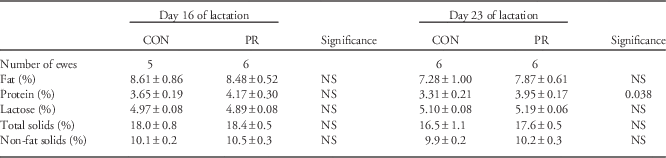
On day 23 of lactation, protein content was ~19% higher in milk from PR compared with CON ewes (P=0.038, Table 2). There were no differences in the protein content of the milk between PR and CON ewes at day 15 of lactation, nor in fat, lactose, total solid and non-fat solid contents of the milk at either lactation stage (Table 2).
Milk composition in control (CON) and placentally restricted (PR) ewes (P>0.1).

Data were analysed by mixed model within each lactational stage and are presented as mean±s.e.m.
Neonatal milk intake
Effects of treatment
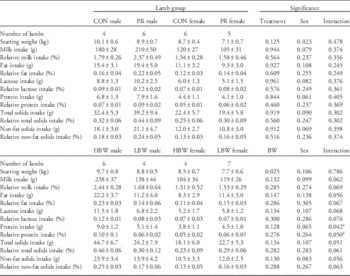
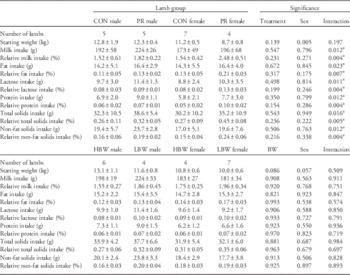
Lamb weights were similar between treatments before each WSW in both males and females (Table 3). At day 15, absolute and relative total milk intake and intakes of each milk component (fat, protein, lactose, total solids, non-fat solids) were similar in CON and PR lambs in both males and females, and there were no interactions between sex and treatment for any of these measures (Tables 3 and 4).
Intake of milk and individual milk components in male and female control (CON) v. placentally restricted (PR) lambs, and in the heavier (HBW) v. lighter birth weight (LBW) twin within each litter at day 15 of age (P>0.1)

Data were analysed by mixed models including treatment or birth weight within each twin pair (BW), sex and dam as a random factor to account for common gestation and lactation environment and are presented as mean±s.e.m. for each group.
a Absolute (P=0.061) and relative (P=0.095) protein intakes tended to be higher in HBW than LBW males, and were not different between LBW and HBW females (each P>0.6).
Intake of milk and individual milk components in male and female control (CON) v. placentally restricted (PR) lambs, and in the heavier (HBW) v. lighter birth weight (LBW) twin within each litter at day 23 of age (P>0.1)

Data were analysed by mixed models including treatment or birth weight within each twin pair (BW), sex and dam as a random factor to account for common gestation and lactation environment and are presented as mean±s.e.m. for each group.
a Absolute and relative intakes of milk and milk components at day 23 of age did not differ between CON and PR males (each P>0.8) or between CON and PR females (each P>0.1).
At day 23, however, while there were no overall effects of treatment on measures of milk intakes, there were interactions between sex and treatment for the majority of these measures (Table 5).
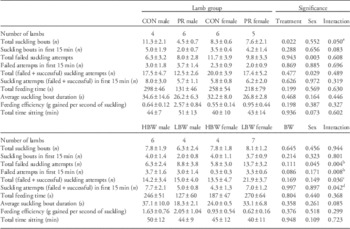
Feeding behaviour in male and female control (CON) v. placentally restricted (PR) lambs, and in the heavier (HBW) v. lighter birth weight (LBW) twin within each litter at day 15 of age (P>0.1)

Data were analysed by mixed models including treatment or birth weight within each twin pair (BW), sex and dam as a random factor to account for common gestation and lactation environment and are presented as mean±s.e.m. for each group.
a The total number of feeding bouts at day 16 of age was greater in CON than PR males (P=0.023) and did not differ between CON and PR females (P=0.721).
b The total number of failed suckling attempts and number of failed suckling attempts in the first 15 min of the feeding test at day 15 were higher in LBW females than HBW females (P=0.004 and 0.030, respectively) and did not differ between HBW and LBW males (P=0.167 and 0.056, respectively).
c The total number of suckling attempts (failed+successful) at day 15 were higher in LBW females than HBW females (P=0.027) and did not differ between HBW and LBW males (P=0.289).
d The number of suckling attempts (failed+successful) in the first 15 min of the feeding test at day 15 did not differ between LBW and HBW females (P=0.110) or between HBW and LBW males (P=0.091).
Within-litter comparisons
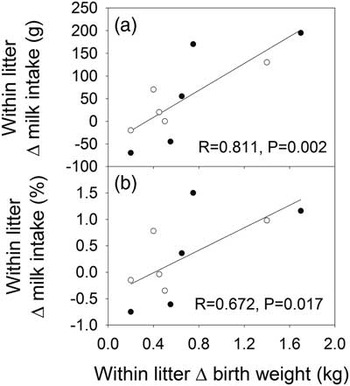
The HBW twin was heavier than the LBW twin at the start of WSW protocols at day 15 (+14.3%, =0.025, Table 3) but not at day 23 P=0.086, Table 4), independent of sex. At day 15, there was no difference in either milk consumption or the intake of any individual milk components during the WSW between LBW and HBW twins in either absolute or relative terms (each P>0.08, Table 3). There were, however, significant interactions with sex for both total and relative protein intakes, such that protein intakes tended to be higher (by ~40%) in HBW than LBW lambs in males, but not in females. The differences in absolute and relative milk intakes between twins at day 15 correlated positively with their birth weight difference (Fig. 2). At day 23, absolute and relative intakes of milk and milk components did not differ between HBW and LBW twins, independent of sex (Table 4), and between-pair differences in intake did not correlate with differences in birth weight (data not shown).
Within-litter differences in (a) absolute (g) and (b) relative milk intakes (as a % of current weight) between twins correlate with their differences in birth weight. Data are differences between each twin pair (HBW–LBW), with control pairs indicated by unfilled circles and placentally restricted pairs indicated by filled circles. Only data for pairs where milk intake data was available for both twins was included. Relationships were analysed across all lamb pairs by Pearson’s correlation. HBW, heavier birth weight twin; LBW, lighter birth weight twin.

Neonatal feeding behaviour
Effects of treatment
At day 15, CON lambs had 1.6-fold more suckling bouts during the WSW period than PR lambs overall (P=0.022), and in males (P=0.023) but not females (P>0.7, Table 5). There were no differences in the total number of suckling attempts, number of unsuccessful suckling attempts, average length of each suckling bout, total time spent suckling or feeding efficiency between CON and PR lambs at this age, independent of sex (Table 5). Measures of feeding behaviour during the first 15 min of the WSW period at day 15 also did not differ between treatments (Table 5).
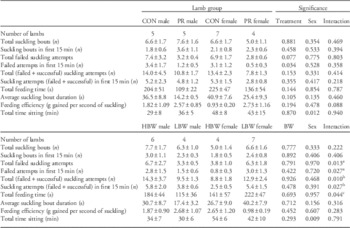
At day 23, CON lambs had approximately three-fold more unsuccessful suckling attempts in the first 15 min of the WSW period (P=0.034) and also tended (P=0.08) to have more unsuccessful suckling attempts during the entire feeding period than PR lambs, with no effect of sex (Table 6). There were no differences between CON and PR lambs for any other feeding measures at this age, either overall or in the first 15 min after fasting (Table 6). Female lambs spent more time during the WSW period sitting compared with male lambs, independent of treatment (P=0.012).
Feeding behaviour in male and female control (CON) v. placentally restricted (PR) lambs, and in the heavier (HBW) v. lighter birth weight (LBW) twin within each litter at day 23 of age (P>0.1)

Data were analysed by mixed models including treatment or birth weight within each twin pair (BW), sex and dam as a random factor to account for common gestation and lactation environment and are presented as mean±s.e.m. for each group.
a The total number of failed suckling attempts and number of failed suckling attempts in the first 15 min of the feeding test at day 23 did not differ between LBW and HBW females (P=0.107 and 0.068, respectively) or between HBW and LBW males (P=0.061 and 0.217, respectively).
b The total number of suckling attempts (failed+successful) at day 23 overall and in the first 15 min of the test tended to be higher in in LBW females than HBW females (P=0.058 and 0.055, respectively) and did not differ between HBW and LBW males (P=0.091 and 0.270, respectively).
c The total feeding time at day 23 of age did not differ between HBW and LBW males (P=0.376) or females (P=0.244).
Within-litter comparisons
At day 15, LBW twins had more suckling attempts in total during the WSW period compared with HBW twins in females (P=0.027), but not in males (P=0.17, Table 5). This was due to a greater number of unsuccessful suckling attempts in LBW compared with HBW female twins (P=0.004, Table 5), while the number of successful feeding bouts was not different. There were no differences in any other feeding measures, time spent suckling or sitting or feeding efficiency between HBW and LBW twins (Table 5). The difference in feeding efficiency between twins tended (R=0.55, P=0.052, n=9 litters) to correlate positively with their birth weight difference.
At day 23, overall and acute feeding behaviour measures did not differ between LBW and HBW twins (Table 6). However, consistent with sex-specific responses at day 15, LBW females tended to have more total and failed suckling attempts compared with HBW females, and these outcomes did not differ between HBW and LBW males (Table 6). The between-twin differences in the number of feeding bouts across the entire WSW period (R=0.60, P=0.040, n=11 litters) and in the first 15 min after fasting (R=0.63, P=0.035, n=11 litters) were each correlated positively with their birth weight difference.
Relationships between milk intake, feeding behaviour and neonatal growth
At day 15, neither absolute nor relative milk intake were correlated with the total number or total duration of feeding bouts across all lambs combined (P>0.1 for all). Absolute and relative milk intakes at day 15 correlated negatively with the total number of feeding attempts at (absolute intake: R=−0.45, P=0.041, n=21; relative intake: R=−0.50, P=0.021, n=21) with similar trends for the number of unsuccessful feeding attempts (absolute intake: R=−0.40, P=0.072, n=21; relative intake: R=−0.43, P=0.053, n=21). AGR and FGR during the neonatal period (birth to day 30) correlated positively with absolute milk intake (AGR: R=0.45, P=0.040, n=21; FGR: R=0.44, P=0.048, n=21). A similar positive correlation was evident between fractional but not absolute neonatal growth and relative milk intake at day 15 (AGR: R=0.16, P=0.050, n=21; FGR: R=0.45, P=0.038, n=21). AGR but not FGR at the first WSW (days 12–18) correlated positively with absolute milk intake at day 15 (R=0.44, P=0.045, n=21). Growth rates during the first WSW week did not correlate with relative milk intake at day 15 (each P>0.1). Interestingly, AGR and FGR during the WSW week correlated negatively with total feeding time (AGR: R=−0.49, P=0.025, n=21; FGR: R=−0.56, P=0.008, n=21) and positively with feeding efficiency at day 15 (AGR: R=0.48, P=0.026, n=21; FGR: R=0.51, P=0.019, n=21).
At day 23, neither absolute nor relative milk intake were correlated with the total number or total duration of feeding bouts across all lambs combined (P>0.2 for all), nor with the number of unsuccessful or total feeding attempts (all P>0.05). Neonatal AGR and FGR also did not correlate with absolute or relative milk intakes at day 23 (all P>0.2). Similarly, AGR and FGR during the second WSW week (days 20−26) did not correlate with absolute or relative milk intakes at day 23 (all P>0.1), current growth rates were also not related to measures of feeding behaviour at day 23.
Discussion
This study is the first to report lamb milk intake and feeding behaviour and dam milk composition in an experimental model of IUGR. Contrary to our hypotheses, we found no effect of PR on milk intake in either absolute or relative terms, and PR lambs suckled less frequently than CON lambs during the WSW study at 15 days of age in males, but not in females In contrast, comparisons of milk intake and feeding behaviour measures between the HBW and LBW twin within each pair indicated that LBW twins had more total and failed suckling attempts during the WSW than their HBW counterparts, in females, but not in males. Interestingly, between-twin differences in relative as well as absolute milk intakes correlated positively with differences in birth weight, indicating that relatively larger lambs at birth are consuming more milk in relative as well as absolute terms. These results indicate that natural or experimentally induced restriction of growth before birth does not lead to increased neonatal milk consumption in male or female lambs reared as twins, but has sex-specific effects on feeding behaviour. The greater numbers of total and unsuccessful feeding attempts in LBW compared with HBW female twin lambs are consistent with our previous finding of increased feeding frequency in PR compared with CON singleton lambs, and support the hypothesis of increased appetite drive after natural or induced IUGR. The lack of difference in milk intake between PR and CON lambs in the present study is consistent with the relatively subtle (−15%) effects of PR on average birth weight in this cohort and may reflect a degree of natural restriction in all twins as well as lactational constraint and littermate competition in twin litters.
Milk composition
In the present study, which provides the first assessment of milk composition in this animal model, we found a higher protein content in milk from PR ewes at day 23 of lactation, in the absence of any significant changes in the concentration of any other key milk macronutrients. The mechanism underlying this increase in milk protein content is unclear. One possibility, however, is that this is secondary to reductions in milk yield, since breast milk protein concentrations correlate negatively with milk volume in women.Reference Nommsen, Lovelady, Heinig, Lonnerdal and Dewey 25 While we did not assess milk yield in the present study, previous studies have reported that concentrations of placental lactogen in both the utero–ovarian vein and maternal plasma in late gestation are lower in PR compared with CON ewes,Reference Falconer, Owens, Allotta and Robinson 26 and reduced placental lactogen has been associated with decreased milk yield. In dairy goats, maternal circulating placental lactogen concentrations in late gestation are positively correlated with milk yield during the first 50 days of lactation,Reference Hayden, Thomas and Forsyth 27 while in sheep, administration of purified or recombinant placental lactogen in either late pregnancy or mid-lactation promotes milk production even in the absence of prolactin.Reference Martal and Djiane 28 , Reference Leibovich, Gertler, Bazer and Gootwine 29 In clinical studies, higher concentrations of protein in breast milk or formula are associated with increases in infant growth rate and fat deposition,Reference Prentice, Ong and Schoemaker 30 , Reference Koletzko, von Kries and Closa 31 however the magnitude of the increase in protein concentration in PR compared with CON ewes in the present study does not appear sufficient to increase lamb growth rates, based on our results. This lack of effect of milk protein on growth may also be related to the fact that this was a twin cohort, since previous studies have reported that the relationship between milk protein content and lamb growth is blunted in twin compared with singleton lambs.Reference Torres-Hernandez and Hohenboken 32
The limited studies in other species which have attempted to assess the impact of fetal growth restriction on breast milk composition to date have produced conflicting results. In humans, total fat content of breast milk was similar in mothers of normal weight and small for gestational age infants in one study,Reference Domany, Mandel, Hausman Kedem and Lubetzky 33 whilst another reported alterations in fatty acid composition, particularly the levels of capric, lauric and gadoleic acids.Reference Bobinski, Mikulska, Mojska and Simon 34 In a rodent model of acute, severe placental restriction induced by bilateral uterine artery ligation in late pregnancy (day 18 of the 21-day pregnancy) PR dams produced less milk, which was lower in lactose, than CON dams.Reference O’Dowd, Kent, Moseley and Wlodek 19 Differences in timing and the nature of the induced placental restriction make it difficult to compare the effects of this acute placental restriction to those of the chronic placental insufficiency in our ovine model. It is also important to note that milk composition, particularly the fat content, is highly dynamic, varying across the day and between samples collected before and after a feed.Reference Daly, Di Rosso, Owens and Hartmann 35 Further studies comparing milk composition in CON and PR ewes more intensively, including during the initial days of lactation, and measuring milk yield over longer time frames, for example using isotope dilution techniques,Reference Jaquiery, Oliver, Bloomfield and Harding 36 , Reference Cameron 37 would help to better characterize effects of PR on milk yield and composition.
Effects of placental restriction
We were not able to use comparisons between CON and PR lambs to evaluate our initial hypothesis that increased milk intake in the early neonatal period would be an important contributor to accelerated neonatal growth previously reported in PR lambs,Reference De Blasio, Gatford, McMillen, Robinson and Owens 17 , Reference De Blasio, Gatford, Robinson and Owens 18 as in the present cohort size at birth was not significantly decreased and neonatal growth rates were not increased in PR compared with CON lambs. Consistent with this lack of difference in neonatal growth rates, we found no difference in milk intake between CON and PR lambs in the present study at either 15 or 23 days of age. Therefore, the absence of significant effects on milk intake may be related to lack of catch-up and fact that this was a twin cohort – as the CON twin lambs would also be subject to a degree of growth restriction in utero.Reference van der Linden, Sciascia, Sales and McCoard 38 The environment of a multiple gestation including twinning reduces growth rates from early in gestation, compared with singletons, and birth and postnatal outcomes of twin pregnancies in sheep cannot be normalized to that of singletons by removal of a co-twin in early gestation.Reference Muhlhausler, Hancock, Bloomfield and Harding 39 , Reference Hancock, Oliver, McLean, Jaquiery and Bloomfield 40 In utero restriction due to twinning may have similarities to the effects of PR, where reduction in the number of available placental attachment sites induced before mating will also restrict placental development from early gestation.Reference Alexander 15
Unexpectedly, the frequency of suckling events, an indirect indicator of feeding drive, was decreased in PR compared with CON twin lambs in the present study overall and in males, although this was not associated with decreased milk intake. The reduced suckling bouts in PR compared with CON lambs in the absence of differences in milk intake or average duration of feeding bouts suggests that PR lambs consumed a greater volume of milk at each successful feed. This did not, however, translate into a significant increase in feeding efficiency (i.e. amount of weight gained per unit time spent suckling during the WSW period), suggesting a relatively subtle effect. The decrease in feeding frequency in PR lambs in the present study contradicts our previous finding that feeding frequency was increased in PR compared with CON lambs at the same age, particularly in the first 15 min after fasting.Reference De Blasio, Gatford, Robinson and Owens 18 Milk intake was not measured in our initial study, so it is not clear whether increased feeding frequency also increased milk consumption of PR lambs in that study. We therefore suggest that future studies to determine effects of IUGR on milk intake and appetite and its role in catch-up growth will need to be performed in cohorts of singleton progeny to minimize natural constraint of fetal growth and potential competition between littermates for available milk. The suggestion of sex differences in these outcomes, with the difference appearing to be more pronounced in males, indicates that sufficient numbers of both sexes are required in order to evaluate potential sex-specific differences in future studies.
Within-litter comparisons
Comparing the feed intake and behaviour measures in lambs from each twin pair who were heavier and lighter at birth provided an opportunity to explore the impact of birth weight on feeding behaviour and growth over the first month of postnatal life, independent of PR. Twin comparisons also reduce variation in outcomes due to differences in genetics and maternal factors, and growth disparities between-twin pairs have therefore been used to investigate developmental programming questions in human cohorts.Reference Muhlhausler, Hancock, Bloomfield and Harding 39 , Reference Davies 41 As expected, we observed that the lambs with the lower birth weights grew less in absolute terms than their heavier birth weight littermates. Although the LBW twin remained smaller than the HBW twin at day 30, we did see evidence of relative catch-up, particularly in LBW males, whose FGR across the first 30 days after birth was significantly greater than their HBW counterparts and in which the relative difference in body weight between HBW and LBW lambs decreased from ~20% at birth to ~7% at day 30. Furthermore, the FGR of the smaller twins was greater than that of their heavier littermates in the 4th week after birth in both males and females, at the time of the second feeding study. It is possible that proportional catch-up growth in the lighter twin might start later than previously observed in PR neonates due to lower feeding efficiency in the early neonatal period, particularly in females since at day 15 the LBW female lambs had significantly more failed suckling attempts than their HBW littermates. Whether this greater frequency of failed suckling in LBW compared with HBW twin lambs within a pair was due to less efficient suckling capacity, competition from the larger twin or ewe preference is unclear, as is the reason why an increased frequency of failed suckling attempts was not seen in LBW males. One possibility, however is that this reflects a lower suckling success rate in females compared with males, as female lambs had a more failed suckling attempts than males overall in the absence of any differences in total suckling attempts.
Although milk intake did not differ between LBW and HBW littermates, this might reflect the very small differences in birth weight within some pairs. Our observation that between-pair differences in milk intakes at day 15 correlated positively with their difference in birth weights is also consistent with the hypothesis that between-pair competition or inefficient feeding limit milk intake of the smaller littermate. Because the correlation was observed for relative as well as absolute milk intake, the effect does not appear to be simply related to current body weight. Importantly, however, both absolute milk intake and numbers of total and unsuccessful suckling attempts were no longer different between HBW and LBW lambs by 23 days of age, suggesting that the lighter twins overcome early deficits in feeding by ~3 weeks of age.
Strengths and limitations
The strengths of this study are the use of a large animal model which induces chronic restriction of placental function similar to that suggested to occur in IUGR human pregnancies.Reference Morrison 42 We also provide the first quantification of milk intake in such a large animal, chronic model of restriction using a method (WSW) that provides comparable measures of milk production and intake to those measured by machine milking.Reference Benson, Henry and Cardellino 43 While the use of twin pregnancies adds complexity, it also provides the significant advantage of enabling us to compare effect of birth weight within each twin pair, independent of placental restriction, thus controlling for maternal effects. We performed repeated WSW studies on each animal at ages corresponding to those in previous studies of ovine IUGR which have reported differences in feeding behaviour.Reference De Blasio, Gatford, Robinson and Owens 18 The measurement of milk composition at the time of the WSW studies also enabled us to assess the impact of PR on intake of individual milk components (e.g. fat, protein, lactose), which enabled us to assess the potential impact of differences in milk composition between individual ewes on intake in their lambs.
Nevertheless, the present study had some limitations. While experimental placental restriction tended to reduce birth weight in this study, the extent of this growth restriction (~15% reduction in birth weight) was lower than the 20–25% previously reported in studies of singleton PR lambs by our group and others.Reference De Blasio, Gatford, Robinson and Owens 18 , Reference Muhlhausler, Duffield and Ozanne 44 This is likely to be related to differences between singletons and twins. As twinning induces naturally occurring fetal growth restriction, the potential for further reductions in growth as a result of placental restriction is likely to be less in twin compared with singleton pregnancies.Reference van der Linden, Sciascia, Sales and McCoard 38 , Reference Muhlhausler, Hancock, Bloomfield and Harding 39 , Reference Gruenwald 45 The fact that this study was conducted in twins may also explain why AGR and FGR were not different between CON and PR groups in the early postnatal period. In support of this, the FGR in the CON twin lambs (8.30±0.6%/day) observed in this study was high when compared with that previously reported in a CON cohort comprised mostly of singleton lambs (5.44±0.40%/day).Reference De Blasio, Gatford, Robinson and Owens 18 Although total milk intake is greater in ewes who give birth to twins compared with singletons, milk intake per lamb and growth rates are each lower in twins, suggesting a degree of maternal constraint to milk supply per lamb in twin litters.Reference Thompson 46 The inclusion of lambs reared as twins only was necessary in this study due to insufficient availability of singleton pregnancies. The extent to which this masked or prevented previously observed effects of PR on IUGR and neonatal catch-up was unexpected, and suggests that future mechanistic studies of catch-up growth in this model will need to be restricted to singleton progeny.
While the WSW method is widely accepted as a method for estimating milk intake in lambs and calves, and has been shown to compare favourably to alternate methods, it nevertheless imposes certain limitations. In the present study, it was necessary to exclude a number of lambs/ewes from the experiment due to diapers becoming dislodged during the experiment, while one ewe refused to feed her lambs while the diapers were being worn, and this may have introduced bias. The use of isotope dilution approaches undoubtedly provides more accurate and allows longer-term measures of milk intake,Reference Cameron 37 , Reference Dove 47 but has the limitation of requiring frequent blood sampling of the lamb and ewe, which disrupts normal feeding behaviour. Future studies in which both WSW and isotope dilution experiments are performed in the same mother–lamb pairs will be important for characterizing intake throughout the neonatal period after IUGR and its relationship with neonatal catch-up growth. A retrospective power calculation based on the measured variation within groups in this study indicates that a sample size of nine per group would be required to provide 80% power to detect treatment/birth weight group and sex effects of 50% on milk intake. Therefore, future studies in a larger sample are required to confirm the data. The available sample also did not provide sufficient numbers to be able to examine the effect of differences in sex combinations within twin pairs on the outcomes, something which might also have the potential to affect these outcomes.
In summary, the results of the present study suggest that PR is not associated with an increase in milk intake in either absolute or relative terms in twin lambs in the first 3 weeks after birth, and was actually associated with a decreased suckling frequency at 15 days of age, particularly in males. Comparisons of heavier and lighter twins within each litter suggested that twins who are relatively lighter at birth do not consume higher volumes of milk in either absolute and relative terms than their HBW counterpart, indicating that natural or experimentally induced restriction of growth before birth does not lead to increased neonatal milk consumption in lambs reared as twins. The greater numbers of total and unsuccessful feeding attempts in LBW compared with HBW twin female lambs is, however, consistent with our previous finding of increased suckling attempts in PR lambs, and supports the hypothesis of increased feeding drive after natural or induced IUGR. To maximize potential effects of PR, and minimize potential naturally induced IUGR within CON groups, we suggest that future mechanistic studies of catch-up growth in the PR sheep be performed in singletons.
Acknowledgements
The authors wish to thank Marie Vinh-Mau and Margaux Edet, intern students from the Institut Polytechnique, La Salle Beauvais, France, for their assistance with WSW procedures. They thank the staff of Laboratory Animal Services of the University of Adelaide for their excellent animal care throughout this project. Preliminary data from this study were presented at the annual meeting of the Annual Meeting of the Australian and New Zealand Society for the Developmental Origins of Health and Disease Adelaide, Australia in June 2016.
Financial Support
The study was supported by the 2014 Underworks Millennium Type 2 award from the Diabetes Australia Research Trust. A.L.W. is supported by an Australian Postgraduate Award from the Australian Government and a Healthy Development Adelaide scholarship. B.S.M. is supported by a Career Development Award from the National Health and Medical Research Council of Australia (APP:1038009).
Conflicts of Interest
None.
Ethical Standards
The authors assert that all procedures contributing to this work comply with the ethical standards of the Australian Guidelines for the Ethical Conduct of Research in Animals and were approved by the University of Adelaide Animal Ethics Committee (approval M-2013-231).