Introduction
Chen’s (Reference Chen2025) evolution of theories framework (hereafter, the theory-evolution map or simply Chen’s map) provides a roadmap for indigenous management research: it shows how context-rich theories, such as those arising from China’s rapid digital transformation and blurred organizational boundaries, can move toward more universal contributions by clarifying when and where to expand across contexts or outcomes. Yet expansion is often derailed by two recurring problems: meaning drift, where labels travel while underlying constructs or measures shift (Meredith, Reference Meredith1993; Vandenberg & Lance, Reference Vandenberg and Lance2000), and mechanism slippage, where theories are stretched to fit new results via post hoc one-off moderators or rotating mediators instead of defending a unified, rival-resistant causal story (Burnham & Anderson, Reference Burnham and Anderson2002; Meehl, Reference Meehl1967). The field-level result is ambiguous accumulation: studies that cannot cumulate because measures and designs are non-comparable (Tsui, Reference Tsui2004). These concerns are not hypothetical; for example, critiques of charismatic–transformational leadership document unclear construct boundaries and measurement that blends cause with effects, fostering both meaning drift and post hoc causal add-ons (van Knippenberg & Sitkin, Reference van Knippenberg and Sitkin2013).
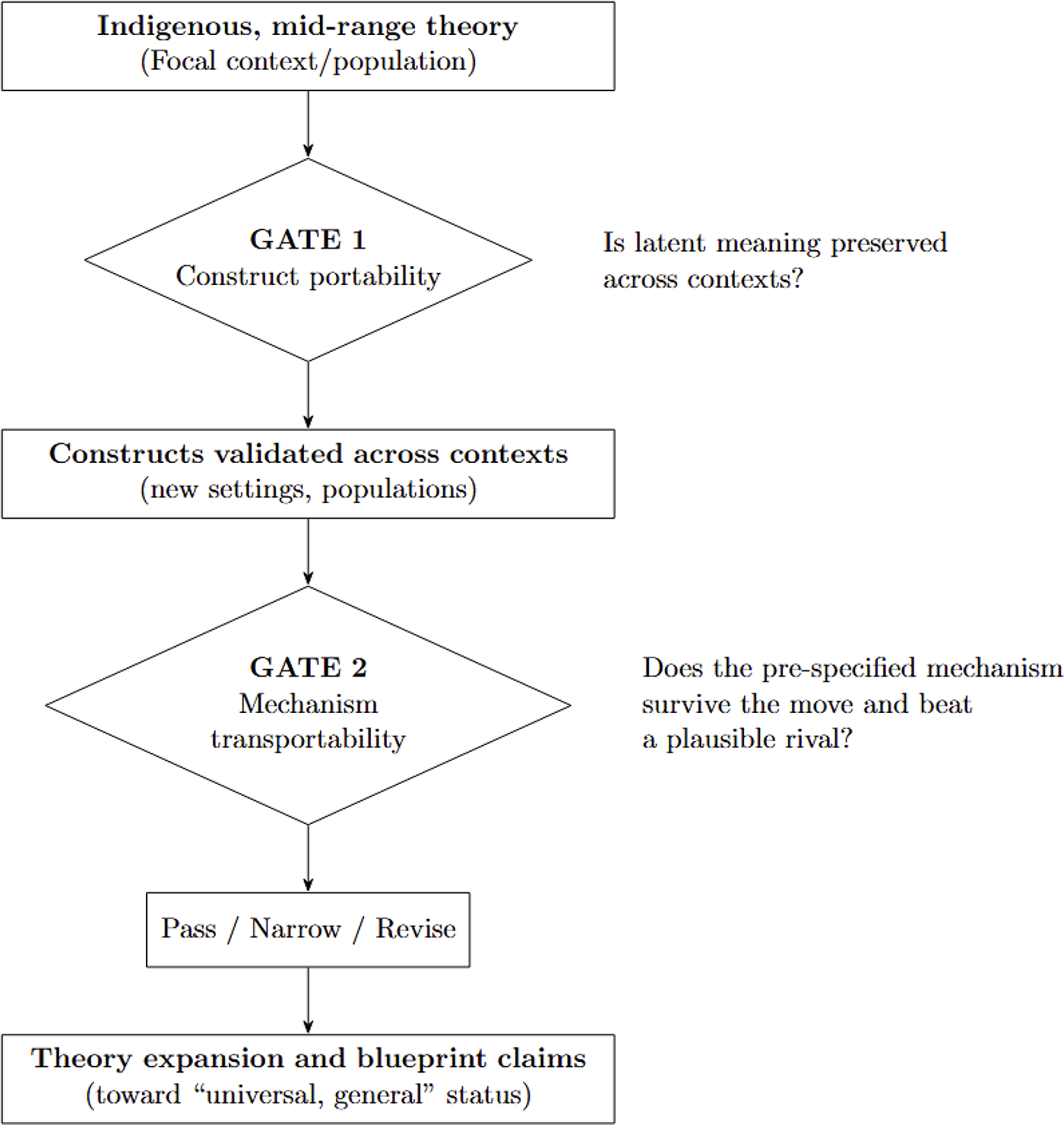
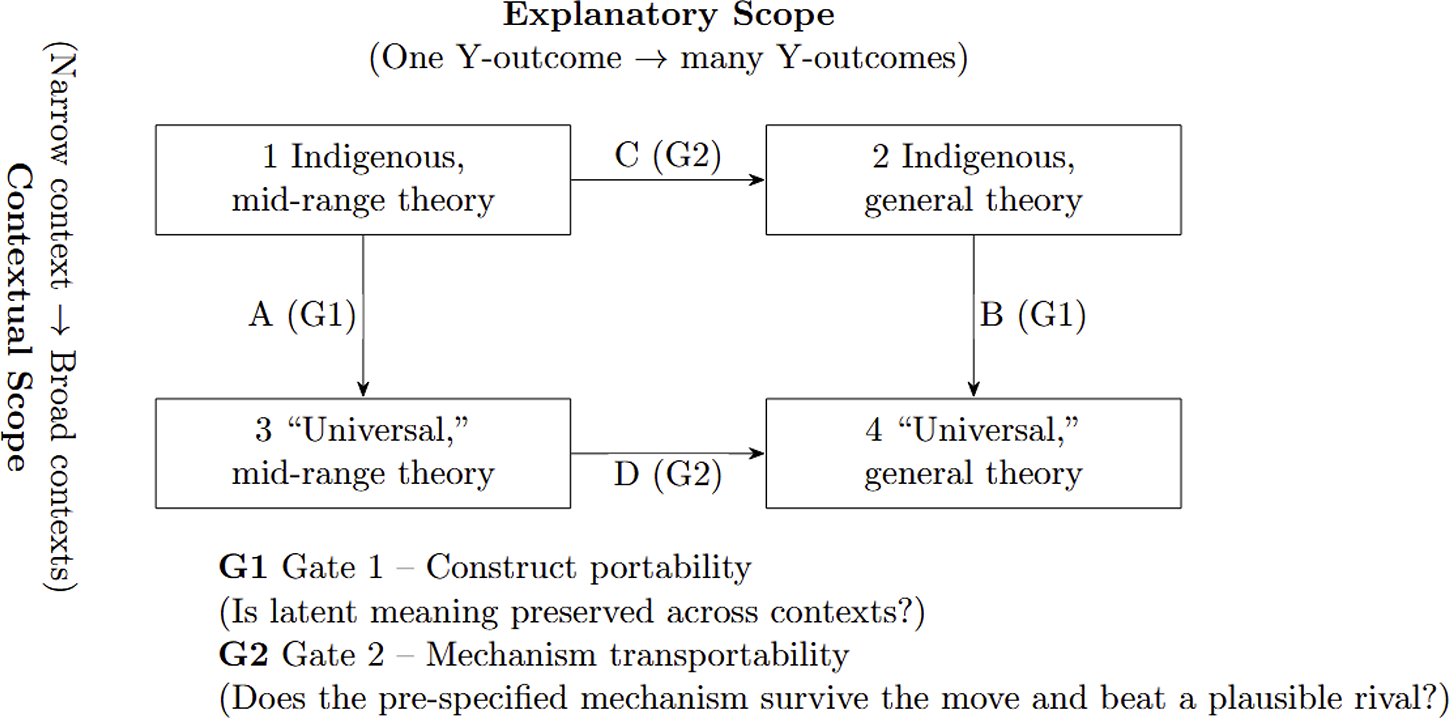
We address these challenges by building directly on Chen’s map and adding two checkpoints (Fig. 1). Gate 1 (Construct Portability) asks whether the focal construct retains the same latent meaning and measurement across the contexts being compared. Gate 2 (Mechanism Transportability) asks whether a compact, pre-specified causal mechanism still explains the effect when the theory is extended to new outcomes or groups and outperforms at least one plausible rival mechanism. Chen’s map then indicates where theories might evolve – from ‘indigenous, mid-range’ to ‘universal, general’ – while our gates specify what must be true before moving along those routes (Fig. 2). Clearing both supports cumulative theoretical claims rather than post hoc patchwork. Because comparable constructs without surviving mechanisms yield only descriptive travel – movement across settings without a stable explanatory account – whereas recurring mechanisms without construct equivalence yield unstable generalization, our aim is to specify when empirical extension constitutes credible theory evolution: only when constructs remain portable and mechanisms remain transportable should broader claims of generality be made. Figure 1 zooms in on the two gates as simple diagnostic questions for any portability claim, whereas Figure 2 zooms out and shows how those same gates map onto the vertical (contextual scope) and horizontal (explanatory scope) dimensions of Chen’s map.
Gate-and-Expand checkpoints in the evolution of indigenous theories

Chen’s theory-evolution map with Gate 1 and Gate 2. Vertical moves (Routes A and B) expand contextual scope and therefore require evidence for Gate 1; horizontal moves (Routes C and D) expand explanatory scope and therefore require evidence for Gate 2. Claims that a theory has reached Cell 4 (‘universal, general’) require that both gates have been cleared along the path

Gate 1: Construct Portability – Why Comparability Precedes Expansion
In Gate 1, we ask whether the focal construct retains the same latent meaning and measurement when we move from one context to another, so that cross-context comparisons are meaningful. Gate 1 preserves the emic (context-specific) richness of indigenous constructs while ensuring comparable latent meaning across groups, enabling valid comparison and guarding against meaning drift (Meredith, Reference Meredith1993). In Chen’s (Reference Chen2025) terms, Gate 1 must be cleared before an ‘indigenous, mid-range’ theory can credibly claim to have moved toward a ‘universal, mid-range’ position along Route A. Practically, specify which features of the emic construct constitute its non-negotiable core and which context-bound expressions may vary, then derive an etic definition that preserves that core while enabling cross-context comparison. Empirically, establish measurement invariance (i.e., comparable loadings/intercepts across groups) before cross-setting claims.
Guardrail
If comparability is weak, keep inferences within the setting and state limits (Asparouhov & Muthén, Reference Asparouhov and Muthén2014; Cheung & Rensvold, Reference Cheung and Rensvold2002; Meredith, Reference Meredith1993; Vandenberg & Lance, Reference Vandenberg and Lance2000) (examples and a reporting checklist appear in Exhibit A).
We use transformational leadership as a boundary-spanning illustration because it shows that the same credibility problems arise both when Western-origin theories are localized and when indigenous theories seek to travel outward. Early applications of the Western transformational leadership scales in Chinese samples revealed a different factor structure, signaling potential meaning drift (Chen & Farh, Reference Chen, Farh, Mobley and McCall2001). This prompted scholars to engage in rigorous measurement work, including developing indigenous scales, to ensure the construct’s latent meaning is portable and comparable across Chinese and non-Chinese settings (Zhang, Chen, Chen, & Ang, Reference Zhang, Chen, Chen and Ang2014).
Gate 2: Mechanism Transportability – Why Causal Stories Must Survive the Move
After Gate 1 establishes Construct Portability, Gate 2 asks whether the compact, pre-specified mechanism that originally justified the theory still does the explanatory work in new outcomes or groups and outperforms at least one plausible rival mechanism. In other words, extensions reflect explanation rather than mere coverage: the theory ‘travels’ because its causal story survives the move and does more work than obvious competitors, consistent with the expectation that strong theories identify causal mechanisms and rule out rival accounts rather than multiplying ad hoc mediators (Angrist & Pischke, Reference Angrist and Pischke2009; Meehl, Reference Meehl1967). In practice, when Gate 2 is applied within the original context, we assume that the constructs have already cleared Gate 1 in that context, i.e., their latent meaning and measurement model are stable. Gate 2 then asks whether this fixed mechanism extends to new outcomes or groups and outperforms a rival explanation.
Guardrail
Authors should pre-specify a compact mechanism (e.g., X → M → Y) and at least one rival that implies a different pattern of results (in timing, across subgroups, or in placebo outcomes). Designs should leverage evidence that can discriminate the focal mechanism from plausible rivals, for example, timing, subgroup, placebo, or process evidence, so that the proposed pathway is rendered more credible than competing accounts. Mechanism slippage – adding post hoc moderators or swapping mediators so results appear to ‘travel’ – is a signal to Narrow or Revise, not to claim portability (Angrist & Pischke, Reference Angrist and Pischke2009; Beach & Pedersen, Reference Beach and Pedersen2019; Burnham & Anderson, Reference Burnham and Anderson2002; Meehl, Reference Meehl1967). The relevant evidence may come from quantitative, qualitative, experimental, or comparative designs, provided that it preserves construct comparability and adjudicates the focal mechanism against plausible rivals; illustrative options appear in Exhibit A.
For transformational leadership, clearing Gate 2 means moving beyond documenting multiple correlated outcomes to a pre-specified test that pits the focal mechanism against at least one plausible rival. Suppose, for example, that we posit the compact pathway ‘transformational behaviors → follower identification → commitment to the change’ and treat transactional leadership or leader–member exchange as rival accounts. A Gate-2 design would (a) state this mechanism and the rival set ex ante; (b) specify how each mechanism implies a different pattern of effects, for instance, that transformational leadership’s impact on commitment should attenuate more in units where follower identification cannot form than in otherwise similar units where contingent reward is weak but identification can still develop; and (c) interpret the observed pattern using a Pass/Narrow/Revise rule. If the pre-specified transformational leadership mechanism consistently fits the data better than the rivals across multiple outcomes, authors may claim a Pass for Gate 2 within that context. If rival mechanisms explain some outcomes equally well or better, they should Narrow or Revise transformational leadership’s scope rather than treat it as a broadly transportable explanation (Judge & Piccolo, Reference Judge and Piccolo2004; van Knippenberg & Sitkin, Reference van Knippenberg and Sitkin2013).
From Heterogeneity to Conditional Scope Claims
Once both gates have been considered, researchers can treat heterogeneity as a discovery engine by pre-specifying mechanism-implied axes along which effects should vary. Such axes should be defined substantively rather than statistically. For example, researchers might draw on classic organizational contingencies to examine whether effects differ across more formal versus less formal approval environments, or across settings with greater versus more limited discretionary resource slack. They can then map where effects strengthen or weaken, compress the evidence into a few interpretable regimes, and validate those patterns on fresh data or over time. If an if-then rule is unstable or non-positive, the prescription should be withheld (Tsui, Reference Tsui2004; Whetten, Reference Whetten2009). Operational options appear in Exhibit A.
For example, in studies of transformational leadership, researchers might pre-specify that the leadership’s effect on employees’ commitment to a change depends heavily on the ‘job-level impact’ of that specific change (Herold, Fedor, Caldwell, & Liu, Reference Herold, Fedor, Caldwell and Liu2008). Having mapped this heterogeneity, they could then validate a simple practical rule: in units where a digital transformation materially disrupts daily roles and routines, organizations should invest in transformational leadership training; conversely, in more routine, low-impact contexts, they should prioritize other interventions.
The Relationship Between the Two Gates and Chen’s Map
Figure 2 makes explicit how the two gates relate to Chen’s map. Her map distinguishes an ‘indigenous, mid-range’ stage (Cell 1) from a ‘universal, general’ stage (Cell 4) along two dimensions: contextual scope (from ‘narrow context’ to ‘broad contexts’) and explanatory scope (from ‘one Y-outcome’ to ‘many Y-outcomes’). All theories start in Cell 1 and may evolve toward Cell 4 via different routes (A–D). Gate-and-Expand does not add new cells or routes; instead, it specifies what must be true before a theory is allowed to move along each dimension. Movements that broaden contextual scope (vertical moves, such as Route A and the contextual component of Route B) require Gate 1 (Construct Portability): before claiming a shift from an ‘indigenous’ to a more ‘universal’ position, authors must show that the focal construct retains comparable meaning and measurement properties across contexts. Movements that broaden explanatory scope (horizontal moves, such as Route C and the outcome component of Route D) require Gate 2 (Mechanism Transportability): before claiming that a theory explains additional Y-outcomes, authors must articulate a compact mechanism, specify at least one rival, and show that the focal mechanism better accounts for the expanded outcome set. By overlaying G1 and G2 on Routes A–D, the figure makes explicit that Chen’s map tells us where theories might evolve, while the Gate-and-Expand framework specifies what evidentiary standards must be met for those evolutionary claims to be credible; the two gates are analytically distinct but often operationally cumulative, because when a theory expands across both contexts and outcomes, Gate 1 must first establish construct comparability in the new setting before Gate 2 can test whether the focal mechanism survives the enlarged outcome space. A theory residing in Cell 4 as ‘universal, general’ is most convincing when, across its evolutionary path, accumulated evidence has cleared both gates. For example, a transformational leadership theory that begins in Cell 1 in its original Western corporate context must clear Gate 1 as it expands from Western firms to other contexts (Route A or B) and Gate 2 as it expands from one outcome to many (Route C or D) and before it can credibly be treated as Cell 4 (Fig. 2).
Applying the Framework to Indigenous Theories: Guanxi
As an illustration of how Gate-and-Expand can discipline the evolution of indigenous theories beyond leadership, we apply the framework to the quintessential indigenous construct of guanxi, which has been central to indigenous management theorizing and debates about contextualization and global contribution (Chen & Chen, Reference Chen and Chen2004; Chen, Chen, & Huang, Reference Chen, Chen and Huang2013; Tsui, Reference Tsui2004). In this discussion, we suggest using ‘relational governance’ only as an analytic shorthand for the aspect of guanxi most relevant to the focal mechanism under examination, not as a substitute for guanxi as a broader indigenous construct. This term is not intended to replace or diminish the rich, emic complexity of guanxi. Rather, it serves as an analytical tool to capture its widely documented properties including renqing (reciprocity), ganqing (affect), xinren/xinyong (trust/credibility), and long-term obligation (Chen & Chen, Reference Chen and Chen2004) in a portable, measurement-friendly form. As an illustrative focal mechanism rather than an exhaustive account of guanxi, we posit that guanxi can reduce contracting and coordination frictions, thereby lowering managerial thresholds for approving exploratory projects when budgets are tight. In this illustration, two contextual dimensions are especially important: formality and budget slack. Formality refers to the extent to which project approval and coordination are governed by explicit rules, documentation, and standardized procedures, whereas budget slack refers to the discretionary resource cushion available for exploratory initiatives. A plausible rival expects this advantage to attenuate as formality and public scrutiny increase.
Gate 1
Validate that a scale capturing the initiating–building–using stages of guanxi (Chen & Chen, Reference Chen and Chen2004) has comparable meaning across ownership types, regions, and pre-/post-platformization; then assess comparability before any cross-setting claims (Asparouhov & Muthén, Reference Asparouhov and Muthén2014; Cheung & Rensvold, Reference Cheung and Rensvold2002; Exhibit A).
Gate 2
Use anti-corruption intensity or procurement rollouts as exogenous shocks to test the prediction that the guanxi-to-exploration pathway attenuates as formality increases, a pattern consistent with documented guanxi tie adjustments (Chen & Peng, Reference Chen and Peng2008). Leverage staggered rollouts with modern event-study difference-in-differences diagnostics (Sun & Abraham, Reference Sun and Abraham2021), complement with process tracing (Beach & Pedersen, Reference Beach and Pedersen2019), and include a placebo outcome (e.g., routine approvals).
From Heterogeneous Effects to Conditional Scope Claims
Once researchers establish that guanxi’s effects are contingent rather than uniform, they can use that heterogeneity to specify the conditions under which guanxi is more or less likely to aid exploration (Chen et al., Reference Chen, Chen and Huang2013). Specifically, if the evidence shows that guanxi is most effective under low formality and limited budget slack, those conditional findings can be translated into a simple decision rule (Kitagawa & Tetenov, Reference Kitagawa and Tetenov2018): when formality is low and budget slack is limited, guanxi-based coordination is more likely to support exploratory project approval; when those conditions are not present, formal screening should be preferred. To avoid turning sample-specific patterns into premature prescriptions, the value of this rule should then be evaluated out of sample by comparing its performance with the status quo (Wager & Athey, Reference Wager and Athey2018).
Reporting Guidance and Practical Outputs
To make the framework usable for authors, reviewers, and editors, authors should specify a small set of concrete reporting outputs. For Gate 1, authors should state the highest level of construct comparability they have established and clarify which cross-context comparisons that evidence actually permits (Meredith, Reference Meredith1993; Vandenberg & Lance, Reference Vandenberg and Lance2000). For Gate 2, authors should report their pre-specified compact mechanism, at least one plausible rival mechanism, one prediction that differentiates the two, and the identification strategy used to adjudicate between them; they should then indicate whether the evidence supports a Pass, Narrow, or Revise conclusion (Meehl, Reference Meehl1967). If authors wish to move from explanation to practice, they may also present a simple if-then-unless rule together with out-of-sample evidence on whether that rule improves decisions. When such a rule performs inconsistently or fails to outperform the status quo, it should be withheld rather than presented as a generalizable practical implication (Tsui, Reference Tsui2004; Whetten, Reference Whetten2009; Exhibit A).
Discussion
The strongest claims on Chen’s map – those that implicitly place a theory in Cell 4 as ‘universal, general’ – are only persuasive when both gates have been cleared. To claim that transformational leadership, guanxi, or any other indigenous theory now supports broader contextual and explanatory scope requires credible evidence that (a) the core constructs travel without meaning drift (Gate 1), consistent with long-standing calls to make boundary conditions and contextual assumptions explicit when generalizing beyond the original sample (Tsui, Reference Tsui2004, Reference Tsui2007; Whetten, Reference Whetten2009), and (b) the core mechanism continues to operate and outperforms plausible rivals as the theory accumulates new outcomes and settings (Gate 2), echoing concerns about under-specified mechanisms and construct redundancy in charismatic–transformational leadership research (Judge & Piccolo, Reference Judge and Piccolo2004; van Knippenberg & Sitkin, Reference van Knippenberg and Sitkin2013). In practice, a theory may satisfy Gate 1 without satisfying Gate 2, or vice versa: comparable constructs without surviving mechanisms yield only descriptive travel, whereas recurring mechanisms without construct equivalence yield unstable generalization. Gate-and-Expand makes these gaps visible and encourages researchers to treat ‘universal, general’ status as a hypothesis to be earned rather than a default label.
Chen’s map offers an inspiring destination for indigenous theory. Gate-and-Expand supplies the conceptual checkpoints – Construct Portability and Mechanism Transportability – so claims can credibly travel before expansion. Used alongside the theory-evolution map, these gates help convert context-rich phenomena (from the digital economy to relational governance) into portable, cumulative knowledge without sacrificing validity or richness (Tsui, Reference Tsui2004; Whetten, Reference Whetten2009). We offer these checkpoints to help authors decide when to broaden, narrow, or revise their claims, to help reviewers and editors distinguish credible theory evolution from label reuse or ad hoc mediator swapping, and to underscore that a well-bounded indigenous theory remains valuable even when a narrow conclusion is the most credible one. Our goal is not to slow down indigenous theory evolution, but to make sure that when we say a theory now ‘travels’, we can point to concrete evidence that its constructs retain comparable meaning and that its causal mechanism continues to hold.
Acknowledgements
I am grateful for the constructive guidance and feedback that improved the paper’s framing and exposition. I also thank Stephen Zhang for his thoughtful comments. Any remaining errors are my own.
AI disclosure
The author used ChatGPT 5 for language editing and phrasing assistance; all substantive ideas, arguments, and interpretations are the author’s own.
Exhibit A. Gate-and-Expand Author Checklist
A. Gate 1 – Construct Portability
Purpose: ensure that the construct has comparable latent meaning and measurement across settings you compare before making cross-context claims (Cheung & Rensvold, Reference Cheung and Rensvold2002; Meredith, Reference Meredith1993; Vandenberg & Lance, Reference Vandenberg and Lance2000).
Acceptable evidence (use one or more, and state what claims they permit):
• Structured qualitative mapping showing stable core dimensions across settings (template/coding with expert adjudication).
• Cognitive interviews/Q-sorting demonstrating similar interpretive anchors across groups.
• Convergent/nomological patterns that replicate across settings (same correlates or subdimension ordering).
• Quantitative comparability tests (e.g., multiple-group measurement invariance and alignment optimization to approximate scalar equivalence with many groups) (Asparouhov & Muthén, Reference Asparouhov and Muthén2014).
Guardrail: If comparability is weak or unclear, keep claims within the setting; avoid cross-setting mean/path comparisons.
B. Gate 2 – Mechanism Transportability
Purpose: show that the causal mechanism survives the move and beats a plausible rival when the theory is extended to new outcomes or groups (Angrist & Pischke, Reference Angrist and Pischke2009; Beach & Pedersen, Reference Beach and Pedersen2019; Meehl, Reference Meehl1967).
Acceptable evidence (use one or more, and name a rival that would predict a different pattern):
• A clearly pre-specified, concise causal mechanism paired with at least one plausible rival explanation that generates distinct empirical predictions (e.g., differences in timing, subgroup effects, or placebo outcomes) (Meehl, Reference Meehl1967).
• Distinctive pattern of results: effects appear where the mechanism should be strong and attenuate where it should be weak.
• Timing/sequence credibility: use staggered rollouts with event-study difference-in-differences diagnostics to estimate group–time effects and inspect pre-trends/dynamics; pair with process evidence (e.g., decision logs/interviews) (Angrist & Pischke, Reference Angrist and Pischke2009; Beach & Pedersen, Reference Beach and Pedersen2019; Sun & Abraham, Reference Sun and Abraham2021).
• Comparative cases: same mechanism under varied surface features.
Guardrail: If results ‘travel’ only after adding post hoc moderators or swapping mediators, label Narrow or Revise, not portable (Burnham & Anderson, Reference Burnham and Anderson2002).
C. Decision Rule (Pre-Specified)
• Pass: gate(s) cleared with acceptable evidence; claim portability as specified.
• Narrow: specify exactly who/where/when the claim holds.
• Revise: re-specify construct or mechanism; refrain from portability claims.
D. From Heterogeneity to Blueprints (Optional, if Offering Practice Rules)
• Map where effects strengthen or weaken along mechanism-implied axes (e.g., formality and budget slack).
• Translate conditional effects into a clear decision rule, and validate the practical value of this rule by evaluating its accuracy using out-of-sample data (these steps complement, instead of replace, your identification strategy) (Kitagawa & Tetenov, Reference Kitagawa and Tetenov2018; Wager & Athey, Reference Wager and Athey2018).
• If the decision rule performs inconsistently or fails to outperform the status quo, researchers should withhold prescriptive claims.
Jiyao Chen (jiyao.chen@oregonstate.edu), Associate Professor at Oregon State University, specializes in technology and innovation management, new product development, research innovation, and responsible research. With a PhD from Stevens Institute of Technology, his research is featured in publications like the Academy of Management Review, Journal of Operations Management, Journal Product Innovation Management, and Research Policy.