The old adage, “Thus passes the glory of the world,” often is used to note that after leaders step down, their relevance to public life diminishes rapidly. The term “lame duck” indicates that even the prospect of leaving office dramatically diminishes a politician’s influence. Yet, this view seems to contradict prominent counterexamples of politicians who established a political presence long after bodily death. Franklin D. Roosevelt, for example, served as president almost a century ago, but the entitlement programs he introduced as part of the New Deal continue to play a leading role in the contemporary political agenda. More than a decade after Ronald Reagan’s death, Republican presidential candidates often compete to present themselves as the most devout followers of his ideas.Footnote 1 Indeed, media pundits routinely describe legacy concerns as a motivation for the actions and statements of elected officials.Footnote 2 Is it the case that “out of sight” means “out of mind” or do politicians establish lasting legacies that are enshrined in the public’s consciousness long after they leave office?
We explored this puzzle by developing the first systematic study of political legacies and how they operate in the mass public. By examining how members of the mass public conceive of, debate, and react to political legacies, our study contributes to the literature on determinants of political decision making. Although this article examines mass behavior and not elites, we establish a mechanism by which politicians motivated by policy goals would care about how they are remembered by future generations. By cultivating a positive and enduring legacy, politicians can continue to influence future policy debates even after they leave office.
This article builds on the literature on political “collective memory” (Schuman and Rieger Reference Schuman, Rieger, Conway, Rubin, Spinnler and Wagenaar1992; Schwartz Reference Schwartz1982). The focus of this work is the notion that shared histories influence and shape individuals’ social identities and group attachments. Schuman and Scott (Reference Schuman and Scott1989), for example, argued that generations are defined by significant events during their coming-of-age years and their subsequent collective memories of those events. We extend this literature from memories of events to memories of politicians, arguing that citizens have memories and—in some cases—shared understandings of past politicians. These memories can shape how they think of and argue about politics today, suggesting that the stakes in forming an enduring political legacy can be considerable. This also is consistent with more recent literature arguing that key political figures are central to political socialization (Jacobson Reference Jacobson2009).
We extend this literature from memories of events to memories of politicians, arguing that citizens have memories and—in some cases—shared understandings of past politicians. These memories can shape how they think of and argue about politics today, suggesting that the stakes in forming an enduring political legacy can be considerable.
We also assessed the breadth of the application of any given legacy. One plausible conception of political legacies is akin to a general brand. Associating a policy alternative with a successful politician’s legacy may benefit the standing of the policy in the mind of citizens as a result of the “halo effect” of the brand. Yet, we contend that political legacies actually function in a narrower fashion, operating primarily in the specific domains associated with a politician’s expertise or enduring achievements. For instance, the legacy of a political figure mainly known for foreign policy (e.g., Henry Kissinger) does not extend to unrelated arenas such as tax or education policy. In other words, our claim is that legacies should be viewed as more of a specialized brand.
STUDY 1: HOW OFTEN DO PEOPLE EMPLOY LEGACIES IN POLITICAL DISCUSSIONS?
To explore the invocation of former politicians’ legacies among the mass public, we turned to data from Reddit.com. Reddit is a news aggregator that, according to the Alexa Rankings, is the most popular news website in the world and the sixth most heavily trafficked website in the United States (Alexa Reference Alexa2019a; Reference Alexa2019b). Users post links to content from around the Internet, and all users on the site have the opportunity to comment on these links. To help users find posts that will be most interesting to them, the website is divided into “subreddits” that focus on particular topics.
The “politics” subreddit, which focuses on American politics, is one of the largest and most active subreddits, with more than 3 million subscribers.Footnote 3 Most posts are links to news stories from either major news outlets or independent media, but some are prompts for discussions about salient political issues. Users then have the opportunity to comment on these posts. The comments can be reactions to the linked stories, but many respond to other comments rather than the original story. These often evolve into discussions involving dozens or hundreds of users. Accordingly, comments from the politics subreddit provide an opportunity to observe citizens discussing issues of the day in a natural setting, as opposed to in a research setting in which subjects clearly know they are being monitored by academics. More specifically, the comments allowed us to assess the relevance of politicians who are no longer in office to everyday political discussions.
We downloaded all comments on the politics subreddit during a two-year period (i.e., from January 2013 to December 2014) via the Reddit application program interface. This yielded a dataset of 5,280,337 comments from 307,523 users. To contextualize the use of legacies in contemporary political discussion, we compared the rate at which politicians who are no longer in office are mentioned to the rates of several other entities that we expected to be relevant in political discussions. The rate at which politicians that are currently in office was an important and natural baseline quantity. We also compared the rate of references to past politicians with other modes of argumentation that people use when substantiating their claims. For example, we expected that users would mention various news sources because many posts are links to content from them and because they confer legitimacy to users’ arguments. Referencing think tanks provides an even greater opportunity for users to enhance the legitimacy of their arguments. Finally, we expected that users would deploy numbers and figures frequently in the course of political discussion—for example, when discussing costs associated with particular projects, proportion of the population that is unemployed, number of firearms in the United States, and so on (definitions of all of these comment features are in online appendix A). Precise coding rules, along with the entire corpus of legacy-related comments, are available in the replication materials for interested readers.
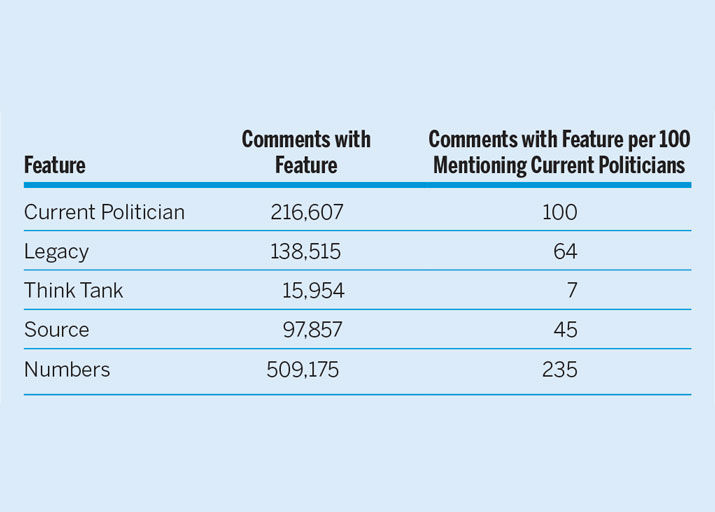
Table 1 shows that political legacies—operationalized as mentioning a politician who is no longer in office by name—play a prominent role in political discussion. Recall that these comments respond to or debate topics raised by links to current news articles. Current politicians are the dominant political actors in the news and natural objects of discussion when reacting to current events. For every 100 times a current politician was mentioned, a former politician was mentioned 64 times. The fact that former politicians were invoked about twice for every three times a current politician was mentioned is striking and suggests that citizens find the legacies of past politicians relevant in making arguments about current events. Comparisons to other comment features lend further credence to the notion that political legacies are important in contemporary political discussion. Moreover, about 25% of comments that referenced a legacy also mentioned a politician currently in office. This suggests that historic politicians are being used explicitly as reference points for understanding current events.
...historic politicians are being used explicitly as reference points for understanding current events.
Invocation of Legacies on Reddit
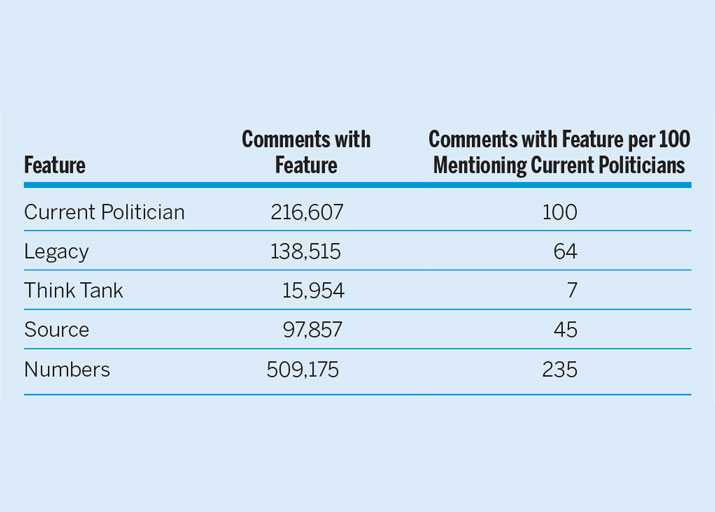
Note: The presence of the features was identified using rules described in online appendix A. The total number of comments was 5,280,337. Only about 5% of posts mentioned a current politician. This is because many posts were quite short (e.g., “Lol love it” and “What a surprise”).
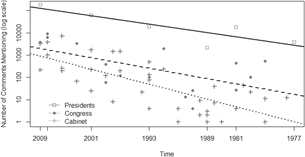
Presidential legacies remain relevant for substantially longer than the legacies of Cabinet secretaries and congressional leaders. Figure 1 shows how frequently politicians are mentioned as a function of their office and when they left office. For each office, the slope of the line of best fit indicates the rate at which conversation about those officeholders decays.Footnote 4 George W. Bush is mentioned more than three times as often as all of the Speakers of the House, Senate Majority Leaders, Secretaries of State, and Secretaries of the Treasury in the dataset combined—including Hillary Clinton and the officeholders who were in their positions in 2013–2014. The least-mentioned president in the plot, George H. W. Bush, was mentioned more often than most politicians who were in office at the time of the discussion—including prominent politicians such as Nancy Pelosi, Mitch McConnell, and John Kerry. Discussion of Cabinet secretaries decays so rapidly that those who served in the Reagan administration were mentioned, at most, a few dozen times during the two-year period. Temporally distant congressional leaders fared better but not by much.
Presidential legacies remain relevant for substantially longer than the legacies of Cabinet secretaries and congressional leaders… George W. Bush is mentioned more than three times as often as all of the Speakers of the House, Senate Majority Leaders, Secretaries of State, and Secretaries of the Treasury in the dataset combined.
Decay of Mentions in Political-Discussion Forums
Note: The x-axis gives the date that an officeholder left office. Cabinet members include the Secretary of State, Secretary of the Treasury, Secretary of Defense, and Attorney General. Congress includes Speakers of the House and Senate Majority Leaders.

Turning to a qualitative analysis of the actual text of the comments, discussion of past presidents often focused on establishing historical facts. However, these facts were used in ways that imply they are relevant to contemporary policy debates. At times, they were used to invoke brands that characterize particular policies or behaviors (e.g., “Eisenhower warned of the military–industrial complex and even detailed the number of schools and hospitals that one ship or bomber cost. Cut the military budget now!”). They also were used frequently to provide reference points for assessing the performance of contemporary politicians (e.g., “Obama didn’t triple the debt. He only added 44% more. Not nearly as much as Reagan or Bush jr [sic] at 186% and 104%”) and to establish precedents for proposals (e.g., “What exactly is wrong with impeaching Obama? Nixon was impeached for spying on what, 4,000 Americans? What Obama has done with the NSA makes Watergate look tiny”). They also were used to apportion credit or blame for current circumstances (e.g., “Bill Clinton laid the foundations for what we now have—economic depression—through his policies of massively increasing the money supply, encouraging consumerism, and discouraging productive long-term investment during his tenure”). More examples of each strategy are listed in online appendix B. All of these strategies relate historical events to contemporary politics.
It is interesting that the important role played by legacies in these discussions led participants to contest the past. One perennial point of contention was whether modern-day Republicans have a legitimate claim to the legacies of Abraham Lincoln and Theodore Roosevelt; these debates frequently devolve into strictly historical debates as to what these figures did and believed (see online appendix B for examples). The fact that such debates regularly flared up on a forum dedicated to the discussion of current events tellingly demonstrates the relevance of political legacies to contemporary policy debates.
To further explore the content of people’s memories, we administered a survey to a national sample of 2,202 American adults collected by Survey Sampling International in January 2016 (details about the survey are in online appendix C). We asked respondents whether they remembered a set of prominent national politicians and analyzed their open-ended responses regarding their recollections of each politician. Online appendix D presents the rules by which we hand-coded features of a sample of 1,500 open-ended recollections; table 1 in online appendix E shows the results.Footnote 5 The majority of memories were simple descriptions and personal characteristics—the office that the politician held, the party of which the politician was a member, and biographic details (e.g., Jimmy Carter was a peanut farmer from Georgia).
Affective evaluations also were common (e.g., Jim Wright was “good,” George H. W. Bush was “horrible”). More important, respondents were fairly likely to have memories of presidents that relate directly to public policy. Dwight Eisenhower’s role in the creation of the interstate highway system, Jimmy Carter’s Iran hostage-crisis debacle, Ronald Reagan’s call to tear down the Berlin Wall, and Bill Clinton’s budget surplus were remembered. With the notable exception of Newt Gingrich’s Contract with America, these policy-relevant details were far less prevalent in recollections about other officeholders. As shown in online appendix E, copartisans were no more likely to recall a given politician’s policy achievements than those outside of the politician’s party.
STUDY 2: HOW DO LEGACIES AFFECT POLITICAL ARGUMENTATION?
We showed that people remember past politicians and that these memories are deployed in conversations about current political issues. Our second study demonstrates that political legacies play an important role in these discussions—that is, they act as specialized brands that make arguments more persuasive. To test this hypothesis, we designed an experiment embedded within the survey described previously.Footnote 6 Each respondent was presented with a policy proposal and a list of five arguments favoring the proposal. They then were asked to rank the arguments from best to worst. For each set of arguments, we identified one argument as an ex ante “good” argument and another as an ex ante (i.e., intentionally) “bad” argument.Footnote 7 Respondents in the treatment group saw text in which either the good argument invoked a presidential legacy or the bad argument invoked a presidential legacy. For respondents in the control group, none of the arguments invoked a legacy.
We tested the legacies of two popular ex-presidents, one from each party: Bill Clinton and Ronald Reagan. The policy we invoked in each instance was randomly assigned to be either relevant or irrelevant to the politician’s legacy. The relevant Clinton policy was balancing the budget and the irrelevant policy was requiring school uniforms in public schools. The relevant Reagan policy was reducing taxes on the rich and the irrelevant policy was making it more difficult to purchase a firearm. By “irrelevant,” we do not mean that Bill Clinton and Ronald Reagan had nothing to do with school uniforms and gun control, respectively. Indeed, both presidents issued statements on these policy domains; therefore, the prompts would be sensible to respondents. We simply mean that respondents were unlikely to associate the two presidents mainly with these respective policies. Conversely, balancing the budget was a key achievement of the Clinton presidency and supply-side tax policy was at the core of Reagan’s governing philosophy. Indeed, the open-ended survey responses from study 1 corroborated these labels.Footnote 8
In summary, we used a 3×2 factorial design in which the first factor was attaching the legacy to a good argument, a bad argument, or no argument, and the second factor was whether the issue was relevant or irrelevant to a president’s legacy. This design allowed us to assess whether presidential legacies function merely as party cues, which a plethora of literature has shown to influence policy attitudes. If legacies were simply party cues, then they should have the same effect for bad and good arguments and for relevant and irrelevant issues. This is not what we found.
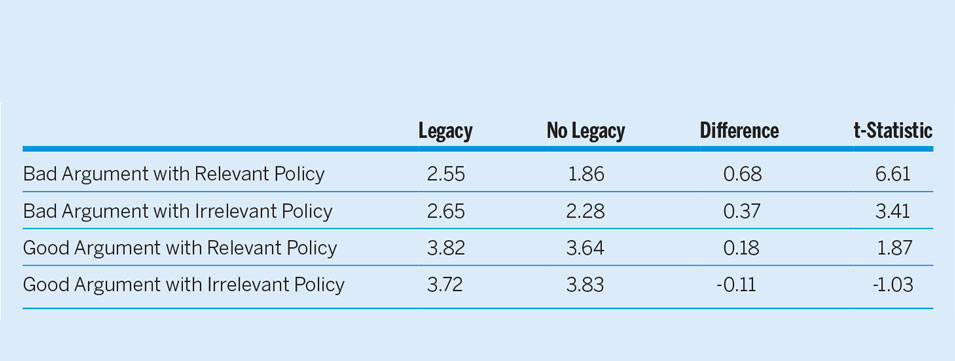
Table 2 presents average rankings for eight argument groups in which 5 is the highest ranking and 1 is the lowest. The table presents the effects of Reagan’s legacy on Republicans and of Clinton’s legacy on Democrats. Three features are immediately apparent. First, the good arguments were ranked higher than the bad arguments, confirming the logic of the design. Second, the effect of attaching a legacy to any argument was stronger for relevant than for irrelevant policies. For instance, attaching a legacy associated with a relevant policy to a bad argument increased the ranking by 0.68 units compared to only 0.37 units for an irrelevant policy. Third, the effect of attaching a legacy was stronger for bad than for good arguments. For example, attaching a legacy to a bad argument associated with a relevant policy increased the ranking by 0.68 units compared to only 0.18 units for a good argument.
Ranking of Arguments by Characteristics

Note: Argument rankings range from 1 to 5, where 5 denotes the strongest argument.
Table 3 presents estimates from regression models predicting the argument rankings. As shown in columns 1 and 3, legacies had no significant effect on good arguments and a substantial, positive effect on bad arguments. Attaching a legacy to a bad argument improved the ranking by 0.54 units (p<10-6), whereas attaching a legacy to a good argument increased the ranking by a negligible 0.03 units (p=0.70). Incorporating the interaction between legacies and relevance, legacies were more potent for relevant policy areas for both good and bad arguments. Because the coefficients for legacy and its interaction with relevance have different signs for good arguments, we needed to test whether the total effect for legacies on relevant policies was positive. To do this, we took 1,000 bootstrap samples and calculated the sum of the coefficients for legacy and its interaction with relevance in each sample. We obtained a 95% confidence interval of (-0.03, 0.36) for good arguments and (0.49, 0.88) for bad arguments. The 95% confidence interval of the difference between the total effects for bad arguments and the total effect for good arguments was (0.25, 0.79). Thus, there was, at best, weak evidence for a positive effect of a legacy (even for relevant issue areas) for good arguments and a significant—and significantly larger—total effect for bad arguments.
Effect of Legacy on Argument Rankings
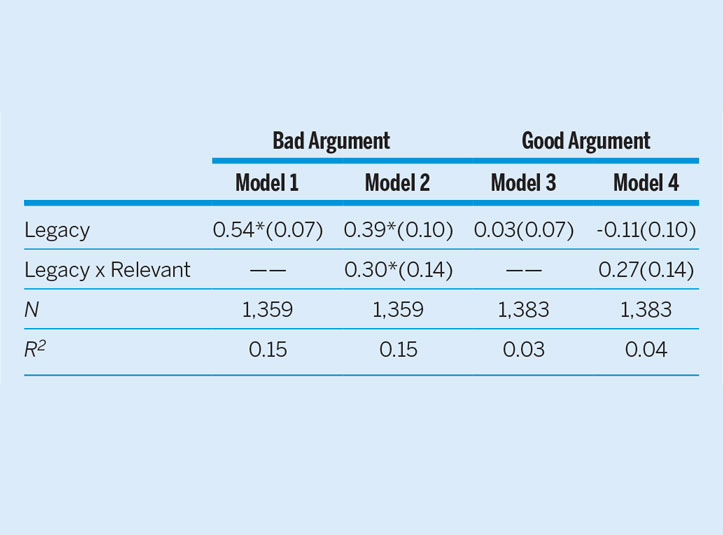
Notes: Standard errors in parentheses; *p<0.05 (two-tailed). Estimates are from a linear model of ranking for good and bad arguments as a function of issue fixed effects (not shown), the presence of legacy, and whether the issue is relevant to a politician’s legacy. Ns are less than the total number surveyed because each model includes four of six treatment assignments. The main effect of “Relevant” drops out due to the inclusion of issue fixed effects.
Estimating the same models for the effect of Bill Clinton’s legacy on Republicans and Ronald Reagan’s legacy on Democrats, we found that the pattern was similar but the substantive effect of legacies was smaller (the regression table is in online appendix G). Repeating the same bootstrap exercise for the relevant-issue legacy effect in the different party sample, we found a 95% confidence interval of (-0.33, 0.05) for good arguments and (0.06, 0.47) for bad arguments. Bootstrapping the difference between the total effect of a legacy on a relevant argument for in-partisans and out-partisans, we found a 95% confidence interval of (0.14, 0.71). Thus, legacies for relevant policy positions had a stronger effect for in-partisans than for out-partisans. This could be because, as popular presidents, Reagan and Clinton enjoyed a mix of out-party support and opposition. Consequently, the influence of legacies might be less pronounced when aggregating responses from these subgroups.
To summarize the findings of study 2, we found that legacies improved the perceived quality of bad arguments—particularly when they pertained to an issue area that was closely associated with the politician. The effect was stronger when the politician was in the same party as the receiver of the argument. Legacies did not affect the perceived quality of good arguments.
Notably, this effect defies simple categorization as a party cue because there is no reason to expect that a party cue would operate for bad arguments but not good arguments, nor for why the cue would be stronger for relevant issue areas.Footnote 9 Rather, political legacies seem to function as a specialized brand, one that holds more appeal for copartisans and exerts more influence on relevant issue areas.
What are the mechanisms underlying the results of the experiment? Although we only can speculate, one possibility is that a legacy provides valence information in a way that a simple party cue does not. A politician’s past success in a particular domain contributes information about the likely quality of an argument and therefore increases the credibility of a bad argument relative to an already-strong argument. This also explains why legacies work only in relevant domains because past performance in irrelevant domains would not provide valence advantages. We look forward to future research that will further investigate these mechanisms. Additional iterations of this experimental design also could compare legacy-based justifications to others invoked by current politicians and media sources.
DISCUSSION
The finding that political legacies are effective in elevating the persuasiveness of weak political arguments is perhaps not surprising given how often people invoke former politicians in justifying their positions in current debates. Yet, we found this effect to be far stronger in domains associated with the accomplishments of former politicians, indicating that legacies—like specialized brands—have a limited “halo.” This pattern suggests that political parties have a strong interest in building and cementing their leaders’ legacies in the broadest range of domains possible if they are to later benefit from the specialized brand. Indeed, case studies of the historical evolution of specific legacies—ranging from Lincoln to Reagan—indicate that interested parties, including the media, can have substantial influence on the way that the public remembers specific figures and events (Fine Reference Fine2014; Schudson Reference Schudson1993). Future research can investigate this instrumental approach to legacy building, including how political parties carefully cultivate how their leaders’ accomplishments are shaped in the public mind.
In study 1, we found that presidential legacies were prominent in political discussions. This does not mean that officeholders other than presidents are not thinking about or acting to cement their legacies. They may hold more optimistic beliefs about the longevity of future generations’ recollections of past leaders. However, even if politicians recognize the short memory of the broad public, they still may be concerned with establishing their legacy among a much narrower group—such as historians, public intellectuals, party elites, or the public in a smaller geographical unit. Future scholars can examine these scope conditions in more detail.
Likewise, although this article examines political legacies in the American context, the concepts and arguments we advance are not unique to US politics. In fact, based on studies of collective political memories in other countries (Kligler-Vilenchik, Tsfati, and Meyers Reference Kligler-Vilenchik, Tsfati and Meyers2014), we expect many of the insights gleaned from the American evidence to hold up in other advanced democracies. However, one notable source of difference is the US presidential system, in which Cabinet members are not career bureaucrats or legislators but instead personal appointees made by the president. This institutional feature suggests that our finding regarding the dominant presence of presidential legacies compared to those of other senior officeholders is possibly a US-specific finding. Whether this is true requires replicating this investigation in countries with parliamentary systems—a challenge that we hope is pursued in future work.
SUPPLEMENTARY MATERIAL
To view supplementary material for this article, please visit https://doi.org/10.1017/S1049096519000209
ACKNOWLEDGMENTS
We thank Steve Callander, Andy Eggers, Greg Huber, Oren Meyers, Terry Moe, Paulina Patana, and seminar participants at Cornell University, Haifa University, University of California–San Diego, University of Chicago, and the APSA Annual Meeting for valuable feedback. This article was reduced from a longer version (available at https://dx.doi.org/10.2139/ssrn.3028390).