Introduction
According to the projections in the World Population Prospects (WPP), the population aged 65 and above in China is expected to reach 30.9 per cent by 2050 (United Nations 2024). Ageing is more advanced and develops faster in rural areas than in urban areas. The 2020 census data reveals that while the proportion of older adults in urban areas grew by 3.3 per cent to 11.1 per cent since 2010, rural areas saw a more than twofold increase, surging from 10.1 per cent to 17.7 per cent over the same period (National Bureau of Statistics of China 2021). Even though the government policies actively work to reduce the urban–rural inequality, the long-standing dual economic structure has led to significant disparities, with rural areas in China still lagging far behind urban areas in terms of public services, pensions and social security. As a result, the issue of rural older care has become a focal point of contemporary society, directly impacting both the wellbeing of the rural older adults and broader social development. In China, the ‘family collective contract’ emphasizes the role of offspring in supporting and meeting the health needs of older parents (Liu and Wen Reference Liu and Wen2024; Shanas Reference Shanas1971), and this situation is more prominent in rural China. However, as the cost of education continues to rise, rural children face increasing difficulties in achieving upward educational mobility. Under such circumstances, can the traditional ‘family collective contract’ still play a role? In other words, can offspring who ‘jump out of the farm gate’ and achieve educational success still have a positive impact on the health of their rural older parents?
Psychologically, offspring’s educational achievements can bring a sense of pride to older parents (Zhang and Li Reference Zhang and Li2021). Materially, offspring with higher education are able to secure better jobs and income, thus providing financial support for their parents (Torssander Reference Torssander2014). While children’s education or one’s own education alone affects outcomes through individual mechanisms, intergenerational educational mobility influences health through dual pathways. For rural families with limited resources, intergenerational educational mobility affects both the distribution of market resources and the allocation of internal family resources. This study aims to propose the dual-axis concept of intergenerational educational mobility’s impact on older health based on existing theories and further validate the mechanisms through which it operates.
The impact of intergenerational educational mobility on older parents’ health shows age- and gender-related differences. As age advances, declining physical functions increase health risks, with rural parents needing more care than younger ones (Du et al. Reference Du, Sun, Zhang and Wang2016). Gender norms foster closer bonds between mothers and offspring, making mothers more dependent and likely to receive support, indicating that offspring’s education influences mothers’ health more than fathers’ (Ma et al. Reference Ma, Yahirun, Saenz and Sheehan2021; Yuan and Du Reference Yuan and Du2023). This study offers new insights into how family culture shapes health outcomes among older adults during China’s transformation, particularly through the lens of intergenerational educational mobility.
In summary, this study will explore the following research questions: Under the framework of dual-axis distribution theory, how do upward and downward intergenerational educational mobility affect the health of older parents in rural China? What are the age and gender differences in this impact? In addition, what are the mediating mechanisms of this effect? This article uses the 2014–2020 China Longitudinal Aging Social Survey (CLASS) data to solve the limitations of the traditional linear model used in existing studies by using a diagonal reference model to separate the net effect of intergenerational educational mobility and distance on the health of rural older parents, highlighting the unique importance of social mobility for rural older adults in China. As for mechanism analysis, we innovatively explored the relationships between mediating variables, deepening the empirical investigation in this field.
Literature review
Intergenerational educational mobility and the health of older parents
The relationship between education and health has been widely studied (Oreopoulos Reference Oreopoulos2003). Previous studies proved that individuals with higher levels of education and more prestigious occupations tend to exhibit better physical and mental health (Chen et al. Reference Chen, Yang and Liu2010; Phelan et al. Reference Phelan, Link and Tehranifar2010). However, with the continuous advancement of urbanization in China, the trend towards smaller family structures and the intensification of population ageing have rendered the impact of offspring education on parental health a new research hotspot. Although an individual’s education still affects the acquisition of health resources, its influence may decrease with age, while family factors, especially those related to children, become more significant. Recently, both domestic and international scholars have found a positive effect of offspring education on the psychological health of parents (Friedman and Mare Reference Friedman and Mare2014; Graham and Sabater Reference Graham and Sabater2016; Lee et al. Reference Lee, Glei, Goldman and Weinstein2017; Lundborg and Majlesi Reference Lundborg and Majlesi2018; Lv and Liu Reference Lv and Liu2020; Torssander Reference Torssander2013; Zimmer et al. Reference Zimmer, Martin, Ofstedal and Chuang2007). Existing research has provided valuable insights from an emotional perspective, such as the symbolic meaning of children’s educational attainment for parents (Yahirun et al. Reference Yahirun, Sheehan and Mossakowski2020) and the emotional bonds between children and their parents (Pillemer et al. Reference Pillemer, Suitor, Mock, Sabir, Pardo and Sechrist2007). However, these studies tend to overlook the broader implications of intergenerational educational mobility, which go beyond the emotional domain and influence the allocation of resources within both families and society. From the perspective of resource distribution, education affects the flow of resources in both social and familial contexts, and this flow is jointly shaped by the educational levels of both parents and offspring. Therefore, it is necessary to further explore how the educational attainment of parents and offspring are interrelated and how their interplay affects the wellbeing of older adults, rather than considering them as independent factors. Intergenerational educational mobility can reflect the relative educational gap between offspring and parents, and considering its impact on the health of older parents can fill the gap left by previous studies that focused only on one generation. Although a study in China found that parents whose children have received more schooling than themselves tend to have a more positive outlook on their own health (Qin Reference Qin2022), the existing literature still leaves ambiguity in explaining the impact of intergenerational educational mobility on the health of older parents.
This study contends that the influence of intergenerational educational mobility manifests in two distinct domains: the first is educational mobility within the process of social redistribution, and the second is within the family. With the acceleration of China’s transition to a market-oriented economy, the influence of educational mobility in social redistribution has grown increasingly significant, as it is closely linked to the acquisition of market resources. A relative improvement in the educational level of the younger generation can enhance older family members’ access to economic benefits and non-material rewards beyond their own capabilities (Grossman Reference Grossman, Hanushek and Welch2006). For instance, improved access to medical resources can help cure diseases (Friedman and Mare Reference Friedman and Mare2014). These factors can have a lasting impact on the health of the older generation (Case et al. Reference Case, Lubotsky and Paxson2002). Moreover, educational mobility within the family determines the distribution of resources. Scholars who view education as human capital have long noted its spillover effects (Jacobson Reference Jacobson2000); in this context, with the increasing trend of smaller family sizes and greater involvement of children in family matters, the spillover effect of education as human capital will become even more significant. Intergenerational educational mobility will also have a spillover effect on family members beyond the individual, facilitated by daily interactions and engagements. In developing countries, where public welfare systems remain incomplete, parents in old age tend to rely more heavily on the support of their children; consequently, the impact of educational mobility on parental health is likely to be greater (De Neve and Fink Reference De Neve and Fink2018). Moreover, the resource allocation process within Chinese families is also influenced by intergenerational obligations, which is particularly evident in rural households. In rural households, traditional intergenerational obligations involve parents supporting underage children and adult children supporting ageing parents. However, marketization has led to a shift, where intergenerational obligations now often involve both ‘children supporting older parents’ and ‘older parents supporting the young’. In summary, the impact of intergenerational educational mobility on the health of older adults might be influenced by both market distribution and intergenerational obligations. For simplicity, we can conceptualize this as a dual-axis model, where pension resources influenced by educational mobility follow a dual-axis flow pattern:
• Market Axis: Educational mobility influences access to market resources, such as economic benefits and medical resources.
• Family Axis: Educational mobility shapes internal family resource distribution, constrained by intergenerational obligations.
Under this dual-axis model, the effect of the distance of intergenerational educational mobility on the health of older individuals, depending on the direction of mobility, requires further explanation.
Upward intergenerational educational mobility in the dual-axis model
In the dual-axis resource allocation model, the impact of upward intergenerational educational mobility on the health of older parents can be explained using status attainment theory and Confucian tradition theory. Status attainment theory posits that education is an important means of accumulating human capital, which helps workers achieve upward social mobility (Zhuo et al. Reference Zhuo, Ye and Ji2023). When the educational level of offspring surpasses that of their parents, it not only reduces the likelihood of downward intergenerational social mobility but also enhances their ability to provide economic and emotional support to older parents, thereby improving their health (Chen et al. Reference Chen, Zheng and Xu2019). Studies in the field of social mobility indicate that, compared to urban residents, educational mobility plays a more significant role in promoting intergenerational mobility among rural residents (Chen and Yuan Reference Chen and Yuan2012). This increased access to market resources enables upwardly mobile offspring to secure better jobs and higher incomes, allowing them to provide more financial and material support to their parents, thereby improving their health. Moreover, upwardly mobile offspring are more capable of fulfilling traditional Confucian filial duties. The long-standing ‘raising younger children to secure old age’ tradition is a typical practice of intergenerational exchange in Chinese families (Zhan and Montgomery Reference Zhan and Montgomery2003). This practice has been legally protected in communist China. For example, the 1954 Constitution of the People’s Republic of China and the 1980 Criminal Law stipulate legal penalties for adult children who fail to support their parents. Adult children raised in such a culture are naturally inclined to reciprocate by providing for their parents when they are able. Therefore, it is not difficult to infer that upward educational mobility not only increases the overall resources of the family but also directs internal family resources along the family axis from offspring to parents, thereby improving the health of the older generation.
Even within the same upward intergenerational mobility situation, offspring with different mobility distances may provide different types of support, which could lead to varying degrees of health benefits. Offspring with a greater distance of upward mobility are better able to offer informational support to their parents, as they themselves have received more health education (Friedman and Mare Reference Friedman and Mare2014). However, children who experience greater mobility are more likely to secure better jobs with larger income disparities compared to their parents, making the cost of maintaining close ties with their parents potentially higher (Torssander Reference Torssander2013). Some scholars have found that the distance of upward mobility is inversely proportional to the likelihood of intergenerational cohabitation (Lei et al. Reference Lei, Strauss, Tian and Zhao2015). Further research indicates that older parents who do not live with their children receive more financial assistance, while those who cohabit with their children receive more physical assistance in daily activities (Sun Reference Sun2002). Although both types of intergenerational support are undeniably beneficial, given the primary role of economic gaps in older care in China, we hypothesize that a significant upward mobility will have a greater positive effect on the health of older adults. This leads to the following hypotheses:
Hypothesis 1. Intergenerational upward educational mobility positively affects the health of older adults in rural areas.
Hypothesis 2. The longer the upward intergenerational educational mobility distance, the stronger the positive effect on rural parental health.
Downward intergenerational educational mobility in the dual-axis model
In the dual-axis resource allocation model, downward intergenerational educational mobility may lead to intergenerational exploitation, while the concept of ‘unlimited responsibility’ within intergenerational obligations complicates the impact of this exploitation on health. According to status attainment theory, downward educational mobility has a negative effect on social status and resource acquisition. Specifically, on the market axis, downward educational mobility weakens a family’s ability to access market resources, leading to a reduction in internal family resources. Meanwhile, on the family axis, when the educational level of offspring is lower than that of their parents, material resources within the family inevitably shift towards meeting the daily needs of the younger generation. Research has shown that one-way resource flows towards offspring can cause health issues for the older generation. For instance, excessive economic support from rural parents to their children can lead to negative emotions, which are detrimental to psychological health (Cui and Jin Reference Cui and Jin2016). Additionally, the ongoing burden of providing both economic and physical support leads to serious health problems among older adults in rural China (Chen and Liu Reference Chen and Liu2012). Some scholars refer to this phenomenon as ‘intergenerational exploitation’. However, the traditional cultural notion of ‘unlimited responsibility’ in rural areas complicates this dynamic. This concept implies that intergenerational responsibility is unbalanced, as parents often continue to bear an endless obligation towards their adult children, even after they have reached independence (Dong Reference Dong2019). The ‘ethics of responsibility’ in older adults makes parents more tolerant of their children’s achievements while holding themselves to strict standards. Research by Li (Reference Li2018) suggests that ‘downward’ economic support from parents can promote labour force participation among older adults, and a certain level of labour participation benefits their physical health. Therefore, even though downward intergenerational educational mobility may cause a shift in resources towards the younger generation on the family axis, the impact on the health of the older generation is uncertain. This leads to the following set of competing hypotheses
Hypothesis 3a. Intergenerational downward educational mobility negatively affects the health of older parents in rural areas.
Hypothesis 3b. Intergenerational downward educational mobility positively affects the health of older parents in rural areas.
Age heterogeneity
The cumulative disadvantage theory posits that as individuals age, those in disadvantaged positions face increasing health risks (Li and Xia Reference Li and Xia2014; Merton Reference Merton1968). On one hand, as age increases, older adults experience declining physical function and reduced mobility, increasing their dependency on care. Consequently, older adults, particularly those of advanced age, exhibit poorer health compared to younger older adults, requiring more specialized medical resources and higher levels of care-giving. Research has shown that family care-giving significantly enhances the psychological wellbeing of older adults (Huang et al. Reference Huang, Hu and Chen2017). On the other hand, analysis from China highlights substantial urban–rural disparities in income sources of older adults: urban older adults can get more pensions, whereas rural older adults rely significantly on support from their offspring, accounting for 32.48 per cent of their income, particularly among those unable to work (Du et al. Reference Du, Sun, Zhang and Wang2016). These disparities further exacerbate rural older adults’ vulnerability, as those with limited pensions, especially senior older adults who have lost their ability to work, must rely more heavily on their children for financial support than younger older adults. In summary, rural senior older adults, who have more health and long-term care needs, require more assistance from their offspring than younger older adults. Therefore, given that intergenerational educational mobility plays a crucial role in shaping the economic and care-giving resources available to older adults, it is likely that the economic and health resources resulting from upward educational mobility have a more significant impact on the health of senior older adults compared to younger older adults. On the contrary, intergenerational downward mobility may result in more significant negative health effects for senior older adults, who are in greater need of economic resources and care, owing to intergenerational exploitation (Yang and He Reference Yang and He2004). Based on the analysis, the following hypothesis is proposed:
Hypothesis 4. Upward mobility has a stronger positive impact on senior older adults compared to younger older adults, while downward mobility has a stronger negative effect on senior older adults.
Gender heterogeneity
Traditional patriarchal cultures emphasize a division of labour where men are expected to work outside the home while women manage domestic responsibilities (Ma et al. Reference Ma, Yahirun, Saenz and Sheehan2021). As a result, women tend to have more frequent and intimate interactions with their offspring during their upbringing. This close relationship between women and their offspring may further influence the health effects of intergenerational educational mobility. Existing research has found that higher educational levels among offspring not only reduce depression levels in mothers but also enhance their cognitive abilities, with a more significant positive impact on maternal health compared to fathers’ health (Yuan and Du Reference Yuan and Du2023). Additionally, societal expectations and norms derived from patriarchal cultures contribute to lower labour force participation rates among women compared to men. Consequently, older women often face greater economic vulnerability and lower levels of social security in their later years, increasing their reliance on support from their offspring (Cai et al. Reference Cai, Giles, O’Keefe and Wang2012). Therefore, the intergenerational exploitation caused by downward educational mobility may have a more pronounced negative impact on the health of older mothers. The following hypothesis is proposed:
Hypothesis 5. Upward mobility has a stronger positive impact on older mothers compared to older fathers, while downward mobility has a stronger negative effect on older mothers.
Mediating factors of intergenerational educational mobility on older parental health
According to the dual-axis resource allocation model, intergenerational educational mobility affects the health of older parents through the resource transmission along the market and the family axes, with economic resources being a crucial component. As mentioned earlier, on the market axis, upward educational mobility allows descendants to gain more market economic resources, which is specifically reflected in their income. On the family axis, the allocation of family economic resources between generations is primarily manifested as intergenerational financial support. Moreover, income of the younger generation is a prerequisite for intergenerational economic support. Therefore, intergenerational educational mobility may impact older parents’ health through a serial mediation pathway, whereby it first influences the income of the younger generation, which in turn affects the intergenerational economic support, ultimately impacting the health of older adults. In summary, this study focuses on three potential mediating effects of intergenerational support: the independent mediating effects of offspring’s economic status and intergenerational financial support; as well as the serial mediating effect of economic status and intergenerational financial support on older parental health.
The first potential mediating factor is the economic status of offspring. Upward educational mobility provides offspring with better career opportunities and social status transitions, thereby increasing their income levels. The advantage in material resources often enables and motivates offspring to support the health of their ageing parents, especially when older adults in rural areas lack health insurance or other government-sponsored health-care programmes (Couch et al. Reference Couch, Daly and Wolf1999; Henretta et al. Reference Henretta, Hill, Li, Soldo and Wolf1997). Moreover, the increase in offspring’s income may also bring additional social resources and psychological support, further enhancing the overall wellbeing of older adults (McGarry and Schoeni Reference McGarry and Schoeni1995).
The second potential mediating factor is intergenerational financial support. Since the latter half of the twentieth century, the application of social exchange theory in the study of intergenerational family support has garnered increasing attention (Bengtson and Kuypers Reference Bengtson, Kuypers, Munnichs, Mussen, Olbrich and Coleman1985; Fiori and Denckla Reference Fiori and Denckla2012; Ramos and Wilmoth Reference Ramos and Wilmoth2003). The core concept of social exchange is the reciprocal relationship of resources. Most research agrees that balanced intergenerational support is beneficial for older adults (Ramos and Wilmoth Reference Ramos and Wilmoth2003). Conversely, imbalanced intergenerational support may have adverse effects on individuals’ physical and psychological health. For instance, overprotection can negatively impact the sense of freedom and independence among older adults (Bengtson and Kuypers Reference Bengtson, Kuypers, Munnichs, Mussen, Olbrich and Coleman1985) and may even induce feelings of guilt (Fyrand Reference Fyrand2010; Liang et al. Reference Liang, Krause and Bennett2001). However, it is important to note that imbalanced intergenerational support is a more common phenomenon, and its consequences warrant further investigation.
In Western societies, when older adults provide less support to their offspring than they receive, this imbalance can conflict with the values of independence prevalent in Western cultures, potentially leading to negative effects (Lowenstein and Daatland Reference Lowenstein and Daatland2006). However, in Chinese culture, the values of ‘raising children for old age’ and ‘filial piety’ mean that adult children tend to support their older parents as a form of repayment for their upbringing (Guo and Chen Reference Guo and Chen1998). In this context, financial support becomes a crucial element of intergenerational relationships, especially as older adults’ physical functions decline, limiting their ability to engage in household labour. Additional economic help from their offspring can provide services such as housekeeping, thereby enhancing older adults’ life satisfaction and self-rated health (Li et al. Reference Li, Song and Feldman2009). However, with the progress of modernization, older adults in rural China have started to place more emphasis on equal and reciprocal intergenerational relationships (Huang et al. Reference Huang, Hu and Chen2017). Research has found that when older adults in China receive excessive economic support from their children, it can lead to psychological stress, which is detrimental to their health (Xu and Peng Reference Xu and Peng2024).
The third potential mechanism is the serial mediating effect of economic status of offspring and intergenerational financial support on rural older parental health. Social exchange theory argues that human behaviour fundamentally involves rational activities of weighing benefits and costs (Fiori and Denckla Reference Fiori and Denckla2012), which indicates that intergenerational exchanges are driven by economic considerations. Specifically, the socio-economic status of offspring plays a crucial role in shaping the dynamics of intergenerational financial support, which in turn affects the health of older parents (Grundy Reference Grundy2005). As offspring become financially capable, those with better economic conditions are more motivated to provide greater financial support to their parents as part of a reciprocal exchange (Huang et al. Reference Huang, Hu and Chen2017). Based on these studies, we argue that offspring’s income consistently influences the intergenerational financial support. Given this analysis, this article proposes the following hypotheses regarding mediation mechanisms:
Hypothesis 6a. Intergenerational educational mobility affects the health of older parents through the economic status of the offspring.
Hypothesis 6b. Intergenerational educational mobility affects the health of older parents through intergenerational financial support.
Hypothesis 6c. The economic status of the offspring indirectly affects the health of older parents through intergenerational financial support.
Methods
Data and sample
This study utilizes data from the China Longitudinal Aging Social Survey (CLASS), a nationwide, continuous large-scale social survey project which was conducted by the Renmin University of China. The CLASS survey initiated a baseline survey in 2014 and conducted three follow-up surveys in 2016, 2018 and 2020. Our study selected rural respondents aged 60 and above with at least one adult child in each wave. The study retained the highest-educated offspring of these older respondents; when older adults had more than one offspring with the highest education, we randomly selected one to retain. Owing to the requirement of the diagonal reference model (DRM) for cross-sectional data and to education on health having typically a gradual and cumulative impact, if a respondent has participated in two or more surveys, only the most recent survey data is used, ensuring that each respondent appears only once in the sample and allowing for a more accurate capture of this lagged health effect. To verify the robustness of the results, we selected the following sample to test: (a) the child with the lowest level of education in the family; (b) the child providing the most emotional and household support to the parents; (c) a randomly selected child. We also excluded any missing values for variables in the analysis, resulting in a final sample of 7,094 persons.
Variables
Outcome variables
The dependent variable of this study is self-rated health status. In the CLASS survey questionnaire, the question regarding self-rated health is as follows: ‘How would you rate your current physical health condition?’. Answers are on a five-point scale, so we recoded it, with 5 representing very healthy and 1 representing very unhealthy. Respondents who answered ‘don’t know’ are coded as missing and excluded from this analysis. We believe that such a self-rated health score can measure the health condition effectively, because previous studies have found that it is a composite index in order to not only reflect the degree of health risk based on blood test data but also indicate psychological health based on depression scores (Liu, Hu and Gong, Reference Liu, Hu and Gong2021).
Explanatory variables
Our main explanatory variable is intergenerational educational mobility, which is determined by both the self-education of older adults and their offspring’s education. Education is acquired early in life and cannot easily be changed; it serves as a direct indicator of the socio-economic status of both older parents and their offspring (Xu and Peng Reference Xu and Peng2024). This study uses the educational level of the respondents’ highest-educated offspring as the variable for offspring’s education. We combined the responses into three categories based on the five answer options regarding the educational levels of older adults and their offspring in the CLASS questionnaire. Considering that our study sample spans multiple generations, and that the societal events they experienced will impact educational attainment, we observed fewer respondents with higher education and fewer cases of illiteracy among the offspring. Therefore, we categorized the education level of respondents and their highest-educated offspring into three groups: elementary school and below (coded as 1), junior high school (coded as 2) and senior high school and above (coded as 3).
Based on this, we were able to create a variable that describes the intergenerational educational mobility. Referring to the definition of intergenerational educational mobility, we considered the direction and distance of the mobility and operated it as a categorical variable. When cleaning the data, we found that the number of respondents who experienced downward intergenerational educational mobility by two units was very small. Therefore, we grouped the samples of downward mobility into one category. When parents and offspring have the same education (immobility), this variable is coded as 0; when the education of the offspring exceeds that of the parent (upward mobility) by one unit, this variable is coded as 1; when the education of the offspring exceeds that of the parent by two units, this variable is coded as 2; and when the education of the offspring is lower than that of the parent (downward mobility), this variable is coded as 3.
In order to test the heterogeneity of gender and age, we classified the interviewed older parents by gender as male and female, and by age as younger older adults (< 80 years old) and senior older adults (≥ 80 years old).
Mediating variables
According to previous literature, we supposed that the economic status of offspring and intergenerational financial support can reflect economic resources and changes along both the market axis and the family axis. Therefore, we tested the income of offspring and intergenerational financial support as the mediating factors through which intergenerational educational mobility influences the health of older parents.
Economic status of offspring. We used ‘What do you think of the offspring’s financial situation?’ in the CLASS questionnaire to measure the subjective economic status of the highest-educated child. Answers are on a five-point scale, so we recoded it so that bigger values indicate better economic status for the offspring. Previous research has confirmed that subjective, ladder-type measures of economic status are consistent with objective economic conditions (Fraile and Pardos-Prado Reference Fraile and Pardos-Prado2014). Therefore, it is reasonable to use this variable to measure the economic status of offspring.
Intergenerational financial support. According to social exchange theory, we focused on the role of intergenerational financial support in transmitting the impact of education on older adults’ health. It is noteworthy that the support between parents and offspring is often reciprocal, so we used the net value of the intergenerational financial support, which captured the differences between financial support transfer from offspring to parents and those from parents to offspring. Moreover, supported by other literature (Tur-Sinai and Lewin-Epstein Reference Tur-Sinai and Lewin-Epstein2020), the intergenerational financial support should align with that of intergenerational educational mobility, which refers to the change of educational level between two generations. Following the questions from the CLASS survey, ‘In the past month, has this child given you any money or goods, and what is their value?’ and ‘In the past month, have you given this child any money or goods, and what is their value?’, ordinal responses were converted into approximate monetary values according to the questionnaire coding scheme (e.g., 1 coded as 0 yuan, 2 as 100 yuan, and 3 as 350 yuan). The net intergenerational financial support is calculated by subtracting the monetary value of parental support from that of offspring support. A constant is then added to this difference, followed by taking the logarithm to obtain the final analytical variable. Overall, a larger value of this variable indicates that offspring provide significantly more financial support to their older parents than they receive from them, reflecting a greater net financial contribution from offspring to parents.
Control variables
In terms of characteristics of older parents, we controlled for demographic variables, including age, gender and marital status; some socioeconomic variables, including income, work condition and occupation (before retirement); also living arrangements and the number of offspring. As for characteristics of their highest-educated offspring, we controlled their age, gender, marital status and work conditions.
Analytical strategy
Diagonal reference model
Previous research on the impact of intergenerational educational mobility on health often forms a dummy variable included in linear regression models to measure the effect of educational gradient on older parental health. However, this method is constrained by strong collinearity issues and cannot properly separate the net effect of intergenerational educational mobility. Given the limitations of traditional methods, we employed the DRM proposed by Sobel (Reference Sobel1981) to control for individual’s education levels and offspring’s education levels, thereby separating the effects of intergenerational educational mobility on older parental health. The model compares individuals with the same level of education as their offspring (the reference group) to those with different levels of education from their offspring. The basic model of the diagonal reference model can be represented as:
 \begin{equation}{Y_{ijk}} = p{\mu _{ii}} + q{\mu _{jj}} + \mathop \sum \nolimits^ \beta {x_{ijk}} + {e_{ijk}}.\end{equation}
where  ${Y_{ijk}}$ is the dependent variable of our study, which represents the self-rated health score of older adult
 $k$, with self-education level
 $i$ and offspring’s education level
 $j$;
 ${\mu _{ii}}$ and
 ${\mu _{jj}}$ represent the self and offspring effects, and
 $p\,$ and
 $q$ are two parameters representing the relative weights of individual and offspring effects, with the constraint that
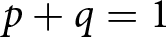 $p + q = 1$. By combining diagonal effects with weight parameters, the estimated intercept for each non-diagonal cell can be calculated. Further,
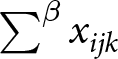 $\mathop \sum \nolimits^ \beta {x_{ijk}}$ represents the covariates in the model, while
 ${e_{ijk}}$ denotes the random error term.
To examine the net effect impact of intergenerational educational mobility on older parental health, our study augmented the basic model by incorporating a categorical variable 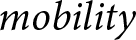 $mobility$ representing intergenerational educational mobility,
 ${\beta _1}$ is the coefficient of it. The resulting model is as follows:
 \begin{equation}{Y_{ijk}} = p{\mu _{ii}} + q{\mu _{jj}} + {\beta _1}mobility + \mathop \sum \nolimits^ \beta {x_{ijk}} + {e_{ijk}}.\end{equation}
As for exploring the heterogeneity of gender and age, we interacted the intergenerational educational mobility variable (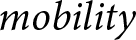 $mobility$) with the gender and age group variables (
 $gender/age\,group)$separately to create interaction terms. The interaction model is as follows:
 \begin{equation}{Y_{ijk}} = p{\mu _{ii}} + q{\mu _{jj}} + {\beta _1}mobility + {\beta _2}gender + {\beta _3}mobility \times gender + \mathop \sum \nolimits^ \beta {x_{ijk}} + {e_{ijk}}.\end{equation}
 \begin{equation}{Y_{ijk}} = p{\mu _{ii}} + q{\mu _{jj}} + {\beta _1}mobility + {\beta _2}age\,group + {\beta _3}mobility \times age\,group + \mathop \sum \nolimits^ \beta {x_{ijk}} + {e_{ijk}}.\end{equation}
3.3.2 Serial mediation model
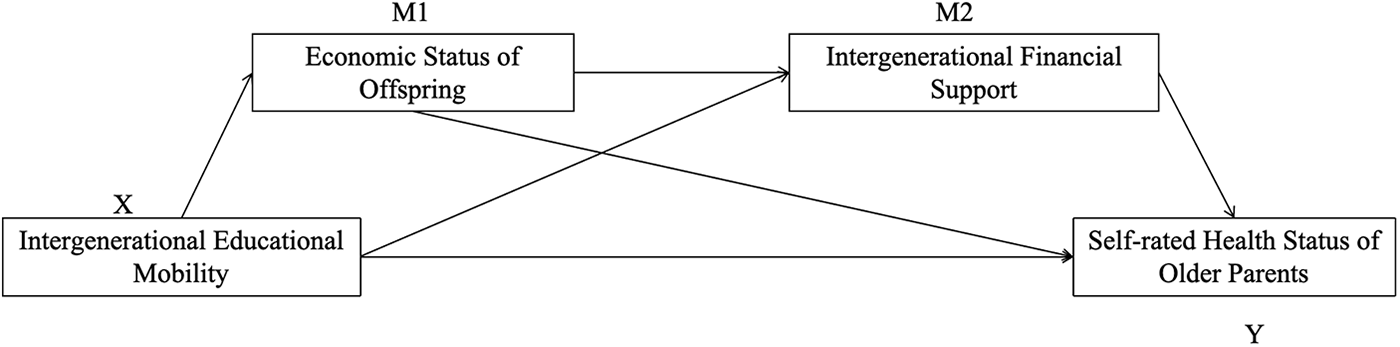
Because these two mediating variables are not in parallel, we will use a serial mediation model within the framework of mediation analysis with multiple mediators to test the relationships between the variables. According to the literature review, we tended to examine the path between intergenerational educational mobility and self-rated health of older parents as follows (Figure 1):
Serial mediation path diagram.

In this model, intergenerational educational mobility affects the self-rated health of older parents through two mediating variables: economic status of offspring and intergenerational financial support. Additionally, these two mediating variables impact each other. The formula for this model is as follows:
 \begin{equation}Y = {\alpha _0} + c{^{\prime}}Mobility + {b_1}Eco + {b_2}Exchange + \varepsilon .\end{equation}
 \begin{equation}Eco = {\alpha _0} + {a_1}Mobility + \varepsilon .\end{equation}
 \begin{equation}Exchange = {\alpha _0} + {a_2}Mobility + {d_{21}}Eco + \varepsilon .\end{equation}
where  $c{^{\prime}}$ is the direct effect coefficient of
 $Mobility$ (intergenerational educational mobility) on
 $Y$(self-rated health of older parents);
 ${b_1}$,
 ${b_2}$ present coefficients of
 $Eco$ (economic status of offspring) and
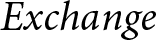 $Exchange$ (intergenerational financial support) on
 $Y$;
 ${a_1}$,
 ${a_2}$ is coefficient of
 $Mobility$ on
 $Eco$ and
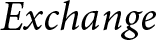 $Exchange$;
 ${d_{21}}$ is coefficients of
 $Eco$ on
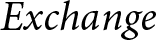 $Exchange$. There are three types of indirect effects in this model: the effect of
 $Mobility$ on
 $Y$ through
 $Eco$ (
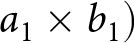 ${a_1} \times {b_1})$, the effect of
 $Mobility$ on
 $Y$ through
 $Exchange$ (
 ${a_2} \times {b_2}$) and the effect of
 $Mobility$ on
 $Y$through the sequential path of
 $Eco$and
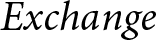 $Exchange$(
 ${a_1} \times {d_{21}} \times {b_2})$. Lastly, we utilized the Bootstrap method to test these mediation effects.
Results
Descriptive statistical analysis
As shown in the 3 × 3 contingency Table 1, comparing the education of older adults and their offspring, the majority of older adults had offspring with a higher level of education than themselves (77.45 per cent). We found that when both generations have an education level of primary school or below, the self-rated health scores of older parents are the lowest (2.92); older parents and their offspring who are both educated to high school level or above exhibit the best health (3.56). Meanwhile, it is interesting that when parents who received a high school education or above have offspring who achieve only middle school education or below (3.21), their health status is worse compared to parents with middle school offspring (3.47), suggesting that intergenerational educational mobility may impact the health of older adults.

In our study, Table 2 shows that the mean of the respondents’ age is 71.57 years old,16.9 per cent is senior older adults, 50.13 per cent is male and 66.22 per cent have been married. As we focus on rural areas, 87.75 per cent of the older parents in our sample have worked or are currently working as farmers, and 41.37 per cent of them live with their offspring. Additionally, the majority of the highest-educated offspring is male (61.29 per cent); to some extent, this reflects the gender inequality in rural education resources. About the mediating variables, the mean scores of economic status of offspring and intergenerational financial support are 3.12 and 11.93, respectively.
Descriptive statistics for independent and mediating variables

Effects of intergenerational educational mobility on older parental health
The results of the DRM are presented in Table 3. Model 1 is the baseline model considering parental and offspring’s education along with control variables. Model 2 adds the intergenerational educational mobility variables based on Model 1. Model 3 controlled the mediation variables based on Model 2.
Effects of intergenerational educational mobility on older parental health

b Notes: Diagonal effect indicates the effect of education on the health of older parents under the condition that both generations attain the same level of education. Levels of significance: +p < 0.1, *p < 0.05, **p < 0.01, ***p < 0.001.
As for the diagonal effects in Model 1, there is a clear positive correlation between the older parents’ health and the education level of both generations. After controlling for the intergenerational educational mobility variables in Model 2, the weight of offspring’s education and AIC (Akaike Information Criterion) significantly decreased, indicating that intergenerational educational mobility has a net effect on the health of older parents and Model 2 has a better goodness-of-fit. In this model, the coefficient difference between those who have primary education or below and those who have a middle school education is the largest, indicating that the impact of these two education levels on the health of older parents differs significantly (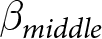 ${\beta _{middle}}$-
 ${\beta _{primary}} = 0.14 - \left( { - 0.23} \right) = 0.37$). Meanwhile, the effect weight of older parents’ own education is 0.74, and the result is significant (p < 0.001). This indicates that when intergenerational educational mobility occurs, the self-rated health status of older adults is more influenced by their own education level, accounting for 74 per cent.
After controlling the diagonal effect of the parental education and offspring’s education, upward mobility by 2 units ( $\beta = 0.24,\,p \lt 0.001$) and downward mobility had a significant net effect on the health of older adults compared to the immobility group (
 $\beta $ = − 0.15,
 $p$ < 0.1). The self-rated health score of those who had upward mobility by two units is 0.24 higher compared to the immobility group, which validates the hypothesis that the greater the upward intergenerational educational mobility, the greater the positive impact on the health of older parents. And those who had downward mobility are 0.15 lower compared to the immobility group, which validates Hypothesis 3a. Since intergenerational educational mobility is the result of the combined effects of offspring’s own efforts, family background, social environment and so on, some of these factors also impact the older parental health. To further address the endogeneity problem caused by these confounding variables, we used the inverse probability of treatment weighting by the propensity score. The results are presented in Model 2a. We found that the sign and significance of the coefficients of the key variables do not change much compared to Model 2, which indicated that the impact of endogeneity is relatively weak. Therefore, the results from Model 2 will be used for the subsequent discussion.
And in Model 3 we found a decrease in the coefficient of intergenerational educational mobility ( ${\beta _{m2 - up2}} = 0.24 \gt {\beta _{m3 - up2}} = 0.15)$ and AIC (
 $AI{C_{m2}} = 20148.11 \gt AI{C_{m3}} = 19962.58)$, showing that the economic status of offspring and intergenerational financial support might act as mediators.
Age heterogeneity
As shown in Table 4, the coefficient of the interaction item ‘Upward mobility by 2 unit*Senior older group’ ( $\beta = - 0.13,\,p \lt 0.05)$ and ‘Downward mobility *Senior older group’ (
 $\beta = - 0.51,\,p \lt 0.05)$ is significant, partly aligning with Hypothesis 4.Therefore, we have plotted line charts showing the health changes of different age groups of older adults with primary education or below as they experience upward mobility (Figure 2a), and the health changes of different age groups with middle school or above as they experience downward mobility (Figure 2b). As shown in Figure 2a, upward mobility by two units had a weaker positive impact on the health of senior older adults compared to those at younger ages. However, we can find that the health of senior older adults experiences a more significant decline owing to downward mobility compared to those at younger ages in Figure 2b.
Age heterogeneity of the health effects.

Health effects of intergenerational educational mobility by age groups

+ Notes: Levels of significance: p < 0.1, *p < 0.05, **p < 0.01, ***p < 0.001.
Gender heterogeneity
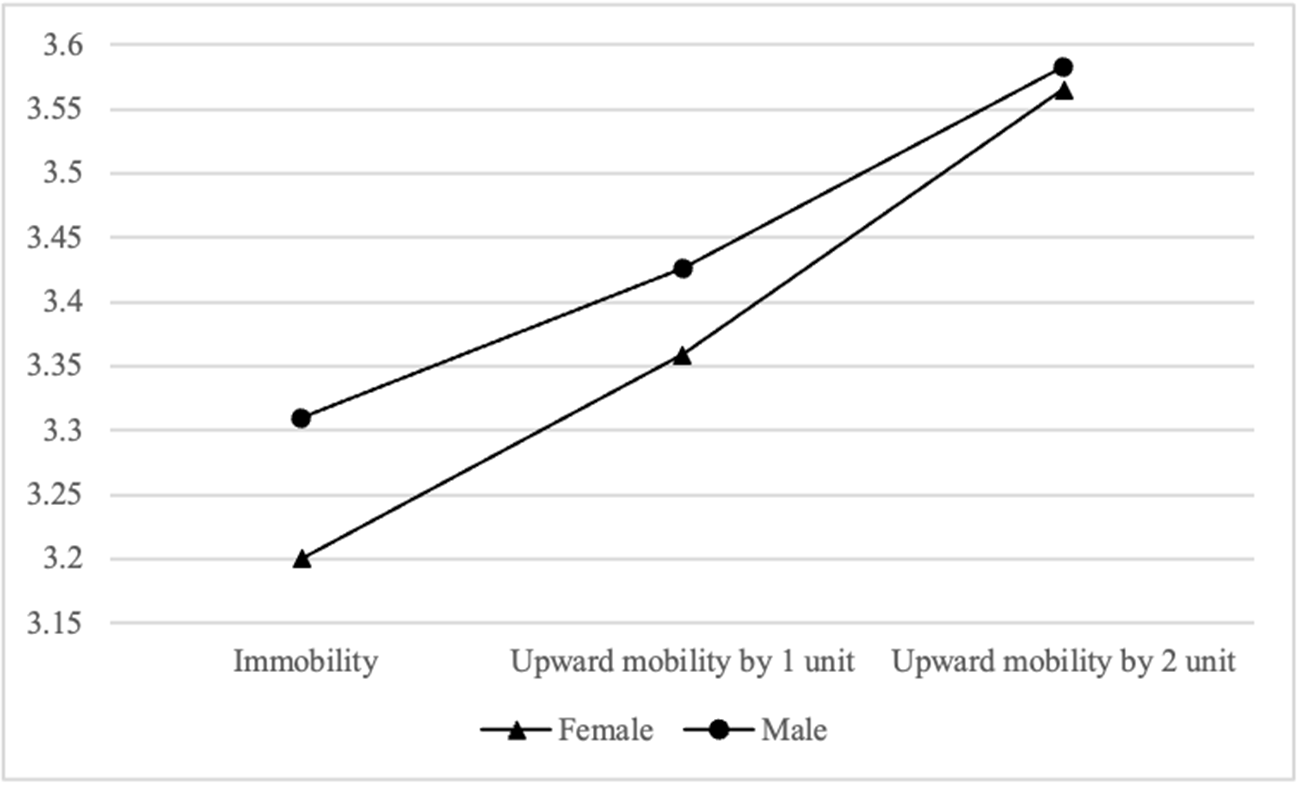
Given the context of rural China, the gender of older parents is an important factor influencing intergenerational relationships; therefore, we have conducted a heterogeneity test on it. Based on Table 5, the coefficient of the interaction items ‘Upward mobility by 2 unit*Male’ is significant and negative ( $\beta = - 0.09,\,p \lt 0.05)$. Based on this, we have plotted the health changes of different gender groups with primary education or below in relation to intergenerational educational mobility. Figure 3 clearly shows that the positive impact of upward mobility by two units on health is weaker for males than for females, aligning with Hypothesis 5.
Gender heterogeneity of the health effects.

Health effects of intergenerational educational mobility by gender of older adults

+ Notes: Levels of significance: p < 0.1, *p < 0.05, **p < 0.01, ***p < 0.001.
Mediation analysis
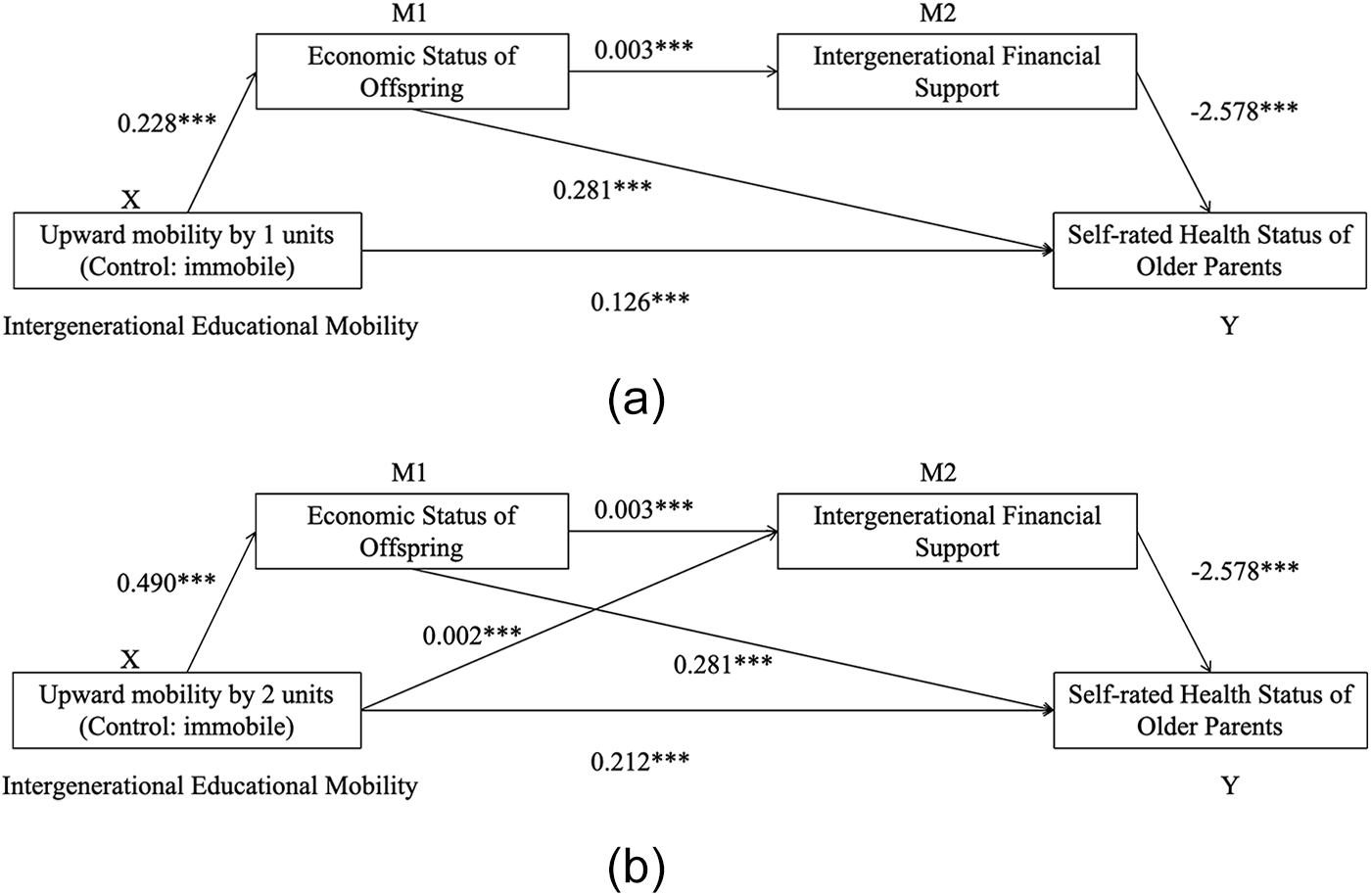
The DRM indicated that the education levels of older parents and their offspring have a significant impact on the health of older adults. To achieve more accurate conclusions, we have also controlled for the education levels of the older parents themselves and their offspring in the mediation analysis. Owing to the results of the serial mediation model, we found that the coefficients in Figure 4 are significant when the older parents experience upward mobility, but the coefficients for downward mobility group are not significant, so the result of downward mobility is not presented. The impact pathway of upward mobility by two units on health fully aligns with our expectations, whereas upward mobility by one unit has no significant effect on intergenerational financial support. Noticeably, the longer the distance of upward mobility, the larger the direct positive effects ( ${\beta _{2units}}$ = 0.212 >
 ${\beta _{1unit}}$ = 0.126,
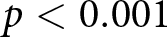 $p \lt 0.001$) on the health status of older parents; also, the larger the positive effects on the economic status of offspring (
 ${\beta _{2units}}$ = 0.490 >
 ${\beta _{1unit}}$ = 0.228,
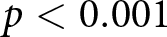 $p \lt 0.001$). Economic status of offspring positively predicts both intergenerational financial support (
 $\beta = 0.03,\,p \lt 0.001)\,$and the health of older parents (
 $\beta = 0.281,\,p \lt 0.001)$, but intergenerational financial support negatively impacts the health of older parents (
 $\beta = - 2.578,\,p \lt 0.001)$.
Analysis of the mediating mechanisms of economic status of offspring and intergenerational economic support.

The results of the mediation analysis using the Bootstrap method (1,000 samples) in Table 6 indicate that when experiencing upward mobility by two units, both the independent mediation effects of X2→M1→Y and X2→M2→Y and the serial mediation effect of X2→M1→M2→Y are significant. It is noteworthy that the effect among X2→M2→Y and X2→M1→M2→Y is negative but contributes very little. However, when the older parents experienced upward mobility by one unit, the confidence interval includes zero, indicating that the mediation effect of X1→M2→Y is not significant. Even so, we can find that the indirect effect of upward mobility by two units on health accounted for 37.83 per cent, which was higher than the 32.63 per cent observed for upward mobility by one unit and mainly comes from X→M1→Y.
Decomposition of direct effect, indirect effect and total effect in mediation analysis

Notes: The confidence interval excludes zero, indicating statistical significance.
Robustness test
To verify the reliability of the results of the DRM and the mediation analysis mentioned earlier, we conducted robustness tests. For the scientific integrity of the study, the highest-educated offspring of the sample was randomly selected. However, in families with multiple children, choosing different children may have impacted the robustness of the results. Therefore, we selected the following for the robustness check: (a) the child with the lowest level of education in the family; (b) the child providing the most emotional and household support to the parents; (c) a randomly selected child. Table 7 presents the DRM analysis results for each of the three selected children, which are generally consistent with the main effects in Table 3. In addition, the results of the heterogeneity test and mediation analysis are also consistent. The above test results indicate that the findings of this study are robust, and that the choice of child does not influence the effects of intergenerational educational mobility on the parental health.
Robustness test for diagonal reference model

+ Notes: Levels of significance: p < 0.1, *p < 0.05, **p < 0.01, ***p < 0.001.
Discussion
Previous studies have emphasized the impact of offspring’s education level or an individual’s own education level on the health of older adults, while overlooking the role of educational mobility, which simultaneously affects the flow of market resources and the distribution of family resources, ultimately influencing the health of older adults. This study analysed the net effect of intergenerational educational mobility on the health of older parents within the context of population ageing and prevailing traditional Confucian values, proposing and verifying the dual-axis model. We found that in rural families with low socio-economic status, an increase in the educational level of offspring compared to their parents can significantly improve the health of older parents, especially for mothers; otherwise, it would worsen parental health, particularly for senior older adults. Building on this, we further explored the mediating mechanisms and found that intergenerational educational mobility affects the health of older parents through the transmission of economic resources along both the market and the family axes, and there exists a serial relationship between them. Our research findings can be discussed from the following three aspects.
Firstly, our study suggests that the direction and the distance of intergenerational educational mobility are crucial to the health of rural older parents. In particular, we found that offspring who experience upward educational mobility bring positive health benefits to their rural older parents, while downward mobility may be negatively associated with parental health. This finding validates the assumptions of status attainment theory and China’s traditional filial piety within the framework of the dual-axis theory. Specifically, intergenerational educational mobility significantly alters the economic status and social standing of children and the entire family along the market axis, where upward mobility enhances the opportunities for elderly parents to access health-care resources. Furthermore, intergenerational educational mobility redefines resource allocation along the family axis. Upward mobility tends to channel resources towards older parents, whereas downward mobility may lead to intergenerational exploitation, shifting resources towards younger generations. As for mobility distance, the greater the upward mobility, the more the offspring will achieve in the labour market and allocate more economic and health resources to their parents, thereby contributing to better health outcomes for the older parents.
Secondly, the impact of intergenerational educational mobility on the health of older parents varied by the gender and age of the parents. The positive impact of upward mobility on the health of senior older parents is less than that of younger parents, and the negative impact of downward educational mobility on the health of senior older parents is greater than on younger contemporaries. These two impacts are both related to senior older parents’ higher needs for family support. As age increases, the physical condition of older adults gradually deteriorates, leading to a range of issues such as cognitive impairment and loss of self-care ability; their need for support is therefore higher than that of younger older parents. Although upward educational mobility may bring an increase in material resources, these improvements are limited, especially for older senior adults, owing to their greater needs and reduced ability to adapt to and effectively utilize these resources. As a result, the health improvements for older senior adults are less significant compared to younger older adults. Meanwhile, offspring of downward mobility may not only fail to provide adequate support but also become a significant burden on their older parents. Senior older adults have fewer resources to cope with this predicament, which results in worse health outcomes compared to younger older adults.
When intergenerational educational mobility is upward, the positive impact on the health of older mothers is significantly greater than that on older fathers. This finding is consistent with previous research (Ma et al. Reference Ma, Yahirun, Saenz and Sheehan2021). However, our results can only partly support Hypothesis 5, as downward mobility does not have a significantly different impact on the health of older fathers and mothers. In rural Chinese families, the traditional division of labour often leads women to primarily undertake childcare responsibilities, fostering closer relationships with their children. In this context, the upward educational mobility of children enhances older mothers’ socio-economic status and emotional satisfaction through improved intergenerational support, ultimately leading to a more pronounced positive impact on their health. Although this role also limits older mother’s access to pensions, making them more reliant on their children for economic support than fathers (Cai et al., Reference Cai, Giles, O’Keefe and Wang2012), downward educational mobility often signifies a loss of expected family resources, reflected in the decline of the household’s overall social status and prospects. As this setback is highly familial and structural in nature (Walsh Reference Walsh1996), both fathers and mothers are likely to experience similar levels of economic strain and psychological distress, thereby rendering gender differences insignificant when families experience downward intergenerational educational mobility.
Thirdly, in cases of upward mobility, the economic status of the offspring and intergenerational financial support act as a serial mediation in the pathway through which intergenerational educational mobility impacts the health of older parents, thereby validating from the perspective of economic resources that intergenerational educational mobility influences health among older parents through the transmission and allocation of resources along both the market and the family axes. Our study finds that upward educational mobility can improve the health of older parents by promoting access to economic resources, such as increased income, along the market axis. However, only when the mobility distance is greater does it significantly affect the health of older parents through the exchange of family resources. In other words, when resources are skewed towards older parents, it has an impact on their health, but this effect is negative. Moreover, the increase in offspring incomes along the market axis also promotes a greater transfer of intergenerational resources towards older parents along the family axis. However, this pathway has a negative impact on the health of rural older parents, partially validating the health effects of imbalanced intergenerational exchanges. According to previous literature, it is possible that unbalanced intergenerational support has led to overprotection for older adults, which affects older adults’ sense of freedom and independence (Bengtson and Kuypers Reference Bengtson, Kuypers, Munnichs, Mussen, Olbrich and Coleman1985) and induces feelings of guilt (Fyrand Reference Fyrand2010; Liang et al. Reference Liang, Krause and Bennett2001), thereby adversely impacting their health.
This study also has several limitations. Firstly, owing to the limitations of the survey data, our discussion of the mechanisms did not consider factors such as offspring’s health education for older adults, preventing us from exploring a comprehensive set of mediating factors. Additionally, the current data only measures the subjective economic status of the offspring, which may differ from the objective situation. Secondly, regarding the handling of variables, given that our sample spans multiple generations, addressing the educational levels of parents and offspring needs to consider the different educational opportunities, environments and characteristics across generations. However, owing to the lack of relevant data, this aspect could not be fully addressed. Thirdly, there is a lack of operationalized studies on measuring the differences in intergenerational exchange, leading to relatively simple handling in this study. Future research can employ more appropriate methods to examine these aspects.
Conclusion
In summary, from the perspective of intergenerational and social mobility, this study highlighted and validated the significant impact of intergenerational educational mobility on the health of older parents, as emphasized by the dual-axis model. Diagonal reference models, unlike traditional methods, can isolate the net effect of intergenerational educational mobility by removing the impact of both generations’ education. We also discovered the moderating effects of age and gender, providing targeted empirical evidence for family-related policies. Meanwhile, this study updates the mediating variables and their relationships based on the dual-axis theory, exploring more comprehensive and extensive pathways through which intergenerational educational mobility affects the health of older parents.
Our research findings can provide policy recommendations and targeted preventive measures to improve the living conditions and health of older adults in rural areas within the family-based care environment of contemporary Chinese society. Upward educational mobility of the offspring brings health benefits to older adults, suggesting that the government should increase investment in education, improve the infrastructure and teaching resources of rural schools, and provide more educational resources and opportunities. This would promote the educational level of rural children, thereby enhancing family support for older adults and improving the care-giving environment. In addition, the study indicates that while upward educational mobility of offspring promotes intergenerational financial support for older parents, a larger gap in intergenerational financial support can adversely affect the health of older parents. This finding should prompt us to consider how to establish a more balanced family support system while encouraging educational mobility, to better protect the health of older parents. This includes developing more comprehensive social security policies, strengthening community eldercare services and enhancing the balance in economic support and emotional care provided by offspring, ensuring that all older adults can enjoy a healthy and happy later life. Finally, regarding targeted health measures, communities should pay more attention to older adults whose offspring have poor socio-economic status, strengthening health education for both older adults and their offspring to improve their health status. Future research should consider how intergenerational educational mobility affects the health of older parents in different social contexts, highlighting the significance of intergenerational relationships and support in studies on the health of older adults.
Author contributions
Conceptualization: Zhuoying Yan; methodology: Yicen Jiang; formal analysis and investigation: Yicen Jiang; writing – original draft preparation: Yicen Jiang, Zhuoying Yan; writing – review and editing: Yicen Jiang, Zhuoying Yan, Qin Zhu; supervision: Qin Zhu.
Financial support
This study has been funded by the Major Project of the National Social Science Fund of China (No.23ZDA102).
Competing interests
The authors have no relevant financial or non-financial interests to disclose.
Ethical standards
This study does not involve human subjects, animals or any research that requires ethical approval. Therefore, no ethical approval was sought or required for this research. We confirm that our research adheres to ethical standards and guidelines applicable to the nature of our study.