INTRODUCTION
Deficiency of soil phosphorus (P) is a universal constraint to crop production and constitutes the second most important soil fertility problem throughout the world. A large quantity of soluble forms of P fertilizers is applied to achieve maximum plant productivity. The P fertilizer utilization efficiency should be considered when making P fertilizer recommendations (Tang et al. Reference Tang, Shi, Ma and Hao2011). However, a great part of the soluble P introduced into soil as fertilizer reacts with soil components, forming insoluble P products (Vassileva et al. Reference Vassileva, Azcon, Barea and Vassilev2000), which are not efficiently taken up by the plants (Omar Reference Omar1998). This unmanaged excess of P application is known to cause economic and environmental problems. Thus, a high P concentration in soil can lead to eutrophication of natural water reservoirs due to soil erosion and runoff water (Carpenter Reference Carpenter2005).
Organic P represents 0·20–0·80 of the total P in most soils and consequently represents a significant reserve of potentially available P (Fransson & Jones Reference Fransson and Jones2007). Although some forms of organic P may be taken up directly by plants and micro-organisms, there is a general agreement that most organic phospho-compounds must first be mineralized through hydrolysis catalysed by extracellular phosphatases. The activity of these enzymes plays a key role in soil P cycling and plant nutrition (Tarafdar et al. Reference Tarafdar, Bareja and Panwar2003).
Increased P bioavailability was studied by inoculation of P-solubilizing bacteria (Canbolat et al. Reference Canbolat, Bilen, Çakmakçi, Şahin and Aydin2006; Mishra et al. Reference Mishra, Sharma and Vasudevan2008) and P seed coating (Peltonen-Sainio et al. Reference Peltonen-Sainio, Kontturi and Peltonen2006; Sekiya & Yano Reference Sekiya and Yano2010). Burns et al. (Reference Burns, Alstrom, Burton, Dartnall, Vancura and Kunc1988) suggested the use of a stable phosphatase seed coating as a tool to enhance P bioavailability. Busto & Perez-Mateos (Reference Busto, Perez-Mateos and Pandalai1997) reviewed the relationship between soil enzymes, environment and fertility, including some biotechnological application of immobilized enzymes.
A definition of seed coating is ‘a general term for the application of finely ground solids or liquids containing dissolved or suspended solids to form a more or less continuous layer covering the natural seed coat’ (Scott Reference Scott1989). Seed coating can be employed to change the physical form, i.e. to facilitate the mechanical sowing, to increase seed weight for air-seeding purposes and to apply chemical seed treatment formulations, including chemical pesticides, biological pesticides or germination enhancers, nutrients or plant growth regulators (Scott Reference Scott1989; Taylor et al. Reference Taylor, Allen, Bennett, Bradford, Burris and Misra1998; Halmer Reference Halmer, Black and Bewley2000; Ziani et al. Reference Ziani, Ursúa and Maté2010). The two main methods for seed coating are pelleting and film-coating. Pelleting is defined as the deposition of a layer of inert materials that can change the original shape and size of the seed, resulting in a substantial weight increase. Film-coating, however, retains the shape and the general size of the raw seed with minimal weight gain (Taylor et al. Reference Taylor, Allen, Bennett, Bradford, Burris and Misra1998).
Pilar et al. (Reference Pilar, Ortega, Perez-Mateos and Busto2009) observed that the encapsulation of barley seeds in calcium alginate hollow beads with a stable phosphatase–polyresorcinol complex (PPC) exhibited high rhizosphere phosphatase activity, resulting in a positive effect on phosphate uptake and plant growth. In the present paper, the coating of barley seed by film-coating and pelleting with both free and immobilized alkaline phosphatase is presented as a potential means to enhance plant utilization of accumulated soil P. The effects of barley seed coating on soil phosphatase activity, seed germination, plant growth and P uptake were also investigated. Specifically, the present study may help in development of sustainable agriculture, avoiding the deleterious effects of excessive P fertilizer application and maintaining adequate crop yield.
MATERIALS AND METHODS
Experimental design
Barley seeds, Hordeum vulgare L. cvar Volley, were coated with free and immobilized alkaline phosphatase (EC 3.1.3.1). The enzymatic solution was obtained, as described Pilar et al. (Reference Pilar, Ortega, Perez-Mateos and Busto2003), from Escherichia coli ATCC27257, a phosphatase hyperproductive strain obtained from the Spanish Official Culture Collection (Valencia, Spain). Phosphatase was immobilized by co-flocculation with humate and by phenolic co-polymerization with resorcinol. The coating methods applied were film-coating, using methylcellulose (MC) as a binder and pelleting with poly(vinyl alcohol) (PVA) as a filler. First, the binder or filler concentration and the enzyme/binder or enzyme/filler relation were optimized for each seed coating. The optimal conditions were selected in order to achieve adequate levels of phosphatase activity in the coating layer, avoiding seed agglomeration and fragmentation of the coating. A germination test was performed to assess the viability of seeds treated. Seeds with low germination were discarded for the pot tests.
A pot culture experiment was carried out to study the effects of the coating on the plant growth and P uptake. The soil used in the experiments was collected from the surface (0–100 mm) from a farm field at Ribera del Arlanza in Burgos (Spain). Prior to use, the soil was air-dried at room temperature (22 ± 1 °C) and then gently ground to pass through a 2 mm sieve. Relevant soil properties are: pH 8·7, organic C 5·93 g/kg, C:N ratio 7·15, organic P 0·27 g/kg and inorganic P 0·52 g/kg. Soil pH was measured in 1:5 (w/w) soil:H2O extract. Soil organic carbon was determined following the wet digestion method of Walkley & Black (Reference Walkley and Black1934). C:N ratio was determined using an elemental analyser (CHN A-932, LECO, St. Joseph, MI, USA). Inorganic P and organic P were estimated following the method reported by Saunders & Williams (Reference Saunders and Williams1955). Seeds were germinated on a wet filter paper at 26 °C in a growth chamber (Conviron® E7) for 96 h. Five seedlings were transplanted to a plastic pot (containing 150 g of soil) at 10 mm below the soil surface, and then the pots were transferred to an artificial climatic chamber. The plants were grown under environmental conditions of 20/15 °C light/dark period temperature and a 16 h photoperiod per day. The pots were watered everyday with 15 ml of water. Each experiment was conducted five times. One plant from each replicate was carefully freed from soil at 7, 14, 21, 28 and 35 days after planting (DAP). After each harvest, the plant growth was determined by measuring the length, dry weight and P concentration of the shoot. Parallel soil samples were taken in order to evaluate the inorganic P and organic P, as described by Saunders & Williams (Reference Saunders and Williams1955), and phosphatase activity in the bulk soil.
Alkaline phosphatase immobilization
Immobilization in soil humates
The immobilization of alkaline phosphatase by co-flocculation with soil humates in the presence of Ca2+ was as described Pilar et al. (Reference Pilar, Ortega, Perez-Mateos and Busto2003). The immobilized enzyme was frozen and lyophilized. The insoluble humate–phosphatase complex (HPC) resuspended in 2-amine-2-methyl-1propanol (2A2M1P) (15 mg/ml) was assayed separately for alkaline phosphatase activity.
Preparation of the alkaline PPC
Alkaline PPC was synthesized following the method reported by Pilar et al. (Reference Pilar, Ortega, Perez-Mateos and Busto2009). The copolymer was frozen and lyophilized. The insoluble PPC resuspended in 2A2M1P (2·5 mg/ml) was assayed separately for alkaline phosphatase activity.
Alkaline phosphatase assay
The activity of alkaline phosphatase was assayed by using p-nitrophenyl phosphate (pNPP) (Sigma, St. Louis, MO, USA) as an artificial substrate (Tabatabai & Bremner Reference Tabatabai and Bremner1969). Activity of both immobilized and free enzyme was determined by incubating 1 ml of 25 mmol/l pNPP, 3 ml of 0·1 mol/l 2A2M1P (pH 10·5, containing 1 mmol/l MgSO4·7H2O and 2 mmol/l ZnSO4·7H2O), and 1 ml of the enzyme solution at 37 °C for 60 min. For the phosphatase activity of coated seeds and soil, samples of six seeds (mean weight of 0·29 ± 0·01 g) and 1 g of fresh soil, respectively, were added to 4 ml of 0·1 mol/l 2A2M1P buffer at pH 10·5. Thereafter, 5 ml of 0·5 mol/l NaOH and 1 ml of 0·5 mol/l CaCl2 were added to the mixtures (to flocculate the organic matter and extract the p-nitrophenol (pNP)), first shaking and then allowing standing for 10–15 min at 20 °C. The contents were filtered (Whatman No. 6) and the p-nitrophenol released was measured at 410 nm using a spectrophotometer (Hitachi U-2000). In parallel, a calibration curve using concentrations of pNP in the range 0–20 μg/ml was run. Controls, the substrate of which was added after incubation, were assayed in all cases to deduct any non-enzymatic activity. Phosphatase activity was referred to 1 ml of enzyme solution, 1 g of immobilized enzyme, 1 g of coated seed or 1 g of dry weight soil.
Techniques for seed coating with alkaline phosphatase
Prior to coating, the barley seeds were surface-sterilized by washing with 50 mg/ml sodium hypochlorite for 1 min, followed by rinsing five times with sterile distilled water. Then, the seeds were placed on filter paper and dried by a current of sterile air in a laminar flow cabinet Bio-II-B (Telstar®).
Film-coating
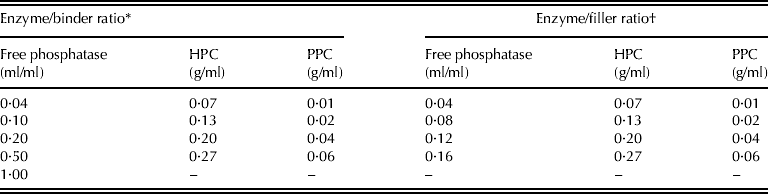
Barley seeds were film-coated with a solution containing MC (Sigma, St. Louis, MO, USA) and free or immobilized enzymes. MC concentrations and enzyme/binder ratio tested for free and immobilized enzyme are detailed in Table 1. The seeds were coated with each coating solution by the following procedure: 3 g of seeds were added to 1 ml of the coating solution with free phosphatase or PPC or to 1·5 ml of the coating solution containing HPC. The mixture was agitated to accomplish uniform coating of the seed surface. Then, seeds were carefully placed, one by one, on filter paper in Petri dishes and dried under sterile airflow in a laminar flow cabinet.
Enzyme/binder and enzyme/filler ratios assayed in the seed film-coating and seed pelleting process, respectively

* Seed film-coating: each experiment was conducted at 0·02, 0·03, 0·04, 0·05 and 0·06 g/ml MC.
† Seed pelleting: each experiment was conducted at 0·04, 0·06 and 0·08 g/ml PVA.
Pelleting
Barley seeds were pelleted using PVA as coating agent. The PVA used had a number average molecular weight, M n, of 72 000, a degree of polymerization of 1600 and a saponification value >97·5 (Sigma, St. Louis, MO, USA). PVA and sodium hydroxide (NaOH, 1:0·025 w/w) were dissolved in 16 ml deionized water by autoclaving for 15 min at 121 °C, cooled to room temperature, neutralized with hydrochloric acid (HCl, 350 g/kg), mixed with free or immobilized phosphatase and diluted to 25 ml with water. Coating solutions with different PVA concentrations and enzyme/filler ratios were prepared (Table 1). Three grams of seeds were mixed with 4·5 ml of each pelleting solution, and added (one by one) into liquid nitrogen (N), whereupon seeds were coated with PVA instantly. After 1 h, the liquid N was decanted and the seeds slowly warmed to 5 °C. The pelleted seeds were washed with water for 1 min, and placed on filter paper under sterile airflow in a laminar flow cabinet to dry.
Coating phosphatase activity
The coating phosphatase activity was defined by the ratio of the phosphatase activity of the coated seeds to the activity of the free or immobilized enzyme used in the coating process.
Germination test
The germination test assayed was an unofficial test based on the physiological criterion of radicle emergence (Taylor et al. Reference Taylor, Eckenrode and Straub2001). Germination trials were performed by placing seeds (coated and non-coated) in Petri dishes on filter paper moistened with distilled water and incubated in a growth camber (Conviron® E7) at 26 °C for 96 h. Five replicates of 50 seeds per treatment were used. Seeds were considered as germinated when the radicle was visible.
Rhizosphere phosphatase activity
In order to determine the effect of the seed coating on the rhizosphere phosphatase activity, a qualitative visualization method was used (Trolldenier Reference Trolldenier1992). The procedure was described in detail in Pilar et al. (Reference Pilar, Ortega, Perez-Mateos and Busto2009). Briefly, barley seeds pre-germinated for 3 days were placed in agar plates containing phenolphthalein phosphate and kept at room temperature for 15 h. Then, the medium was adjusted to a higher pH so that bright purple-coloured zones occurred on the roots, indicating enzymatic hydrolysis of the reagent.
Plant growth
The length, dry weight and P concentration of the shoot in plants grown from seeds film-coated with free and immobilized phosphates were determined. Dry weight was determined by oven-drying the shoots at 70 °C for 48 h. Shoot samples were subsequently ashed (16 h at 550 °C) and the residue dissolved in 0·9 mol/ml H2SO4 (c. 1 ml for each 10 mg of oven-dry tissue weight) (Hayes et al. Reference Hayes, Simpson and Richardson2000). The inorganic P content of the acid solutions was then measured according to the ascorbic acid-molybdate method of Murphy & Riley (Reference Murphy and Riley1962). Plant P uptake was calculated by multiplying dry weight by P concentration of the shoot.
Statistical procedure
Analysis of variance and regression analysis were performed by Statgraphics Centurion XVI.I for Windows. All determinations were replicated five times. The standard errors of the mean (s.e.m.) are given in Tables and Figures. The standard errors of difference (s.e.d.) were calculated to test differences in phosphatase activity of soil, inorganic and organic P in soil and plant growth between seeds film-coated and control (soil planted with untreated seeds).
RESULTS
Seed coating
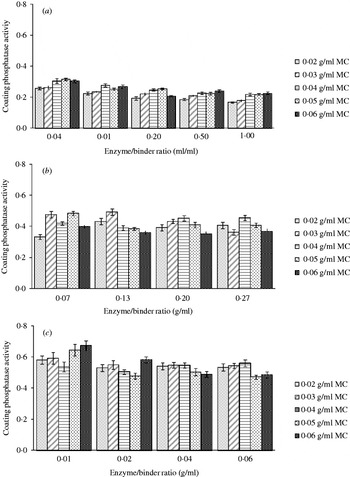
The coating phosphatase activity of barley seeds film-coated with free and immobilized phosphatase as a function of the MC concentration and enzyme/binder ratio is shown in Fig. 1. The highest values, ranging from 0·48 to 0·67 (average 0·55), were obtained for seeds coated with PPC. The coating phosphatase activity decreased and ranged from 0·33 to 0·45 and 0·17 to 0·28 with an average of 0·41 and 0·24 for seeds coated with HPC and free enzyme, respectively. Fragmentation of the coating layer was observed in seeds treated with HPC at enzyme/binder ratio of 0·20 and 0·27 g/ml. Moreover, the film-coating at 0·05 and 0·06 g/ml MC promoted seed agglomeration during coating.
The effect of enzyme/binder ratio at 0·02, 0·03, 0·04 and 0·06 g/ml MC on the coating phosphatase activity of seeds treated with free phosphatase (14 738 μg pNP/ml/h) (a), HPC (3728 μg pNP/g/h) (b) or PPC (14 268 μg pNP/g/h) (c). Bars represent s.e.m. (n = 5).

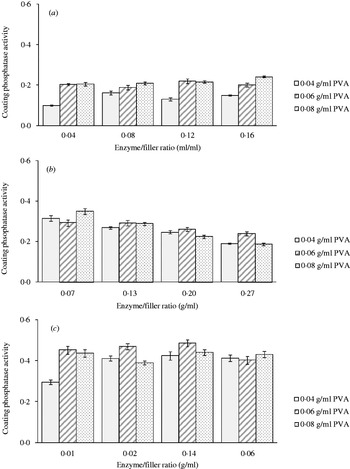
Barley seed pelleting with free and immobilized phosphatase, using PVA as a filler, were also investigated (Fig. 2). The highest coating phosphatase activity was achieved with PPC (ranging from 0·39 to 0·44). The average yields for seed treated with free and immobilized enzyme by humates (HPC) and copolymerization (PPC) were 0·18, 0·26 and 0·41, respectively. The coating phosphatase activity was not significantly affected by PVA concentration, except for 0·04 g/ml PVA in seed pelleted with free phosphatase, resulting from the low viscosity of the polymer solution (enzyme––PVA mixture). The seeds easiest to handle were those coated with 0·08 g/ml PVA.
The effect of enzyme/filler ratio at 0·04, 0·06 and 0·08 g/ml PVA on the coating phosphatase activity of seeds treated with free phosphatase (13 369 μg pNP/ml/h) (a), HPC (3562 μg pNP/g/h) (b) or PPC (15 896 μg pNP/g/h) (c). Bars represent s.e.m. (n = 5).

Effect of coating in seed germination
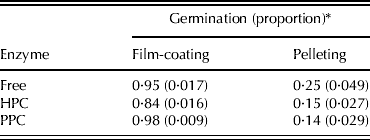
Coating with free phosphatase and PPC did not affect germination, in comparison with untreated seeds (Table 2), whereas a slight decrease (about 16%) was observed in seeds coated with HPC. Germination for seeds pelleted with PVA was between 0·14 and 0·25.
Germination test of seeds coated with free or immobilized (HPC and PPC) phosphatase. Values are presented as the mean (n = 5) and s.e.m. (in parenthesis)

* In relation to untreated seeds. Control germination: 0·87 (0·009).
Effect of seed coating on rhizosphere phosphatase activity and soil phosphorus mobilization
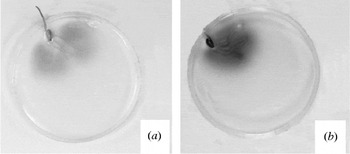
A higher rhizosphere phosphatase activity was observed in seedlings grown from coated seeds, showing a more intense pink colouration around the roots than the control. As an example of the results obtained, Fig. 3 shows that the colouration around the roots of seeds film-coated with PPC was more intense than that of roots of untreated seeds. No differences were detected in seed coating with free or immobilized enzyme.
Barley seedling growing in agar with phenolphtalein phosphate. Seed untreated (control) (a) or seed film-coating with PPC (b).

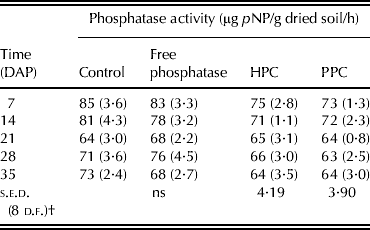
The phosphatase activity of the control and soil with film-coated seeds is shown in Table 3. At 35 DAP, no significant differences were detected between the control and soils planted with seeds coated with free phosphatase. In contrast, the phosphatase activity compared to the control was 12·5 and 11·5% lower in soil planted with seeds coated with HPC and PPC, respectively.
Phosphatase activity of soil planted with untreated seeds (control) and seeds film-coated with free or immobilized (HPC and PPC) phosphatase. Values are presented as the mean (n = 5) and s.e.m. (in parenthesis)*

* Soil phosphatase activity at t = 0: 72·09 (1·60) μg pNP/g dried soil/h.
† s.e.d. to compare the coated seeds and the control at 35 DAP.
ns, not significant; d.f., degrees of freedom.
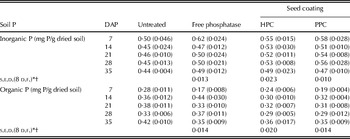
The effects of soil planted with film-coated seeds on organic and inorganic P were assessed (Table 4). A decrease of the inorganic P (16·7, 7·2, 6·8 and 9·9%) and an increase of the organic P (54·2, 30·6, 30·9 and 27·3%) were observed in both the control and soils planted with seeds coated with free, HPC and PPC, respectively. After 35 DAP, the pots planted with coated seeds showed higher inorganic P (8–11%) and lower organic P (15–17%) concentrations than the control (non-coated seeds). No significant differences among seeds coated with free or immobilized enzyme were detected.
Influence of the seed coating with free and immobilized (HPC and PPC) phosphatase on the dynamic of inorganic P and organic P fraction in soil planted with untreated seeds (control) and seeds film-coated with free phosphatase, HPC or PPC. Values are presented as the mean (n = 5) and s.e.m. (in parenthesis)*

* Inorganic P at t = 0: 0·526 (0·021) mg P/g dried soil. Organic P at t = 0: 0·271 (0·006) mg P/g dried soil.
† s.e.d. to compare the coated seeds and the control at 35 DAP. d.f. = degrees of freedom.
Effect of seed coating on plant growth and P uptake
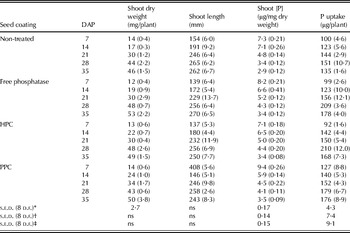
The effect of seed coating with free and immobilized phosphatase on P uptake and plant growth is shown in Table 5. Seed coating did not affect the visual aspect of the plant, showing the highest growth during the 21 first days. Plants from seeds coated with phosphatase showed similar shoot length compared to the control. The seed coating with free phosphatase significantly (P < 0·05) increased shoot dry weight, by 14%, at 35 DAP. The shoot P content was significantly higher in plants from seeds film-coated with free phosphatase (P < 0·05) and with PPC (P < 0·01) than in control plants (Table 5), showing an increase of 26 and 28%, respectively, after 28 DAP. In addition, the coating with PPC improved the plant P concentration, resulting in increases of c. 20% after 21 and 35 DAP. Phosphorus content in shoots was significantly correlated with phosphatase activity in soil (non-treated seeds, r = 0·713, P < 0·005; seeds coated with free phosphatase, r = 0·749, P < 0·005; seeds coated with HPC, r = 0·711, P < 0·005; seeds coated with PPC, r = 0·735, P < 0·01). In addition, a decrease in shoot P concentration with time was observed in all pots. Finally, the barley seed coating with free and immobilized phosphatase significantly increased (P < 0·01) the P uptake by plants. Thus, after 35 DAP, the plants grown from coated seeds showed an increase in the P uptake ranging from 25 to 31% in comparison with non-treated seeds (Table 5).
Influence of the seed coating with free or immobilized phosphatase (HPC and PPC) on the plant growth (dry weight, length and P content of shoots) and P uptake. Values are presented as the mean (n = 5) and s.e.m. (in parenthesis)

* s.e.d. to compare the coated seeds with free phosphatase and control 35 DAP.
† s.e.d. to compare the coated seeds with HPC and control 35 DAP.
‡ s.e.d. to compare the coated seeds with PPC and control 35 DAP.
ns, not significant.
DISCUSSION
Coating of seeds with fertilizer or other active ingredients prior to sowing has large potential benefits (Liu & Lister Reference Liu and Lister1993). The nutrient is available precisely where it is required and, in addition, seed coating can also reduce the rate of fertilizer application required. Phosphorus seed coatings have been studied to determine whether this increases P bioavailability for plants. Ros et al. (Reference Ros, Bell and White2000) analysed the effect of coating and of soaking rice seed with various P fertilizers on early plant growth. Peltonen et al. (Reference Peltonen, Saarikko and Weckman2006) found that coating the seeds with soluble P fertilizer mixed with a biodegradable fixing agent improved P use, resulting in enhanced early root and seedling growth. An alternative approach, presented in the present paper, is to coat seeds with stable phosphatase as a means of bringing about a localized solubilization of organic phosphate, particularly important in the early stages of seedling establishment.
Barley seeds were film-coated and pelleted with free and immobilized phosphatase. The MC concentration affects of the quality of the coating layer. Scott et al. (Reference Scott, Blair and Andrews1997), studying the use of the adhesive Methocel K35 (a low-viscosity MC) on lucerne seeds, observed an increase in the percentage agglomeration at higher MC concentration. A higher viscosity is frequently observed with higher polymer concentrations, resulting in seed agglomeration during the particle coating process (Chen et al. Reference Chen, Yang, Mujumdar and Dave2009). Moreover, the non-spherical shape of barley seeds increases agglomeration (Liu & Lister Reference Liu and Lister1993). Therefore, an MC concentration of 0·04 g/ml was set up to avoid seed agglomeration. The enzyme/binder ratios selected were 1 ml/ml (free phosphatase), 0·20 g/ml (HPC) and 0·06 g/ml (PPC). When seeds were pelleted with PVA, the highest coating phosphatase activity was also achieved with PPC, although this was lower than that obtained with the film-coating. For this technique the optimal conditions were an enzyme/filler ratio of 0·16 ml/ml (free enzyme), 0·27 g/ml (HPC) and 0·06 g/ml (PPC) at 0·08 g/ml PVA.
In many coated seeds, germination and subsequent seedling growth can be inhibited by the mechanical restriction exerted by the seed coating (Sung & Chiu Reference Sung and Chiu1995). Moreover, the compounds present in the coating layer applied to the seed surface can also affect germination. Thus, the decrease in germination rate observed in seed film-coated with HPC could be related with the chemical nature of the enzymatic complexes. In this way, Muscolo et al. (Reference Muscolo, Panuccio and Sidari2001) reported that phenolic compounds extracted from soil inhibited the germination of Pinus laricio seeds, and the effects were variable with regard to the phenolic compounds utilized and their composition. The adverse effect of the coating on germination of pelleted seeds was attributed to the freezing of seeds in liquid nitrogen for gel formation. Seed cryopreservation studies revealed that seed viability is directly related to water content, because the ice crystals formed during freezing could produce cellular damage and therefore a decrease in germination (Wood et al. Reference Wood, Pritchard and Lindegaard2003). Taking into account the loss of seed viability of pelleting using PVA, film-coating using MC was selected to study the effect of coating on rhizosphere phosphatase, plant growth and P uptake.
Film-coated seeds showed higher rhizosphere phosphatase activity in comparison with the control. The enzyme activity observed in the controls was associated with acid phosphatase activity released by roots. Likewise, as the barley seedlings were ground under non-sterile conditions, some of the phosphatase activity observed could be released for micro-organisms attached to the root surface (Trolldenier Reference Trolldenier1992). However, planting film-coated seeds did not increase the enzymatic activity in the bulk soil (non-rhizosphere) (Table 3). Therefore, seed film-coating was mainly effective in the root vicinity. Nevertheless, this qualitative method of evaluating the rhizosphere phosphatase did not allow differences in seeds treated with free or immobilized enzyme to be detected.
In the present study, a slight decrease in the inorganic P and an increase in organic P were observed with time in all pots. It is generally accepted that organic P plays an important role in P nutrition of plants; however, there was a discrepancy concerning the change of organic P in the rhizosphere of plants (Li et al. Reference Li, Luo, Wei and Yao2008). Organic P accumulation in the rhizosphere could be caused by the immobilization of inorganic P forms into organic P forms by micro-organisms in the rhizosphere, whose activity was higher in this zone, mainly because of their utilization of organic anions secreted by plants (Ryan et al. Reference Ryan, Delhaize and Jones2001; George et al. Reference George, Gregory, Wood, Read and Buresh2002). Alternatively, organic P depletion in the rhizosphere could be explained by the fact that organic P hydrolysis by phosphatase was higher than the immobilization of inorganic P into organic P forms (George et al. Reference George, Gregory, Wood, Read and Buresh2002). In fact, phosphatase in the rhizosphere was observed to be closely related to depletion or utilization of organic P in the rhizosphere of the plant (Asmar et al. Reference Asmar, Gahoonia and Nielsen1995; Nuruzzaman et al. Reference Nuruzzaman, Lambers, Bolland and Veneklaas2006). Thus, the pots planted with film-coated seeds (with high rhizosphere activity) showed higher inorganic P and lower organic P than soil planted with non-coated seeds. This higher inorganic P accumulation could explain the lower phosphatase activity observed in soil planted with film-coated seeds, since phosphate competitive inhibit the alkaline phosphatase (Pilar et al. Reference Pilar, Ortega, Perez-Mateos and Busto2009).
The results obtained in the present pot culture experiment showed the beneficial effect of the seed film-coating with phosphatase by increasing the biomass, the P content of shoot and the P uptake. These results can be related to higher rhizosphere phosphatase activity of film-coated seeds. Solaiman et al. (Reference Solaiman, Marschner, Wang and Rengel2007) reported that in canola cultures, shoot P content was significantly positively correlated with phosphatase activity in rhizosphere, root length and pH. The decrease observed in the P content of shoot has been reported in barley and other annual species (Hoppo et al. Reference Hoppo, Elliott and Reuter1999; Bolland & Brennan Reference Bolland and Brennan2005; Ziadi et al. Reference Ziadi, Bélanger, Cambouris, Tremblay, Nolin and Claessens2008), as a result of the higher internal P requirements of annual plants in the early growth. Hoppo et al. (Reference Hoppo, Elliott and Reuter1999) suggested that the decrease in shoot P content could be attributed to a dilution effect caused by the increase in the shoot dry weight.