Introduction
The worldwide increase in obesity and type 2 diabetes evidently reflects changes in lifestyle.Reference Schulze and Hu1 As in the case of lifestyle factors, markers of early life experiences, including fetal growth, may account for a similar proportion of the incidence of the metabolic syndrome.Reference Parker, Lamont and Unwin2
Maternal psychosocial stress is one factor that contributes to the fetus’ early life experience. It has repeatedly been associated with low birth weightReference Paarlberg, Vingerhoets, Passchier, Dekker and van Geijn3–Reference Wadhwa, Sandman and Garite5 and preterm delivery in humans,Reference Paarlberg, Vingerhoets, Passchier, Dekker and van Geijn3, Reference Wadhwa, Sandman and Garite5–Reference Hedegaard, Henriksen, Secher, Hatch and Sabroe7 although not all studies have replicated these findings.Reference Littleton, Breitkopf and Berenson8, Reference Littleton, Bye, Buck and Amacker9 In turn, low birth weight for gestational age and preterm delivery have been associated with adiposity,Reference Kensara, Wootton and Phillips10 altered glucose toleranceReference Newsome, Shiell and Fall11 and type 2 diabetes in later life.Reference Hales and Barker12, Reference Barker, Hales and Fall13 Tse et al.Reference Tse, Rich-Edwards, Koenen and Wright14 reported an association between cumulative stress during pregnancy and corticotropin-releasing hormone concentrations, with possible consequences for the fetus.
Evidence linking prenatal stress to offspring glucose metabolism is mainly available from animal studies administering corticosteroids.Reference D’mello and Liu15–Reference Moss, Sloboda and Gurrin17 For instance, from studies on rats, we know that prenatal exposure to excess maternal glucocorticoids causes hyperglycemiaReference Lindsay, Lindsay, Waddell and Seckl18 and glucose intolerance.Reference Nyirenda, Lindsay, Kenyon, Burchell and Seckl19 Human studies are scarce. A 30-year follow-up of an randomized controlled trail on betamethasone administration provided evidence of fetal programming of glucose metabolism (insulin resistance) in adult life.Reference Dalziel, Walker and Parag20 However, glucocorticoid treatment usually takes place when preterm birth is expected, adding bias because of the complications of premature birth. Another prenatal form of stress, psychosocial complaints, are also of importance, because they are highly prevalent in otherwise normal pregnanciesReference Woods, Melville, Guo, Fan and Gavin21 and are accompanied by increases in naturally occurring stress hormones.Reference Tse, Rich-Edwards, Koenen and Wright14, Reference O’Donnell, O’Connor and Glover22–Reference Miller and O’Callaghan24
A few human studies have reported associations between prenatal depression or bereavement and adiposity in children.Reference Ertel, Koenen, Rich-Edwards and Gillman25, Reference Li, Olsen and Vestergaard26 Entringer et al. Reference Entringer, Wust and Kumsta27 also focused on prenatal psychosocial stress exposure, and observed higher insulin resistance in prenatally stressed young adults, in response to an oral glucose tolerance test. They studied this in a relatively small study sample (n=58) and were not able to test possible sex differences. In a recent review,Reference Clifton28 Dr Clifton, who has conducted important research on prenatal exposure to maternal asthma and inhaled glucocorticoids,Reference Clifton and Murphy29 emphasizes the sex differences in placenta functioning. She argues to take potential sex differences into account when testing fetal programming hypotheses. In the current study, we consider boy–girl differences in the associations, because prenatal stress exposure has been found to exert different effects on male or female human fetuses. After the 9/11 terrorist attacks in 2001, the U.S. population experienced heightened stress and anxiety, which appear to have resulted in increasing male fetal loss.Reference Bruckner, Catalano and Ahern30 Generally, male fetuses are found to be more sensitive to stress in utero.Reference Bruckner, Catalano and Ahern30–Reference Owen and Matthews32
To the best of our knowledge, no (human) studies to date have examined whether the putative relationship between prenatal psychosocial stress and changes in glucose metabolism in the offspring already occurs before adulthood and whether there might be sex differences. Therefore, the aim of this study is to examine maternal psychosocial stress during pregnancy as a potential determinant of the offspring’s glucose metabolism at 5–6 years of age. We will also explore possible effect modification by sex. We hypothesize that the presence of psychosocial stressors is associated with higher fasting glucose and C-peptide, and more glucose intolerance, with more pronounced associations in boys.
Materials and methods
The present study is part of the Amsterdam Born Children and their Development (ABCD) study, a longitudinal birth cohort study.Reference Van Eijsden, Vrijkotte, Gemke and van der Wal33 All participants provided written informed consent for themselves and their children.
Potential associations between prenatal psychosocial stress and other health outcomes in the offspring (i.e. birth outcomes, autonomic nervous system, blood pressure) have been studied in previous papers by van Dijk et al.Reference Loomans, van Dijk and Vrijkotte34–Reference van Dijk, van Eijsden, Stronks, Gemke and Vrijkotte36
Study population
(Figure 1) In 2003–2004, a total of 12,373 Amsterdam women who first attended antenatal care in Amsterdam were approached to participate. Of these women, 8266 (67%) returned the pregnancy questionnaire, which included multiple psychosocial stress instruments) (phase 1). For singleton live births, 6735 mothers provided permission for follow-up. When the children turned five, the addresses of 6161 mothers were retrieved from the Youth Health Care registry; attrition in this follow-up number was largely due to untraceable changes in address or migration. The mothers received a questionnaire, including an informed consent sheet for a health check of their child. The health check itself consisted of various health measurements in 3321 children (2008–2010).Reference van Dijk, van Eijsden, Stronks, Gemke and Vrijkotte37
Procedure of the Amsterdam Born Children and their Development (ABCD) study cohort and inclusion in the current analyses.

The current study population included only mother–child pairs in which: the mother had completed the psychosocial questions during pregnancy (mean gestational age 16 weeks, interquartile range 13–19); the mother did not have pre-existent or gestational diabetes [information available from the Dutch Perinatal Registration (PRN), www.perinatreg.nl]; the child participated in the age five health check, including body mass index (BMI) assessment; and data on all covariates was available. A total of 3140 mother–child pairs were eligible for inclusion in the current study’s analyses. The population for blood glucose analyses was a subsample because not all participating parents consented to the finger prick test for their children, and the child should have been fasting (n=1952). For part of the population, the amount of capillary blood obtained was too small to estimate C-peptide concentrations (C-peptide n=1478).
Independent variables: maternal prenatal psychosocial stress
State anxiety was assessed using the Dutch versionReference van der Ploeg, Defares and Spielberger38 of the State-Trait Anxiety Inventory.Reference Spielberger, Gorsuch and Lushene39 The 20 items regarding state anxiety (transient or temporarily experienced anxiety) were included in our questionnaire, with each item scored on a four-point scale.
Depressive symptoms were assessed using the validated Dutch version of the 20-item Center for Epidemiological Studies Depression Scale.Reference Hanewald40, Reference Radloff41 This scale evaluates the frequency of depressive symptoms experienced during the preceding week. Each item was scored on a four-point scale.
Pregnancy-related anxiety was assessed using an abbreviated 10-item versionReference Huizink, Mulder, Robles de Medina, Visser and Buitelaar42 of the Pregnancy Related Anxieties Questionnaire.Reference Van den Bergh43 Each item was scored on a four-point scale. In the current study, not the three underlying constructs, but the overall score was used.
To assess parenting stress, a Dutch adaptationReference Groenendaal and Gerrits44 of the 20-item Parenting Daily Hassles scale was used.Reference Crnic and Greenberg45 The parents rated the occurrence of typical everyday events in parenting and parent–child interactions on a four-point scale.
To assess job strain, a Dutch version of the Job Content Questionnaire was used.Reference Karasek, Brisson and Kawakami46, Reference Houtman, Goudswaard and Dhondt47 This questionnaire consists of two subscales: job demands (25 four-point scale items on work pace, mental workload and physical workload) and job control (11 items). The total score of the job demands scale was dichotomized using the 80th percentile as the cutoff, and the job control scale was dichotomized using the 20th percentile as the cut-off to create four (2×2) categories of job strain. Jobs that are high in demands and low in control are considered most stressful (high job strain).
A cumulative total stress score was calculated by ascribing points to the number of times a mother scored above the 80th percentile for three of the above-mentioned stress scales (depressive symptoms, pregnancy-related anxiety and parenting stress – women without previous children automatically got a 0 regarding parenting stress). A fourth point was added if the mother scored ‘high’ on the job strain scale. This approach resulted in a sum score between 0 and 4, which was divided into: No stress (0 stressors), 1 stressor, 2 stressors and 3–4 stressors. State anxiety was not included in this score because of its high correlation with depressive symptoms (correlation coefficient 0.9 in our cohort).
Dependent variables
As a part of the age five health check, in a subsample of children, capillary blood was collected in the morning after fasting overnight. We used an ambulatory collection kit (Demecal kit: LabAnywhere, Haarlem, The Netherlands)Reference Gootjes, Tel, Bergkamp and Gorgels48 to determine plasma glucose (mmol/l) and C-peptide (nmol/l). The C-peptide variable was left-censored: 49% of the assessed C-peptide concentrations fell below the detection limit of 0.34 nmol/l. Therefore, associations with C-peptide were explored using survival analysis. To quantify insulin resistance, the latest homeostatic model assessment (HOMA2-IR) was used. The HOMA (web-based automated) equations enable the researcher to estimate insulin resistance and β-cell function from fasting glucose and insulin levels. The improved HOMA2 model was recalibrated to modern insulin assays, and enabled the researcher to estimate insulin sensitivity and β-cell function from paired fasting plasma glucose and radioimmunoassay insulin, specific insulin or C-peptide concentrations (Diabetes Trials Unit, University of Oxford; http://www.dtu.ox.ac.uk/homa).
We used the children’s sex, age and BMI to predict C-peptide concentrations for the missing cases with survival analysis in R (‘survreg’),Reference van den Berg, van Eijsden, Vrijkotte and Gemke49 applying the log-logistic distribution because it was the best fitting, based on log-likelihood (R 2.13.0, R Foundation for Statistical Computing, Vienna, Austria).
Covariates
The origins and definitions of most of the covariates have been described previously.Reference van Dijk, van Eijsden, Stronks, Gemke and Vrijkotte37 Maternal age, ethnicity, pre-pregnancy weight and height (BMI, kg/m2), educational level (years of education after primary school; proxy for socioeconomic status), smoking and alcohol consumption in pregnancy were available from the pregnancy questionnaire; hence, all were self-reported. Ethnicity was defined by maternal country of birth [in line with the definition by Statistics Netherlands (CBS)] and categorized into eight categories (Dutch; Surinamese; Antillean; Turkish; Moroccan; Ghanaian; Other non-western country; Other western country). Smoking during pregnancy was categorized into non-smoking, one to five cigarettes/day and greater than or equal to six cigarettes/day. Alcohol consumption during pregnancy was dichotomized (yes/no). Maternal hypertension (no/pre-existent/pregnancy-induced) was available by combining data from the questionnaire and Dutch PRN (www.perinatreg.nl) and classified in accordance with the guidelines of the International Society for the Study of Hypertension in Pregnancy (www.isshp.com). Parity (primiparous: yes/no), gestational age at birth, standardized birth weight and sex were available from the PRN and Youth Health Care Registration. Birth weight was standardized for gender, gestational age and parity using reference values from the PRN. Gestational age was based on ultrasound by the obstetric care provider or, when unavailable (<10%), on the first day of the last menstrual period. During the age five health check measurements, height and weight of the children were measured, from which BMI was calculated. The children were only wearing their underwear bottoms. Height was determined to the nearest millimeter using a Leicester portable height measure (Seca, Hamburg, Germany) and weight to the nearest 100 g using a Marsden MS-4102 weighing scale (Oxfordshire, United Kingdom). Information on exclusive breastfeeding (never, <1 month, 1–3 months or >3 months) was retrieved by combining data from a neonatal questionnaire and Youth Health Care Registration.Reference de Hoog, van Eijsden, Stronks, Gemke and Vrijkotte50
Statistics
Descriptive statistics were retrieved using SPSS (SPSS, Chicago, IL, USA). Associations of stress scales with glucose and HOMA2-IR were explored using ordinary least squares linear regression analysis (‘ols’) in R (R Foundation for Statistical Computing). Associations of stress scales with C-peptide were explored using survival analysis (‘survreg’), applying a log-normal distribution. All analyses were adjusted for sex and age of the child by default (model 1). All potential confounders were determined a priori and added simultaneously in model 2 (=model 1+maternal age, ethnicity, pre-pregnancy BMI, educational level, parity, hypertension, smoking, alcohol consumption, breastfeeding gestational age and BMI of the child, if applicable). Associations were also checked for linearity using restricted cubic splines: There were no signs of non-linearity. Effect modification by sex was tested by adding an interaction term to model 2. Mediation was tested using the Baron and Kenny mediation testReference Baron and Kenny51 in combination with linear and logistic regression models. Betas of depressive symptoms, state anxiety, pregnancy-related anxiety and parenting daily hassles were multiplied by 10 to obtain a more comprehensible interpretation of the data (betas of job strain and stress category were not multiplied).
Results
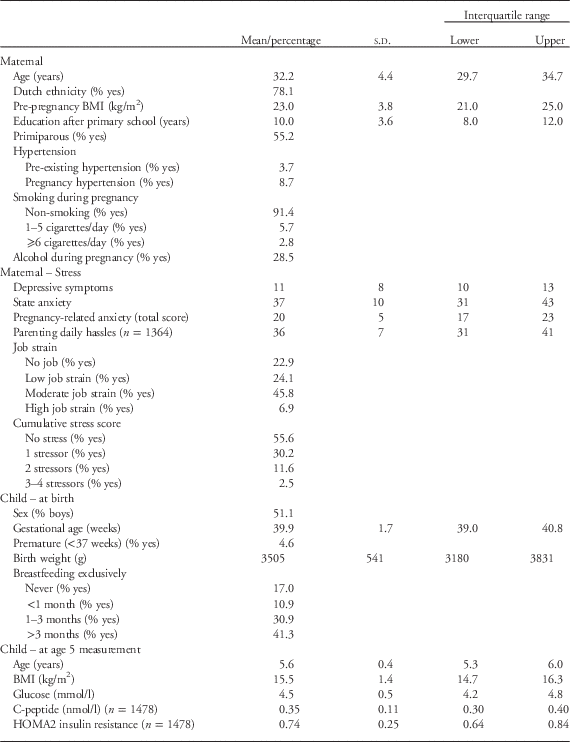
The characteristics of the mothers and children are presented in Table 1. BMI of the child was positively correlated with glucose, C-peptide and HOMA2-IR (all P<0.01; data not shown).
Maternal and offspring characteristics (n=1952)
BMI, body mass index; HOMA, homeostatic model assessment.
We compared the mother–child pairs included in the current study (n=1952) to all other mother–child pairs that were eligible for inclusion (n=6161; invited for age five health check). As would be expected, the included women were an overall slightly healthier representation (BMI 23.0 v. 23.1, P<0.01) with small but statistically significantly lower scores on the psychosocial stress scales.
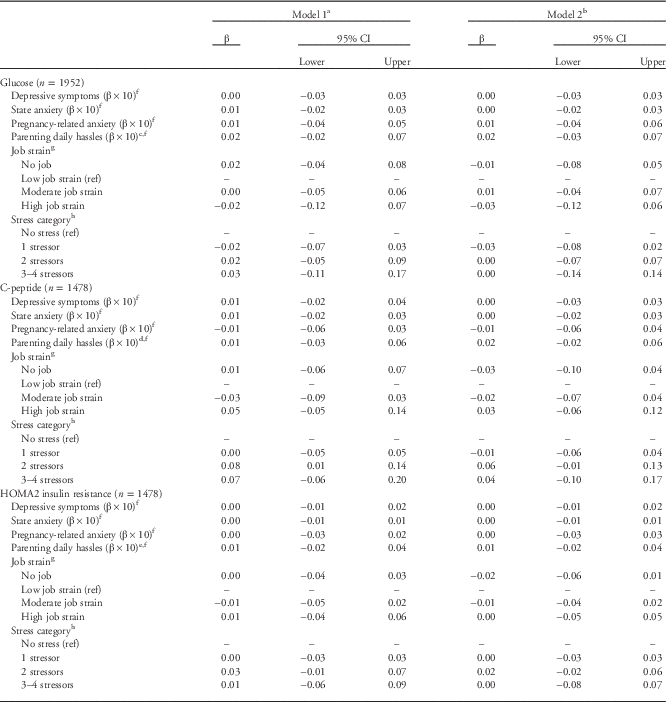
The betas and confidence intervals of the associations between the stress scales and outcome measures are presented in Table 2. Depressive symptoms, state anxiety, pregnancy-related anxiety, parenting daily hassles, job strain and cumulative stress were not associated with glucose, C-peptide or insulin resistance, both before (model 1) and after full adjustment for confounders (model 2).
Associations of maternal prenatal stressors with blood glucose metabolism measures in the resulting children at 5–6 years of age
BMI, body mass index; HOMA, homeostatic model assessment.
a Sex and age of the child at time of assessment were added to model 1 as covariates.
b Additional covariates added to model 2 are: maternal age, ethnicity, pre-pregnancy BMI, educational level, parity, hypertension, smoking, alcohol consumption, gestational age, breastfeeding and BMI of the child.
c Analyzed in subgroup of women already parenting (n=1364).
d Analyzed in subgroup of women already parenting (n=864).
e Analyzed in subgroup of women already parenting (n=676).
f Each 10-unit increase in depressive symptoms/state anxiety/pregnancy-related anxiety/parenting daily hassles increases the mean BMI/glucose/C-peptide/insulin resistance with β mmHg.
g The βs per job strain category indicate the mean difference in mmHg as compared with the low job strain category.
h The βs per cumulative stress score category indicate the mean difference in mmHg as compared with the no stress category.
The interaction term sex*-independent variable was not statistically significant in any of the equations (all P⩾0.23). Therefore, there was no indication that a potential association between maternal stress and any of the outcomes would differ between boys and girls.
Discussion
Psychosocial stress was not associated with (unfavorable) parameters of fasting glucose metabolism in offspring at 5–6 years of age. There was no indication of effect modification by sex of the child.
Comparison to existing literature
Our null finding regarding glucose metabolism is not in agreement with findings from the single most comparable human study by Entringer et al.Reference Entringer, Wust and Kumsta27 There are, however, four major differences that could explain this inconsistency. First, Entringer et al. assessed glucose, insulin and C-peptide in response to an oral glucose tolerance test (a metabolic challenge), as did previous animal studies on programming by glucocorticoids.Reference Moss, Sloboda and Gurrin17–Reference Nyirenda, Lindsay, Kenyon, Burchell and Seckl19 Second, the only significant difference in baseline concentrations observed by Entringer et al. was that fasting insulin concentrations were 58% higher in the exposed group, an outcome measure we did not have. In agreement with the present study, Entringer et al. did not observe any other significant differences in baseline concentrations of glucose or C-peptide. Third, they used major stressful life events as a determinant, which, like maternal bereavement, might exert a more pronounced effect. Fourth, the offspring that Entringer et al. reported on were young adults, not children.
The offspring in the present study are still relatively young. Most previous studies measured outcomes in adult human,Reference Dalziel, Walker and Parag20, Reference Entringer, Wust and Kumsta27 ratReference Lindsay, Lindsay, Waddell and Seckl18, Reference Nyirenda, Lindsay, Kenyon, Burchell and Seckl19 and sheep offspring.Reference Gatford, Wintour, De Blasio, Owens and Dodic16 Possibly, the programming effects are not yet visible in baseline concentrations. We speculate that a glucose tolerance test, and/or follow-up throughout adulthood, might yield different results. The possibility of an age effect is supported by a striking differences between animal studies on rats and lambs in different stages of life.Reference D’mello and Liu15, Reference Moss, Sloboda and Gurrin17, Reference Lesage, Del-Favero and Leonhardt52 However, it must be borne in mind that some studies concerned glucocorticoid administration, which exerts circulating levels that are much higher than the naturally occurring fluctuations in glucocorticoids that occur as a result of psychosocial stress.Reference O’Donnell, O’Connor and Glover22–Reference Miller and O’Callaghan24 Hence, the programming effect may have been larger and thus easier to detect in such studies.
Potential mechanisms
The understanding of the pathway through which prenatal stress exerts its putative effect on glucose metabolism is limited, but several mechanisms have been suggested. It likely involves fetal exposure to glucocorticoids.Reference Gatford, Wintour, De Blasio, Owens and Dodic16–Reference Dalziel, Walker and Parag20 Stress-induced alterations of the maternal hypothalamic–pituitary–adrenal axis lead to hypersecretion of the glucocorticoid cortisol, which partly reaches the developing fetus.Reference O’Donnell, O’Connor and Glover22, Reference Glover, O’Connor and O’Donnell23, Reference Glover, Bergman, Sarkar and O’Connor53, Reference Entringer, Kumsta, Hellhammer, Wadhwa and Wust54 In rats prenatally exposed to excess glucocorticoids, Nyirenda et al. uncovered increased hepatic expression of glucocorticoid receptor mRNA and phosphoenolpyruvate) mRNA, which may promote glucose intolerance by increasing gluconeogenesis.Reference Nyirenda, Lindsay, Kenyon, Burchell and Seckl19 Alternative mechanisms involve inflammation markers: maternal psychosocial factors can contribute to increased inflammation during pregnancy,Reference Coussons-Read, Okun and Nettles55 which has been associated with preterm birth, subsequently leading to low birth weight. The influence of maternal inflammation-linked preterm birth on the development of adult cardiovascular disease has not been extensively investigated.Reference Coussons-Read, Okun and Nettles55, Reference Rogers and Velten56
Furthermore, previously published research reporting on an association between maternal prenatal stress and offspring adiposityReference Ertel, Koenen, Rich-Edwards and Gillman25, Reference Li, Olsen and Vestergaard26 indicates a mediating role of offspring BMI. In a previous study, we have already studied the association between job strain during pregnancy and body composition in the child at 5–6 years of age, which was not present.Reference van Dijk, van Eijsden, Stronks, Gemke and Vrijkotte57 In light of our current work, including other stress scales and the cumulative stress score, we did not observe a mediating role of offspring BMI.
Strengths and limitations
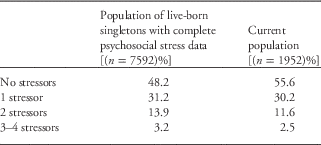
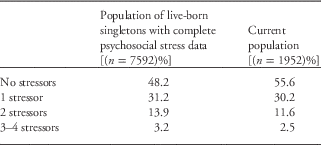
The current study was conducted in a large, multi-ethnic cohort. However, as in most cohort studies, selective loss to follow-up was present. Stress was more prevalent in the ABCD cohort as a whole than it is in the current subgroup, which is now a slightly healthier reflection of the population (i.e. higher educational level and age, lower BMI, more of Dutch ethnicity). Selective nonresponse poses a threat to study validity. In addition, a nonresponse analysis using national perinatal registry data has revealed that, although selective nonresponse was present in our cohort, selection bias was acceptably low and did not influence main study outcomes.Reference Tromp, Van Eijsden, Ravelli and Bonsel58 Furthermore, the mean scores on the psychosocial stress scales were somewhat higher in the ABCD cohort as a whole than they are in the groups left in the current analyses. The proportion of women in the higher stress categories would have been higher at the initial population level, although the drop in the prevalence of the cumulation of 3–4 stressors (3.2–2.5%) does not seem very severe (Table 3). However, most associations in this study are far from statistically significant: even in a population with higher stress levels, those associations are not very likely to become significant.
Dropout analysis: prevalences of stress cumulation scores
Methods used to assess maternal stress vary greatly among studies in the field of developmental origins of health and disease.Reference Lobel59 We chose to use a score of multiple validated psychosocial stress constructs to identify women subjected to high levels of stress occurring in a normal pregnant woman’s day-to-day life, and therefore with a putatively high level of generalizability. In one of our previous publications,Reference Loomans, van Dijk and Vrijkotte34 the multiple psychosocial stress scales were captured in five latent classes, each encompassing women with distinct patterns of psychosocial stressors. Although the associations with birth outcomes were very informative from a public health perspective, the latent classes did not enable us to pinpoint those women with multiple high stress scores from various angles (e.g. work, parenting, intrinsic). In fact, it shows that different forms of psychosocial stress are generally not experienced by the same women. We therefore calculated a cumulative stress score, which was based on the 80th percentiles on each of the stress scales. The rather arbitrary cutoff of the 80th percentile point could be considered a limitation. However, it enabled us to consistently identify women scoring ‘high’ on each of the scales.
The assessment of stress took place in the first week of the second trimester, thus assessing experienced stress in the preceding first trimester weeks. Nearing the end of the first trimester is often considered the trimester with the highest fetal vulnerability to glucose deregulation, because of the development of critical, basal systems, including the formation of β-cells as true endocrine cells by the end of the first trimester of human pregnancy.Reference Piper, Brickwood and Turnpenny60 Unfortunately, we did not have multiple measurements throughout pregnancy to test this hypothesis.
Predicting censored C-peptide concentrations in a substantial proportion of the population is a major limitation of the current study, which may have induced error. In addition, the smaller number of available data for metabolic markers might be responsible for the null findings. However, if either were the case, we would have expected to see (at minimum) a subtle trend in the hypothesized direction regarding either glucose or C-peptide.Reference van den Berg, van Eijsden, Vrijkotte and Gemke49 When repeating the C-peptide analyses on only the group with measured C-peptide (thus, values above the detection limit; n=541; 36%), the associations with prenatal psychosocial stress were also not present (data not shown).
We did not include the child’s energy intake and physical activity in our models, because the fetal programming effect might be mediated by high energy intake of the offspring: high maternal cortisol levels may be associated with altered adiponectin metabolism in the offspring,Reference Fasting, Oken and Mantzoros61 a hormone that mediates energy consumption.Reference Fasting, Oken and Mantzoros61, Reference Meier and Gressner62 Moreover, the offspring of stressed mothers may have a preference for high-energy foods or altered appetitive traits, as suggested by the results of animal studies.Reference Lesage, Del-Favero and Leonhardt52, Reference Tamashiro, Terrillion, Hyun, Koenig and Moran63 Therefore, adjusting analyses for postnatal feeding and eating behavior could be overadjusting.
In addition, the child’s weight at birth was not included in our models. Adding birth weight as a confounder did not change our findings (betas and confidence intervals for all determinants).
Conclusions
In sum, the current study provides no evidence that maternal psychosocial stress during pregnancy is associated with parameters of fasting glucose metabolism. It is possible that this fetal programming effect does not exist because maternal psychosocial stress during pregnancy does not exert sufficient strain on offspring. Alternatively, differences emerging later in life or in response to a metabolic challenge should not be ruled out.
Acknowledgments
The authors thank all participants of the Amsterdam Born Children and their Development study. They would also like to thank the statistician at the Department of Public Health of the Academic Medical Center, Wim B. Busschers, for his help and extensive advice.
Financial Support
Financial support for the current study was granted by the Netherlands Heart Foundation (Nederlandse Hartstichting; DHF-2007B103).
Conflicts of Interest
None.
Ethical Standards
The authors assert that all procedures contributing to this work comply with the ethical standards of the relevant national guidelines on human experimentation and with the Helsinki Declaration of 1975, as revised in 2008, and has been approved by the institutional committees: Approval was obtained from the Academic Medical Center Medical Ethical Committee, the VU University Medical Center Medical Ethical Committee and the Registration Committee of Amsterdam (MEC02/039 April 2002 & amendment August 2007).