Introduction
On Friday 14 August 2015, the Central Única dos Trabalhadores (Unified Workers’ Central, CUT) and Força Sindical (Union Strength), the largest labour confederations in Brazil, issued a statement in the main Brazilian newspapers in which they made a bold call to defend democracy and Partido dos Trabalhadores (Workers’ Party, PT) President Dilma Rousseff ‘in a context of destabilising attacks’.Footnote 1 President Rousseff had met just that week with some of Brazil's leading social activists in the government-promoted ‘Diálogo com Movimentos Sociais’ forum in a show of their support in hard times. That same Friday, Ecuador witnessed one of the wildest of strikes waged in recent times by portions of the labour movement. The day of protest culminated in a demonstration by indigenous movements in Quito that erupted in violence and resulted in police repression. In these turbulent days, Brazil's PT government garnered the support of unions and social movements to thwart an offensive from the mainstream media, the judiciary and the political opposition that would eventually result in the President's removal. Ecuador's progressive Latin American government, headed by Rafael Correa, which had expanded social policy and contested media control by traditional economic groups, nonetheless clashed both rhetorically and in the streets with labour unions and indigenous social movements.
Of course, this contrasting picture of working-class politics under the Latin American, post-neoliberal Left Turn is not limited to Brazil and Ecuador. In Argentina, Kirchnerismo in its heyday boasted the support of a variety of working-class actors, ranging from middle-class and affluent ‘business unionists’ to militants from pauperised community organisations in the poorest areas of Greater Buenos Aires. The Uruguayan Frente Amplio (Broad Front, FA) set the stage for a union labour market offensive very similar to what their labour counterparts on the opposite side of the River Plate were carrying out. However, independent social movements were absent from the political construction of the Left in Uruguay. Alternative types of community organisations and social movements, on the other hand, had been at the centre of the grassroots political mobilisation sparked by the Movimiento al Socialismo (Movement towards Socialism, MAS) in Bolivia and initially by Chavismo. By contrast, unlike in Argentina and Brazil, the established labour leaders in Venezuela not only opposed Chávez's left-wing populist government, but played an active part in the attempted coup led by a sector of the armed forces in 2002.
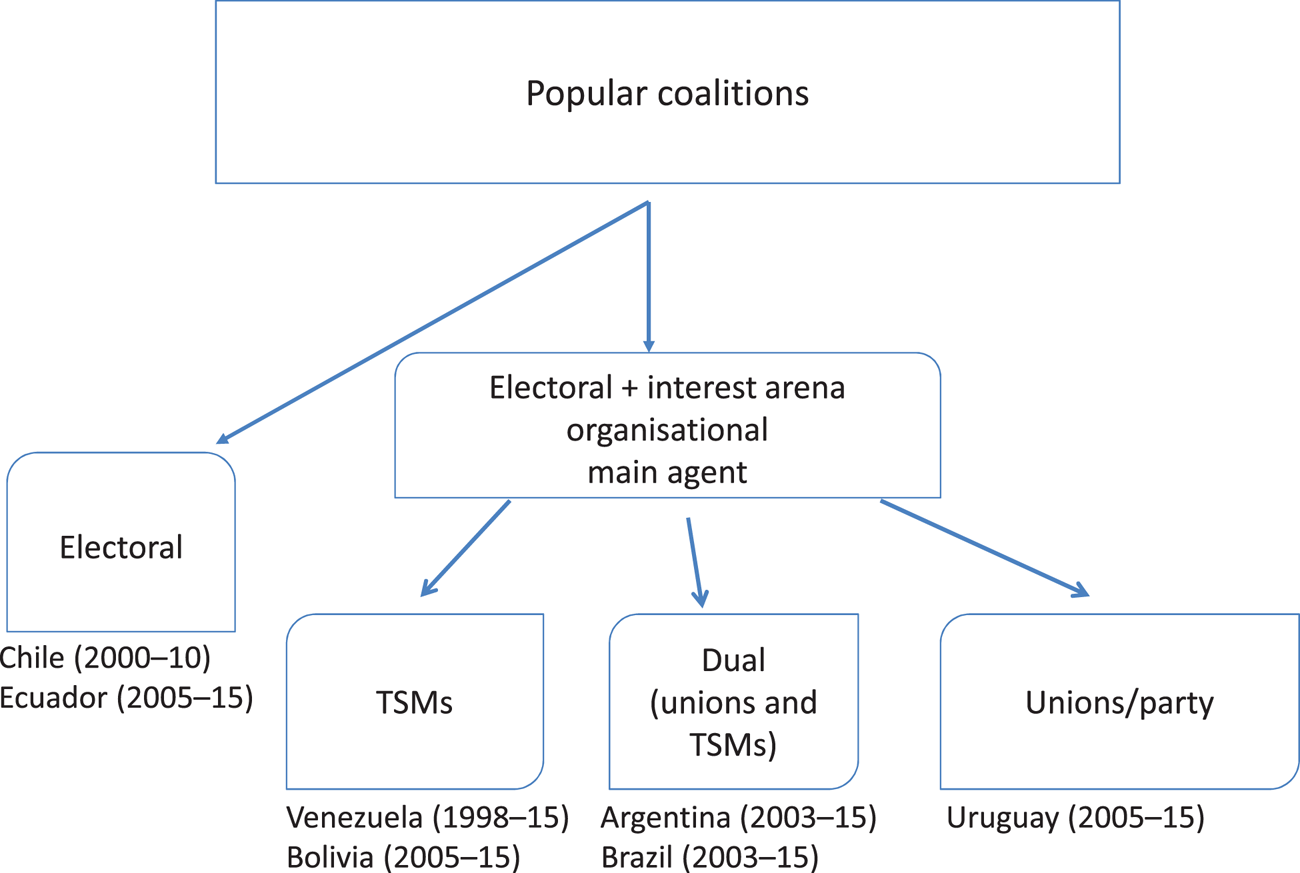
In effect, although ‘post-neoliberalism’Footnote 2 entailed a return of the state and expanded social policies as a common trend for many Latin American governments in the 2000s, coalitions with popular actorsFootnote 3 displayed much variation. The main goal of this article is to conceptualise and explain the varieties of relations between governments and the subaltern sectors during the post-neoliberal period in the continent. In a region in which most popular actors had been widely activated since democratisation in the 1980s, why did some left-of-centre governments in the 2000s elicit the organisational support of informal sector-based social movements, but not of mainstream labour unions? Why did some include both types of working-class actors in governing coalitions? Why did some progressive parties choose not to court any organised popular actors in the interest realm, and essentially fostered only popular electoral coalitions? I will contend that the continent witnessed four types of popular-sector coalitions in the post-neoliberal period: electoral (Ecuador and Chile), territorial social movement (TSM)-based (i.e. made up of informal sector-based organisations: Venezuela and Bolivia), dual (i.e. composed of both unions and TSMs: Argentina and Brazil) and union/party-based (Uruguay). It is worth stressing from the outset that in Venezuela, Bolivia, Argentina, Brazil and Uruguay left-wing governments also constructed popular electoral coalitions. Yet they combined their popular electoral appeal with the crafting of interest coalitions in the policy realm with at least some segment of the subaltern classes, or with organisations on both sides of the informal/formal divide.
These trajectories yield a map of popular coalitions in the region that differs from dominant comparative approaches to the period 2000–15. The study of working-class politics in Latin America under post-neoliberalism has followed two broad paths. One main strand of the literature has analysed the return of leftist and national-popular parties and leaders to power in the context of a neoliberal backlash beginning in the late 1990s.Footnote 4 A second group of scholars has theorised about the types and institutional features of popular incorporation to the polity under the third-wave democracies in the region.Footnote 5 As argued below, the first camp has mostly concentrated on policy debates, and on the ‘radical’ vs. ‘moderate’ type of left-wing parties and movements. The ‘new incorporation’ scholars have focused primarily on the informal sector-based social movements, and have left unions or labour-based parties – especially in the Latin American Southern Cone – undertheorised.
This article proposes a new approach to understanding popular mobilisation in the region. My perspective is based neither on the type, or possible radicalisation, of left-wing parties, nor exclusively on the possible incorporation of mostly informal sector-based popular constituencies or labour market ‘outsiders’.Footnote 6 It builds upon the capacity of governments to craft coalitions that could bridge (or not) the working class insider/outsider divide. I compare national coalitions in the Southern Cone and Andean Latin American countries that tend to be analysed separately. Generally speaking, Southern Cone countries are considered to have more relevant unions, and more consolidated welfare states. Andean countries, by contrast, developed larger informal sectors and smaller welfare systems. Yet, all Latin American countries that underwent popular-sector (re)activation after 2000 had both formal and informal popular sectors that could be politicised, and therefore a broader comparative exercise may be useful.
The article will present a series of conceptual tools that can help to understand the variations in government alliances with alternative popular constituencies. Based on a qualitative comparative analysis, I argue that a sizeable formal economy seems to be a necessary (but not sufficient) condition for labour inclusion. Yet, coalitions with informal sector-based TSMs emerged in countries where the informal economies were both large (so that TSMs were logically more likely) and relatively small (by regional standards). Thus, a more thorough explanation should complement class structure with political variables. The first political factor is institutional and relatively straightforward: where the main labour-based parties historically allied with hegemonic labour confederations led the Left Turn, as in Argentina, Brazil and Uruguay, they crafted durable interest coalitions with the mainstream union movement. The second political factor is more contingent. Interest coalitions with informal sector-based associations and social movements were rooted in the political activation of these labour market ‘outsiders’ during the neoliberal 1990s. TSMs which would eventually join progressive governments in Argentina, Brazil, Bolivia and Venezuela were central in the protest cycles prior to the Left Turn that produced high levels of anti-neoliberal contention, and had largely remained external to the state during the neoliberal period.
The first section situates my study in relation to the ‘Left Turn’ and the ‘New Incorporation’ approaches that have dominated the literature on the political economy of the popular sectors under post-neoliberalism in Latin America. Next, I propose the idea of ‘variations in popular coalitions’, to analyse working class re-activation along the two main dimensions of electoral and organisational/interest politics. Subsequently, the article maps alternative paths to popular sector mobilisation on both sides of the formal/informal divide between 2000 and 2015, and offers an explanation for these different trajectories. Finally, the article identifies avenues for research and offers some insights into the consequences of these coalitional arrangements for the future of the countries’ political economies.
The Theoretical Setting: Crafting Popular Coalitions in Post-Neoliberal Latin America
Jean Grugel and Pía RiggirozziFootnote 7 have argued that, although almost all countries maintained some core aspects of the ‘Washington Consensus’, under ‘post-neoliberalism’ development in Latin America was framed in ways that were clearly distinct from the prevalent orthodoxies of the 1990s. Key elements of post-neoliberal governments have been an emphasis on welfare, the re-crafting of fiscal pacts through increased taxation specially on commodity production and a project of ‘enhancing citizenship’.Footnote 8 For my purpose the idea of ‘post-neoliberalism’ is useful as a starting point because it does not entail a type of partisan politics (i.e. traditional Left, populist or ‘new’ Left), a dominant social actor or specific policy recipe beyond these broad trends. As Grugel and Riggirozzi state, unlike the traditional Left and its labour core, post-neoliberal forces have no ‘single constituency, coalition or electorate to represent’; they had to ‘reach out different social groups’.Footnote 9
The more specific studies on popular politics at this developmental stage have undergone two broad trends. A first camp has tried to identify the type of progressive party or political leadership that embodied this reaction to neoliberalism.Footnote 10 It has analysed primarily the degree of policy moderation or radicalism in each government. In particular, the political economy of the Latin American Left/Populist Turn has been assessed under the general lens of ‘social-democrat vs populist’,Footnote 11 the implications of the commodity boom for redistribution,Footnote 12 or the determinants of social policies.Footnote 13 Other works (which employ a historical perspective not restricted to the New Left) have illuminated the role played by unions and social movements in social policy expansion, especially in Argentina, Brazil, Chile and Mexico.Footnote 14 These studies have greatly expanded our knowledge about the more interventionist states, and enlarged social policies, that the progressive turn brought about. Yet we still lack a general systematic assessment of the origins of different types of popular interest coalitions that have backed each left-wing or populist strategy, whether composed of unions, social movements in the informal sector, or both.
The new incorporation literature has analysed more extensively the novel forms of popular organisations and, in some cases, national coalitions involving the post-neoliberal, fragmented working classes. Some scholars have investigated the new forms of mainly local-level popular participation.Footnote 15 Others have concentrated on national-level interest politics, mostly on the political inclusion of the newly expanded informal sectors. In their seminal book Ruth B. Collier and Samuel HandlinFootnote 16 have contrasted the logic of interest organisation in the new community associations that flourish mostly in the informal sector with traditional, union-based functional representation. Eduardo Silva, Federico Rossi, Octavio Humberto Moreno and Carlos Alberto Figueroa focus on progressive projects which organised (mostly informal) popular sectors in the post-neoliberal world.Footnote 17 Silva conceptualises ‘segmented incorporation’ as the differential articulation of heterogeneous subaltern groups to the political arena, ‘understood as the state, legislative institutions, political parties and policy’.Footnote 18
Silva's analysis of the new forms of popular political organisation in the continent is illuminating. It has the virtue of refocusing the discussion on the institutional features of coalitions between alternative types of subaltern social groups at the national level. Yet the approach may have two drawbacks. First, Silva leaves undertheorised the popular-sector offensive in the Southern Cone of the region during the 2000s. Here more traditional working-class actors such as historical labour-based parties and unions were also part of the new politicisation. The second problem relates to the concept of ‘incorporation’ itself. Silva argues that the ‘substance’ of incorporation took place under the new Left governments post-2000. However, the hegemonic indigenous movement in Ecuador – the Confederación de Nacionalidades Indígenas del Ecuador (Confederation of Indigenous Nationalities of Ecuador, CONAIE) – for example, was by any measure (representatives in Congress, participation in policy councils or national cabinets) more ‘incorporated’ during the neoliberal era than after 2005 under the Correa presidency. Even the most rebellious groups, such as the Movimento dos Trabalhadores sem Terra (Landless Workers’ Movement, MST) in Brazil, or the organisations of the unemployed in Argentina, despite suffering episodes of violent state repression, were, by the early 2000s, recognised as interlocutors by non-Left governments, and frequently became members of policy councils. In this context we should also mention the labour movement in countries like Venezuela, Argentina and Mexico which, unlike those during the initial incorporation in the early twentieth century,Footnote 19 were established political brokers and sometimes subordinated components of neoliberal coalitions in the 1980s and 1990s.Footnote 20
Assessing the Political (Re)Activation of Popular Actors in Latin America
I propose that popular coalitions emerge when a political party or movement in government takes the popular sectors as its main, ‘core’ constituency, and actively seeks its support in the electoral arena, in the domain of interest politics, or in both. In a now classic definition, Edward Gibson identifies as a party's ‘core constituency’ those sectors of society ‘that are most important to its political agenda and resources’.Footnote 21 He explains that most conservative parties or political movements are polyclass in nature, and court diverse groups. This tends to be the case with the popular parties/movements analysed in this article. Yet he argues that ‘the notion of core coalitions recognizes hierarchies’ (p. 7). Thus, the first question to ask is: for which parties in government did the popular sectors become a core coalitional partner or constituency after the neoliberal backlash?
Furthermore, incumbent parties/movements may look at popular sectors as a constituency in a variety of ways. The popular sectors may emerge as the main social strata on which to base their electoral discursive appeals and support. In addition, left-wing parties may engage working-class organisations, such as unions, to negotiate and implement policies, and enhance the prospects for governability. Indeed, the two dimensions of electoral and interest politics correspond roughly to the great divide posed by the classic literature on pluralism and corporatism in the 1970s and early 1980s.Footnote 22 The crucial question here is whether governments take the popular sector mainly as an electoral constituency, or whether they rather promote the organisation of the subaltern beyond elections and in the interest arena.
The most central novelty with respect to the initial incorporation period at the economic–structural level is, however, the demise of import substitution industrialisation (ISI), the broad sweep of recent market reforms and the consequent trends in working-class informalisation. Thus, in the interest intermediation arena, if labour unions, often allied with mass parties, were the hegemonic actors in the initial incorporation, now both labour unions and territorial associations nurtured by the informal sector may represent popular-sector individuals. Collier and Handlin and co-authors have studied most comprehensively the massive ‘associationalism’ that has flourished throughout the region.Footnote 23 These popular associations encompass a broader category than the standard definition of ‘social movements’ that tend to function through single-issue politics (environment, gender, institutional violence etc.). Crucially, these organisations (be they urban associations of the unemployed or community groups or cooperatives, or indigenous rural movements etc.) (1) are defined by a certain type of territorial anchor, and tend to operate in the informal economy, and (2) their demand-making generally involves the allocation of state economic resources, and thus it can be argued that they operate in the domain of ‘interest politics’. In this article I use the concept of TSMs to differentiate those types of associations from traditional, ‘single-issue-driven’ social movements in the interest politics realm.
Finally, for our initial theoretical setting, it is useful to identify the dimensions or indicators of the alternatives types of popular coalitions. Electoral coalitions refer to the fact that governments target, both discursively and practically, the lower strata to obtain their main voting support in presidential and legislative elections. Hence, governments that foster ‘popular electoral coalitions’ should elaborate a sustained political campaign or public opinion narrative in which the popular sectors are conceived to have distinctive and (to some extent) opposed interests to those of elites or more affluent social groups
In the realm of interest groups, governments can engage working-class organisations in three dimensions:
(1) They can grant state positions to militants or leaders of labour unions or TSMs.
(2) They can foster the involvement of labour unions and TSMs in the design and implementation of (generally social and/or labour) policies that benefit popular organisations or their constituencies, and encourage their participation in government-sponsored policy councils.
(3) They can promote, induce or actively tolerate collective action on the part of unions and/or TSMs. The forms of direct action may vary from public-opinion or electoral campaigns or demonstrations supporting the government and confronting elite or right-wing sectors, to measures specific to each sector such as occupations or road blockades in the case of social movements, and strikes in the case of labour.
Before proceeding to the empirical sections of this essay, some caveats are needed. First, popular organising in the electoral and interest arenas does not imply revolution (but in essence reformist consolidation). Indeed, the restraints on direct action may be part of the policies of governments that overall have elevated working-class interests to a new, different stage, especially when compared with the neoliberal period. Second, the three dimensions of interest coalitions (state participation, policy inclusion and joint collective action) should be present to a minimum degree to characterise a case as positive. State participation of class organisations without the dimensions of policy inclusion and collective action might be a symbol of simple cooptation rather than of some degree of mobilisation.
Mapping Popular Coalitions in Post-Neoliberal Latin America
Figure 1 maps the scope of government-sponsored popular coalitions in Latin America along the theoretical lines just sketched. The figure includes the major countries that embody the post-neoliberal Left during the 2000s. At first glance, the popular mobilisation map yields counterintuitive results. The grouping of countries diverges from the most common comparisons drawn by the New Left literature. For example, Ecuador and Chile, frequently scored as examples of radical and moderate Left governments in the 2000s,Footnote 24 converge in a purely electoral type of popular progressive coalition. Argentina under Kirchnerismo and Brazil under the PT have also been considered as polar examples of radical and more moderate left-wing policies, or populist and ‘social democrat’ approaches.Footnote 25 Yet they present very similar formats of interest group coalitions with the popular sectors.
Popular Coalitions in Post-Neoliberal Latin America, 2000–15

Moreover, the literature on the dynamics and polarisation of post-liberal party systems does not seem to be useful for accounting for these alternative interest coalitions. According to Kenneth Roberts’ seminal work on the social basis of electoral politics,Footnote 26 countries with historical labour-mobilising party systems, such as Bolivia, Chile, Venezuela, Brazil and Argentina, which were destabilised by the critical juncture of neo-liberalism, display very different popular-interest coalitions in the 2000s. Likewise, left-wing outsiders pushed party-system polarisation in Ecuador, Bolivia and Venezuela.Footnote 27 However, Ecuador underwent a very different path in terms of interest coalitions with the subaltern sectors. The next section describes in more detail these popular mobilisation patterns.
Electoral Mobilisation: Chile and Ecuador
The first group, constituted by Chile under the Centre–Left Concertación governments (2000–10) and Ecuador under Correa (2005–15), have promoted some degree of popular-sector mobilisation, but arguably only at the electoral and discursive/public-opinion dimensions mentioned above. Both governments have targeted the working class (though clearly in different ways) in the public-opinion debate and in their quest to win elections. However, many scholars agree that in Chile the Concertación in general, and the Socialist-headed governments of the 2000s in particular, have not encouraged further organisational mobilisation, and have maintained cold relations with mainstream unions and grassroots organisations at the community level.Footnote 28 The unions unsuccessfully pressed to reform a notoriously anti-union labour law at the onset of Michelle Bachelet's first government (2006–10). Indeed, after 2010 the country witnessed a cycle of protests led by the student organisations, which also pushed labour, social (e.g. the ending of the private pension system) and environmental demands. The movement largely outflanked the governing Centre–Left parties. In Roberts’ words, this civil-society mobilisation has ‘articulated claims that found little expression in the mainstream party organisations that dominated electoral and policy-making arenas under the post 1990 democratic regime’.Footnote 29
The Correa government was notorious for having unfriendly and adversarial relations with the most significant unions and social movements. Tensions between the ‘productivist’ approach of the Correa government and the more participatory and environmentalist stance of the Left and (mostly indigenous) social movements started in the Constitutional Convention of 2007–8, and culminated in the resignation of Alberto Acosta, former close ally and president of the Convention.Footnote 30 Thereafter, relations between the government and social movements turned sour. By 2010 CONAIE, the most powerful indigenous organisation, had joined forces with right-wing parties and organised labour in the opposition. Marc Becker argues that ‘in addition to undercutting existing organisational efforts, Correa has not used his executive power to create new spaces for grassroots social movements’.Footnote 31 Established unions for the most part contested policy exclusion. The teachers’ union virulently opposed Correa's state rationalisation measures and would later be dissolved by the government.Footnote 32 Correa's party – Patria Altiva I Soberana (Proud and Sovereign Fatherland, PAIS, known as ‘Alianza PAIS’) remained essentially an electoral tool. Carlos de la Torre has coined the term ‘tecnopopulismo’ to refer to the top-down, technocratic policymaking style of the Ecuadorian left-wing leader.Footnote 33 In his words, Correa's government did not ‘organise the subaltern beyond elections’.Footnote 34
Electoral and TSM Interest Mobilisation: Venezuela and Bolivia
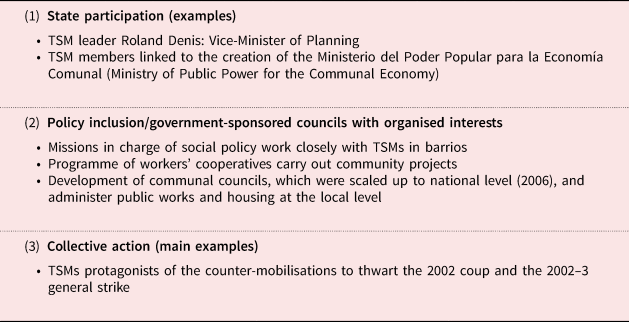
The governments of Hugo Chávez (1998–2013) in Venezuela and Evo Morales (2005–15) in Bolivia not only articulated a general class-based discourse in the public and electoral spheres, but also stimulated the mobilisation of a wide array of community organisations and social movements, mostly among the informal poor. There is no question that the informal popular sectors were the target of Chávez’ policies and his main constituency for political support, to the point that Collier and Handlin suggest the possibility of a partisan ‘associational neo-corporatism’.Footnote 35 The Constitutional Assembly in 1999 signals the peak moment in the inclusion of urban, environmental and indigenous social movements.Footnote 36 Later on, grassroots organisation promoted by Chavismo witnessed a series of waves and forms, from worker's cooperatives to Misiones and Consejos Comunales. (The Misiones provide a variety of social services outside the line ministries; the Consejos Comunales are neighbourhood organisations that distribute resources for development projects and public works in communities.)Footnote 37 Both developed important linkages to TSMs at the local level. The regime also sponsored territorial urban associations in specific policy areas such as technical water roundtables and urban land committees. Table 1 summarises informal-sector mobilisation under the Chávez governments along the dimensions presented above.
Venezuela: TSM Coalitions in the Interest Arena

Of course, though important pre-existing community-based TSMs joined Chavismo, with time mobilisation and political organising largely occurred ‘from above’. Community organisations mushroomed initially outside the Chavista electoral parties but not autonomously from the government, and were progressively aligned under the aegis of the Partido Socialista Unido de Venezuela (United Socialist Party of Venezuela, PSUV). After 2007 more radicalised, ‘productivist’ and statist economic policy (including widespread nationalisations) and the consolidation of the PSUV as the umbrella organisation of all Chavista groups narrowed the space for bottom-up grassroots organisation.Footnote 38 Still, María Pilar Garcia-Guadilla notes that popular and social mobilisation in Venezuela during the period 1998–2013 does ‘not always respond to a dynamic strictly from above or below[;] sometimes they are mixed’.Footnote 39 The key general point for my argument is, however, that Chávez promoted popular organisation essentially among the informal popular sectors, and that this mobilisation included (especially c. 1998–2007) territorial, community-group activism that was external to Chavista embryonic parties.
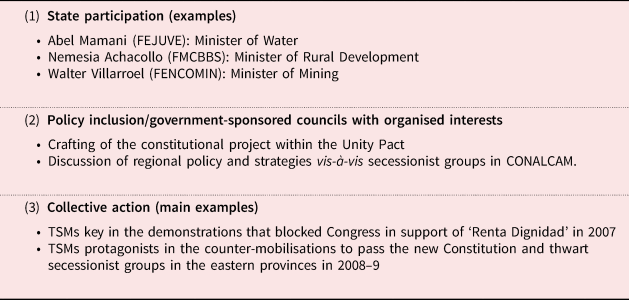
Bolivia is the second case in which a post-neoliberal government has built strong coalitions mostly based in the informal-interest arena. The two main axes of this alliance have been the indigenous movements (in particular the coca growers) and the urban associations of El Alto on the outskirts of La Paz.Footnote 40 In other words, unlike in Venezuela and Argentina (and similar to Brazil) interest coalitions with informal popular actors in Bolivia were both urban and rural. Despite the obvious concentration of leadership in Morales, organised and territorially-based social movementsFootnote 41 played a role in government probably unmatched in the Latin American Left Turn (see Table 2). The appointments of Abel Mamani, President of the Federación de Juntas Vecinales de El Alto (Federation of Neighbourhood Councils of El Alto, FEJUVE) as Minister of Water, Nemesia Achacollo from the Federación de Mujeres Campesinas de Bolivia Bartolina Sisa (Bartolina Sisa Bolivian Peasant Women's Federation, FMCBBS) as Minister of Rural Development and Walter Villarroel from the Federación Nacional de Cooperativas Mineras de Bolivia (National Federation of Bolivian Mining Cooperatives, FENCOMIN) as Minister of Mining are just three diverse examples.Footnote 42
Bolivia: TSM Coalitions in the Interest Arena
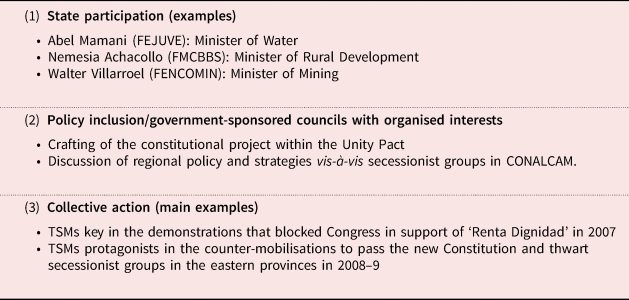
In addition to the negotiation of state positions, the coalition with informal popular actors crystallised in two defined moments during Morales’ initial years. First, in 2006 the most important indigenous organisations, among them the Confederación Sindical Única de Trabajadores Campesinos de Bolivia (Unified Confederation of Peasant Workers of Bolivia, CSUTCB), the Confederación Sindical de Colonizadores de Bolivia (Bolivian Trade Union Confederation of Settlers, CSCB), the FMCBBS, and the lowland peasants of the Confederación Indígena del Oriente, Chaco y Amazonia de Bolivia (Confederation of Indigenous People of Eastern Bolivia, Chaco and Amazonia, CIDOB) coalesced in the Unity Pact. The Unity Pact formally presented a proposal to reform the constitution to Morales in 2006, later amended in negotiations during the Constitutional Assembly of 2006–7. Subsequently, the government sponsored the creation of the Coordinadora Nacional para el Cambio (National Coordination for Change, CONALCAM) in 2007, which became a body for the coordination of the interplay of social movements, the executive and the MAS’ legislative branch. Unlike the Unity Pact, which essentially cemented the alliance with more traditional indigenous movements, in 2008 CONALCAM also incorporated key urban territorial associations such as cooperative workers and neighbourhood councils.Footnote 43 However, some organisations, such as CSUTCB (the traditional ‘corporatist’ peasant organisation born out of the 1952 revolution) and the coca unions remained more tied to the core of Morales leadership than others. By contrast, Morales’ relation with the formal sector-based Central Obrera Boliviana (Confederation of Bolivian Workers, COB), essentially made up of miners and teachers, was ‘fraught with tension’ and, unlike the mainstream indigenous movements, traditional labour ‘oscillated back and forth as ally and adversary of the government’.Footnote 44 No major union leader was appointed to a top government position.
Finally, in both Venezuela and Bolivia social movements were at the forefront of collective action specially during key political battles – the third dimension of popular-sector mobilisation. Chavista grassroots urban movements played a central role in the counter-demonstrations that – along with the decisive support of the military – converged on Miraflores (the presidential palace) and brought Chávez back to power in 2002.Footnote 45 They also staged explicit support in favour of the government during the two-month general strike waged by the opposition in December 2002–January 2003. In Bolivia, in the context of the Unity Pact, indigenous social movements carried out significant demonstrations to support the 2006 constitutional project and the ‘Renta Dignidad’ non-contributory pension programme.Footnote 46 Likewise, in 2008 the MAS leadership organised a big march by CONALCAM organisations to the eastern provinces to confront right-wing groups that threatened the area with secession.
Electoral and Dual (Labour Unions and TSMs) Interest Mobilisation: Argentina and Brazil
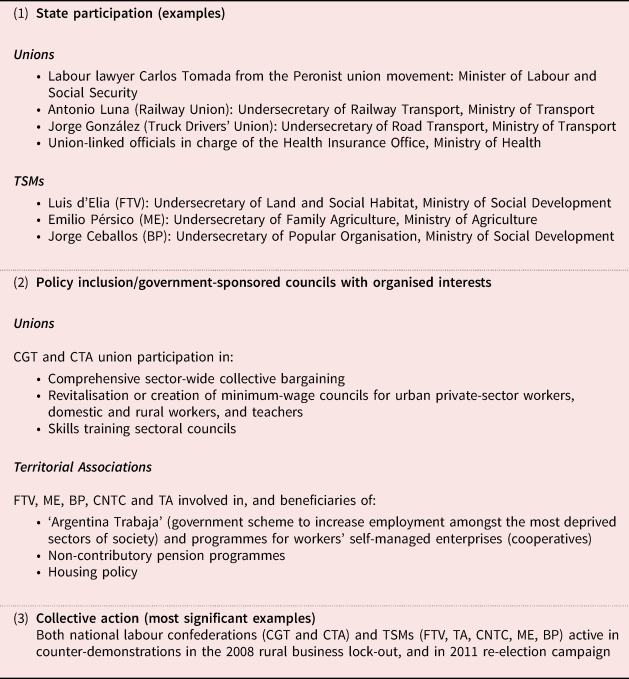
Argentina and Brazil in the 2000s constitute the two cases in which we find not only electoral working-class mobilisation, but also interest politics activation in both areas of the post-neoliberal class divide: formal and informal. Kirchnerismo established from the outset an odd dual alliance with mainstream and traditionally corporatist unions, and a significant portion of urban social movements that operated outside the machine politics of the Partido Justicialista (PJ). The labour movement witnessed an unlikely comeback after its subordination in the neoliberal years. Carlos Tomada, a labour lawyer who had historically advised key unions, was named Minister of Labour and Social Security, and union and union-linked officials staffed the Ministry of Transport and the Ministry of Health in areas in which union interests were at stake (see Table 3).Footnote 47 Most importantly, the labour movement played a pivotal role in the re-launching of sector-wide, state-oriented collective bargaining and tripartite or bipartite (i.e. state–union) minimum-income councils for the private sector in general, and for teachers in the public sector and rural and domestic workers.Footnote 48 This labour-market offensive was backed by laws and decrees (drafted in consultation with the labour movement) that put in place the institutional architecture for this resurgence in centralised collective bargaining.
Argentina: Union and TSM Coalitions in the Interest Arena

TSM leaders from organisations such as the Federación de Tierra, Vivienda y Hábitat (Federation of Land, Housing and Environment, FTV), Movimiento Evita (ME), Barrios de Pie (Neighbourhoods on the Move, BP), the Asociación de Vecinos de Tupac Amaru (Tupac Amaru Neighbourhood Organisation, TA), the Confederación Nacional de Cooperativas de Trabajo (National Confederation of Workers’ Cooperatives, CNCT) and others were also included in government and participated in the formulation of social policy, especially in the areas of non-contributory pensions and housing.Footnote 49 In sum, defined policy areas served as main coalitional fulcra in these interest-politics coalitions with popular actors: labour policy/collective bargaining with the mainstream unions of the Confederación General del Trabajo (General Labour Confederation, CGT), education policy and teachers’ national wage councils with the left-wing Central de Trabajadores de la Argentina (Argentine Workers’ Central, CTA, a group of mostly public-sector unions that broke with the CGT in the 1990s), and cooperative programmes essentially cemented the alliance with organisations of unemployed and informal workers.Footnote 50
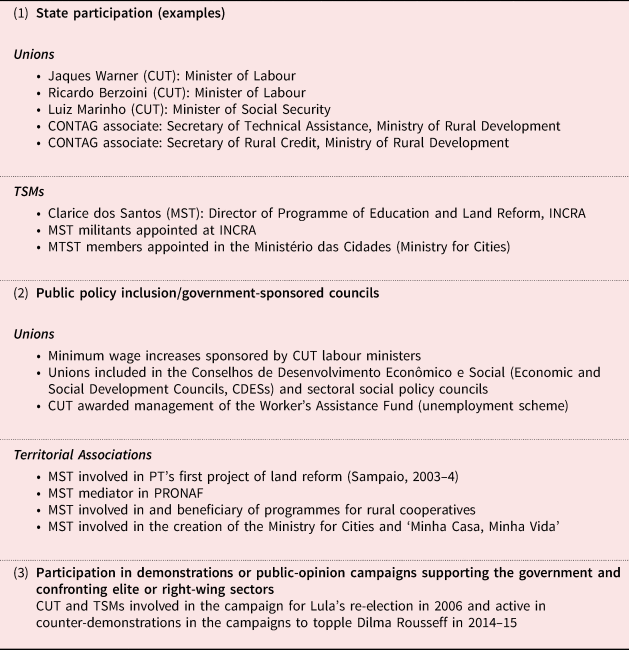
In Brazil the PT government also established initial interest coalitions with the largest popular organisations: the CUT and the Confederação Nacional dos Trabalhadores na Agricultura (National Confederation of Rural Workers, CONTAG) in the formal sector, and the MST and the Movimento dos Trabalhadores Sem Teto (Homeless Workers’ Movement, MTST) in the informal popular sector. Hernán Gómez Bruera has carried out an extensive examination of how the PT used state positions and public-policy involvement to cement an alliance with these social actors.Footnote 51 President Inácio Lula da Silva appointed prominent CUT leaders as ministers in diverse areas including Labour and Social Security in his first administration (Table 4). Union-linked labour ministers pushed forward the policy of a systematic increase in the minimum wage, a key mechanism for social redistribution under the PT government.Footnote 52
Brazil: Union and TSM Coalitions in the Interest Arena

CONTAG and MST members also occupied several positions in the Ministry of Rural Development and the Instituto Nacional de Colonização e Reforma Agrária (National Institute for Colonisation and Agrarian Reform, INCRA) (see Table 4). Both ministries implemented programmes that benefitted their social-movement constituencies, in particular the Programa Nacional de Fortalecimento da Agricultura Familiar (National Programme for the Invigoration of Family Agriculture, PRONAF) delivered by the Ministry of Rural Development, which was staffed by CONTAG in key areas. The expansion of PRONAF under Lula was massive, and scholars argue that it became an important source of funding for the MST.Footnote 53 Likewise, an MST-linked official headed the Programa Nacional de Educação na Reforma Agrária (National Programme for Education and Land Reform), which had a fivefold budget increase under Lula. The MST was also actively involved in the first version of Lula's land reform project in 2003–4, crafted by the prestigious agrarian specialist and PT founder Plínio Sampaio.Footnote 54 Likewise, the MTST, a social housing movement based in São Paulo, participated in the Ministry for Cities and in the ‘Minha Casa, Minha Vida’ housing programme. Of course, it is difficult to measure the degree of social-movement inclusion in the PT administrations as many activists wore two hats as members of party and of unions or social movements.Footnote 55 But there is no question that labour-movement and territorial-association leaders played a relevant and unprecedented role in the national executive offices of their respective areas, and in policy implementation.
In sum, in both Argentina and Brazil unions and informal economy-based social movements were included in the government coalitions. Social actors used this platform (at least initially, and to some extent) to promote mobilisation and advance policy goals. In Argentina, the government ostensibly backed union strike mobilisation during the collective-bargaining resurgence of 2003–7. Land occupations and strike activity also increased remarkably in the first years of the Lula administration.Footnote 56 Furthermore, as in Bolivia and Venezuela, progressive governments in Argentina and Brazil sought the backing of these organised class actors in electoral contests and major political disputes with right-wing sectors. In Argentina, both major unions and social movements were active in the pro-government counter-mobilisations against the lock-out organised by rural business organisations in 2008. In Brazil, unions and social movements publicly backed Lula's re-election in 2006. They also supported Dilma Rousseff on the streets in order to counter the impeachment process against her in 2016.
Electoral and Union/Party Interest Mobilisation: Uruguay
Uruguay is an atypical case. After 2005, the FA governments of both Tabaré Vázquez and José Alberto Mujica set the stage for a union labour market offensive comparable only to that of Argentina in 2003–15. Sector-wide bargaining and minimum wage councils were put in place for private, public-sector and rural workers, and the Ministries of Labour and Health were staffed with union-linked officials.Footnote 57 As in Argentina, the FA government voted in Congress for a new institutional framework for collective bargaining in consultation with unions that was strongly rejected by the business sector. On the other hand FA, unlike the progressive parties that formed the Concertación in Chile, is a mass, organic party deploying deep organisational roots and linkages among the informal poor that go beyond electoral campaigns,Footnote 58 and includes grassroots alliances with neighbourhood and shanty-town associations and with squatter organisations.Footnote 59 Its difference from the TSM mobilisation countries is, however, that those local associations lack any relevant autonomous voice outside the FA. In other words, informal popular-sector urban ‘interest’ demands in Uruguay are mediated by party–community linkages. Social movements that possess (or once possessed) a certain national impact and autonomous demand-making vis-à-vis the government (such as the MST in Brazil, the Tupamaros in Venezuela or the Piqueteros in Argentina) are non-existent in Uruguay.
Origins of Alternative Popular-Sector Coalitions in Latin America
The preceding section has systematically described alternative patterns of popular coalitions in the largest Latin American countries during the post-neoliberal period. Of course, these alliances were far from being stable, and they mutated frequently – especially in a continent with a low tradition of interest-politics institutionalisation. In Bolivia, for example, the direct inclusion of social-movement leaders at the cabinet level c. 2005–7 slowly diminished as Morales relied more on MAS political and intellectual cadres. The government also entered in a virulent conflict with the mining cooperatives that culminated in the assassination of the Vice Minister of Interior by protesters in 2016 in the midst of negotiations. In Venezuela, the alliances with urban TSMs soon took a top-down corporatist form which severely reduced the space for social-movement autonomy. In Brazil, Lula's relations with the MST cooled after the original project for land reform drafted in consultation with the rural workers’ organisations was largely watered down. In Argentina, however, the alliance with the TSMs strengthened with time (particularly under Cristina Kirchner), yet the powerful Truckers’ Union broke with the government in 2012.
Overall, progressive governments did not appoint social actors’ representatives in general policy areas such as the Presidency, Ministry of Economy or Finance, but in those more related to the economic roles of specific organisations (i.e. labour, social, housing or rural policy). In countries in which governments crafted the most solid interest coalitions with unions and/or informal economy-based organisations (Venezuela, Bolivia, Argentina, Brazil and Uruguay), only in very few cases did the main popular economic actors break with incumbent authorities, and pass to the opposition. Most allied unions and TSMs supported the left-wing governments in their first re-election attempts. For the informal economy-based urban and rural organisations (such as the indigenous movements in Bolivia, the MST in Brazil, the organisations of the unemployed in Argentina and the grassroots community groups in Venezuela) – historically victims of policy exclusion and of fierce repression on the part of national and local government – the new environment of no, or low, repression represented a considerable payoff.
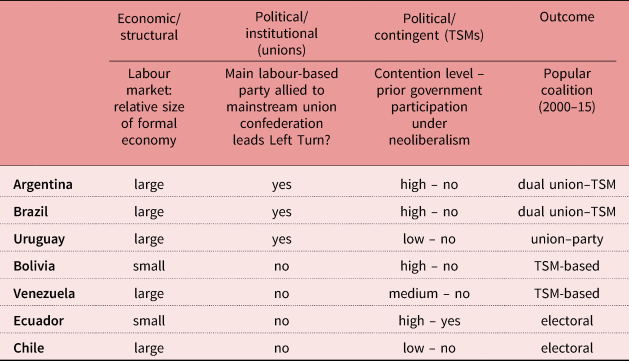
Table 5 summarises the main factors that help explain the different patterns of popular coalitions. I argue that the structure of the labour market is an initial general variable for considering the potential for alternative working-class coalitions. Small n comparative analysis suggests that a large formal economy (by regional standards) was ultimately a necessary condition for labour coalitions. By contrast, coalitions with ‘outsider’ organisations took place both under large informal economies (in which they were logically more to be expected) and under small ones. Two decisive political variables complement this structural factor. One stems from institutional legacies: when the main historical labour-based party allied with the hegemonic labour confederation led the Left Turn, as in Argentina, Brazil and Uruguay, interest coalitions with organised labour were the norm. The second political factor was more contingent and is related with the trajectories of TSMs prior to the Left Turn: TSMs that had staged high levels of anti-neoliberal contention during the second half of the 1990s and early 2000s, and had largely remained external to the state, were systematically courted by progressive governments. This is the case with dominant TSMs in Argentina, Brazil, Bolivia and Venezuela. These factors also explain why, despite their many differences, the Left in Chile and Ecuador organised only at the electoral level. In Chile, the main labour-based party did not lead the Left Turn and, thus, unions were ignored. Once-powerful TSMs from the poblaciones (shanty towns) were weakened and marginalised by the Concertación during the 1990s. In Ecuador, the dominant indigenous movement had been seriously tarnished by its participation in neoliberal governments prior to the Left Turn. The next two sections describe in more detail these trajectories, and elaborate on the causal mechanisms underlying hypothesised relations.
Explaining Popular Coalitions with Unions and TSMs: General Economic/Structural and Political Variables

The Structural Dimension of the Working Class: Size of Formal Sector and Unemployment
Perhaps the most obvious structural factor that may affect the coalitional strategies of progressive governments regarding alternative working-class actors is the size of the formal/informal sector and unemployment levels. A straightforward initial hypothesis would propose that in countries with relatively high levels of working-class formalisation (and potentially, of unionisation), left-of-centre governments need to govern wage-setting and administer labour conflict for a relevant constituency. Thus, they will reach out to the labour movement. In countries where the formal sector is small (and hence we find lower chances of union activation), and ‘shadow’ economies are large, or in which a large part of the working population is unemployed, the Left will rely more on TSM-led mobilisation.
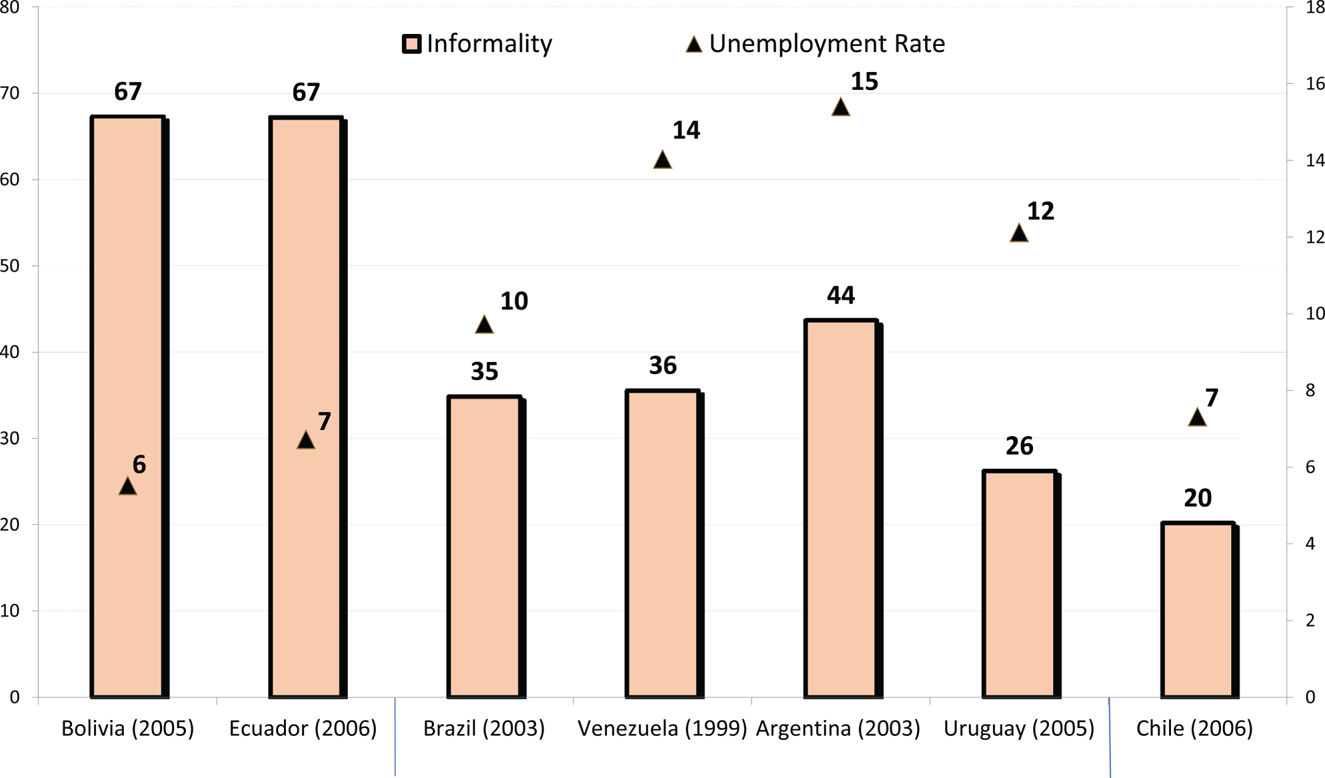
Figure 2 suggests that the first part of the hypothesis is more plausible: Brazil, Argentina and Uruguay display some degree of union mobilisation, and are countries in which formal economies have remained larger. We find no union mobilisation within the Left Turn in the two countries with high levels of informality: Bolivia and Ecuador. These data would also suggest that high initial unemployment (more than 10 per cent, for example, as in Argentina and Uruguay) does not preclude union mobilisation and, conversely, low unemployment (for example in the Andean countries) does not favour it. This is entirely logical: what matters for union mobilisation in a region like Latin America, more than if workers are employed or not, is whether they are registered in the formal sector, and can therefore be more easily organised. Venezuela and Chile, with moderate and low levels of informal economy and no union activation, are, of course, outliers in this initial explanation. As argued below, political variables need to complement class structure for a more thorough account. In brief, a relatively large formal economy seems to be a necessary, but not sufficient, condition for labour coalitions.
Informality and Unemployment in the Year of the Left Turn. The left axis shows the percentage of the adult population that does not pay social security taxes; the right axis gives the rate of unemployment rate as a percentage. Note the three groupings: Bolivia and Ecuador (high informality, low unemployment); Brazil, Venezuela, Argentina and Uruguay (medium–high informality, high unemployment); Chile (low informality, low unemployment).

The second part of this general structural hypothesis would posit that, in countries with large informal economies, left-wing governments have naturally greater incentives to form alliances with the more relevant and larger territorially-based community organisations. Small n comparison does not lend support to this proposition. Interest coalitions with TSMs occur with both high and moderate levels of informal economies. Countries in the region with high levels of informality (which also tend to have larger indigenous populations) that should induce, in principle, possible coalitions with TSMs, such as Ecuador (or Peru, not analysed in this study as it was not part of the Left Turn), have witnessed no government-sponsored TSM activation in the 2000s. Conversely, we find TSM coalitions in countries with moderate levels of informality, such as Venezuela, Brazil and Argentina. In short, informal sector-based social-movement mobilisation (either rural or urban) is unrelated to this more structural variable, and is driven, as we shall see, by political and historical conditions.
The Political Dimension: Labour Institutional Legacies and the Trajectory of TSMs in the Anti-Neoliberal Struggle
Government–Union Interest Coalitions and Labour-Based Parties
When the main traditional labour based-party led the Left Turn, as in Argentina, Uruguay and Brazil, governments crafted interest coalitions with the mainstream union movement, evidenced by state participation, policy inclusion and joint collective action. In these three cases these party–labour alliances were forged before the neoliberal period. The hegemonic or main labour confederation in each country, the CGT in Argentina, the CUT in Brazil and the Plenario Intersindical de Trabajadores – Convención Nacional de Trabajadores (Inter-union Workers’ Plenary – National Worker's Convention, PIT–CNT) in Uruguay, had been historical allies of the PJ, the PT and the FA respectively. Although the labour movements in Argentina and Uruguay had grown more distant from the parties during the 1990s,Footnote 60 important institutional ties and ideological identifications remained in place. In Brazil, the PT grew out of union militants (who would eventually form the CUT) in the late 1970s and early 1980s, and the leadership of the two organisations practically overlapped. In Argentina, mainstream unions were far from having the weight they had once in the Peronist party. Yet most CGT and CTA leaders identified themselves as Peronists, and unions are still part of the life of the Peronist party at the local/district level. In sum, only the main and traditional labour-based parties which headed the Left Turn consolidated national coalitions with formal-sector unions in the 2000s.
Thus, unlike in the case of TSMs – which built government alliances with both established (Peronism or the PT) or new political movements on the Left (Chavismo or the MAS in Bolivia)Footnote 61 – in the case of labour unions the type of party that commanded the Left Turn is more decisive. Historically more institutionalised alliances between an ‘old’ popular party and the labour movement explain the emergence of government–union coalitions better than a prior period of political activation (as it is the case with informal social movements). Typically, anti-neoliberal contention in Latin America was mostly led by social movements and not by mainstream (especially private-sector) unions, which were the main victims of deregulation, formal-sector shrinking and layoffs. However, in nations where the formal sector was still moderately large, as argued above, registered workers became a central constituency to administer governability. Argentina and Uruguay in practice established neo-corporatist, state-oriented and centralised income policies.Footnote 62 They ran a more expansive economic and monetary policy than did Chile, Bolivia or Brazil, for which union cooperation was essential.
Neither in Chile nor in Venezuela, two countries with a history of union mobilisation, did the main labour-based party allied with a hegemonic workers’ confederation lead the Left Turn. In Chile the Socialists who headed the Concertación governments in the 2000s can doubtfully be labelled as a ‘labour-based’ or ‘labour-backed’ party at the time. First, the main labour-backed party in Chile was the Communists, the force that historically built stronger ties to unions than the Socialists. Indeed, the Communists increased their leverage in Chile's trade union confederation, the Central Unitaria de Trabajadores (Workers' United Centre, CUT), during the 2000s,Footnote 63 but remained out of the Centre–Left coalition until 2014. Second, the absence of union mobilisation under the Concertación in Chile cannot be understood without considering the massive assault of the Pinochet dictatorship on the labour movement, and its legacy of institutional and market weakness.Footnote 64 Unlike in Argentina, Brazil and Uruguay, the Pinochet-era reforms that deregulated employment protection, banned collective bargaining beyond plant level, and allowed for workers to be replaced by scabs during strikes, further severed all institutional legacies with the pre-neoliberal labour order. The labour movement was just too fragmented and detached from Centre–Left parties to become an attractive coalition partner for the Concertación.
Likewise in Venezuela, the mainstream union movement was entirely tied to the Punto Fijo system, and was therefore from the outset an unlikely associate for an outsider like Chávez. Indeed, Alianza PAIS in Ecuador and Chavismo in Venezuela attempted to construct alternative union movements ‘from scratch’, and faced significant political and institutional barriers. The absence of national labour coalitions in these contexts becomes more understandable.
TSMs: Political Activation in the Anti-Neoliberal Struggle
A more systematic explanation of popular coalitions in the post-neoliberal period should complement the structure of the labour market and the institutional legacies of labour parties just analysed with a more contingent political dimension. This article argues that the trajectory of informal sector-based organisations in the neoliberal era, in particular the political activation of relevant social movements prior to the Left Turn, are key to explaining eventual TSM-based interest coalitions with progressive governments. All the countries in which new Left Turn leaders formed alliances with TSMs witnessed high levels of political activation of popular informal sectors or the unemployed against pro-market governments during the second half of the 1990s, which largely sidelined the established party system. This mobilisation was manifested in diverse types of ‘contentious politics’ (marches, road blockades, pickets, riots) typical of popular sectors that operate outside the formal economy, and often on the margins of the political system.
Unfortunately, there are no regional or global institutional data on ‘contention’ comparable to the statistics that measure strike activity for the formal sector. Yet few comparative social-movement analysts and country specialists in Latin America would dispute that in Bolivia, Venezuela, Argentina, Ecuador and Brazil informal sector-based TSMs were key in the waves of anti-neoliberal protests prior to the Left Turn. In perhaps the most comprehensive quantitative analysis on the subject, Paul Almeida argues that a wave of anti-neoliberal forms of collective action swept Latin America between 1995 and 2001.Footnote 65 In his dataset, Argentina, Ecuador, Brazil and Bolivia (in that order) are the top-ranked countries in South America in terms of number of ‘anti-neoliberal protest campaigns’ during this period.Footnote 66 Though Almeida does not clearly distinguish between union-led and social movement-led dissent, he shows that most protests were organised by public employees, students, peasants and ‘community, neighbourhood and indigenous groups’.Footnote 67 In the most ambitious qualitative study of anti-neoliberal protest in the region, Silva characterises Argentina, Bolivia, Venezuela and Ecuador as countries of high dissent in which various organised informal sector-based groups confronted neoliberalism on the streets during the 1990s and early 2000s, as opposed to the no-conflict cases of Uruguay and Chile.Footnote 68
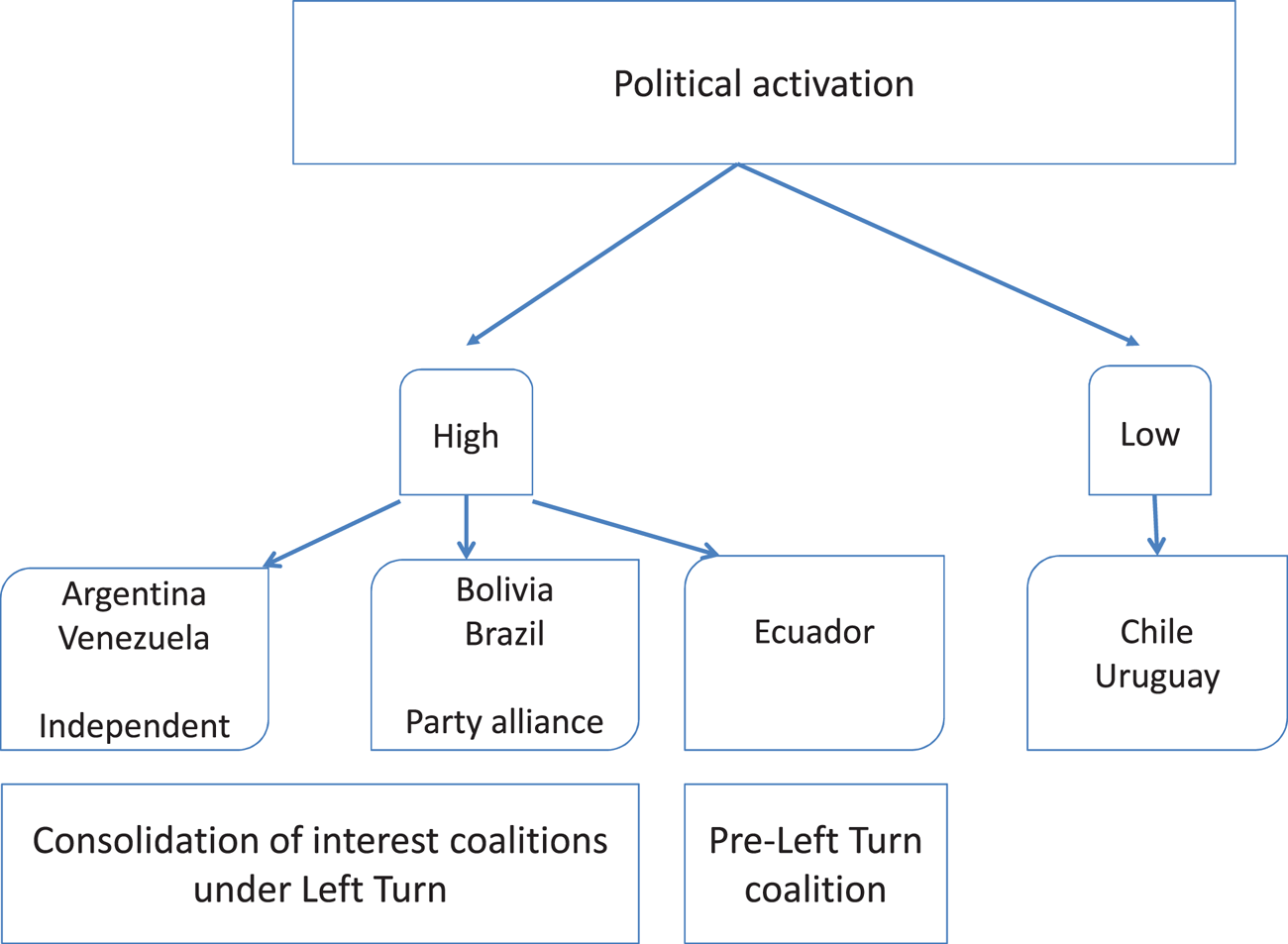
My argument is that, though protest is the starting point, the paths that shaped eventual TSM coalitions in the post-neoliberal period were essentially two (Figure 3). In the case of Argentina and Venezuela urban social movements independent of political parties mushroomed and became politically active in the second part of the 1990s as pro-market governments lost legitimacy. In the case of Brazil and Bolivia, activated rural and urban social movements converged under the umbrella of progressive electoral parties before the Left took power. This trajectory echoes what Candelaria Garay has called ‘social movement coalitions’ (i.e. alliances between outsider social movements and unions or parties) that often predate the new-Left wave of the 2000s.Footnote 69 In both the ‘independent’ and ‘party-alliance’ roads to informal sector-based popular coalitions, progressive governments needed the support of social movements that had gained broad legitimacy in their fight against repression and neoliberalism, and were a source of (and potential threat to) their own governance capacity.
Political Activation of TSMs and Trajectories under Neoliberalism (1995–2000/5)

In Argentina the social movements of the unemployed, the most important of which would join the Kirchners’ governments, were active in the unrest that led to the fall of the governments of Fernando de la Rúa (1999–2001) and Eduardo Duhalde (2000–2).Footnote 70 Likewise, Silva notes that, after the urban rebellion known as the ‘Caracazo’ (1989) and its reverberations, ‘a second wave of anti-neoliberal contention gripped Venezuela during the Caldera (1994–8) presidency’, embodied in public sector unions, students and ‘neighbourhood associations’.Footnote 71 In the same vein, Margarita Lopez-Maya points out that collective action, which she defines as ‘confrontational’, rose remarkably in the second half of the 1990s, and that the overwhelming majority of these protests were motivated by socioeconomic concerns.Footnote 72 Unlike in Argentina, where contention was clearly articulated by larger organised social movements with a broader territorial reach, in Venezuela smaller groups, in general restricted to a small number of urban barrios (such as the Tupamaros of western Caracas) were an important, but not unique, ingredient of these general anti-neoliberal protests. This convergence of the urban community movements born out of the anti-neoliberal struggles with Chavismo is well described in Ciccariello's We Created Chávez and Fernandes’ Who Can Stop the Drums? Footnote 73
It is well established in the literature that in Bolivia MAS rode the cycle of popular protests led by indigenous movements and urban-based community groups that swept the country after 2000, and resulted in the resignation of two presidents: Gonzalo Sánchez de Lozada in the Gas War of 2003, and Carlos Mesa in the turmoil of June–July 2005.Footnote 74 Originally a ‘regional’ party of the coca growers’ federations of the Chapare region in 1998–9, the MAS soon reached out to other indigenous movements to form a party made up of peasant organisations.Footnote 75 After 2002, and in the midst of the social dislocations that began with the Water War in 2000 in Cochabamba, the MAS sought to penetrate the cities with a new discursive appeal (more nationalist and less ‘ethnic’), and a formal alliance with popular urban organisations, especially those of EL Alto.Footnote 76 The two groups – the original peasant unions that by 2000 had consolidated the, in their terms, ‘instrumento político’ (i.e. the ‘political instrument’ or party) and the new urban grassroots associations of El Alto such as FEJUVE and Central Obrera Regional (Regional Workers’ Central, COR) – would form the backbone of the government-sponsored interest coalitions after 2005 described above.
In Brazil, Latin America's largest social movement – the informal sector-based MST – launched the most important contention cycle in its history in the 1995–2000 period, largely triggered by violent state repression and the massacres of Corumbiara (1995) and Eldorado dos Carajás (1996). For the first time the MST, born in Rio Grande do Sul, became active in the north-east. CONTAG, the massive union which organises informal as well as formal rural workers, supported many of these struggles. Numbers of land invasions markedly increased in this period.Footnote 77 The government of Fernando Henrique Cardoso reacted by stepping up its programme of agrarian reform and land distribution. Although the MST was founded separately from the PT – unlike the CUT, whose leaders were core party cadres – it shared base-level electoral and social activism with the party, which backed these struggles for agrarian reform.Footnote 78
In sum, in the ‘party-alliance’ path of Brazil and Bolivia, coalitions of electoral parties and social movements formed or consolidated prior to the Left governments in contexts of high popular informal sector politicisation. By contrast, in Venezuela and Argentina activated TSMs (in these cases mostly urban), independent of electoral parties and emerging political leaders, shared a discourse of neoliberal repudiation. Yet TSMs converged with Kirchnerismo and Chavismo decisively when governments of these persuasions took power. Still, both in the independent and in the party-alliance paths, contention shaped the increasing political prominence and legitimacy of TSMs during the mid to late 1990s and early 2000s. Left government incumbents knew that interest coalitions with activated informal sector-based social movements were important to (1) securing governability in contexts of high prior mobilisation and (2) garnering support for future political battles against non-elected power holders such as the economic elite and the mainstream media.
Ecuador stands out as a deviant case in this trajectory. From the massive upheaval that blocked roads and commercial transport in the early 1990s, to the riots that ousted Presidents Abdalá Bucaram in 1997 and Jamil Mahuad in 2000, the indigenous movement led by CONAIE became a key player in the cycles of contention 1990–2002. Around the same time, however (1996) the movement launched its own political party, Pachakutik, which enjoyed considerable success. Thus, CONAIE in Ecuador was arguably the most powerful and institutionalised informal sector-based association during the neoliberal 1990s analysed in this article.Footnote 79 It was represented in national councils for development and in Congress.Footnote 80 It appointed ministers initially in the Bucaram government, and participated actively in the constitutional convention of 1998.Footnote 81 However, its political alliances would jeopardise its future as a viable coalitional partner in the post-neoliberal world. First, CONAIE leaders participated in the coup against Mahuad in January 2000 in coalition with a group of army officials, which for many tainted the democratic credentials of the indigenous movement. Second, and most crucially, in 2002 CONAIE–Pachakutik established an electoral front with Lucio Gutiérrez (their ally in the 2000 coup). It became a central part of his government. CONAIE–Pachakutik negotiated key cabinet positions – the Ministers of the Interior, Agriculture, Education, Foreign Relations and Tourism.Footnote 82 The alliance lasted only six months and Pachakutik left the government when the first austerity measures began. However, by the time Gutiérrez himself was toppled by popular protests in 2006 (which now largely sidelined the indigenous movement), CONAIE's legitimacy had been seriously tarnished. The damage to CONAIE–Pachakutik provoked by its failed participation in governments during the neoliberal era, in particular under Gutiérrez, cannot be overstated. Franklin Ramírez Gallegos puts it bluntly: CONAIE ‘was the hegemonic actor in the popular camp until its participation in the government of Gutiérrez’.Footnote 83
In short, seen through a comparative lens, two factors help explain the absence of a Left government–TSM interest coalition in Ecuador despite the centrality of the CONAIE in the cycles of anti-neoliberal contention. First, unlike the rural social movements in Brazil and Bolivia, CONAIE never built an enduring alliance with an urban-based progressive political party or organisation – indeed by 2002 it had fallen back on an ‘ethnic public agenda’ which hindered its prospects in the coastal provinces.Footnote 84 The urban component, ‘original’ in the TSMs in Argentina and Venezuela, and built through alliances in the case of rural social movements in Brazil and Bolivia, enhanced the political clout of TSMs in the decisive political and electoral space of twenty-first-century democracies. Second, and more important for my general argument, unlike politically active TSMs in Bolivia, Venezuela, Argentina and Brazil, which remained actors external to the state prior to the Left Turn, CONAIE became part of national alliances and governments during the neoliberal era. Thus, it was largely seen as part of the discredited political class in Ecuador after the fall of Gutiérrez, and was associated with the years of political and economic instability.Footnote 85 In brief, TSMs which joined progressive governments in Latin America had been active in the anti-neoliberal cycles of protest, and had largely remained external to the state prior to the Left Turn.
Finally, informal sector-based national anti-neoliberal contention was absent in the cases of Chile and Uruguay in the 1990s. Here no TSM–government interest coalitions would take shape under the Left Turn. In Chile a robust social movement of the urban poor in the poblaciones led the protests against Pinochet in the early 1980s. Nonetheless, there is abundant literature to show that it later became marginalised and demobilised by the Concertación during the 1990s.Footnote 86 They were just not relevant actors in the 2000s, especially when the first government headed by the Socialists took power. Likewise, popular organisational atomisation was even more pronounced in the rural sector after radical neoliberal reforms.Footnote 87
In Uruguay independent national social movements never coalesced outside the networks of the left-wing FA during the neoliberal 1990s. A large informal sector-based squatter movement did unfold in the Montevideo area during that period, and peaked in 1990 and 1994–5 amidst a wave of land invasions. In the most comprehensive study on the topic, María José Álvarez Rivadulla shows that the squatter movement was in fact channelled and mediated by the political parties, especially the FA.Footnote 88 The fact that the FA started to compete for the votes of the poor in the informal sector and won the city of Montevideo in 1989 catalysed the wave of land seizures. Most of these invasions were, however, brokered by activists of the FA factions, especially the Movimiento de Participación Popular (Movement for Popular Participation, MPP),Footnote 89 Communists and Socialists, who actually negotiated the land settlements with the city government. The movement in essence waned when the FA took national office in 2005.Footnote 90 Unlike in Argentina, Venezuela, Brazil or Bolivia, these Uruguayan TSMs never challenged the neoliberal order at a national level nor bypassed the party system during the 1990s and early 2000s.
Popular Coalitions: Assessing Medium- and Long-Term Consequences
The primary goals of this article were to (1) conceptualise alternative forms of popular coalitions among progressive governments in Latin America in the 2000s and (2) offer a plausible set of factors that help explain these different trajectories. A further question becomes, what were the consequences of these alternative interest and electoral alliances for the countries’ political economies? I point to three types of implications that may constitute fertile avenues for future research.
Bridging the Insider/Outsider Divide
A burgeoning comparative political economy literature in Europe argues that popular parties often advance the interests of ‘insiders’ (formal working class) that have high political clout against those of atomised outsiders, i.e. part-time, informal or unemployed workers.Footnote 91 In Latin America, in the ‘dual’ (union and TSM coalitions) cases of Argentina and Brazil, formal and informal sectors’ popular organisations converged into progressive governing coalitions. In Uruguay, as stated above, the FA organised both insiders (unions) and outsider groups linked to the socially-entrenched party organisation. One could argue that these nations present combined benefits for the working class across the formal and informal divide in a way unmatched in the rest of Left Turn cases. Argentina, Brazil and Uruguay deployed economic and institutional improvements for the formal unionised sector not present in the other Latin American cases – for example, through state-oriented centralised collective bargaining in Argentina and Uruguay, and through the rise in the minimum wage in Brazil. Simultaneously, they also developed relatively expansive policies catering to the informal sector, e.g. the flagship conditional cash transfer programmes Bolsa Família (Family Grant, Brazil), Asignación Universal por Hijo (Universal Allocation per Child, Argentina) and Plan de Atención Nacional a la Emergencia Social (National Social Emergency Response Plan, PANES, Uruguay), plus other antipoverty programmes such as non-contributory pensions and those directed at workers’ cooperatives. The issue is worth exploring further, but as a preliminary result it seems that in the dual and union/party-based cases, governing coalitions have countered popular-sector fragmentation and the insider–outsider dilemma to an important degree.
Political Survival: The Importance of Institutionalising Social Embeddedness
What are the consequences of electoral and interest coalitions for the political sustainability of new Left projects? After 2015 the Left wave receded in the continent: Centre–Right or non-Left parties won elections in Argentina, Chile, Ecuador and Brazil. It could be argued that the three ‘survivors’, Left parties in Bolivia, Uruguay and Venezuela (though this latter case is more problematic, as after 2015 the country slid out of the democratic frame), are cases of socially-embedded political organisations, existing well beyond the purely electoral sphere. In addition, interest organisations (i.e. territorial and community organisations and/or unions) are well integrated in diverse ways into the MAS, the FA and the PSUV. As shown above, in Chile and Ecuador incumbent left-wing parties eschewed social mobilisation. The PT, though a dual (union/TSM) interest coalition, has mutated with time into a textbook case of a professional/electoral party.Footnote 92 Arguably, it downplayed political and social mobilisation after its initial years in government. Kirchnerismo, on the other hand, never institutionalised its relation with unions and social movements, even when it was hegemonic, though the most relevant organised popular actors still operate under the (broad) umbrella of Peronism. In sum, though political survival has many dimensions, one could speculate that social embeddedness, and the consolidation – to varying degrees – of interest coalitions under the aegis of broad electoral parties or fronts (PSUV, FA and MAS, and to a lesser extent Peronism) becomes an important asset for resisting bad times. Conversely, in the cases in which left-wing governments rejected popular interest coalitions (Ecuador and Chile) or failed to consolidate them well under the aegis of a popular party (Brazil), the Right found more fertile terrain in the lower classes to stage its counter-attack after 2012.
Policy Performance
What are the consequences of the inclusion of organised popular actors for public policy? In some areas, notably social and labour policy, inclusion of organised interests, both formal and informal, frequently enhanced the reach, efficiency and enforcement of government programmes and income policies.Footnote 93 In other cases, policy inclusion may have had less positive effects. Transport policy in Argentina and mining policy in Bolivia are examples in this respect: state inclusion of representatives of sectoral unions in Argentina and of the mining cooperatives in Bolivia occasionally produced erratic government initiatives and policy capture by private interests. A more systematic analysis across different policy areas is needed to distinguish the advantages and disadvantages of the inclusion of organised interests in governing popular coalitions.
Concluding Remarks
This article has attempted to systematise and explain the origins of alternative types of governmental coalitions with working-class actors in post-neoliberal Latin America. I have assessed the occurrence of government-sponsored popular coalitions in the electoral sphere and in the interest arena. The latter organisational dimension involved both formal (unions) and informal (TSM) actors in the sub-areas of state participation, public policy inclusion and joint collective action. Overall, a structural factor – a relatively large formal economy – and the institutional legacy of popular parties traditionally allied with hegemonic labour help explain government union–interest coalitions in Argentina, Brazil and Uruguay. In the case of TSMs, more contingent political factors are at stake. TSMs, both independent from electoral parties (Argentina, Venezuela) and within party alliances (Bolivia, Brazil), which were active in the struggle against market reforms, and had not participated in the neoliberal governments of the 1990s, eventually turned into attractive coalition partners for progressive governments in the 2000s.
After 2015, non-Left parties in Argentina, Chile and Ecuador, plus different types of democratic reversals in Venezuela and Brazil, threatened the social policy improvements and working-class empowerment experienced during the 2000s. By 2018, organised popular actors have begun to witness the consequences. In Argentina, a new Centre–Right government has implemented a harsh fiscal and monetary policy adjustment, and has undermined some of the financial basis of the welfare state rebuilt in the 2000s. The initially ‘moderate’ approach of the Mauricio Macri government soon mutated in outright right-wing policies. In Brazil, the slide to the Right has been even more pronounced. Michel Temer's government passed regressive social and labour reforms in the areas of subcontracting and union finances. Furthermore, Lula's dubious imprisonment paved the way for the election of a right-wing extremist, Jair Bolsonaro. Popular organisations anchored in both the formal and informal sectors are still active under the umbrella of the PT in Brazil, and have extracted some policy concessions from the Macri government in Argentina. Still, the social regression is evident.
In Uruguay and Bolivia, by contrast, popular-interest coalitions, which are well institutionalised in left-wing parties, have been more successful in navigating hostile times under democratic regimes after 2015. Mainstream indigenous social movements in Bolivia, and a powerful unified labour movement in Uruguay, are still part of functioning left-wing governing coalitions by 2019 – though in Bolivia both party and movements have clearly been unable to find an alternative to the leadership of Evo Morales. However, despite these alternative recent trajectories in the continent, a simple return to the period prior to the popular mobilization of the past decade is simply impossible in any country. In most cases unions and TSMs, empowered in the popular coalitions between 2000 and 2015, will be a relevant part of the political landscape in the years to come.
Acknowledgements
I thank Marcelo Mangini and Juan O'Farrell for their excellent work as research assistants in this project. I am also grateful to Germán Feierherd, Carlos Freytes, Marcus Kurtz, Sara Niedzwiecki, Andrés Schipani and Andrew Schrank for their comments. Previous versions of this article were presented at the Latin American Political Science Association (ALACIP) meeting at Montevideo, 2017, and at seminars at the MIT Department of Political Science, Princeton University and at the Center of Latin American Studies at Brown University. I thank the participants at these meetings for their comments.