Implications
The long-chain polyunsaturated fatty acids (PUFAs) are important constituent of phospholipids, the major structural components of the cell membranes, and include two series of fatty acids, n-3 and n-6. The essential α-linolenic acid (18:3n-3) is the parent of the first series and the essential linoleic acid (18:2n-6) is the parent of the second series. PUFAs affect important functions related to fecundation, such as acrosomial reaction and the sperm cell–oocyte fusion. The increase of reproductive performances is of remarkable scientific and commercial interest because European hare farming is developing due to an increase of market request particularly for restocking. Therefore, the aim of this study was to investigate the effect of dietary supplementation with linseed oil or soybean oil with respect to olive oil on the reproductive capacity of the European hare breeders.
Introduction
The long-chain polyunsaturated fatty acids (PUFAs) are important constituent of phospholipids, the major structural components of the cell membranes (Zaneveld et al., Reference Zaneveld, De Jonge, Anderson and Mack1991), and include two series of fatty acids, n-3 and n-6. The essential α-linolenic acid (18:3n-3) is the parent of the first series and the essential linoleic acid (18:2n-6) is the parent of the second series. The most widely available sources for α-linolenic acid are cold-water oily fish and some vegetable oils. The linoleic acid is found primarily in vegetable oils.
In gametes, PUFAs affect important functions related to fecundation, such as acrosomial reaction and the sperm cell–oocyte fusion (Yanagimachi, Reference Yanagimachi1981; Connor et al., Reference Connor, Lin, Wolf and Alexander1998; Müller et al., Reference Müller, Pomorski, Muller and Herrmann1999; Flesch and Gadella, Reference Flesch and Gadella2000; Lenzi et al., Reference Lenzi, Gandini, Picaro, Tramer, Sandri and Panfili2000). Spermatozoa from human and other animal species contains a large amount of PUFAs, mostly n-3 PUFAs (Zalata et al., Reference Zalata, Hafez, Mahmoud and Comhaire1995; Kelso et al., Reference Kelso, Cerolini, Noble, Sparks and Speake1997; Calamera et al., Reference Calamera, Buffone, Ollero, Alvarez and Doncel2003).
Hare has a potential life span in the wild of 13 years; it reaches sexual maturity at 6 to 7 months (Stott and Wight, Reference Stott and Wight2004) and give birth from one to four times per year (Tume, Reference Tume2000). Pregnancy lasts for 41 days, but the interval between two successive parturitions is often shorter, ranging between 35 and 40 days. This is due to conception occurring at a fertile oestrus some days before parturition, and this phenomenon is known as superfetation (Caillol and Martinet, Reference Caillol and Martinet1976). Consequently, the increase of reproductive performances is of remarkable scientific and commercial interest because European hare farming is developing due to an increase of market request, particularly for restocking. In recent years, there has been considerable concern about an apparent decline in populations of European hare (Lepus europaeus) in Western and Central Europe where an important haunting is carried out (Homolka and Zima, Reference Homolka and Zima1999).
The aim of this study was to investigate the effect of dietary supplementation with linseed oil (LIO) (56% of n-3 and 17% of n-6) or soybean oil (SBO; 7% of n-3 and 54% of n-6) with respect to olive oil (OLO) on the reproductive performance of the European hare breeders.
Material and methods
The trial was carried out on 42 breeder couples (42 males and 42 females) of the European brown hare, during the spring–summer season of 2007, housed in a farm belonging to a natural park (Parco Regionale di Gallipoli Cognato Piccole Dolomiti Lucane) located in Southern Italy (40°29′N and 16°09′E, 770 m above sea level). Ambient temperature varied, on average, seasonally between 6°C in April and 27°C in July. The inclusion criteria of the couples were healthy status, age (2 to 4 years) and good fertility in the last breeding season. Unlike domesticated animals, which breed at any time when placed with a mature individual of the opposite sex, hares observe the coupling period linked to seasons and will not necessarily accept any partner (Tume, Reference Tume2000). Therefore, each breeder couple (one male and one female) was housed in a reproduction cage at 1 April, 2 weeks before starting the experimental period. Cages measuring 1.61 × 0.90 × 1.45 m were provided with a nest equipped with an access control system and a sliding grating to separate male from female during suckling. The nest consisted of one compact body structure with two compartments, as suggested by González-Redondo (Reference González-Redondo2006), but with different dimension; the nest body of our cages is bigger (40 × 45 × 35 cm), as the European brown hare is generally larger than the wild rabbit. Cage was placed open aired (exposed to natural photoperiod and natural temperatures) and protected from wind. No female was gestating or lactating at the beginning of the trial.
Hares were fed ad libituma commercial pelleted feedstuff (55% NDF, 3.8% ADL, 15.4% CP and 10.35 MJ/kg of digestible energy, calculated according to the regression proposed by Fernandez-Carmona et al., Reference Fernandez-Carmona, Cervera and Blas1996). The main ingredients were corn, wheat, barley, oat, 48% protein soybean meal and dehydrated alfalfa meal.
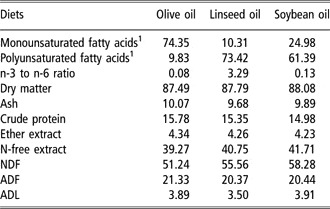
The couples were randomly divided into three groups (14 couples per group) and fed according to the following experimental design: control group received the described diet supplemented with 2% of OLO (a mix of monounsaturated fatty acids), whereas n-3 and n-6 groups were fed a supplemented diet with 2% of LIO (56% of n-3 and 17% of n-6) and SBO (7% of n-3 and 54% of n-6), respectively. LIO, SBO and OLO were obtained by cold-pressing process and supplemented with 20 mg/kg of vitamin E (91% of α-tocopherol). The purpose of the vitamin E supplementation was to prevent any peroxidation of PUFAs in LIO and SBO treatments (Sahin et al., Reference Sahin, Sahin, Yaralioglu and Ondereci2002), whereas in OLO treatment, vitamin E was supplied to standardise the diets. Diets were supplied for 5 months, from 15 April to 30 September, and management was always carried out by the same operator, twice a week, to reduce anxiety. In fact, hares are considered to be sensitive animals which never completely rid themselves of their fright reaction to man, and the constant presence of humans disrupts the captive hares so much that the relationships with other hares are prevented (Tume, Reference Tume2000). At the same time, feed intake was recorded and feed samples were collected and grounded in a hammer mill provided with a 1-mm pore size screen to determine the average chemical composition. Chemical analysis of diets was carried out using the method of Mertens (Reference Mertens2002) for NDF, and the official method (973.18) of the Association of Official Analytical Chemists (AOAC; 2000) for ADF and ADL. NDF was determined directly and corrected by its ash content, whereas ADF and ADL were extracted successively and corrected by ash content of ADL residue. Procedures of the AOAC (2000) were also used for moisture content (oven-drying method: 934.01), ash (muffle furnace incineration: 967.05), CP (Kjeldahl method: 976.05) and ether extract (989.05, with previous hydrolysis in compound feeds). Fatty-acid composition in oils was determined by gas chromatography according to the official method (969.33) of the AOAC (2000). Chemical composition of diets is reported in Table 1.
Chemical composition (% as-fed basis) of diets used in the experimental hare groups (mean ± s.d.)

1Results expressed as % of total fatty acids fraction.
For each group, the following data were recorded: days from 15 April to the first parturition, parturition interval, number of parturitions, number of leverets born (alive and dead), dead during suckling, the total number of leverets weaned and feed intake per cage (of males, females and leverets until weaning).
To reduce stress and anxiety, pregnancy diagnosis was not carried out according to Alves and Rocha (Reference Alves and Rocha2003), and each male was separated from its female during the whole suckling period. Natural weaning age in the European hares varies from 35 to 67 days (Zorner, Reference Zorner1996), but sometimes there is an aggressive behaviour in captivity towards leverets after 5 weeks of lactation (Hacklander et al., Reference Hacklander, Arnold and Ruf2002). Thus, we stopped placing leverets to their mothers for suckling when they reached 35 days of age, as suggested by Hacklander et al. (Reference Hacklander, Arnold and Ruf2002). At the same time, the sliding grating was removed to reintroduce each male.
All data expressed in percentage (leverets mortality rate at birth and during suckling) were analysed with a χ 2 test. A Yates’ correction was applied to χ 2 test (Zar, Reference Zar1996), whereas the remaining data were analysed with the MIXED procedure of SAS (1999) using the following model:

where Yijk is the dependant variable; μ is the overall mean; Ti is the fixed effect of ith treatment; and eik is the residual error. Differences were considered significant at P < 0.05.
Results and discussion
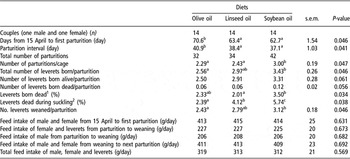
Data related to the effects of dietary supplementation on reproductive parameters and feed intake are reported in Table 2. In all groups, dietary oils supplementation did not modify the feed intake (414 g/day as average) and all females gave birth at least once.
Effect of dietary fatty acids supplementation on reproductive traits and feed intake of hares

1Percentage calculated on total leverets born.
2Percentage calculated on total leverets born alive.
a,b,cMeans within a row with no common superscript differ significantly (P < 0.05).
The days from 15 April to the first parturition were, on average, less than 3 (P < 0.05) in LIO and SBO groups compared with the OLO group (63.1 v. 70.6 days, respectively). The superfetation phenomenon occurred only in females fed n-6 and n-3 diets; in fact, the parturition interval was lower (P < 0.05) in hares fed SBO and LIO than in those fed OLO. The total number of parturitions per cage was higher (P < 0.05) for hares fed SBO compared with those fed LIO and OLO (3.00 v. 2.36, respectively), resulting in a total number of parturitions per treatment of 42, 34 and 32 for hares fed SBO, LIO and OLO diets, respectively. These results showed that the diet supplementation with SBO improved the reproductive performances in hare, supporting the importance of n-6 PUFAs in regulation of the reproductive processes. The superfetation phenomenon could be influenced by the effect of the diet on PUFAs composition of preovulatory follicles (Zachut et al., Reference Zachut, Arieli, Lehre, Argov and Moallem2008). Whereas the higher number of parturitions in SBO group with respect to LIO group may depend on an improvement of male reproductive dynamics, because one of the most sensible targets of dietary n-6 PUFAs supplementation may be also spermatogenesis (Leat, Reference Leat1983). However, nowadays there are no specific studies on hare about the fatty-acid composition of semen. Contrary to rabbit, collection of semen from hares is difficult, as the use of artificial vagina is still impossible (Kozdrowski and Dubiel, Reference Kozdrowski and Dubiel2005). It is nevertheless plausible that there are analogies between hare and rabbit, as they both belong to the family Leporidae. Contrary to the majority of mammalians, in fact, sperm membranes of rabbits are rich in n-6 and poor in n-3 PUFAs, and high levels of n-6 PUFAs were observed also in seminal plasma (Zaniboni et al., Reference Zaniboni, Gliozzi, Maldjian, Luzi and Cerolini2004).
The total number of leverets born per cage and parturition in SBO and LIO groups was higher than in OLO group, (3.20 v. 2.56, respectively; P < 0.05), resulting in a total number of born leverets of 144, 101 and 82 for hares fed SBO, LIO and OLO diets, respectively. The increase in prolificacy was probably due to an optimisation of follicular rise and oocyte maturation. In fact, fatty acids are an energy source during oocyte maturation and the extended period of embryo development before implantation (Wathes et al., Reference Wathes, Abayasekara and Aitken2007).
The leverets’ mortality rate at birth per cage and parturition was higher (P < 0.05) in SBO group (3.50%) than in LIO and OLO groups (2.17% on average). In addition, during suckling, leverets’ mortality rate in the OLO group was lower (P < 0.05) with respect to LIO and SBO groups, showing litters from hares fed SBO diet the highest mortality rate (5.74%, 4.12% and 2.39%, respectively; P < 0.05). The high leverets’ mortality rates in SBO group might be explained by the increment of litter size. It causes leveret losses not only during pregnancy, but also during suckling, because the variability of birth weight and the competition among leverets increase, and there is a high probability of crushing trauma.
The total number of leverets weaned per cage and parturition was higher in SBO group than in LIO and OLO groups (P < 0.05). Significant differences (P < 0.05) were also recorded between LIO and OLO groups. Therefore, leverets weaned in the group of hares fed SBO-supplemented diet were 131, and 95 in the group fed LIO-supplemented diet, whereas in the group fed a diet supplemented with OLO, a total of 78 leverets were weaned.
Conclusion
In conclusion, data that were obtained in our experiment confirmed, also in hare, the importance of PUFAs in reproductive dynamics. The significant increments, recorded in the hares fed a supplemented diet with LIO and particularly SBO, can lead to hypothesise that feeding may influence PUFAs composition of phospholipids in cell membranes. Further studies are necessary to clarify this aspect and to collect more data on PUFAs dietary levels, which probably depend on hare’s physiological moment.