Initial antimicrobial trials rarely focus on conditions such as bacteremia, osteomyelitis, or hospital-acquired pneumonia; instead, they focus on conditions such as complicated urinary tract infections (c-UTIs) or acute bacterial skin and soft-tissue infections (ABSSTIs). Providers must often select agents with limited efficacy data for the condition being treated. At institutions with robust antimicrobial stewardship programs (ASPs), mechanisms may be present to limit and monitor use in areas of unproven efficacy. For institutions without robust ASPs, the ability to follow evidence-based practices for new antimicrobials is unclear. We undertook a review of the initial use of 7 new antimicrobial agents (oritavancin, dalbavancin, tedizolid, ceftolozane-tazobactam, ceftazidime-avibactam, peramivir, and isavuconozonium) after Food and Drug Administration (FDA) approval at 6 community hospitals in western Pennsylvania.
Methods
For each agent, medical records of up to the first 10 unique adult patients at each hospital were reviewed through December 2017. Only initial FDA indications were included: ABSSTI for oritavancin, dalbavancin, and tedizolid; c-UTI and complicated intra-abdominal infections for ceftolozane-tazobactam and ceftazidime-avibactam; acute uncomplicated influenza for peramivir; and invasive aspergillosis and invasive mucormycosis for isavuconozonium. This study was deemed exempt from approval by the Institutional Review Board of University of Pittsburgh. All analyses were performed in SAS version 9.3 software (SAS Institute, Cary, NC).
Results
We included 103 unique patients. Hospital occupancy ranged from 49 to 374 beds. Of 6 hospitals, 5 had an infectious diseases (ID) physician on staff during the review period. No hospital had a pharmacist with ID training or certification, and pharmacists at each hospital reported inadequate time for addressing antimicrobial usage (via personal communications with local staff). Median time to first use ranged from 14 to 39 months by hospital and from 12 to 25 months by agent. All hospitals used at least 1 reviewed agent; 3 hospitals were responsible for 90% (93 cases) of use. Use of dalbavancin, peramivir, and isavuconazonium was minimal (<5 total uses of each drug). Oritavancin was used in 35 unique patients followed by ceftazidime-avibactam (23 patients), tedizolid (20 patients), and ceftolozane-tazobactam (14 patients).
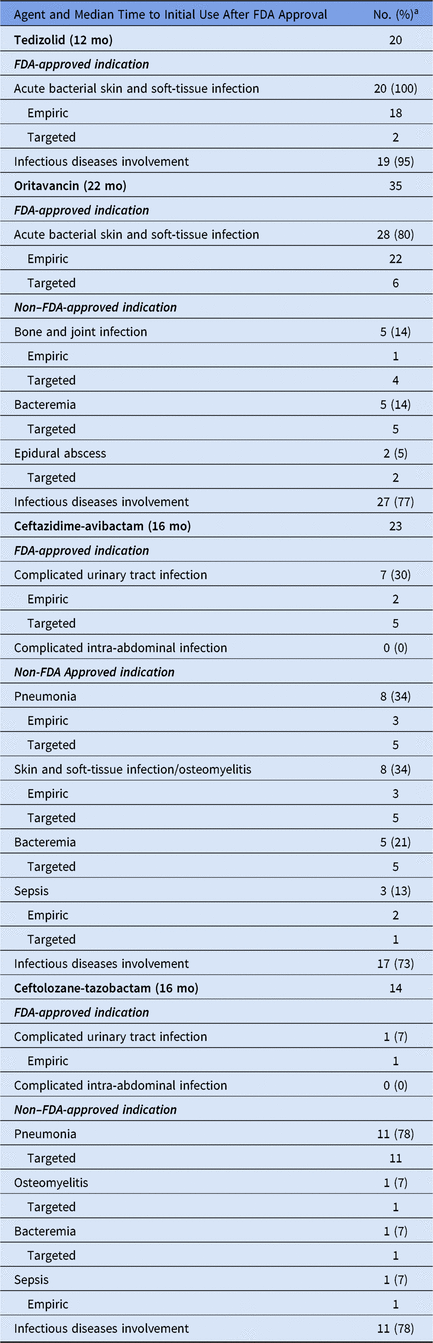
Table 1 describes usage of the 4 most common agents; 60% of use was for FDA-approved indications. Tedizolid and oritavancin were used for ABSSTIs in 100% and 80% of cases, respectively. Ceftazidime-avibactam and ceftolozane-tazobactam were used for c-UTI in 30% and 7% of cases, respectively; neither was used for intra-abdominal infection. Compared to tedizolid and oritavancin, ceftazidime-avibactam and ceftolozane-tazobactam were significantly less likely to be used for an FDA-approved indication (21% vs 87%; P < .0001) and were significantly less likely to initially be used empirically (24% vs 74%; P < .0001). The most common off-label indications were bone and joint infections and bacteremia for oritavancin (14% each), ABSSTI and osteomyelitis as well as pneumonia for ceftazidime-avibactam (34% each), and pneumonia for ceftolozane-tazobactam (78%). Bacteremia was an indication in 21% of ceftazidime-avibactam cases and 7% of ceftolozane-tazobactam cases. ID physicians were involved in 74 cases (80%).
Summary of Initial Indications for Use of Most Frequently Used Antibacterial Agentsa

Note. FDA, US Food and Drug Administration.
a Some cases had >1 documented indication for use
Susceptibility testing for the newer agents was rarely performed (7 for ceftazidime-avibactam and 2 for ceftolozane-tazobactam). Of the 7 isolates, 6 (85%) were ceftazidime-avibactam susceptible, and both tested isolates were ceftolozane-tazobactam susceptible. Klebsiella was the most resistant targeted pathogen in 10 of 16 patients (62%) treated with ceftazidime-avibactam with available culture results, and Pseudomonas was the most resistant targeted pathogen in 8 of 12 patients (66%) treated with ceftolozane-tazobactam for whom culture results were available. Of these 16 patients treated with ceftazidime-avibactam, 4 patients (25%) had options other than aminoglycosides, colistin, or ceftazidime-avibactam if tested. None of the 12 patients treated with ceftolozane-tazobactam had options other than aminoglycosides, colistin, or ceftolozane-tazobactam if tested.
Discussion
Our study, though retrospective and limited to 6 community hospitals, provides insight into how and when new antimicrobials may be used. Use of new antibacterial agents occurred within 1–2 years of FDA approval, similar to a recent report,Reference Schulz, Kim, Hartsell and Rose1 and ceftolozane-tazobactam and ceftazidime-avibactam were more frequently used for targeted therapy and for non-FDA approved indications. Although this finding may be understandable due to limited alternatives, much of this initial use occurred before any published experience in these settings.Reference Shields, Potoski and Haidar2 – Reference Delaportas, Estrada and Darmelio4 Since some agents’ release, for example, authors have raised concerns about their use as pneumonia monotherapy in renal failureReference Shields, Nguyen, Chen, Press, Kreiswirth and Clancy5 and with the initially approved dose.Reference Plant, Dunn and Porter6
We did not gauge appropriateness of decisions to use these drugs, nor did we compare rates of off-label use to rates in academic medical centers. However, early off-label use should be reserved for situations with no safe and effective alternative and should always be monitored carefully, especially for processes such as epidural abscesses or sepsis. Few gram-negative isolates from these hospitals were tested for ceftazidime-avibactam and ceftolozane-tazobactam susceptibility, and ASPs should make sure susceptibility testing is performed when these agents are used.
It is unlikely that most antimicrobial agents will receive initial approval for settings in which they will be most needed. The issues with developing antibiotics for complicated infections have been noted by others.Reference Cox, Nambiar and Badan7 In the future, some agents that address a critical need with limited current options may be approved via streamlined approval processes yet will also require additional labeling to make clear the limitations of available data.8 ASPs and hospital pharmacies must be aware of these limitations. Expanding the use of antimicrobials to nonapproved indications can sometimes lead to unexpected inferior outcomes.Reference Cox, Nambiar and Badan7 Hospitals should consider and plan for immediate off-label use of new agents when making formulary decisions, and they should maintain close oversight of all newly approved antimicrobials to ensure that they are used in accordance with FDA guidance and literature that supports additional use, especially with early use.
Acknowledgments
None.
Financial support
No financial support was provided relevant to this article.
Conflicts of interest
J.R.B. is an advisory board member for Mayne Pharma.
All other authors report no conflicts of interest relevant to this article.