

OUR STARTING POINT
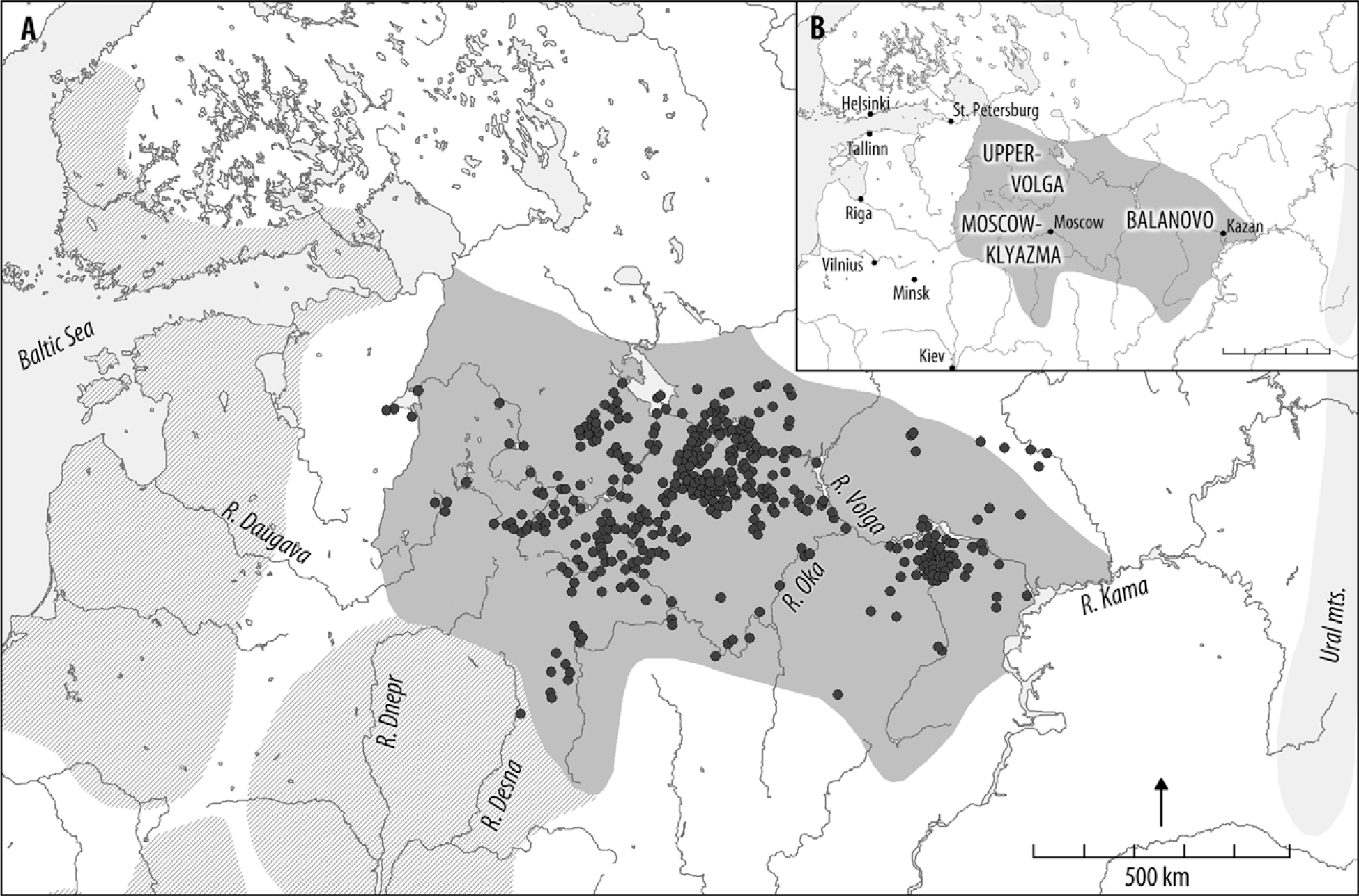
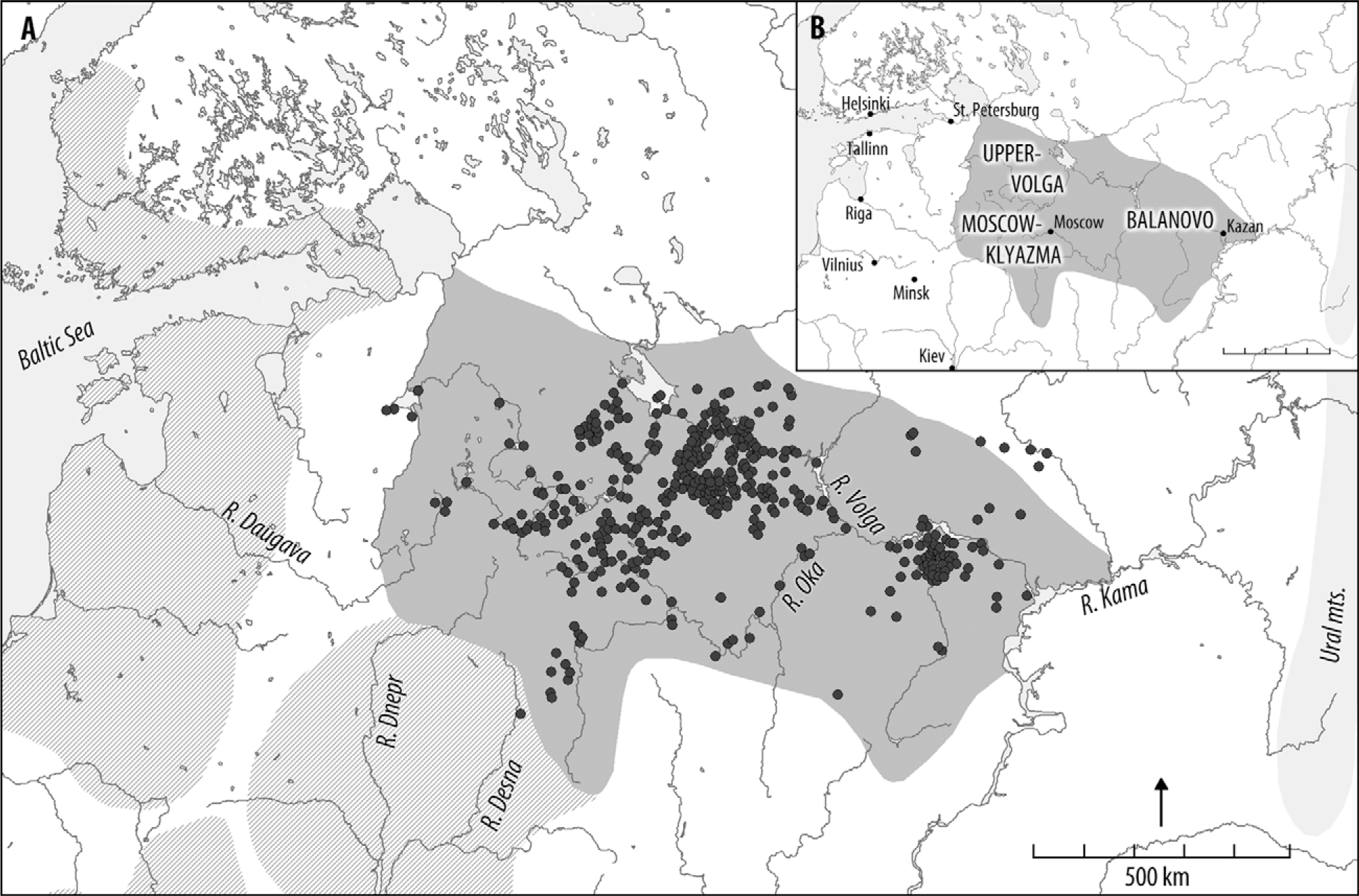
For a long time, accounts of the Corded Ware Complex (hence CWC), especially in western European archaeology, tended to focus profoundly on Continental Europe, on regions delimited by the Carpathian Mountains, the Alps, the North Sea and southern Scandinavia (eg, Furholt Reference Furholt2014; Bourgeois & Kroon Reference Bourgeois and Kroon2017). In so doing, a large part of the territory, particularly in eastern Europe, once occupied by the various CWC related groups, was left outside of any discussion (Fig. 1). In reality, the Corded Ware phenomenon extended well to the east of the Baltic Sea, all the way to the Middle Volga and Lower Kama River basins (Fig. 2). Most of this vast area, more than 1400 × 800 km in extent, was occupied by groups classified archaeologically as the Fatyanovo and Balanovo Cultures. These share many similar features in material culture but regional differences exist in, for example, certain aspects of burial customs, settlement sites, and metal production (Bader Reference Bader1963, 315; Kraynov Reference Kraynov1972, 11). Consequently, two schools have emerged in Russian archaeology, the first of which takes the Fatyanovo and Balanovo as two separate, albeit closely related, archaeological cultures (Bader Reference Bader1961, 55; Tretyakov Reference Tretyakov1966, 91; Krenke Reference Krenke2019, 110; also Carpelan & Parpola Reference Carpelan, Parpola, Carpelan, Parpola and Koskikallio2001, 87), whereas the second sees Balanovo as a local, eastern variant of Fatyanovo Culture (Kraynov Reference Kraynov1972, 238; Gadzyatskaya Reference Gadzyatskaya1976, 10; Volkova Reference Volkova1996, 31–2; also Anthony Reference Anthony2007, 382).
The pan-European distribution of Corded Ware Complex (after Müller et al. Reference Müller, Seregély, Becker, Christensen, Fuchss, Kroll, Mischka and Schlüssler2009, fig. 1; amended)

The eastern extent of the Corded Ware Complex: A) the area of Fatyanovo and Balanovo Cultures and the distribution of the main burial sites (after Kraynov Reference Kraynov1987, figs 5–6; amended); B) the principal regional groups
Several overviews of the regional CWC groups and their material culture have been recently published from the eastern Baltic region (eg, Grasis Reference Grasis2007; Lakiza Reference Lakiza2007; Zaltsman Reference Zaltsman2010; Nordqvist & Häkälä Reference Nordqvist and Häkälä2014; Piličiauskas Reference Piličiauskas2018; Ahola & Heyd Reference Ahola and Heyd2020), but the situation differs in the vast landscapes further east. Furthermore, as most publications are in Russian (but see Krainov Reference Krainov1992; Dolukhanov Reference Dolukhanov1996; Anthony Reference Anthony2007; Krenke et al. Reference Krenke, Erschov, Erschova and Lazukin2013; Häusler Reference Häusler2014), the territory and its archaeology have remained inaccessible for many western scholars. This means basically that since the introduction provided by M. Gimbutas (Reference Gimbutas1956), the contact to the eastern child of ‘western’ Corded Ware has been lost.
This paper aims to tackle this problem by first giving a literature-based overview of the Fatyanovo Culture in English. Secondly, as the interest towards Fatyanovo has recently been revitalised not least due to the emerging ancient DNA (hence aDNA) research (see Saag et al. Reference Saag, Vasilyev, Varul, Kosorukova, Gerasimov, Oshibkina, Griffith, Solnik, Saag, D’Atanasio, Metspalu, Reidla, Rootsi, Kivisild, Scheib, Tambets, Kriiska and Metspalu2020 for the first, yet preliminary overview on Fatyanovo genetic data)Footnote 1 , proposing major population turnovers for much of Europe in the early 3rd millennium bc (eg, Allentoft et al. Reference Allentoft, Sikora, Sjögren, Rasmussen, Rasmussen, Stenderup, Damgaard, Schroeder, Ahlström, Vinner, Malaspinas, Margaryan, Higham, Chivall, Lynnerup, Harvig, Baron, Della Casa, Dąbrowski, Duffy, Ebel, Epimakhov, Frei, Furmanek, Gralak, Gromov, Gronkiewicz, Grupe, Hajdu, Jarysz, Khartanovich, Khokhlov, Kiss, Kolář, Kriiska, Lasak, Longhi, McGlynn, Merkevicius, Merkyte, Metspalu, Mkrtchyan, Moiseyev, Paja, Pálfi, Pokutta, Pospieszny, Price, Saag, Sablin, Shishlina, Smrčka, Soenov, Szeverényi, Tóth, Trifanova, Varul, Vicze, Yepiskoposyan, Zhitenev, Orlando, Sicheritz-Pontén, Brunak, Nielsen, Kristiansen and Willerslev2015; Haak et al. Reference Haak, Lazaridis, Patterson, Rohland, Mallick, Llamas, Brandt, Nordenfelt, Harney, Stewardson, Fu, Mittnik, Bánffy, Economou, Francken, Friederich, Garrido Pena, Hallgren, Khartanovich, Khokhlov, Kunst, Kuznetsov, Meller, Mochalov, Moiseyev, Nicklisch, Pichler, Risch, Rojo Guerra, Roth, Szécsényi-Nagy, Wahl, Meyer, Krause, Brown, Anthony, Cooper, Alt and Reich2015; Kristiansen et al. Reference Kristiansen, Allentoft, Frei, Iversen, Johannsen, Kroonen, Pospieszny, Price, Rasmussen, Sjögren, Sikora and Willerslev2017; Heyd Reference Heyd2017; Olalde et al. Reference Olalde, Brace, Allentoft, Armit, Kristiansen, Booth, Rohland, Mallick, Szécsényi-Nagy, Mittnik, Altena, Lipson, Lazaridis, Harper, Patterson, Broomandkhoshbacht, Diekmann, Faltyskova, Fernandes, Ferry, Harney, de Knijff, Michel, Oppenheimer, Stewardson, Barclay, Alt, Liesau, Ríos, Blasco, Miguel, García, Fernández, Bánffy, Bernabò-Brea, Billoin, Bonsall, Bonsall, Allen, Büster, Carver, Navarro, Craig, Cook, Cunliffe, Denaire, Dinwiddy, Dodwell, Ernée, Evans, Kuchařík, Farré, Fowler, Gazenbeek, Pena, Haber-Uriarte, Haduch, Hey, Jowett, Knowles, Massy, Pfrengle, Lefranc, Lemercier, Lefebvre, Martínez, Olmo, Ramírez, Maurandi, Majó, McKinley, McSweeney, Mende, Modi, Kulcsár, Kiss, Czene, Patay, Endrődi, Köhler, Hajdu, Szeniczey, Dani, Bernert, Hoole, Cheronet, Keating, Velemínský, Dobeš, Candilio, Brown, Fernández, Herrero-Corral, Tusa, Carnieri, Lentini, Valenti, Zanini, Waddington, Delibes, Guerra-Doce, Neil, Brittain, Luke, Mortimer, Desideri, Besse, Brücken, Furmanek, Hałuszko, Mackiewicz, Rapiński, Leach, Soriano, Lillios, Cardoso, Pearson, Włodarczak, Price, Prieto, Rey, Risch, Rojo, Guerra, Schmitt, Serralongue, Silva, Smrčka, Vergnaud, Zilhão, Caramelli, Higham, Thomas, Kennett, Fokkens, Heyd, Sheridan, Sjögren, Stockhammer, Krause, Pinhasi, Haak, Barnes, Lalueza-Fox and Reich2018), the article provides a subtext for the analytical studies by summarising the current state of research. Thirdly, it presents an assessment of the Fatyanovo legacy for the subsequent cultural development of Bronze Age Eurasia. As our personal interests lay in the connections between the Volga Basin and the eastern Baltic Sea regions, we focus here particularly on the western part of Fatyanovo–Balanovo area, to the materials unanimously included into the Fatyanovo Culture.
Traditionally, Russian archaeology is distinctively organised around the concept of archaeological culture, often with solid links to linguistic and ethnic labels. The challenges and dangers of such an equalling of ‘pots’ with ‘people’ are currently again widely discussed in connection to aDNA and other scientific studies (eg, Heyd Reference Heyd2017; Furholt Reference Furholt2019a; Reference Furholt2019b). Although fully acknowledging that concepts like ‘Fatyanovo Culture’ and ‘Balanovo Culture’ are classificatory instruments created by archaeologists based on co-occurring sets of material culture and especially (conservative) burial customs, we largely retain the culture-historian nomenclature used in the sources compiled within this framework, including also much interpretations as given by the original scholars. Still, the overview remains necessarily simplistic and generalising due to the more than 1 million square kilometres of examined area and nearly 150 years of research.
FATYANOVO RESEARCH HISTORY
The first Fatyanovo antiquities – including the eponymous Fatyanovo burial ground found in 1873 near Yaroslavl – were included in the early publication of Russian Stone Age by A.S. Uvarov (Reference Uvarov1881, 395–419). The Fatyanovo Culture was separated in the beginning of the 20th century by A.A. Spitsyn (1903) and V.A. Gorodtsov (Reference Gorodtsov1916), and the first non-Russian overviews were given by Finnish scholars (Tallgren Reference Tallgren1922; Reference Tallgren1924; Äyräpää Reference Äyräpää1933) soon after World War I. In the 1920s and especially in the 1930s, the Fatyanovo Culture became the focus of active fieldwork, not least due to the ‘Fatyanovo commission’ based in the Moscow Sector of the State Academy of the History of Material Culture (for a complete research history, see Kraynov Reference Kraynov1972, 5–17; Kostyleva & Utkin Reference Kostyleva and Utkin2014). Among the locations studied were also the Balanovo cemetery near Cheboksary and other key sites, which led to the separation of the Balanovo Culture, although the results were often published only after World War II (Bader Reference Bader1937; Reference Bader1961; Reference Bader1963; Kraynov Reference Kraynov1941; Krivtsova-Grakova Reference Krivtsova-Grakova1947).
The most intensive research phase took place in the 1950s–1970s. Large-scale fieldworks, many executed by the Upper-Volga Archaeological Expedition of the Institute of Archaeology (Academy of Sciences of the Soviet Union, Moscow), were undertaken at a number of sites (Stepanov 1950; Raushenbakh Reference Raushenbakh1960; Gadzyatskaya Reference Gadzyatskaya1975; Kraynov Reference Kraynov1972; Reference Kraynov1975). The intensive phase was followed by a lack of excavations. Some individual graves or small burial grounds – more rarely settlements – were investigated, often in connection with excavations of sites dating to other periods (Sidorov & Trusov Reference Sidorov and Trusov1986; Sorokin & Dukelskiy 1986; Kravtsov Reference Kravtsov1988). Only the excavations at the Novinki cemeteries in Tver in the 1990s make a greater exception (Volkova et al. Reference Volkova1994; Volkova Reference Volkova2010). During the 2000s, a few scientific surveys and excavations have produced some new data on small camp and settlement sites (Krenke et al. Reference Krenke, Erschov, Erschova and Lazukin2013; Krenke Reference Krenke2019). Simultaneously, rescue archaeology due to construction projects has increased and revealed finds belonging to Fatyanovo (eg, Kravtsov et al. Reference Kravtsov2015). Such new discoveries also include the first large Fatyanovo burial ground investigated for decades in the Istrinsky district near Moscow (Engovatova Reference Engovatova2019; IA RAN 2019).
Studies focusing on the material culture were published during or soon after the fieldwork boom. Chronology and periodisation, local groups, and their origins were discussed (Krivtsova-Grakova Reference Krivtsova-Grakova1947; Foss Reference Foss1952; Bryusov Reference Bryusov1961; Tretyakov Reference Tretyakov1966), and the compiling works on both Fatyanovo and Balanovo Cultures were made public in the 1960s and 1970s (Bader Reference Bader1963; Kraynov Reference Kraynov1972; also Bader & Khalikov Reference Bader and Khalikov1987; Kraynov Reference Kraynov1987). In addition, regional collections of materials published (Kraynov Reference Kraynov1963; Reference Kraynov1964; Bader & Khalikov Reference Bader and Khalikov1976; Gadzyatskaya Reference Gadzyatskaya1976; Kraynov & Gadzyatskaya Reference Kraynov and Gadzyatskaya1987). After the 1980s, publishing activities quieted down and include mainly the publication of the Novinki studies and numerous accounts using pottery as a source material (Volkova et al. Reference Volkova1994; Volkova Reference Volkova1996; Reference Volkova1998; Reference Volkova2010; Reference Volkova2014; Reference Volkova2018). Further, regional studies and material catalogues have been published (Chelyapov & Ivanov Reference Chelyapov and Ivanov2000; Nedomolkina & Ivanishcheva Reference Nedomolkina and Ivanishcheva2006; Tkach Reference Tkach2018; also Solovev et al. 2012; 2015).
GEOGRAPHY AND CHRONOLOGY
Geographical extent
The area of the Fatyanovo Culture stretches from the upper reaches of the Dnepr and Desna Rivers and Lake Peipus to the Mari El and Chuvash Republics on the Middle-Volga, whereas Balanovo extends all the way to the Vyatka–Kama interfluve (Fig. 2: A). The distribution area is located in the zone of deciduous or mixed forests, with sites and finds following the major river valleys and watersheds, even if individual discoveries have been made further away in the surrounding territories.
Regional groups have been recognised since the early 20th century (Äyräpää Reference Äyräpää1933, 9; Krivtsova-Grakova Reference Krivtsova-Grakova1947, 33) based on the similarity in pottery and stone (battle) axes, the amount and type of burials, and, to a much lesser extent, settlements. A commonly used division, with nomenclature based on river hydronyms, was proposed by D.A. Kraynov (Reference Kraynov1972, 222; also Reference Kraynov1963, 13; Reference Kraynov1987, 63) and includes eight groups. Still, the research literature is dominated by three main groups only: the western Moscow-Klyazma and Upper-Volga groups and the eastern Balanovo (or Middle-Volga or Sura-Sviyaga) (Fig. 2: B). These have also been thought to indicate temporal differences and the west–east spread of Fatyanovo through the stages of early (Moscow-Klyazma), developed (Upper-Volga), and late (Balanovo-)Fatyanovo (Kraynov Reference Kraynov1987, 62–3, 72; Volkova Reference Volkova1996: 81; cf. Krivtsova-Grakova Reference Krivtsova-Grakova1947, 33). The remaining groups – Dvina-Ilmen; Oka-Desna (west); Lower-Oka; Vyatka-Vetluga; and Lower-Kama (east) – are less well studied and represented by fewer finds. Whether they really exist as such is another question for future research.
Chronology
The Fatyanovo Culture has been placed varyingly between the Late Neolithic and the Late Bronze Age (Gorodtsov Reference Gorodtsov1916, 126; Krivtsova-Grakova Reference Krivtsova-Grakova1947, 33; Kraynov Reference Kraynov1987, 71; Volkova Reference Volkova2010, 166). There has been a strong tendency to explain all differences in material culture as temporal (see above) but, so far, chronologies and internal phasing are based on typology, analogies, and stratigraphy, and not properly verified by radiocarbon dating.
Fatyanovo Culture has been considered to be late in comparison to the other CWC members, with Balanovo being even later (Äyräpää Reference Äyräpää1933, 109, 119; Kraynov Reference Kraynov1972, 215; Carpelan & Parpola Reference Carpelan, Parpola, Carpelan, Parpola and Koskikallio2001, 85). The absolute chronology was for a long time based on just two conventional radiocarbon dates (LE-1044 and 1046, published in the 1980s; see Table 1), as well as some CWC dates from the surrounding areas (Kraynov Reference Kraynov1972, 215–16; Reference Kraynov1987, 71; also Solovev Reference Solovev2016, 92–3). Even while drafting this paper, the published dates were numbering fewer than 15, geographically unbalanced, and basically inconclusive. With the Saag et al. (Reference Saag, Vasilyev, Varul, Kosorukova, Gerasimov, Oshibkina, Griffith, Solnik, Saag, D’Atanasio, Metspalu, Reidla, Rootsi, Kivisild, Scheib, Tambets, Kriiska and Metspalu2020) preliminary research, 26 more data points are now being introduced, however it is too early to understand fully their implications.
RADIOCARBON DATES FROM FATYANOVO (AND THE BALANOVO-NOVOSYURBEEVO CEMETERY) CONTEXTS

All dates are calibrated with OxCal 4.3.2 (Bronk Ramsey Reference Bronk Ramsey2009) using the IntCal13 atmospheric curve (Reimer et al. Reference Reimer, Bard, Bayliss, Beck, Blackwell, Bronk Ramsey, Buck, Chenge, Edwards, Friedrich, Grootes, Guilderson, Haflidason, Hajdas, Hatté, Heaton, Hoffmann, Hogg, Hughen, Kaiser, Kromer, Manning, Niu, Reimer, Richards, Scott, Southon, Staff, Turney and van der Plicht2013) and given at 95.4% probability
The beginnings of Fatyanovo – as of CWC in many other areas – date to the period marked by a plateau in the calibration curve (c. 2900–2600 cal bc). Thus, based on current knowledge, we cannot directly pinpoint the earliest occurrence, although the datings imply that the development of Fatyanovo was not significantly later than the CWC further west. Its end has previously often been placed somewhere in the 2nd millennium bc, but termination over the final centuries of the 3rd millennium is a more realistic option (Krenke Reference Krenke2019, 115; Saag et al. Reference Saag, Vasilyev, Varul, Kosorukova, Gerasimov, Oshibkina, Griffith, Solnik, Saag, D’Atanasio, Metspalu, Reidla, Rootsi, Kivisild, Scheib, Tambets, Kriiska and Metspalu2020). Unfortunately, absolute dating of other partially overlapping or subsequent cultural phases is poorly known as well, making the studying of their relationships challenging.
FATYANOVO SITES AND MATERIAL CULTURE
Burials are the main source of information and their distribution defines the core area of the Fatyanovo Culture. Some years ago, at least 330 burials in more than 50 locations were associated with Fatyanovo (excluding Balanovo burials; Kostyleva & Utkin Reference Kostyleva and Utkin2014, 66) (Fig. 2: A). In addition, thousands of stray finds (mostly stone battle axes) have been discovered and considered to indicate the wider territory of Fatyanovo influence (Kraynov Reference Kraynov1987, 62). Settlement sites are counted only in dozens and are mostly concentrated in the east, the Balanovo area.
Burials
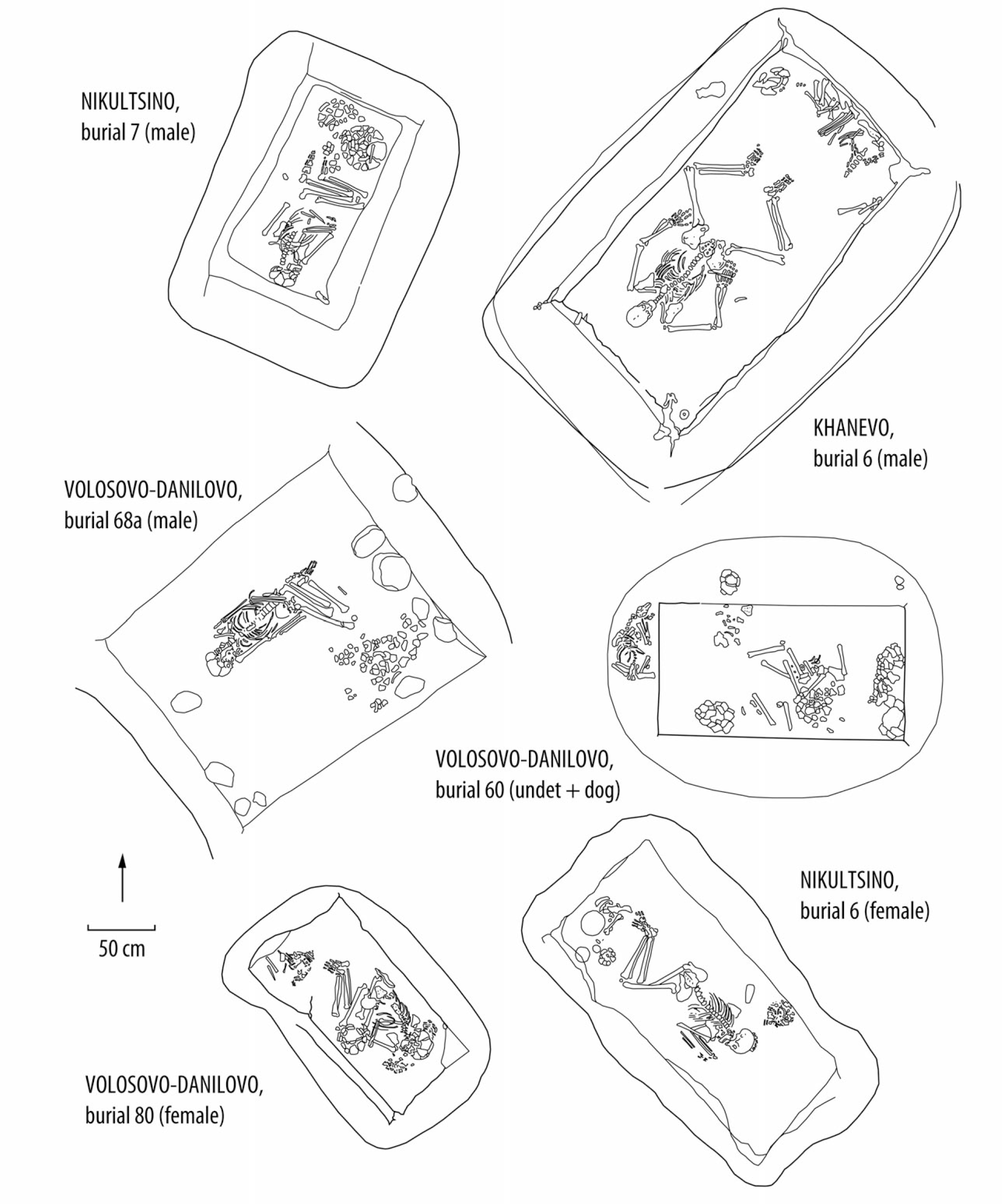
Cemeteries and burials are situated on high ground, on hilltops and high slopes, along waterways, wetlands and on watersheds (Kraynov Reference Kraynov1972, 18; Volkova Reference Volkova2010, 177). Occasionally, they are encountered on lower elevations and on earlier settlement sites (Kraynov Reference Kraynov1972, 18; Sidorov & Trusov Reference Sidorov and Trusov1986, 102). Many of the cemeteries – located on morainic or sandy hills – had already been partially destroyed by sand extraction before their discovery. The size of burial grounds varies from solitary burials to cemeteries with over 100 graves. Similar to the eastern Baltic and Finnish CWC groups, barrows are not often identified among the Fatyanovo antiquities. Apart from a few possible examples in the Moscow-Klyazma region (Kraynov Reference Kraynov1972, 26; Gadzyatskaya Reference Gadzyatskaya1976, 73), kurgans are known only in the Balanovo area (Bader & Khalikov Reference Bader and Khalikov1987, 78–9; Solovev Reference Solovev2016, 63–4). Fatyanovo burials are flat earth graves (Fig. 3). The pits are usually rectangular with rounded or protruding corners and vertical or sloping walls, and on average 1–1.5 m (but up to 3 m) deep. Especially in the Upper-Volga area, the walls and floor of the grave pits can be covered with wooden planks, bast or birch bark, braids of osier or roots. Occasionally, the pit may have been plastered with (burnt) clay, more rarely with red ochre. Light roofing covered the graves, creating a closed chamber. In some cases, post-holes have been noted and the remains of fireplaces or traces of fire are recorded in or nearby the grave pits (Kraynov Reference Kraynov1972, 170–92; Reference Kraynov1987, 64; Volkova Reference Volkova2010, 73–5). However, there is considerable variation in size and other details, and simple pits with basically no furnishings have also been studied (Kraynov Reference Kraynov1986, 96).
Selection of Fatyanovo burials from the cemeteries of Khanevo (Moscow region), Nikultsino (Yaroslavl region), and the largest of the Fatyanovo burial grounds, Volosovo-Danilovo (Yaroslavl region) (after Kraynov Reference Kraynov1987, fig. 24; Kraynov & Gadzyatskaya Reference Kraynov and Gadzyatskaya1987, tables 4–5, 29, 32, 36)

Single graves predominate, although double and even multiple burials exist (Raushenbakh Reference Raushenbakh1960; Kraynov Reference Kraynov1975, 180; Volkova Reference Volkova2014, 40; see below). Burials are usually inhumations. Cremations are known only in a few cases in areas adjacent to the neighbouring Middle-Dnepr Culture, where this burial custom is more common (Kraynov Reference Kraynov1986, 95; cf. Artemenko Reference Artemenko1987, 38). The bodies have been buried in contracted position, occasionally in other postures such as supine with spread legs, and may have been bound or wrapped in hides or bark (Kraynov Reference Kraynov1972, 188–9, 192). Burial ritual is gender-specific and applies also to the juveniles. Grave orientation is predominately west–east or south-west–north-east, but regional variation is large and north-west–south-east and north–south orientations are known. Commonly, females are lying on the left side with the head pointing eastwards, while males are on the right side, the head towards westerly directions (Kraynov Reference Kraynov1972, 189–91; Kraynov & Gadzyatskaya Reference Kraynov and Gadzyatskaya1987, 11–13) (Fig. 3). This generally replicates the body positions in continental Europe, despite certain variation (cf. Furholt Reference Furholt2014, 75–6; Bourgeois & Kroon Reference Bourgeois and Kroon2017).
Grave goods are almost always present. They tend to reflect sex, age, and status of the deceased, and their location in relation to the body seems to have been regulated. A stone battle axe is present in most male burials, rarely in female or juvenile graves. Many deceased have been buried with a wedge-shaped flint work axe and pottery vessels are encountered in nearly all graves. Other grave goods include flint knives (both sexes), occasional whetstones (male), bone and antler tools (daggers, knives, adzes, awls, points, spatulas, pins – male; awls, needles – female), adornments (bone, tooth, shell, amber – predominately female), as well as small flint tools (blades, scrapers, points, burins), and debitage and animal bones (remains of meals?) (Kraynov Reference Kraynov1972, 193–8; Reference Kraynov1987, 65). Metal is rare. As a special case, a couple of burials with utensils for metal production (hence the name ‘founder’s grave’) can be mentioned from Fatyanovo-Balanovo contexts (Kraynov Reference Kraynov1972, 168–9; Chernykh Reference Chernykh1992, 135).
The question of settlements
Settlements always played a minor role when discussing Fatyanovo. In this respect, it differs from the Middle-Dnepr Culture, and the eastern Baltic and Finnish CWC groups with their many settlement sites (Artemenko Reference Artemenko1987, 38; Nordqvist & Häkälä Reference Nordqvist and Häkälä2014, 8; Piličiauskas Reference Piličiauskas2018, 24). More substantial settlements with permanent (pit)houses and even fortified locations are known only in the Balanovo area (Stepanov 1950; Bader & Khalikov Reference Bader and Khalikov1976, 41–7; Solovev Reference Solovev2016, 65–6). Recently, some small seasonal camp sites with fireplaces and possible light tent-like structures have been investigated in Fatyanovo contexts (Krenke et al. Reference Krenke, Erschov, Erschova and Lazukin2013, 418; Kravtsov et al. Reference Kravtsov2015, 70). In addition to the unsatisfactory research situation, the scarcity of settlement sites has been explained by a mobile way of life and subsistence (Bader Reference Bader1963, 27; Tretyakov Reference Tretyakov1966, 88; Kraynov Reference Kraynov1987, 61).
Fatyanovo artefacts are often encountered at sites predominantly containing (earlier) hunter-gatherer materials, occasionally also traces of later human habitation. In general, the existence of diachronic material cultures at a suitable natural location is not exceptional in the research area. But the fact that many of the Fatyanovo sites contain settlement traces associated with the hunting and gathering Volosovo Culture has led to various speculations as to whether the locations represent Fatyanovo sites after all, or reflect just the transmission of some Fatyanovo artefacts (in one way or another) into Volosovo contexts (see Tretyakov Reference Tretyakov1966, 88; Kraynov Reference Kraynov1972, 215; Sidorov & Trusov Reference Sidorov and Trusov1986, 98). However, the co-occurrence of CWC material culture and that of other archaeological cultures also prevails in many other regions and need not to be taken to imply a deviatory or ‘non-settlement’ character of the locations. A major obstacle in the whole discussion limiting the understanding of Fatyanovo Culture (other than as a burial context) lies in the direct equation of an archaeological culture with a population. That being said, it has been also proposed that both the Volosovo and Fatyanovo antiquities belong to the same population, the former representing the domestic and the latter the ritual/mortuary context (Kraynov Reference Kraynov1972, 28; Dolukhanov Reference Dolukhanov1996, 89). This straightforward suggestion cannot be confirmed though, first, because generally a different burial tradition is related to Volosovo (see eg Kostyleva & Utkin Reference Kostyleva and Utkin2010), and secondly, because the temporal overlap of Volosovo and Fatyanovo traditions remains, thus far, undefined (see Macāne et al. Reference Macāne, Nordqvist and Kostyleva2019, 9).
Pottery and clay
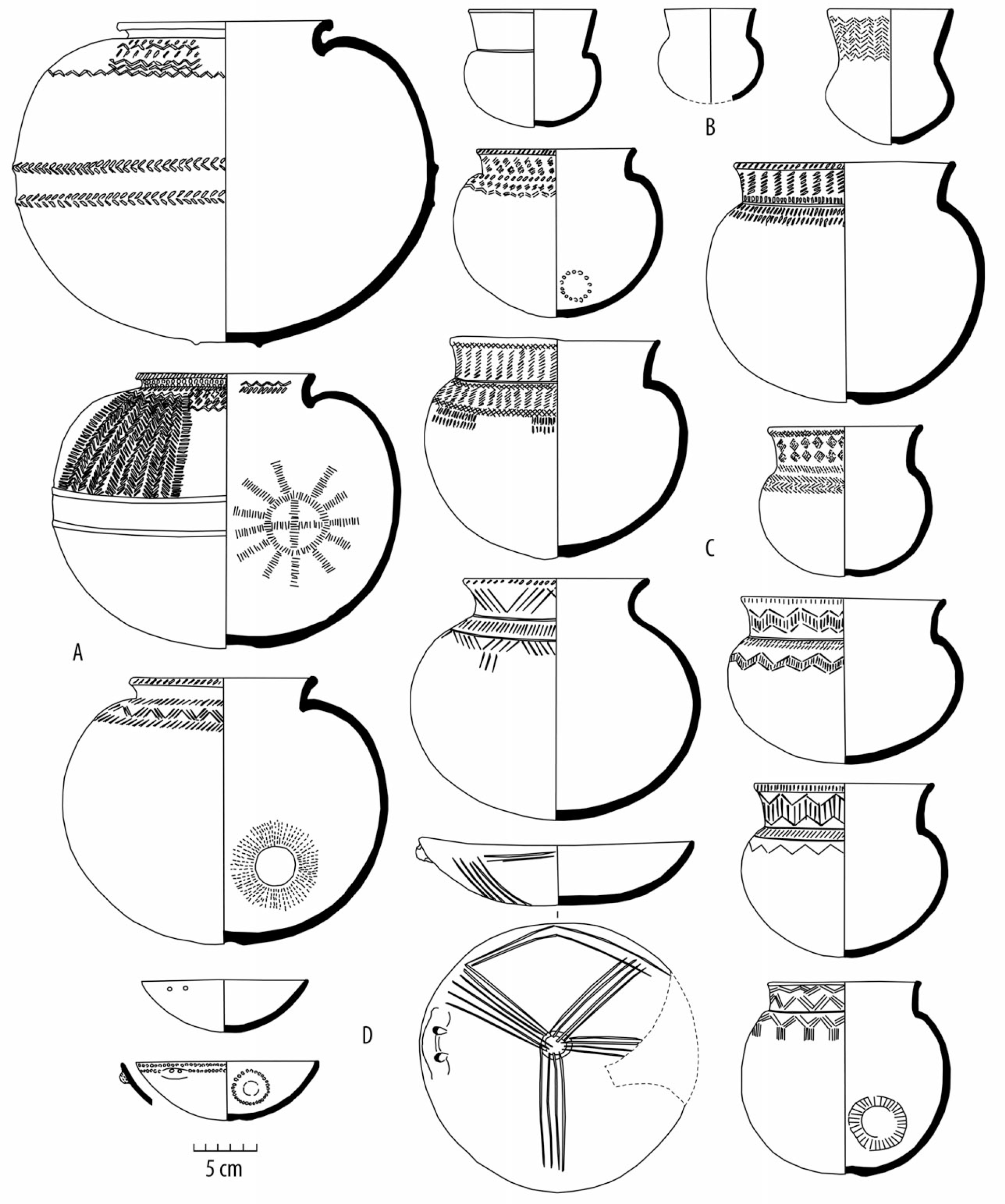
Ceramics are the most numerous find category and have played a key role in defining regional and chronological groups, their development and interaction. Pottery has been classified many times over the years (eg, Gorodtsov Reference Gorodtsov1916, 160–1; Bader Reference Bader1963, 196–7), and the most established divisions (Kraynov Reference Kraynov1963, 19–22, Reference Kraynov1972, 94; Volkova Reference Volkova1996, 59; Reference Volkova1998, 5; also Gadzyatskaya Reference Gadzyatskaya1976) present four main vessel types: pots, amphorae, beakers, and bowls. Pots with globular body and S-shaped profile or straight high neck are the most numerous (Volkova Reference Volkova1996, 59), especially in the Moscow-Klyazma region (Kraynov Reference Kraynov1972, 95), and bear a general resemblance to pots known in other regions, including the Middle-Dnepr area (Fig. 4: C). Amphorae or amphora-like vessels have globular or napiform body, low neck and small mouth (Fig. 4: A). They are common especially in the Upper-Volga area (Kraynov Reference Kraynov1972, 100–1) and find parallels among the amphorae of the other CWC groups. Beakers are small vessels with long neck and round body, and basically equal to the beakers found further west (Kraynov Reference Kraynov1972, 100) (Fig. 4: B). They are relatively rare, especially in the eastern areas (Volkova Reference Volkova1996, 59). The low open bowls are the most uncommon type and encountered especially in the Upper-Volga region and in children’s burials (Kraynov Reference Kraynov1972, 103) (Fig. 4: D). Some parallels are found from the Baltic States (Kriiska et al. Reference Kriiska, Nordqvist, Gerasimov and Sandell2015, 57; Piličiauskas Reference Piličiauskas2018, 150).
Fatyanovo pottery from the Upper-Volga area representing the basic vessel forms: A) amphoras; B) beakers; C) pots; and D) bowls (after Gadzyatskaya Reference Gadzyatskaya1976, tables 7–10)

Materials derive predominately from burial contexts and may therefore present a biased view of the so-called household ware (Kraynov Reference Kraynov1972, 106). Still, carbonised crusts on some pots indicate that they were used on fire. Based on morphology and associated finds, the vessels are deduced to have served as tableware and in various storing functions (Kraynov Reference Kraynov1972, 154; Volkova Reference Volkova2019) and, through ethnographical parallels, used also in processing foodstuffs (including the so-called colanders, ie, vessels with perforations; Krenke et al. Reference Krenke, Erschov, Erschova and Lazukin2013, 423; also Bader & Khalikov Reference Bader and Khalikov1987, 79).
Decoration is often limited to the upper part of the vessel but may be found around the bottom; non-decorated vessels also exist (Volkova Reference Volkova1996, 65, 72). Ornamentation consists of one or a few horizontal zones or rows of vertical or oblique stamps, geometric motifs, or fish-bone patterns (Kraynov Reference Kraynov1972, 114, 129–30; Volkova Reference Volkova1996, 65, 69; Reference Volkova1998, 5). Amphorae can be very decorative and can also have vertical decoration on the outer surface. Decoration is done with small toothed or flat stamps, incised or drawn lines, occasional cord impressions, notches, or other impressions. Some vessels have raised cordons (Kraynov Reference Kraynov1972, 114, 131; Volkova Reference Volkova1996, 63–4; Reference Volkova1998, 5). Common tempers include (coarse) sand, chamotte, and organic material, and show considerable regional, possibly also temporal, variation (Volkova Reference Volkova1996, 40, 47; Reference Volkova1998, 4; see also Kraynov Reference Kraynov1972, 152; Bader & Khalikov Reference Bader and Khalikov1987, 79). Organic temper is rarely connected with CWC pottery but is present in the Baltic States (Kriiska et al. Reference Kriiska, Nordqvist, Gerasimov and Sandell2015, 43; Piličiauskas Reference Piličiauskas2018, 122). All pots are handmade by using patching, coiling, even moulds. The vessels are relatively thin-walled, dense in mass, and the surfaces are usually smoothed and may be burnished (Kraynov Reference Kraynov1972, 153; Volkova Reference Volkova1996, 49–50, 56–8, Reference Volkova1998, 5).
Other clay artefacts include some clay spoons, again with individual equivalents in the eastern-Baltic assemblages (Edgren Reference Edgren1970, 43–4; Piličiauskas Reference Piličiauskas2018, 81). Miniature models of axes (similar ones are made of stone), just like miniature vessels, are mostly encountered in children’s burials and interpreted as votives (Kraynov Reference Kraynov1972, 154–5; Gadzyatskaya Reference Gadzyatskaya1976, 58–9). In addition, clay balls, rings, and other pieces of clay are known. Metallurgy related items include a few crucibles and fragments of casting moulds.
Axes and lithic artefacts
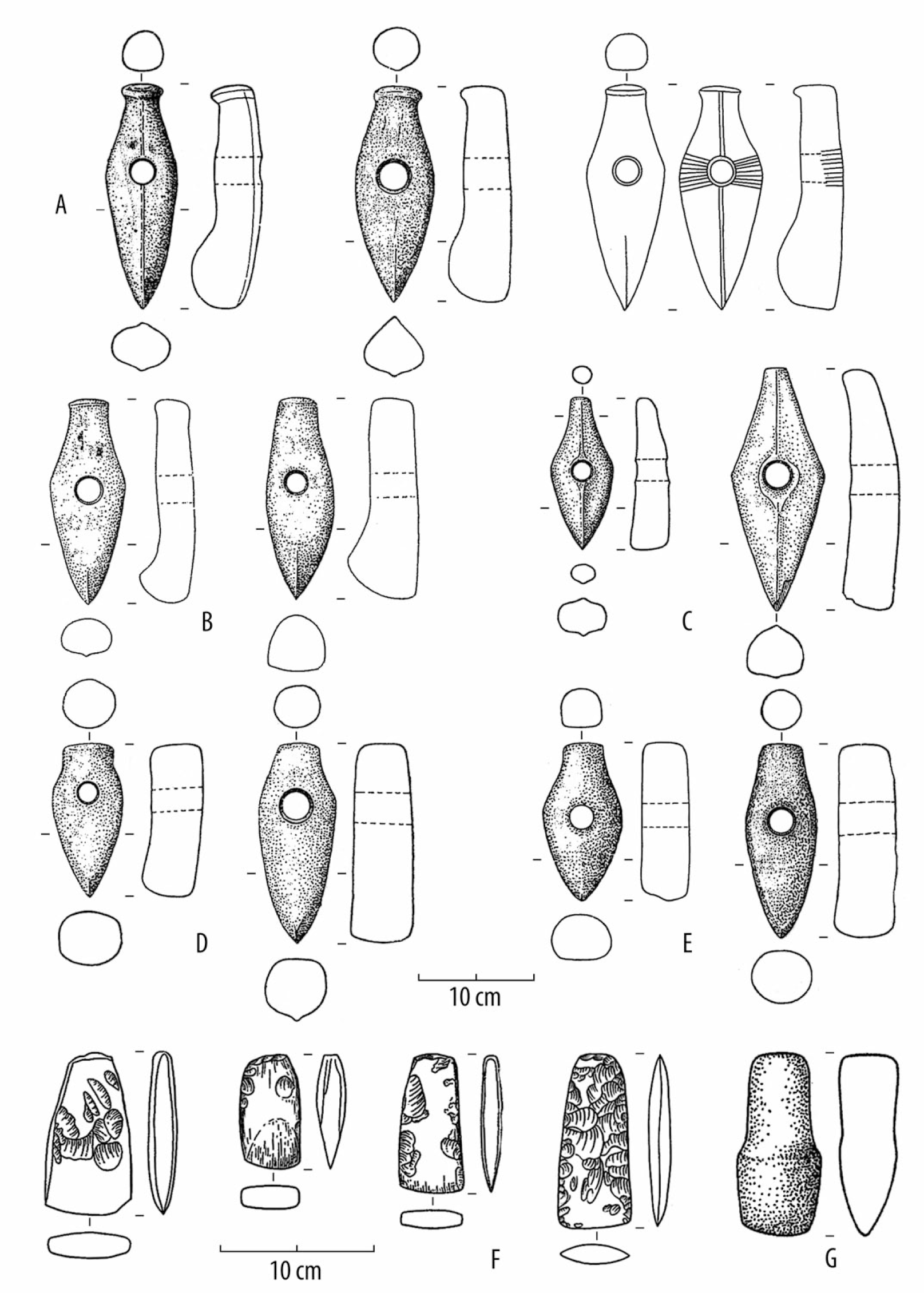
Stone battle axes have been the other fossil directeur of the era (Gorodtsov Reference Gorodtsov1916; Äyräpää Reference Äyräpää1933; Bryusov & Zimina Reference Bryusov and Zimina1966). In the most commonly used classification (Kraynov Reference Kraynov1972, 39; Gadzyatskaya Reference Gadzyatskaya1976, 50), c. 15 main types (including the Balanovo axes; cf. Solovev et al. 2012; 2015) are recognised, including artefacts from simple shaft-hole axes to battle axes. As with pottery, the proposed chronological differences are hard to verify since few absolute dates exist, and most axes are anyway stray finds without a proper context. Battle axes are described as status or social unit symbols, weapons, as well as tools (Bader Reference Bader1963, 178; Kraynov Reference Kraynov1972, 38–9; 61; Volkova Reference Volkova2010, 181). The most numerous types, battle axes with short and intermediate butts, are found throughout the Fatyanovo territory and are said to have parallels in the Middle-Dnepr, eastern Baltic and Belarus (Fig. 5: D, E). They have a round or oval cross-section, relatively straight or flat profile, and almost straight or moderately curved blade. Poll-knobs, shaft hole collars, and ‘casting seams’ are rare (Kraynov Reference Kraynov1972, 43–6).
Commonly encountered Fatyanovo axe types: A) ‘Fatyanovo battle axe’ ie battle axes with long blade; B) battle axes with short blade; C) sharp-butted battle axes; D) battle axes with short butt; E) battle axes with intermediate butt; F) wedge-shaped flint axes; G) shouldered axe (after Kraynov Reference Kraynov1972, figs 15–16, 18–21, 24; Gadzyatskaya Reference Gadzyatskaya1976, table 31)

The battle axe with short blade is the only type directly paralleled with the European A-axe (Kraynov Reference Kraynov1972, 56, 59; cf. Bryusov & Zimina Reference Bryusov and Zimina1966, 19–20) (Fig. 5: B). Fairly few in number, it is morphologically close to the battle axe with long blade, portrayed as the archetypal Fatyanovo axe (Gorodtsov Reference Gorodtsov1916, 135; Krivtsova-Grakova Reference Krivtsova-Grakova1947, 30; Kraynov Reference Kraynov1972, 54) (Fig. 5: A). A characteristic feature here is a pronounced, strongly backwards-curving blade. Knob-shaped polls and ‘casting seams’ are common and, in addition to collar, decoration is occasionally present around the shaft-hole (Kraynov Reference Kraynov1972, 52–5; Gadzyatskaya Reference Gadzyatskaya1976, 55). Their distribution is concentrated in the Upper-Volga region, but exemplars of Fatyanovo-like axes are known in Belarus and the eastern Baltic area. The west-focused distribution of rhombic narrow or sharp-butted battle axes (Kraynov Reference Kraynov1972, 50–1) also indicates contacts with the latter areas (cf. Nordqvist Reference Nordqvist2016, 61) (Fig. 5: C).
Wedge-shaped or four-sided polished flint axes are extremely common, typologically divided into c. 15 types, and with analogues in wide areas further west (Kraynov Reference Kraynov1972, 63, 67; Gadzyatskaya Reference Gadzyatskaya1976, 59–62) (Fig. 5: F). Due to their morphology and high numbers, such artefacts are assumed to be ‘working axes’ used for multiple purposes (Kraynov Reference Kraynov1972, 150; Gadzyatskaya Reference Gadzyatskaya1976, 59). Corresponding axes and adzes of crystalline rocks are relatively rare (Kraynov Reference Kraynov1972, 77), but have numerous parallels in the northern Baltic Sea area, as do the even more uncommon shouldered or tanged axes (Gadzyatskaya Reference Gadzyatskaya1976, 64; Bader & Khalikov Reference Bader and Khalikov1987, 80) (Fig. 5: G).
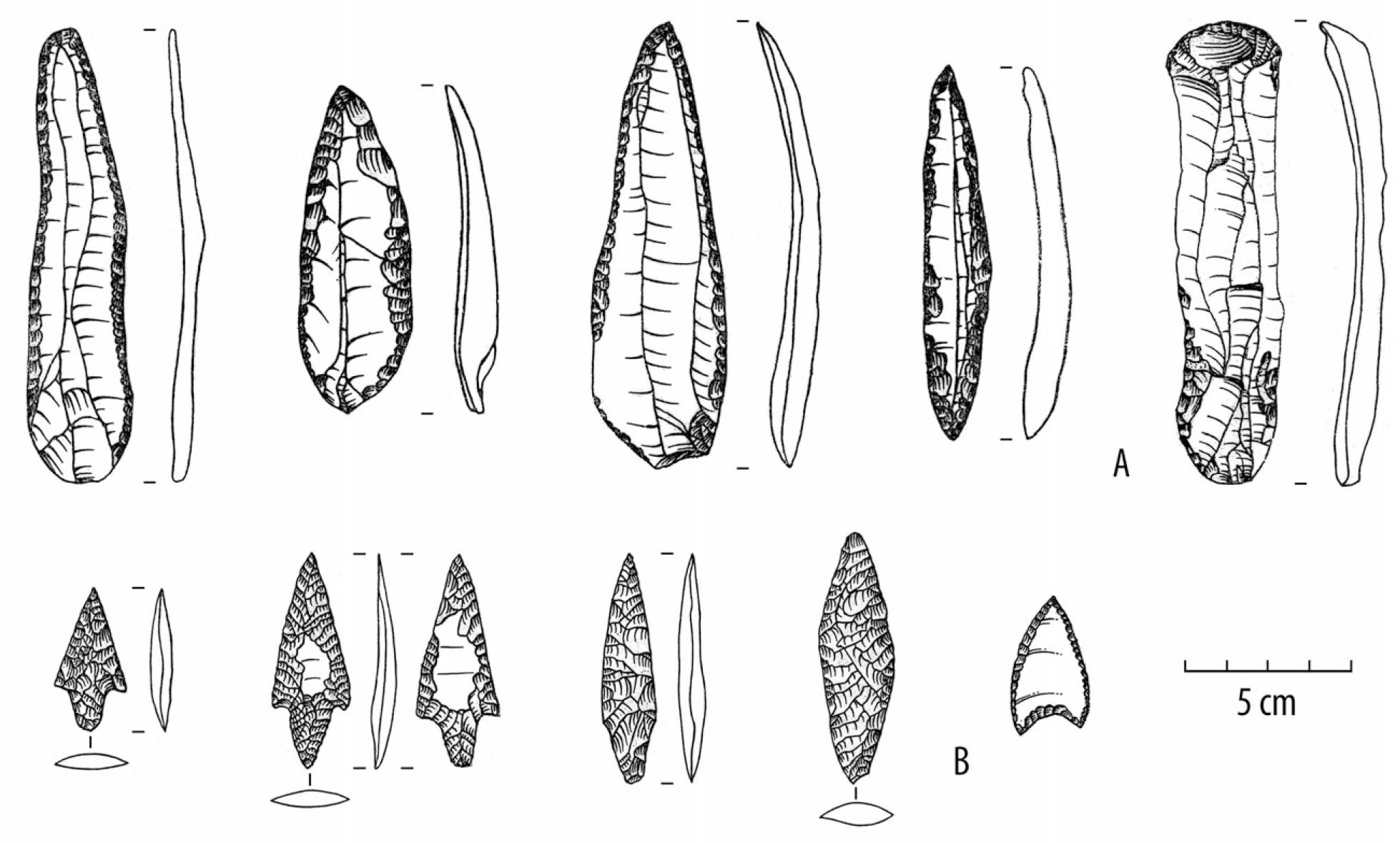
Other stone tools include clubs, sling stones, so-called arrow-shaft straighteners, various graters, grinders, pestles, hammers, as well as polishing slabs and whetstones (Kraynov Reference Kraynov1972, 77–82). Flint knapping resulted in the production of (micro)blades and flakes and tools (knives, points, scrapers, awls, borers). Large (blade) knives are common and find parallels among the other CWCs (Kraynov Reference Kraynov1972, 62, 73; Volkova Reference Volkova2010, 157–61) (Fig. 6: A). On the contrary, arrowheads are fairly rare and found predominately in the Moscow-Klyazma area (Kraynov Reference Kraynov1972, 195; Volkova Reference Volkova2010, 156) (Fig. 6: B). They are bifacially worked, either tanged, leaf-shaped, or triangular, and similar to the points found in the Middle-Dnepr Culture and further to the west (Kraynov Reference Kraynov1972, 70, 195; Volkova Reference Volkova2010, 153–7).
A) flint blade knives are often found in burials, whereas B) flint arrowheads are rare discoveries (after Kraynov Reference Kraynov1972, figs 26 & 28)

The most commonly used raw materials for ground stone tools are hard crystalline rocks, diabases, granitoids, diorites, and porphyries (Kraynov Reference Kraynov1972, 147; also Solovev et al. 2012, 63). Stone quarries are not known in the Fatyanovo area. Raw materials were obtained from local surface outcrops and boulders and, in the case of flint and wedge-shaped axes, partially imported from the mines of Belarus and Poland (Kraynov Reference Kraynov1972, 149–51).
Bone, antler, and other materials
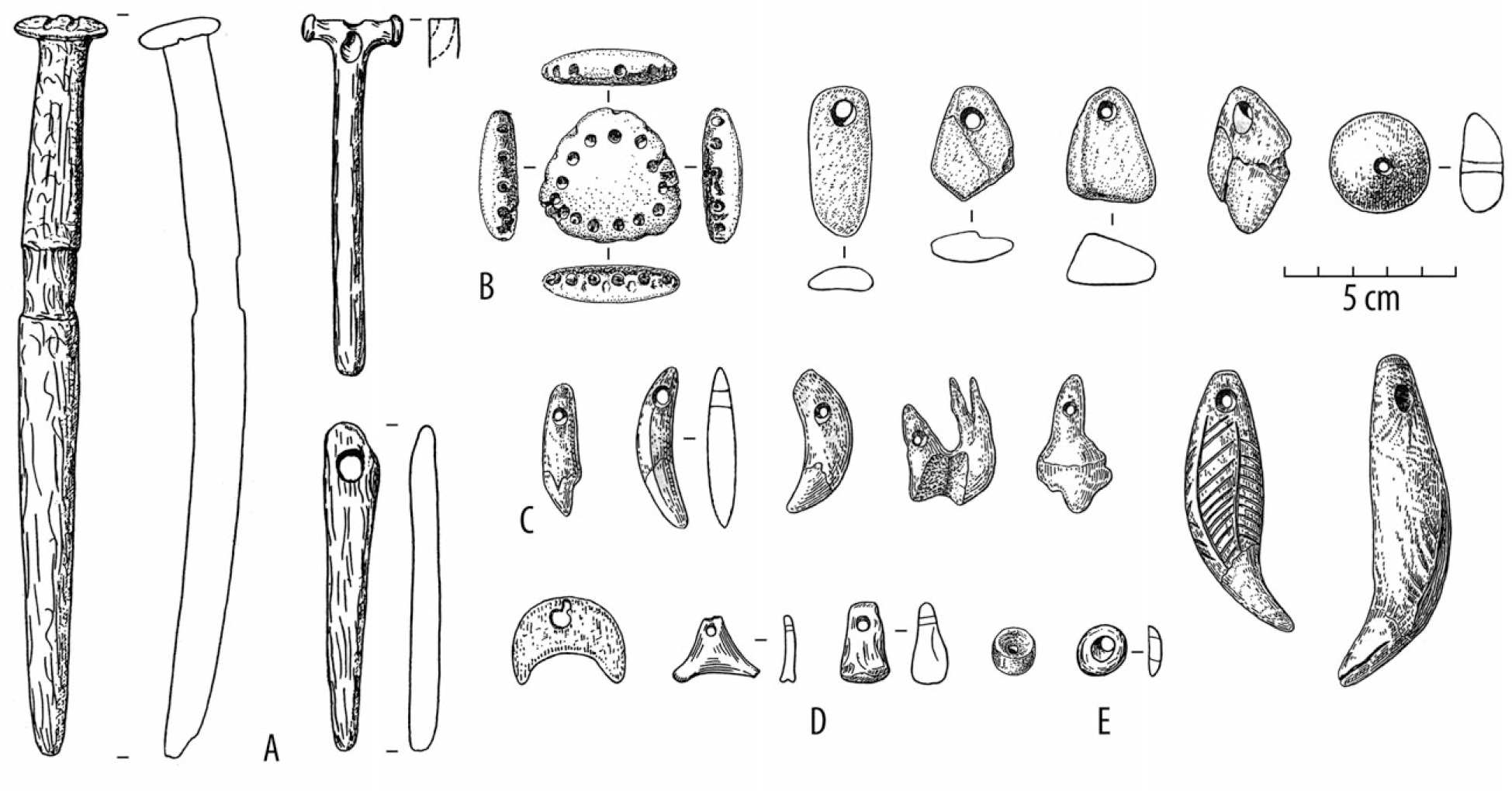
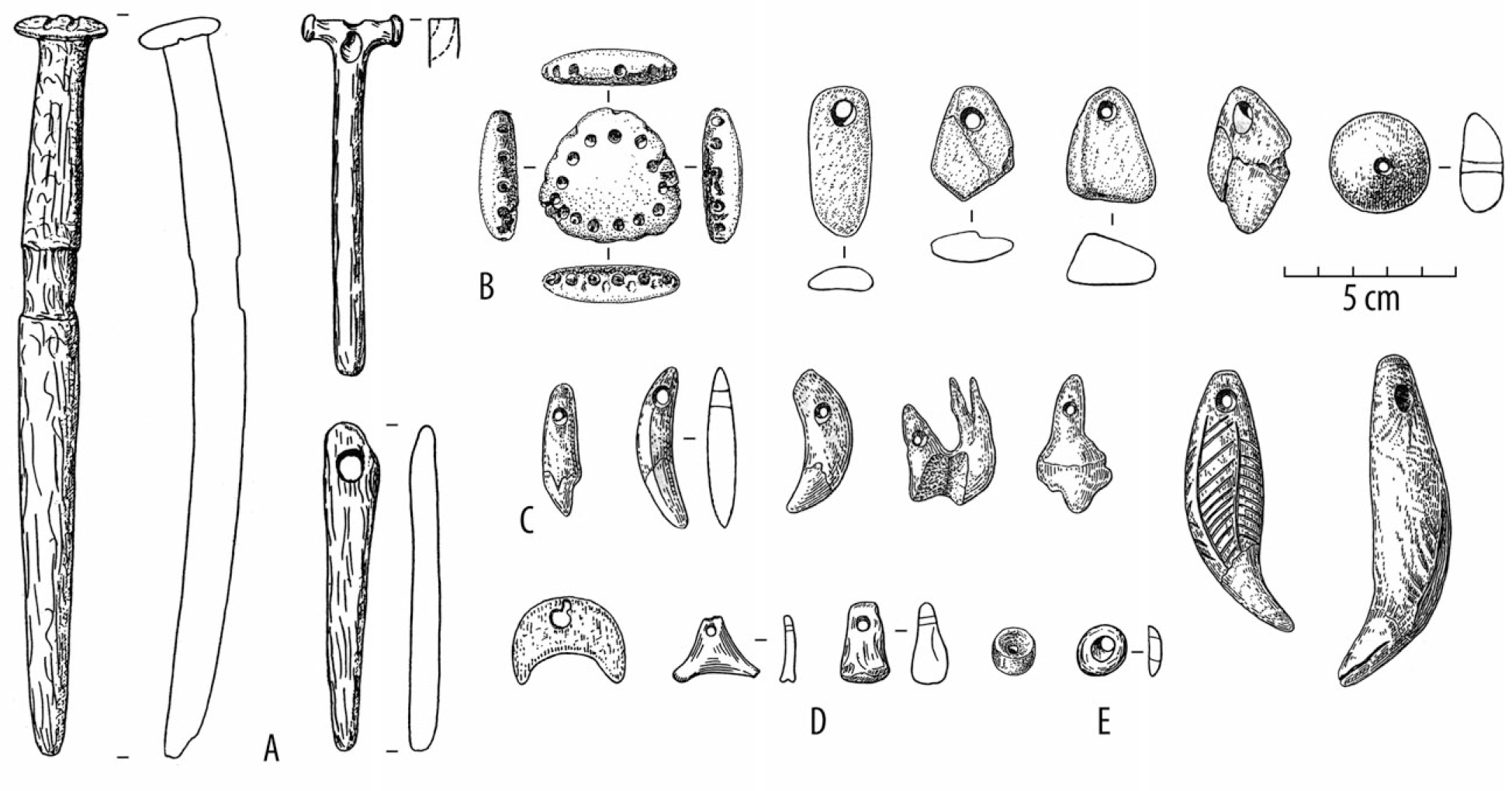
Information about bone and antler working is limited due to preservation conditions. Both wild and domesticated species were used as raw material for various tools, such as adzes, awls and borers, daggers, arrowheads, needles, etc (Kraynov Reference Kraynov1972, 82–3). Pendants and ornaments of animal tooth and bone are present, but only a few hammer-, disc-, and flat-headed pins, common in many CWC-related contexts, are known (Kraynov Reference Kraynov1972, 86, 88) (Fig. 7: A, C–D). Other raw materials are encountered occasionally, including pendants and beads of Baltic amber and shell (Kraynov Reference Kraynov1972, 88, 92; Volkova Reference Volkova2010, 182) (Fig. 7: B, E).
Ornaments and imports from the Fatyanovo contexts: A) bone pins; B) amber pendants and beads; C) animal tooth pendants; D) bone pendants; and E) shell beads (after Kraynov Reference Kraynov1987, fig. 28a; Kraynov & Gadzyatskaya Reference Kraynov and Gadzyatskaya1987, tables 55 & 63; Volkova Reference Volkova2010, fig. 12)
Metal objects
Despite earlier occurrences of simple copper items in the forest zone (Nordqvist et al. Reference Nordqvist, Herva, Ikäheimo and Lahelma2012, 15–16), the CWC horizon represents the wider spread of metal artefacts in the area. The origins of metalwork have been sought between the Caucasus and eastern Europe (Gorodtsov Reference Gorodtsov1916, 147–8; Äyräpää Reference Äyräpää1933, 153; Krivtsova-Grakova Reference Krivtsova-Grakova1947, 32), and currently associated with the Circumpontic areas and the Carpathian region (Chernykh Reference Chernykh1992, 136). The focus of metallurgy was in the east, in the Middle-Volga region and the Balanovo territory, where raw material was procured from copper-bearing sandstones of the Kama River valley and the western Ural Mountains. Metal finds are relatively few in the west, especially in the Moscow-Klyazma area (Krivtsova-Grakova Reference Krivtsova-Grakova1947, 32; Kraynov Reference Kraynov1972, 156).
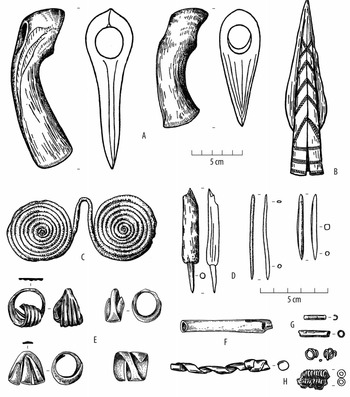
Most metal finds are small tools, such as awls, and especially ornaments and jewellery, like wide bracelets, rings, pendants, cylindrical or tubular beads, twisted temple rings, and spirals (Kraynov Reference Kraynov1972, 156–63) (Fig. 8: C–H). Other finds, like battle axes or socketed spearheads, are extremely rare and connected with high-status male burials (Kraynov Reference Kraynov1972, 196) (Fig. 8: A–B). No alloying was practised and technology was based on smelting, casting, and forging, which is also evidenced by the finds of moulds, crucibles, and whetstones (Bader & Khalikov Reference Bader and Khalikov1987, 80; Kraynov Reference Kraynov1987, 70; Chernykh Reference Chernykh1992, 135).
Copper finds from Fatyanovo sites: A) axes; B) socketed spearhead; C) spiral pendant; D) awls (one with a handle); E) temple rings; F) fragment of a bracelet; G) tubular beads; and H) spirals (after Gadzyatskaya Reference Gadzyatskaya1976, tables 31–2; Kraynov Reference Kraynov1987, fig. 35; Kraynov & Gadzyatskaya Reference Kraynov and Gadzyatskaya1987, table 66)

SUBSISTENCE AND SOCIETY OF FATYANOVO
Subsistence
Direct evidence on livelihoods is fairly limited and many opinions are rather based on common reasoning and indirect proof. It is generally believed that Fatyanovo is associated with the introduction of animal husbandry into the forest zone. Domestic animals (excluding dog) are not known in the earlier materials from the area, but their existence in Fatyanovo contexts is testified by bones and teeth of several species. Pig and sheep/goat are considered significant from the beginning and cattle and horse are later supplements, in addition to which dog was present (Kraynov Reference Kraynov1972, 137; Reference Kraynov1987, 65–6; also Bader & Khalikov Reference Bader and Khalikov1987, 80). However, the temporal trends cannot be confirmed by absolute dating and the poorly-published quantitative data do not allow us to estimate the general importance of different species. Amphorae and big pots, as well as the assumed colanders, are intuitively linked with dairy products (Kraynov Reference Kraynov1972: 154, Krenke et al. Reference Krenke, Erschov, Erschova and Lazukin2013, 423), although, so far, no biomolecular analyses have been published. Ritual interments of sheep are considered as further evidence of the significance of animal husbandry (Kraynov Reference Kraynov1941, 136–7; Reference Kraynov1972, 140), but remain, to date, at the level of an interesting curiosity.
Factual evidence of farming is even more limited. The practice of simple slash-and-burn cultivation is proposed (Bader Reference Bader1937, 29; Kraynov Reference Kraynov1972, 146), but its role is not considered crucial. Supporting proof consists only of allusions inferred from, for example, (burial) site locations or the current deforestation of some of the areas occupied by the Fatyanovo groups (Kraynov Reference Kraynov1987, 66; also Bader Reference Bader1937, 31; cf. Kristiansen Reference Kristiansen, Hornborg and Crumley2007). No macrofossil evidence exists, and palynological evidence is narrow in scope, including some indications of anthropogenic opening of landscape (forest clearing) and solitary corrupted pollens of Cannabis and Cerealia (Ershova Reference Ershova2014, 31). Surely, a part of the subsistence still came from hunting, fishing, and gathering. Exploitation of wild resources is testified by the remains of both meat- and fur-bearing animals like elk, wild boar, brown bear, reindeer, roe deer, beaver, marten, fox, lynx, otter, birds, and fish, as well as shells and nutshells (Kraynov Reference Kraynov1987, 66; also Bader & Khalikov Reference Bader and Khalikov1987, 81). Artefactual proof of hunting, fishing, and gathering is, nevertheless, scarce.
Society and worldview
The structure of society has been investigated through the material culture of death, ie, the planigraphy of cemeteries and the presence, placement, and association of grave goods, also acknowledging the theoretical implications of the material approach to societal development. Family systems have often been described as patriarchal and patrilocal (Kraynov Reference Kraynov1972, 203), albeit some scholars have recognised the spatial organisation of the graves and burial goods to reflect matriarchal community or (stadial) transition from matriarchy to patriarchy (Ravdonikas Reference Ravdonikas1947, 384; Bader Reference Bader1963, 287; Volkova Reference Volkova2014, 41). Cemeteries are supposed to be associated with family-based blood-kin groups who, together with other similar and related groups, formed larger tribes and alliances (Kraynov Reference Kraynov1972, 203; Volkova Reference Volkova2014, 41; also Bader & Khalikov Reference Bader and Khalikov1987, 81), but these suggestions still await confirmation from biomolecular studies. The society is stereotypically described as chief- and male-oriented due to the presence of some richly furnished male burials (Kraynov Reference Kraynov1972, 203–4; Volkova Reference Volkova2014, 41), occasionally accompanied by individuals interpreted as sacrificed household members or wives (Kraynov Reference Kraynov1972, 192). Consequently, warrior class is seen to constitute the top of social hierarchy and labour is described, again stereotypically, as gender-specific based on grave goods (Kraynov Reference Kraynov1972, 204–5; also Bader Reference Bader1963, 296–8).
The discussion about religion and worldview has remained generic and, as in the preceding matter, is founded on common-sense based reasoning. Fire cult is suggested, referring to traces of fireplaces and fire making in and near the burials (charcoals, occasional flint flakes, and finds of tar/pitch and tinder or red ochre) (Kraynov Reference Kraynov1972, 199–200; Reference Kraynov1987, 64). In addition, the frequent south (ie, sun) facing body position is taken to indicate the importance of a fire or sun cult. Animal and especially bear cult is suggested because of the few bear burials and bear tooth pendants in graves (Kraynov Reference Kraynov1972, 199; Reference Kraynov1987, 71), and the cult of ancestors is also assumed, but not elaborated further (Kraynov Reference Kraynov1941, 135).
What is said above (cf. also material culture) resonates with many other CWC groups. Interpretations of Fatyanovo society and worldview are seen to reflect properties conceived to be integral features of the early Indo-European populations. Although Fatyanovo Culture is customarily treated as a separate, self-sustained unit, its roots and origins are still firmly linked with the CWC and community, as will be explored further below.
ORIGINS, EXPANSION, AND LEGACY
Apart from the early period of Soviet dogmatism, when autochthonous ancestry was imperative (Kraynov Reference Kraynov1941, 140; Ravdonikas Reference Ravdonikas1947, 384), the Fatyanovo Culture is seen a newcomer. Opinions of its origins have ranged from the Caucasus and the Pontic Steppes, to Central Europe and the eastern Baltic Sea region (Gorodtsov Reference Gorodtsov1916, 169; Äyräpää Reference Äyräpää1933, 154; Gimbutas Reference Gimbutas1956, 166–7; Bryusov Reference Bryusov1961, 32–3; Bader & Khalikov Reference Bader and Khalikov1976, 75; Kraynov Reference Kraynov1987, 64). Presently, the most supported ‘homeland’ of Fatyanovo is located to the west and south-west of its later territory, between southern Latvia and the northern Ukraine. From there, migrants would have followed the (north-)east-leading river routes and developed – partially through (not well specified) engagement with local groups – into regional Fatyanovo communities (Kraynov Reference Kraynov1972, 257–8; Volkova Reference Volkova2010, 174; Krenke et al. Reference Krenke, Erschov, Erschova and Lazukin2013, 425). Even if population movements are involved, many authors describe rather small-scale movements and a slow pace of development (Kraynov Reference Kraynov1972, 247, 257; Dolukhanov Reference Dolukhanov1996, 90).
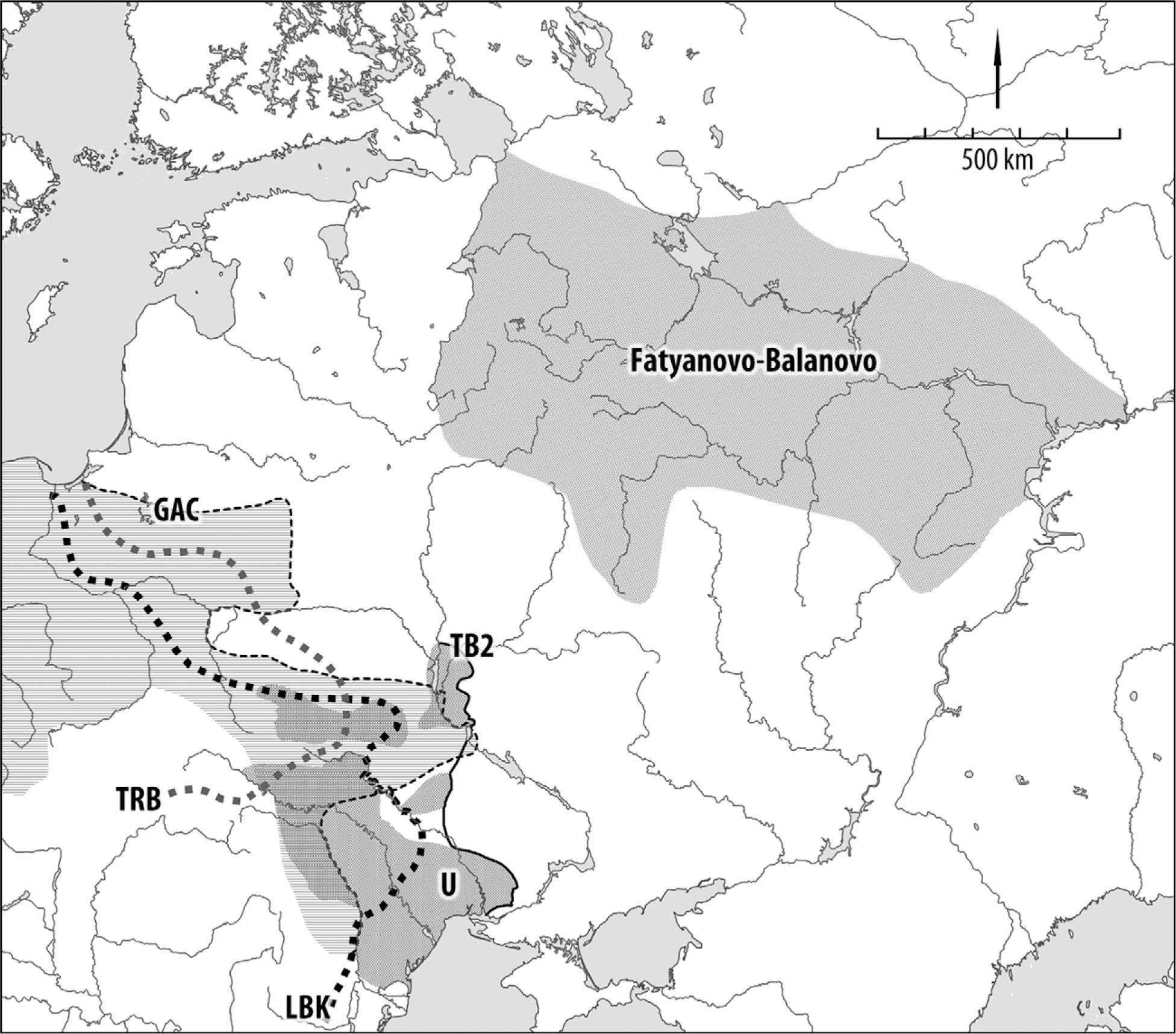
Previously presented scenarios are based on the similarities in material culture and links provided by natural geography, and thus propose different western contact areas for the different regional Fatyanovo groups (especially Kraynov Reference Kraynov1972, 249, 258–9; Reference Kraynov1987, 74–5; also Krenke et al. Reference Krenke, Erschov, Erschova and Lazukin2013). The first aDNA analyses of Fatyanovo individuals now confirm, in principle, their western origins. However, their ancestry is assumed as being directly derived from the area of present-day Ukraine, more accurately from the region of the Middle Dnepr River (Saag et al. Reference Saag, Vasilyev, Varul, Kosorukova, Gerasimov, Oshibkina, Griffith, Solnik, Saag, D’Atanasio, Metspalu, Reidla, Rootsi, Kivisild, Scheib, Tambets, Kriiska and Metspalu2020, fig. 1). Contrary to this, we here suggest an alternative scenario which, like Kraynov’s, does not exclude numerous contact zones between the western Ukraine and the southern Baltic States, but generally focuses on regions further to the west. For the time being, these remain at the level of scholarly hypotheses and await confirmation from more aDNA, isotopic, and radiocarbon data. Besides the archaeological points, a key argument for us lies in the genetic make-up of this new population, attested also in the eastern Baltic region (Saag et al. Reference Saag, Varul, Scheib, Stenderup, Allentoft, Saag, Pagani, Reidla, Tambets, Metspalu, Kriiska, Willerslev, Kivisild and Metspalu2017; Malmström et al. Reference Malmström, Günther, Svensson, Juras, Fraser, Munters, Pospieszny, Tõrv, Lindström, Götherström, Storå and Jakobsson2019) and being genetically similar to central European CWC peoples. They nearly all show a mixture of predominantly steppe and low amounts of so-called ‘Early Neolithic farmers’ ancestry of ultimately Anatolian origin. The latter can, in this part of Europe, only stem from the descendants of Linear Pottery Culture peoples whose eastern border barely goes beyond a line from the Lower Vistula in Poland to the Southern Bug in the Ukraine (eg, Dębiec & Saile Reference Dębiec and Saile2015; Czekaj-Zastawny Reference Czekaj-Zastawny and Włodarczak2017). By c. 3000 bc (Fig. 9) there are only three archaeological cultures left, those people would yield, as far as we know (Wang et al. Reference Wang, Reinhold, Kalmykov, Wissgott, Brandt, Jeong, Cheronet, Ferry, Harney, Keating, Mallick, Rohland, Stewardson, Kantorovich, Maslov, Petrenko, Erlikh, Atabiev, Magomedov, Kohl, Alt, Pichler, Gerling, Meller, Vardanyan, Yeganyan, Rezepkin, Mariaschk, Berezina, Gresky, Fuchs, Knipper, Schiffels, Balanovska, Balanovsky, Mathieson, Higham, Berezin, Buzhilova, Trifonov, Pinhasi, Belinskij, Reich, Hansen, Krause and Haak2019; Immel et al. Reference Immel, Ţerna, Simalcsik, Susat, Šarov, Sîrbu, Hofmann, Müller, Nebel and Krause-Kyora2020), significant amounts of this ancestry: Late Funnel Beaker Culture (Szmyt Reference Szmyt2018) and Tripolye B2 Culture (Diachenko & Harper Reference Diachenko and Harper2016), both just about to disappear from our records, and the Globular Amphora Culture (Szmyt Reference Szmyt, Furholt, Grossmann and Szmyt2016; Reference Szmyt2018), just expanding from the north-west. Importantly, their eastern borders have not shifted that much further east (perhaps with the exception of Usatovo Culture, however Usatovo is a case in its own right) but retain centres of gravity between the Rivers Siret, Prut, Dnester, and the right tributaries of the Pripyat in the historical regions of Volhynia, Podolia, and Moldavia. Particularly the users of Globular Amphoras, with their wide distribution between Poland, Lithuania, Belarus, and the Ukraine, might soon emerge as the primary candidates from where Fatyanovo newcomers must have acquired this component.
The eastern extent of Linear Pottery Culture societies (6th and 5th millennium bc; LBK, black dashed line) as well as Funnel Beaker (TRB, grey dashed line), Tripolye B2 (TB2, shaded with solid black line; U marks the area of Usatovo) and Globular Amphora Cultures (GAC, hatched with dotted line) of c. 3000 bc as indications of the eastern boundary of farming (animal husbandry and agriculture) and, in consequence, of descendants of ‘Early Neolithic farmers’ ancestry

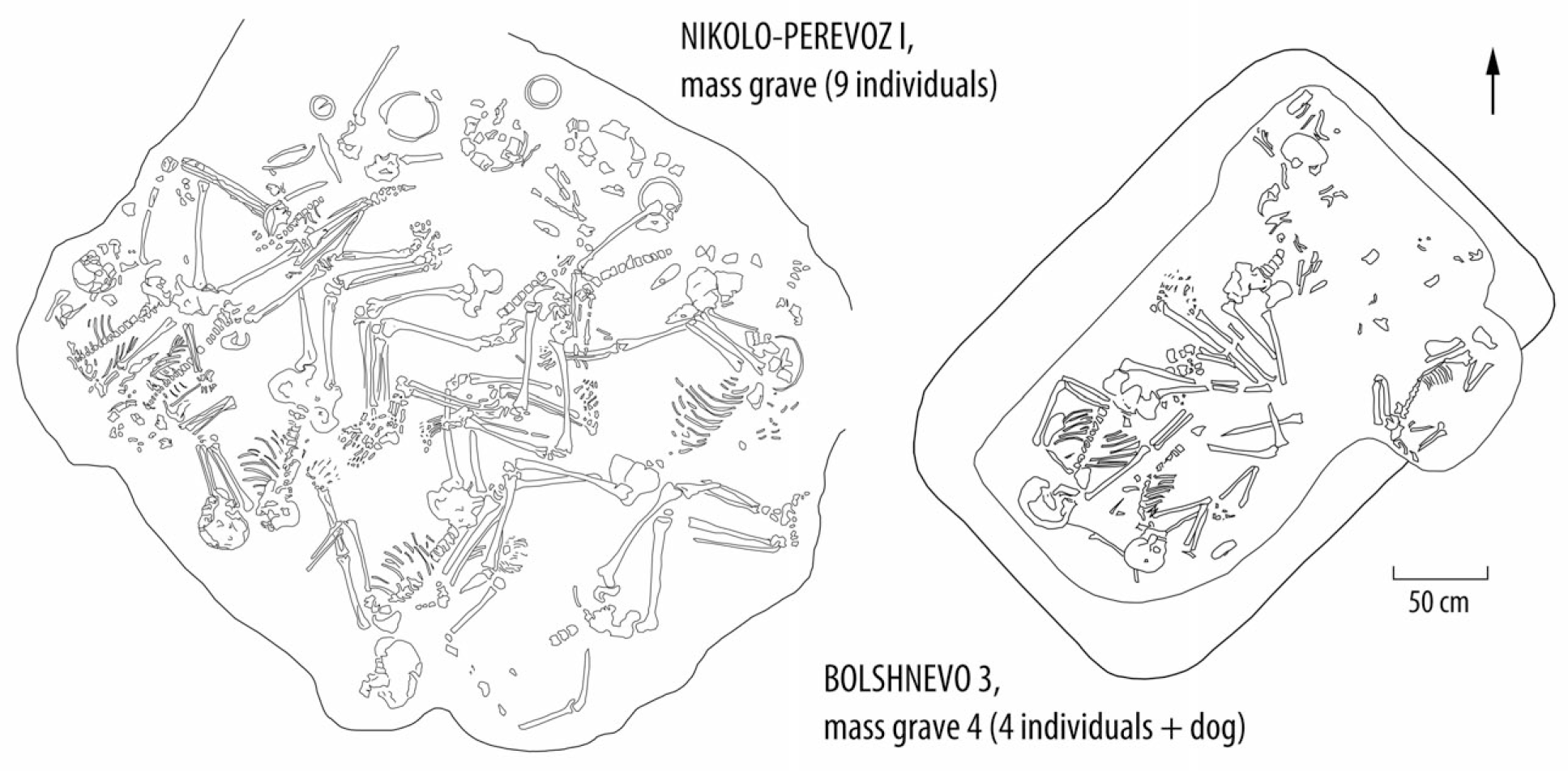
Discussion on the relationships between the ‘foreign’ Fatyanovo and ‘local’ hunter-gatherer populations is directed by the culture-historically defined concept of ethnic archaeological culture, rather than overlapping and interacting groups of people and material cultures; that Fatyanovo Culture is known predominately through its burial customs complicates things further. Even if the formative stage of Fatyanovo Culture is occasionally seen to involve interaction (Kraynov Reference Kraynov1987, 75), the hunter-gatherers are not given a big role in development. Consequently, two major views about the relationships between these groups exist. The first one proposes separate co-existence (eg, Fatyanovo materials at Volosovo sites), and eventual assimilation, due to different backgrounds, subsistence strategies, and exploited ecological niches (Tallgren Reference Tallgren1924, 1; Foss Reference Foss1952, 187–8; Bryusov Reference Bryusov1961, 33; Tretyakov Reference Tretyakov1966; 88; Kraynov Reference Kraynov1972, 269; Dolukhanov Reference Dolukhanov1996, 89). The second portrays conflicts and inter-group violence leading to the eviction or extermination of hunter-gatherers, as evidenced, for example, by some mass graves at Volosovo sites, but also in Fatyanovo contexts (Fig. 10) (Raushenbakh Reference Raushenbakh1960, 36; Kraynov Reference Kraynov1972, 191; but see Utkin & Kostyleva Reference Utkin and Kostyleva1996, 308; Kostyleva et al. Reference Kostyleva2018, 574 explaining these as a result of pandemic diseases).
Fatyanovo mass graves from the sites of Nikolo-Perevoz I (Moscow region) and Bolshnevo 3 (Tver region) (not to scale; after Raushenbakh Reference Raushenbakh1960, fig. 2; Kraynov Reference Kraynov1975, fig. 3)

The new genetic data, indeed, suggests there was little to no admixture between the two genetically differing populations (Saag et al. Reference Saag, Vasilyev, Varul, Kosorukova, Gerasimov, Oshibkina, Griffith, Solnik, Saag, D’Atanasio, Metspalu, Reidla, Rootsi, Kivisild, Scheib, Tambets, Kriiska and Metspalu2020). The ideas of co-existence and even hybridisation should, however, not be totally rejected as they could well resonate with findings from regions further in the west, eg, between CWC and local late Comb Ware, Pitted Ware, as well as late Funnel Beaker related societies (Nordqvist Reference Nordqvist2016; Iversen Reference Iversen, Olsen, Olander and Kristiansen2019; Malmström et al. Reference Malmström, Günther, Svensson, Juras, Fraser, Munters, Pospieszny, Tõrv, Lindström, Götherström, Storå and Jakobsson2019). Mixing of traditions is also at the core of the so-called Fatyanoidnaya-question, often exemplified by (organic-tempered) Fatyanovo-like pottery at hunter-gatherer or Fatyanovo sites (Foss Reference Foss1952, 190; Gurina Reference Gurina1963, 196–7). Controversy prevails if this stands for local (short-termed) hybrids, or an independent culture, or local variants of similar (post-Fatyanovo) cultural developments over a wide territory (Gavrilova Reference Gavrilova1983, 107; Gadzyatskaya Reference Gadzyatskaya1992, 138–9; Zhulnikov Reference Zhulnikov2008, 418; Volkova Reference Volkova2018, 59). Even if resolving the nature and timing of this question is a task for upcoming research, such material suggests that evidence of interactions could be found also in differently sampled genetic data in the future. In a territory as wide as the one once occupied by the Fatyanovo Culture, different mechanisms could contribute both to the development and further destinies of human groups: Population replacements certainly took place; but at the same time, there must have been areas where traditions intermingled.
In the traditional narrative, the Fatyanovo people – like the CWC populations in general – are regarded as Indo-European, representing the pre-Balto-Slavic (-Germanic) stage (Carpelan & Parpola Reference Carpelan, Parpola, Carpelan, Parpola and Koskikallio2001, 88; Anthony Reference Anthony2007, 380; also Gimbutas Reference Gimbutas1956, 163; Tretyakov Reference Tretyakov1966, 109) in the spread of Indo-European languages. In the non-steppe parts of European Russia, the Fatyanovo Culture is also seen to herald the transition into the Bronze Age. Consequently, Fatyanovo societies do play a key role in the further, complex cultural development of the initial Bronze Age in the wooded parts of eastern Europe. This crucial period of the Eurasian prehistory is also characterised by a gradual decline of climatic and environmental conditions in the last third of the 3rd millennium bc, culminating in the effects of the 4.2 ka event (Baillie & McAneney Reference Baillie, McAneney, Meller, Arz, Jung and Risch2015). Although not much research is undertaken to understand the changes caused by the hydroclimatic Meghalayan anomaly in northern Eurasia, colder conditions with unsettled precipitation regimes nevertheless may well have prevailed for another two or three centuries after 2190 bc (Helama & Oinonen Reference Helama and Oinonen2019; Perşoiu et al. Reference Perşoiu, Ionita and Weiss2019).
Such a long downturn period may have, gradually over time, forced societies to adapt their subsistence economy, social systems, mobility pattern, and established worldviews, while losing their previous cultural coherence. Fatyanovo can surely not have remained unaffected. Although our database is weak, and badly resolved chronologically, a result could have been a cultural decline and fragmentation, possibly over a longer period of time. This scenario, coupled with hybridisation, interaction, and potential rivalry of hunter-gatherer and other late CWC related groups, and under cultural influences from the steppe societies and regions beyond the Urals, resulted in a versatile patchwork of novel Bronze Age societies in the Upper and Middle Volga region during the last centuries of the 3rd millennium bc. They go under archaeological labels of Chirkovo, Abashevo, Pozdnyakovo, Prikazan, Textile (or Netted) Ware, and so forth (Kraynov Reference Kraynov1972, 270–1; Khalikov Reference Khalikov1987, 136; Pryakhin & Khalikov Reference Pryakhin and Khalikov1987, 131; Gadzyatskaya Reference Gadzyatskaya1992, 139; Carpelan & Parpola Reference Carpelan, Parpola, Carpelan, Parpola and Koskikallio2001, 87).
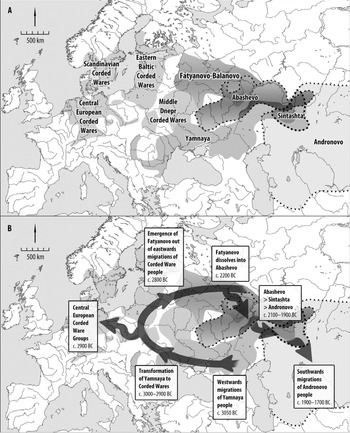
Of these new cultural manifestations, the Abashevo Culture is considered the very last representative of the CWC in the east and partially deriving from Fatyanovo-Balanovo backgrounds (Pryakhin & Khalikov Reference Pryakhin and Khalikov1987, 130; Anthony Reference Anthony2007, 383). This Abashevo and the key lands of the forest-steppe between Don and Volga its cultural proponents inhabit are, in turn, regarded the starting point for the next pieces in the big dominoes game of the Eurasian Bronze Age: The development of the Sintashta Culture centred in the southern Urals and of the Andronovo Culture in south-western Siberia (Anthony Reference Anthony2007, 381; Koryakova & Epimakhov Reference Koryakova and Epimakhov2007, 59; Parzinger Reference Parzinger2011, 246ff.) (Fig. 11: A). Both are innovative, in terms of their fortified sites, advanced metallurgy, horse-drawn chariots, and warrior ideals, to name only the most important, as well as geographically expansive. Their link to the CWC has recently been strengthened by aDNA studies proposing similarity between individuals affiliated with the CWC, on the one hand, and Sintashta and Andronovo, on the other (Allentoft et al. Reference Allentoft, Sikora, Sjögren, Rasmussen, Rasmussen, Stenderup, Damgaard, Schroeder, Ahlström, Vinner, Malaspinas, Margaryan, Higham, Chivall, Lynnerup, Harvig, Baron, Della Casa, Dąbrowski, Duffy, Ebel, Epimakhov, Frei, Furmanek, Gralak, Gromov, Gronkiewicz, Grupe, Hajdu, Jarysz, Khartanovich, Khokhlov, Kiss, Kolář, Kriiska, Lasak, Longhi, McGlynn, Merkevicius, Merkyte, Metspalu, Mkrtchyan, Moiseyev, Paja, Pálfi, Pokutta, Pospieszny, Price, Saag, Sablin, Shishlina, Smrčka, Soenov, Szeverényi, Tóth, Trifanova, Varul, Vicze, Yepiskoposyan, Zhitenev, Orlando, Sicheritz-Pontén, Brunak, Nielsen, Kristiansen and Willerslev2015, 169; Damgaard et al. Reference Damgaard, Marchi, Rasmussen, Peyrot, Renaud, Korneliussen, Moreno-Mayar, Pedersen, Goldberg, Usmanova, Baimukhanov, Loman, Hedeager, Pedersen, Nielsen, Afanasiev, Akmatov, Aldashev, Alpaslan, Baimbetov, Bazaliiskii, Beisenov, Boldbaatar, Boldgiv, Dorzhu, Ellingvag, Erdenebaatar, Dajani, Dmitriev, Evdokimov, Frei, Gromov, Goryachev, Hakonarson, Hegay, Khachatryan, Khaskhanov, Kitov, Kolbina, Kubatbek, Kukushkin, Kukushkin, Lau, Margaryan, Merkyte, Mertz, Mertz, Mijiddorj, Moiyesev, Mukhtarova, Nurmukhanbetov, Orozbekova, Panyushkina, Pieta, Smrčka, Shevnina, Logvin, Sjögren, Štolcová, Taravella, Tashbaeva, Tkachev, Tulegenov, Voyakin, Yepiskoposyan, Undrakhbold, Varfolomeev, Weber, Wilson Sayres, Kradin, Allentoft, Orlando, Nielsen, Sikora, Heyer, Kristiansen and Willerslev2018a). In particular, a special role of writing world history is conferred on Andronovo in that it likely forms a substrate in the forwarding of steppe ancestry to southern Asia (Parpola Reference Parpola2015; Damgaard et al. Reference Damgaard, Martiniano, Kamm, Moreno-Mayar, Kroonen, Peyrot, Barjamovic, Rasmussen, Zacho, Baimukhanov, Zaibert, Merz, Biddanda, Merz, Loman, Evdokimov, Usmanova, Hemphill, Seguin-Orlando, Yediay, Ullah, Sjögren, Iversen, Choin, de la Fuente, Ilardo, Schroeder, Moiseyev, Gromov, Polyakov, Omura, Senyurt, Ahmad, McKenzie, Margaryan, Hameed, Samad, Gul, Khokhar, Goriunova, Bazaliiskii, Novembre, Weber, Orlando, Allentoft, Nielsen, Kristiansen, Sikora, Outram, Durbin and Willerslev2018b; Narasimhan et al. Reference Narasimhan, Patterson, Moorjani, Rohland, Bernardos, Mallick, Lazaridis, Nakatsuka, Olalde, Lipson, Kim, Olivieri, Coppa, Vidale, Mallory, Moiseyev, Kitov, Monge, Adamski, Alex, Broomandkhoshbacht, Candilio, Callan, Cheronet, Culleton, Ferry, Fernandes, Freilich, Gamarra, Gaudio, Hajdinjak, Harney, Harper, Keating, Lawson, Mah, Mandl, Michel, Novak, Oppenheimer, Rai, Sirak, Slon, Stewardson, Zalzala, Zhang, Akhatov, Bagashev, Bagnera, Baitanayev, Bendezu-Sarmiento, Bissembaev, Bonora, Chargynov, Chikisheva, Dashkovskiy, Derevianko, Dobeš, Douka, Dubova, Duisengali, Enshin, Epimakhov, Fribus, Fuller, Goryachev, Gromov, Grushin, Hanks, Judd, Kazizov, Khokhlov, Krygin, Kupriyanova, Kuznetsov, Luiselli, Maksudov, Mamedov, Mamirov, Meiklejohn, Merrett, Micheli, Mochalov, Mustafokulov, Nayak, Pettener, Potts, Razhev, Rykun, Sarno, Savenkova, Sikhymbaeva, Slepchenko, Soltobaev, Stepanova, Svyatko, Tabaldiev, Teschler-Nicola, Tishkin, Tkachev, Vasilyev, Velemínský, Voyakin, Yermolayeva, Zahir, Zubkov, Zubova, Shinde, Lalueza-Fox, Meyer, Anthony, Boivin, Thangaraj, Kennett, Frachetti, Pinhasi and Reich2019).
Third and early 2nd millennium bc east–west relations in western Eurasia: A) distributions of key cultures; B) interconnections of societies in the east to west, to east loop

Overall (Fig. 11: B), the trajectory described here must appear like an irony of prehistoric east–west relationships in western Eurasia of the 3rd millennium bc. The CWC undoubtedly received its formation incentive from the initial westward migrations of Yamnaya populations from the Caspian-Pontic steppe. Only two or three centuries later, Fatyanovo-Balanovo, as the easternmost child of the wider CWC family, derives out of a probable eastward migration of these Corded Ware people just 5–10° latitude further north in the Upper and Middle Volga basin.
A kind of continental-scale east–west loop closes in, finally, with the emergence of subsequent, ultimately CWC derived, cultures of Abashevo, Sintashta and Andronovo at 2200–1900 bc. It is in this context where the importance of Fatyanovo lies, as the hinge between east and west, pastoralists and last hunter-gatherers, woodland and steppe, and the 3rd and 2nd millennium bc.
FATYANOVO: JUST A CHILD IN A DYSFUNCTIONAL PATCHWORK FAMILY?
What is Corded Ware after all between its original definition, deeply rooted in culture-history (eg Buchvaldek Reference Buchvaldek1986; Buchvaldek & Strahm Reference Buchvaldek and Strahm1992) then converted in processual, post-processual, and ‘post-post-processual’ archaeologies (eg, Furholt passim; see below), and now shaken up again in the age of aDNA? This question is not only important as the oldest paper we cite in this article is nearly 150 years old, and more than a century of different Zeitgeister and methodological approaches towards the CWC has rightly transformed its original definition, but also because the still largely prevailing culture-historical approaches towards the CWC and Fatyanovo Culture in Russia stand so far apart from the western 21st century discussions about Corded Ware identities, material cultures, burial links and settlement differences, and ethnicities. While we tried to bring the east and west together in this study, we however found ourselves in an awkward position between the fundamentally different approaches dominant in different regions. It is, in this context, good to remember that there is never a single truth in archaeology. Therefore, the culture-historical approaches in Russian archaeology (and by extension to many countries in central and eastern Europe) still have their merits, as do they have their pitfalls. But in no way can the western views be regarded superior. Both are best described as complementary.
Complementariness is also the keyword when reflecting particularly on Martin Furholt’s recent publications on the Yamnaya, Corded Ware, and Bell Beaker horizon as a whole, two of them in this journal (Reference Furholt2014; Reference Furholt2019a; besides Reference Furholt, Furholt, Grossmann and Szmyt2016 & Reference Furholt2019b). Undeniably, one can interrogate whether massive and rapid migration (Furholt Reference Furholt2018, passim) is involved in the expansion of Corded Ware, although the demographics from which scale on the term ‘mass’ is applicable are not explained, and probably will not be for some time. To apply a polythetic classification and consequently regard ‘core’ Corded Ware as a representative of super-cultural single grave burial rituals, his SGBR complex, to which genetic steppe ancestry is linked, has indeed virtues when attempting to understand the 3rd millennium bc migration pattern and concurrently trying to reconcile archaeology and genetics. Scrutiny of his named elements of SGBR, ‘Single burial in crouched position, strict orientation rules, gender differentiation by body placement, burial mound, prominence of drinking vessels, prominence of weapons in male graves’ (Furholt Reference Furholt2019a, legend of fig. 1), clearly makes the Fatyanovo Culture a member (despite the lack of barrows and the generally smaller proportion of beakers). On the other hand, Yamnaya, for example, has to be excluded as it has no gender differentiation (if one does not count their preference for male burials as their gendered way) and the crouched body position, drinking vessels and offering of weapons are rare. In a stinging contrast, steppe societies of the 5th and 4th millennium bc fit the SGRB better again. No matter, as in highlighting the common features, one can also pronounce the dividing as Furholt himself actually did in 2014 (‘diversity and regional variability’, abstract on p. 67), leading to a more atomised picture of what Corded Ware burials represent. Perhaps the best solution is to regard any dichotomy, simple or complex, small-scale regional or large-scale continental, as well as culture-historical or polythetic definitions, as no more than two sides of the same coin when it comes to explaining the wider Corded Ware family. All is a matter of perspective and all the pairs are right, and wrong.
We could now also discuss results, merits and failures of Vander Linden (Reference Vander Linden2016), Bourgeois & Kroon (Reference Bourgeois and Kroon2017), Klejn (Reference Klejn2017), Lemercier (Reference Lemercier2018), Piličiauskas (Reference Piličiauskas2018), Iversen (Reference Iversen, Olsen, Olander and Kristiansen2019), Kroon et al. (Reference Kroon, Huisman, Bourgeois, Braekmans and Fokkens2019), and Wentink (Reference Wentink2020), to name a selection in which the definition of the CWC plays one role or another, published in the last few years from different schools of thought, starting points, and regional backgrounds, methodologies, and underlying agendas. They all offer fresh perspectives and modern thinking for the concept of Corded Ware. However, much more beneficial for our article and its intention to (re-)introduce Russian Fatyanovo Culture to a western audience, is to underline four summarising propositions:
-
First of all, Fatyanovo Culture is an integral part of the Corded Ware family, namely of the densely wooded Upper and Middle Volga River basin, in the same way than we have Dnepr (Middle-Dnepr Culture), Vistula (eg, Małopolska Corded Ware), Oder (eg, Lusatian Corded Ware), Elbe (Bohemian and Middle-Elbe-Saale Corded Ware), and Rhenish (eg, Dutch/Lower Rhine Single Grave) Corded Ware Cultures, all lined up along, and radiating from, these motorways of prehistory.
-
Second, differences less in burial customs but more in material culture justify Fatyanovo Culture to be named an independent culture within the wider CWC. It also appears surprisingly coherent – at least within our scale of observation – when reflecting on its huge distribution and potential interaction with various late hunter-gatherer and other neighboring, predominantly pastoralist, societies.
-
Third, Fatyanovo as an archaeological culture arrives from the ‘west’, is intrusive and expanding, has no predecessors in the region, and brings many innovations, not or barely known beforehand.
-
And fourth, Fatyanovo is both ‘culture’ and ‘peoples’ in a region not touched before by farming societies. This is the essence of latest aDNA research (Saag et al. Reference Saag, Vasilyev, Varul, Kosorukova, Gerasimov, Oshibkina, Griffith, Solnik, Saag, D’Atanasio, Metspalu, Reidla, Rootsi, Kivisild, Scheib, Tambets, Kriiska and Metspalu2020) and we have a case here in which cultural identity and biological ethnicity are intriguingly linked.
So overall, while our Corded Ware family might indeed be patchy, it is certainly not dysfunctional. There is consequently no need for the authorities to report to a Family Court.
Acknowledgements
This study was made with the support of the Helsinki University Humanities project and forms part of Volker Heyd’s ERC Advanced project 788616: The Yamnaya Impact on Prehistoric Europe (YMPACT). We would like to thank the three reviewers for their valuable comments which we tried to implement as much as possible.