Introduction
Psychiatric symptoms are common in patients with autoimmune encephalitis (Kayser et al. Reference Kayser, Kohler and Dalmau2010). Hallucinations, delusions, anxiety, mania, depression and personality change often lead to an initial evaluation by a psychiatrist (Dalmau et al. Reference Dalmau, Gleichman, Hughes, Rossi, Peng, Lai, Dessain, Rosenfeld, Balice-Gordon and Lynch2008; Chapman & Vause, Reference Chapman and Vause2011). Numerous case reports have described the challenges in distinguishing early signs and symptoms of anti-N-methyl-d-aspartate receptor (NMDAR) encephalitis from primary psychotic disorders (Barry et al. Reference Barry, Hardiman, Healy, Keogan, Moroney, Molnar, Cotter and Murphy2011; Zandi et al. Reference Zandi, Irani, Lang, Waters, Jones, McKenna, Coles, Vincent and Lennox2011; Tidswell et al. Reference Tidswell, Kleinig, Ash, Thompson and Galletly2013; Jørgensen et al. Reference Jørgensen, Hansen, Stanislaus, Düring, Jørgensen, Pinborg and Kondziella2015). So far, little is known about the prevalence and significance of anti-neuronal antibodies for patients with psychiatric disorders without evidence of autoimmune encephalitis. In this study we therefore investigate the prevalence of six anti-neuronal autoantibodies in patients admitted to acute psychiatric care.
According to a recent meta-analysis patients with schizophrenia have a low but significantly higher prevalence of NMDAR immunoglobulin (Ig) G antibodies compared with controls (Pollak et al. Reference Pollak, McCormack, Peakman, Nicholson and David2014). In contrast, healthy blood donors and patients with non-psychotic neuropsychiatric disorders most frequently have NMDAR antibodies of classes IgA or IgM (Dahm et al. 2014; Hammer et al. Reference Hammer, Stepniak, Schneider, Papiol, Tantra, Begemann, Sirén, Pardo, Sperling, Mohd Jofrry, Gurvich, Jensen, Ostmeier, Lühder, Probst, Martens, Gillis, Saher, Assogna, Spalletta, Stöcker, Schulz, Nave and Ehrenreich2014; Steiner et al. Reference Steiner, Teegen, Schiltz, Bernstein, Stoecker and Bogerts2014). Anti-neuronal autoantibodies that have been less well-studied in psychiatric cohorts include antibodies binding to leucine-rich glioma-inactivated protein-1 (LGI1) and to contactin-associated protein-like 2 (CASPR2). These are the two most common specific targets of antibodies directed against the voltage-gated potassium channel (VGKC) complex (Klein et al. Reference Klein, Lennon, Aston, McKeon, O'Toole, Quek and Pittock2013). In one study, affective and other neuropsychiatric symptoms were found in 44% of VGKC antibody-positive patients (Somers et al. Reference Somers, Lennon, Rundell, Pittock, Drubach, Trenerry, Lachance, Klein, Aston and McKeon2011). Encephalitis caused by antibodies against γ-aminobutyric acid B receptor (GABABR) and α-amino-3-hydroxy-5-methyl-4-isoxazolepropionic acid receptor (AMPAR) are associated with epileptic seizures and memory deficits as well as psychiatric symptoms (Dogan Onugoren et al. Reference Dogan Onugoren, Deuretzbacher, Haensch, Hagedorn, Halve, Isenmann, Kramme, Lohner, Melzer, Monotti, Presslauer, Schabitz, Steffanoni, Stoeck, Strittmatter, Stogbauer, Trinka, Von Oertzen, Wiendl, Woermann and Bien2015). Autoantibodies against glutamic acid decarboxylase-65 (GAD65) are associated with neurological disorders such as epilepsy, limbic encephalitis and stiff person syndrome (Malter et al. Reference Malter, Helmstaedter, Urbach, Vincent and Bien2010). These antibodies have been reported to be more prevalent in patients with bipolar disorder compared with healthy controls (Padmos et al. Reference Padmos, Bekris, Knijff, Tiemeier, Kupka, Cohen, Nolen, Lernmark and Drexhage2004).
The primary aim of this study was to examine the prevalence of NMDAR, CASPR2, LGI1, AMPAR, GABABR and GAD65 autoantibodies in a cohort of unselected patients admitted to acute psychiatric care. The secondary aim was to compare the prevalence of NMDAR antibodies in patients with and without psychotic mental disorders.
Method
Setting
In this cross-sectional study serum was analysed from patients acutely admitted to the Department of Psychiatry, St Olavs University Hospital, Trondheim, Norway. The hospital receives all patients 18 years old and above, admitted to acute in-patient psychiatric care in the catchment area. Patients were included in two different time periods: 2004–2006 and 2011–2012. Blood samples were drawn from patients within 24 h after admission and/or at discharge. The sera were stored at −80° until analysis. Analyses of anti-neuronal antibodies were performed in 2014 at Euroimmun (Lübeck, Germany).
Patients
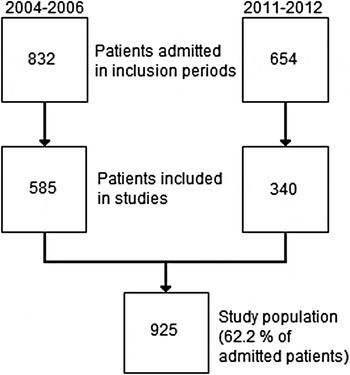
Informed consent to participate was given by 925 out of 1486 (62.2%) consecutively admitted patients (Fig. 1). The inclusion criterion was admission to acute psychiatric care. Exclusion criteria were inability to give informed consent, not speaking Norwegian or English and discharge before consent could be obtained. Of the serum samples in this study, 16 were drawn at discharge due to failure to achieve blood upon admission; all others were drawn at admission.
Admitted and included patients in the inclusion periods.

Psychiatric diagnosis
Diagnoses were set according to the International Classification of Diseases (ICD)-10 criteria for research (World Health Organization, 1993) in a consensus meeting with the physician or psychologist in charge of the treatment of the patient and at least two psychiatrists and/or senior clinical psychologist present, of which at least one of them personally had examined the patient. The main diagnosis was used in this study.
In order to compare autoantibody prevalence in patients with psychotic disorders with patients with non-psychotic disorders we defined ICD-10 codes F20–F29 (schizophrenia, schizotypal and delusional disorders), F30.2 and F31.2 (mania with psychosis), and F32.3 and F33.3 (depression with psychosis) as psychotic disorders and all other diagnoses as non-psychotic disorders. For the further assessment of antibody prevalence in different psychiatric diagnostic categories the following ICD-10 categories were used: organic, including symptomatic, mental disorders (F0–F09); mental and behavioural disorders due to psychoactive substance use (F10–F19); schizophrenia, schizotypal and delusional disorders (F20–F29); bipolar disorders (F30–F31); depressive disorders (F32–F39); neurotic, stress-related and somatoform disorders (F40–F49); disorders of adult personality and behaviour (F60–F69); other psychiatric disorders [including behavioural syndromes associated with physiological disturbances and physical factors (F50–F59), mental retardation (F70–F79), disorders of psychological development (F80–F89), behavioural and emotional disorders with onset usually occurring in childhood and adolescence (F90–F98) and external causes of morbidity and mortality (V01–Y98, intentional self-harm and adverse medicament effects)]; and patients without a specific psychiatric diagnosis (Z00–Z99).
Serological analysis
Sera were tested for the presence of autoantibodies against the following neuronal antigens: NMDAR (NR1a subunit), CASPR2, LGI1, AMPAR, GABABR and GAD65. Biochip mosaics of frozen brain sections (rat, monkey) and transfected HEK293 cells expressing the respective recombinant target antigens (Euroimmun, Germany) were used as previously described (Probst et al. Reference Probst, Saschenbrecker, Stoecker and Komorowski2014). Antibodies of the IgA, IgG and IgM isotype were evaluated. Samples were classified as positive or negative based on fluorescence intensity of the transfected cells in direct comparison with non-transfected cells and control samples. Endpoint titres refer to the last dilution showing a detectable degree of fluorescence, with 1:10 being the cut-off for positivity. We report immunohistochemistry findings without corresponding positivity in the cell-based assays, as these could have clinical relevance. We also performed analyses with a cut-off for positivity of NMDAR antibodies at titre 1:100 and above (high positive titre) due to variations in reliability and validity of low positive titres (Doss et al. Reference Doss, Wandinger, Hyman, Panzer, Synofzik, Dickerson, Mollenhauer, Scherzer, Ivinson, Finke, Schöls, Müller Vom Hagen, Trenkwalder, Jahn, Höltje, Biswal, Harms, Ruprecht, Buchert, Höglinger, Oertel, Unger, Körtvélyessy, Bittner, Priller, Spruth, Paul, Meisel, Lynch, Dirnagl, Endres, Teegen, Probst, Komorowski, Stöcker, Dalmau and Prüss2014; Steiner et al. Reference Steiner, Teegen, Schiltz, Bernstein, Stoecker and Bogerts2014).
Ethics
All participating patients gave written informed consent. The study was conducted in accordance with the Declaration of Helsinki and approved by The Regional Committee for Medical Research Ethics, Central Norway.
Statistics
Continuous and non-normally distributed variables were compared using the Mann–Whitney U test. Categorical variables were analysed using the χ2 test or the Fischer exact test. Logistic regression analysis was used to study predictive effects of age, sex and diagnostic categories. Bonferroni correction was used to adjust for multiple testing. The α level was set to 0.05. SSPS version 20.0 for Windows was used for statistical analysis (USA).
Results
Demographic data
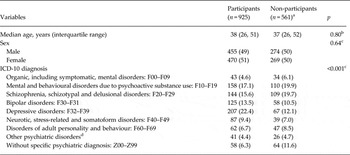
Median age was 38 years (interquartile range 26, 51 years; 49.2% men). There were no significant differences regarding age and sex comparing the study population with the patients not included in the study. The major diagnostic categories represented in the study population were depressive disorders (22.4%), substance use disorders (17.1%), schizophrenia and delusional disorders (15.6%) and bipolar disorders (13.5%). When comparing the diagnostic distribution among study participants and non-participants, bipolar, depressive and neurotic disorders were over-represented and several diagnostic categories under-represented in the study population (Table 1). These differences in inclusion of diagnostic categories were significant (χ2 44.28, p < 0.001).
Population characteristics regarding age, sex and diagnostic categories in participants and non-participants

Data are given as number of participants (percentage) unless otherwise indicated.
ICD, International Classification of Diseases.
a Data on age and sex missing for 18 patients and diagnosis missing for seven patients.
b Mann–Whitney U test.
c χ2 Test.
d F50–F59 (n = 10); F70–F79 (n = 9); F80–F89 (n = 4); F90–F98 (n = 11); X and Y diagnoses in chapter XX of ICD-10, intentional self-harm and adverse medicament effects (n = 7).
Antibody prevalence
In total, 107 of 925 (11.6%) patients tested positive on one or more antibodies in the cell-based assay. Of the patients, five had coexisting antibodies (four NMDA/GAD; one NMDA/CASPR2). Eight patients were positive for two isotypes of the same antibody (seven NMDA IgM and IgA; one GAD IgG and IgA). The prevalence of positive antibody samples when all antibodies were included was equally distributed between men and women (χ2 0.006, p = 0.94). A total of 17 patients (1.8%) showed immunofluorescence staining on the tissue sections without corresponding binding in the cell-based assay.
NMDAR antibodies
IgG isotype
Of the patients, five (0.5%) were positive for NMDAR IgG antibodies. Median age was 28 years (range 24–66 years), two were females, median antibody titre was 1:100 (range 1:10–1:100). These patients were diagnosed with bipolar disorder (n = 2), depressive disorder (n = 1), unspecified personality disorder (n = 1) and without specific psychiatric diagnosis (n = 1). No significant diagnostic category differences were found.
IgA/IgM isotype
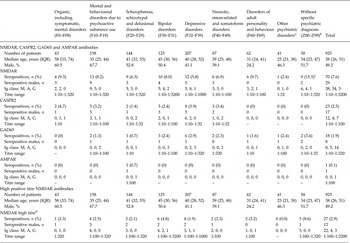
In all, 65 patients (7.1%) were positive for NMDAR IgA or IgM antibodies. Median titre was 1:32 (range 1:10–1:3200). High positive IgM/IgA titres were found in 24 patients (2.6%) (Table 2). The few positive titres of 1:1000 and above were found in patients with bipolar and depressive disorders. Isotype and titre of all positive NMDAR antibody samples are shown in online Supplementary Fig. S1.
Prevalence of NMDAR, CASPR2, GAD65 and AMPAR antibodies, and high positive titre NMDAR antibodies in total and in diagnostic categories

NMDAR, N-methyl-d-aspartate receptor; CASPR2, contactin-associated protein-like-2; GAD65, glutamic acid decarboxylase-65; AMPAR, α-amino-3-hydroxy-5-methyl-4-isoxazolepropionic acid receptor; IQR, interquartile range; Ig, immunoglobulin.
a Behavioural syndromes associated with physiological disturbances and physical factors (F50–F59) (n = 10), mental retardation (F70–F79) (n = 9), disorders of psychological development (F80–F89) (n = 4), behavioural and emotional disorders with onset usually occurring in childhood and adolescence (F90–F98) (n = 11), X and Y diagnoses in chapter XX of International Classification of Diseases-10, intentional self-harm and adverse medicament effects (n = 7).
b Primarily patients diagnosed with Z03.2 (observation for suspected mental or behavioural disorders) (n = 48), problems with partner or legal problems (n = 10).
c Prevalence of NMDAR antibodies was significant higher than in psychotic (χ2 4.38, p = 0.036), depressive (Fisher exact p = 0.025) and other psychiatric disorders (Fisher exact p = 0.043) categories, but not significant after Bonferroni correction for multiple testing.
d Titre 1:100 and above considered positive.
Distribution of patients with positive NMDAR antibody titres according to psychiatric diagnosis
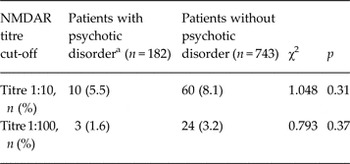
There were no significant differences in the prevalence of NMDAR antibodies between patients with psychotic and non-psychotic disorders (5.5% v. 8.1%, respectively, χ2 1.04, p = 0.31), regardless of the cut-off for serum positivity (Table 3). The five patients with NMDAR IgG antibodies were all in the non-psychotic group.
Prevalence of NMDAR antibodies in patients with and without psychosis

NMDAR, N-methyl-d-aspartate receptor.
a Both affective and non-affective psychosis (F20–F29, F30.2, F31.2, F32.3 and F33.3): 38 patients with affective psychosis and 144 with non-affective psychosis.
The percentage of patients positive for NMDAR antibodies in the diagnostic categories was 2.4–15.5% [0–8.6% with high positive titre (⩾1:100)] (Table 2). For most diagnostic categories the prevalence was between 6 and 10% with the 1:10 titre cut-off. The category without specific psychiatric diagnosis (ICD-10 Z-category) had the highest prevalence regardless of cut-off. There were no significant overall diagnostic category differences, either for all titres or high titres only (χ2 8.83, p = 0.36 and 10.79, p = 0.21, respectively). When comparing individual diagnostic categories with each other we found significant differences in the prevalence of NMDAR antibodies between patients without a specific psychiatric diagnosis and psychotic disorder, depressive disorder and other psychiatric disorders. This finding was not significant after correction for multiple testing.
Because of studies showing increasing age as a predictor of a positive NMDAR antibody status (Busse et al. Reference Busse, Busse, Brix, Probst, Genz, Bogerts, Stoecker and Steiner2014; Dahm et al. Reference Dahm, Ott, Steiner, Stepniak, Teegen, Saschenbrecker, Hammer, Borowski, Begemann, Lemke, Rentzsch, Probst, Martens, Wienands, Spalletta, Weissenborn, Stocker and Ehrenreich2014; Hammer et al. Reference Hammer, Stepniak, Schneider, Papiol, Tantra, Begemann, Sirén, Pardo, Sperling, Mohd Jofrry, Gurvich, Jensen, Ostmeier, Lühder, Probst, Martens, Gillis, Saher, Assogna, Spalletta, Stöcker, Schulz, Nave and Ehrenreich2014) and the relatively young age in the category without specific psychiatric diagnosis a logistic regression was performed to adjust for age and sex in order to examine if there were significant difference in prevalence between patients without a specific psychiatric diagnosis compared with all other patients. Logistic regression showed that age predicted serum positivity with an odds ratio (OR) of 1.28 [95% confidence interval (CI) 1.14–1.43, p < 0.001] for every 10-year increase in age. Sex was not a significant predictor (95% CI 0.39–1.09, p = 0.10). The ORs for NMDAR antibody positivity in the category without specific psychiatric disorder compared with all others were 2.8 (95% CI 1.3–6.2, p = 0.008) and 4.1 (95% CI 1.5–11.6, p = 0.007) for all titres and high titres, respectively (see online Supplementary Table S1A and B).
CASPR2 antibodies
CASPR2 antibodies were found in 23 patients (2.5%). Of these, seven were of the IgG isotype. The prevalence in the different diagnostic groups was 0–4.7% (Table 2). There were no significant overall diagnostic category differences (χ2 7.91, p = 0.44) and no in-between-group differences of antibody prevalence. Of the 23 CASPR2 antibody-positive patients, 17 were men, showing a significantly increased prevalence in men (χ2 5.77, p = 0.016).
GAD65 antibodies
GAD65 antibodies were found in 18 patients (1.9%). Of these, 14 were of the IgG isotype. The prevalence in the different diagnostic groups was 0–3.4% (Table 2). There were no significant overall diagnostic category differences (χ2 4.37, p = 0.82), no in-between-group differences of antibody prevalence and no differences in antibody distribution between men and women (χ2 0.17, p = 0.68).
AMPAR, GABABR and LGI1 antibodies
AMPAR IgG antibodies were detected in one patient (0.1%) with schizophrenia. LGI1 and GABABR antibodies were not found.
Immunohistochemistry
A total of 17 patients showed staining on frozen sections of hippocampus (rat) or cerebellum (rat, monkey), but had no corresponding findings in the cell-based assay. There were no significant differences in age or sex between patients with these isolated tissue findings compared with the rest of the population. The immunohistochemistry findings were heterogeneous, with a majority of staining on monkey cerebellum. Further data on demographic, clinical and immunohistochemistry findings are shown in online Supplementary Table S2.
Discussion
In this population of acutely admitted psychiatric patients, 107 of 925 (11.6%) were tested positive for one or more anti-neuronal serum autoantibodies (NMDAR 7.6%, CASPR2 2.5%, GAD65 1.9% or AMPAR 0.1%). NMDAR IgG antibodies, which have been shown to be highly specific and associated with anti-NMDAR encephalitis (Dalmau et al. Reference Dalmau, Gleichman, Hughes, Rossi, Peng, Lai, Dessain, Rosenfeld, Balice-Gordon and Lynch2008), were only found in five patients. NMDAR antibodies including all isotypes were equally prevalent in patients with psychotic and non-psychotic disorders. Except a higher OR of being NMDAR antibody positive for patients without a specific psychiatric diagnosis there were no significant differences in antibody prevalence in the different diagnostic categories.
The prevalence of NMDAR IgG antibodies in our study population (0.5%) corresponds well with two studies including patients with schizophrenia, affective disorders and personality disorders (0.3–1%) (Hammer et al. Reference Hammer, Stepniak, Schneider, Papiol, Tantra, Begemann, Sirén, Pardo, Sperling, Mohd Jofrry, Gurvich, Jensen, Ostmeier, Lühder, Probst, Martens, Gillis, Saher, Assogna, Spalletta, Stöcker, Schulz, Nave and Ehrenreich2014; Steiner et al. Reference Steiner, Teegen, Schiltz, Bernstein, Stoecker and Bogerts2014). Most studies so far have examined the prevalence of NMDAR IgG antibodies in patients with psychosis, primarily schizophrenia, both first episode and chronic disorders. According to a meta-analysis by Pollak et al. (Reference Pollak, McCormack, Peakman, Nicholson and David2014) there is a low but significantly higher prevalence of NMDAR IgG antibodies in patients with schizophrenia compared with controls (1.5% v. 0.3%, respectively). The control subjects included blood donors and students or hospital personnel undergoing regular health screening. The limitations of this meta-analysis include heterogeneity of the patient populations as well as the laboratory methods. In the present study, none of the five patients with NMDAR IgG antibodies was diagnosed with schizophrenia. When including all isotypes of NMDAR antibodies we did not find any differences in prevalence between patients with or without psychotic disorders. Studies published after the meta-analysis by Pollak et al. (Reference Pollak, McCormack, Peakman, Nicholson and David2014) show conflicting results. Authors of one study found no NMDAR IgG antibodies in cohorts of patients with schizophrenia (De Witte et al. Reference De Witte, Hoffmann, Van Mierlo, Titulaer, Kahn and Martinez-Martinez2015), whilst others have found NMDAR IgG antibodies in 2% of patients with post-partum psychosis compared with none in healthy post-partum women (Bergink et al. Reference Bergink, Armangue, Titulaer, Markx, Dalmau and Kushner2015). A study in a population of children with first-episode psychosis found a high prevalence of NMDAR IgG antibodies compared with controls consisting of healthy or somatically ill children (11.6% v. none) (Pathmanandavel et al. Reference Pathmanandavel, Starling, Merheb, Ramanathan, Sinmaz, Dale and Brilot2015). One study analysed cerebrospinal fluid (CSF) in patients with psychosis and found one of 125 (0.8%) positive for NMDAR IgG antibodies (Endres et al. Reference Endres, Perlov, Baumgartner, Hottenrott, Dersch, Stich and Tebartz Van Elst2015).
It is well established that some cases of anti-NMDAR encephalitis may be misdiagnosed as primary psychiatric disorders (Jørgensen et al. Reference Jørgensen, Hansen, Stanislaus, Düring, Jørgensen, Pinborg and Kondziella2015; Van Mierlo et al. Reference Van Mierlo, Titulaer, Kromkamp, Van De Kraats, Van Veelen, Palmen, Kahn and De Witte2015). Patients with anti-NMDAR encephalitis may present with isolated psychiatric episodes where affective symptoms often have been a component of the symptomatology (Kayser et al. Reference Kayser, Titulaer, Gresa-Arribas and Dalmau2013). In a case series, nine patients with psychosis and serum NMDAR IgG antibodies, without clear neurological involvement, were treated with immunotherapy. Of the nine patients, eight had significantly improved general function (evaluated with the modified Rankin Scale) and six of the nine patients achieved clinical remission (Zandi et al. Reference Zandi, Deakin, Morris, Buckley, Jacobson, Scoriels, Cox, Coles, Jones, Vincent and Lennox2014). Further studies of paired serum and CSF antibodies and randomized controlled trials are needed to study the potential of immunotherapy for patients with acute psychiatric symptoms and a positive NMDAR antibody titre.
The most frequent NMDAR antibodies in the present study were the IgA and IgM isotypes. This corresponds with previous studies (Hammer et al. Reference Hammer, Stepniak, Schneider, Papiol, Tantra, Begemann, Sirén, Pardo, Sperling, Mohd Jofrry, Gurvich, Jensen, Ostmeier, Lühder, Probst, Martens, Gillis, Saher, Assogna, Spalletta, Stöcker, Schulz, Nave and Ehrenreich2014; Steiner et al. Reference Steiner, Teegen, Schiltz, Bernstein, Stoecker and Bogerts2014). The clinical significance of NMDAR IgA and IgM antibodies is poorly examined. Their ability to induce NMDAR hypofunction has been shown in cell cultures and animal models (Prüss et al. Reference Prüss, Finke, Höltje, Hofmann, Klingbeil, Probst, Borowski, Ahnert-Hilger, Harms, Schwab, Ploner, Komorowski, Stoecker, Dalmau and Wandinger2012a , Reference Prüss, Höltje, Maier, Gomez, Buchert, Harms, Ahnert-Hilger, Schmitz, Terborg, Kopp, Klingbeil, Probst, Kohler, Schwab, Stoecker, Dalmau and Wandinger b ; Hammer et al. Reference Hammer, Stepniak, Schneider, Papiol, Tantra, Begemann, Sirén, Pardo, Sperling, Mohd Jofrry, Gurvich, Jensen, Ostmeier, Lühder, Probst, Martens, Gillis, Saher, Assogna, Spalletta, Stöcker, Schulz, Nave and Ehrenreich2014). Whether or not these antibodies have a pathogenic effect in humans remains unknown. One report on a NMDAR IgA antibody-positive patient with cognitive impairment who improved following immunotherapy (Prüss et al. 2012b) and another report of a high prevalence of NMDAR IgA and IgM antibodies in unclassified dementia (Doss et al. Reference Doss, Wandinger, Hyman, Panzer, Synofzik, Dickerson, Mollenhauer, Scherzer, Ivinson, Finke, Schöls, Müller Vom Hagen, Trenkwalder, Jahn, Höltje, Biswal, Harms, Ruprecht, Buchert, Höglinger, Oertel, Unger, Körtvélyessy, Bittner, Priller, Spruth, Paul, Meisel, Lynch, Dirnagl, Endres, Teegen, Probst, Komorowski, Stöcker, Dalmau and Prüss2014) suggest that also IgA and IgM antibodies may play a role. A study of patients with schizophrenia shows that if the patients have serum IgG, IgA or IgM NMDAR antibodies and evidence of prior blood–brain barrier (BBB) dysfunction they have more severe neurological phenotypes evaluated with the Cambridge Neurological Inventory compared with patients with the same antibodies but without evidence of prior BBB dysfunction. Thus it can be hypothesized that BBB dysfunction is required for these antibodies to be pathogenic (Hammer et al. Reference Hammer, Stepniak, Schneider, Papiol, Tantra, Begemann, Sirén, Pardo, Sperling, Mohd Jofrry, Gurvich, Jensen, Ostmeier, Lühder, Probst, Martens, Gillis, Saher, Assogna, Spalletta, Stöcker, Schulz, Nave and Ehrenreich2014). Future studies need to address the clinical significance of IgA and IgM antibodies in patients with neuropsychiatric and cognitive symptoms.
Interestingly, in the present study patients not meeting ICD-10 criteria for a specific psychiatric disorder had the highest prevalence of NMDAR antibodies of all isotypes. The age-adjusted OR for antibody prevalence was significantly higher in this group compared with the rest of the study population. This group is very heterogeneous and includes patients subsequently diagnosed with a specific psychiatric disorder as well as patients with social or somatic rather than psychiatric phenotypes. This finding could indicate that these antibodies may play a particular role in a subgroup of patients with a pleomorphic psychiatric presentation not fulfilling diagnostic criteria. Organic psychiatric syndromes, like epilepsy-specific psychiatric conditions, display difficulties in categorizing according to the ICD-10 criteria (Krishnamoorthy et al. Reference Krishnamoorthy, Trimble and Blumer2007; Vaaler et al. Reference Vaaler, Morken, Iversen, Kondziella and Linaker2010). It remains unknown if these antibodies are clinically relevant in patients with psychiatric phenotypes.
The prevalence of CASPR2 antibodies (2.5%) was significantly higher in our sample than in a recent observational study with the same laboratory methods on 1703 German blood donors (0.7%) (χ2 14.5, p < 0.001) and of patients with schizophrenia, affective or personality disorders (1.3%) (χ2 4.8, p = 0.028) (Dahm et al. 2014). We did not find differences in prevalence between the different diagnostic groups in our sample. It might be that these antibodies lack clinical significance but it could also indicate a diverse symptomatology in the presentation of CASPR2-related disorders and the wide symptomatic overlap between different psychiatric diagnoses. Antibodies targeting CASPR2 are normally found in 4–20% of patients positive for VGKC antibodies (Irani et al. Reference Irani, Alexander, Waters, Kleopa, Pettingill, Zuliani, Peles, Buckley, Lang and Vincent2010; Klein et al. Reference Klein, Lennon, Aston, McKeon, O'Toole, Quek and Pittock2013; Paterson et al. Reference Paterson, Zandi, Armstrong, Vincent and Schott2014; Huda et al. Reference Huda, Wong, Pettingill, O'Connell, Vincent and Steiger2015). Given the relatively high CASPR2 prevalence in our study, we speculate that the prevalence of VGKC antibodies might be even higher. Whether or not CASPR2 and VGKC antibodies are clinically relevant in patients with acute psychiatric symptoms warrants further examination.
The prevalence of GAD65 antibodies (1.9%) was also significantly higher in our sample than in the previously mentioned cohort of blood donors (0.5%) (χ2 11.8, p < 0.001) and psychiatric patients (0.6%) (χ2 11.6, p < 0.001) (Dahm et al. Reference Dahm, Ott, Steiner, Stepniak, Teegen, Saschenbrecker, Hammer, Borowski, Begemann, Lemke, Rentzsch, Probst, Martens, Wienands, Spalletta, Weissenborn, Stocker and Ehrenreich2014). In our study, bipolar and depressive disorders were among the three diagnostic groups with the highest prevalence. Using a different laboratory method from the present study, Padmos et al. (Reference Padmos, Bekris, Knijff, Tiemeier, Kupka, Cohen, Nolen, Lernmark and Drexhage2004) found GAD65 antibodies to be more prevalent in bipolar patients compared with controls (11.6% v. 2.3%, respectively). GAD65 antibodies are associated with type 1 diabetes (Kawasaki, Reference Kawasaki2014), as well as epilepsy, limbic encephalitis and stiff person syndrome (Malter et al. Reference Malter, Helmstaedter, Urbach, Vincent and Bien2010). A study has shown that GAD65 antibodies found in patients with different specific neurological disorders bind to different antigen-epitopes and therefore may have different pathological effects (Manto et al. Reference Manto, Honnorat, Hampe, Guerra-Narbona, López-Ramos, Delgado-García, Saitow, Suzuki, Yanagawa, Mizusawa and Mitoma2015). This could be one way to further assess the possible clinical significance of these antibodies in psychiatric patients.
Antibodies against AMPAR, LGI1 and GABABR rarely have been found in psychiatric populations (Steiner et al. Reference Steiner, Walter, Glanz, Sarnyai, Bernstein, Vielhaber, Kastner, Skalej, Jordan, Schiltz, Klingbeil, Wandinger, Bogerts and Stoecker2013; Dahm et al. Reference Dahm, Ott, Steiner, Stepniak, Teegen, Saschenbrecker, Hammer, Borowski, Begemann, Lemke, Rentzsch, Probst, Martens, Wienands, Spalletta, Weissenborn, Stocker and Ehrenreich2014). The present study is in line with this. Still, the encephalopathy associated with such antibodies makes patients prone to psychiatric symptoms such as psychosis, mood disturbances, agitation, memory deficits and personality change (Dogan Onugoren et al. Reference Dogan Onugoren, Deuretzbacher, Haensch, Hagedorn, Halve, Isenmann, Kramme, Lohner, Melzer, Monotti, Presslauer, Schabitz, Steffanoni, Stoeck, Strittmatter, Stogbauer, Trinka, Von Oertzen, Wiendl, Woermann and Bien2015; Höftberger et al. Reference Höftberger, Van Sonderen, Leypoldt, Houghton, Geschwind, Gelfand, Paredes, Sabater, Saiz, Titulaer, Graus and Dalmau2015). In our study population we identified one patient with AMPAR IgG antibodies diagnosed with schizophrenia. The clinical significance of this finding remains uncertain. However, Höftberger et al. (Reference Höftberger, Van Sonderen, Leypoldt, Houghton, Geschwind, Gelfand, Paredes, Sabater, Saiz, Titulaer, Graus and Dalmau2015) recently emphasized that AMPAR-positive encephalitis should be considered as a differential diagnosis of autoimmune psychosis.
The finding of a small number of patients with immunohistochemistry findings without specific findings on the cell-based assays raises the possibility of until now undiscovered anti-neuronal antibodies among these patients. It is unknown if these antibodies are of clinical significance. Interestingly, Bergink et al. (Reference Bergink, Armangue, Titulaer, Markx, Dalmau and Kushner2015) found a small proportion of patients (two of 96) with post-partum psychosis with immunohistochemistry findings on neuronal tissue and live neurons without findings of specific antibodies in cell-based assays. However, the findings should be interpreted with care and further evaluation of these and similar findings is needed.
Strength and limitations
Our psychiatric department provides the sole acute psychiatric in-patient service in the catchment area, giving a representative epidemiological representation of psychiatric morbidity.
Our inclusion rate of 62% compares favorably with other studies on patients admitted to acute psychiatric care (Bagoien et al. Reference Bagoien, Bjorngaard, Ostensen, Reitan, Romundstad and Morken2013; Kohigashi et al. Reference Kohigashi, Kitabayashi, Okamura, Nakamura, Hoshiyama, Kunizawa, Futori, Kitabayashi, Narumoto and Fukui2013; Mordal et al. Reference Mordal, Medhus, Holm, Morland and Bramness2013). Research on selection bias in recruitment to clinical studies in in-patient psychiatric populations is sparse. Cohen et al. (Reference Cohen, McGarvey, Pinkerton and Kryzhanivska2004) found that both patients with schizophrenia and depression had higher rates of declining participation in research compared with healthy controls, and patients with schizophrenia were the group declining participation most. Significant over- and under-representation of some diagnostic categories are seen in our study. Severity of the psychiatric disorder is also a possible selection bias.
The present study has a few limitations that should be acknowledged. First, it lacks a control group. However, we used an identical analytical method performed by the same laboratory as several earlier studies on psychiatric populations and controls (Hammer et al. Reference Hammer, Stepniak, Schneider, Papiol, Tantra, Begemann, Sirén, Pardo, Sperling, Mohd Jofrry, Gurvich, Jensen, Ostmeier, Lühder, Probst, Martens, Gillis, Saher, Assogna, Spalletta, Stöcker, Schulz, Nave and Ehrenreich2014; Steiner et al. Reference Steiner, Teegen, Schiltz, Bernstein, Stoecker and Bogerts2014), including a recent study on healthy blood donors (Dahm et al. Reference Dahm, Ott, Steiner, Stepniak, Teegen, Saschenbrecker, Hammer, Borowski, Begemann, Lemke, Rentzsch, Probst, Martens, Wienands, Spalletta, Weissenborn, Stocker and Ehrenreich2014). However, comparing our results with this control group might introduce bias because geographical differences in antibody prevalence in healthy and diseased people cannot be ruled out. Second, in order to be able to screen a large population of psychiatric patients in need of acute admission, we analysed serum only and not CSF. Also magnetic resonance imaging of the brain and electroencephalograms were not systematically performed. Third, due to lack of consent to review patients’ files clinical data were limited to ICD-10 diagnosis.
Several analytical methods are used to detect NMDAR antibodies. The cell-based assay used in this study has been criticized for being too sensitive (Steiner et al. Reference Steiner, Teegen, Schiltz, Bernstein, Stoecker and Bogerts2014; De Witte et al. Reference De Witte, Hoffmann, Van Mierlo, Titulaer, Kahn and Martinez-Martinez2015). This analytical method uses fixed cells which may lead to membrane damage and exposure of intracellular antigens. Compared with other cell-based assays using live cells this might lead to higher sensitivity and less specificity. To our knowledge, so far there are no multicentre studies comparing different analytical methods and laboratories for the reproducibility and consistency of the different antibodies analysed in the present study. A similar multicentre study has so far only been performed for aquaporin-4 antibodies associated with neuromyelitis optica (Waters et al. Reference Waters, Reindl, Saiz, Schanda, Tuller, Kral, Nytrova, Sobek, Nielsen, Barington, Lillevang, Illes, Rentzsch, Berthele, Berki, Granieri, Bertolotto, Giometto, Zuliani, Hamann, Van Pelt, Hintzen, Höftberger, Costa, Comabella, Montalban, Tintoré, Siva, Altintas, Deniz, Woodhall, Palace, Paul, Hartung, Aktas, Jarius, Wildemann, Vedeler, Ruiz, Leite, Trillenberg, Probst, Saschenbrecker, Vincent and Marignier2016). In studies like the one we present here the specific method and potential errors in indirect immunological methods must be kept in mind when interpreting the results.
Conclusion
To our knowledge, this is the first study examining a population of unselected patients admitted to acute psychiatric care for the presence of anti-neuronal autoantibodies. More than 10% of patients were positive for serum anti-neuronal antibodies. The IgG isotype of NMDAR antibodies was rarely identified. NMDAR antibodies of the IgG, IgM and IgA isotypes were equally frequent in patients with psychotic disorders and non-psychotic disorders. CASPR2 and GAD65 antibodies were more frequently encountered compared with healthy controls and psychiatric patients in earlier studies. Further studies are needed to shed light on the potential pathogenic effects of these antibodies as well as the role of immune modulation for antibody-positive patients in acute psychiatric in-patient care.
Supplementary material
The supplementary material for this article can be found at http://dx.doi.org/10.1017/S0033291716002038.
Acknowledgements
This work was supported by the Norwegian University of Science and Technology with an unspecified grant (Morten Brix Schou, grant number 10/4321). The authors thank Biobank1 for handling, registering, and storing all blood samples.
Declaration of Interest
W.S. is CEO of and shareholder with Euroimmun AG. B.T. and K.B. are employed by Euroimmun AG. All other authors report no financial relationships with commercial interests.