Ischemic heart disease is the leading cause of death in the European Union (6) and other industrialized nations. Although deaths from coronary heart disease have decreased notably during the past few decades, especially among people of working-age, an aging population shifts the focus of treatment to older groups of patients with a higher comorbidity and an increasing number of hospital discharges (6). New interventions have been developed rapidly, and older treatment options have been improved. In 2000, over 1,202,000 percutaneous coronary intervention (PCIs) and 519,000 coronary artery bypass graft (CABGs) were carried out in the United States (20). In Great Britain, almost 39,000 PCIs were performed in 2001 and approximately 25,000 CABGs in 2000 (9).
Myocardial revascularization aims to alleviate ischemic symptoms and to prevent myocardial infarction, arrhythmias, or heart failure and, thus, reduce mortality (20). When invasive treatment is indicated, the selection of the appropriate myocardial revascularization technique can be challenging and is at least partly subjective. The operative risk, co-morbidities, coronary anatomy, and the patient's preferences play a role in the decision. vTherefore, to arrive at a balanced decision, reliable comparative data on the health benefits and adverse effects of different revascularization procedures should be available (2).
Systematic reviews gather and combine evidence in a structured and rigorous manner. A comprehensive summary of scientific studies is useful as a basis for decisions (12). Many systematic reviews have compared medical treatment, percutaneous interventions, and surgical treatment for coronary artery disease. These comparisons typically cover only two treatment options. vHowever, in clinical decision making, the choice is between several treatment options, even though they are seldom unequivocally interchangeable.
Our intention was to summarize evidence on the clinical effectiveness of coronary interventions in patients with stable coronary heart disease. To attain this target, we evaluated the reliability of the systematic reviews as a source of best evidence and interpret the results of the systematic reviews.
METHODS
Paper selection, validity assessment, data abstraction, and qualitative synthesis of the data were performed independently by two of the authors (P.K., A.M.). The selections made and the data collected were compared in each phase, and consensus was required from the two authors on each item. vDisagreements were solved in a consensus meeting by checking the original data once more
Searching
Electronic databases were searched for meta-analyses and systematic reviews of invasive treatment of stable coronary heart disease without language restriction from January 1966 to March 2004. The databases used for the search were as follows: EBM Reviews—Cochrane Database of Systematic Reviews (3rd Quarter 2003) (OVID); EBM Reviews—Cochrane Central Register of Controlled Trials (4th Quarter 2003) (OVID); DARE (NHS CRD); the Health Technology Assessment (HTA) (NHS CRD); MEDLINE(R) from 1966 to February 2004, week4; MEDLINE(R) In-Process & Other Non-Indexed Citations to March 9, 2004. A focused search for coronary stents was performed in DARE, NHS Economic Evaluation Database, and HTA. A Science Citation Index search of the identified systematic reviews was performed in May 2004, and references to the systematic reviews identified were checked.
Search strategies were planned by an information specialist for each database. The following medical section head search terms were used: Angioplasty, Transluminal, Percutaneous Coronary, Coronary Artery Bypass, Comparative Study, Meta-Analysis, Review, Stents. Other keywords were balloon, bypass, angioplasty, cabg, pci, ptca, versus, vs, compare, alternate, systematic.
Selecting
The abstracts identified were reviewed using the screening criteria in the study eligibility form regarding study design, population, intervention, control intervention, and outcome. We included systematic reviews of randomized controlled trials (RCTs) on patients with stable coronary heart disease undergoing percutaneous coronary intervention or coronary artery bypass surgery in comparison with medical treatment or comparison between invasive techniques. At least one of the following outcomes had to be reported: death, myocardial infarction, angina pectoris, revascularization. vAll papers judged to be potentially relevant were retrieved for detailed evaluation.
Reviews before 1994 were considered out of date and were excluded. We excluded studies focusing on acute coronary syndrome. For the report to be included as a systematic review, we expected intent to cover all relevant studies and a qualitative or quantitative synthesis of the included papers. vResearchers were not precluded from knowing the source or authors of the reviews.
Validity Assessment
The methodological quality of the reviews was assessed by using a modified version (11) of a quality scale of research overviews (16). The scale combines nine items, each ranging from 0 to 2 points, resulting in a maximum score of 18 points.
Data Abstraction
The following main topics were covered in the standardized data-extraction form: framing the study question, identifying relevant literature, inclusion criteria for articles, assessing the quality of the literature, data synthesis, and results and applicability.
Study Characteristics
The baseline characteristics of the studies included and the inclusion criteria were tabulated. Primary outcome measures were defined as (i) mortality, (ii) myocardial infarction, (iii) revascularization, and (iv) angina pectoris. Any other outcome measures reported were regarded as secondary outcomes. The outcome measures in chosen articles were cited as given. Systematic reviews were divided into groups according to intervention contrasts: (i) CABG versus medical treatment, (ii) PCI without stents versus medical treatment, (iii) PCI with or without stents versus CABG, (iv) PCI with stents versus PCI without stents, (v) PCI with drug-eluting stent versus PCI with bare metal stent, and (vi) off-pump versus on-pump CABG.
Data Synthesis
The clinical effectiveness was evaluated on the basis of one intervention being more effective than the other or no detected difference between interventions. Quantitative results were described.
Clinical Relevance
The method used to evaluate clinical relevance was carried out using updated method guidelines from the Cochrane Back Research Group, which contained the following questions (24). Question 1 was evaluated by one of the authors (P.K.) and the rest by two of the authors (P.K., A.M.).
- Are the patient populations included in the meta-analysis and systematic reviews described in enough detail to enable you to decide whether they are comparable with those that you see in your practice?
- Are the interventions described in enough detail to allow you to provide the same treatment for your patients?
- Are the treatment settings described well enough so that you can provide the same setting for your patients?
- Were all four clinically relevant outcomes reported?
- Are both the treatment benefits and complications presented?
RESULTS
Trial Flow
In the primary searches, 1,114 potentially relevant publications were identified: 4 in the Cochrane Database of Systematic Reviews, 8 in the Cochrane Central Register of Controlled Trials, 17 in DARE, 10 in the Health Technology Assessment Database, 1,007 in MEDLINE, and 45 in MEDLINE(R) In-Process & Other Non-Indexed Citations. A search focused on stents found twenty-three articles. The flow diagram of the systematic reviews is shown in Figure 1. After this selection process had been completed, sixteen reviews were included for the study. FinOHTA's (Finnish Office for Health Care Technology Assessment) continuous screening of HTA Internet resources revealed three other reviews that also fulfilled our criteria (1;7;14). A forward search in the Science Citation Index for these systematic reviews produced 489 citations but no further reviews were used. These nineteen reviews form the basis of this review.

Flow diagram of inclusion/exclusion of systematic reviews. RCT, randomized clinical trial.
Study Characteristics
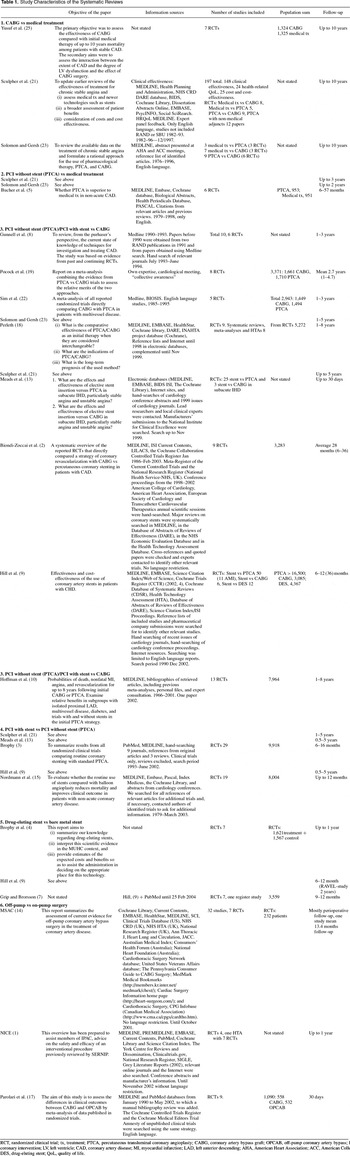
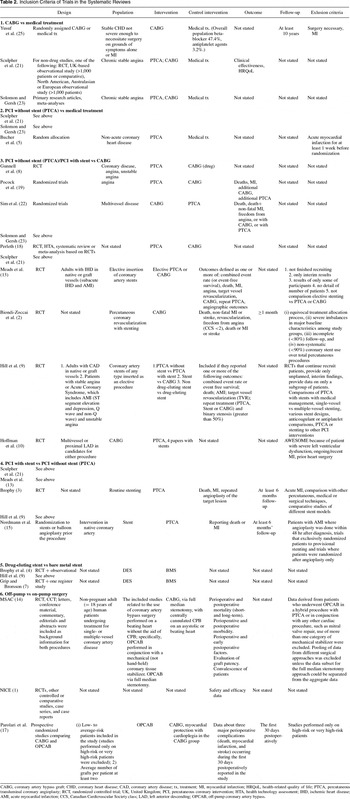
Table 1 shows the study characteristics of the systematic reviews and contains information describing the objective of the study, the information source, the number of studies included, and the population sum with follow-up times. Table 2 shows inclusion criteria of the trials in the systematic reviews eligible for this report to describe patient populations.


The quality of the nineteen identified systematic reviews is summarized in Table 3. Three papers did not give data on the information sources. vReviewers were not precluded from knowing the source or authors of the studies, and only seven of nineteen studies explicitly reported article selection criteria. A quality assessment of the studies included was ignored in eleven papers. Other quality aspects were quite well considered, and the median score was 13 points (range, 6–17 points).

Clinical Relevance
Most reviews describe the patient population adequately, but four were unclear about age and gender distribution, disease severity, and extent (1;7;17;19). The description of interventions was sufficient for judging applicability, but settings were poorly described. All primary outcomes, as defined in this study, were given in six reviews (2;5;10;18;21;22). At least one primary end point and complications were described in only nine of the reviews, hampering the evaluation of trade-offs between benefits and harms (1;5;7;8;14;15;19;22;25).
Data Synthesis
Quantitative results were given in thirteen papers (2–5;9;10;13–15;17;19;22;25). The remaining six reports gave a descriptive synthesis of the collected data (1;7;8;18;21;23). Because of this heterogeneity, we summarized clinical effectiveness qualitatively. Most of the reviews showed no effectiveness in survival rates or the risk of myocardial infarction (Table 4). Systematic reviews comparing off-pump and on-pump surgery reported only surrogate end points or perioperative outcomes. Results by outcome where effectiveness was shown are summarized below.

The risk of death can be reduced by CABG compared with medical treatment in high-risk patients (21;23;25). In two of eight reports where death was given as the outcome measure, CABG was considered to reduce mortality compared with a percutaneous procedure (10;21).
In one systematic review, the risk of nonfatal myocardial infarction was found to be lower after PCI with stent than after CABG at 3 years (risk difference [RD], −2.9 percent; 95 percent confidence interval [CI], −5.1—0.6 percent; p=.01) (10).
Repeated Revascularization. Bucher et al. (5) observed an increased need for CABG after PCI without stent (relative risk, 1.59; 95 percent CI, 1.09–2.32) compared with medical treatment. The need for repeated revascularization constantly has been reported to be greater after performing percutaneous procedures than after CABG in all ten referred papers. PCI with stenting was also found to be associated with a higher risk of repeated revascularization: 19.0 percent for stenting versus 4.7 percent for CABG (odds ratio [OR], 4.6; 95 percent CI, 3.5–5.9; follow-up 16 months) (2). According to Hoffman et al. (10) the risk of additional PCI or CABG was higher after PCI (including four studies with stent) than after CABG (RDs, 24 percent to 38 percent; p=.001, follow-up 8 years). Hill et al. (9) reported that data for single-vessel trials is limited, but in the one reporting trial, CABG shows benefits over stents. Two studies on multiple-vessel disease (ARTS and SOS) reported a statistically significant advantage of CABG over PCI with stenting (OR, 0.16; 95 percent CI, 0.12–0.23) (9) at 1 year.
In the hierarchical Bayesian meta-analysis of Brophy et al. (4), there was no evidence to suggest a difference between routine coronary stenting and PCI without stenting in terms of a need for coronary artery bypass surgery (OR, 1.01; credible interval, 0.79–1.31). Coronary stenting reduced the need for repeated PCI (OR, 0.59; credible interval, 0.50–0.68). Routine stenting probably reduces the need for repeated angioplasty by fewer than 4 to 5 per 100 persons treated compared with PCI with provisional stenting. vNordmann et al. (15) reported additional events prevented per 1,000 patients (95 percent CI) treated with stents rather than balloon angioplasty at three time points (30 days, 6 months, and 12 months): revascularization of the target vessel 3 (−2 to 8), 55 (40 to 71), and 46 (25 to 66); coronary artery bypass grafting −1 (−6 to 4), 3 (−5 to 10), and 0 (−10 to 10).
In a comparison between drug-eluting stents and bare metal stents, Brophy (3) reported a reduced need for revascularization at 6 months (OR, 0.35; 95 percent CI, 0.27–0.44), but no difference in the subsequent CABG rate. Grip and Brorsson (7) reported that the need for repeated procedures is lower with drug-eluting stents than with bare metal stents: paclitaxel stent 3.3 percent versus BMS 12.2 percent; sirolimus stent 4.0 percent versus BMS 20.6 percent, with follow-up times of between 9 and 12 months.
CABG and PCI appear to relieve angina pectoris better than medical treatment (21;23). CABG was found to give invariable relief of angina in seven of seven studies that compared percutaneous procedures with CABG and that reported angina as the outcome. Biondi-Zoccai et al. (2) found that stenting was associated with a significantly higher risk of symptomatic angina (Canadian Cardiovascular Society class [CCS], 2 or higher): 18.4 percent for stenting versus 8.9 percent for CABG (OR, 2.3; 95 percent CI, 1.8–2.8; follow-up, 12 months). In a report by Hoffman et al. (10), patients treated with CABG had a 10 percent (p=.001) lower risk of angina than those treated with PCI after 1 and 3 years. After 5 years, the risk difference was 5.3 percent (p=not significant), respectively.
DISCUSSION
Several systematic reviews and meta-analyses have been conducted on invasive treatments for stable coronary heart disease. These reviews provide an important source for clinical and health policy decision making, as well as for clinical guidelines. Thus, there is a dire need for a critical appraisal of the content and methodological quality of the reviews. A systematic review of systematic reviews can give an overall view of the current knowledge of the effectiveness of invasive treatments for stable coronary heart disease. A broader understanding seems important as there are several intervention options available and the systematic reviews focus only on one intervention contrast at a time. From a health policy point of view, the manifold differences in intervention frequencies call for a better understanding of this field: in the United States, invasive procedures are carried out five times as often as in the United Kingdom (9;20).
The reviews identified in the current study address all the clinically important intervention contrasts relevant to invasive treatment for stable ischemic heart disease. However, many review articles did not describe in detail the patient populations included and present only some of the relevant outcome characteristics. Some reviews use composite end points, and appraisal of the specific outcomes is not possible. Adverse effects of intervention are rarely reported. There are also shortcomings in the design of the reviews: a lack of unbiased selection of the primary studies is common and validity assessments of the trials are often lacking. The heterogeneity of the primary studies is only reported in some of the reviews.
As we have undertaken an overview of systematic reviews, and not assessed the primary studies, all inferences on the effectiveness must be considered with due caution. We may conclude that CABG is more effective than medical treatment in terms of reducing mortality among high-risk patients as defined by Yusuf et al. (25), although the data do not reflect the current treatment praxis, neither operative nor conservative. PCI without stenting is also more effective than medical treatment in terms of angina relief, but again, data from the referred trials are too old to warrant valid conclusions for today because of advances both in interventional techniques and in medical treatment. CABG gives better relief for angina, and the need for repeated procedures is less frequent after CABG than after percutaneous interventions. PCI with bare metal stent is better than PCI without stent in terms of a less-frequent need for repeated percutaneous coronary procedures, although there is no evidence of any difference in mortality or in the rate of myocardial infarctions. Apparently, repeated percutaneous coronary procedures are done less frequently after drug-eluting stents than after bare metal stents, but there is no evidence of a difference in the need for bypass grafting or in mortality or myocardial infarctions. The data are insufficient to draw any conclusions on whether off-pump is more effective than on-pump CABG.
Subgroup analyses, for example, on the best indications for each intervention, rarely have been executed, perhaps sometimes because of a lack of data (9;10;15;18). This finding hampers our chances of making conclusions about optimal treatments in major subgroups. However, Hoffman et al. (10) showed that, for diabetic patients, CABG provided a significant survival advantage over PCI at 4 years but not at 6.5 years. Our inference of the review by Perleth (18) is that CABG is more powerful than PCI without stents in providing 5-year survival in diabetic patients in comparison with medical treatment. Hill et al. (9) also concluded that diabetics are a particularly high-risk group after stenting but not after CABG. Limited existing data indicate that the benefits of drug-eluting stents are maintained in diabetics (9).
There are some weaknesses and potential biases in our methodology. Some reviews base their inferences not only on RCTs but also on health technology appraisals and even on cohort studies, making the inference chain not transparent. The case mix of patients in some reviews includes some unstable anginas, which constitutes a potential confounding factor in our review. vPublication bias as an inherent validity issue for any systematic review may favor the effectiveness of interventions.
As some of the current systematic reviews clearly are out of date because of rapidly evolving invasive and medical treatment, we think that there is a need for rigorously designed systematic reviews on all the important intervention contrasts. In particular, a systematic review on PCI versus contemporary medical treatment would be valuable. Because of the rapid diffusion of new technology, cumulative meta-analyses might be the design of choice. We think that all trialists should consider whether it is ethically acceptable to add a medical treatment arm in all studies on invasive treatment of coronary heart disease.
We conclude that the evidence for invasive treatment on survival is limited, partly because of difficulties in detecting differences in rare end points. vRevascularization appears not to decrease the risk of myocardial infarction. vEvidence is much stronger on the potential of invasive treatments to provide symptomatic relief. Surgery seems to provide a longer-lasting effect than percutaneous interventions with bare metal stents or without stents. vEvidence in favor of drug-eluting stents to date is based on short-term follow-up and mostly on patients with single-vessel disease. As progress has also been made in medical treatment, there is an urgent need for more data on the effectiveness of all the treatment options.
CONTACT INFORMATION
Pekka Kuukasjärvi, MD, PhD (pekka.kuukasjrvi@stakes.fi), Medical Advisor, Antti Malmivaara, MD, PhD (antti.malmivaara@stakes.fi), Senior Medical Officer, Finnish Office for Health Care Technology Assessment, Stakes, P.O. Box 220, FIN-00531 Helsinki, Finland
Matti Halinen, MD, PhD (matti.halinen@kuh.fi), MD FESC, University Docent, Department of Medicine; Director, Block of Conservative Disciplines, Juha Hartikainen, MD, PhD (juha.hartikainen@kuh.fi), Department of Medicine, Kuopio University Hospital, P.O. Box 1777, FIN-70211 Kuopio, Finland
Pekka E. Keto, MD, PhD (pekka.keto@hus.fi), Assistant Professor, Department of Radiology, University of Helsinki; Head of Section, Department of Cardiovascular and Interventional Radiology, Helsinki University Central Hospital, P.O. Box 340, FIN-00029 Helsinki, Finland
Taisto Talvensaari, MD (taisto.talvensaari@khshp.fi), Kanta-Häme Central Hospital, FIN-13540 Hameenlinna, Finland
Ilkka Tierala, MD (ilkka@tierala@hus.fi), Cardiovascular Consultant, Head of CCU, Department of Medicine, Division of Cardiology, Helsinki University Central Hospital, P.O. Box 340, FIN-00029 Helsinki, Finland
Marjukka Mäkelä, MD, PhD (marjukka.makela@stakes.fi), Research Professor, Finnish Office for Health Care Technology Assessment, Stakes, P.O. Box 220, FIN-00531 Helsinki, Finland
Information specialist Riitta Grahn is acknowledged for performing searches and for numerous consultations during the work. This work had no external funding.