


Introduction
This paper aims to demonstrate a possible clinical pathway for the cognitive behavioural assessment and treatment of traumatized asylum seekers and refugees. For brevity, the various important multicultural issues that this work entails will not be emphasized (e.g. de Silva, Reference De Silva and Yule1999). Similarly, not all possible mental health presentations in this population will be considered, simply those characterized by traumatic stress symptoms. A refugee is a person who has “a well-founded fear of persecution for reasons of race, religion, nationality, membership of a particular social group or political opinion” (United Nations, 1951). The range of events that lead to a decision to flee may include war, ethnic cleansing, political repression, detention and torture. Torture refers to “deliberate, systematic or wanton infliction of physical or mental suffering by one or more persons acting alone or on the orders of any authority, to force another person to yield information, to make a confession, or for any other reason” (World Medical Association, 1987). Torture can be psychological, physical, or sexual, or a combination thereof. Once the decision to leave one's country of origin has been made, the flight itself is likely to be dangerous and to involve significant hardship. Finally, on arriving in the UK, many asylum seekers face practical, social and cultural difficulties.
Psychological sequelae
Numerous studies indicate that refugees and asylum seekers experience significant mental health problems. Most have adopted Western psychiatric classifications although this approach has been criticized (e.g. Summerfield, Reference Summerfield2001). Prevalence rates depend upon the manner of recruitment, location of individuals, time since trauma, and method of diagnosis. Turner, Bowie, Dunn, Shapo and Yule (Reference Turner, Bowie, Dunn, Shapo and Yule2003) used structured interviews with 842 newly arrived Programme refugees from Kosovo. They found that 49% met criteria for Posttraumatic Stress Disorder (PTSD) and 18% for Major Depressive Disorder. These people were already granted Leave to Remain in the UK and thus would have no reason to exaggerate symptomatology. In contrast, Mollica et al. (Reference Mollica, Donelan, Tor, Lavelle, Elias, Frankel and Blendon1993) reported that 15% of Cambodian refugees in Thailand met criteria for PTSD. However, this group had been in the country of refuge for a longer period of time compared to the newly arrived group in the Turner et al. (Reference Turner, Bowie, Dunn, Shapo and Yule2003) study. Clinic recruited samples tend to show higher rates of problems than these epidemiological samples. For example, Weine et al. (Reference Weine, Becker, McGlashan, Laub, Lazrove, Vojvoda and Hyman1995) found 65% of Bosnian refugees at a US clinic met criteria for PTSD.
Factors in exile such as social isolation and unemployment are stronger predictors of depressive morbidity than trauma factors (Gorst-Unsworth and Goldenberg, Reference Gorst-Unsworth and Goldenberg1998; Hermansson, Timpka and Thyberg, Reference Hermansson, Timpka and Thyberg2002; Miller et al., Reference Miller, Weine, Ramic, Brkic, Bjedic, Smajkic, Boskailo and Worthington2002; van Velsen, Gorst-Unsworth and Turner, Reference van Velsen, Gorst-Unsworth and Turner1996). The identified risk factors for development of PTSD and depression include a loss of social network, fear of repatriation and family separation (Steel et al., Reference Steel, Silove, Brooks, Momartin, Alzuhairi and Susljik2006). These hold clear policy implications. However, individual experience also helps account for the development of psychological problems. The higher the level of trauma exposure, the higher the psychological morbidity (Mollica, McInnes, Poole and Svang, Reference Mollica, McInnes, Poole and Svang1998). In particular, if an individual has been tortured they are more likely to experience PTSD (Holtz, Reference Holtz1998; Silove, Steel, McGorry, Miles and Drobny, Reference Silove, Steel, McGorry, Miles and Drobny2002). Intrusive PTSD symptoms are associated with impact/physical torture and isolation, whereas avoidant symptoms are associated with sexual torture (van Velsen et al., Reference van Velsen, Gorst-Unsworth and Turner1996). The latter may be mediated by high levels of shame. Intra-individual factors that protect against developing psychological problems include religious faith (Shrestha et al., Reference Shrestha, Sharma, Van Ommeran, Regmi, Makaju, Komproe, Shrestha and de Jong1998), political commitment and, in those who have been tortured, a preparedness for this outcome (Basoglu et al., Reference Basoglu, Mineka, Paker, Aker, Livanou and Gok1997).
Theoretical perspectives
Our focus here is upon those specific cognitive behavioural models that help us address traumatized clients. However, given the importance of social factors, wider systemic models and social identity theory models are also clearly applicable, perhaps particularly when considering the development of state organized violence and inter-ethnic conflict (Silove, Reference Silove1999).
Recent cognitive models of PTSD (Brewin, Dalgleish and Joseph, Reference Brewin, Dalgleish and Joseph1996; Ehlers and Clark, Reference Ehlers and Clark2000) have highlighted the roles of inadequate processing of the trauma memory and of negative appraisals. If the traumatic memory is not held in working memory to be emotionally processed then it remains in a more sensory form, distinct from everyday autobiographical memory, and is easily triggered outside of voluntary control. Ehlers and Clark (Reference Ehlers and Clark2000) introduce the useful concept that individuals with PTSD experience a sense of ongoing serious threat when the memories are triggered and reinforced by particular appraisals (e.g. “bad things are likely to happen to me”, “anything can happen at anytime”). Ehlers and Clark (Reference Ehlers and Clark2000) further describe the range of negative appraisals and dysfunctional coping strategies adopted. These prevent change in the nature of the trauma memory or appraisals and hence maintain the sense of threat. This model focuses on factors that help to maintain PTSD and explain its persistence. The initial presence of posttraumatic stress symptoms after traumatic experiences is seen as a normal human response to overwhelming events.
A number of elements of this model are of particular application to refugees and asylum seekers. First, as PTSD is a maintenance of a sense of threat, then it may be further reinforced by a fear of repatriation (Steel et al., Reference Steel, Silove, Brooks, Momartin, Alzuhairi and Susljik2006). Therefore it would be predicted that levels of PTSD are maintained by uncertain asylum status, and that granting refugee status should reduce the sense of threat and hence potentially PTSD symptoms. Second, the significance of social factors such as inadequate housing and media coverage can affect an individual's sense of threat. In the UK, predominantly negative media coverage may serve to increase a person's perceived (and indeed actual) vulnerability.Footnote 1 In our clinical experience many people do not appear to have many PTSD symptoms when they first arrive in the UK but then develop them later, such as when initially refused asylum, or on the anniversary of a specific traumatic event. This could be explained by a reduction in sense of threat when first arriving in a perceived safe country, to be followed by a later perceived increase in threat. Third, Ehlers and Clark (Reference Ehlers and Clark2000) and Ehlers, Maercker and Boos (Reference Ehlers, Maercker and Boos2000) highlight two sets of negative appraisals that predict poorer outcome in treatment following RTA and assault. One is perceived permanent change and the other is mental defeat. Perceived permanent change refers to an individual's belief that they have changed permanently for the worse. A broader concept of permanent change would include the many losses that refugees experience and this clearly overlaps with depression. Mental defeat is a state of having given up, feeling non-human and being at the whim of others. It may be seen particularly in those who have been tortured (Ehlers et al., Reference Ehlers, Maercker and Boos2000). The protective factors of political commitment and preparedness (for torture) may help provide explanations for the actions occurring (“it's political”) and may prevent the development of unhelpful post trauma beliefs (“it's because I'm a bad person”).
Given the multiple losses experienced by refugees and asylum seekers it is unsurprising that many develop low mood and symptoms of depression (Turner and Gorst-Unsworth, Reference Turner and Gorst-Unsworth1990). These losses include deaths of family and friends, loss of family contact, loss of job, status, wealth, and loss of their homeland. It is important to recognize the normal processes of adjustment and grieving that are likely to occur following such experiences. It is also possible that low mood leads to a more isolated lifestyle, which in turn increases the number of such losses.
Multiple and prolonged traumatic events, such as torture, may lead to more complex traumatic stress presentations, which result in a profound impact on the client not captured by PTSD. ICD-10 attempts to cover these presentations with the diagnosis Enduring Personality Change Following Catastrophic Experience (EPC; WHO, 1992). The criteria include: a permanently hostile or distrustful attitude to the world; social withdrawal; a constant feeling of emptiness or hopelessness; an enduring feeling of being “on edge”, including hypervigilance and irritability; and a permanent feeling of being changed or different from others. Herman (Reference Herman1992) refers to this as “complex trauma”. The utility of terms such as complex trauma or EPC is currently unclear. Specific cognitive conceptualizations of such a traumatic stress reaction are currently limited. Cognitive models of depression, PTSD and personality disorders can be helpful in planning specific treatment approaches, as may other psychological frameworks (Silove, Reference Silove1999). The clinical pathway presented here may help in dealing with symptoms resulting from multiple traumatic events and in addressing certain torture-related cognitions.
Assessment
It is important to establish the client's level of knowledge and provide information about the National Health Service, the nature of the service to which they have been referred, the role of mental health professionals, and rules about confidentiality. The client's main pre-occupations, possible goals and standard background information and history should be elicited. At first assessment, it is probably better to ask only for a brief history of trauma in their country of origin, together with an account of their flight to the UK. In addition, details of specific psychological difficulties should be gathered as usual. When assessing traumatic stress symptoms, special attention should be paid to which aspects, of what may be an extensive trauma history, are being re-experienced by the client, in the form of intrusions, flashbacks or nightmares.
Even if the client speaks English well it may be necessary to move at a slower pace, with more explanation and checking of understanding. It may be better to use the client's first language for particularly important concepts or meanings that cannot be as easily expressed in English. Beyond this it may also be necessary to use an interpreter. The most important aspect of providing good therapy in this context is that a three-way trusting relationship can be developed between the client, interpreter, and therapist (Haenel, Reference Haenel1997; Tribe and Raval, Reference Tribe and Raval2002). This may require a change of interpreter if necessary. We provide written guidelines for the interpreter and discuss the case before and after the session with them. Many UK NHS Trusts have developed their own guidelines for these circumstances. It is helpful to show cultural curiosity of the person's background and perhaps to learn a few words of their first language. The issue of engagement in therapy using an interpreter is a broader one than the scope of this paper allows but therapist and interpreter characteristics such as age, gender and ethnicity may be important.
Assessment is an ongoing process and the focus of treatment may change over time between trauma-focused work and other therapeutic work. The clinician should be open with the client and discuss the available options. It is important to establish that the client wants to focus on tackling the traumatic stress symptoms before attempting such work. While there are few available translated and validated self-report questionnaires, assessment should still include idiosyncratic empirical measurement. The frequency and intensity of specific symptoms can be assessed in a consistent manner at assessment and during treatment, including the use of visual-analogue scales and subjective units of distress (SUDS) ratings where appropriate.
Treatment
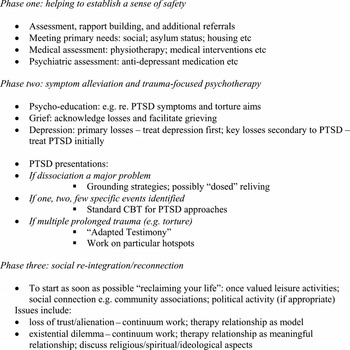
The NICE guidelines recommend a phased approach (NICE, 2005), which broadly follows the framework set out by Herman (Reference Herman1992). In the first phase the focus is on primary needs such as establishing safety, including housing, finances, immediate medical treatment and family separation issues. Phase two consists of trauma-focused interventions, which are the main focus of this paper. Phase three is the integration into a new community or later reintegration into the community of their own country (NICE, 2005). Treatment may move back and forth between phases as events occur.
Clients may be so preoccupied with their asylum status, accommodation, finances, family separation, physical complaints, occupationaI or social functioning that they can think or talk about little else. If this is the case, then it may be that specific therapy for traumatic stress symptoms should be delayed until these issues are less preoccupying or, indeed, resolved. However, general supportive counselling or activating other support networks can be facilitated in order to help resolve these issues. Common onward referrals might include psychiatric assessment for medication, medical assessment of torture injuries or chronic pain, contact with housing authorities, benefits agencies, or solicitors. A lack of trust in others may make clients reluctant to pursue these avenues and may come to be an agreed goal for treatment. In such cases the therapeutic relationship may become a more explicit vehicle for treatment. Regular ratings can be taken of the client's trust in the therapist and as these (hopefully) increase the factors behind this can be explored. The risks that the client had taken in trusting the therapist can then be discussed as a precursor to attempting to generalize this to others, in order to help re-establish social networks. It is important, where possible, to utilise existing methods of coping and in particular any cultural rituals that can help address the current problems. This is particularly important around anniversaries, of bereavements and other events.
Lack of refugee status is not a reason for not providing specific therapy. If a person has not received refugee status and is expecting to be deported in the very imminent future, therapy aimed specifically at traumatic stress symptoms may not be possible. However, others may be awaiting status and not perceive immediate threat of removal and be better able to address their traumatic stress symptoms at this stage.
The treatment path will vary according to the client's precise presentation. Many will have experienced bereavement. If their presentation is predominated by grief, then focused work in this area is important. Where depression seems to arise from the client's primary losses (e.g. of home, family, country), rather than being secondary to PTSD symptoms (e.g. from not being able to sleep, go out, work), then CBT approaches for grief and depression can be adopted. In any case, psychotherapeutic work with traumatized refugees and asylum seekers is likely to have a dual focus; not just alleviation of trauma related psychological symptoms but also social integration. Due to multiple problems and the use of interpreters, treatment is more likely to need approximately 18–25 sessions or more, rather than the common 12–16 sessions of CBT for PTSD. These sessions may be spaced fortnightly rather than weekly if preferred by the client. However, monthly, or longer, sessions are likely to greatly change the nature of what can be achieved using the CBT approaches described here. A possible clinical pathway showing the phases of treatment is given in Figure 1. Movement between phases during treatment is common.
Possible clinical pathway for working with traumatized asylum seekers and refugees

CBT approaches to traumatic stress symptoms in refugees and asylum seekers
There are few randomized treatment outcome studies with refugee populations. Paunovic and Ost (Reference Paunovic and Ost2001) showed exposure to trauma-related cues and images was found to be as efficacious alone as when combined with cognitive re-interpretation of symptoms and controlled breathing techniques. Unfortunately, the generalizability of this result is severely limited by the small size of the sample (n = 16) and the fact that participants all spoke the language of their host country (Sweden).
Neuner, Schauer, Klaschik, Karunakara and Elbert (Reference Neuner, Schauer, Klaschik, Karunakara and Elbert2004) demonstrated the effectiveness of Narrative Exposure Therapy (NET), an adapted form of CBT, in a randomized controlled trial. Forty-three Sudanese refugees living in a Ugandan refugee settlement either received four sessions of NET, four sessions of supportive counselling or one session of psychoeducation. One year after treatment, only 29% of NET participants, but 70% of the supportive counselling group and 80% of the psychoeducation group, still met criteria for PTSD. NET consists of psychoeducation, followed by the person constructing a detailed chronological account of his or her experiences together with the therapist, with encouragement to relive traumatic events until habituation occurs.
Otto et al. (Reference Otto, Hinton, Korbly, Chea, Ba, Gershuny and Pollack2003) investigated the addition of CBT to the use of clonazapam and sertraline in Cambodian refugees with PTSD in the US. From a group of 10 refugees, 5 were randomly selected to receive 10 sessions of CBT that consisted of education, exposure to trauma memories, interoceptive exposure exercises, cognitive restructuring, and stress management. Of interest is the fact that the therapy took place in a Buddhist temple. The combination of medication and CBT was more effective than medication alone on measures of PTSD and anxiety, but not depression.
An approach known as Testimony also has elements of cognitive behaviour therapy within its procedures. Originally used as a way of documenting human rights abuses in Chile, Testimony was introduced as a therapeutic tool by Cienfuegos and Monelli (Reference Cienfuegos and Monelli1983). The client is asked to give an account of the events leading to their current symptoms. The therapist asks clarifying questions where necessary. The account is tape recorded and transcribed between sessions. Each subsequent session starts with a review and edit of the material produced from the previous session. The result of the therapy is a document that describes all that has happened to the client. Weine, Kulenovic, Pavkovic and Gibbons (Reference Weine, Kulenovic, Pavkovic and Gibbons1998) report a 50% decrease in PTSD diagnosis at 6-month follow-up, using this procedure with a group of 20 adult Bosnian refugees, over an average of six sessions. The procedure provides imaginal exposure to the trauma, at the same time as helping the client to integrate the traumatic experiences into their lives, by understanding their significance in the context of political and personal events. Unfortunately, little detail is given in the literature about how the therapist undertaking Testimony responds to clients who blame themselves unfairly for events, or who feel intense shame when recounting certain details.
A recent audit showed that Cognitive Processing Therapy (CPT) for PTSD with 53 refugees from Bosnia and Afghanistan in a community setting in the US was highly effective whether delivered directly or through an interpreter (Schulz, Resick, Huber and Griffin, Reference Schulz, Resick, Huber and Griffin2006). CPT is an established manualized, empirically supported treatment that combines cognitive therapy and written exposure (Resick and Schnicke, Reference Resick and Schnicke1993). While not a controlled trial, and with a number of other acknowledged limitations such as confounds of therapist effects, this naturalistic study is encouraging in that CBT based treatments can be used in such circumstances, particularly when delivered through an interpreter.
All standard cognitive behavioural treatments for PTSD involve, to varying degrees, “reliving” of the traumatic experience (NICE, 2005). The client is asked to recount the event, or parts of it, in great detail, on a number of occasions. When faced with a person who has experienced many traumatic events, often over a period of several years, reliving each event may not seem viable. Approaches for such a presentation will be considered below.
Re-experiencing of up to a few events
Where the client has been involved in only a few traumatic events, or has experienced many, but re-experiences only a few, then reliving of each troubling event can be attempted. In these cases, standard CBT approaches to traumatic stress symptoms can be used, including a focus on the worst moments (“hotspots”), and other specific appraisals and maintaining factors (Ehlers and Clark, Reference Ehlers and Clark2000). Similarly, this may be possible if the client re-experiences many events but one or two stand out in terms of severity or frequency.
When working with interpreters, reliving will obviously need to be adapted. The process of translation back and forth presents a challenge to the client's ability to relive the original trauma strongly enough for emotional processing to occur. It is important that the interpreter and client fully understand the rationale, and the importance of exact translation. If the interpreter is able to translate simultaneously he or she can sit close to the therapist and whisper the translation into their ear. The therapist then whispers further questions, and so on. If the interpreter is not able to do this, the client can be asked to speak only one or two sentences at a time. It may help to practise this process first, by asking the clients to relive a neutral scene, such as wandering around their own house.
Re-experiencing more than a few events
Where clients have been involved in a series of traumas, and present with re-experiencing symptoms related to many, it is not possible to undertake reliving of all troubling events. In such cases, an adaptation of standard CBT and Testimony can be helpful.
In “adapted testimony” the client is first educated about their symptoms and given a detailed explanation of the development and maintenance of PTSD. Second, a rationale for producing an account of their trauma is discussed. Third, grounding strategies are taught where dissociation is a major problem (Kennerley, Reference Kennerley1996). Fourth, the client is asked to start their account before the trauma, to provide a fuller context. The therapist asks clarifying questions, as well as for details of the client's cognitive, behavioural, emotional and somatic reactions to events. Where emotions described involve guilt, shame or other non-fear reactions to trauma, the therapist can use cognitive restructuring techniques where appropriate. The focus is on the moments of highest distress (hotspots) at which points important meanings can be most easily accessed and discussed. Often, the client struggles to make sense of what has happened to them. They may, for example, personalize events that occurred during ethnic cleansing, or they may question human nature or their God's will. The therapist can help the client find possible explanations, by drawing upon sociological, psychological or religious texts (as described in the case example below). The historical account and all discussions between client and therapist are audiotape-recorded. Rather than transcribing the recordings (which represents an unrealistic administrative burden for many services), the client is asked to listen to the tape between each session. At the start of the next session, the homework task is reviewed and any corrections recorded onto tape. The narrative proceeds, with new tapes used as necessary. The client is asked to listen to all tapes between sessions for homework, so that each part of the story is heard on a number of occasions. The length of time needed to complete this task will depend upon the length of the client's trauma history. However, five to ten one-hour sessions should generally suffice.
Case example
Ahmed, a 45-year-old Middle Eastern asylum seeker, was referred for psychological help by his GP.Footnote 2 He was seen with an Arabic-speaking interpreter. Ahmed stated that he would like help with “feeling depressed and being afraid to go to sleep at night, and to go out onto the streets”. He explained that he had nightmares every night about the torture he suffered and that he would often become frightened when he saw other Middle Eastern men near where he lived. Consequently, Ahmed rarely left the house.
Ahmed had grown up in a middle class family; his father worked as a scientist for the government. He studied engineering at university and married when he was 23. He had had no pre-morbid psychological problems. Aged 25, he was about to take up a job in a government department when there was a regime change. His father was imprisoned and executed after 6 months. Ahmed was the eldest son and was left with the task of supporting his mother and three siblings. He had always been a conscientious child and took this added responsibility seriously. Incensed at the treatment of his father, Ahmed became increasingly politically active, working for an illegal opposition party. The family was visited frequently by security services, who would search the house for evidence of illegal activity. Each time, they would damage furniture and verbally and physically abuse Ahmed and his siblings.
Following the arrest and execution of a close associate, Ahmed became increasingly concerned for his safety. He went into hiding in another town, planning to leave the country as soon as possible. A fortnight later, he learnt that soldiers had come to look for him and, on finding that he had fled, took his mother prisoner, to encourage him to give himself up. While discouraged from doing so by friends, he handed himself in to a local police station. He was imprisoned and tortured on a daily basis for 5 months. After that, he was put on trial and sentenced to 15 years in prison. After 7 years, he was released and ordered to live in a remote part of the country. The harassment continued, as did Ahmed's political activity. Three years before the referral, Ahmed had fled the country and sought asylum in England, having learnt that the authorities intended to arrest him again. His wife and two children had joined him 2 years later.
Ahmed was awaiting a response from the Home Office about his asylum claim. While he was concerned about it, he believed that they would not deport a man who had a family. The family shared a one-bedroom flat on a large urban council estate. He was unhappy about the lack of privacy that this afforded him and his wife. He had a limited social life, seeing only a cousin and a former political associate. He complained of severe pain from his torture injuries, which was not alleviated by the medication prescribed by his GP.
Ahmed met criteria for both from Major Depressive Disorder and Post-Traumatic Stress Disorder. While often thinking of suicide, he was certain that he would not take his life for religious reasons. He had intrusive images and flashbacks to two particular torture sessions, both of which involved the execution in front of him of another prisoner. He had an intrusive image or flashback at least once each day and he rated them at 100/100 on a SUDS. His nightmares occurred every night and involved a variety of his experiences in prison. It seemed that his difficulty leaving the house arose from his extreme distress and physiological arousal upon seeing men who looked similar to the guards who had tortured him in prison. In addition, Ahmed talked about feeling extremely angry (SUDS 90) with himself for handing himself in to the police when they arrested his mother, and feeling guilty (SUDS 80) about surviving when fellow prisoners had been executed. Finally, he said on many occasions that the torture had “taken away my pride, I am nothing, they defeated me, I am a broken man” (with a belief rating of 100%).
A preliminary cognitive formulation of Ahmed's difficulties was made. His PTSD had arisen as a result of the overwhelming nature of his experiences in prison. He had been unable to form a coherent autobiographical memory of that time due to the intense fear, guilt and shame that he felt, as well as frequent losses of consciousness due to beatings. As a result, when presented with matching triggers in his current environment, he re-experienced traumatic memories. These led him to feel intensely afraid, guilty and ashamed. He may have been at “greater risk” of perceiving himself to be responsible in some way, and hence feel guilty, due to his pre-morbid conscientious nature and role of responsibility within his family. Understandably, he would avoid any situations (such as going out) that might provide such triggers and avoided thinking and talking about his experiences. Unfortunately, this meant that the incoherent state of his trauma memories remained. In addition, Ahmed interpreted his torture experiences and their sequelae as signalling that he was permanently changed, shamed and defeated. This caused him great distress and prevented him from thinking about or discussing his experiences.
Ahmed's depression was viewed as secondary to his PTSD, as it had developed more recently. Clearly, a number of factors could have contributed to its development: loss of country, status, family, and lack of pleasurable activity, chronic pain, as well as feelings of shame, guilt and defeat. Ahmed was offered 30 sessions of cognitive-behavioural treatment, which roughly fell into the three phases (Herman, Reference Herman1992; NICE, 2005).
Phase one
After some initial educational sessions, a referral to a pain clinic was made. In addition, the therapist wrote a letter to the housing department, urging them to find accommodation that would be more suitable for Ahmed. He was also invited to ask the solicitor dealing with his asylum claim to make contact if she would like a professional report for use in his case. Ahmed was taught grounding strategies for his flashbacks. He was also encouraged to make further contact with community organizations. This was helped by the fact that he was here together with his immediate family and his wife had already made contact with other mothers in the community.
Phase two
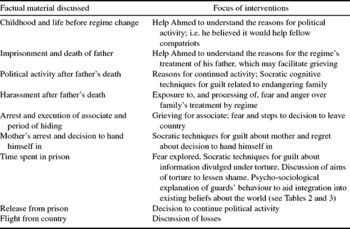
Because Ahmed had intrusive images related to two specific events, re-living was part of the treatment plan. However, adapted testimony was also thought to be indicated for two reasons: first, because Ahmed's nightmares related to a number of events; second, because from Ahmed's brief account of his trauma, the guilt, shame and fear that he re-experienced seemed to have been present on and off throughout his 7 and a half years of imprisonment. Clearly, it would not be possible to undertake re-living for such a long event. In order to understand better Ahmed's experiences, testimony was chosen as the first intervention. It was undertaken over 10 one-hour sessions, and a brief summary of the process is outlined in Table 1.
Example of adapted testimony

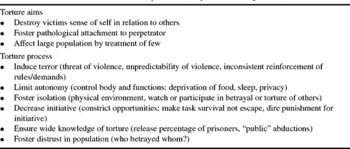
Ahmed felt a great deal of shame during torture. In our experience, it is necessary to help the client to depersonalize this experience and understand that shaming their victim is a major aim of the torturer. In this way, levels of shame may decrease. Thus, the process and aims of torture were discussed with Ahmed, who then related it to his own experience (see Table 2).
Torture aims and processes (adapted from Basoglu, Reference Basoglu and Basoglu1992)

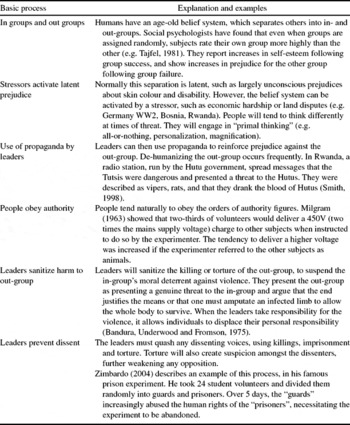
Ahmed also struggled with understanding how the prison guards had been able to commit such atrocities against him and the other prisoners. Their behaviour challenged his beliefs about human nature, making the integration of these experiences more difficult. A possible psycho-sociological explanation (adapted from Beck, Reference Beck1999) was discussed with him and related to his own experience (see Table 3).
A clinical heuristic for how people may become violent (adapted from Basoglu and Mineka, Reference Basoglu, Mineka and Basoglu1992; Beck, Reference Beck1999; Zimbardo, Reference Zimbardo and Miller2004)

At this point in treatment, Ahmed's intrusive images and flashbacks to two particular torture sessions had reduced considerably. It was hypothesized that this was a consequence of his feeling less ashamed and responsible for events that occurred in prison, following the testimony. Nevertheless, Ahmed was still experiencing some intrusions and was keen to reduce them. The least distressing of the two incidents was chosen to work on first (although this is not always the case). The re-living was conducted one or two sentences at a time, using an interpreter. Cognitive re-structuring within reliving was also used to help alleviate Ahmed's guilt about the death of others (Ehlers and Clark, Reference Ehlers and Clark2000; Grey, Young and Holmes, Reference Grey, Young and Holmes2002). After seven re-living sessions, Ahmed's intrusions to both events had reduced in frequency (weekly) and intensity (SUDS 30).
Phase three
As Ahmed's PTSD symptoms were now mild and at a level that he experienced as tolerable, he found it easier to go outside. He was further encouraged to engage in pleasurable and meaningful activity.
At the end of treatment, Ahmed was no longer depressed. Some PTSD symptoms remained, but they did not cause him significant distress. He had started to go out more and had become involved in a British branch of his former political party. The frequency of his nightmares had reduced to roughly monthly and his ratings of distress were also reduced (although still present): guilt (10%), anger (20%), and defeated (30%). It is possible that the level of “defeat” experienced may reduce further as he increases his levels of activity and re-integrates into his local community. In order to help this process, a “blueprint” was drawn up with Ahmed, detailing what he had learned from therapy, how he may continue to make progress, and how he could attempt to overcome any future set-backs and obstacles.
Discussion
In this paper we have described a possible clinical pathway to guide assessment and intervention when working with asylum seekers and refugees who have experienced traumatic events. Whilst these people often face multiple social and psychological difficulties, the approach is essentially one of careful assessment and the appropriately timed application of established psychological interventions for traumatic stress symptoms. Clearly, the dearth of research in this area requires attention and the pathway presented here has no standard empirical support in the form of treatment trials, controlled or otherwise. However, in the face of this clinicians still have to provide treatment for people. This pathway is based on both clinical experience and on the application of established cognitive models (Salkovskis, Reference Salkovskis2002). We have also suggested that, whilst sometimes difficult, work with asylum seekers and refugees can be accomplished (see also Clark, Reference Clark2004; van der Veer, Reference Van der Veer1998). We do not intend to suggest, however, that all cases have as good an outcome as the one presented here. Clearly there is a wider range of possible psychological presentations than those presented in this paper. Again, we would suggest that the pathway provided here can help guide the interventions tried. Furthermore, we emphasize the need for broader social interventions for people, which include links with community organizations and other suitable groups, and helping to obtain suitable housing and refugee status. The individual interventions that we discuss in this paper are not at the expense of these broader issues but merely recognize that, even with good provision of social care, individuals can still experience significant psychological distress. We encourage enquiring about traditional approaches to such distress that may be used within a cultural group, and for the person to use any such approaches that seem appropriate, such as particular grief rituals. We also encourage people to talk with other members of their family and community, including community elders or religious leaders, to establish what others believe too. Contemporary CBT models of PTSD and other psychological problems do not explicitly discuss how the experiences of refugees and asylum seekers may be best understood, including these issues described above.
There are similarities between the explicitly cognitive-behavioural approach we propose and the established intervention of Testimony as previously developed for survivors of torture. Both approaches provide education about and normalization of the psychological symptoms experienced, and provide a rationale for discussing the experiences. They also both provide at least some element of exposure to the traumatic memories and homework to be completed between sessions. However, there are also a number of important differences. Formal Testimony is transcribed, whilst in CBT this is not necessarily the case. There is more emphasis within CBT on full emotional exposure (reliving) of the traumatic memory so that all the associated meanings can be identified and cognitive restructuring attempted where appropriate. This is a crucial difference, in that CBT explicitly focuses on changing these key cognitions. CBT is also less overtly political than Testimony. Originally, the written transcripts from Testimony were used as evidence to push for political change in Chile (Cienfuegos and Monelli, Reference Cienfuegos and Monelli1983).
Part of the pathway described here includes an adaptation of the Testimony method, to incorporate re-scripting of unhelpful peri- or post-traumatic cognitions. It has some similarities with Narrative Exposure Treatment (NET), which is a helpful and accessible adaptation of CBT and Testimony that is used within refugee camps in the field (Neuner, Schauer, Roth and Elbert, Reference Neuner, Schauer, Roth and Elbert2002; Schauer, Neuner and Elbert, Reference Schauer, Neuner and Elbert2005). The adapted testimony method described in this paper focuses more explicitly on cognitive restructuring than does NET. In particular, there is focus on identifying hotspots within a trauma memory and also on the broader cognitive themes than need to be addressed, such as depersonalizing torture experiences. Furthermore, an outpatient population in a western country is clearly different to the population for whom NET has currently been used.
It will be of benefit to ascertain which interventions should be applied at which time points in the process. In this case, reliving was helpful, probably because Ahmed had some sense of safety and was not pre-occupied with other issues. Further case studies would be helpful, perhaps especially those that report working with interpreters. However, with the paucity of wider evidence available, using established techniques for posttraumatic stress symptoms with careful consideration of their timing and manner of application seems appropriate (NICE, 2005).
Acknowledgements
This work was originally developed while we were working at the Traumatic Stress Clinic, Camden and Islington Mental Health and Social Care Trust. We would like to thank those people with whom we discussed our clinical work at that time. In addition, many thanks to James Gray, Mary Robertson, Pippa Stallworthy, Craig Steel, Richard Stott, and the very helpful comments of reviewers.



Comments
No Comments have been published for this article.