Introduction
Delirium is a cognitive disorder characterized by acute onset, fluctuating course, and disturbances in consciousness, orientation, memory, thought, perception, and behavior (American Psychiatric Association, 2000). It occurs in hyperactive, hypoactive, or mixed forms in up to 70% of older long-term care (LTC) residents (Rovner et al., Reference Rovner, German, Broadhead, Morriss and Brant1990; Fries et al., Reference Fries, Mehr, Schneider, Foley and Burke1993; Sandberg et al., Reference Sandberg, Gustafson, Brannstrom and Bucht1998; Kiely et al., Reference Kiely2003; Voyer et al., Reference Voyer, Richard, Doucet and Carmichael2009; McCusker et al., Reference McCusker2011a) and is associated with many poor outcomes (Pitkala et al., Reference Pitkala, Laurila, Strandberg and Tilvis2005; McCusker et al., Reference McCusker2011b).
Up to half of older LTC residents appear to display one or more Confusion Assessment Method (CAM)-defined core symptoms of delirium without having the full syndrome (Cole et al., Reference Cole2011; Reference Cole2012; Reference Cole2013; McCusker et al., Reference McCusker2013). Such core symptoms not meeting criteria for delirium may occur independently of an episode of delirium (Cole et al., Reference Cole2011) or precede or follow an episode of delirium (Cole et al., Reference Cole2012). Such symptoms may last for weeks or months (Cole et al., Reference Cole2011; Reference Cole2012; Reference Cole2013) and appear to predict incident delirium (Cole et al., Reference Cole2013) and cognitive decline (Cole et al., Reference Cole2011) during six months of observation.
The immediate clinical significance of CAM-defined core symptoms not meeting criteria for delirium in older LTC residents is not clear. If such symptoms are associated with cognitive and functional impairment, mood and behavior problems and increased Burden of Care (BOC), efforts to prevent or detect and treat these symptoms may be further justified. Therefore, the objective of this study was to determine if CAM-defined core symptoms of delirium not meeting criteria for delirium were associated with cognitive and functional impairment, mood and behavior problems, and increased BOC in older LTC residents.
Methods
Study design
The study was a secondary analysis of data collected for prospective study of delirium among older LTC residents (McCusker et al., Reference McCusker2011a). There were seven study sites in Montreal and Quebec City. Two cohorts of residents aged 65 years or over were enrolled in separately funded, concurrent studies that used the same staff and methods: a cohort of residents with no-moderate cognitive impairment (i.e. MMSE 10 or more) and a cohort of residents with severe cognitive impairment (i.e. MMSE 9 or less). Residents were excluded only if they were unable to communicate in English or French.
Competence to consent was based on the clinical impression of the primary nurse. Competent residents were invited to participate in the study. The legal guardian or a responsible family member of incompetent residents was asked to provide substitute consent. The study was approved by the research ethics boards of McGill University and the study sites.
A research assistant (RA) visited each facility weekly to enroll residents and conduct follow-up assessments. Residents had weekly assessments for up to 24 weeks or until death, withdrawal or transfer to another facility. At the end of the study, data on socio-demographic variables, medical problems, dementia status, and medication use were abstracted from resident charts, blind to the RA assessments.
Measures
At baseline, the RA completed the Mini-Mental State Exam (MMSE; Folstein et al., Reference Folstein, Folstein and McHugh1975), CAM (Inouye et al., Reference Inouye1990), Barthel Index (BI; Mahoney and Barthel, Reference Mahoney and Barthel1965), Cornell Scale for Depression in Dementia (CSDD; Alexopoulos et al., Reference Alexopoulos, Abrams, Young and Shamoian1988), Nursing Home Behavior Problem Scale (NHBPS) (Ray et al., Reference Ray, Taylor, Lichtenstein and Meador1992), and BOC (Zarit et al., Reference Zarit, Reever and Bach-Peterson1980). The MMSE and CAM were repeated weekly for six months; the BI, CSDD, NHBPS, and BOC were repeated monthly for six months.
The MMSE (Folstein et al., Reference Folstein, Folstein and McHugh1975) measures cognition; scores range from 0 to 30; a lower score indicates greater cognitive impairment. The CAM (Inouye et al., Reference Inouye1990) was used to identify the core symptoms of delirium. At each prospective assessment, the RA scored at least the first five items of the MMSE, reviewed the resident's chart for the previous week and completed the CAM.
Measures of physical function, mood, behavior problems, and BOC were based on information provided by the primary nurse. The BI (Mahoney and Barthel, Reference Mahoney and Barthel1965), a measure of activities of daily living, was scored using the method suggested by Shah et al. (Reference Shah, Vanclay and Cooper1989); scores were categorized as severe-moderate (0–59) and mild to no disability (60 and over). The CSDD (Alexopoulos et al., Reference Alexopoulos, Abrams, Young and Shamoian1988) measures depression severity in older adults with and without dementia; a cut-point of 6 or more indicates clinically significant symptoms (Korner et al., Reference Korner2006). The NHBPS Ray et al. (Reference Ray, Taylor, Lichtenstein and Meador1992) is a 29 item checklist of behavioral manifestations of dementia developed for nursing home residents; each item is scored on a five-point scale from 0 (never) to 4 (always); increasing scores indicate increasing problems. The BOC (Zarit et al., Reference Zarit, Reever and Bach-Peterson1980) measures BOC; we used a modified version (Sourial et al., Reference Sourial, McCusker, Cole and Abrahamowicz2001) that includes 13 items, each scored from 0 (never) to 4 (nearly always); increasing scores indicate increasing BOC. Information on socio-demographic variables, medical problems, and dementia status at baseline was abstracted from resident charts and used to compute the Charlson Co-morbidity Index (CCI; Charlson et al., Reference Charlson, Pompei, Ales and MacKenzie1987).
Similar to procedures used in our previous studies of delirium, we trained the research staff (nurses and psychologists with experience in geriatrics) to recognize the symptoms of delirium. Before data collection began and during the course of the study, samples of residents were assessed simultaneously and independently by the research staff and clinical investigator. The sensitivity and specificity of research staff assessments, as compared to the clinical investigator, were calculated for each of the CAM-defined core symptoms of delirium (fluctuation, inattention, disorganized thinking, and altered level of consciousness). Sensitivity ranged from 75% to 100%; specificity ranged from 75% to 91%.
Delirium status
For purposes of the analysis, we created a three-category variable: core symptoms of delirium meeting criteria for delirium, core symptoms of delirium not meeting criteria for delirium, and no core symptoms. Delirium (prevalent or incident) was defined using criteria for probable delirium (acute onset or fluctuation, inattention and either disorganized thinking or altered consciousness); these criteria appear to be the most appropriate in a nursing home population (Voyer et al., Reference Voyer, Richard, Doucet and Carmichael2009; McCusker et al., Reference McCusker2011b). Core symptoms of delirium not meeting criteria for delirium were defined as the presence of one or more of the following prevalent or incident CAM core symptoms of delirium not meeting criteria for probable delirium: fluctuation, inattention, disorganized thinking, and altered level of consciousness. If no core symptoms were present, residents were categorized as no core symptoms.
Statistical analysis
Regression analysis was used to assess the impact of delirium status (i.e. delirium, core symptoms not meeting criteria for delirium, no core symptoms) or changes in delirium status at each monthly assessment on the monthly change in each outcome (MMSE, BI, CSDD, NHBPS, and BOC). The change in the outcome was defined as difference in the score between two consecutive monthly assessments (t−1, t). Seven categories of monthly delirium status were defined: (1) no change: no symptoms at (t−1) and (t), (2) no change: core symptoms only at (t−1) and (t), (3) no change: delirium at (t−1) and (t), (4) change: no symptoms (t−1) − core symptoms only (t), (5) change: core symptoms only (t−1) − delirium (t), (6) change: core symptoms only (t−1) − no symptoms (t), (7) change: delirium (t−1) − core symptoms only (t). The first category was used as the reference category. The relationship between delirium status or changes in delirium status and outcomes was investigated using a generalized estimating equation (GEE; Fitzmaurice et al., Reference Fitzmaurice, Laird and Ware2004) approach with exchangeable and autoregressive correlation structures to account for the repeated measures on individual patients; selection of the error covariance structure was based on the Quasi-Akaike Information Criterion (QIC) (Pan, Reference Pan2001). Regression coefficients (betas) with their 95% CIs were computed for each risk factor exposure category in comparison with the reference category. For each of the outcomes listed above a full multivariable model was developed including as covariates previous outcome score (at time t−1) and baseline variables (age, sex, time in LTC, CCI). Additional analysis was performed on data from demented residents (n = 170) to test for interaction between delirium status and severity of dementia (i.e. baseline MMSE group, >14 vs. <14).
Results
Study sample
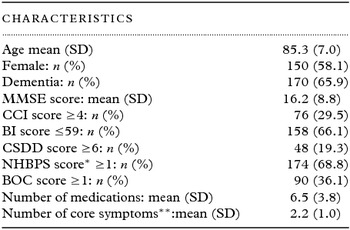
Recruitment began in July, 2005; follow-up ended in February, 2008. Overall, 1484 residents were considered for the study; 928 (62.6%) were eligible; 556 were not eligible (126 died, 11 were transferred, 95 were short-term respite care residents, 68 were on restricted floors, 13 were too sick, 225 did not meet inclusion criteria, and 18 were not eligible for other reasons). Consent to participate was obtained for 283 residents. The most common reason for failure to obtain consent was inability to contact a family member. The mean age and proportion of women was almost identical among those who consented and those not included in the study. Of the 283 residents for whom consent was obtained, 3 died before the baseline assessment and 22 did not complete at least 2 consecutive monthly CAMs or outcomes. Thus, the sample of analysis included 258 residents. The baseline characteristics of the 258 residents are shown in Table 1. The majority was aged 80 years or over, female and had dementia at baseline. Forty-three percent of residents had one or more core symptoms not meeting criteria for delirium at one or more time points: 19% had one symptom, 13% had two symptoms, and 11% had three symptoms. Among residents who had such core symptoms, the mean number (SD) of core symptoms was 1.8 (0.8).
Baseline characteristics of the study sample (n = 258)

*Number of behaviors (0–6).
**Among all assessments with at least one core symptom (n = 642 patient-months).
MMSE: Mini-Mental State Exam; CCI: Charlson Comorbidity Index; BI: Barthel Index; CSDD: Cornell Scale for Depression in Dementia; NHBPS: Nursing Home Behavior Problem Scale; BOC: Burden of care.
Associations between CAM-defined core symptoms not meeting criteria for delirium and cognitive and functional impairment, mood and behavior problems, and burden of care
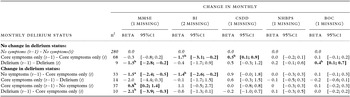
Increasing scores on the MMSE and BI indicate better outcomes; increasing scores on the CSDD, NHBPS, and BOC indicate worse outcomes. The associations between core symptoms not meeting criteria for delirium and the outcomes are included in Tables 2 and 3 by dementia status. The associations were consistent for the most part. Among all residents without dementia (Table 2) who had no change in delirium status between time t and the previous month (t−1), those residents with core symptoms not meeting criteria for delirium at both time points had a decrease of 0.3 points in MMSE score compared to residents with no core symptoms at either time point; those with delirium at both time points had a decrease of 1.5 points in MMSE score. Among all residents who had a change in delirium status between time t and the previous month (t−1), those residents who had no core symptoms at t−1 but core symptoms not meeting criteria for delirium at t had a decrease in MMSE score of 1.5 points; those with core symptoms only at t−1 but delirium at t had a decrease in MMSE score of 2.0 points.
Regression results of monthly changes in delirium status and outcomes among residents without dementia (n = 88)

2 Average number of patient–months in each category among all five outcomes; a<0.01; b<0.05; 95% CI (confidence interval); (t−1) = Previous month, (t) = Current month.
Beta is computed from the multivariate models* and represent the average monthly change in the outcome between two groups (reference group: No symptoms (t−1) and (t)).
In the multivariate model were adjusted for previous outcome baseline score, and patient baseline characteristics: age, sex, CCI, number of medications;
*GEE model with covariance structure : Compound Symmetry(CS) except for CSDD Auto-regressive of order 1 (AR(1)).
Negative value in the beta for MMSE and BI represent a decline in the score, which is the opposite for the CSDD, NHBPS, and BOC.
MMSE: Mini-mental state examination, BI: Barthel Index; CSDD: Cornell scale of depression dementia; NHBPS: Nursing home behavioral problem scale; BOC: Burden of Care; CCI: Charlson comorbidity index.
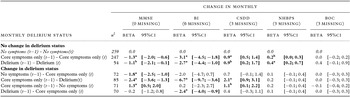
Regression results of monthly changes in delirium status and outcomes among residents with dementia (n = 170)

2 Average number of patient–months in each category among all five outcomes; a<0.01; b<0.05; 95% CI (confidence interval); (t−1) = Previous month, (t) = Current month.
Beta is computed from the multivariate models* and represent the average monthly change in the outcome between two groups (reference group: No symptoms (t−1) and (t)).
In the multivariate model were adjusted for previous outcome baseline score, and patient baseline characteristics: age, sex, CCI, number of medications;
*GEE model with covariance structure : Compound Symmetry(CS) except for CSDD Auto-regressive of order 1 (AR(1)).
Negative value in the beta for MMSE and BI represent a decline in the score, which is the opposite for the CSDD, NHBPS, and BOC.
MMSE: Mini-mental state examination, BI: Barthel Index; CSDD: Cornell scale of depression dementia; NHBPS: Nursing home behavioral problem scale; BOC: Burden of Care; CCI: Charlson comorbidity index.
Finally, those residents who had core symptoms not meeting criteria for delirium at t−1 but no core symptoms at t had an increase in MMSE score of 0.8 points. Two groups (no core symptoms to delirium and delirium to no core symptoms) are not included in Table 2 because there were too few cases in these groups for analysis. The results of additional analyses (not shown) to test for interaction between delirium status and severity of dementia were significant only for the NHBPS: among residents with no core symptoms at t−1 but core symptoms at t (compared with residents with no core symptoms at either time point) there was a statistically significant increase in NHBPS scores only for the group with less severe dementia.
Similarly, core symptoms not meeting criteria for delirium were associated with changes in BI, CSDD, and NHBPS scores, although the directions of changes in the CSDD and NHBPS scores were understandably reversed. There were little or no changes in BOC scores. Of note, the outcomes for those with core symptoms not meeting criteria for delirium were intermediate between those with delirium and those with no core symptoms. Among residents with dementia (Table 3), the pattern of associations was similar but the magnitude of changes in outcome scores was greater.
Discussion
CAM-defined core symptoms not meeting criteria for delirium in older LTC residents with or without dementia appear to be associated with cognitive and functional impairment and mood and behavior problems but not increased BOC. The associations appear to be intermediate between those of full delirium and no core symptoms. These findings suggest that subsyndromal delirium (whether defined as either CAM-defined core symptoms not meeting criteria for delirium and occurring independently of an episode of full delirium (Cole et al., Reference Cole2011) or CAM-defined core symptoms not meeting criteria for delirium occurring before or after an episode of full delirium (Cole et al., Reference Cole2012)) in residents with or without dementia may have immediate clinical impact on cognition, function, mood and behavior. These findings may support the notion of a spectrum of acute neurocognitive disorder in older LTC residents in which increasing numbers of core symptoms of delirium are associated with increasingly adverse shorter and longer-term outcomes (Cole et al., Reference Cole2011; Reference Cole2013).
The magnitude of change in the outcome scores was consistently greater among residents with dementia. This finding may be relevant to understanding behavioral and psychological symptoms of dementia (BPSD). BPSD are reported to occur in up to 85% of LTC residents (Zuidema et al., Reference Zuidema, Derksen, Verhey and Koopmans2007). Delirium and core symptoms not meeting criteria for delirium are also frequent in this population (Rovner et al., Reference Rovner, German, Broadhead, Morriss and Brant1990; Fries et al., Reference Fries, Mehr, Schneider, Foley and Burke1993; Sandberg et al., Reference Sandberg, Gustafson, Brannstrom and Bucht1998; Kiely et al., Reference Kiely2003; Voyer et al., Reference Voyer, Richard, Doucet and Carmichael2009; Cole et al., Reference Cole2011; Reference Cole2012; McCusker et al., Reference McCusker2011a). Moreover, patients with delirium superimposed on dementia have more symptoms of delirium than patients with delirium only (Cole et al., Reference Cole, McCusker, Dendukuri and Han2002); patients with delirium or delirium superimposed on dementia have more severe non-cognitive symptoms (sleep disturbance, perceptual abnormalities, affective lability, thought disorder, and motor retardation) than patients with dementia only (Meagher et al., Reference Meagher2010); LTC residents with delirium superimposed on dementia have more frequent BPSD than residents with dementia only (Landreville et al., Reference Landreville, Voyer and Carmichael2013). Given these findings and the associations between delirium and core symptoms and mood and behavior problems reported in the present study, it is possible that BPSD in older LTC residents can be explained, at least in part, by the presence of delirium or core symptoms not meeting criteria for full delirium.
The findings of the study may have implications for preventing cognitive and functional impairment and emotional and behavior problems in LTC settings. In a previous study (McCusker et al., Reference McCusker2013), we reported that six environmental factors (absence of reading glasses, aids to orientation, family member and a glass of water, and the presence of bedrails and other restraints) and prescription of two or more new medications predicted the severity of delirium symptoms in LTC residents with or without delirium; residents with dementia were more sensitive to the effects of these factors. The measure of delirium symptoms in this previous study was the Delirium Index (McCusker et al., Reference McCusker, Cole, Dendukuri and Belzile2004), a measure of seven symptom domains of delirium including the core symptoms. In the present study, we report an association between core symptoms not meeting criteria for delirium and cognition, function, and mood and behavior problems. Thus, attention to the six environmental factors and use of medication in LTC settings may reduce not only the severity of delirium symptoms but also cognitive and functional impairment and mood and behavior problems, especially among residents with dementia.
The findings may have implications for the management of cognitive and functional decline and emotional and behavior problems in LTC settings. Putative causes of full delirium include physical illness and drug toxicity; putative causes of core symptoms not meeting criteria for delirium may include physical illness and drug toxicity not severe enough to cause full delirium. LTC residents with recent cognitive or functional decline or mood or behavior problems could be screened for the presence of delirium or core symptoms only; those with either condition could receive appropriate medical assessment and intervention, perhaps leading to improved cognition and function and fewer mood and behavior problems.
As measured in this study, there was little change in NHBPS scores and almost no change in BOC scores. Although delirium or core symptoms not meeting criteria for delirium may not be associated with behavior problems or BOC in LTC settings, it is more likely that our use of these two measures resulted in lower scores and decreased sensitivity to change. In the present study, the NHBPS and BOC were completed by an RA who interviewed staff monthly about behavior problems and BOC during the previous week. In contrast, previous studies have completed the NHBPS based on either interviews with staff (who knew the resident) from each of three shifts about behavior problems in the past three days (Ray et al., Reference Ray, Taylor, Lichtenstein and Meador1992) or review of the resident's medical record for the previous three days and direct observation of the resident during seven hours (Landreville et al., Reference Landreville, Voyer and Carmichael2013). Similarly, a previous study completed the modified BOC scale based on interviews with staff from each of three shifts who had cared for identified patients during the previous two weeks and who had been instructed to review the patient's chart for the two weeks prior to the interview (Sourial et al., Reference Sourial, McCusker, Cole and Abrahamowicz2001).
The study has five strengths. The cohort included older LTC residents from seven LTC facilities in two cities. We used monthly assessments for core symptoms of delirium and the outcomes over six months. Assessments were completed by trained staff using reliable and valid measures. The data collection was remarkably complete. The associations between core symptoms not meeting criteria for delirium and the outcomes were consistent for the most part, although not always statistically significant.
The study has three potential limitations. The consent rates were low; consequently, the sample of residents may not be representative of the institutions although two variables, mean age and proportion of women were similar among those included or not included in the study. Our use of measures of behavior problems and BOC may have been sub-optimal. Finally, the analyses of some outcomes and interactions had limited statistical power, perhaps because of the small numbers of residents in some of the groups.
To conclude, CAM-defined core symptoms of delirium not meeting criteria for delirium appear to be associated with cognitive and functional impairment and mood and behavior problems in LTC residents with or without dementia. The associations appear to be intermediate between those of full delirium and no core symptoms and were greater for residents with than without dementia. These findings may have implications for the prevention and management of cognitive and functional impairment and mood and behavior problems in LTC settings.
Conflict of interest
None.
Description of authors’ roles
M. Cole and J. McCusker: conception and design, obtaining funding, acquisition of data, analysis and interpretation of data, drafting of manuscript, supervision. P. Voyer: conception and design, obtaining funding, acquisition of data, drafting of manuscript, supervision. J. Monette and N. Champoux: conception and design, obtaining funding, drafting of manuscript. A. Ciampi and E. Belzile: conception and design, obtaining funding, analysis and interpretation of data, drafting of manuscript. M. Vu: acquisition of data, drafting of manuscript, supervision.
Acknowledgments
This work was support by the Canadian Institutes of Health Research (IAO69519), Canadian Institute of Aging & Institute of Gender and Health (CRG-82953), and the Alzheimer Society of Canada and the Canadian Nurses Foundation (07-91).