


Introduction
Reference Bader, Bader, Haefeli, Bucher, Neher, Eckel, Thams and NiggliBader and others (1939), Reference QuervainQuervain (1948), Reference NaritaNarita (1969, Reference Narita1971), and Reference KryKry (1975) described techniques for preparing section planes in snow specimens for photomicrography and image analysis. Sample preparation includes: filling the pore space with a supercooled liquid, freezing the liquid so that the specimen becomes a rigid solid, cutting and microtoming the solid to obtain a microscopically plane surface, and treating this surface to enhance contrast for photomicrography.
Pore filler
The first task is to choose a water–insoluble liquid that can fill the pore space of the snow specimen without dissolving the ice skeleton. Just what constitutes acceptable “water insolubility” of snow grains has not been established. In this study, it is assumed that an “insoluble” pore filler would dissolve less than one part H2O for 100 parts of filler. For many families of organic liquids (alcohols, esters, ketones), 1:100 water insolubility is frequently observed if the number of carbon atoms exceeds about five. The pore filler should also perform as follows:
-
(1) Melt above laboratory temperature, which is usually in the range of –20 to 0°C.
-
(2) Supercool 5 deg or more below its melt point, and remain in the liquid state when poured or gently agitated at laboratory temperature.
-
(3) Have sufficiently low viscosity in the supercooled state to flow by capillary action into pore space.
-
(4) Freeze into a rigid solid that can be microtomed at laboratory temperature; for convenience, freezing should initiate at dry–ice temperatures or higher.
-
(5) Freeze into a solid that has a surface which can be polished and treated with dyes; that is, the surface must have a negligible liquid film at laboratory temperatures.
Virtually all liquids can be supercooled to some extent but, as a general rule, chemicals with symmetric structures, e.g. benzene, cannot be supercooled significantly below their melt point. By contrast, chemicals with asymmetric structures such as esters, ketones, aldehydes, and alcohols will normally supercool 5 deg or more, resist solidification when poured and agitated, and do not drastically increase in viscosity in the 5 deg supercooled region below the melt point.
A large number of water–insoluble liquids which satisfy the above conditions (1) through (5) can be eliminated on the basis of cost, toxicity, corrosivity, and decomposition in storage. The cost factor can be offset somewhat if the chemical is re–usable (after use, the specimen is melted, then refrozen and the ice is easily separated from the water–insoluble chemical). Toxicity is a consideration because many refrigerated laboratories (typically, “walk–in” freezers) are poorly ventilated, confined work areas. The sawing and microtoming of specimens generates particulate wastes which accumulate and pose a health hazard despite precautions of wearing protective gloves, aprons, eyeshields, and respirators. Almost all water–insoluble inorganic liquids, aromatic amines, halogenated hydrocarbons, and aromatic nitro compounds can be excluded on the basis of toxicity. As a starting guideline, toxicity and corrosivity are usually minimized if the organic liquid has a formula restricted to Cx Hy Oz, but each possibility has to be studied individually, and moreover it can be assumed that there will be some risk even using the most innocuous of possibilities.
Pore fillers used in earlier studies
Table I lists chemicals used earlier. Tetrabromoethane (Reference Bader, Bader, Haefeli, Bucher, Neher, Eckel, Thams and NiggliBader and others, 1939) is toxic (acutely and chronically), a potent mutagen, will corrode microtome knives, and cannot be recommended. Aniline (Reference Kinosita and WakahamaKinosita and Wakahama, 1960) is toxic and water soluble. Before use as a pore filler it must be saturated with water; this lowers its melt point to about –12°C, which seems unnecessarily low for most stereological studies. Ethyl laurate (Reference Bader, Bader, Haefeli, Bucher, Neher, Eckel, Thams and NiggliBader and others, 1939) freezes with a dendritic texture that is difficult to confine and too soft for microtoming. Diethyl phthalate (Reference QuervainQuervain, 1950) is used by many investigators in Switzerland and North America. It is satisfactory if the laboratory temperature is colder than – 10°C during microtoming and surface preparation. A liquid surface film begins to appear at about –7°C, depending on the particular brand, contamination, and decomposition in storage. The toxicity of diethyl phthalate has been discussed by Reference SaxSax (1979) and many others (Reference LewisLewis, 1979).
Pore fillers used in earlier studies

Pore filler at warmer temperatures
There are probably a large number of alternatives to diethyl phthalate that could be used at warmer temperatures (> –10°C). For example, several brands of dimethyl phthalate (see Appendix A) gave consistently good results with laboratory temperatures in the range of –10° ≤ T ≤ –5°C. A surface film appears on dimethyl phthalate at –3°C; this requires that the laboratory temperature remains below about –5°C during microtoming, surface preparations, and photomicrography. Purified (99%) dimethyl phthalate supercools to below –15°C, at least for short periods (c. 1 h), and particles of dry ice may be required to initiate freezing. After it has been re–used a few times, contaminated dimethyl phthalate may freeze spontaneously at T > –10°C. Its toxicity has been discussed by Reference SaxSax (1979) and others (Reference LewisLewis, 1979).
Pore fillers that are solid at 0°C
In applications where it is necessary to transport rigid snow specimens from a field location to a laboratory, or where it is necessary to fill the pore space at 0°C (wet–snow studies), then the filler must melt above 0°C, and must supercool to 0°C or below. This added constraint greatly narrows the possibilities. Appendix A provides data on 20 water–insoluble chemicals with melting points in the range 0 to 8°C. These were chosen by first excluding all chemicals except those with the formula C x H y O z, then eliminating chemicals of high cost (> $ 100⁄kg, 1980 Canadian prices), and finally eliminating chemicals of high toxicity using guidelines from Reference SaxSax (1979) and Reference LewisLewis (1979). Best overall results were obtained using ethyl anisate and α-tetralone
Dyeing the filler
Diethyl phthalate, dimethyl phthalate, and ethyl anisate are almost colorless; α–tetralone has a weak brownish red color. To enhance photomicrographic contrast, it is helpful to add a small quantity of water–insoluble dye to the above liquids. Two dyes which color all the chemicals shown in Table I and Appendix A are oil blue N (solvent blue 14) and oil red O (solvent red 27).
Filling, microtoming, and polishing
An example of a quick and simple procedure is as follows. The snow specimen (approx. 30 mm by 30 mm) is placed in a small stainless steel tray. The supercooled liquid filler is poured into the tray. Capillary action carries the liquid up into the pore space to at least 20–30 mm above the liquid level in the tray. The capillary rise is easier to observe if the filler is dyed, as discussed above. If the snow specimen is relatively dense (> 600 kg/m3) or relatively coarse–grained with large pores, then capillary action may not uniformly fill the specimen; total immersion may be necessary. Small chunks of dry ice are inserted in the corners of the tray to initiate freezing. (Frozen scrap particles of the filler can be used if dry ice is not available.) To accelerate freezing, the tray is then set in a small cold chamber (T > –20°C). After the filler completely solidifies (c. 2 h storage at – 20°C), the tray is clamped in a microtome and shaved. Next, the surface of the specimen is polished gently with a high–quality lens–cleaning tissue and left undisturbed at laboratory temperature for about 5 to 10 min so that sublimation of the ice etches an observable boundary around the ice–filler interface. Exposed to incident light under the microscope, the ice appears darker since it is more transparent than the filler, an effect amplified considerably if the filler is dyed as discussed above. A ring illuminator connected to a fibre–optic light source will furnish relatively cool incident lighting with minimum disturbance to the surface of the specimen.
Contrast enhancement
Gentle polishing of the microtomed surface is an essential step for contrast enhancement. Presumably, removal of asperities minimizes surface scattering of incident light and accentuates the absorption difference between ice and filler. Contrast for photomicrography of the polished surface is further improved using either of two methods:
-
(1) A very finely ground, water–insoluble powder (e.g. carbon powder) is gently rubbed on the surface with a cotton swab. To avoid accumulation of large particles on the surface, it is helpful to apply the powder through a lens tissue, or similar filter. The surface is then gently polished with lens tissue. The powder is rubbed off the surface, but remains in the microscale crevices at the ice–filler boundary, thus outlining the boundary and greatly improving photographic contrast. Various carbon powders were compared; best results were obtained using “fingerprint” powder and lampblack. Graphites gave poorer results.
-
(2) The ice crystals are stained with a water–soluble compound. Good results were obtained by dipping a cotton swab into a finely ground powdered stain, picking up only a trace of the stain on the swab, which is then rubbed on the surface. It is sometimes helpful to clean the surface with lens tissue. Attempts to use liquid stains in place of powder stains gave poorer results.
Method (1) produces the sharpest outlines, whereas method (2) produces colourful photomicrographs (see Fig. 1).
Photomicrograph of a stereological plane cut through a coarse–grained snow specimen.

A large number of water–soluble stains were compared in connection with method (2) (see Appendix B). Best results were obtained using acid fuchsin (Reference GurrGurr, 1960, p. 202) which colors the ice violet–yellow and contrasts nicely against a filler dyed with oil blue N. The yellow is intensified by mixing eosin Y (Reference GurrGurr, 1960, p. 173) with the acid fuchsin. Good results were also obtained using aniline blue water soluble (Reference GurrGurr, 1960, p. 39), methyl blue (Reference GurrGurr, 1960, p. 269), water blue (Reference GurrGurr, 1960, p. 409), fast green FCF (Reference GurrGurr, 1960, p. 195), fast sulphon black FCF, and sulfonazo III, all of which are acid stains with high water solubility, characterized by sulfonic acid groups (S03 –). Reference NaritaNarita (1969, Reference Narita1971) also obtained good results with water blue. Less satisfactory or negative results were obtained using the remaining stains listed in Appendix B.
Acknowledgement
Dr Karin Caldwell, Department of Chemistry, University of Utah, provided helpful advice.
Appendix A. Pore fillers tried in this study, and results
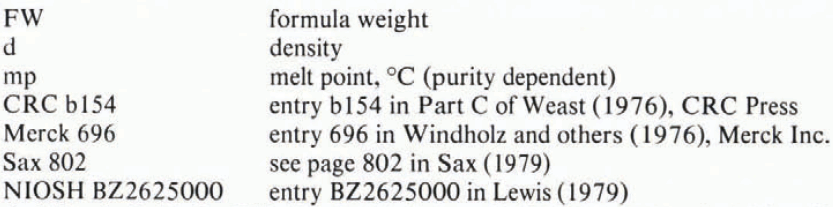
Explanation of abbreviations used below:
-
p–anisaldehyde C8H802 FW 136.15 d 1.119 mp 0°CRC b154 Merck 696 Sax 802 NIOSH BZ2625000. Supercooled below –5°C. Soft surface at –5°C. Could not prepare surface at –5°C.
-
Bicyclohcxl C12 H22 FW 166.31 d 0.864 mp 4° CRC b2186 Sax 416. Could not supercool below 0°C.
-
Cycloheplanol C7H14O FW 114.19 d0.948 mp? CRC c616. Supercooled below –10°C. Could not verify mp given in CRC c616.
-
Cyclohexane C6H22 FW 84.16 d 0.779 mp 7° CRC c637 Merck 2728 Sax 529 NIOSH GU6300OO0. Could not supercool below 00C.
-
Cyclohexylbenzene C12H16 FW 160.26 d 0.950 mp 6° CRC b484 Sax 900 NIOSH CZ1330000. Supercooled below –5°C. Froze quickly when disturbed. Soft surface at ⁻5°C.
-
n–decyl alcohol C10H22O FW 158.28 d 0.830 mp 7° CRC d57 Merck 2835 Sax 536 NIOSH HE4375000. Could not supercool below 0°C.
-
Didecyl phthalate C28H4604 FW 446.67 d 0.960 mp 4° NIOSH T10900000. Very viscous at 0°C. Difficult to freeze.
-
Diethyl fumarate C8H12O4 FW 172.18 d 1.053 mp 2° CRC fl87 Sax 578 NIOSH EM5950000. Supercooled below –5°C. Hard surface at – 5°C. Soft at 0°C. Vapour appears to irritate.
-
Diethyl sebacate C14H26O4 FW 258.36 d 0.965 mp 1° CRC d35 Merck 3794 NIOSH VS1180000. Supercooled to –3°C. Surface softens ‹0°C. Narrow range.
-
Diethyl suberate C12H2204 FW 230.31 d 0.981 mp 6°C CRC o 144. Supercooled below 0°C. Hard surface at –5°C. Could not obtain outline of ice texture (decomposition and/or solubility problem?).
-
Dimethyl adipate C8H1404 FW 174.20d 1.063 mp8°CRC h390 Merck 151. Could not supercool below 0°C.
-
O–dimethyl phthalate C10H10O4, FW 194.19 d 1.189 mp2° CRC p824 Merck 3244 Sax 611 NIOSH T11575000. Supercooled below –5°C. Hard at –5‹C. Surface film ›–5‹C. Too soft at 0°C to support sample.
-
1–ethoxynapthalene C12H12O FW 172.23 d 1.060 mp 6° CRC n179. Brown liquid. Supercooled below ⁻10°C. Soft surface at –2°C. Expensive.
-
Ethyl anisate C10H12O3 FW 180.20 d 1.104 mp 7° CRC bl779 NIOSH BZ46970OO. Supercooled below 0°C. Trace of surface film at 0°C. Rigid enough to support sample at 0°C.
-
Ethyl cinnamate C11H1102 FW 176.22 d 1.049 mp 7° CRC c356 Merck 2288 NIOSH GD9010000. Supercooled to 0°C.Too soft at –5°C for surface preparation. Decomposes in storage.
-
Ethyl salicylate C9H10O3 FW 166.17 d 1.131 mp 3° CRC bl662 Merck 3793 NIOSH V03000000. Supercooled below 0°C. Hard and no surface film at 0°C. Inconsistent results due to water solubility and decomposition.
-
l–fenchone C10H6O FW 152.23 d 0.948 mp 5° CRC f12 Merck see 3896 NIOSH RB7875000. Supercooled below 0°C. Soft at 0°C. Could not obtain outline of ice texture at –5°C.
-
Isopropyl myristate C17H34O2 FW 270.46 d 0.853 mp 8° CRC t83 Merck 5075 NIOSH XB8600000. Supercooled below 0°C. Surface too soft at ⁻5°C.
-
Methyl laurate C13H2602 FW 214.35 d 0.870 mp 6° CRC d303. Could not supercool below 0°C.
-
α–tetralone C10H10O FW 146.19d 1.099 mp 6° CRC tll7 NIOSH QK4375000. Reddish brown. Supercooled below –10°C. Hard and no trace of film at 0°C.
B. Stains, Dyes, and Indicator tried in this study



