1. Introduction
Embodied approaches to cognition strongly emphasize the role of the body, action, and sensory perception in mental processes. In one form or another, all “embodied cognition” researchers accept that higher-level processes, such as language, are influenced or even “structured by our constant encounter and interaction with the world via our bodies and brains”.Footnote 1 The “body,” in the term “embodied cognition,” emphasizes the cognitive development and management of motor functions to reach special purposes. In this view, cognition is rooted in the body and develops from the perception of humans' physical beings. Therefore, there is a very close link between perception-action-cognition and the notion of mind, of thought that arises and develops from the body's interaction with the environment. The embodiment hypothesis is based on the claim that our conceptual and linguistic systems are grounded in human physical, cognitive and social embodiment. The role of the human body in human conceptualization has attracted much attention in recent years. In this view, the body shapes the mind.Footnote 2 Thus, “The mind emerges and takes shape from the body with which we interact with our environment.”Footnote 3
In past decades, the Conceptual Metaphor Theory (CMT) has been a highly influential approach to embodied cognition arguing that metaphors are part of human's everyday thought and linguistic activity.Footnote 4 According to the CMT, a conceptual metaphor is a mental mapping between two different conceptual domains. This mapping is usually believed to be asymmetrical, with a more concrete and familiar source domain mapped onto a more abstract target domain.Footnote 5
From Aristotle to the present, metaphor has been an important topic of research. Although already recognized as a fundamental figure of speech for over 2000 years, Lakoff and Johnson's influential paper revolutionized the concept by finding that metaphor is not merely a rhetoric device, as it also functions in people's conceptual systems, playing a significant role in shaping thoughts and minds.
Metaphor is prevalent in man's everyday life, in our language, thought, and action. If true, then our daily experiences have something to do with metaphor. Similarly, body parts that function as the vehicles of human performance are considered the bases of many metaphorical expressions. Indeed, analysis of the important role body parts play in our daily communication has a long history; however, it is not until an understanding of cognitive linguistics occurred that particular attention began focusing on many bodily basis expressions. In the field of cognitive linguistics, linguists contributed greatly to establishing links between the human body and meaning. As noted, body parts are the starting point upon which our knowledge of the structure and functions of our body is based. Then our bodily experiences, both physical and psychological, exert an impact on metaphorical expressions involving body-part terms in different languages. The expressions of various languages will accordingly interact with different cultures and be shaped by their own cultural modes.Footnote 6
Metaphors use one entity (a “source”) to present another entity (a “target”); in other words, intangible entities are often described metaphorically. For example, positive experiences are metaphorically “up,” and negative experiences are metaphorically “down”.Footnote 7
In many metaphorical expressions, the human body and organs are used to describe abstract things, like communication, machines, and computers, and complex things such as teams, parties and groups, cities, nations, or technological facilities. In such metaphors, certain parts of the body are used as a source domain to describe other things. Thus, the body and body parts are concrete things used as a source domain in these metaphors.Footnote 8
The human body is often regarded as the dimension by which to measure things; as said by the sage Protagorus, “Man is the measure of all things”.Footnote 9 Humans have hands, feet, fingers, toes, a mouth, ankles, and knees. Our physical, social, and cultural experience provides many possible bases for the metaphorical usage of body parts in forming different terms in, for instance, numeral systems, mensural and sortal classifiers. This paper, through using Iran's Tāti language group as evidence, thus investigate the role and effects body parts have in the formation of such numerals and classifiers.
2. Theoretical background
Mathematics is a particularly challenging test case for conceptual metaphor theory, as it is one of the most abstract domains of human activity.Footnote 10 Speakers commonly refer to mathematical objects—such as numerals—in metaphorical terms, for instance by referring to “high numbers,” “falling prices,” and “rising taxes”.Footnote 11 An extensive analysis of the embodiment of such abstract mathematical structures concluded that “mathematics results from the human cognitive apparatus and must therefore be understood in cognitive terms.”Footnote 12 This study advocates and includes examples of a cognitive idea analysis of mathematics, which analyses mathematical ideas in terms of human experiences, metaphors, generalizations, and other cognitive mechanisms and propose that mathematical concepts are ultimately grounded in ordinary human activities, primarily interactions with the physical world.
There is much empirical evidence for embodied mathematics, which is any framework that sees at least some aspects of mathematical thinking as influenced by basic perceptual or sensorimotor processes. There are hundreds of studies on the embodied grounding of mathematics.Footnote 13
3. Linguistic background of Tāti Language Group
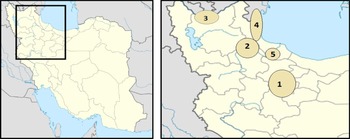
The evidence for this paper is gathered from Tātic, a northwest Iranian language family from the southwest of the Caspian Sea. Tātic consists of two closely related main groups, Tāti and Tālyshi, both of which are further grouped into Northern, Central, and Southern clusters. In addition to these, there is a third off-shoot of the group, Tātoid. The subgroups of Tātic are shown in Figure 1 below, where the numbers in parenthesis refer to the numbering in the image.Footnote 14
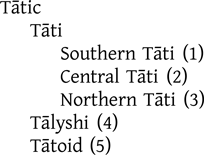
Locations of Tātic varieties in Northwest Iran
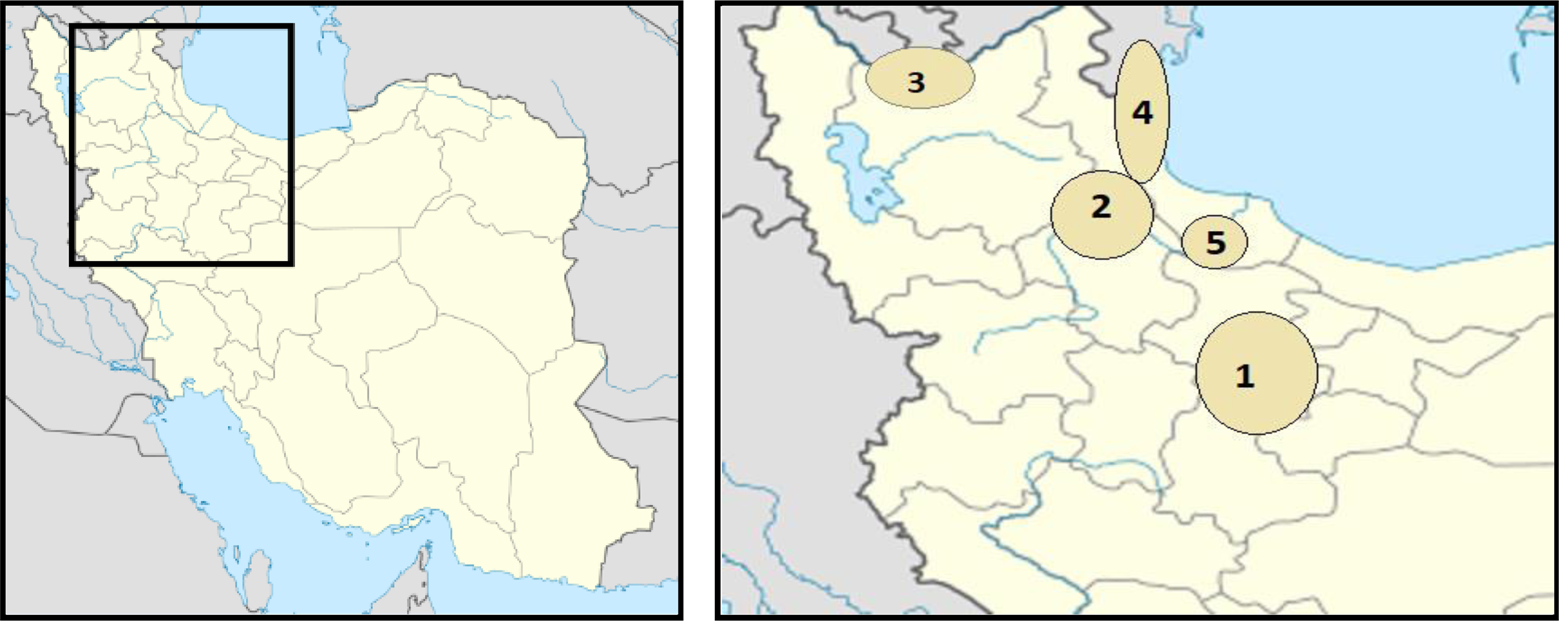
Tāti varieties are Iranian dialects (excluding Persian and Kurdish) spoken in northwest Iran, in areas where Azerbaijani Turkish is the common vernacular. These dialects, which are spoken sporadically across an area extending from the southern borders of the Aras River to the north of Sāveh in Markazi province, are so similar that there is no doubt of their common appellation. According to Yar-Shater: “technically speaking, Tāti does not refer to any particular dialect or group of dialects. The word Tāt is generally used in the area to denote the Iranian-speaking peoples in the region.” The designation of these dialects as “Tāti” follows general and vague usage, and thus Yar-Shater proposes that they instead be called “Median,” a more appropriate appellation.Footnote 15
The spread of Turkish across northwest Iran has resulted in many Tāti varieties becoming endangered or lost altogether. Indeed, this has happened to such an extent that the remaining Tāti varieties only exist in a few disparate, remote areas far from large cities such as Tabriz.
The evidence for this study comes from three varieties of the Tāti language family: Harzani, Karingāni, and Dəravi. Harzani (also called Harzandi) is a Northern Tāti variety from the Iranian branch of the Indo-European language family, and is considered a descendant of the Old Azeri language spoken in northwest Iran a millennium ago, long extinct as a result of Turkish diffusion in the area. On the ethnologue.com, glottolog.com, and multitree.org websites, Harzani's standard code or ISO 639-3 identifier code is hrz; on Unesco.org, it is given a critically endangered language classification, meaning its youngest speakers are grandparents and older, who speak the language partially and infrequently. Speakers of Harzani principally reside in the rural districts of Harzand, particularly in the villages of Galin Qayeh, Babratein, and Dash Harzand in the northern regions of Iran's East Azerbaijan province. Indeed, Harzani could be considered an almost extinct language, as, in 2021, we could only find one fluent native speaker, who was too ill to help us gather data.
The second language looked at here, Karingāni/Keringāni, is a variety of Northern Tāti of the Tātic language group. Karingāni is spoken in Karingān (locally Kerāngān), a village in the Eastern Dizmār rural district of the Varzaqān sub-province of Ahar, in Iran's East Azerbaijan province. On glottolog.org, Keringāni is identified as “keri1252,” its ISO 639-3 code is “kgn,” and it is considered a threatened language. When Yar-shater visited Karingān in 1960, he noticed: “The memory of the entire Dizmār and Kaleybar districts speaking Tāti lingered among some older people, but Turkish had been rapidly gaining ground, swallowing up the Tāti dialects, as has been the case in the entire Azerbaijan”.Footnote 16 Thus, Karingāni may be the last remnant of the Indo-European language in Iran's Azerbaijan province.
Dəravi is the third Tāti variety studied here. Dəravi is a Central Tāti dialect spoken in the village of Dərav in Shāhrud county, Khalkhāl sub-province, in the south of the Ardebil province. Dəravi and other varieties of Tāti in Khalkhāl have the ISO 639-3 code “shm” and glottocode “shah1254.” According to glottology.org, these dialects are endangered, as their status is shifting to both the vernacular Turkish and the country's formal language, Persian. However, the number of native speakers of this variety are many more than the other varieties mentioned; even children learn to speak this variety, along with Persian and Turkish.
4. Data Collection
The data used in this study was gathered via three methods. First, during fieldwork in the region between 2019 and 2021, we prepared and distributed a questionnaire of basic numbers and 40 natural sentences containing different numerals, as well as conducted interviews. These sentences were asked from a representative of native speakers of Tātic subgroups—including Harzani, Karingāni, and Dəravi—to be produced in audio form in their native Tāti languages. Here, we present the more interesting and unique numerals derived from these questionnaires. Second, we studied previous material on different Tāti languages and dialects, including descriptive grammar books, papers, and dictionaries, to analyze and discover how such numerals and classifiers are used. Third, as one of the authors is a native speaker of a Central Tāti Dəravi variety, he gathered data on this dialect organically, through his natural presence in this village.
5. Counting expressions in Tāti
Numerals are mathematical objects used to count, measure, and label. The most common examples of numerals are the natural numbers: 1, 2, 3, 4, and so forth. Numbers can be represented in language by number words, and individual numbers can be represented by symbols, called numerals. As only a relatively small number of symbols can be memorized, basic numerals are commonly categorized into a numeral system, i.e., an organized way to represent any number.
Many ancient numeral systems used powers of 10 to represent numbers, likely because there are 10 fingers on two hands and people began counting by using their fingers; a simplified method of counting used for thousands of years. The early Indo-European counted on their fingers and toes, a practice that usually led to base-5, base-10, and base-20 numeral systems.Footnote 17
The following subsection presents the numeral systems prevalent in Tāti.
1-5- Numeral systems in Tāti
Different Tāti varieties use different numeral systems. While most such varieties use a numeral system based on 10, a few still employ a more ancient, base-20 system, and fewer still take 50 as their base. These numeral systems are explained in greater detail below.
1-1-5- Harzani
Harzani uses two counting systems: base-10 and base-20. Base-10, also called the decimal or denary system, refers to the place value number system in common use around the world, which uses decimal numbers and relies on where the decimal point sits. This system uses 10 as its base number, with each digit in the position of a number able to have an integer value ranging from 0 to 9, thus it is called the base-10 system. Base-20, or the vigesimal numeral system, is based on 20 in the same way the decimal numeral system is based on 10. Vigesimal is derived from the Latin adjective vicesimus, meaning “twentieth,” as 20 individual numerals (or digit symbols) are used in this system, 10 more than in the decimal system. These counting systems are studied in next subsections.
Base-10 counting system
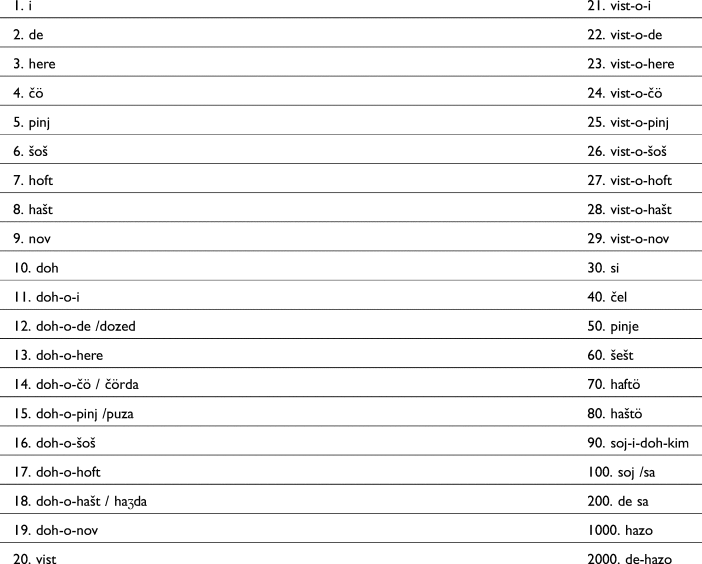
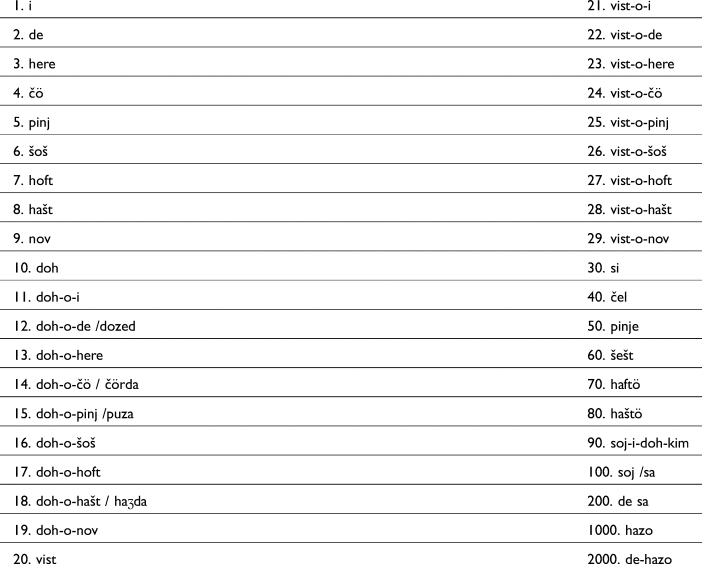
It goes without saying that hands, with the fingers providing their main functions, are one of the most important external body parts we use to deal with the outside world. Thus, human fingers have been widely used in various counting functions. The decimal system, noted above, is one of the most common numeral systems used throughout the world—and throughout time—to represent numbers. In Harzani, base-10 is the most common counting system and used similarly to that of Persian, except for number 90, which is soj-i-doh-kim or 100-1-10-less, meaning 100 minus 10. Another characteristic of the decimal system used in Harzani is that most of numbers 11 to 19 are made using number 10 plus numbers 1 to 9, with only numbers 12, 14, 15, and 18 having alternative separate terms. The decimal system in Harzani is typologically common, particularly among Iranian languages. Some examples are shown in Table 1 below.
The decimal system in Harzani
Base-20 counting system
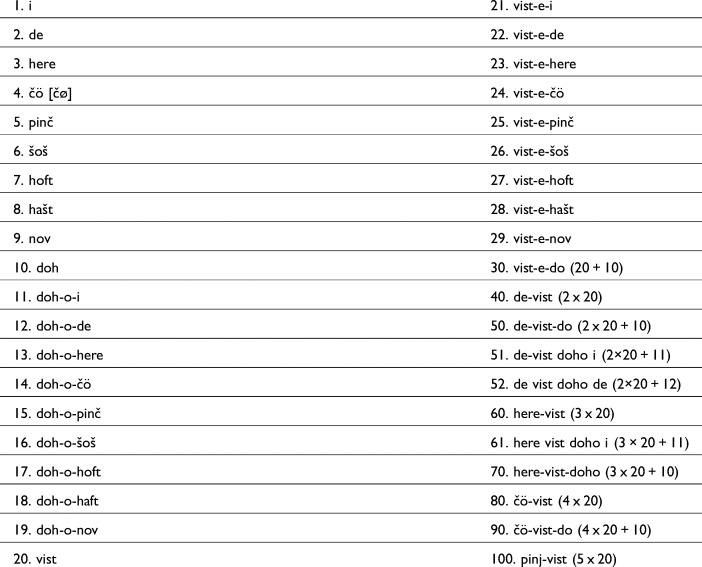
Aside from the decimal counting system, Harzani's older number system is based on 20. Examples of the base-20 counting system in Harzani are found in Table 2 below.
The vigesimal system in Harzani
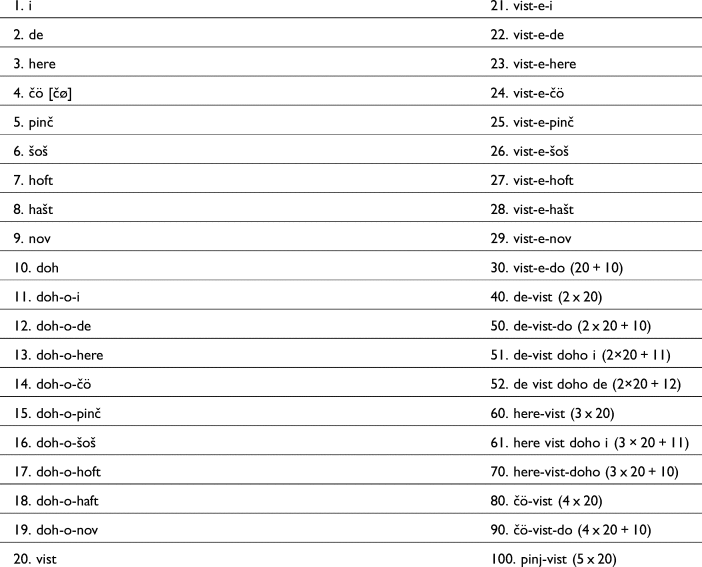
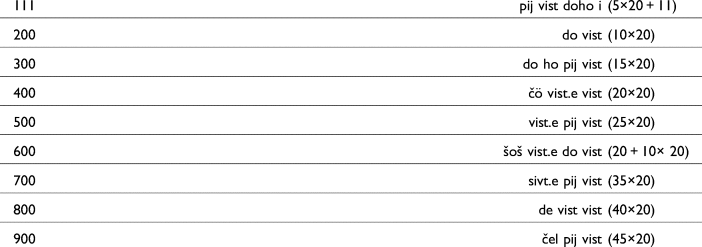
The vigesimal system continues into larger numbers through addition and multiplication. Some such examples are shown in Table 3.
The vigesimal system in 3-digit numbers
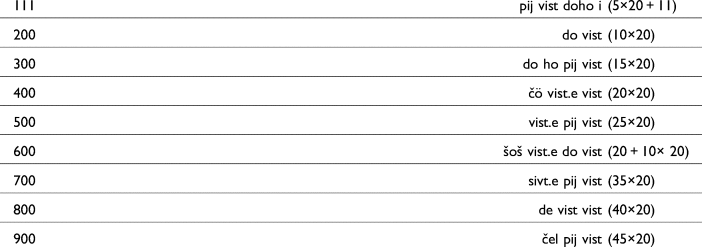
Harzani is not the only Iranian language that uses the vigesimal system. Indeed, in the Digor dialect of Ossetic, both the vigesimal and decimal systems are used. Further, Wakhi also has an old traditional vigesimal system and a modern decimal system borrowed from Persian. While the older generation of speakers tends to use the traditional vigesimal system, the younger generation uses more the modern decimal system in their spoken language. Additionally, both Yazgulami and Yadgha (Yidgha)—the latter of which is spoken in the Chitral district of Pakistan's Khyber Pakhtunkhwa province—also use a traditional vigesimal system. Southern Pashto, likewise, seems to have a decimal system and an old traditional vigesimal system as well.Footnote 18
As Harzani is nearly an extinct language, the only native speaker was 85 years old in 2021 and too ill to produce any Tāti sentences for us to use as examples here.
2-1-5- Karingāni
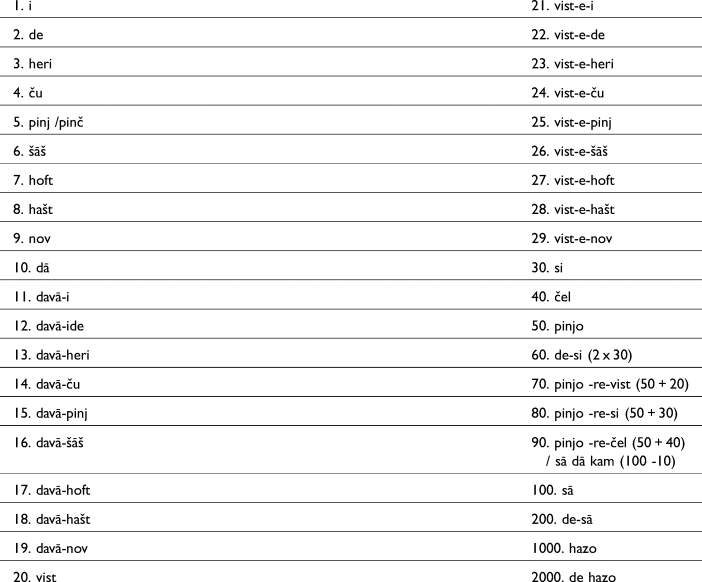
Karingāni or Keringāni uses a decimal system for numbers 1 to 50 but has special constructions for numbers 60, 70, 80, and 90. Karingāni's numeral system is shown in Table 4 below.
Karingāni's numeral system
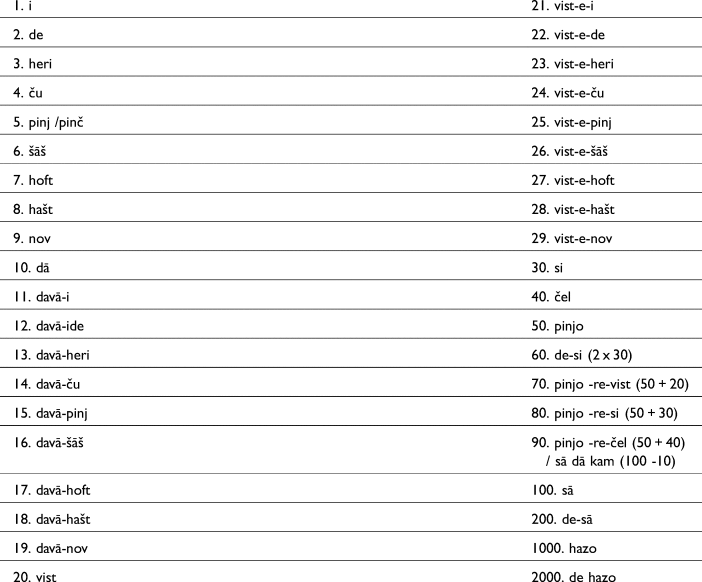
As Table 4 shows, Karingāni uses a unique system to form numbers 60 to 100, as it does so by adding 50 to other numbers. This is called a base-50 system. Numbers 90 to 99 are formed by subtracting from 100. Although this is unique to Karingāni, Calude and Verkerk state:
the Indo-Iranian languages make use of subtraction rather than addition for 19 (representing it as 1–20, rather than the expected 10 + 0). And in Sanskrit, 19 can be coded either using subtraction or addition, and similarly, in Ladin, a Romance language of Northern Italy, there is variation between how 18 and 19 are coded (using subtraction or addition).Footnote 19
It seems that using subtraction to form numbers near the end of a number line is more convenient than using addition or multiplication.
Based systems are classified according to the number of bases used in the organization of counting. Hammarström defines the set of bases of a natural language numeral system as follows:
the number n is a base if
(1) the next higher base (or the end of the normal expressions) is a multiple of n; and
(2) a proper majority of the expressions for numbers between n and the next higher base are formed by (a single) addition or subtraction of n or a multiple of n with expressions for numbers smaller than n.Footnote 20
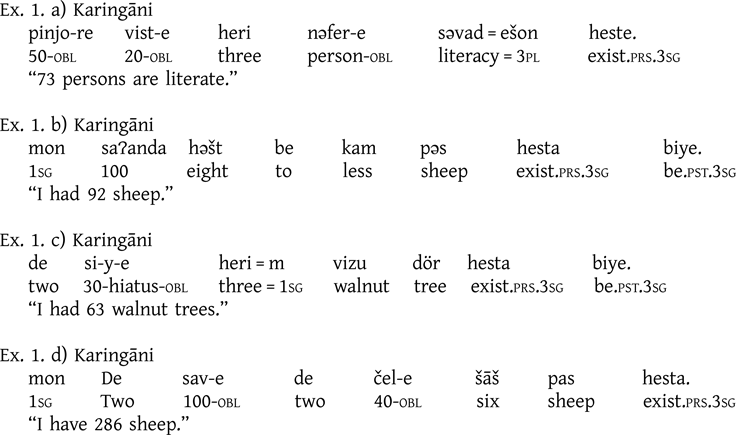
Thus, the expression “base-50 system” may be used for Karingāni to indicate that “50 is in the set of bases” for its numeral system. In this language, all the numbers greater than 60 are expressed not by simple words, but by compound words made up of the base 50 added to other numbers. Below, Example 1 shows instances of these numbers used in sentence form:
This section presented the morphology and semantic structure of Tāti's numeral system, which is sometimes based on a decimal system, sometimes based on a vigesimal system, and sometimes based on both.
2-5- Mensural classifiers in Tāti
Researchers identify two general types of classifiers: mensural and sortal.Footnote 21 Mensural classifiers have a contingent or temporary relationship with nouns, often belong to an open class, and usually co-opt as units of quantification.Footnote 22 The word “mensural” comes from the word “measure,” i.e., words of measure words, such as one kilo of bananas, a basket of grapes, and three cubits of cloth. Mensural classifiers are usually preceded by numbers because their general use is in counting amounts; that is, measuring entities in units that can themselves be counted. Mensural classifiers, however, are not part of the numeral system, as they instead accompany the numeral system. For example, when we say three baskets of grapes, we are not actually counting the number of grapes; we are counting the baskets. In this instance, the baskets could be differently sized, so we do not actually know how many grapes each one holds. Indeed, three baskets of grapes could be three kilos of grapes or nine kilos of grapes. While we count the same grapes in terms of baskets or kilos, these are not numbers per se; they are amounts, thus mensural.
The Dəravi dialect of Central Tāti makes great use of body parts in forming mensural classifiers. The first such interesting usage is employing the hand as a counting unit. For instance, Dəravi uses a particular method for counting walnuts, a method traditionally used in the Dərav village, which is common nowadays. The word “das” literally means “hand” but metaphorically i das (one hand) means 10 walnuts, which are usually placed in two hands.Footnote 23 However, das is only used for counting walnuts; other items are counted using other classifiers. Instances of this kind of Dəravi counting are shown in Example 2 below:
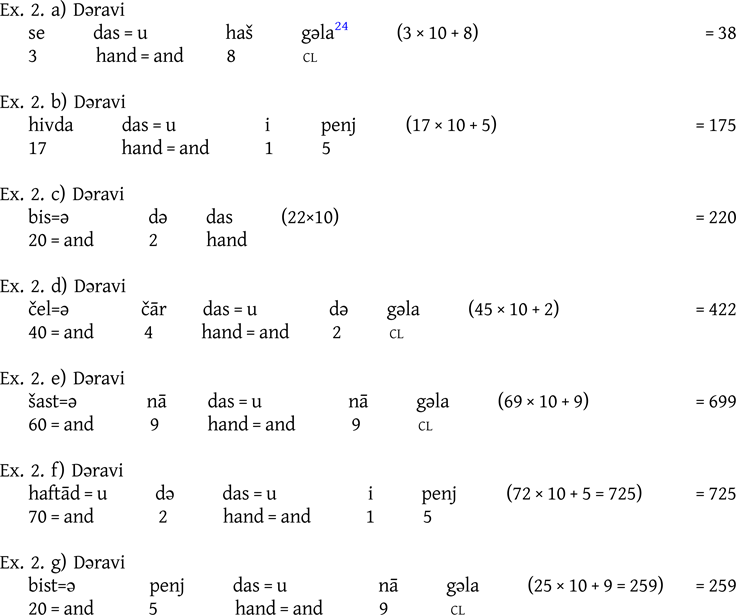
As Example 2 shows, the fingers of the two hands are used to count walnuts. In practice, people place walnuts five by five into two hands and count according to the 10 fingers of the two hands.
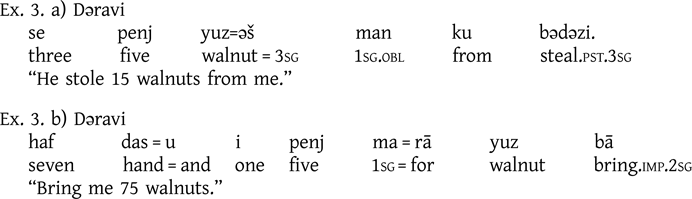
Penj: literally means five, but when used together with walnuts, this classifier means five fingers of a hand, which metaphorically means whatever can be held in an adult person's hand. This classifier is also mostly used for counting walnuts. For example:
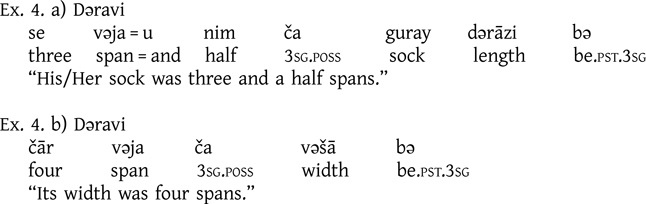
Vǝja: literally is a body part, and means the distance (span) from the end of the thumb to the end of the little finger of a spread hand. This word is also used metaphorically as a unit of length equal to 22.9 centimeters.
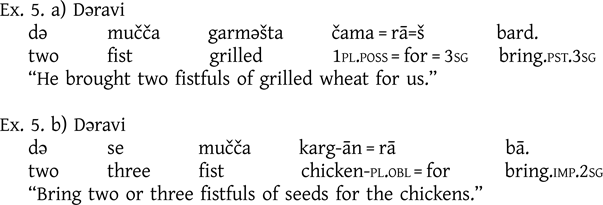
Mučča: literally means a fist, and implies anything that can be held inside a fist.
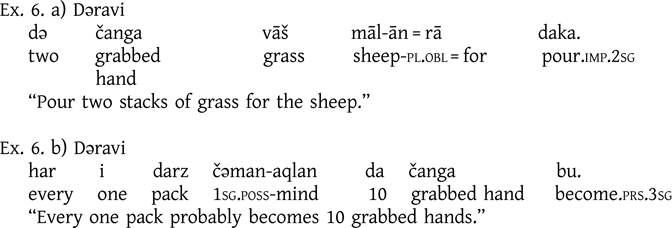
Čanga: literally means a clenched hand, and refers to whatever can fit in a grabbed hand. This classifier is usually used for counting, for example, a stack of grass or harvested wheat. See Example 6:
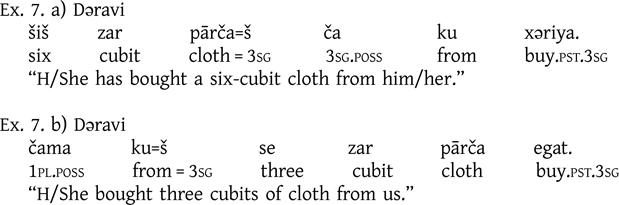
Zar: “cubit,” literally means the length of the arm from the elbow to the tip of the middle finger and is considered equivalent to two spans. This word is used to measure the length of items such as cloth. See Example 7:
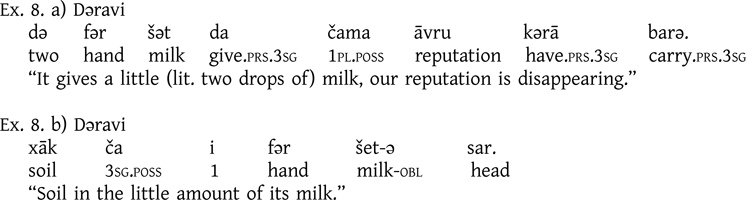
Fǝr: literally means “hand,” and refers to the amount of milk that pours with every pull of the hand when milking a cow. This expression has negative semantic content. See Example 8:
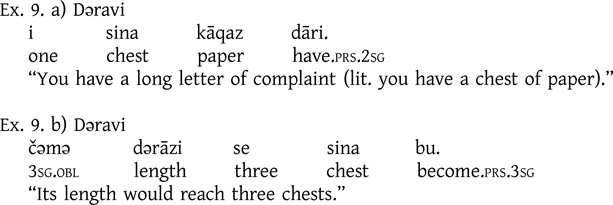
Sina: literally means chest, and is used as a unit of length from the tip of the fingers of an extended arm and open palm to the tip of the nose, which is equal to nearly a meter. The conceptual metaphor for this word would be formulated as chest as a unit of measurement.
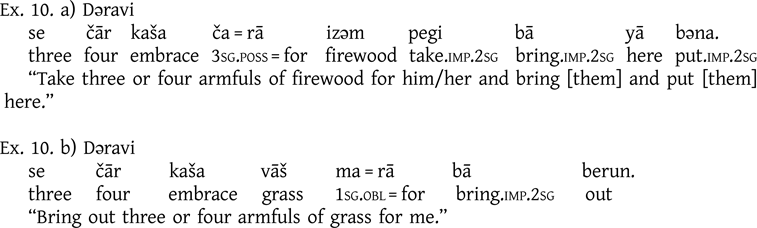
Kaša: literally means embrace or armful and refers to the amount that can be held in an armful when both arms are open.Footnote 25 This classifier is used for items such as firewood, grass, etc.
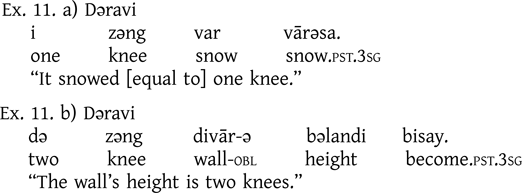
Zəng: literally means the knee of a human and is used to measure height.Footnote 26 This classifier equals about 30 centimeters. For example:
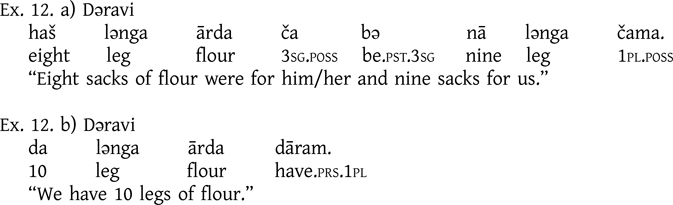
Lǝnga: literally means leg, and refers to the amount of the load that hangs over the two sides of a load-bearing animal, such as a horse or donkey. It is as if the load is a human riding the animal, with its legs hanging down the animal's sides. The conceptual metaphor for this word would be: load is a human. In other words, when an animal carries a load that hangs over its two sides, the load is similar to a human with two legs.
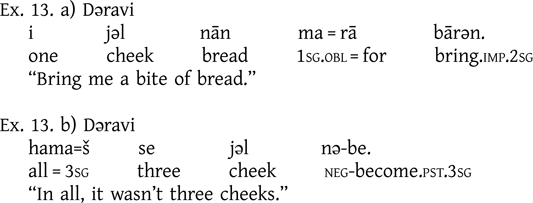
Jǝl: literally means cheek but is used metaphorically for the amount of food that can be placed inside the mouth or in one cheekFootnote 27. For example:
Dam: literally means mouth, and refers to the number of times an animal bites and takes grass inside its mouth.
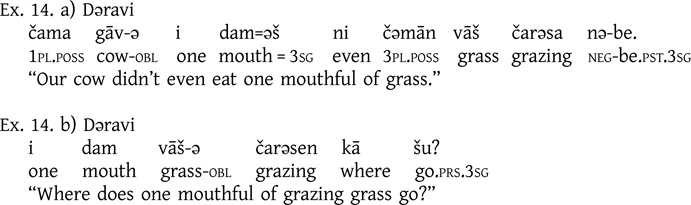
Gāz: literally means tooth, and metaphorically denotes the number of times a person bites a food or fruit, such as an apple. Thus, it is used as a unit of counting.
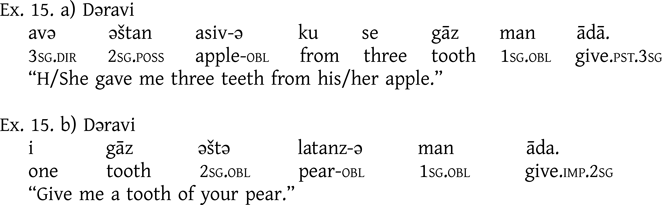
3.5. Sortal Classifiers
Sortal classifiers are words (or morphemes) that are needed within the enumeration context; indeed, in the context of enumeration in some languages, sortal classifiers are obligatory.Footnote 28 In such languages, sortal classiifers are used to indicate quantificational units for sortal nouns, which name things with natural quantificational units. Sortal classifiers are in a closed class and rote memorization is often required in order to use the correct classifier in each context.Footnote 29
Gǝla: literally means the eye pupil and nipple in Dəravi.Footnote 30 Example 16 shows instances of the original lexical sense of gəla in Dəravi.
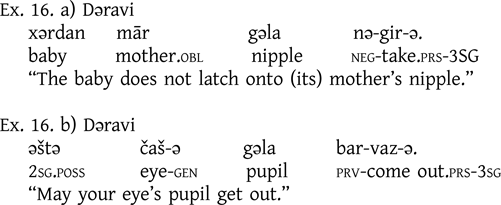
Gəla is also the numeral classifier for human, animate, and other inanimate head nouns in Dəravi, as well as used in all dialects of Talyshi and a few neighboring Tati languages.Footnote 31 As, in Dəravi, gəla is generally used as a classifier for all countable items, it is considered a universal numeral classifier in this dialect; a classifier that can also be used for human nouns, as Example 17 below shows.
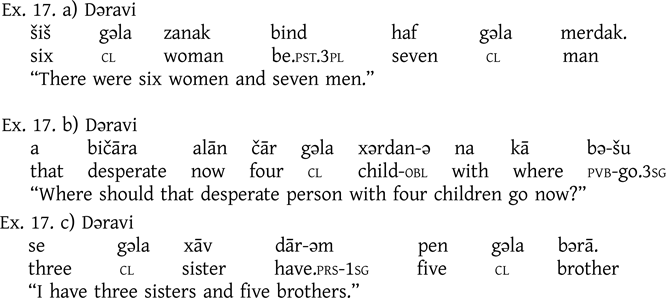
This classifier is also used for countable animals, as Example 18 demonstrates.
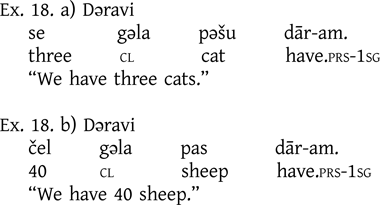
Countable objects are also accompanied by gəla, as Example 19 shows.
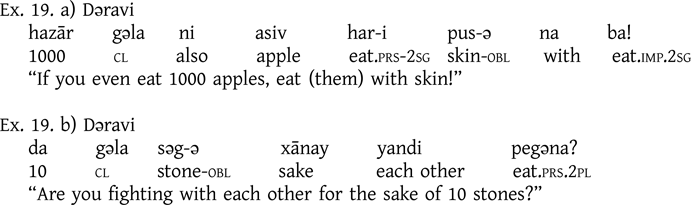
However, this classifier is not used for noncountable nouns in Dəravi, as expected.
6- Discussion
This article pays special attention to the connection between metaphors that employ the body or body parts as domains in the metaphoric mapping of numbers, numeral systems, classifiers, and the notion of embodiment. Embodiment means that parts of our conceptual system, and aspects of our language as a result, are structured by our bodily characteristics and functioning in everyday life. In particular, this article discusses three different but closely related topics about the role of human body parts in forming numerals and classifiers. First, the morphology and semantic structure of the numeral systems in Tāti, which are sometimes based on a decimal system and sometimes based on a vigesimal system (or other).
Numeral systems and classifiers are part of everyday language, are widely used in all aspects of human life, and are expressed using different methods in world languages. Here, the role of body parts in forming numerals is the focus. The human body—those body parts easily seen, such as hands and feet, or more precisely fingers and toes, in particular—is a concept humans become familiar with in early childhood and continue to connect with throughout their lives. This how body parts have played a determining role in the formation of language vocabulary, in particular words related to numerals and classifiers.
Human babies see, experience, and use their body parts from very early in childhood, and are most in contact with their body parts at this time. In the same manner, human toddlers learn the words to refer to hands and feet as early as 18 months, as well as understand basic parts such as head, eyes, mouth, fingers, and toes. It is no wonder that many languages use fingers and/or toes to form numerals.
Many scholars have studied the role of language in the development of numerical reasoning. For example, Tylor states that numeral words have an object origin and did not come into existence through any preconceived ideas, describing the universality of the direction of thought as: “all nations appear to have commenced counting with gesture-signs on the fingers to express successive numerals, then to have coined words from the hand, fingers, toes, & etc., for the numerals”Footnote 32. Furthermore, the use of the human body is widely assumed to account for the cross-linguistic prevalence of base-5, base-10, and base-20 systems, or a combination.
The early Indo-Europeans counted on their fingers and toes, a practice that often led to numeral systems with base-5, base-10 or base-20Footnote 33. Aside from European languages, which usually prefer base-10 systems, base-5 systems are quite widespread across the world.Footnote 34 In many languages, the number “5” is associated with “hand,” from the counting of five digits on one hand, alongside the word for five being related to the term “hand”.Footnote 35 The Dəravi dialect of Tāti seems to have a restricted base-5 system, particularly in counting walnuts, as the word das (hand) is used to form numbers 10 and above.
Finger counting has always been a universal factor shaping the spatial nature of numerical processing. Most children initially acquire number concepts via finger counting, either through spontaneous practice, observing their parents, or direct tutorial. There is also a long cultural tradition of finger counting that is still, surprisingly, prevalent today, both as overt behavior and cognitive representation. Base-10 counting systems are one of the most widespread numeral systems in the world, including among Tāti, as shown in the example of Harzani in Table 1.Footnote 36 Harzani's base-10 system is clear, as numbers 11 to 19 are formed by adding 10 to numbers 1 to 9.
Most base-20 systems have sub-base-5 or sub-base-10, as purely base-20 systems are uncommon.Footnote 37 Only a few groups of people used both hands and feet to form base-20 systems, resorting to their 10 toes after exhausting their 10 fingers.Footnote 38 Indeed, the highly endangered Harzani dialect of Tāti uses a base-20 system, but has also preserved the decimal system, using it in counting. The only native speaker of this language we encountered, however, was 85 years old and unable to express any example sentences at the time of data collection in 2021.
The difference between Tāti's numeral systems and other world languages that use body parts in counting is that some of these languages use body parts as numerals—e.g., in Guaraní (Paraguay), po means “hand” and “five” (i.e., one, two, three, four, hand) as well as in languages of New Guinea and other parts of the world.Footnote 39 Iranian languages like Tāti, on the other hand, do not body part words for actual numerals. For example, in the Dəravi numbers (i, də, se, čār, penj, šiš, haf, haš, nā, da, hivda, bist, čel, šast, haftād, etc.), no number also means a part of the body. However, in the discussion on Harzani and Keringāni, we saw that counting on fingers or fingers and toes yielded numeral systems based in 10 and 20, which are common in the world's languages. The base-50 system is very unusual, and although no body part words are actually used as a numeral, body parts do affect the numeral/counting systems.
The second and third topics discussed in this paper were mensural and sortal classifiers that use body parts metaphorically as units of measure. The Dəravi dialect of Tāti uses body parts such as the chest, knee, etc. for referring to height, volume, length, depth, etc. For example, whatever which can be placed in a hand or fist is a measurement of volume and whatever equals the length to the knee can be compared and measured using this body part. In other words, Dəravi uses body parts to form mensural classifiers that indicate size, amount, length, etc. These are all examples of metaphors that use body parts to describe other things; metaphors in which certain parts of the body are used as a source domain for the description of other things. Such metaphors are proof of embodiment, in that body parts are concrete things used as source domains and mensural and sortal classifiers are abstract concepts made based on these concrete notions. The direction of these mappings is from concrete to abstract, as the body is mapped onto more abstract concepts such as mensural and sortal classifiers.
7- Summary
In this paper, three different but closely related topics about how body parts are used to form and affect number systems and classifiers are discussed. These topics included numeral systems, mensural classifiers, and sortal classifiers. Number systems and classifiers make up part of nearly everyone's daily vocabulary.
The Tāt people have metaphorically employed various body parts, including fingers and toes, in their methods of reckoning, using body parts as visual counting aids in order to come up with base-10, base-20, and base-50 counting systems. While base-10 and base-20 systems are the most common among world languages, base-50 is a unique counting system peculiar to the Tāt people. However, these Tāti varieties—the remnants of ancient languages spoken in Iran—are quickly shifting to Turkish and Persian; unfortunately, their unique counting systems will be lost with them.
In this research, we found evidence of three counting systems in the northwestern branch of Iranian languages. The vigesimal system will soon be forgotten, as there are very few speakers of Harzani and they are very old. The other interesting finding is the role human body parts play in forming the mensural and sortal classifiers used for quantifying and counting in the Dəravi variety of Tāti. All this has shown the human body's important role in forming the vocabulary of languages, as well as how body parts are used metaphorically as classifiers.
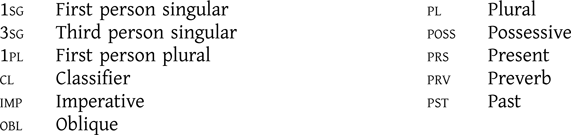
Abbreviations
Acknowledgements
We would like to thank Professor Donald Stilo and an anonymous reviewer, who offered comments and criticism on earlier versions of this paper. We also sincerely thank the native speakers of Tāti languages for sharing their linguistic knowledge with us, in particular, many thanks go to Mr. Mohammad-Nezhad, native speaker of Karingāni.
Financial Support
This research received no specific grant funding from any funding agency, commercial or non-for-profit sectors.
Disclosures
None