Introduction
The late onset form of Alzheimer's disease (LOAD) has a multifactorial etiology involving a complex interaction of multiple genetic and environmental factors (Tanzi, Reference Tanzi2012). Genetic findings within the last five years explain about 47% of the population attributable risk of LOAD which rises to 61% taking account the established APOE haplotype (Medway and Morgan, Reference Medway and Morgan2014). There are other suggested risk factors as advanced age, low educational level and vascular risk factors such as diabetes mellitus (DM) type 2 and arterial hypertension (AH) (Reitz and Mayeux, Reference Reitz and Mayeux2014).
In 2007, Reiman and colleagues (Reiman et al., Reference Reiman2007) carried out a GWAS which first identified the GRB-associated binding protein 2 (GAB2) gene as a susceptibility gene for LOAD and further suggested that GAB2 modifies the risk in APOE ε4 carriers subgroup. Although subsequent studies showed contrasting results, numerous follow-up studies have supported GAB2 as a strong candidate gene in Caucasian but not in Asian populations (Jin et al., Reference Jin2013; Zou et al., Reference Zou2013). GAB2 might play a role in preventing neurofibrillary tangle formation and cell death, and therefore a loss-of-function GAB2 haplotype would reduce such protection (Reiman et al., Reference Reiman2007).
Several lines of evidence point the brain-derived neurotrophic factor (BDNF) as an important candidate gene conferring risk for AD. BDNF is widely distributed at central nervous system and has an essential role at synaptic plasticity, function and neuronal survival. Genetic studies have implicated the functional SNP rs6265 (G/A) -a valine to methionine substitution at codon 66 (Val66Met) – as a risk factor for AD, although negative findings have also been reported (Diniz and Teixeira, Reference Diniz and Teixeira2011).
Our aim was to study the association between GAB2 and BDNF polymorphisms and the risk of developing LOAD and the age-at-onset in a sample of Brazilian population with low educational level.
Material and methods
Subjects
Subjects were recruited from the outpatient clinic Instituto Jenny de Andrade Faria for the Elderly-Universidade Federal de Minas Gerais, Brazil and characterized as previously described (Bicalho et al., Reference Bicalho2013). Their medical records were retrospectively reviewed. The clinical and demographic variables studied were age, sex, education, AH, type 2 DM, dyslipidemia and smoking. The protocol has been approved by the University's Ethics Committee. A written informed consent was obtained from all subjects and their families.
Genotyping analysis
Genomic DNA was obtained from peripheral blood using high salt extraction method (Lahiri and Nurnberger, 1993). Genotyping was performed by Real-time PCR using Taqman® technology (7,500 Real-time PCR system). PCR protocols were carried out with TaqMan® SNP Genotyping Assays, according to the manufacturer's instructions (Applied Biosystems, Foster City, CA).
The sample was independently genotyped for a set of 40 biallelic short insertion/deletion polymorphisms (indels) to determine European, African and Amerindian ancestries. The PCR was performed with four multiplex reactions, each one consisting of a mix of 10–12 primer pairs (Bastos-Rodrigues et al., Reference Bastos-Rodrigues, Pimenta and Pena2006).
Statistical analysis
The χ 2 test was used for the comparison of genotypic and allelic frequencies in Unphased software version 3.1.4 (Dudbridge, 2008). The proportion of European, African and Amerindian ancestry was estimated using the Structure program version 2.1 (Pritchard et al., Reference Pritchard, Stephens and Donnelly2000).
In order to analyze the interactions between the three genes (epistasis), we estimate the gain of gene interaction between the polymorphisms according to Moore (Reference Moore2004) description with the MDR software (version 2.0), which can be used in small samples sizes. The top-ranked interaction model was chosen for a given order interaction according to cross validation consistency (CVC) of > 7/10, prediction accuracy of > 50%, and empirical P value of < 0.05 based on 1,000 permutation tests.
The normality of quantitative data was assessed with Shapiro–Wilk test. Clinical and demographic data were analyzed by χ 2, Mann–Whitney and Kruskal–Wallis tests. Variables with p-value < 0.20 in the univariate analysis were selected for a multiple logistic regression analysis with backward selection of predictors. A p-value of p < 0.05 was considered statistically significant. The statistical analysis was conducted using R version 3.0.2 (R Core Team, 2013). The findings from regression model were internally validated by bootstrapping resampling method (Steyerberg et al., Reference Steyerberg, Harrell, Borsboom, Eijkemans, Vergouwe and Habbema2001; Brunelli, Reference Brunelli2014) using SPSS version 20.0.
Results
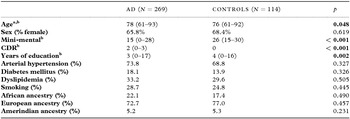
The main characteristics of the sample are described in Table 1. The control group was significantly younger than patients (p = 0.048) but this difference should not impact negatively the results, since we use age as covariate. There was no difference in genomic ancestry among Brazilians with African, European or Amerindian ancestries between the groups. The strong imprint of European genomic ancestry in Brazilians was confirmed in our results (Table 1). There were no differences for sex, AH, DM, dyslipidemia or smoking. The years of education were significantly lower in AD (p = 0.002).
Subjects’ clinical and demographic data

AD: Alzheimer's disease; CDR: Clinical Dementia Rating.
aAge at diagnosis for AD patients, and age at inclusion in the study for controls.
bExpressed as median (minimum– maximum).
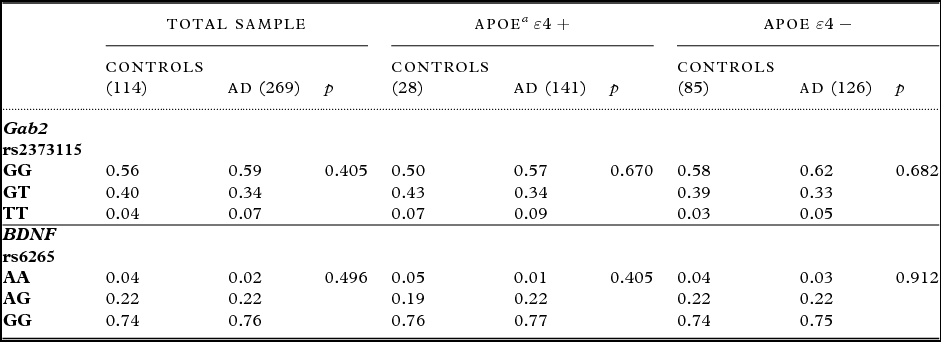
All the groups were in Hardy–Weinberg equilibrium. No statistical differences between the GAB2 and BDNF polymorphisms were observed even when stratifying by APOE ε4 status (Table 2). No association was observed at the age-at-onset, either (p = 0.848 and p = 0.356 respectively, data not shown).
Genotypic distributions of GAB2 rs2373115 and BDNF rs6265 polymorphisms between cases and controls in total sample and stratified by APOE ε4 status
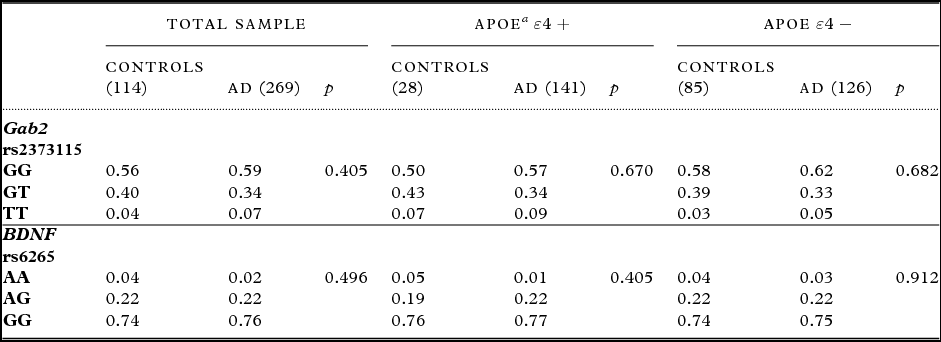
AD: Alzheimer's disease.
aGenotyping of APOE from 1 control and 2 AD patients are missing.
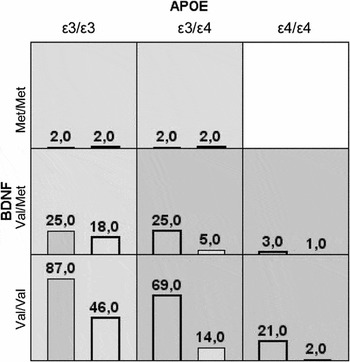
For the gene–gene interaction, we found the best interaction model consisted of two genes on LOAD group (Figure 1). At the two-locus model between BDNF and APOE, we observe a synergic association between ε4 allele and val allele (CVC of 7/10; prediction accuracy of 0.59; p-value = 0.031, after 1,000 permutation test). The combination of these polymorphisms gives a positive gain of information and raises the power of disease prediction.
MDR attribute construction for a two-locus interaction identified at multifactor dimensionality reduction (MDR) analysis.
Distribution of cases (left bars), and controls (right bars) for each genotype combination. Dark shading represents high-risk genotypes while light shading low-risk genotypes. White cells are empty cells (no cases or controls). Note that the patterns of high-risk and low-risk cells differ across each of the different multilocus dimensions, presenting evidence of epistasis. (Accuracy: 0.5949; cross-validation consistency: 07/10; permuted p-value: 0.031 (1,000-fold permutation testing)).

The results from interaction between APOE and GAB2 suggest redundancy – their combination gives a negative information gain and therefore decreases the power of disease prediction – and was not considered a good model. At the three locus model, the interaction between BDNF and APOE were also observed regardless of the GAB2 genotype but it was not statistically significant (cross-validation consistency of 10/10; prediction accuracy of 0.55; p-value: 0.289, after 1,000 permutation test).
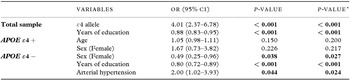
The best model from the multiple logistic regression analysis examining associations of the variables with AD is shown in Table 3. In total sample, the ε4 allele (OR = 4.01), and education (OR = 0.88) were the best predictors. In the ε4 positive subgroup, none of the variables were associated. On other hand, in the ε4 negative subgroup LOAD patients had a lower level of education (2.8 ± 2.5 vs. 4.6 ± 3.9 years, p = 0.002), and a higher frequency of AH (79.2% vs. 65.1%, p = 0.025) compared to controls. As the sample is relatively small, we used bootstrapping with 5,000 samples in order to internally validate the regression models. At the multivariate analysis, the best predictors were female sex (OR = 0.49), years of education (OR = 0.80), and AH (OR = 2.00).
Best model from multivariate analysis of the risk of developing AD in total sample and stratified by APOE ε4 status

OR: odds ratio; CI: confidence interval.
*p-value obtained from logistic regression with bootstrapping sampling method (5.000 bootstrap samples).
Discussion
In our sample, the GAB2 and BDNF genes was not associated with LOAD as previously reported.
Recently, a meta-analysis made with all available published data observed significant population heterogeneity across the studies for GAB2 variants (Zou et al., Reference Zou2013). Our sample shows a mix from three different ancestral roots – Ameridians, Europeans and Africans – and consequently a heterogeneous genomic ancestry (Bicalho et al., Reference Bicalho2013). It is also hypothesized that the susceptibility to LOAD may be dependent on the GAB2 haplotype background rather than a single variant (Zou et al., Reference Zou2013).
There are conflicting data regarding the association between AD and Val66Met. Even though, Val66Met was not directly associated with the disease, its synergic association with APOE indicates a role of this functional SNP in AD. The synergy means a situation which the interaction between the SNPs generates more information than the correlation between the pairs. The genetic interaction analysis from MDR demonstrated a two-locus synergic interaction between val66met and APOE ε4 in AD. AD is a complex disease that involves several molecules, cells and systems, and both APOE and BDNF are critical for the brain functions and integrity. Interaction effects between APOE and BDNF genes were already been observed influencing β-amyloid load, cognitive performance (episodic memory and executive function), serum BDNF levels and hippocampus activity both in older adults cognitively normal and AD patients. (Adamczuk et al., Reference Adamczuk2013; Kauppi et al., Reference Kauppi, Nilsson, Persson and Nyberg2014; Liu et al., Reference Liu2014; Ward et al., Reference Ward, Summers, Saunders, Janssen, Stuart and Vickers2014; Sapkota et al., Reference Sapkota, Vergote, Westaway, Jhamandas and Dixon2015).
Although patients were significantly older than control group, age was not an independent predictor at the multiple regression analysis. We observed that years of formal education were a protective factor for LOAD. The cognitive reserve (CR) hypothesis suggests that higher educational level is a factor that contributes to delay the manifestation of dementia by allowing individuals with Alzheimer's pathology to use cognitive processing or compensatory approaches to cope with brain damage. CR is a theoretical construct that postulates that certain lifetime experiences such as education increase the efficiency, capacity and flexibility of brain networks resulting in greater ability to sustain brain damage without any noticeable deficit in cognition. As a result, individuals with greater CR are thought to be able to sustain greater levels of brain pathology before showing clinically significant levels of impairment (Roe et al., Reference Roe2007; Soldan et al., Reference Soldan2013). Education may also trigger a cascade of events that reduces the risk of brain damage such as a healthier lifestyle (physical activity, lower alcohol consumption, non-smoking) and decreases the risk for cardiovascular diseases (Scazufca et al., Reference Scazufca2008).
While in ε4 carriers subgroup, we did not find any association, in ε4 negative subgroup sex, AH and years of education were associated with LOAD. AH was a risk factor for AD only in the absence of the strong genetic risk factor from APOE gene. Indeed hypertension may impair cognitive functions and is related to the occurrence of AD (Duron and Hanon, Reference Duron and Hanon2008). Data from histopathological studies indicates a major overlap between vascular lesions and AD. The differences in frequency across ε4 status might be explained by the role of apoE in cholesterol and lipid transportation. ApoE regulates the metabolism of lipids by directing their transport, delivery, and distribution from one tissue or cell type to another (Verghese et al., Reference Verghese, Castellano and Holtzman2011). Converging evidence from several studies indicate an important relationship between the deterioration of brain lipid homeostasis, vascular changes, and the pathophysiology of LOAD (Leduc et al., Reference Leduc, Jasmin-Bélanger and Poirier2010). The apoE isoforms interact differently with specific lipoprotein receptors, ultimately altering circulating levels of cholesterol (Eichner et al., Reference Eichner2002). The ε4 isoform has been linked to increased levels of LDL and has been demonstrated to be a risk factor for cardiovascular disease (Kim et al., Reference Kim, Basak and Holtzman2009).
As observed in total sample, in the ε4 negative subgroup a longer time of education was a protective factor. While the CR in AD has been consistently observed, there is only little research investigating the role of genetic background. An unfavorable genotype might influence disease expression by reducing the potential of reserve mechanisms (Garibotto et al., Reference Garibotto2012). It has been suggested that APOE ε4 carriers have more severe AD pathology and a faster cognitive decline. As a consequence, it could be considered a factor disruptive to reserve mechanisms (Garibotto et al., Reference Garibotto2012) justifying why education was not associated with AD within this group. Evidences suggest that apoE modulates processes of neurodegeneration and may impact negatively on synaptic plasticity and response to neuronal injury (Verghese et al., Reference Verghese, Castellano and Holtzman2011). The APOE alleles have differential impacts on plasticity – the ε4 allele inhibits neurite growth and dendritic plasticity whereas the ε3 allele promotes these processes (Mesulam, Reference Mesulam1999).
Opposite to the literature, we found that sex is associated with AD. The prevalence of AD is higher in women compared to men. However, incidence studies examining sex differences in AD are equivocal. While the majorities of these studies have not observed the differences in the rates of developing AD, some studies report a higher incidence of AD in men than women until the age of 78. These sex differences could be explained by biological (genetics, hormones), and social factors (education, occupation, exercise, and smoking) (Mielke et al., Reference Mielke, Vemuri and Rocca2014).
Conclusions
In summary, only APOE ε4 was an independent genetic risk factor for AD in our sample. In addition, the ε4 allele presented a synergic association with BDNF.
Limitations of this analysis are the only one SNP genotyped for each gene and the small sample size. So, in order to internally validate the regression models we used bootstrapping with 5,000 samples. We observed the factors sex, years of education, and AH influencing the susceptibility for LOAD. Hypertension as a risk factor only in ε4 non-carrier suggests that the occurrence of AD and hypertension is modulated by the APOE alleles and strengthens its role in cardiovascular diseases. The sex differences in this specific genetic background should be considered and the understanding of these particularities will help define individualized treatment, and preventions for AD.
Our data also suggest that ε4 carriers could have disrupted CR mechanisms. The strategies to improve education level and to prevent AH should be applied with the aim to reduce the impact of LOAD and moreover ε4 non-carriers may have more benefits from these strategies.
Conflict of interest
None.
Description of authors’ roles
R. Vieira made the genotyping and the statistical analysis with the assistance of J.J. de Paula and M.T.G. Cintra. R. Vieira and M. Moriguti wrote the manuscript with the assistance of all the authors. J. Magalhães and J. Sant’Anna collected the subjects’ data. M.A.C. Bicalho and E. Moraes contributed to the recruitment and evaluation of the subjects. L. de Marco, D. Miranda and M. Romano-Silva were responsible for the research project and study design.
Acknowledgments
This work was supported by grants from Conselho Nacional de Desenvolvimento Científico e Tecnológico (#555080/2006-4; #573646/2008-2; #474208/2013-3), Fundação de Amparo à Pesquisa do Estado de Minas Gerais (#APQ-04706-10) and Instituto Nacional de Ciência e Tecnologia de Medicina Molecular (INCT-MM).
We are also indebted to the patients and their families for participating in our study.