Introduction
The number of reported new cases of laryngeal cancer was 3.0 per 100 000 population per year and the number of deaths was 1.0 per 100 000, based on 2011–2015 cases.1 The foremost risk factor for the development of laryngeal cancer is tobacco use, followed by acid reflux and alcohol consumption. The main mechanism in laryngeal cancer development is chronic exposure to these irritators.
Acute effects of the irritants on macrophages and epithelial cells promote inflammation, by inducing the recruitment of cells from microcirculation to the larynx, and they impair defence mechanisms, including macrophages, epithelial cells, dendritic cells and natural killer cells. This results in: the impaired ability of macrophages to kill bacteria or viruses; the loss of the ability to remove dead cells; degradation; and chemical modification of the extracellular matrix. This increases the retention of T-helper 1 and 2 cells, and induces interleukin (IL)-17 secreting effector T-helper 17 cells. After prolonged exposure to cigarette smoke and other irritants, DNA damage, somatic mutations in the epithelium and alteration of macrophage phenotype promote inflammation and the development of cancer.Reference Stämpfli and Anderson2 However, to date, no studies have been published that explore the role of T-helper 17 cell related immunity in the pathogenesis of laryngeal cancer.
Inflammation is a physiological process that occurs in response to tissue damage resulting from microbial infection, chemical irritation and/or wounding. It is known that at least three independent pathways are involved in inflammatory responses: IL-12/T-helper 1 cell, IL-4/T-helper 2 cell, and IL-23/T-helper 17 cell pathways.
T-helper 17 cells, a novel subset of the cluster of differentiation 4+ T-helper cells are characterised by the production of IL-17A and IL-22. Although T-helper 17 cell related ILs, including the IL-23 to IL-17 cascade, have been studied for their roles in autoimmunity and host defence, they have also been detected in various human cancers, including those of the colon, ovaries, lung, breast, stomach, skin, liver, and head and neck.Reference Langowski, Zhang, Wu, Mattson, Chen and Smith3–Reference Schetter, Nguyen and Bowman6
We hypothesise that ILs might be detectable in the peripheral circulation of patients with squamous cell carcinoma (SCC) of the larynx as a reflection of disease status. In order to address the possibility of transition from inflammation to laryngeal cancer, we investigated T-helper 17 cell related ILs involved in this process. To our knowledge, this is the first study to examine T-helper 17 cell related cytokines in patients with laryngeal cancer.
Materials and methods
Study population
A total of 180 consecutive patients with a suspicious laryngeal lesion were scheduled to undergo direct laryngoscopy and biopsy between May 2015 and December 2015. Patients with an underlying systemic disease, such as autoimmune disease, cardiovascular disease, diabetes mellitus or chronic obstructive pulmonary disease, or those with a known infection not including chronic laryngitis, were excluded from the study to avoid the possible impact of co-morbidities on interleukin (IL) levels. Thus, a total of 110 patients with a suspicious laryngeal lesion were included in the study.
Pre-operative blood samples were taken from the participants to assess IL-17A, IL-22 and IL-23 levels. Furthermore, the patients were divided into 2 groups after pathological evaluation, comprising: 49 patients with malignancy and 61 with benign pathology.
Written informed consent was provided by the participants. The local ethical committee of the institution approved the study.
Serum interleukin evaluation
A fasting blood sample (5 ml) was collected from each subject before surgical intervention. Serum was prepared within 2 hours, by centrifugation at 2000 g/minute for 15 minutes at 4°C, and stored at −80°C until use. Serum levels of T-helper 17 cell related ILs, including IL-23, IL-17A and IL-22, were measured using an eBioscience™ Platinum enzyme-linked immunosorbent assay kit. Concentrations of ILs were calculated using a standard curve.
Data analysis
Statistical software SPSS, version 22.0, was used to analyse the data. The descriptive data were given as mean±standard deviation. The distribution of data was calculated using the Kolmogorov–Smirnov test. Continuous variables with a normal distribution were described as means and standard deviations, while continuous variables without a normal distribution were presented as medians and interquartile ranges. Categorical variables were described as numbers and percentages. Continuous variables with a normal distribution were compared using an independent sample t-test. The relationships between variables were analysed by Pearson's correlation analysis according to the distribution type of the parameters. The receiver operating characteristic curve was used to show the sensitivity and specificity, and optimal cut-off value, of IL level for predicting laryngeal cancer. The significance was set at p < 0.05.
Results
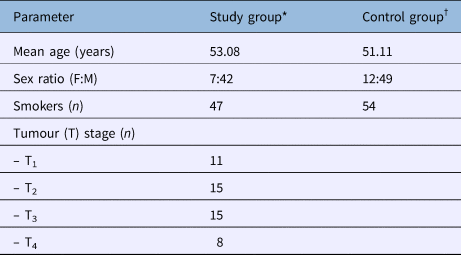
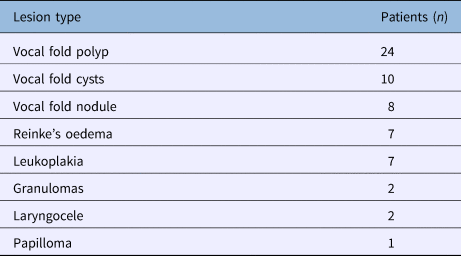
We evaluated 49 patients with laryngeal cancer, including 42 men (86 per cent) and 7 women (14 per cent). We also examined 61 age-matched control subjects with benign laryngeal lesions, including 49 men (80 per cent) and 12 women (20 per cent). There was no significant difference in the age and sex distributions between the study (laryngeal cancer) group and control (benign lesion) group (p > 0.05). The demographics and clinical characteristics of all the patients are shown in Table 1. Table 2 summarises the laryngeal lesions in the control group.
Patient demographics and tumour details

*n = 49; †n = 61. F = female; M = male

Patients with laryngeal cancer showed higher levels of interleukin (IL)-17A and IL-22 when compared to the control group, and the difference was statistically significant (p < 0.001, for IL-17A and IL-22). In contrast, there was no significant difference in serum levels of IL-23 between groups. The results are summarised in Table 3. Although the levels of IL-17A and IL-22 were higher in the laryngeal cancer group, there was no correlation between tumour T stage and IL levels (p > 0.05).
Pre-operative interleukin levels of laryngeal cancer patients and controls

*n = 49; †n = 61. ‡Indicates a significant difference (p < 0.05) between the groups. IL = interleukin; SD = standard deviation; CI = confidence interval
A Pearson correlation was conducted to determine the relationships between serum levels of ILs. The data showed no violation of normality, linearity or homoscedasticity. There was a positive correlation between IL-17A and IL-22, which was statistically significant (n = 110; r = 0.565, p < 0.0005). However, the Pearson test indicated that IL-23 and the other ILs did not act in a cascade (Figure 1).
Correlation between interleukin (IL)-17A and IL-22 in all participants (n = 110; r = 0.565, p < 0.005).

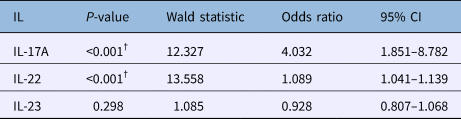
In order to investigate the predictive values of ILs that showed a significant difference between the study and control groups, binary logistic regression analysis was performed. The logistic regression model was statistically significant (chi-square = 57.205, p < 0.001). The model explained 55.3 per cent (Nagelkerke R2) of the variance in laryngeal disease and correctly classified 80.9 per cent of cases. Interleukin 17A levels were 3.87 times and IL-22 levels were 1.09 times more likely to be associated with laryngeal cancer. Increased IL-17A and IL-22 levels were associated with a greater likelihood of exhibiting laryngeal cancer (Table 4).
Predictive value of interleukin levels*

Nagelkerke R2 = 0.558.
* Determined using binary logistic regression analysis.
† Indicates a significant finding (p < 0.05). IL = interleukin; CI = confidence interval
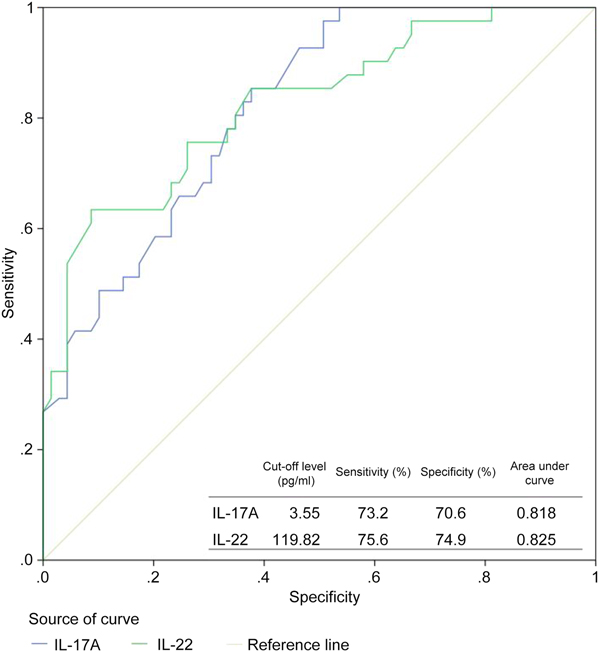
Receiver operating characteristic curve analysis was performed to determine the cut-off values of IL levels to predict laryngeal cancer. The cut-off value of IL-17A level was 3.55 pg/ml, with a sensitivity of 73.2 per cent and a specificity of 70.6 per cent (area under the curve, 0.818). The cut-off value of IL-22 level was 119.82 pg/ml, with a sensitivity of 75.6 per cent and a specificity of 74.9 per cent (area under the curve, 0.825) (Figure 2).
Receiver operating characteristic curve analysis of interleukin (IL)-17A and IL-22.

Discussion
The pathogenesis of cancer may include a process driven by inflammatory cells, with a variety of mediators, including cytokines, chemokines and enzymes, which together establish an inflammatory microenvironment.Reference Coussens and Werb7 Chronic inflammation aids the proliferation and survival of malignant cells, promotes angiogenesis and metastasis, subverts adaptive immune responses, and alters responses to hormones and chemotherapeutic agents.Reference Mantovani, Allavena, Sica and Balkwill8 In light of this information, we aimed to investigate the possible relationship between inflammation and laryngeal cancer. The results revealed higher levels of inflammation markers including interleukin (IL)-17A and IL-22 in the circulation of patients with laryngeal SCC when compared to patients with benign laryngeal lesions.
In 1863, Rudolf Virchow hypothesised that cancer originated from sites of chronic inflammation, after observing leucocytes in tumour tissues.Reference Balkwill and Mantovani9 Other theories considered that chronic inflammation resulted in a pro-cancer microenvironment favourable for the survival of tumour cells and their growth.Reference Schwartsburd10 Scientists had long thought that T-helper cell reaction was completely inhibited in local tumour tissue, but this concept was abandoned after the discovery of regulatory T-cells and T-helper 17 cell subsets. Interleukin 17A and IL-22 are mainly produced by T-helper 17 cells, triggered by IL-23. They have been regarded as key mediators for both adaptive and innate immunity, and are described as inflammatory cytokines that induce chronic inflammation and tumourigenesis.Reference Schwartsburd10
Cancer development is still accepted as a multistep process, with a variety of aetiological factors such as genomic instability and environmental stress.Reference Philip, Rowley and Schreiber11 Epidemiological studies support the belief that chronic inflammation is associated with an increased risk of cancer.Reference Coussens and Werb7–Reference Schwartsburd10 In the human body, possible associations between chronic inflammation not caused by infection and cancer were found for: ulcerative colitis or Crohn's disease and colorectal cancer; Barrett's metaplasia and oesophageal cancer; chronic pancreatitis and pancreatic cancer; Marjolin's ulcer and skin carcinoma; asbestos and mesothelioma; cigarette smoke or silica and bronchial cancer; chronic asthma and lung cancer; ulcerative lichen planus and verrucous carcinoma; foreskin inflammation or phimosis and penile cancer; and ovarian epithelial inflammation and ovarian cancer.Reference Coussens and Werb7–Reference Risch and Howe15 It has been shown that chronic inflammation promotes the production of reactive oxygen species, which have the potential to cause genomic mutations, and in turn prevent mutated pre-cancerous cells from being eliminated.Reference Karin, Cao, Greten and Li16 There is also a strong association between laryngeal cancer and acid reflux, especially after gastric resection, and smoking.
T-helper 17 cells have been shown to play important roles in inflammation and autoimmune diseases, but little is known about their specific roles in tumour immunity. Interleukin 23 induces the differentiation of naïve cluster of differentiation 4+ T-helper cells into highly pathogenic T-helper cells that produce IL-17A and IL-22. However, we do not have a complete understanding of the biological functions of these ILs.
Recent studies have revealed the functions of T-helper 17 cells and T-helper 17 cell related cytokines in tumour development. Colorectal tumour development by the induction of IL-17A expression was triggered by infecting mice with the human enterotoxigenic bacterium. Neutralisation of IL-17A with a specific antibody prevented the acceleration of colorectal tumour.Reference Wu, Rhee, Albesiano, Rabizadeh, Wu and Yen17 In a mouse model, IL-23 promoted the development of skin cancer.Reference Langowski, Zhang, Wu, Mattson, Chen and Smith3 However, these studies did not show that IL-23 and IL-17A acted in a cascade. Moreover, it is not yet clear whether T-helper 17 cells promote or inhibit tumour progression, and the mechanism of their involvement in tumour immunity is still unknown.Reference Ji and Zhang18
Studies investigating the role of cytokines in laryngeal cancer are limited. Mojtahedi et al.Reference Mojtahedi, Khademi, Erfani, Taregh, Rafati and Malekzadeh19 found that serum IL-8 levels were not associated with head and neck SCC, but serum IL-7 levels were specifically elevated in those patients compared to healthy subjects. Melinceanu et al.Reference Melinceanu, Lerescu, Tucureanu, Caras, Pitica and Sarafoleanu20 evaluated several immune mediators in the sera of patients with laryngeal SCC. They found higher levels of IL-8 and IL-10 pre-operatively, and higher levels of IL-6, IL-8 and IL-10 post-operatively, when compared to healthy controls. Eyigor et al.Reference Eyigor, Eyigor, Osma, Yilmaz, Erin and Selcuk21 demonstrated increased levels of IL-6, IL-8 and IL-10 in patients with laryngeal SCC. However, the role of these cytokines in the pathogenesis of laryngeal cancer is not yet well known.
Our study evaluated the serum levels of IL-17A, IL-22 and IL-23 in patients with laryngeal cancer and benign laryngeal lesions. These levels, in the respective laryngeal cancer and control groups, were: IL-17A, 4.56 ± 1.4 ρg/ml and 3.22 ± 0.74 ρg/ml; IL-22, 133.09 ± 16.9 ρg/ml and 114.95 ± 9.26 ρg/ml; and IL-23, 49.55 ± 2.42 ρg/ml and 49.1 ± 3.59 ρg/ml.
These results indicate that T-helper 17 cell related ILs could be potential biomarkers that may be helpful in the diagnosis of laryngeal cancer. Thus, we further evaluated the diagnostic value of ILs. For serum IL-17A, the diagnostic sensitivity was 73.2 per cent and specificity was 70.6 per cent, at the cut-off value of 3.55 pg/ml, with the area under the receiver operating characteristic curve of 0.818. For serum IL-22, the diagnostic sensitivity was 75.6 per cent and specificity was 74.9 per cent, at the cut-off value of 119.82 pg/ml, with the area under the receiver operating characteristic curve of 0.825. Moreover, we found that IL-17A levels were 3.87 times and IL-22 levels were 1.09 times more likely to be associated with laryngeal cancer.
Our results demonstrate that IL-17 mediated inflammation may be an important mechanism for inflammation-mediated tumour development. Our data may also support the concept that disturbance of the appropriate cell-mediated response allows the pathological disease to transform clinically to laryngeal cancer. This disturbance may include a pathological shift from T-helper 1 cells or T-helper 2 cells to T-helper 17 cells, which may be the cause of the transformation. Alternatively, increased T-helper 17 cell related IL levels in laryngeal cancer might arise from their excessive production from the tumour tissue.
The development of laryngeal cancer is likely to be associated with inflammation related to smoking and alcohol intake, or exposure to acid reflux. However, physicians do not know exactly which patients will develop laryngitis or cancer. Melinceanu et al.Reference Melinceanu, Sarafoleanu, Lerescu, Tucureanu, Caraş and Salageanu22 showed that the T-helper 2 cell type of immune response is associated with heavy smoking (those who smoke more than 40 pack-years). Thus, it was not surprising that, when compared with non-smokers, both current and former smokers had higher IL levels. In our study, smoking ratio was similar between the laryngeal cancer and benign laryngeal pathology groups (95 per cent and 88 per cent, respectively).
This study has several limitations. First, the patient numbers in the study are relatively small. Because of the small population, we could not correlate the IL levels with tumour load. Second, we had no IL levels for post-operative or long-term follow up. This study represents preliminary findings. The relationships between pre-treatment serum levels of T-helper 17 cell related cytokines, and tumour recurrence and survival, among previously untreated patients with laryngeal cancer, should be evaluated in further studies. Likewise, if patients at highest risk for recurrence are identified, they could be targeted for more intensive surveillance and chemoprevention therapy.
• This study explored the role of T-helper 17 cell related immunity in the pathogenesis of laryngeal cancer
• T-helper 17 cell related interleukins (ILs) are potential biomarkers that may be helpful in diagnosing laryngeal cancer
• This study found that IL-17A levels were 3.87 times and IL-22 levels were 1.09 times more likely to be associated with laryngeal cancer
Conclusion
Circulating levels of serum interleukin (IL)-17A and IL-22 were significantly higher in the laryngeal cancer group compared with the control group. These data may support neutralisation of T-helper 17 cell related cytokine activity, which may be an attractive strategy for the treatment of laryngeal cancer. Future studies should focus on these IL networks in order to develop more effective treatment options, and investigate the histopathological observations and immunohistochemistry staining of laryngeal cancer specimens for T-helper 17 cell related cytokines to establish their role in the development of laryngeal cancer.
Acknowledgement
This research was funded by the Scientific Research Fund of Yıldırım Beyazıt University (project number: 1738).
Competing interests
None declared