Casein micelles, the sterically-stabilised association colloids in bovine milk, disintegrate when the solvent quality of the milk serum increases. Solvent-mediated disintegration of casein micelles occurs because interactions of the hydrophobic domains of the protein with the solvent become thermodynamically favourable, and can be induced by adding >3·5 mol L−1 urea to milk (Holt, Reference Holt1998; De Kruif & Holt, Reference De Kruif, Holt, Fox and McSweeney2003), addition of >30% ethanol to milk followed by heating to >60°C (O'Connell et al. Reference O'Connell, Kelly, Auty, Fox and De Kruif2001a, Reference O'Connell, Kelly, Fox and De Kruifb) or increasing milk pH to >9·0 (Van Dijk, Reference Van Dijk1992; Vaia et al. Reference Vaia, Smiddy, Kelly and Huppertz2006). Such disintegration is believed to yield individual nanoclusters (Vaia et al. Reference Vaia, Smiddy, Kelly and Huppertz2006), which are the ‘building blocks’ of casein micelles (De Kruif & Holt, Reference De Kruif, Holt, Fox and McSweeney2003; Holt et al. Reference Holt, De Kruif, Tuinier and Timmins2003). The nanoclusters consist of an amorphous core of calcium phosphate, often referred to as micellar calcium phosphate (MPC), surrounded by a shell of caseins though calcium-phosphate ion pairs involving the centres of phosphorylation of αs1-, αs2- and β-casein (Holt et al. Reference Holt, De Kruif, Tuinier and Timmins2003; Holt, Reference Holt2004).
Semo et al. (Reference Semo, Kesselman, Danino and Livney2007) recently reported that artificial casein micelles formed from sodium caseinate can be effectively used for nano-encapsulation and stabilization of hydrophobic nutraceuticals, e.g., vitamin D2. Likewise, micelles reformed following solvent-mediated disruption could also be utilized as carriers for nutraceuticals. For the successful application of reformed micelles for this purpose, it is important that the reformed micelles have properties comparable to those of native casein micelles, particularly in terms of colloidal stability, so as not to limit their application in dairy products. O'Connell et al. (Reference O'Connell, Steinle, Reiter, Auty, Kelly and Fox2003) studied the properties of casein particles reformed from milk which was heated in the presence of ethanol. Such reformed casein particles were considerably larger than native casein micelles and also differed considerably in terms of the colloidal stability of the micelles against heat or ethanol (O'Connell et al. Reference O'Connell, Steinle, Reiter, Auty, Kelly and Fox2003). Casein micelles reformed after urea-induced disruption are smaller than native micelles, but resemble native micelles quite closely in terms of colloidal stability (McGann & Fox, Reference McGann and Fox1974); however, the need to add and remove large quantities of urea to induce micellar disruption and reformation limits practical applications of this approach. Due to the considerably smaller amounts of additives required for the reformation of alkaline disrupted casein micelles, this process may present a more viable alternative. Properties of casein particles reformed from alkaline disrupted casein micelles, however, have not been examined to date and were the subject of investigation in the studies reported in this article. Reformed casein particles were created by consecutive solvent-mediated disintegration and reassociation of casein micelles, induced by increasing milk pH to 10·0 and subsequently reducing it to pH 6·6.
Materials and Methods
Sample preparation
Low-heat skim milk powder (Irish Dairy Board, Dublin, Ireland) was reconstituted in demineralised water, containing 0·5 g L−1 sodium azide, at a level of 90 g L−1. Alkaline disruption of casein micelles was induced by the dropwise addition to 200 ml milk, of 1 m-NaOH to pH 10·0 at 20°C, with simultaneous stirring. After 60 min holding at room temperature at pH 10·0, milk pH was returned to 6·6 by the dropwise addition of 1 m-HCl at a rate of 0·1 ml min−1 with simultaneous stirring; approximately 2·5 ml 1 m-NaOH were required to increase milk pH to 10·0 and an equivalent volume of 1 m-HCl was required to subsequently reduce pH to 6·6. Throughout disruption and reformation, the turbidity of milk was determined at 600 nm using a 1 mm path-length cuvette, and normalised according to the turbidity values of untreated milk (=1·00) and milk serum (=0·00) as outlined by Vaia et al. (Reference Vaia, Smiddy, Kelly and Huppertz2006). For separate samples, an equivoluminar mixture of 1 m-HCl and 1 m-NaOH or a solution of 0·5 mol L−1 NaCl was added to milk at a level of 5 ml 100 ml−1. Three independent replicate samples were prepared for all milks.
Analytical methods
Casein micelle size and zeta potential were determined by photon correlation spectroscopy and laser-Doppler electrophoresis, respectively, as outlined by Huppertz & Fox (Reference Huppertz and Fox2006). The stability of milk against heat-induced coagulation at 140°C was determined as a function of pH as described by Huppertz et al. (Reference Huppertz, Grosman, Fox and Kelly2004). The stability of milk against ethanol-induced flocculation was determined at pH 6·0, 6·5 and 7·0, as described by Huppertz et al. (Reference Huppertz, Grosman, Fox and Kelly2004). The rennet coagulation time of milk was determined as described by Zobrist et al. (Reference Zobrist, Huppertz, Uniacke, Fox and Kelly2005). The concentration of ionic calcium was determined using an ion selective electrode (Vaia et al. Reference Vaia, Smiddy, Kelly and Huppertz2006). The concentration of total calcium in the milk serum was determined by atomic absorption spectroscopy, as outlined by Vaia et al. (Reference Vaia, Smiddy, Kelly and Huppertz2006).
Statistical analysis
The significance of differences in physicochemical properties between native casein micelles and casein particles reformed from alkaline disrupted casein micelles were analysed using a t-test at a 95% confidence level.
Results and Discussion
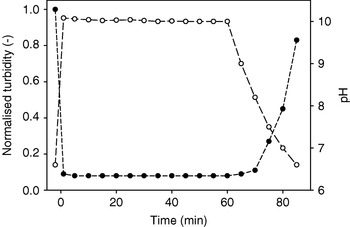
Increasing milk pH to 10·0 reduced milk turbidity to a value close to that of milk serum (Fig. 1), indicating complete disintegration of casein micelles, probably into its constituent nanoclusters. Similar observations were reported by Vaia et al. (Reference Vaia, Smiddy, Kelly and Huppertz2006), who suggested that alkaline disruption of casein micelles is primarily due to increased solvent quality of milk serum at alkaline pH, as a result of significant reductions in the concentration of calcium and phosphate in the milk serum at high pH. Subsequently readjusting milk pH to 6·6 increased turbidity, to a value close to that of untreated milk (~0·83; Fig. 1), indicating the reformation of casein particles. Preliminary experiments had shown that the rate addition of 1 m-HCl (0·02–0·5 ml min−1) had no significant effect on the results so only 0·1 ml min−1 was selected for further experiments. Addition of 1 m-HCl at a rate >0·5 ml min−1 resulted in some micellar flocculation in the samples, strongly suggesting that the reformation processes needs to be carried out in a gradual and controlled manner.
Normalised turbidity (•) and pH (○) of skim bovine milk on addition of 1 m-NaOH to increase milk pH to 10 (t=0 min), followed by holding for 60 min and subsequent addition of 1 m-HCl at a rate of 0·1 ml min−1 to reduce milk pH to 6·6. Values are means of data on three individual milk samples. The coefficient of variation was <5% for all data points.

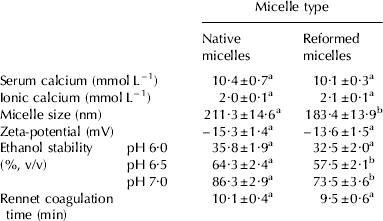
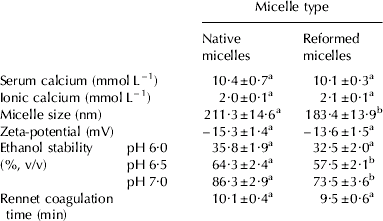
Concentrations of serum and ionic calcium did not differ significantly between control milk and milk which was first adjusted to pH 10·0 and subsequently readjusted to pH 6·6 (Table 1), indicating that the extensive reductions (>95%) in these parameters which occur on increasing milk pH (Vaia et al. Reference Vaia, Smiddy, Kelly and Huppertz2006) are fully and rapidly reversible. This suggests that the increase in solvent quality induced by increasing milk pH (Vaia et al. Reference Vaia, Smiddy, Kelly and Huppertz2006) is reversible on subsequent readjustment of pH to 6·6. The reversal of solvent quality is probably the primary reason for the reformation of casein particles from alkaline-disrupted casein micelles. The physicochemical properties of the casein particles were the subject of investigation in the following studies.
Physicochemical properties of native casein micelles and casein particles formed by first disrupting casein micelles by increasing milk pH to 10·0 and subsequent reforming casein particles by reducing milk pH to 6·6. Values are means of data from experiments on three individual milk samples, ±standard deviation
a,b Values in one row without a common lower-case superscript differ significantly (P=■)
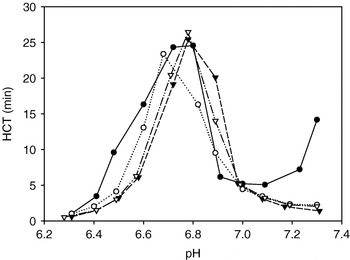
Casein micelle size was significantly (P<0·05) lower for reformed casein particles compared with native casein micelles (Table 1); McGann & Fox (Reference McGann and Fox1974) reported similar observations for casein particles reformed after urea-induced disruption of casein micelles. No significant difference in zeta potential between native casein micelles and reformed casein particles was apparent (Table 1). At pH 6·50 and 7·00, but not at pH 6·00, the ethanol stability of reformed micellar particles was significantly lower than that for native particles, whereas no significant difference in rennet coagulation time was apparent between control milk and milk containing reformed micelles (Table 1). The pH-HCT profile for milk containing native or reformed casein micelles was similar in the pH range 6·3–7·0, with a maximum at pH 6·8. However, in control milk, HCT increased with increasing pH>7·0, whereas no such recovery was observed in milk containing reformed casein particles (Fig. 2). Overall, it is clear that reformed casein particles closely resemble native casein micelles, in terms of physicochemical properties and colloidal stability. Small differences in physicochemical properties that existed between milks containing native micelles or reformed casein particles may indicate that the micelles do not reform in exactly the same way; however, it should also be considered that the addition of equal volumes of NaOH and HCl, effectively equals the addition of a NaCl solution to milk, which is known to influence physicochemical properties of the micelles.
pH-heat coagulation time profile of control skim bovine milk (•), skim bovine milk which was adjusted to pH 10·0 and subsequently readjusted to pH 6·6 (○), skim milk to which a solution containing 0·5 mol L−1 HCl and 0·5 mol L−1 NaOH was added at a level of 5 ml 100 ml−1 (▾) or skim milk to which 0·5 mol L−1 NaCl was added at 5 ml 100 ml−1 (▿).

Differences between the heat stability of native micelles and reformed casein particles may be ascribed to the influence of the additives, i.e., 1 m-HCl and 1 m-NaOH, rather than structural differences between native casein micelles and reformed casein particles, since the addition of an equivalent volume of a, neutral, mixture of NaOH and HCl or an equivalent amount of 0·5 m-NaCl induced the same changes in heat stability as increasing and subsequently decreasing pH (Fig. 2). The increased levels of sodium and chloride ions may also be responsible for the lower ethanol stability and higher zeta-potential of milk containing reformed casein particles (Table 1), as addition of sodium chloride to milk reduces ethanol stability (Horne & Parker, 1987; Huppertz & Fox, Reference Huppertz and Fox2006) and zeta-potential (Dalgleish, Reference Dalgleish1984; Huppertz & Fox, Reference Huppertz and Fox2006). However, differences in micelle size and turbidity (Table 1), which are closely related owing to the fact that casein micelles are the primary light scattering particles in skim milk, cannot be explained with the current knowledge of NaCl on physicochemical properties of milk and suggest that micelles do not reform to exactly their native form.
From the differences in micelle size and turbidity, it can be estimated that the total amount of micellar material is slightly higher in reformed samples than in native samples. From light scattering theory, it follows that for the turbidity, τ:

Where M and C are the mass and total concentration of light scattering particles in the sample (for a more detailed description see Huppertz et al. Reference Huppertz, Smiddy and De Kruif2007). Since M scales to the third power of particle diameter, d, it follows that

Solving equation 2 for the turbidity (Fig. 1) and particle size (Fig. 2) data indicates that Creformed/Cnative=1·09±0·04. Hence, levels of non-micellar casein are expected to be lower in samples containing reformed micelles than in those containing native micelles, which may further contribute to differences in physicochemical properties between samples.
Overall, the physicochemical properties of casein particles reformed from alkaline disrupted casein micelles closely resembled those of native casein micelles, similar to those reformed after urea-induced disruption of casein micelles (McGann & Fox, Reference McGann and Fox1974). This suggests that if reversal of the increase in solvent quality induced by increasing milk pH is carried out in a gentle and controlled manner, the disintegration of casein micelles is largely reversible. Hence, it is apparent that casein micelles can undergo reversible association and dissociation reactions on changes in solvent quality which may be utilised in the selective incorporation of nutraceutical compounds in casein micelles.