For a few days in July 2015, #ThisIsACoup was one of the most popular social media terms around the world (Salmon Reference Salmon2015). A Greek government, elected with a strong plurality, had called a referendum on its creditors’ plans for conditions attached to further lending. In the Greek referendum 61 per cent of voters rejected the creditors’ plans. After a few days of capital controls, closed banks and threats that the European Central Bank would cut off emergency finance to Greek banks, the Greek government capitulated. It actually accepted policy conditions that were more onerous and detailed than those that were offered before the referendum in order to gain temporary support. A Barcelona schoolteacher tweeted that #ThisIsACoup and soon the hashtag was popular worldwide (Kassam Reference Kassam2015).
This was not a military takeover of the kind normally called a coup. There were no tanks in the streets of Athens. Rather, the debate was about democracy and citizenship: what kinds of economics and politics were Greek or other EU citizens entitled to have? For example, journalist Felix Salmon opined that ‘Greece has given up its national sovereignty, and when you give up your sovereignty to a group of leaders who were not elected by your own people, one entirely apposite word for that is “coup”’ (Salmon Reference Salmon2015). Changing institutions and power relations within the EU were changing the rights of Greek, and other, citizens.
The events of early summer 2015 show just how much the European Union, and the lives and rights of European citizens, are changing. It is easy to be so focused on particular issues, such as the dispute between Greece and its creditors, as to miss the cumulative effects of a new treaty, a large block of new legislation, and changes in the interaction of EU institutions with member states and each other, with consequences for citizens of all EU member states.
Citizenship, we argue below, is about more than passports and individual bodies of law. It is about the sum total of civil, social and political rights that a person enjoys from the range of rights-granting politics in which that person is a member (for example, member state, European and perhaps regional or local). If a change in European politics and policy reduces the social, political or civil citizenship rights of a person by reducing egalitarian social programmes, their power over their governments or their rights to free action, then it is reducing their citizenship rights. That is the case even if it does so indirectly by changing the balance of intergovernmental power or constraining public policy options.
Looking at citizenship this way, identifying the changing citizenship rights of people, vis-à-vis the ensemble of governments that define their lives, produces a worrying conclusion. Political changes since the start of the financial crisis in 2008 have changed the political and social citizenship rights of Europeans – for the worse. The EU has for decades been expanding civil citizenship as part of its market-building integration. But its fiscal governance substantially constrains states and thereby constrains social and political rights that primarily exist and are made manifest by states. There is no EU social or political citizenship replacement for the political and social citizenship rights that are being diminished along with member states’ rights.
The first section of this article briefly presents T.H. Marshall’s taxonomy of citizenship rights and their traditional applicability to the EU. It then presents our basic approach, which is to map key EU policies from the crisis that have meaningful consequences for individuals’ citizenship rights. The second section reviews major changes in EU institutions since 2008. It discusses the activities of the European Central Bank, key fiscal legislation and the Economic Adjustment Programmes that do or have applied to Ireland, Portugal, Spain, Greece and Cyprus. In the conclusion, we argue that the EU fiscal governance regime explicitly reduces political rights – increasing the democratic deficit – and is engineered to weigh fiscal rigour much more heavily than social rights. This is a new version of a traditional asymmetry in the EU which weighs civil rights more heavily than social or political ones.
Analysing Changing Citizenship Rights In The EU
There are three basic ways to discuss citizenship in Europe. One is legal-theoretical: starting with the components of European citizenship as detailed in successive treaties and thinking through their nature, impact, relationship with other statuses (such as member state citizenship) and possible improvements (e.g. Shaw Reference Shaw2007). This approach, in particular, tends to focus on law rather than policy and regards citizenship as a property of a given regime. The second is to focus on the composition of the European polity – the extent to which Europeans regard themselves as a single body of citizens, or empirically act as if they are (e.g. Bruter Reference Bruter2005; Eder and Giesen Reference Eder and Giesen2001). This is more likely to be an empirical strategy that looks for shared voting patterns, concerns or statements of shared identity within the EU (e.g. Díez Medrano Reference Díez Medrano2000; Sanders et al. Reference Sanders, Bellucci, Tóka and Torcal2012) or contributes to the vast literature focusing on the development of immigration, citizenship and asylum policy at the EU level (e.g. Azoulai and de Vries Reference Azoulai and de Vries2014; Vink and De Groot Reference Vink and De Groot2010).
The third is the institutionalist approach taken here: to look at the content of citizenship as a body of rights and responsibilities that citizens have and share, rights to freedom, participation in the state and certain social goods. Those rights and responsibilities have institutional embodiments, which can be studied: laws, identifiable political actions, entitlements such as access to benefits and responsibilities such as taxpaying. It is an essentially pragmatist approach that looks for citizenship not in legal theories or behaviour but in institutions and policies (Hansen and Hager Reference Hansen and Hager2012; Maas Reference Maas2007).
Citizenship has long been connected with membership of a political community, and while liberal and cosmopolitan theories of citizenship have to some extent distanced it from participation or belonging to a community, the starting point of citizenship is usually still belonging to a group that affords the ‘right to have rights’ (Somers Reference Somers2009). A problem for such analysis as well as, potentially, for citizenship itself arises when there are multiple political units with some claim to have citizens (Maas Reference Maas2013: 2). The content and meaning of EU citizenship is an example of such a situation, in which an individual person can have what appear to be multiple citizenships with different implications, rights, duties and affective bonds.
That latter situation of ‘nested’ rights or citizenship which characterizes the EU means that the different polities with different citizenships interact and might influence each other’s content (Bauböck and Guiraudon Reference Bauböck and Guiraudon2009; Delanty Reference Delanty2007; Faist Reference Faist2001; Ferrera Reference Ferrera2005). It also means that focusing only on the formal content of any one citizenship might obscure the net effect of their interaction. This point is well understood in the citizenship literature (Neveu Reference Neveu2013; Saward Reference Saward2013; Somers Reference Somers2005).
Understanding interactive citizenships in multilevel governance is important. If the EU is affecting citizenship rights by affecting what member states can do, then it should be understood as doing that, and the effects of its actions should be incorporated into an understanding of the implications of its actions for citizenship. Debates about the nature and extent of an EU democratic deficit are often premised on this recognition of intergovernmental influence. If the EU is assuming powers from or over member states, then it should be democratized in order to avoid having its development be a net diminution of political citizenship (as Lefkofridi and Schmitter paraphrased Mair: what is depoliticized at the national level should be repoliticized at the EU level; Lefkofridi and Schmitter Reference Lefkofridi and Schmitter2015: 17; Mair Reference Mair2007). Likewise, the citizenship-based case for expanded political action and cosmopolitan citizenship often depends on acceptance that a rescaling of political power should be matched by attributes of citizenship. All these cases of interacting polities suggest that a focus on any one citizenship is problematic when trying to understand the rights of a citizen in a complex polity.
In other words: the rights of any given citizen come from all the governments affecting that citizen. We should ask what rights are afforded by the sum of political units affecting that person. The appropriate way to gauge the changing contents of citizenship in Europe is to look at the civil, social and political rights of a given citizen and see how his or her rights in sum are changing. The appropriate way to gauge the changing nature of EU citizenship is to see what role the EU is playing in those changes.
The rest of the article proceeds on the basis that:
-
1 If a policy expands or contracts access to the welfare state, in terms of benefit levels or access, then it expands or contracts social citizenship.
-
2 If a policy expands or contracts the power of an institution with less democratic accountability than existing member states, or expands or contracts the democratic accountability of an institution without otherwise changing its power, then it expands or contracts political citizenship rights.
-
3 If a policy expands or contracts the freedom of movement, association, expression, worship and other civil rights, then it expands or contracts civil citizenship rights.
Whether expansion or contraction of citizenship rights is good, or whether the purported benefits of their contraction in terms of economic growth and stability suffice, is a different question (though, if we reduce political citizenship, the people whose answers matter become ever fewer) (Somers Reference Somers2009).
Civil, Political and Social Citizenship Rights
T.H. Marshall (Reference Marshall1950) supplied a taxonomy that we, like many students of citizenship, can adopt (Bulmer and Rees Reference Bulmer and Rees1996; Ferrera Reference Ferrera2005; Isin and Turner Reference Isin and Turner2007; Lister Reference Lister2005) without necessarily adopting his historical sequencing (Breiner Reference Breiner2006) or empirical claims about their accuracy in the context of the UK (Powell Reference Powell2002, Reference Powell2009). Marshall divided citizenship into three kinds of rights:
-
● Civil citizenship rights are rights to personal liberty: rights to free speech, mobility, free association, fair trials and in general freedom from governmental restrictions on activity. Civil citizenship rights are both crucial to any minimal definition of democracy and freedom, and somewhat limited as they do not redress limitations on action that come from social and economic inequality. All they do is give citizens rights to actions untrammelled by the state.
-
● Political citizenship rights are rights to ‘participate in the exercise of power’. Above all, this means the vote, but it also means associated rights to engage in political action – the rights to run for office, to petition government, to form political associations. They are the rights that make a liberal democracy democratic.
-
● Social citizenship rights, finally, are rights to equal access to certain aspects of life: equal access to key goods such as health, housing, a minimum income, legal representation before the courts, or education.
Marshall was careful to note the boundaries and function of citizenship rights. Rather than writing a charter for decommodified egalitarianism in all aspects of life, as he is sometimes misread to have done, he was writing a charter for a kind of moderate social, liberal, democracy (Greer and Mätzke Reference Greer and Mätzke2009; Wincott Reference Wincott2009). Citizenship rights were to be islands of equality in a sea of inequality, giving all citizens the dignity and wherewithal to participate fully in society. By creating some equality, they would head off the tensions and indignities of an entirely equal or a markedly unequal society. In his English context, such rights would compensate for the inequalities of capitalism. In a European context, they might also compensate for the inherited inequalities between and within member states. He was uninterested in corporatism and organized businesses or unions as a specific area of policy and politics; his approach did not fit well with rights that were not fundamentally defined vis-à-vis the state.
Nor did Marshall talk about the status of foreigners. In his text, the status of citizenship – the right to have rights – was not an issue and he did not discuss the different and often more troubling situation of immigrants, refugees and third-country nationals that has justly received much attention since (Hansen and Hager Reference Hansen and Hager2012). In general, Marshall’s vagueness about the extent of the citizenry (England? the UK?) prefigured the problems faced by any effort to understand the effects of multiple citizenships and multilevel governance for his citizenship rights (Crowley Reference Crowley1998).
European Citizenship Rights
The EU is an uncommonly successful machine for the simultaneous production of supranational integration and transnational civil citizenship rights. The fundamental citizenship rights of the EU treaties are civil rights: freedom to move around, to be treated without discrimination based on member state of origin, freedom to establish oneself or a business in another country and freedom from certain other forms of discrimination on grounds such as gender or age. This has meant individual rights to cross-border mobility as well as a programme of deregulation and re-regulation that has substantially expanded the freedoms of businesses to operate across borders. The financial crisis has produced a few policies that actually further civil citizenship rights as a byproduct of liberalizing markets and producing competition, such as the Single Market Act, though there has recently been a backlash in some countries against perceived ‘benefit tourism’ from poorer EU member states. This backlash has yet to produce policies at the EU level that weaken the civil right of freedom to move, though it has led public and private actors to discriminatory actions that affect both citizens and non-citizen migrants. Member states (most prominently the UK and Germany) have reduced the generosity of welfare programmes used by non-national EU citizens (BBC News 2014a, b).
European social citizenship was always weaker. For decades, it was relatively easy to characterize EU social policy. It grew from treaty bases that were designed to promote the four freedoms rather than equality or solidarity, and its accomplishments frequently depended on internal market regulation (as with labour law) or social security coordination policies. Various formulations of a ‘European Social Model’ tended to mix characterizations of member state social models, ideal types and EU statements supporting some member states’ social priorities (Adnett and Hardy Reference Adnett and Hardy2005; Clift Reference Clift2007; Giddens et al. Reference Giddens, Diamond and Little2006; Goetschy Reference Goetschy2006; Hemerijck Reference Hemerijck2011). Many of them were as decidedly normative as the definitions of European citizenship that also blossomed in the last decade, or, if critical, were critical of the gap between normative claims and reality. Looking at what passed for European social citizenship, it actually tended to be extensions of civil citizenship – essentially, extending the four freedoms so that citizens of one EU member state could enjoy the welfare states of another (Caporaso and Tarrow Reference Caporaso and Tarrow2009). Efforts to develop a deeper European social model, or citizenship, were always ambiguous and never as fixed as normatively tinged theories would suggest (already clear in Wincott Reference Wincott2003; for evidence, Alber Reference Alber2006; Clift Reference Clift2007; Draxler and Van Vliet Reference Draxler and Van Vliet2010).
European political citizenship, compared with the hard-won democratic victories in the member states, can seem rather thin (Bellamy Reference Bellamy2012). This was in large part because the member states are powerful in the EU. Ultimately many of the most powerful EU actors are governments, and elections to the member state governments the key opportunity to participate in political power. EU citizenship depends on member state citizenship, in legal terms as well as perceptions of legitimacy (Bellamy Reference Bellamy2008). The specific political citizenship of EU citizens then amounts to whatever they enjoy by virtue of citizenship in a member state plus the rights to vote in local and EU elections wherever in the EU they may live. It was, like the EU’s explicit social rights, built on legal non-discrimination and is essentially an extension of the civil citizenship right to move around.
The three kinds of citizenship rights, then, have very different standings in the EU. Civil rights to move around freely form the roots of the other EU rights. EU social citizenship rights mostly mean the right to access the welfare state in another country, and political citizenship rights mostly mean the right to move elsewhere and influence local and EU politics.
Fritz Scharpf defined this difference as the ‘constitutional asymmetry’ of the EU (Scharpf Reference Scharpf2002) in an argument that others have expanded (de la Porte and Heins Reference de la Porte and Heins2014; Martinsen and Vollaard Reference Martinsen and Vollaard2014). Asymmetry has produced a theme in research on EU citizenship, which is that the actions of the EU might endanger social citizenship by endangering member states’ ability to actually raise and spend the money necessary to make social citizenship rights effective (Greer Reference Greer2009; Newdick Reference Newdick2009). The EU regulatory state does not spend much, and few or no social rights (housing, health, education, pensions, etc.) are meaningful without massive expenditures. Caporaso and Tarrow (Reference Caporaso and Tarrow2009), in celebrating freedom to access health care in another member state, downplay the fact that such freedom depends on the member states’ organizing and financing health care systems. The EU does not have the money or mandate to organize or finance any meaningful health care with its budget, and member states seem to have little appetite for a more redistributive EU. If EU law constrains welfare states in ways that make them less viable (Ferrera Reference Ferrera2005), then it cannot be said to have helped social citizenship. If it constrains states in their welfare decisions, it is constraining political citizenship. Traditionally the most important EU constraints on member states were in the name of the four freedoms, which often expanded civil citizenship, but fiscal governance changes since 2010 constrain political and social citizenship of member states by constraining member states.
Changing European Citizenship Rights
The next sections track the changing institutions of citizenship in the EU since 2008, compiling major changes in the civil, political and social rights of citizens in part or all of the EU that are attributable to EU policies and politics since 2008. Even if the situation of the eurozone is an effect of the 1990s decision to establish a currency union without fiscal or financial union, the particular decisions taken since the start of the financial crisis in 2008 have had consequences for the shape of the EU, the rights of its citizens and the relationship between political power and individual people that is citizenship.
We discuss three different developments in the institutional structure of the EU since 2008: the creation and operation of Economic Adjustment Programmes (EAPs), governed by the ‘Troika’ (see below); the empowerment of the European Central Bank; and the substantial expansion in the breadth and coerciveness of EU fiscal governance in the form of a Treaty on Stability, Coordination and Governance, legislation, and an expanded oversight procedure called the ‘European Semester’. All three took place as a consequence of the financial crisis and all three involved significant changes to the distribution of power in Europe – within the EU, between the EU and member states, and within the member states.
Redistributing power within the EU – from more democratic institutions such as the European Parliament to less democratic ones such as the European Central Bank – and redistributing power from states to the EU in the form of fiscal surveillance with new coercive force is a net reduction in the right of citizens to participate meaningfully in the exercise of power. The changes should have effects on social citizenship rights by limiting expenditures and prioritizing rigorous fiscal policy over social policy.
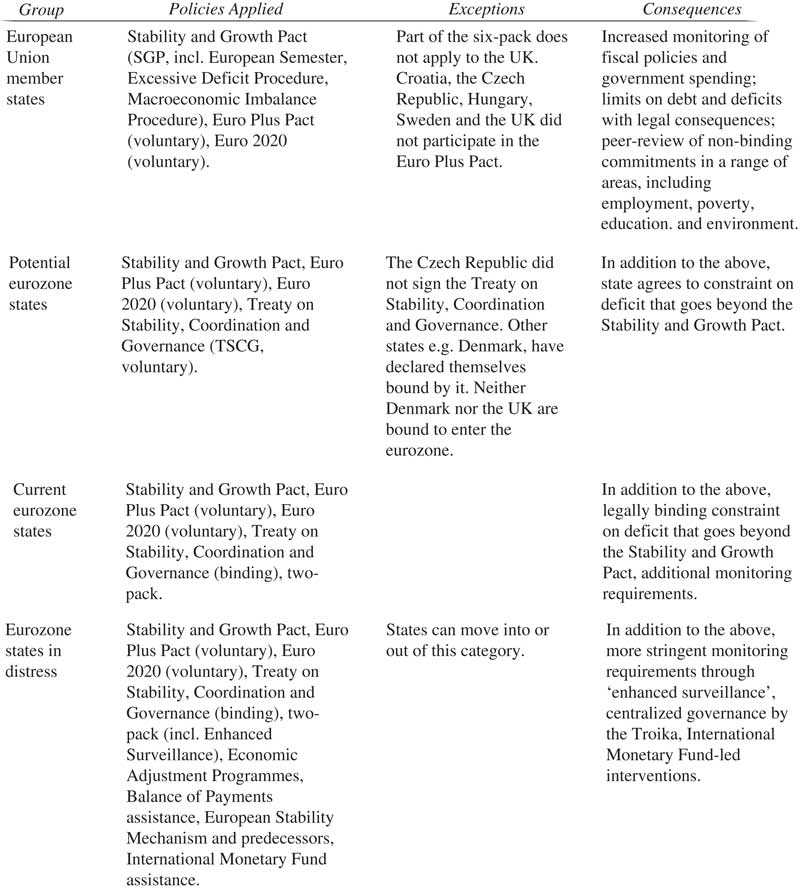
The Troika’s fiscal measures were experienced in only five member states (Cyprus, Greece, Ireland, Portugal and Spain) and by 2015 only operated in two (Cyprus and Greece), but it was a particularly radical, if temporary, shift in citizenship rights for people in those states. Beyond the Troika, however, altered fiscal governance and a changed role for the European Central Bank affect the citizenship of all Europeans, whether in the eurozone or not. Figure 1 summarizes the most important changes and the different sets of countries affected. The EU has a form of differentiated citizenship for citizens of countries in Economic Adjustment Programmes and other member states; the limits to political and social citizenship in Economic Adjustment Programme countries are striking, but so are the new limits to political and social citizenship in every EU member state.
Fiscal Governance Instruments

Economic Adjustment Programmes: The Troika
The Troika is an increasingly formal way to take EU member states into effective receivership, subjecting almost every aspect of their governance to oversight by EU and international institutions. In substance, its policies have tended to erode social citizenship rights, and the process of receivership embodied in the Troika damages political citizenship. The Troika was formally renamed ‘the three institutions’ early in 2015 in response to challenges from the new Greek government, but the change did not catch on and the new name was not enough to mollify Greece (Koutantou and Tagaris Reference Koutantou and Tagaris2015). The Troika is composed of the International Monetary Fund (IMF), the European Central Bank and the European Commission (on behalf of the European Financial Stability Fund and the European Financial Stabilisation Mechanism and, as of September 2012, the European Financial Stability Mechanism).
The Troika is essentially a conditional lender, making public sector loans in return for government compliance with a number of more or less binding fiscal and policy conditions. These conditions are published as Economic Adjustment Programmes, also known as Memoranda of Understanding (MOU). A crisis measure, Economic Adjustment Programmes initially had no clear legal basis. Later, ‘two-pack’ legislation (see below) and a 2013 treaty amendment to Article 136, creating the European Stability Mechanism, brought into being a permanent rescue fund and legal basis for current and future Economic Adjustment Programmes that the Court of Justice of the European Union endorsed in the 2012 Pringle decision (case C-370/12). Economic Adjustment Programme conditionality is tough, but it is worth noting that it comes with support far beyond what indebted countries in the rest of the world could receive. The two Greek bailouts total about €190bn, for a country with a GDP of just under €300bn per year. As of July 2015, the Greeks and institutions are discussing a further loan of about €86bn. Non-eurozone states such as Latvia and Hungary had International Monetary Fund stabilization programmes substantially co-financed by EU institutions, but they were not formally engaged with the Troika.
The Economic Adjustment Programmes are intended to change the trajectories of countries in deep trouble, some of which had clear structural problems even before the boom that burst in 2008 (Greer Reference Greer2014). They combine cuts and tax increases, pro-‘competitiveness’ policies such as labour law deregulation, and smaller-scale policy initiatives such as calls for opening up transport markets, liberalizing professional regulation, administrative changes and privatization of remaining state service providers. There are only a few exceptions to the general message of retrenchment and limited public liabilities.
We can examine the effects of the Economic Adjustment Programmes on citizens of the five states in two ways. First, we can examine the very fact of the programmes’ existence, which has consequences for political citizenship in the affected countries. An Economic Adjustment Programme means that details of policy, consequential ones such as retirement ages, pension levels, privatizations and labour laws, are being rewritten at the behest of the Troika. By design, none of the Troika members affords citizens of any country much opportunity to participate in the exercise of its power. This means that transferring power over the government of Cyprus to the Troika, for example, involves a reduction in the political citizenship rights of the Cypriots.
The consequences of the Economic Adjustment Programmes for political citizenship flow logically from a comparison of the Troika’s composition with that of a member state government. Two of the three institutions in the Troika are essentially ‘non-majoritarian’ in that citizens are firmly distanced from participation in determining their actions. The European Central Bank is effectively governed by central banks of the eurozone, whose governors can be elected to its board. Its autonomy is entrenched in the EU treaties, along with a commitment to price stability as an overriding goal. The International Monetary Fund is governed by its members in accordance with their contributions (quotas), which are fixed in proportions that give big EU member states a significant role and the US an automatic veto. The European Commission is the most democratic of the three in that EU citizens can affect its composition through votes for the European Parliament and for the governments who nominate commissioners and interact with it in the Council. The Troika is not transparent; we do not know how the International Monetary Fund, European Commission, and European Central Bank interact or what exactly is the role of the informal finance ministers gathering in the Eurogroup. Nonetheless, the three institutions all reduce the role of any given member state’s citizens’ participation in the meaningful exercise of power; the citizens best positioned to influence the International Monetary Fund through their choice of government are in the US. It would be possible to argue that the Troika addresses an imbalance in which voters in Greece or other states could ignore the preferences and interests of other member states’ voters, but it is hard to argue that the way to redress such an imbalance is through the empowerment of the Commission, the International Monetary Fund and a central bank.
Then we can examine the contents of the Economic Adjustment Programmes for their effect on social citizenship. In the welfare state itself, the biggest and most reliable policy outcomes are a reduction in social welfare expenditure and some tinkering, especially with health care systems. Nobody would have picked out the health care systems of Greece, Ireland, Portugal or Cyprus as effective equalizers before the crisis (Toth Reference Toth2010), but the scale of the reduction of health care expenditure is dramatic in each (Burke et al. Reference Burke, Thomas, Barry and Keegan2014; Legido-Quigley et al. Reference Legido-Quigley, Urdaneta, Gonzalez, La Parra, Muntaner, Alvarez-Dardet, Martin-Moreno and McKee2013; Maresso et al. Reference Maresso, Mladovsky, Thomson, Sagan, Karanikolos, Richardson, Cylus, Evetovits, Jowett, Figueras and Kluge2015). The effects on access to the welfare state are also dramatic. For example, Greek social insurance eligibility is tied to recent or current employment, so its startling rates of long-term unemployment translate into denial of health care and social care benefits (Kentikelenis Reference Kentikelenis2015). It is reflected in increasing rates of communicable diseases such as AIDS in the wake of cuts in drug treatment programmes and the reappearance of malaria in Greece in the aftermath of cuts to mosquito abatement programmes (Kentikelenis et al. Reference Kentikelenis, Karanikolos, Reeves, McKee and Stuckler2014). More generally, there has been a sharp rise in reported unmet health needs across the countries in receivership (Reeves et al. Reference Reeves, McKee and Stuckler2015). The country with the most severe debt burden, worst economic decline and most corrupt health system, Greece (Matsaganis Reference Matsaganis2011), has perhaps unsurprisingly seen the most serious deterioration of health care access and health outcomes (Kentikelenis et al. Reference Kentikelenis, Karanikolos, Reeves, McKee and Stuckler2014).
The Troika operated initially in parallel to conventional EU law. The body of civil citizenship rights enshrined in EU law remained intact, but the crisis conditions in the Economic Adjustment Programme states cast a new light on EU civil citizenship rights. On one hand, freedom of movement gave citizens of those states the option to migrate elsewhere in the EU. On the other hand, the crisis coincided with increased flows of refugees from outside the EU who disproportionately landed first in Greece and Italy. Under the Schengen Agreement they have no right to cross borders from the state that hosts them. Under the currently very contentious Dublin Regulation, the first member state they enter has the responsibility for them and they can be returned to, or blocked from leaving, that member state (Azoulai and de Vries Reference Azoulai and de Vries2014). The result was a rolling crisis for most of 2015 as different countries took very different approaches to refugees. There is also considerable potential for spillover from restrictive policies aimed at non-citizens (for example, effects on citizens, such as ethnic and racial minorities, who are caught up by policies aimed at non-citizens). A politics of zero-sum ethnic conflict can damage the rights of citizens as well as non-citizens.
The European Central Bank as a Judge of Governments
The participation of the European Central Bank in the Troika is a sign of its dramatic, and generally unanticipated, role in shaping the political future of Europe. Citizens of any member state play only a tiny role in the exercise of its power, but its power over member state policies and governments has increased dramatically with the crisis.
The European Central Bank has given itself a dual mandate: price stability and microeconomic policy reform (the latter is nowhere in the treaties). The actions are the purchase of debt – of governments, of banks – and statements implying that such a thing will happen. The most important was probably the European Central Bank President Mario Draghi’s announcement that the bank would do ‘whatever it takes’ to preserve the euro (Carrel et al. Reference Carrel, Barkin and Breidthardt2012). His key instrument at the time was the ‘Outright Monetary Transactions’ programme that Draghi announced on 6 September 2012, which would involve buying government debt subject to government compliance with conditionalities set by the rest of the EU, presumably including compliance with recommendations from the European Semester. This is an ambiguous goal for any country, especially one not subject to the explicit conditionalities of an Economic Adjustment Programme, supported by a programme that was never needed (Draghi apparently influenced markets without its actual implementation) and is not clearly legal, and a programme that is formally unrelated (the Emergency Liquidity Assistance, ELA, for private banks). It would appear that countries are eligible to have the European Central Bank support their and their banks’ debt based on their compliance with the European Central Bank’s interpretation of compliance with other EU policy reform initiatives.
Participation in the Troika means that the European Central Bank is participating in conditional lending and endorsing a detailed public policy agenda. Beyond that, the bank also has a record of influencing basic member state politics. It is hard to say if the European Central Bank helped to force Silvio Berlusconi out of office as Italian prime minister, but it seems quite likely that it did by declining to purchase Italian government bonds until Berlusconi left (Hopkin Reference Hopkin2012; Jones Reference Jones2012). The European Central Bank also sent a secret letter to Italy in August 2011 calling for detailed policy changes, such as professional services liberalization and firm-level wage bargaining.Footnote 1 There is no mandate for such an action, but it could only have coercive force, coming from the central bank on which the Italian government’s continuing funding depended.
Likewise, the European Central Bank contributed to the effective defeat of Greece’s challenge to the Troika in May–June 2010 when it declined to provide additional Emergency Liquidity Assistance to keep Greece’s private sector banks functioning in the face of a bank run. Its member Bank of Greece (2015) issued an alarming report warning that failure to reach any agreement with the EU ‘would snowball into an uncontrollable crisis’. The European Central Bank decision would have made it impossible for Greek banks to survive a bank run that the Bank of Greece loudly predicted. It forced a crisis in Greece that ended negotiations, even after the referendum on the agreement, with Greek defeat and a threat to the governing Syriza party’s basic electoral and parliamentary stability.
This is far from the world of apolitical guardians that mainstream economists like to imagine when they justify power for central banks (Adolph Reference Adolph2013). A central bank manipulating market expectations and private funding lines to change a prime minster, rewrite labour law or reverse a referendum result is hardly called for in the treaties or in the theory of central banking. Regardless of one’s sympathy for European Central Bank policymakers, and it is possible to argue that their decisions were forced on them, they have not played a positive role for democratic political citizenship. If an organization as distant from citizens as the European Central Bank starts making decisions about economic priorities, regulatory and public policy, and the composition of governments, then we see a net deprivation of political citizenship rights.
As for social citizenship rights, it is hard to argue that cuts in social services, reduction of access, imposition of co-payments and other cost-cutting techniques endorsed by the European Central Bank in its letters or Troika participation improve social services. Each cut reduces their ability to be an equalizing force in society. Even in the systems where there was considerable scope to improve the equalizing effects of welfare states as they actually worked, it is not guaranteed that double-digit cuts, regularly repeated, will produce the kind of improved management that would provide more egalitarian outcomes.
New Fiscal Governance
The actions of the Troika and European Central Bank come with a permanent counterpoint: major legal and institutional changes whose effect is to reduce the involvement of citizens in the exercise of political power, with the goal of limiting the ability of governments to pursue policies that might, among other things, extend or preserve social citizenship.
The Troika was quickly and explicitly created as an emergency measure to cope with financial crises in a few countries. The European Central Bank’s dramatic role, which very much affects eurozone states, was never apparently intended, and it is not clear the European Central Bank’s leaders have wanted it. The intended, permanent, solution to the troubles of the eurozone is a substantially more forceful and intrusive fiscal governance system for all member states. The diagnosis was that the crisis happened because of government profligacy and soft budget constraints. The logic, in general and for German voters (Bastasin Reference Bastasin2015), was that the eurozone could bail out profligate countries only if the rules were hardened so that they would never again be able to run harmful deficits (Greer Reference Greer2014). This logic entailed ‘fiscal governance’: setting European-level binding rules on fiscal policy with automatic enforcement, entrenched in treaties, with a minimum of discretion for Commission and Council. In other words, it involved subjecting essentially all policy-making to strict rules that constrain the autonomy and power of member states. This is a dramatic shift in the political citizenship of EU citizens, made in pursuit of a policy goal with consequences for their social citizenship.
The centre of EU fiscal governance is the Stability and Growth Pact, which was introduced alongside monetary union in the 1991 Maastricht Treaty on European Union and which constrained all EU member states to maximum 3 per cent deficits and 60 per cent debt-to-GDP ratios. The Stability and Growth Pact was formally hard law, but it was substantially softened in 2005 when the Commission deemed Germany and France non-compliant, and it obviously failed to protect the eurozone against the financial and debt crises (Schelkle Reference Schelkle2009).
In 2010 came an effort to build a tougher and more capable Stability and Growth Pact through a complex mixture of new legislation (the ‘six-pack’ and ‘two-pack’), a new intergovernmental treaty (the Treaty on Stability, Coordination and Governance, TSCG), and a procedure for surveillance of member state policies (the European Semester) (see Figure 1). It created both hard budgetary constraints (the ‘corrective’ arm) and a surveillance system to prevent future Stability and Growth Pact violations or macroeconomic imbalances (the ‘preventative’ arm).
The corrective arm is a strengthening of the Stability and Growth Pact. Member states which are violating the Stability and Growth Pact’s deficit or debt rules can be placed in an Excessive Deficit Procedure, which, after a number of years, leads to obligatory fines. The reformed corrective arm formally removes discretion from the Commission, which is now obliged to report Stability and Growth Pact violations, and from the Council, which in fiscal governance will now use a new voting rule. The new voting rule, reverse qualified majority, requires a qualified majority to block the implementation of punishment under the Stability and Growth Pact. In theory, the new fiscal governance of the EU is hard law that tasks member states with supplying quality information, tasks the Commission with identifying non-compliant budgets, economies and policies, and limits the Council’s ability to amend decisions or punishments (Greer et al. Reference Greer, Fahy, Elliott, Wismar, Jarman and Palm2014). In practice, much of the work is done by the ‘eurogroup’ of eurozone finance ministers. The eurogroup might seem to be a formal part of EU governance but it is an informal gathering of eurozone finance ministers, which is how it could decide to exclude a eurozone finance minister in 2015 (Greece’s Yanis Varoufakis).
If the corrective arm is theoretically automatic, punitive and focused on overall finances, the preventative arm involves more detailed engagement in member state policies and priorities such as the appropriate entitlements and expenditures for health, pensions, education and employment. The preventative arm of the Stability and Growth Pact is most visible in the Semester. Essentially, the Semester is a form of surveillance in which EU member states iteratively report on their policies and challenges to the Commission, which responds with ‘Country Specific Recommendations’ (CSRs) that the Council adopts, possibly after amendment, in July. The Country Specific Recommendations can be quite detailed. The 2015 Recommendation for France, for example, requests a review or abolition of the numerus clausus for health professional education (9244/15). France is in an Excessive Deficit Procedure, so in theory France could be fined for failing to review the numerus clausus. That kind of detailed instruction about domestic health policy is a novelty in EU history. Countries in Economic Adjustment Programmes are exempted from Semester participation; the EU already plays a significant role in their policy-making through the Troika.
The legal bases for the Semester are in three places. One is the Stability and Growth Pact. Country Specific Recommendations based on the Stability and Growth Pact address threats to member state compliance. The second is in the Macroeconomic Imbalance Procedure (MIP). This is a new procedure in the six-pack that tasks the Commission, as ratified by the Council, with identifying the kind of destabilizing macroeconomic imbalances that led to debt crises in Spain and Ireland. Those countries had been very fiscally rigorous until their economies suffered major collapses and their governments took on private bank liabilities. The Macroeconomic Imbalance Procedure is supposed to identify and force the correction of imbalances that might lead to a repeat of those events. The third legal base applies only to the European Semester and is currently the Europe 2020 strategy, a set of EU priorities agreed in 2010 under the previous Commission president (and largely overlapping with the voluntary 2011 Euro Plus Pact, which encourages ‘competitiveness’ through a member state agreement to make changes such as abolishing wage indexation, harmonizing corporate taxes and raising pension ages). It is a set of recommendations intended to make the EU a stronger and more competitive economy, including goals such as environmental protection and higher employment. Only the Stability and Growth Pact and Macroeconomic Imbalance Procedure-based recommendations have legal force but compliance with the Europe 2020-based Country Specific Recommendations might give a country a good reputation with others, especially the European Central Bank, should it encounter problems, or would help a country in the Excessive Deficit Procedure to make a case for its improving behaviour. Country Specific Recommendation compliance is also increasingly tightly linked to eligibility for EU Structural and Investment Funds.
Much of the content of the six-pack and two-pack is duplicated in the Treaty on Stability, Coordination and Governance, along with the obligation to constitutionalize the Stability and Growth Pact limits (a ‘debt brake’ in the original German), so that it can be enforced by the member state courts, and access to financial resources for compliant states in case of another debt crisis. The UK and Czech Republic refused to join the Treaty on Stability, Coordination and Governance, so it is an intergovernmental treaty serviced by the European Commission. Because much of the Treaty on Stability, Coordination and Governance is already in EU law thanks to the six-pack and two-pack, and under that the Stability and Growth Pact which all member states have agreed, the implications of non-accession are surprisingly small (the Czechs also ratified the European Stability Mechanism Treaty, amending Article 136 to enable future conditional lending by future Troikas to distressed eurozone states). There is some speculation that the Country Specific Recommendations are milder and less intrusive for non-eurozone states with delicate politics, notably the UK, but evidence is inconclusive so far (Azzopardi-Muscat et al. Reference Azzopardi-Muscat, Clemens, Stoner and Brand2015; Stamati and Baeten, Reference Stamati and Baeten2015). Likewise, it is clear that non-eurozone and non-Treaty on Stability, Coordination and Governance states are at some remove from eurozone policy-making (for example, their finance ministers are not part of the eurogroup), but much of the formal structure still applies across the EU (Figure 1).
Parliaments and consultation with civil society are deliberately sidelined. The European Parliament is merely allowed to comment on the progress of the Semester and is kept informed through bilateral inter-institutional agreements that sharply limit what its members know or can make public about, for example, the activities of the European Central Bank. Member state parliaments are largely absent from the procedure, with their role dependent on their ability to shape their governments’ participation (for example, through scrutiny of submissions to the Semester). The Semester shares much, including key committees such as the Social Protection Committee, with the older and massively researched Open Method of Coordination. Even here, though, it reduces the ability of citizens to participate meaningfully in the exercise of power. The Open Method of Coordination, unlike the Semester, contained a commitment to consultation with civil society. Civil society advocates are still searching for ways to engage in the Semester.
Political Citizenship, Social Citizenship and EU Fiscal Governance
This section has reviewed three major changes in the operation of the EU since 2008, all driven or justified by the financial crisis and all focused on fiscal and economic policies, but with important consequences for citizenship. The first, the Troika, is a mechanism that certainly reduces the ability of citizens of states in receivership to participate meaningfully in the exercise of power. It is not new in the history of sovereign debt for states to lose sovereignty to creditors (Dyson Reference Dyson2014), but inasmuch as the institutions of the Troika are all more distanced from any country’s voters than their elected government, the result is a reduction of political citizenship in those countries. The second, the protagonism of the European Central Bank, also marks an erosion of political citizenship even relative to countries with independent central banks, since whatever formal and informal feedback mechanisms existed for a given central bank were country specific and did not translate to the European Central Bank (Hancké Reference Hancké2013).
The Troika and the European Central Bank’s actions were constituted as temporary expedients for a few countries. The new fiscal governance is, in theory, the permanent solution for all countries. The objective is to create a hard budget constraint on governments through hardened laws, extensive policy and fiscal surveillance, and more automatic enforcement. Unsurprisingly, a system designed to constrain government expenditures, macroeconomic developments and the policies behind them constrains what governments can do. It thereby limits what citizens can ask of them, reducing the scope of what member states do and expanding the scope and importance of what much less democratic institutions do. A distrust of elected officials leads to policies that erode the political rights of the citizens who elected them. In terms of social citizenship rights, the new fiscal governance could conceivably, under certain circumstances, go with a strong welfare state, but in practice it is pointing to substantial constraints on government expenditure. Little suggests that this improves or maintains social citizenship. There is certainly no expansive (or expensive) new EU social or political citizenship established to replace the constrained member state citizenship.
None of the three changes directly affects civil citizenship, which is also under some political pressure. Some governments are challenging the basic right to free movement and access to benefits in other EU member states. The UK is particularly visible in this area, incorporating restrictions on benefits eligibility for recent migrants into its requests for treaty changes. Governments can restrict the social rights of citizens from other EU countries by simply expanding eligibility requirements (for example, making benefits conditional on a certain number of years in work). Insofar as this happens, the key social citizenship rights that flow from civil citizenship in the EU are curtailed – and in pursuit of curtailing rights for migrants in a non-discriminatory fashion, governments adopting that strategy are also likely to curtail their own citizens’ social rights. Finally, there is the separate issue of the treatment of refugees and undocumented migrants, the most vulnerable of third-country nationals. While the scenes of refugees in Europe are dramatic, the member state rights and responsibilities surrounding them have not yet formally changed. From a legal and institutional point of view, civil citizenship rights in the EU have been quite stable in the crisis, and what changes can be found are incremental and mostly applicable to cross-border social citizenship rights. Whether they will remain stable remains to be seen.
Conclusion
If the effect of the new fiscal governance regime at the EU level is to diminish social citizenship rights (for example, by making it impossible for governments to deliver) or to reduce the impact of political engagement at the member state level (by shifting authority to elsewhere – that is, expanding the democratic deficit), then it has reduced Europeans’ social citizenship rights even if their rights vis-à-vis the EU remain just the same. If its effect is to reduce the power of member states and strengthen rules and institutions in which citizens have less participation, then it is reducing political citizenship rights. The EU’s effect on citizenship rights of other, linked, polities such as member states is thus important in understanding its effect on citizenship. The EU has long had a role in civil citizenship by expanding freedom of movement and non-discrimination for EU citizens. Reforms in EU governance since the crisis, however, have eroded the role of member states, thereby eroding the social and political rights that exist vis-à-vis states, without creating compensating EU social and political rights.
First, the new EU has already had effects on social citizenship. The EU’s role in the new fiscal governance regime is to focus on budgetary rigour. There is only minimal social policy of any sort discussed, and it is in the Europe 2020 and other mechanisms that have little legal authority behind them. If a member state persistently violates the Stability and Growth Pact, even in fulfilling social citizenship rights, there is a detailed and even automatic process designed to warn, shame, instruct and punish that member state. If a member state persistently violates one of the Europe 2020 objectives with social content (such as promoting healthy and active ageing), there is only limited sanction (structural funds conditionality). It is hard to imagine the European Central Bank constraining loans to a member state’s private banks or ceasing to buy its bonds because that member state did not promote healthy ageing or a low-carbon economy. The asymmetry is unsurprising in terms of basic institutional architecture and in terms of politics, given that the justification for the fiscal governance regime was the need to reinforce the Stability and Growth Pact. Its implications for social citizenship, however, are problematic. Social citizenship rights are expensive, and the EU is now firmly on the side of regulating expenditure, with little obligation to balance social citizenship against fiscal stability.
The second implication is that political citizenship is reduced by the new role of the EU (Crum Reference Crum2013), for all member states. The EU institutions have more powers to evaluate and discipline member states. Parliaments and other forms of consultation long studied by EU scholars are almost entirely absent, with parliaments mostly relegated to commenting on the European Semester. It is not only symbolic that member state governments will be submitting budget proposals to the Commission before they submit them to their own legislatures. This transfer of power to the EU institutions, notably the Commission (Bauer and Becker Reference Bauer and Becker2014), is not matched by greater oversight or democratic accountability within the EU. Rather, the mechanisms are designed to be automatic – limiting Commission and then Council discretion by forcing the Commission to bring determinations to the Council and giving the Council a new voting rule designed to make it hard to let member states avoid censure. The European Central Bank is left with enhanced discretion for the expansive policy agenda it has developed. The rise in power of the EU institutions also, notably, excludes any increase in power for the European Parliament. Increasing the power and limiting the discretion of the Commission and Council hardly compensates for the lost autonomy of elected member state governments and parliaments. Policies intended to prevent and reduce fiscal deficits seem to have expanded the EU’s democratic deficit.
The third implication is that civil citizenship rights, the topic of so much research on EU citizenship rights, are not entirely secure in their present shape. Austerity politics and perceptions of migration crises invite member states to explore the limits of EU free movement law in their efforts to deny benefits to foreign EU citizens, as the UK and Germany notably have done, even if the main mechanism available is tighter eligibility for all who want to use a benefit.
The fact that there is now an explicit treaty and legal basis on which to constitute new Economic Adjustment Programmes suggests that even if the model was born out of improvisation, it has proved satisfactory enough to be retained. Member states in receivership lost political autonomy and were obliged to significantly alter their welfare states. Citizens found that powers previously in the hands of their domestic governments had been shared out among three institutions over which they had far fewer political claims – the Commission, the non-majoritarian, insulated, European Central Bank and the very non-majoritarian International Monetary Fund (Ladi and Tsarouhas Reference Ladi and Tsarouhas2014). The democratic deficits of these three institutions are considerable, and they are involved to represent creditors and a particular reform agenda rather than extensive social rights.
In sum, we have examined the changes in the structure of the European Union since 2008 in terms of citizenship rights, and found major changes that point to retrenching citizenship. The EU has long had its biggest effect on civil citizenship and expanded it, but the changes in the EU mean that its fiscal governance system now diminishes states and the social and political citizenship rights primarily attached to them. When EU leaders agreed this treaty and legislation, and accepted the European Central Bank’s actions, they were retrenching political and social rights for the future. Researchers who have long been concerned that the EU diminished social and political citizenship now have far more to worry them. Even if member states and the Commission find a way to undermine this incarnation of fiscal governance, as they did its weaker predecessors, they have saddled themselves with a framework whose negative implications for social and political citizenship rights are worrisome.
Acknowledgements
The authors would like to thank for their helpful comments Ken Dubin, Robert Fannion, Pete Mohanty and participants in a workshop organized by Willem Maas (York University, Toronto) and a session of the European Union Studies Association, Boston, March 2015.