One of the most surprising developments in Mexico's ongoing drug wars is the strategic decision by drug cartels to target local elected officials and political leaders for assassination. After sixteen years of inter-cartel wars (1990–2006)Footnote 1 in which drug trafficking organizations rarely targeted active government authorities or politicians, since 2006 drug lords have launched a series of systematic lethal attacks against subnational officials and local political leaders. Between 2007 and 2012 drug cartels murdered fifteen state government officials, sixty-four mayors, forty-five municipal government officials, seven party candidates and twenty-five party activists. If we add assassination attempts, public death threats and kidnappings, Mexico experienced 311 lethal criminal attacks – affecting 9.6 per cent of the country's 2,457 municipalities and the 29 per cent of the Mexican population who live in them.
Scholars of political conflict agree that the killing of a head of state is one of the most severe forms of political violence for any society (Iqbal and Zorn Reference Iqbal and Zorn2006). Likewise, although on a different scale, the murder of a governor, mayor or local party candidate is a traumatic event in the collective life of any city or rural town. If cartels can kill a people at a community's highest level of authority, the generalized perception among civilians will be that everyone is subject to the criminals’ will. Just as the assassination of a head of state immediately captures the whole country's public imagination, the murder of a mayor or party candidate instantly attracts publicity throughout the locality and beyond, and thus acquires a high-profile status.
High-profile criminal violence is puzzling because drug cartels, like any group operating in the criminal underworld, would presumably prefer to stay out of the spotlight (Durán-Martínez Reference Durán-Martínez2017; Gambetta Reference Gambetta1993). Such attacks would appear to be counterproductive, because they attract the attention of national law enforcement agencies and expose drug cartels and illicit drug markets to state intervention. Moreover, cartels have a history of successfully co-opting subnational authorities to assist them in the operation of illegal markets (Snyder and Durán-Martínez Reference Snyder and Durán-Martínez2009), and drug lords have typically preferred the secrecy of bribery to the publicity associated with political killings. Admittedly, if bribes get too expensive, criminals often rely on the threat of violence or a few exemplary executions to lower the bribery price (Lessing Reference Lessing2015). But murdering large numbers of local authorities and politicians would not appear to be a cost-effective option.
Why did Mexican cartels launch major attacks against subnational authorities and politicians when they had secured their co-operation through bribery for more than a decade? Why did they engage in high-profile political assassination if this could be counterproductive?
Scholars of large-scale criminal violence suggest that the dynamics of inter-cartel and state–cartel wars can prompt drug lords to take the unusual decision to attack government authorities. Lessing (Reference Lessing2015) argues that drug cartels attack state agents only when states declare war on the cartels and launch fierce unconditional attacks against them. This is the repression hypothesis. Others argue that in contexts of intense turf wars, competition for criminal markets leads cartels to murder subnational authorities who fail to provide them with effective protection or who protect their rivals (Ríos Reference Ríos and Aguilar2012). This is the competition hypothesis. Alternatively, scholars of civil war suggest that in an ongoing civil conflict, armed groups attack subnational authorities and politicians to capture state rents in order to finance the war (Chacón Reference Chacón2013). This is the rent-seeking hypothesis.
While these accounts provide the basic tools to help unravel the puzzle of high-profile criminal attacks, a close inspection of the Mexican wave of strikes reveals that a narrow focus on the cartels’ needs for retaliation, protection or rents under-explains the extent of violence against government authorities and politicians in Mexico.
Building on new theoretical developments in the organized crime literature (Arias Reference Arias2017) and on studies of civil war (Arjona Reference Arjona2016; Kalyvas Reference Kalyvas2006), we develop a new account: the criminal governance hypothesis. We argue that in a context of dual war, in which cartels were fighting other cartels (Ríos Reference Ríos and Aguilar2012) and the state (Lessing Reference Lessing2015), Mexican drug lords were more likely to use targeted lethal violence against municipal officials and political candidates to subdue local governments and local populations and gain de facto territorial control over several local jurisdictions. Establishing subnational regimes of criminal governance would provide them with invaluable resources to control the criminal underworld, to regulate violence and taxation, and to take control over multiple licit and illicit economic activities.
If cartels use high-profile criminal attacks to develop subnational regimes of criminal governance, the central question is about the conditions that allow cartels to attack subnational political authorities. Following Iqbal and Zorn's (Reference Iqbal and Zorn2006) influential study of political assassination, we focus on political opportunities for criminal attacks. Because cartels are interested in targeting local governments and populations where they are most likely to succeed in establishing control, we argue that drug lords and their private militias will launch attacks against subnational government officials and political leaders who are politically and militarily unprotected by central authorities. Because cartels want to colonize local government structures, we suggest that they will launch attacks during local election cycles, when local governments are elected and incoming mayors put together their cabinets and make new administrative appointments. Finally, because cartels want to establish subnational territorial regimes of criminal governance, we expect they will target officials and politicians from clusters of neighboring municipalities, rather than launch isolated attacks.
We test the criminal governance hypothesis alongside alternative explanations using information from the Criminal Attacks against Politicians in Mexico (CAPAM) Dataset – an original databank of public death threats, kidnappings, disappearances, assassination attempts and murders of government authorities, political candidates and party activists, which we constructed.Footnote 2 Our statistical models for the 2007–12 period show that while high-profile attacks were more common in municipalities where cartels were engaged in major wars against rival cartels and the state, and where mayors had access to greater local fiscal revenues, political opportunities for establishing subnational criminal governance regimes had a large and independent effect on the logic of attacks. In a context of acute political polarization between the Right and Left, such as the one Mexico experienced after the bitterly contested 2006 presidential election, attacks were 4.3 to 4.8 times more likely in opposition municipalities from leftist states, where the conservative federal government did not provide sufficient political and military protection to mayors in conflictive regions. Attacks increased by 64 per cent during subnational election cycles, when state and municipal power was transferred to new administrations and new appointments were made. Our results also show that attacks were regionally clustered: for every additional attack among adjacent geographic neighbors, a municipality became 41 per cent more likely to experience an attack the following year.
The statistical analysis establishes a link between opportunities for criminal governance and high-profile attacks, and we use case studies to show how cartels capitalized on these murders to establish subnational criminal governance regimes. On the basis of fieldwork interviews with leaders of national mayors’ associations, former deputies of murdered mayors, former governors and national security officials, and local agricultural producers, we provide fine-grained information about how cartels seized political opportunities to develop criminal governance regimes in municipalities from the western state of Michoacán – a leftist state with an intense history of high-profile lethal attacks.
The article is structured in six parts. We first discuss the leading explanations of high-profile criminal attacks and use data from CAPAM to assess their explanatory power. In the second section we develop our criminal governance hypothesis. In the third section we present the statistical tests, in the fourth section a series of robustness checks to address empirical challenges, and in the fifth section we discuss the qualitative evidence. In the conclusion we discuss how the use of targeted political violence to establish subnational criminal governance regimes forces us to rethink some of our most fundamental assumptions about organized crime.
EXPLANATIONS OF HIGH-PROFILE CRIMINAL ATTACKS
Three Prevalent Hypotheses
The assassination of subnational government officials and local political leaders by organized criminal groups (OCGs) is not an exclusively Mexican phenomenon. Journalists and scholars of organized crime have documented major waves of criminal attacks against local government officials and politicians in a wide variety of countries in Latin America, including Brazil (Albarracín Reference Albarracín2018), Guatemala (Corcoran Reference Corcoran2011) and Honduras (Spring Reference Spring2013). Students of the Italian mafia have also documented waves of attacks against subnational government officials (Oliveri and Sberna Reference Oliveri and Sberna2014), and analysts of Colombia's civil war have documented the murder of hundreds of local officials perpetrated by armed rebel groups and military forces (López Reference López2010). The literatures on criminal and political violence offer three explanations: repression, competition and rent seeking.
The repression hypothesis
In an ambitious article that outlines the logics of violence in criminal wars in Latin America, Lessing (Reference Lessing2015) distinguishes between two types of wars fought by drug cartels: wars against the state and wars against rival cartels. While Lessing suggests that inter-cartel wars can be easily explained by drug lords’ inability to reach credible commitments to divide up desirable territories, he finds state–cartel conflict puzzling. If cartels do not seek to topple the government and seize formal power, and if they can use bribes or violent threats to elicit the informal co-operation of government authorities, why would they launch lethal attacks that would only ‘bring down additional heat’ on them and jeopardize their illegal activities?
Lessing suggests that drug cartels engage in off-the-path equilibrium behavior and attack state authorities when, regardless of the cartels’ use of violence, government officials order unconditional repression or crackdowns against them. Cartels retaliate against the state in self-defense. Although Lessing is not explicit about which state officials would be attacked, we can presume that the elected officials who ordered the crackdowns would be the targets.
The competition hypothesis
In her study of assassinations of mayors in Mexico's drug wars, Ríos (Reference Ríos and Aguilar2012) suggests that cartels are more likely to attack local elected officials in municipalities experiencing inter-cartel competition and violence. While Ríos provides empirical evidence showing a strong association between violent cartel competition and the murder of mayors, there is no explicit explanation of the motivations driving these killings. In a context of turf wars, in which cartels are fighting for control of plazas, we can presume that drug lords will use lethal coercion to punish mayors who offered protection to their rivals or to coerce future authorities to protect them.
The rent-seeking hypothesis
Students of armed conflict observe that after Colombia created thousands of municipal governments in 2001, armed groups engaged in targeted violence to capture local government resources (Chacón Reference Chacón2013; Eaton Reference Eaton2010; Sánchez and del Mar Palau Reference Sánchez and del Mar2006). Chacón argues that in civil conflicts, non-state armed actors rely on rents in their fight against central authorities and other rebel groups. He provides compelling quantitative evidence showing that after the introduction of an ambitious fiscal decentralization reform, armed groups in Colombia launched major attacks against local officials and politicians in municipalities that received the largest fiscal transfers and that lacked the policing capacity to resist the armed attacks.
Despite their differences, there is a common underlying logic to these three accounts: the needs that result from drug wars drive cartels and armed groups to engage in high-profile attacks. They attack state authorities in self-defense, or in search of protection or rents to fund ongoing conflicts. Using original data from CAPAM, we next assess the extent to which these accounts may explain dynamics of high-profile murders in Mexico.
Evaluating Prevalent Explanations with Mexican Data
Although drug violence in Mexico has only caught the world's attention in recent years, Mexican cartels first went to war in the early 1990s. After the country's four main cartels – Tijuana, Juárez, Sinaloa and Gulf – rose to international prominence in the 1980s, Mexico's drug trafficking industry enjoyed a period of peaceful coexistence under one-party rule (Astorga Reference Astorga2005). However, the first opposition victories in state-level politics and the alternation of political parties in gubernatorial office throughout the 1990s led to the breakdown of informal networks of state protections for cartels and to the outbreak of turf wars (Trejo and Ley Reference Trejo and Ley2018). After sixteen years of inter-cartel conflict, following a fiercely contested election in 2006, President Calderón declared a War on Drugs and deployed the military throughout the country's most conflictive regions to break up the cartels. Mexico experienced a five-fold increase in drug-related murders in the following years and the outbreak of new forms of violence, including high-profile attacks.
To understand whether high-profile attacks are random events or whether there are systematic patterns, we focus our initial descriptive analysis on the timing, targets and geography of targeted criminal violence. We use these descriptive statistics as a baseline test of extant explanations.
Timing
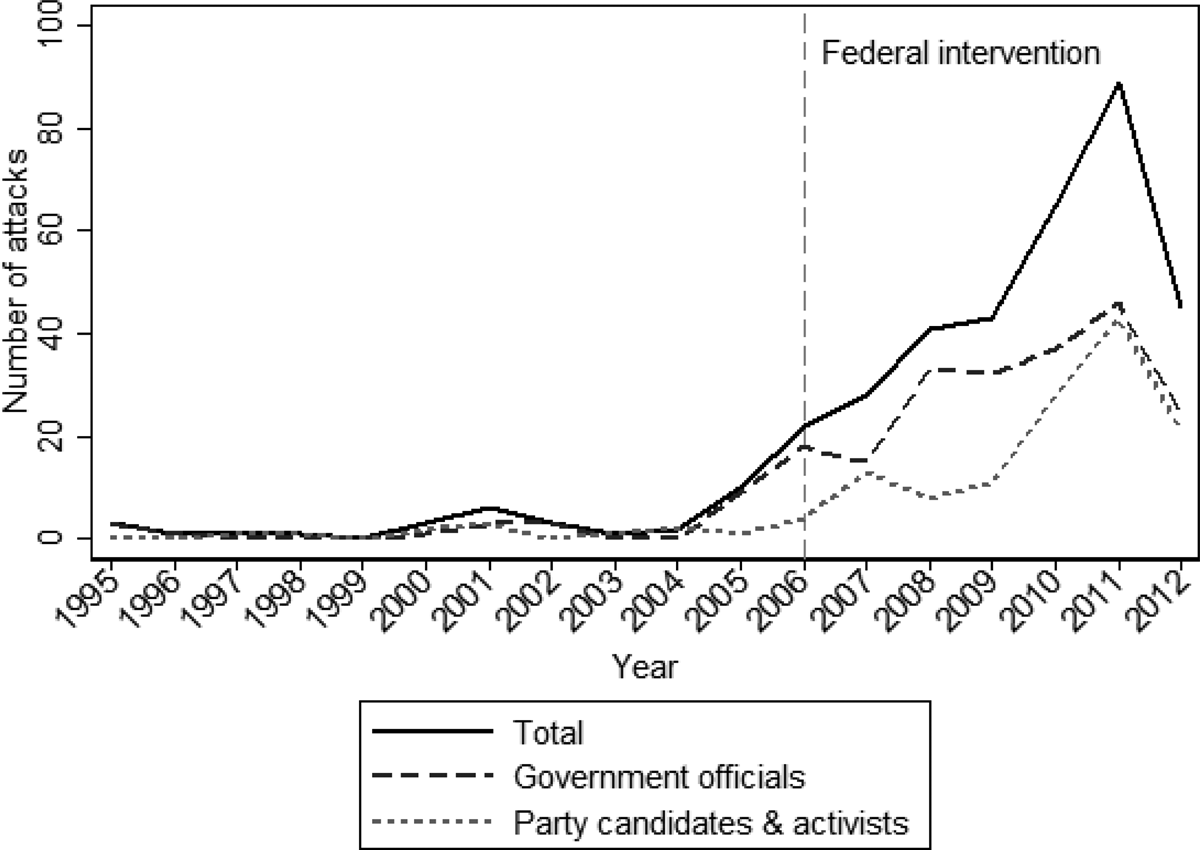
One of the most conspicuous aspects of Mexico's inter-cartel wars is that drug cartels did not launch any systematic attacks against government officials and party candidates for nearly a decade.Footnote 3 As Figure 1 shows, between 1995 and 2005 there were only a few high-profile criminal attacks. Even though the country's main cartels were involved in violent competition for turf and the death toll of inter-cartel wars reached an average of 270 battle deaths per year (Trejo and Ley Reference Trejo and Ley2018), during this period drug lords refrained from attacking government officials and politicians.
Evolution of criminal attacks against government officials and party members, 1995–2012 (counts)

In a context in which the federal government was not attacking the cartels, drug lords may have relied on bribery to negotiate local informal protection because it was cheaper to buy off subnational officials to look the other way than it was to murder them – which would have attracted unwanted federal attention. But, as Figure 1 shows, the wave of high-profile criminal violence began after 2006, when the federal government deployed the military to attack the cartels and the drug lords expanded their activities into illegal industries of human resource extraction (e.g., extortion of local businesses and kidnapping for ransom) to finance war.
The information in Figure 1 reveals that the competition hypothesis overpredicts the extent of attacks: although cartels were at war for ten years, their militias did not murder subnational officials and politicians. By contrast, in line with the repression hypothesis, Figure 1 shows the outbreak of a wave of attacks after the federal government launched an unconditional war against all cartels.Footnote 4
Targets
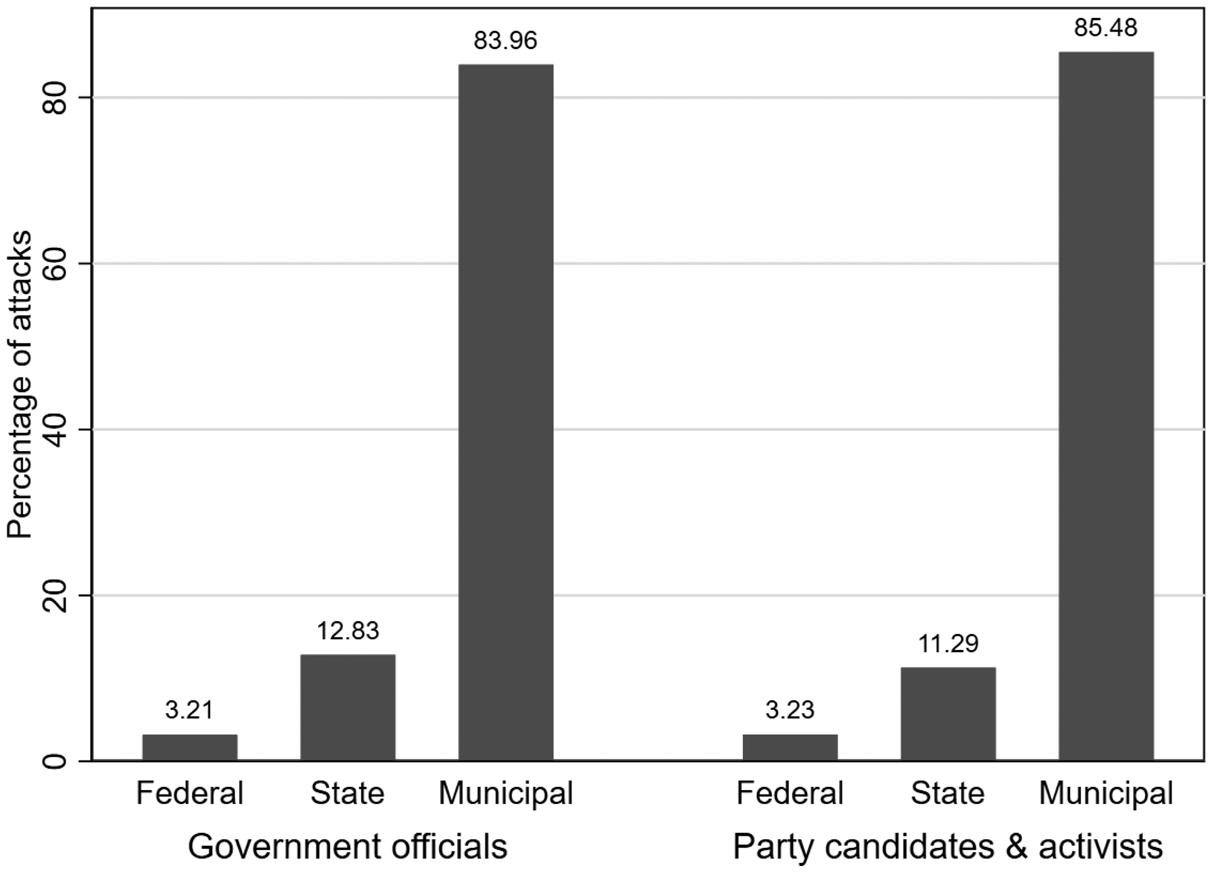
One of the key features of the outbreak of high-profile criminal attacks is that local officials and party candidates were the primary targets. Figure 2 shows that 83 per cent of attacks against government officials involved municipal authorities, and 85 per cent of attacks against party members involved municipal party candidates and activists.
Criminal attacks by target and level of government, 2007–2012 (%)

Figure 2 reveals that the repression hypothesis underpredicts attacks against subnational officials. Following a repression logic, we would expect that after the federal government deployed the military to unconditionally destroy all cartels, drug lords would order their armies to attack incumbent federal officials. As Figure 2 shows, however, fewer than 5 per cent of attacks involved federal elected officials or party candidates. This means that while the repression hypothesis helps us explain when the wave of attacks began, it cannot explain why cartels overwhelmingly targeted officials and politicians who had not ordered the attacks on them.
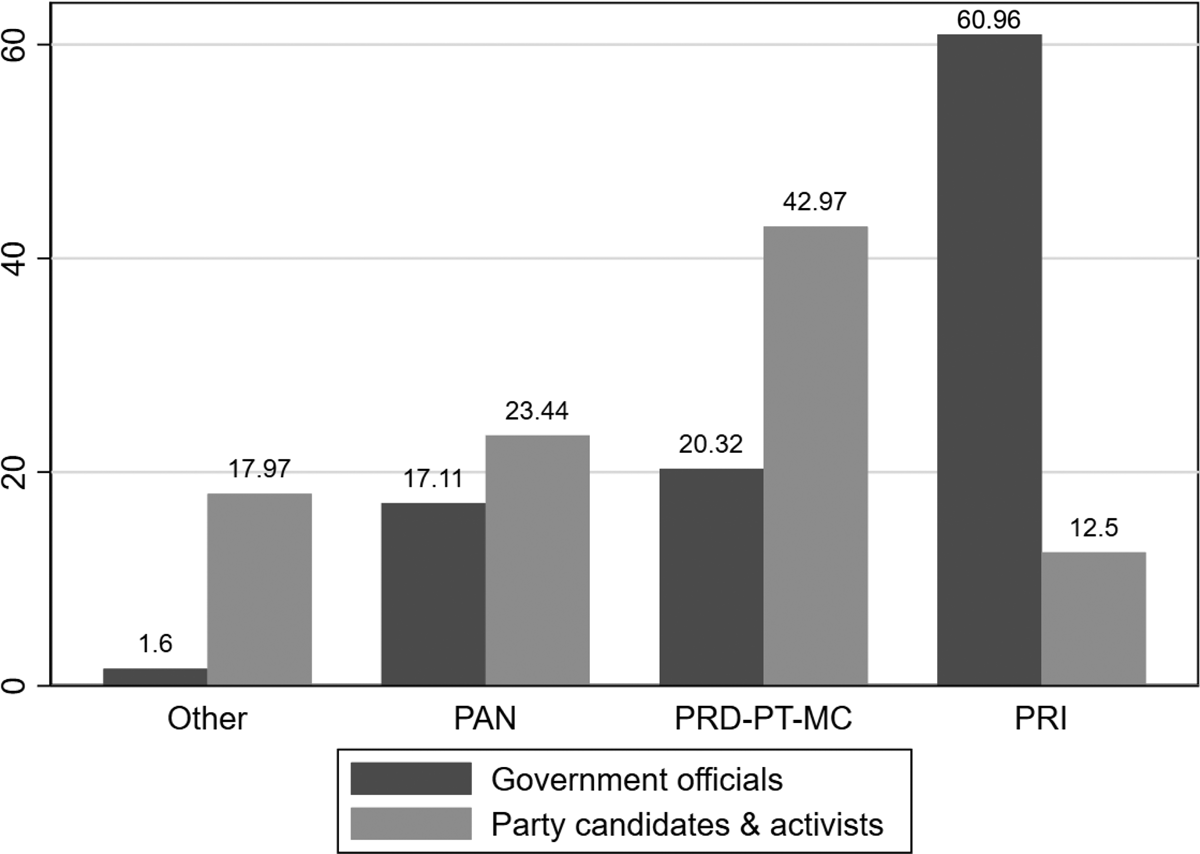
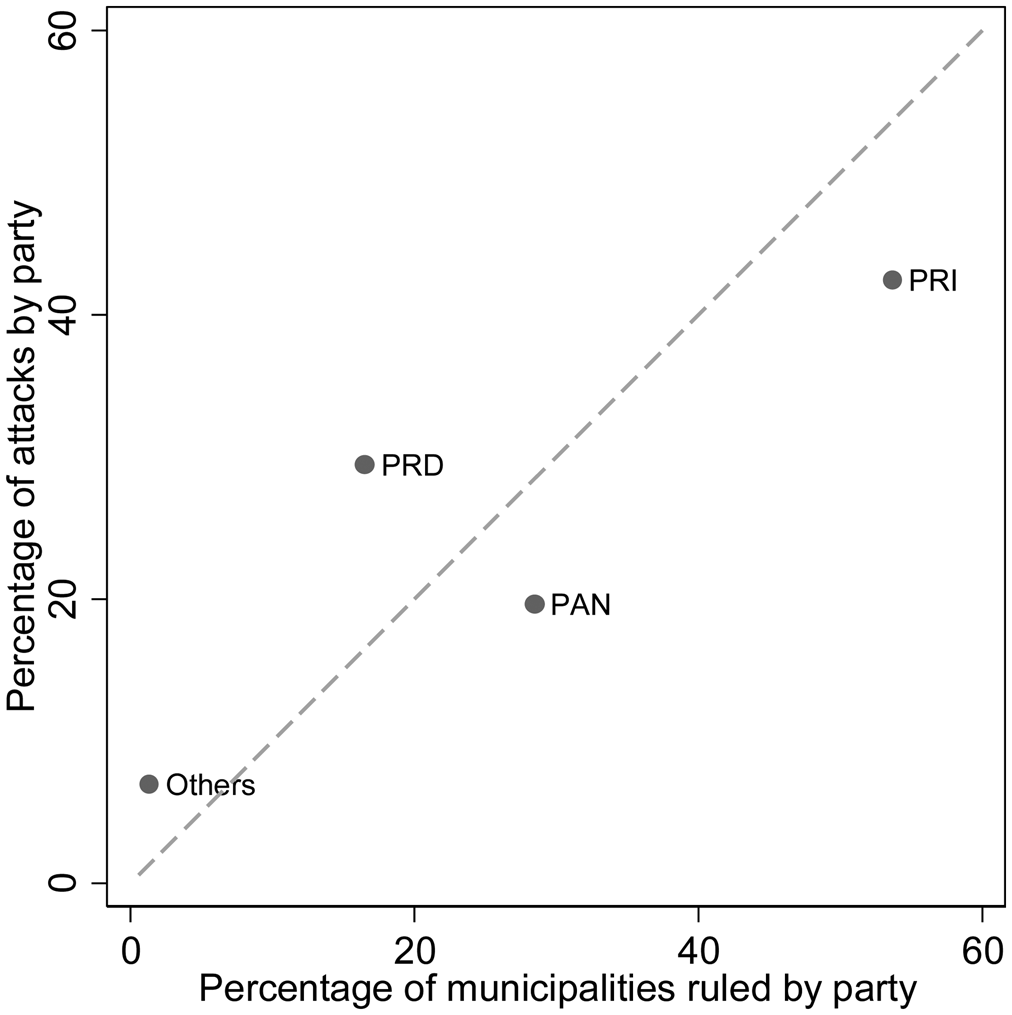
One of the most surprising features of the wave of attacks is that if we categorize victims according to partisan identity, it becomes evident that cartels had a partisan bias against subnational opposition authorities and party candidates, particularly those from the Left. As Figure 3 reports, in absolute terms most attacks against authorities involved government officials from the centrist-opposition Institutional Revolutionary Party (PRI), and most attacks against party candidates involved politicians from the leftist coalition PRD-PT-MC.Footnote 5 In relative terms, however, as Figure 4 reveals, local officials and party candidates linked to the Left were disproportionately punished: the Left governed 16 per cent of the country's municipalities but experienced 29 per cent of the attacks.
Criminal attacks by target and party, 2007–2012 (%)

Municipalities ruled by political party compared to targeted government officials and party members, 2007–2012
Note: PAN = national incumbent (conservative); PRI = opposition (center); PRD = opposition (Left).

Although the repression hypothesis only speaks about cartels counterattacking national state officials who launched an unconditional war against them, a plausible implication of this hypothesis is that in federal systems cartels would attack these officials’ subnational co-partisans. Yet subnational authorities and local politicians from the president's party were not the main target of attacks; on the contrary, most of the violence was directed against opposition officials and candidates, particularly those from the Left – the president's main rival party. While the logic of state–cartel retaliation is an important part of the story, it cannot explain why leftist subnational officials and politicians were disproportionately targeted. Because many of these leftist municipalities are rural and poor, this partisan bias suggests, moreover, that there might be more than pure financial motivations beyond these attacks.
Geography
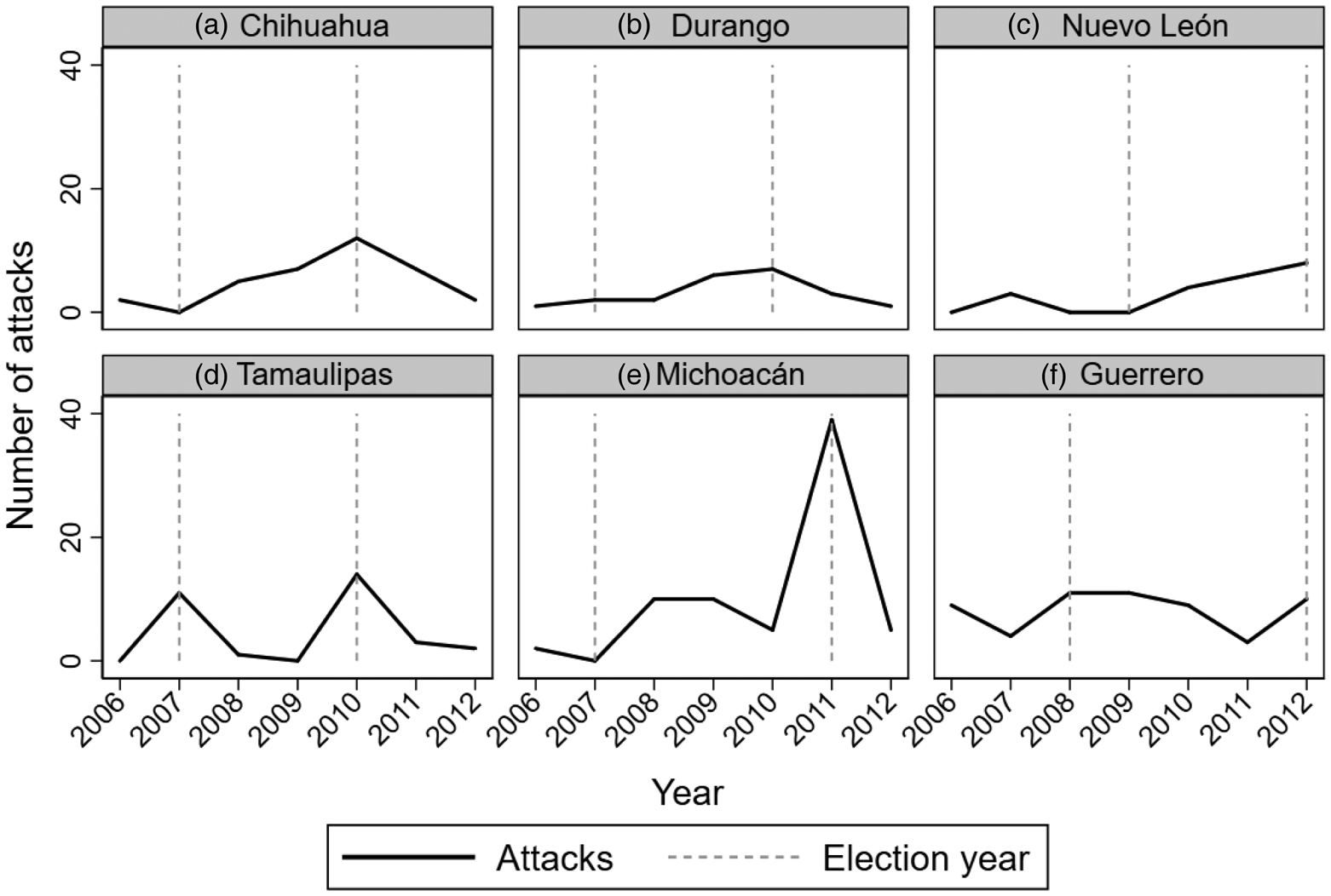
The geography of attacks by state reveals a surprising electoral connection. Figure 5 shows the time series of attacks for six states that experienced more than twenty incidents during the 2006–12 period. The evidence shows a close association between the timing of attacks and the states’ election cycles: high-profile attacks increased during election campaigns or shortly after the new subnational authorities took office. This electoral connection strongly suggests that cartels are particularly interested in influencing the government succession process.
Criminal attacks and local election cycles

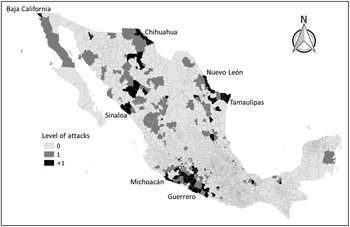
The geography of attacks by municipality shows a logic of territorial control. As Map 1 shows, drug cartels do not simply target one municipality at a time but entire regions. The map identifies three clusters of criminal attacks: 1) northwest in the states of Baja California, Chihuahua, Sinaloa and Durango; 2) northeast in the states of Nuevo León and Tamaulipas; and 3) southwest in the states of Michoacán and Guerrero on the Pacific coast. We interpret this geographic clustering as a significant indication that cartels have moved beyond a desire to simply control drug trafficking routes and now seek to control local governments, populations and territories in adjacent municipalities.
Geography of criminal attacks against government officials and party members, 2007–2012

In sum, a descriptive analysis of who gets killed, when and where suggests that extant explanations only partially explain the temporal and geographic variation in high-profile criminal attacks in Mexico. This could be the result of an important omission. While cartels may launch attacks to defend drug trafficking routes, to coerce mayors into providing them with protection, or simply to capture government rents, the leftist bias, the election timing and the geographic clustering of the attacks may be important indications that cartels have moved beyond interest group logics of influencing local politicians through bribery and coercion and have taken governance into their own hands.
A NEW EXPLANATION: THE LOGIC OF CRIMINAL GOVERNANCE
Building on new developments in the study of organized crime and on the civil war literature, we present a new account: the criminal governance hypothesis. The concept of criminal governance was first introduced by students of the mafia. Gambetta (Reference Gambetta1993) defines the mafia as an OCG that monopolizes violence within a small territorial domain where it provides protection for illegal markets. Varese (Reference Varese2001) and Skarbek (Reference Skarbek2014) succinctly describe the mafia as a form of governance of the criminal underworld.
Whereas initial studies of criminal governance focused mainly on the criminal underworld, Arias (Reference Arias2017) demonstrates that in establishing controls over illicit markets, OCGs often develop criminal governance regimes over the social, economic, and political lives of neighborhoods and districts in urban areas. These territorial criminal groups – as Arias calls them, drawing on Kalyvas (Reference Kalyvas2006) – use coercion and corruption to influence local electoral processes, the local provision of security, the allocation of public resources and the degree of participation of civil society organizations. Criminal groups use bribes to help their preferred political candidates win local office, and use violence against voters and civil society organizations to influence electoral outcomes and the distribution of public resources.Footnote 6
Building on Arias's pioneering studies of criminal governance, our central claim is that when drug cartels are engaged in intense military conflicts with the state and rival OCGs, drug lords will have incentives to launch attacks against local authorities and political actors not only to gain protection or capture public rents but, more fundamentally, to gain control over local government structures and thence over local populations and territories. Controlling key government appointments helps cartels capture the municipality's resources and dominate the local security apparatus. This enables them to engage in dual taxation: to capture government revenues and to impose informal criminal taxes on local businesses and populations. By controlling the municipal police, the cartels can use both the police and their own private militias to force citizens to pay criminal taxes and to influence elections. Gaining control over local governments, populations and territories provides cartels with the economic resources, information and geographic controls to more effectively confront the state and rival groups and to seek to monopolize all illicit markets, including drug trafficking routes.
In developing our main theoretical explanation, we recognize that drug wars give rise to all sorts of needs for cartels. Whether in search of self-defense, protection or financial resources, as wars become more intense cartels are more likely to use violence against subnational authorities to remain competitive in the struggle over the control of drug trafficking routes. We expect that:
Hypothesis 1
Local officials and politicians are more likely to become targets of criminal attacks in municipalities experiencing the most intense levels of state–cartel and inter-cartel violence.
We assume that cartels are not only interested in gaining protection or capturing rents; more fundamentally, they want to take over local government structures and control local populations and territories. We therefore suggest that drug lords will order attacks against local officials and politicians when they face opportunities to establish subnational criminal governance regimes. Following Iqbal and Zorn (Reference Iqbal and Zorn2006), we assume that opportunities for attacks are intimately associated with how political power is distributed in society and the timing of power succession.
In the context of large-scale criminal wars, subnational authorities need protection from national governments to confront powerful armed groups. For example, mayors in Mexico have neither the legal instruments nor the policing power to confront drug cartels and their private militias. But the national government's decision whether to provide protection to governors and mayors is not simply a technical issue. Following students of fiscal federalism, who suggest that partisanship plays a crucial role in the distribution of fiscal transfers from the center to the periphery (Weingast Reference Weingast2014), conflict studies scholars have suggested that electoral incentives often guide policing decisions in polarized societies. Wilkinson (Reference Wilkinson2005) shows that state-level police forces in India deterred Hindu violence against Muslims primarily in subnational jurisdictions where Muslims were pivotal political players and their vote could decide election outcomes. Similarly, Auyero (Reference Auyero2006) shows that in Argentina's 2001 food riots, peronista governors ordered police forces to protect retail shops linked to their party but allowed protestors to loot shops associated with their political rivals.
Trejo and Ley (Reference Trejo and Ley2016) have argued that in the politically polarized context – between Right and Left – that characterized Mexico during the 2006–12 period, inter-cartel violence was more intense in leftist subnational regions, where a conservative federal administration did not provide effective protection for its leftist subnational political rivals and then blamed the resulting escalation of violence on them. In contrast, drug violence was relatively contained in subnational regions where the president provided effective protection to his co-partisans and took credit for the resulting lower levels of violence.
We build on these arguments about the electoral incentives for policing to suggest that Mexico's partisan intergovernmental conflict between Right and Left created opportunities for cartels to establish criminal governance regimes through targeted lethal attacks. We suggest that opportunities for high-profile criminal attacks are greater in subnational regions where local elected officials are politically unprotected and therefore vulnerable. We expect the following hypothesis to apply in a polarized political context.
Hypothesis 2
Local authorities are more likely to become targets of criminal attacks in subnational regions where political power is more vertically fragmented – that is, where subnational officials belong to a party that is an ideological rival of the president's party.
Subnational election cycles – when new governments come in and new administrative appointments are made – present an ideal opportunity for drug cartels to colonize municipal governments. Drug lords can use lethal violence against political candidates to eliminate potentially unfriendly officials and to co-opt likely winners and influence government appointments. Because cartels are not interested in taking over the national government but rather in developing subnational criminal governance regimes, we would expect attacks to take place during local elections.
Hypothesis 3
Local authorities and politicians are likely to become targets of criminal attacks during subnational election cycles.
Following a logic of de facto territorial governance, drug lords no longer seek to simply control the local airports, ports, bus stations, highways and roads that constitute drug trafficking corridors. They also aim to dominate economic and political life in adjacent local administrative jurisdictions. We therefore formulate the following hypothesis.
Hypothesis 4
High-profile attacks become more likely as the number of attacks in neighboring municipalities increases.
Figure 6 summarizes our main theoretical claims and helps us illustrate our research strategy. As the figure suggests, in the next section we assess the statistical association between our key independent variables (turf wars, vertical partisan fragmentation and subnational election cycles) and our output variable (attacks). In a subsequent section we present qualitative evidence from the state of Michoacán to establish a connection between our output variable (attacks) and the process outcome (criminal governance). Our goal is not to establish a statistical association between attacks and criminal governance. Rather, we use statistical models to estimate the likely impact of local political vulnerability (stemming from vertical partisan fragmentation) and local opportunities for criminal governance (presented by subnational election cycles) on high-profile attacks, and we then use the case studies to illustrate how cartels capitalized on the attacks to establish subnational criminal rule.
Explanatory model of the criminal governance hypothesis

TESTING THE CRIMINAL GOVERNANCE ACCOUNT: QUANTITATIVE EVIDENCE FROM MEXICAN SUBNATIONAL REGIONS
Data
We draw on information from the CAPAM dataset to test the criminal governance hypothesis. We use the municipality as our spatial unit of analysis because (1) the drug trafficking industry is a global chain of local operations, (2) drug cartels fight turf wars to control municipal sites (or plazas) and (3) 85 per cent of attacks are linked to municipal politics.Footnote 7 We assess the annual evolution of violence across 2,119Footnote 8 municipalities during the 2007 − 12 period, when the Mexican federal government launched a war against drug cartels.
The total count of criminal attacks against government officials, political candidates and party activists is our key dependent variable. CAit expresses the count of attacks in municipality i in year t. We define lethal attacks as four types:Footnote 9 kidnapping, public death threats, assassination attempts and murders; we examine 311 such attacks.Footnote 10 Two-thirds of all attacks involve murders and assassination attempts.
Note that our dependent variable has two important innovations. First, unlike other studies that look exclusively at attacks against mayors (Ríos Reference Ríos and Aguilar2012), we extend the focus to government officials, political candidates and party activists as well. This is important because drug cartels seek to influence the actions not only of incumbent authorities (for example, mayors and their associates) but also of future political leaders (candidates) and their political associates (activists). Our data show that an exclusive focus on mayors would miss out on two-thirds of the attacks.
Secondly, whereas most studies only consider murders, we collected data on a wide variety of attacks, ranging from kidnappings, public death threats and assassination attempts to murder. An exclusive focus on murders produces two sources of bias: it underestimates the extent of violence by assuming that murders are the only means of coercion available to OCGs, and it excludes unsuccessful assassination attempts. Our data show that an exclusive focus on murders would miss out on one-half of the attacks.
To test for the cartels’ incentives to launch high-profile attacks in contexts of turf wars against the state and rival cartels (Hypothesis 1), we use battle deaths in state–cartel and inter-cartel conflicts. Note that state–cartel conflicts involve battle deaths in wars between cartels and members of the armed forces and the police; this information does not contain targeted attacks against elected officials or party candidates (our dependent variable). Inter-cartel conflicts include battle deaths in wars between rival criminal organizations. We rely on two different information sources: (1) the Criminal Violence in Mexico (CVM) Dataset and (2) a dataset collected by the Office of the President on drug-related homicides. Based on a systematic review of the Mexican daily Reforma, CVM aggregates murders committed by OCGs, both as a result of state–cartel and inter-cartel conflicts, for the period 2007–2012. We transform the count of murders into Drug-Related Murder Rate Per 1,000 Population (CVM). The government database records battle deaths attributed to state–cartel and inter-cartel conflicts, 2007–11.Footnote 11
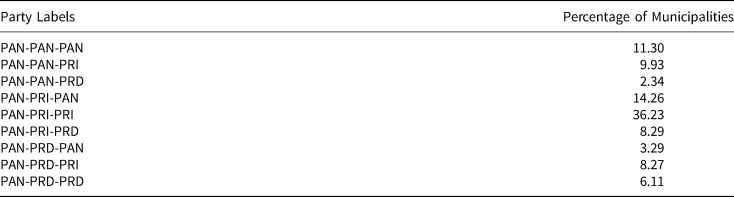
To test whether cartels launch attacks against politically and militarily unprotected subnational officials and political candidates (Hypothesis 2), we use vertical political fragmentation (or juxtaposition) as our indicator of vulnerability. During the 2007–12 period, Mexico's party system had three major political parties (PAN, PRI and PRD) that competed for office at three levels of government (federal, state and municipal).Footnote 12 During this period the conservative PAN held the presidency, but gubernatorial and municipal powers were dispersed across the three major parties, including the center opposition (PRI) and the Left opposition (PRD). As illustrated in Table 1, we test for nine different combinations of power fragmentation;Footnote 13 the party identified on the first row is the party of the president, the second is the party in the state gubernatorial office and the third is the party ruling the municipality. For the purposes of statistical analysis we use unified governance (PAN-PAN-PAN) as the reference category. We alternatively create a Juxtaposition Index in which we rank order the different combinations in a single metric from zero (PAN-PAN-PAN) to eight (PAN-PRD-PRD). This index reflects the polarization between Right and Left.
Layering of parties in Mexico's three levels of government, 2007 − 2012

Note: the party in the first cell is the president's; the second is the governor's; and the third is the mayor's. PAN-PAN-PAN is the reference category. PAN = national incumbent (conservative); PRI = opposition (center); PRD = opposition (Left).
To assess whether drug cartels are interested in colonizing local governments and developing subnational criminal governance regimes, we test for the association of attacks with different election cycles (Hypothesis 3). We use dummy variables to identify years of gubernatorial and/or municipal elections (Local Election Cycles) and years of national legislative and presidential elections (Federal Election Cycles). Mexican states define their own election calendars and therefore subnational elections are staggered.
To assess whether cartels seek to establish subnational criminal governance regimes beyond a single municipal territory, we test for a 1-year lag in criminal attacks against local authorities in neighboring municipalities, Attacks in Adjacent Neighborhoods (t – 1). We define neighboring municipalities as the nearest adjacent neighbors that share geographic borders. Our assumption is that attacks are sequential, rather than simultaneous, events – that is, cartels target one municipality and then expand their rule to neighboring municipalities.
We control for two features of the state: Fiscal Revenue, which measures the percentage of the municipality's total income that comes from local taxes,Footnote 14 and the municipal number of Public Prosecutor Offices Per 1,000 Population,Footnote 15 which is a proxy for state capacity. We also control for political variables that have been shown in the drug violence literature to be important drivers of criminal violence, including Municipal and State Alternation of political parties in office (Trejo and Ley Reference Trejo and Ley2018) and Municipal and State Electoral Competition (Dube, Dube and García-Ponce Reference Dube, Dube and García-Ponce2013). Finally, we control for seven geographic regions: North, North-Center, Center, Pacific, Gulf, South and Southeast. We do not control for poverty and population size because both are highly correlated with Fiscal Revenue.
Models
We use negative binomial regression models, which are the most appropriate technique for count data, particularly when observations are non-independent and over-dispersed – as is the case with the count of criminal attacks. We rely on random-effects models instead of fixed-effects models, because some of our key political variables (for example, the juxtaposition variables) remain unchanged for a number of years and because the time series is relatively short (T = 6) compared to the number of municipalities (N = 2,119). We cluster standard errors by municipality and transform coefficients into incidence rate ratios (IRRs). Because many municipalities did not experience attacks, the dataset contains a large number of zeros. To confront potential biases, we ran rare event logit models using a binary transformation of the dependent variable (0, 1), and the main results remained unchanged (see the Appendix).
Results
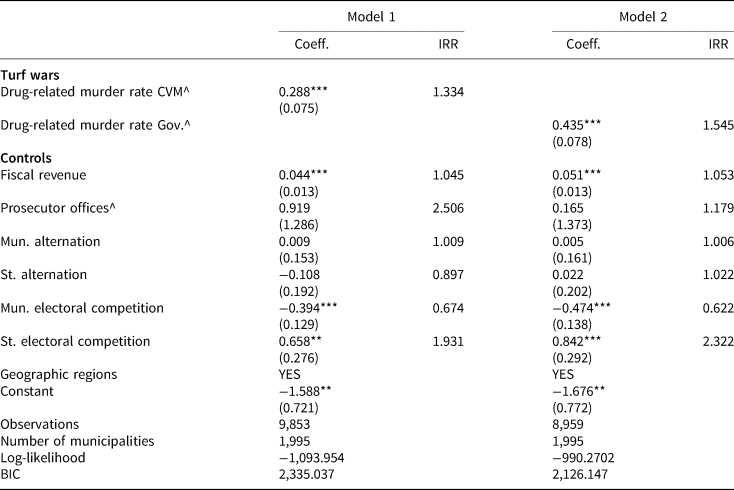
Consistent with Hypothesis 1, the results in Table 2 show that local authorities and party candidates were more commonly attacked in municipalities where cartels were involved in dual wars against the state and rival groups. Using data from newspaper records (CVM) and government statistics (Gov.), the results in Models 1 and 2 show that public officials and party candidates were significantly more likely to become targets of criminal attacks in contexts of greater drug-related violence, where cartels were fighting fierce wars against both state armed forces and rival criminal groups. As Model 1 shows, for every additional murder per 1,000 inhabitants resulting from drug wars, as measured by CVM, the odds of high-profile criminal attacks increase by 33.4 per cent (IRR = 1.334). Using the government data, Model 2 shows that the odds increase by 54.5 per cent (IRR = 1.545).
Turf wars and high-profile criminal attacks, 2007–2012 (random effects negative binomial models)

^per 1,000 inhabitants.
Note: clustered standard errors in brackets. IRR = incidence rate ratio. *** p < 0.01, ** p < 0.05, * p < 0.10
The results in Models 1 and 2 show that high-profile criminal attacks were motivated not only by war dynamics but also by the cartels’ ambition for rents. Attacks were more common in municipalities in which mayors enjoyed greater fiscal autonomy and cartels could extract more rents: for every additional percentage point of a municipality's total income that comes from local tax revenues, the probability of high-profile attacks increases by 4.5 (IRR = 1.045) to 5.3 (IRR = 1.053) per cent.
But beyond the cartels’ war needs and search for rents, the results in Table 3 show that cartels attacked local authorities and political candidates where they saw local political vulnerabilities and opportunities to establish criminal governance regimes.
Governance opportunities and high-profile criminal attacks, 2007–2012 (random effects negative binomial models)

^per 1,000 inhabitants.
Note: clustered standard errors in brackets. IRR = incidence rate ratio. The party in the first cell is the president’s; the second is the governor’s; and the third is the mayor’s. PAN-PAN-PAN is the reference category. PAN = national incumbent (conservative); PRI = opposition (center); PRD = opposition (Left). *** p < 0.01, ** p < 0.05, * p < 0.10
Consistent with Hypothesis 2, the results in Model 1 show that cartels conducted high-profile attacks in politically neglected states where mayors presumably could not count on federal protection. The results strongly suggest that the governor's party affiliation is the main distinguishing factor across cases. Compared to a situation of unified vertical governance in which the president's conservative co-partisans also ruled at the gubernatorial and municipal levels (PAN-PAN-PAN), local authorities and politicians were significantly more exposed to criminal attacks in states ruled by opposition governors – particularly by the leftist PRD, which the president perceived as his greatest political threat. If we focus on opposition municipalities (where the PRI and PRD appear as the third category) from leftist states (where the PRD appears as the second category), the results show that government authorities and party candidates were 434 per cent and 484 per cent (IRR = 5.339 and 5.844) more likely, respectively, to be attacked than local officials in states where the president's co-partisans ruled. But the results also show that, although the odds were lower (IRR = 3.795), conservative PANista mayors in leftist states were also at risk. This is a strong indication that the partisan intergovernmental conflict between a conservative president and leftist state governors affected all mayors and local party candidates, who became likely targets of attacks because murder became a relatively cheaper mechanism of criminal control than bribes.
The results in Model 1 also show that there is nothing unique about leftist municipalities – a likely shared attribute – that would make them more vulnerable to criminal attacks. Compared to a situation of unified governance (PAN-PAN-PAN), leftist mayors and local candidates in conservative states (PAN-PAN-PRD) and in states with PRI governors (PAN-PRI-PRD) were no more likely to experience criminal attacks, but leftist mayors in leftist states (PAN-PRD-PRD) were. If leftist municipalities or leftist politicians had a shared attribute that made them likely targets of attacks, all configurations of partisan vertical fragmentation with PRD mayors would be statistically significant. But this is not the case. In fact, the raw data show that PRD municipalities experienced one attack in PAN states, eight attacks in PRI states and forty-nine attacks in PRD states. It is highly unlikely that leftist PRD governors would have purposefully rendered their local co-partisans vulnerable to attacks; rather, these results are consistent with the logic of intergovernmental partisan conflict in a context of extreme polarization between Right and Left.
The results from the Juxtaposition Index in Model 2 confirm that mayors in opposition-ruled states (particularly those ruled by the Left) were more vulnerable to attacks: for every additional layer away from unified governance (PAN-PAN-PAN), the odds of an attack increased by 24 per cent (IRR = 1.240). This means that at the highest level of juxtaposition, a leftist mayor from a leftist state was 192 per cent more likely to suffer an attack (24 × 8) than a conservative mayor from a conservative state. The raw data confirm these patterns. While Mexicali (PAN), the capital city of the northwestern state of Baja California (PAN), experienced no attacks between 2007 and 2012, Chilpancingo (PRD), the capital city of the southern state of Guerrero (PRD), experienced three attacks. Overall, Baja California experienced six attacks while Guerrero experienced fifty-seven.
As predicted in Hypothesis 3, the results in Models 1 and 2 also show not only that cartels targeted municipal authorities and party candidates in politically vulnerable states, but also that they did so at predictable times – during local election cycles. The results show that municipalities were at least 61 per cent (IRR = 1.640 and 1.609) more likely to experience a high-profile attack during a subnational election cycle. We interpret this as a strong indication that cartels used violence to try to influence local election campaigns and outcomes, as well as administrative appointments in the incoming governments. The fact that attacks decreased by almost 44 per cent during federal election cycles (IRR = 0.615 and 0.564) is also an indication that cartels were probably not interested in contesting national power.
Finally, in line with Hypothesis 4, the results in Model 1 are consistent with a logic of subnational territorial control: for every attack experienced by a municipality in year t, the likelihood of an attack among adjacent neighbors increased by 41 per cent in t + 1 (IRR = 1.409 and 1.411). This suggests that cartels were probably not focused on controlling single towns but on establishing subnational criminal governance regimes in clusters of adjacent municipalities.
EMPIRICAL CHALLENGES
Conditional Effects
Is it possible that the true impact of the political variables on attacks is conditional on the intensity of turf war violence, and that this is truly a story about war needs?
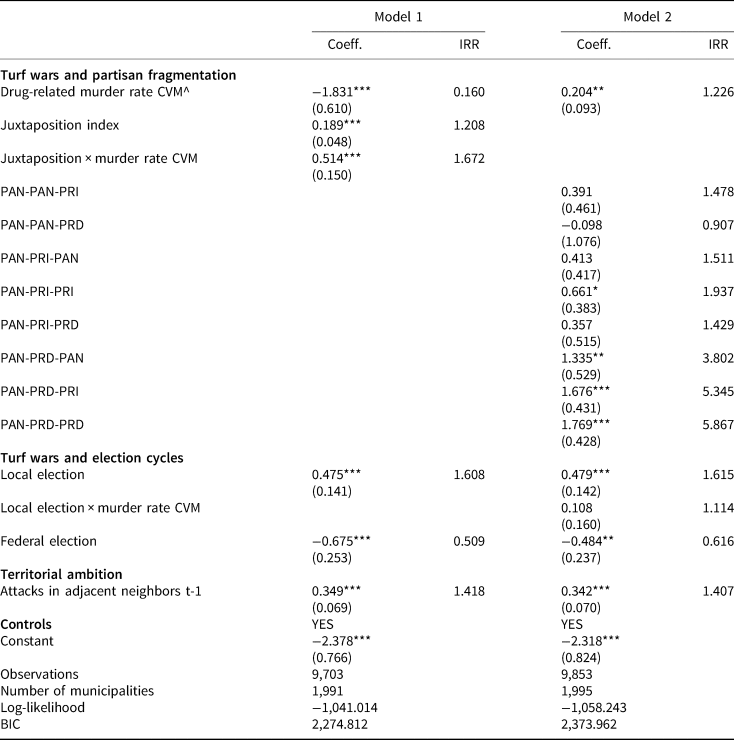
In Table 4, Model 1, we test whether the impact of political vulnerability on cartel attacks is conditional on the intensity of the turf wars. To facilitate the interpretation of the interaction effect, we use the Juxtaposition Index, which ranks the different combinations in a single metric from zero (PAN-PAN-PAN) to eight (PAN-PRD-PRD). The positive and significant coefficient of the interaction term (see Juxtaposition × Murder Rate CVM) indicates that in municipalities where political fragmentation and war became more intense, attacks became even more likely. This means that in municipalities in which war became more lethal, the odds of attacks against mayors and party candidates increased as we move from conservative to leftist states.
Interaction effects and high-profile criminal attacks, 2007–2012 (random effects negative binomial models)

^per 1,000 inhabitants.
Note: clustered standard errors in brackets. IRR = incidence rate ratio. *** p < 0.01, ** p < 0.05, * p < 0.10
But the analysis would be incomplete if we did not assess the constitutive terms of the interaction. The results in Model 1 show that in municipalities with no power fragmentation (see the individual effect of Drug-Related Murder Rate), where the president's party ruled at the gubernatorial and municipal levels and the federal government presumably provided adequate protection to his co-partisans, the prevalence of turf wars decreased the likelihood of criminal attacks by 84 per cent (IRR = 0.160). This means that even if cartels were engaged in major turf wars against the state and other cartels, drug lords refrained from attacking subnational authorities who presumably enjoyed full federal protection.
In contrast, the results reveal that in municipalities with no battle deaths (see the individual effect of Juxtaposition), where cartels were not fighting, greater vertical partisan fragmentation and subsequent political vulnerability increased the likelihood of attacks by 20.8 per cent (IRR = 1.208). That is, cartels attacked local authorities and party candidates in unprotected municipalities even when they were not at war and presumably had a monopoly on violence. Why continue attacking? Unlike armed insurgent political groups, drug cartels cannot defeat the state (Lessing Reference Lessing2015) or engage in peace negotiations and become lawful political organizations. As a result, when drug lords develop subnational criminal governance regimes, they are never fully in control; because their de facto power cannot be transformed into de jure power, the long-term future of criminal governance is uncertain. Thus drug lords tend to have short-term horizons and cartels tend to be more predatory than armed insurgent groups, even under conditions of monopolistic control.
Model 2 in Table 4 examines whether the impact of local election cycles on attacks is conditional on the intensity of the turf wars. The results reveal that turf wars occurring in electoral years (see Local Election × Murder Rate CVM) do not have a statistically significant effect on the likelihood of criminal attacks compared to those occurring in non-electoral years. A possible explanation is that, in contexts of war, cartels have incentives to (violently) intervene in politics using high-profile attacks, but such interventions do not necessarily depend on the electoral calendar.
A close inspection of the constitutive terms of the interaction in Model 2 reveals that in a non-electoral year (see the individual effect of Drug-Related Murder Rate), for every additional murder per 1,000 inhabitants, the odds of an attack increased by 22.6 per cent (IRR = 1.226). This means that regardless of the election calendar, cartels engaged in more high-profile attacks in municipalities experiencing more intense wars.
The results in Model 2 show that in the absence of war (see the individual effect of Local Election), the likelihood of a criminal attack against government officials and party candidates increased by 61.5 per cent during subnational elections (IRR = 1.615). This suggests that even if there is no fierce competition over drug trafficking routes, cartels will have incentives to intervene in electoral politics as a way to influence municipal government appointments or simply to capture local government structures.
In sum, although turf wars led cartels to engage in high-profile attacks, a full inspection of the interaction effects reveals that political factors did have an independent effect. Regardless of the intensity of war, drug cartels took advantage of the political vulnerability of mayors in opposition states and of the opportunities presented by subnational election cycles to use targeted attacks to presumably establish subnational criminal governance regimes.
Endogeneity
Is it possible that attacks shape political opportunities rather than the other way around? Or that there are unobservable factors that may explain both opportunities and attacks? We use the multiple borders of the western state of Michoacán – a leftist state that experienced multiple attacks – with other states – ruled by the PAN, PRI and PRD – to address endogeneity concerns.
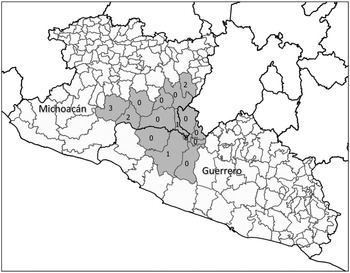
A comparison of the Tierra Caliente region, which cuts across the leftist states of Michoacán and its eastern Guerrero neighbor, as shown in Map 2, allows us to corroborate that local election cycles created opportunities for high-profile violence and had an independent causal effect on criminal attacks. Map 2 highlights the neighboring municipalities from the Tierra Caliente region that we compare and shows the number of attacks per municipality.Footnote 16 Although separated by state borders, these municipalities share many geographic, sociodemographic, cultural, economic and political features (see the Appendix for detailed information). In terms of criminal markets, Tierra Caliente in Michoacán was the bastion of La Familia Michoacana, the state's leading cartel in the 2000s. La Familia extended its grip to the Tierra Caliente region of Guerrero after 2005. In both regions, La Familia was immersed in deadly turf wars and sought to establish criminal governance regimes through high-profile attacks between 2007 and 2012.
Criminal attacks against government officials and party members in neighboring municipalities of Michoacán and Guerrero, 2011

An important difference between the two regions is that Guerrero and Michoacán hold state legislative and municipal elections at different times. In 2011 Michoacán simultaneously held gubernatorial elections, state legislative elections and municipal elections. That same year Guerrero held gubernatorial elections but no legislative or municipal elections. As shown in Map 2, there were significant differences in targeted attacks across state borders: while the Tierra Caliente region of Michoacán experienced eight attacks against municipal authorities and municipal party candidates (or 5 per 100,000 population), the Tierra Caliente region in Guerrero only experienced one (or 0.55 per 100,000 population). We attribute this eight-fold difference in the absolute number of attacks to the election cycle.
Because subnational election cycles are defined by state constitutions on fixed dates, we take election cycles as an exogenous feature. This means that there is no risk of reverse causality: Michoacán's election cycle opened opportunities for attacks, rather than attacks leading to new election cycles. It also means that there is no risk of omitted variable bias: because election calendars are fixed, no other omitted factor may influence the occurrence of elections.
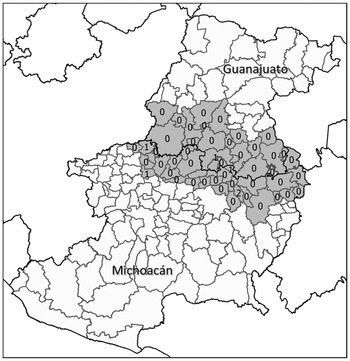
Is it possible that the attacks led to partisan vertical fragmentation and political vulnerability rather than the other way around? A comparison of the northern municipalities of Michoacán with the southern municipalities of the state of Guanajuato, as shown in Map 3, allows us to confirm that partisan vertical fragmentation and conflict between a conservative federal government and a leftist governor rendered municipalities in leftist states more vulnerable to criminal violence and had an independent causal effect on attacks. Both regions share important geographic, sociodemographic, cultural and economic similarities (see the Appendix for detailed information). As in other neighboring states, La Familia made decisive inroads into Guanajuato, engaged in major turf wars, and sought to penetrate local governments and police forces to establish criminal governance regimes.
Criminal attacks against government officials and party members in neighboring municipalities of Michoacán and Guanajuato, 2008–2011

An important difference between these municipalities is that a leftist governor ruled Michoacán and Guanajuato had a conservative governor. To confront the escalation of drug violence in Guanajuato, President Calderón worked closely with his PAN co-partisan and devised a federal intervention that closely aligned the actions of the military, the governor and the state security apparatus (headed by a general), and the mayors of the state's southern region.Footnote 17 With full federal support, the governor, in coordination with municipal authorities, was able to dismantle multiple police forces infiltrated by the cartels.Footnote 18 This coordinated support provided protection to the mayors, deterring La Familia from attempting to use high-profile attacks to take over.Footnote 19
As shown in Map 3, between 2008 and 2011,Footnote 20 there was one attack in the southern municipalities of Guanajuato (or 0.05 attacks per 100,000 inhabitants). In contrast, as we explain below, the federal intervention in Michoacán was unilateral and there was no dialogue between the military and the state security forces. Instead of co-operation, the federal government carried out a mass arrest of leftist security officials and mayors and ran a smear campaign to discredit the Left as corrupt and inept. Between 2008 and 2011 there were five attacks in northern Michoacán (or 0.89 per 100,000 inhabitants). We attribute the five-fold difference in the absolute number of attacks between these two regions to partisan intergovernmental conflict between the Left and the Right.
It is crucial for our claim that the Left ruled in Michoacán and the Right in Guanajuato for reasons unrelated to the drug violence. The governor of Guanajuato was elected prior to the War on Drugs (2006) and the governor of Michoacán as the war was just starting (2007). This should dispel concerns about reverse causality. Within the states, both northern Michoacán and southern Guanajuato are small enough to render it unlikely that voting in these municipalities might have determined the outcome of the gubernatorial elections. It is therefore safe to assume that the fact that one region had a leftist governor and another a conservative governor is an exogenous factor that led the two regions into different trajectories of attacks.
ESTABLISHING CRIMINAL GOVERNANCE REGIMES: QUALITATIVE EVIDENCE FROM MICHOACÁN
While the statistical analyses and cross-border comparisons provide reasonable evidence that governance opportunities and vulnerability actually led to criminal attacks, we need to provide a finer-grained explanation of the linkages between attacks and the development of criminal governance regimes. Drawing on our own fieldwork interviews and investigative journalistic reports, we explore how drug cartels have used high-profile attacks to develop criminal governance regimes.
We focus on municipalities from the western state of Michoacán. Ruled by leftist governors and by mayors from the three leading parties, the state provides multiple examples of vertical political fragmentation and political vulnerability: municipal authorities and party candidates there were 2.8 to 4.8 times more likely to experience attacks than mayors and candidates from states ruled by the president's party. Focusing on cities and towns from the Tierra Caliente and northern regions of the state, we analyze municipalities that score high values on vertical fragmentation and attacks, where cartels were more likely to establish criminal governance regimes.
Intergovernmental Partisan Conflict: Creating Opportunities for Attacks
Michoacán – President Calderón's home state but a leftist bastion – was the first state in which the federal government deployed the armed forces to fight the cartels. Although the initial deployment in 2006–07 was conducted with the close co-operation of the incoming conservative president and an outgoing leftist governor, intergovernmental relations deteriorated sharply after the federal intervention triggered a major spike in violence starting in 2008. Bitter partisan strife between the new PRD governor, Leonel Godoy, and the federal government rendered the state and all of its mayors and local politicians vulnerable to attack. Reflecting on the expansion of the narcos in the state, Guillermo Valencia, the PRI mayor of Tepalcatepec in the Tierra Caliente region, did not hesitate to identify a major cause: ‘the conflict between the leftist governor Leonel Godoy and President Calderón’ (Padgett Reference Padgett2014).
Facing the cartels’ dramatic violent backlash against the federal intervention, President Calderón sought to blame the escalation of violence on the opposition, particularly the leftist PRD – the party that did not accept his victory in the 2006 presidential election. In contrast to the tight coordination between the president and his conservative subnational co-partisans in such places as Baja California and Guanajuato, in leftist states the federal intervention became a unilateral action, in which local authorities were never informed or consulted before the army or the federal police launched an attack against the cartels in their municipalities.Footnote 21
As the turf wars between La Familia Michoacana and their former allies the Zetas escalated to unprecedented levels in Michoacán, President Calderón took a revealing radical step: a few hours before the beginning of the 2009 mid-term national legislative campaign, his attorney general conducted a large-scale arrest of twenty-three top and mid-level officials of Governor Godoy's security cabinet and twelve of the state's mayors (mostly from the PRI and the PRD). Although all but one of the arrested officials were released a year later, this mass arrest allowed the federal government to launch a major smear campaign against the leftist state government and prime the electorate to view the Left as partners of organized crime.
After the mass arrest, intergovernmental co-operation between the armed forces and the federal police and the state and local authorities broke down completely in Michoacán.Footnote 22 In this context of bitter partisan intergovernmental conflict, and facing a two-front war against the Zetas and the federal government, in 2009 La Familia began using high-profile criminal attacks to gain control over local populations and local governments. Leftist mayors who received death threats did not hesitate to reach out to the federal government, but there was no response. As Ricardo Baptista, the director of AALMAC, a network of leftist mayors, declared: ‘[President Calderón] was perfectly aware of the death threats that mayors…were receiving, but he was never willing to meet with us when we asked for help’ (SinEmbargo 2013).
As partisan intergovernmental conflict became more severe, La Familia, which by 2011 had been rebranded as the Knights Templar, capitalized on this window of opportunity by launching an unprecedented wave of high-profile attacks during the 2011 local election cycle.
Seizing Local Electoral Processes
The 2011 election cycle in Michoacán – in which the state elected a new governor, forty state legislators, and 113 mayors – was one of the most violent election periods in recent Mexican history. The Templars and their associates were clear in their intent: they asked the electorate to vote for the PRI and demanded that local party candidates from the leftist PRD (the party of the incumbent state governor) and the conservative PAN (the party of the incumbent national president) step down.Footnote 23 Michoacán experienced thirty-nine attacks during the 2011 elections, most of which targeted candidates from the cross-party coalitions led by the PRD. These attacks and public death threats led forty-six mayoral candidates and five congressional candidates to step down (García Reference García2011).
But the Templars and their criminal associates did not only target government officials and party candidates; they used coercion threats to influence voters directly. A criminal cell working for the Templars used recorded phone conversations to coerce voters to vote for PRI candidates (Univisión 2011). On election day an anonymous message appeared in the local newspaper La Piedad, spelling out the rules of the game: ‘[As you go to the voting stations], don't wear T-shirts with propaganda in favor of the PAN because we don't want any confusion; we don't want to kill innocent people’ (Reforma 2011). Unknown individuals distributed flyers to voters with very specific threats: ‘Mr. Felipe Calderón [Mexico's president]: If you intervene in this election and the PAN wins, there will be war and executions’ (Reforma 2011).
After twelve years in the opposition, the PRI returned to gubernatorial power in Michoacán in 2011 and several PRI candidates won surprising victories in the Tierra Caliente region – a leftist bastion and an epicenter of high-profile attacks. The wave of attacks and the election results showed Michoacán's citizenry and the newly elected local governments ‘who called the shots’ in the state.
Colonizing Municipal Governments
A number of former municipal officials from governments elected in Michoacán during the state's violent 2011 election cycle anonymously reported to us that after they assumed office the Templars – which had by then become the hegemonic cartel – abducted most of the states’ mayors for 24 hours and took them to their stronghold in the state's southern mountains to personally hand them instructions on how to pay their monthly fees.Footnote 24
Guillermo Valencia, a PRI mayor from Tepalcatepec elected in 2011, is explicit about the dynamics of looting: ‘Under life threat, I was forced to surrender 10 per cent of my budget to the Templars…You simply couldn't say ‘no’ to them…Paying the criminal fee was my life insurance’ (Calderón and Chouza Reference Calderón and Chouza2014). Valencia's neighboring mayors from the Tierra Caliente region confirmed that they were coerced by threats into paying criminal fees and surrendering their budgets for public works (Calderón and Chouza Reference Calderón and Chouza2014; Maerker Reference Maerker2014). These are mayors from municipalities mostly with a history of assassination attempts and murders of local officials: Coalcomán (one), Parácuaro (three), Tingüindín (none), Chinicuila (three), Aquila (four) and Uruapan (one).
Mayors were told to pay criminal fees and keep silent.Footnote 25 As Valencia puts it, ‘if you went to the public prosecutor's office to report a criminal threat, the Templars would kill you; there is a lengthy list of murdered mayors…whose main sin was to publicly denounce extortions’ (Padgett Reference Padgett2014). The case of Ygnacio López, the leftist mayor of Santa Ana Maya in the northern part of the state, illustrates the Templars’ modus operandi. After nearly two years of paying criminal fees, Santa Ana went bankrupt. López organized a hunger strike in the senate in Mexico City to demand new federal resources, which he received. However, when the mayor returned home and declined to pay 10 per cent of the new federal transfers to the Templars, he was brutally murdered for both publicly reporting extortion and for refusing to pay criminal fees (Sanders and Zapata Reference Sanders and Zapata2013).
Controlling the Municipal Security Apparatus
Although the municipal police in Mexico are relatively weak, municipal security forces can play a key role in the development of criminal governance regimes. Under the cartels’ control, municipal police officers serve as informants and enforcers of the cartels’ decisions in the localities. Unlike on the battlefield, where they simply seek to eliminate police officers, cartels use targeted attacks against mayors and municipal security deputies to subdue the municipality's security personnel and take control over the security apparatus ‘from above’.
Rafael García, mayor of Coalcomán, a municipality in Michoacán from the Tierra Caliente region, was explicit about the Templars’ use of the police. He described the state of his security apparatus after he was elected in 2011 as thus: ‘My police force was totally subdued; I was not in charge. In fact, [the Templars] controlled me through the municipal police commanders. But I could not resist; those who did were eliminated’ (Maerker Reference Maerker2014). Former government associates of Ygnacio López, the murdered mayor of Santa Ana Maya, also reported that the Templars took over the municipal police.Footnote 26
Regulating Economic Life
Not only do drug cartels target local authorities to extract resources from the municipal coffers or to commandeer the police; they also seek to infiltrate the government and gain access to privileged administrative positions and information, which will enable them to control local economies and loot local businesses and households. Access to the property tax registry, the municipal treasury or local units regulating local economic activities provides them with privileged information.
After establishing their hegemony in Michoacán in 2011, the Templars turned their attention to the state's producers of limes and avocados.
In the Tierra Caliente region the Templars took control of the six lime-producing municipalities, where they selectively attacked local officials: Aguililla (zero), Apatzingán (zero), Buenavista (two), Múgica (two), Parácuaro (two), and Tepalcatepec (zero). Attacks in neighboring municipalities led the mayors of Aguililla and Apatzingán to update their beliefs and become more amenable to the cartel's orders. Rather than simply imposing a criminal tax on producers in the region, the Templars decided to regulate the market: because the price of limes was too low, they reduced the supply by forcing local producers to harvest on a limited schedule, while the cartel's own farms harvested freely and sold at a higher market price (García-Ponce and Lajous Reference García-Ponce and Lajous2014).Footnote 27
North of Tierra Caliente the Templars likewise used violence to gain control over Michoacán's avocado-producing region. The municipality of Tancítaro is an emblematic case. After forcing the resignation of Mayor José Trinidad Meza and his deputies and the municipality's alderman in 2009 through public death threats and then murdering the interim mayor, Gustavo Sánchez, the Templars established their rule in Tancítaro. Avocado growers did not resist when the Templars imposed a criminal quota per cultivated hectare and forced them to schedule the cropping seasons according to the cartel's needs (Reforma 2013).
Establishing Territorial Controls
Building subnational regimes of criminal governance in strategic regions of Michoacán allowed the Templars to militarily defeat and expel the Zetas from the state and to bring their war against the federal government to a stalemate. They not only controlled key formal economic sectors but also expanded their reach to monopolize the state's criminal underworld (Maerker Reference Maerker2014).
Despite their hegemonic control, the Templars could not become a lawful political actor; without a long-term horizon, and facing a permanent threat from the federal government, they continued plundering local governments and citizens. It would take a tax revolt of lime producers, followed by a popular uprising assisted by the federal government in 2014, to dethrone the Templars from de facto power in Michoacán (García-Ponce and Lajous Reference García-Ponce and Lajous2014; Maerker Reference Maerker2014).
CONCLUSION
A widespread assumption in the organized crime literature is that the successful operation of the criminal underworld requires secrecy, and that criminal lords avoid the spotlight (Gambetta Reference Gambetta1993). In this article we addressed the surprising decision by Mexican cartels to launch a major wave of high-profile attacks against municipal government officials and party candidates.
While the scholarly literature suggests that in the context of turf wars cartels attack local officials and politicians to force their successors to provide them with protection or to capture rents to finance wars, we have shown the limitations of looking exclusively at arguments based on war needs. We have offered extensive evidence showing that Mexican cartels took advantage of governance opportunities afforded by politically unprotected municipalities and local election cycles to attack mayors and party candidates and gain control over local governments, populations and territories. Establishing subnational criminal governance regimes allowed cartels to defend themselves from the state and rival groups, expand their reign into the local economy and politics, and recover controls over drug trafficking routes and other illicit activities.
Our findings have important implications for the study of political assassination. We demonstrate that the lethal attacks against Mexican subnational officials and party candidates were not random events. In line with Iqbal and Zorn's (Reference Iqbal and Zorn2006) finding about political factors driving the assassination of fifty-two heads of state, our research shows that the distribution of partisan power and the dynamics of power succession during elections defined the incentives to assassinate subnational officials and politicians in Mexico's drug wars. Looking at lethal attacks by an allegedly apolitical actor – drug cartels – our study reveals that drug lords likewise sought to ‘topple…incumbent government[s], retard [their] policy imperatives, and bring about political change’ (Iqbal and Zorn Reference Iqbal and Zorn2006, 491). In our case, however, drug lords did not seek to become national rulers but to subdue local governments and populations and establish de facto subnational criminal governance regimes.
The causal connections that our research has unveiled between political opportunities for criminal governance and the cartels’ high-profile attacks suggest two important lessons for the study of organized crime and large-scale criminal violence in democracies.
First, while the literature on mafias and prison gangs has made an important analytical contribution by showing that OCGs seek to establish informal governance institutions to facilitate illegal transactions in the criminal underworld, our study joins the work by Arias (Reference Arias2017) and others in broadening the scope of criminal governance and suggesting that criminal groups may also seek to develop de facto local governance regimes over political, economic and social licit activities. In line with the civil war literature (Arjona Reference Arjona2016; Kalyvas Reference Kalyvas2006), our findings highlight the importance of recognizing the cartels’ territorial ambitions to reconstruct local social orders and develop de facto governance across subnational jurisdictions.
Secondly, although Mexican cartels do not want to topple the federal government or become a national political force, it would be misleading to continue defining them simply as illicit economic enterprises that exclusively seek to monopolize the criminal underworld, or as violent interest groups that use coercion simply to influence public policy in their favor. Our findings suggest that the organized crime literature has to recognize that drug cartels can develop informal ‘political’ ambitions that lead them to use targeted lethal violence to establish subnational criminal governance regimes. While this does not turn them into armed rebel groups that seek to topple national institutions, their de facto political ambition distinguishes them from mafias and prison gangs that only want to govern the criminal underworld. After two decades of war, drug cartels in Mexico have become ‘political’ actors with subnational governance ambitions.
When drug cartels engage in off-the-path equilibrium behavior and murder mayors and local political candidates, they do so to establish controls beyond the criminal underworld. A detailed assessment of the political factors that facilitated the cartels’ attacks revealed their governance ambitions. While we have argued that high-profile attacks represent a common path through which cartels and their criminal associates develop subnational criminal governance regimes in Mexico, we cannot rule out the possibility that OCGs may use other methods to develop criminal governance that do not necessarily involve targeted attacks. Future research should explore various possible pathways to criminal governance and the extent to which these different strategies may lead to a plurality of local criminal orders. Exploring these different subnational regimes of criminal governance opens new research frontiers in the study of organized crime.
Supplementary material
Data replication sets are available in Harvard Dataverse at: https://doi.org/10.7910/DVN/VIXNNE and online appendices at: https://doi.org/10.1017/S0007123418000637
Acknowledgements
Preliminary versions of this article were presented at Brown University, CIDE, Columbia University, Harvard University, the University of Chicago, and the University of Notre Dame and at the 2015 Meeting of the Midwest Political Science Association. We thank Juan Albarracín, Ana Arjona, Mario Chacón, Luis de la Calle, Oeindrila Dube, Angélica Durán-Martínez, Agustina Giraudy, Todd Eisenstadt, Hernán Flom, Leslie MacColman, Eduardo Moncada, Vicky Murillo, Camilo Nieto Matiz, Brian Phillips, Pablo Picatto, Richard Snyder and Lucía Tiscornia for insightful comments. We are grateful to Caroline Domingo for her editorial assistance and to Magdalena Guzmán and Elizabeth Orozco for superb research assistance. We benefitted from the sharp observations of the BJPolS editors and of three anonymous reviewers. All errors and omissions are our own.