More than seventy years ago, political scientist E.E. Schattschneider called groups the raw material of politics. Building on Schattschneider’s insights, recent theories of political parties argue that political parties are primarily the creations of organized groups, who shape party agendas while most voters pay little attention (Cohen et al. Reference Cohen, Karol, Noel and Zaller2008; Bawn et al. 2012). The UCLA Theory of Parties argues that groups often force candidates and parties to take positions that hurt, rather than help, their prospects for winning general elections. Coalitions of groups negotiate an agenda that enables them to unite a large enough group of people to take parties in a new direction. Politicians understandably try to straddle existing groups in the party and the mass public even when such agendas are incompatible, as when civil rights supporters and opponents both inhabited the Democratic Party. As such, politicians are more of a force for stasis.
This dynamic helps explain why politicians in Rhode Island had difficulty passing state marriage equality legislation despite public support and a legislature overwhelmingly composed of the Democratic Party, which had long been more sympathetic in both statewide and national politics. Only civil unions were passed in 2011, but full marriage equality passed in 2013 by a vote of 51–19 in the State House and 26–12 in the State Senate, shortly before the Supreme Court of the United States required it of all states in 2015. By examining the factors that differed from one year to another, we can isolate the conditions leading to the successful passage of marriage equality. Rhode Island’s Democratic supermajority, conscious of social issue divisions within its ranks, generally suppressed social issues unless both sides could agree on concessions. State Democrats had to contend with pressure from the Catholic Church in the nation’s only Catholic-majority state. But different interest groups forced state Democrats to confront public support using high-profile primary challenges.
Voters, interest groups, and social ties each pulled legislators in different directions. Rhode Island legislators were not activating latent majorities as electoral strategies, but avoiding painful confrontations with their social ties, including other legislators. One might argue that multiple necessary conditions needed to hold: public support, national party support, the presence of openly LGBT legislators, and the relative absence of organized evangelical opposition. When two or more causes are both necessary, the rarer of the causes is more important. Daytime, sunshine, and a sun shower are necessary causes of a rainbow, but the last is the most important cause⸺sun showers are more strongly correlated with rainbows than either sunshine or daytime (Mahoney, Kimball, and Koivu Reference Mahoney, Kimball and Koivu2009). The rarest cause in Rhode Island was increased electoral activity by interest groups.
The UCLA Theory of Parties emphasizes that interest groups exploit public inattention to pass policies in line with their agenda. In the passage of marriage equality in Rhode Island, one set of interest groups reminded politicians of majority support in opposition to organized opposition trying to obstruct majority support. The Catholic church’s success in keeping marriage equality off of the legislature’s agenda in 2011, followed by the mobilization of liberal groups to force it on to the agenda in 2013, shows that interest group interactions with parties can be used to obstruct as well as amplify majority public opinion.
Methods
This case study is based primarily on elite interviews. As others have noted, interviews allow researchers to understand the way political actors viewed their alternatives in a way that quantitative data often cannot. Archived documents can serve the same function, but most organizations do not make their records of the past decade available. Additionally, interviews allow researchers to probe subjects on questions unanswered by written documents. Most Rhode Island legislators and interest group activists who supported marriage equality responded to my requests for interviews. Unfortunately, many national interest groups like the Human Rights Campaign (HRC), as well as state opponents, were unresponsive. One might argue that interest groups have an interest in exaggerating their own role in events, but it is notable that interest group chairs in Rhode Island claimed credit, while activists I interviewed in other states did not. Additionally, Rhode Island activists might have exaggerated their own role over that of HRC, but many instead credited HRC. Finally, the timing of the initial failure and successive passage lines up with the role attributed to interest groups in the interviews. When available, I supplement interviews with documents from the HRC and Gay Rights National Lobby (GRNL).
Parties, Officeholders, and Activist Groups
Many scholars since the 1970s have focused on parties as tools of candidates, used to broadcast compressed information about their agenda in party brand names. By then, party machines disappeared, party identification weakened, and candidates ran campaigns independent from formal party organizations. Following in this vein, Carmines and Stimson argue that when party leaders changed on civil rights and won elections in the 1960s, the party followed suit and voters in their party followed suit (Carmines and Stimson Reference Carmines and Stimson1989). While interest groups, voters, and social movements matter, they influence candidates mainly by changing vote calculations. The UCLA Theory of Parties has argued that interest groups still possess important influence over candidates, primarily because they wield outsized influence in nominations. Candidates need to consolidate the interest groups constituting a party coalition before and during general elections.
For policy demanders to change legislative outcomes, they may need to change the position of the “pivot point,” what Krehbiel calls the specific policymaker who controls the passage of legislation. The pivot point thesis is consistent with the UCLA Theory of Parties as long as policy demanders took actions that changed the pivot point’s behavior between 2011 and 2013. Cox and McCubbins argue that party leaders in the legislature block policies that might split the party or contaminate the brand name (Cox and McCubbins Reference Cox and McCubbins1993), as Rhode Island had for years with divisive social issues. But as scholarship on parties as policy demanders has shown, groups in ambivalent parties can create robust alliances and force a party to abandon its straddle and support a broad agenda, often by being active in nomination contests when most voters pay little attention (Baylor Reference Baylor2017). Generally, they need to establish trusting relationships well before an election year. Heaney’s study on coalitions demonstrates that two interest groups ally both on the basis of common issue positions and the trust established through previous interactions (Heaney Reference Heaney2004).
Inquiries into the role of parties as policy demanders at the state level have yielded mixed results. Karol and Thurston find that Catholic religious affiliation predicted pro-life positions of California state legislature members at first. As Republicans became associated with the Christian Right and Democrats became associated with feminists, party became a better predictor of one’s position on abortion. Catholic legislators were less likely to support pro-life positions in the 1980s because they were more likely to be Democrats (Karol and Thurston Reference Karol and Thurston2020). Baylor shows that in Iowa and New Hampshire, Christian Right activists took control of largely unpaid party positions in Iowa and South Carolina, allowing them to provide endorsements for likeminded candidates and marginalize party moderates (Baylor Reference Baylor2017). At the state level, interest groups can also pass controversial legislation, or block popular legislation, with little public notice. For example, the American Legislative Exchange Council (ALEC) was able to pass controversial legislation in many states on labor rights, self-defense, electricity, and voter ID by providing legislators with ready-made policy blueprints, though ALEC avoided party takeovers or obvious ties to a single party. As with ALEC, voter inattention in Rhode Island initially enabled state legislators to take a position on marriage equality against the wishes of the majority of the population. Hertel-Fernandez argues that liberal groups have largely failed to replicate the success of conservative state groups, but they passed marriage equality in several states within a few years of public opinion change (Hertel-Fernandez Reference Hertel-Fernandez2019).
Studies on the role of public opinion in the passage of gay rights legislation have yielded mixed results. Several studies published when states were mostly proscribing gay marriage found that public support, the evangelical community, and statewide Democratic control were the most influential variables in the passage of proscriptive legislation (Lewis and Rogers Reference Lewis, Rogers, Riggle and Tadlock1999; Lewis and Soo Oh 2008). Consistent with research arguing that interest groups pass legislation over public blind spots, Barclay and Fisher find that the strength of the gay community, rather than mass opinion, influences the chance of passage for gay rights legislation (Barclay and Fisher Reference Barclay and Fisher2003).
Other work on LGBT state legislators shows that the presence of openly gay state legislators, even in small numbers, contributes to both the introduction and passage of statewide antidiscrimination legislation (Haider-Markel, Joslyn, and Kniss Reference Haider-Markel, Joslyn and Kniss2000; Haider-Markel Reference Haider-Markel2010). Gay legislators can undermine negative stereotypes and "personalize the wishes of the gay community” (Haider-Markel, Joslyn, and Kniss Reference Haider-Markel, Joslyn and Kniss2000). Other state-level evidence shows that religious coalitions can sometimes prioritize liberal economic positions (Cammisa Reference Cammisa, Cleary and Hertzke2006, 67). Cultural conservatives can also be strategically disadvantaged in states where courts upheld marriage equality as a right, but well positioned in states passing marriage equality through legislation. Court decisions that favored marriage equality put opponents of marriage equality in the position of seeking to overturn court decisions with constitutional amendments, inherently a bold, non-incremental change. But in states like Rhode Island, marriage equality supporters wanted to pass full marriage equality through legislation and opponents were in the more strategic position of opposing bold change (Cammisa Reference Cammisa, Cleary and Hertzke2006, 51).
I employ an extreme case design using a state that passed marriage equality shortly after rejecting it, with high public approval in both legislative sessions but different interest group involvement. If parties in the state government are primarily driven by policy-demanding groups, we would observe supportive group activity present in the successful year but absent in an unsuccessful year, or interest group opposition present in the unsuccessful year but absent in a successful year. Groups, rather than politicians, would be managing any coalitions active in the passage of legislation. The UCLA Theory of Parties emphasizes that groups influence parties by controlling nominations in particular. If politicians change their position, it would be due to a change in group activity, including primaries, rather than maximizing dispersed votes.
By contrast, if parties in the state government are primarily driven by officeholders and candidates, we would observe politicians changing their positions autonomously, whether through changed relationships with other legislators or changed perceptions of public opinion and electoral interests. States would be more likely to pass marriage equality when public opinion is more supportive, due to entrepreneurial politicians more than interest group involvement. Politicians playing an active role in the strategies of interest group coalitions would also be evidence of candidate-centered parties.
The Rhode Island Political Landscape
Gay marriage polled well in Rhode Island, but Catholic Church opposition ensured that it would be difficult to introduce the issue in the legislature. Rhode Island public support, Democratic party dominance, and the absence of evangelical Christians did not lead to legislative support for gay rights, as Lewis and Rogers found in other states. Diverging from Karol and Thurston, I found that the Catholic Church membership among legislators strongly influenced their positions on gay rights (as well as abortion) long after the parties had sorted on such issues at the national level. This was in part due to the greater social influence of the church in the nation’s most Catholic state, and partly due to the negligible influence of the Republican Party. With no possibility of taking over a vibrant Republican Party, cultural conservatives ran as Democrats and successfully kept cultural issues off of the agenda.
By the time that Massachusetts courts enacted marriage equality, Rhode Island voters were second only to Massachusetts voters in their support for same-sex marriage. Using responses to fifty-seven surveys from 1992–2006, Lewis and Soo Oh estimated that 44% of Rhode Islanders supported same-sex marriage, compared with a national average of 26.5% (Lewis and Soo Oh 2008). When marriage equality was considered by the Rhode Island legislature in 2011, supermajorities of voters supported it. Polls taken in Rhode Island between 2009 and 2013 found between 57% and 70% support. In a survey where both marriage equality and civil unions were offered on the eve of its passage in 2013, 57% supported marriage equality and 31% supported civil unions.Footnote 1
The partisan composition of Rhode Island state government was ostensibly favorable to the passage of marriage equality. The Democratic Party has long dominated the Rhode Island legislature. In 2011, the State House consisted of sixty-five Democrats and ten Republicans, with twenty-nine Democrats and eight Republicans in the State Senate. Republicans who have won statewide office, such as Lincoln Chafee, were much more liberal than their counterparts from other regions and have even switched parties. After Governor Chafee⸺then an Independent⸺signed a bill in favor of civil unions in 2011, he announced that the bill did not go far enough and that he would work for full marriage equality, in the spirit of state founder Roger Williams’ support for toleration (Seelye Reference Seelye2013). One of the Republicans who voted against civil unions in 2011, Dawson Hodgson, would only support full marriage equality.
Despite popular support, Rhode Island was the last state in New England to pass legal recognition of the legal rights of same-sex couples when it passed civil unions in 2011. When marriage equality was passed in 2013, nine states had passed full marriage equality, five of which were in New England. Democratic politicians in Rhode Island were arguably most worried about their ties to the Catholic Church. Bishop Thomas Tobin, who changed his party affiliation after the 2012 Democratic convention supported gay marriage (Desmond Reference Desmond2013), was active in building coalitions against marriage equality and helped defeat it at many junctures. Church groups could not endorse candidates, but still published candidate issue positions and instructed churchgoers to call their representatives on the way out of church.Footnote 2 Tobin wrote a letter stating that “homosexual acts are … always sinful … Catholics should examine their consciences very carefully before deciding whether or not to endorse same-sex relationships or attend same-sex ceremonies. To do so might harm their relationship with God” (Klepper Reference Klepper2013). Some priests read the letter in mass.Footnote 3 Others were privately supportive of marriage equality and said as little as possible.Footnote 4 According to one advocate of same-sex marriage, a private letter from the bishop reversed a committee majority to bring same-sex marriage to a vote in 2001.Footnote 5 Church influence also affected coalition building, dissuading immigrant rights groups from working with culturally liberal groups.Footnote 6 Even meetings of liberal churches agreed not to raise social issues in their capacity as a bloc to avoid alienating particular members, although some participated in liberal alliances on their own.Footnote 7
Rhode Island has the highest Catholic population per capita in the nation with 43% of the population identifying as Catholic, but the church as an institution opposed marriage equality much more than the number of Catholic parishioners. Pew Research Center data indicate that by 2011, a national majority of Catholics supported it.Footnote 8 A 2011 survey by the Public Religion Research Institute found that Catholics as a whole were more supportive of gay rights than other Christian denominations. At a national level, 38% of Catholics became more accepting of marriage equality between 2003-2006 (Considine Reference Considine2011). While much smaller than support among Jewish and non-religious Americans, Catholic support was larger than mainline Protestants and was increasing rapidly.Footnote 9
But the Catholic Church had institutional influence that legislators cared about, and this led some legislators to oppose marriage equality despite support in their districts. Opponents in the legislature were not distinguished by a large Catholic constituency, which characterized most legislative districts. Instead, they were either active Catholics or friends and relatives of active Catholics.Footnote 10 In addition to attending church, some legislators hold official positions in Catholic institutions such as schools and hospitals. Senate president Paiva Weed claimed that her faith was one factor in her opposition to full same-sex marriage, although not the deciding factor (Stanton Reference Stanton2011). Weed’s Catholic faith was enough for her to oppose marriage equality despite her own district’s Democratic committee, which endorsed it, and a strong relationship with openly gay Assembly speaker Gordon Fox (Gregg, Edgar, and Marcelo Reference Gregg, Edgar and Marcelo2013). Bishop Tobin, instead of attending the inauguration of governor Lincoln Chafee (a marriage equality supporter), sat next to Weed for the senate’s opening day in 2011 (Stanton Reference Stanton2011). When marriage equality passed in 2013, then-majority leader Nick Mattiello lost his position as a church lector at church for supporting marriage equality, though he said he was proud of his vote. When he became House speaker, Mattiello continued to oppose abortion rights just as many predecessors had since the 1980s. State senator William Conley, a Catholic from East Providence, cast a decisive vote in the Judiciary Committee to allow the bill to come to a floor vote. He was accosted by both his priest and fellow parishioners ahead of the vote.Footnote 11
Just as some Republicans were liberal, some conservatives in Rhode Island run as Democrats due to electoral realities. But even economic liberals in Rhode Island are often conservative when the Catholic Church is conservative. For example, the Providence Journal wrote that Weed was often viewed as a “mercurial ringleader of a Senate hostile to same-sex marriage and abortion rights,” but also as a “tool for organized labor” and a “tireless advocate for women, children and the poor” (Stanton Reference Stanton2011). Senate Judiciary chair Michael McCaffrey was also strongly supportive of the economic policies favored by unions but opposed to same-sex marriage. Weed and McCaffrey were critical in keeping full marriage equality from coming to a vote on the Senate floor until 2013. Consistent with Cox and McCubbins, legislative leaders have preferred not to raise issues that divided their party caucus. Some activists ascribed inaction to a “gentlemen’s agreement” on social issues, where one move in a socially liberal direction had to be juxtaposed with a countermove in a different direction. For example, civil unions were passed in 2011 only with a religious liberties amendment. Movement on social issues risked blowback.Footnote 12
Whether or not the gentlemen’s agreement existed, it is clear that at least some high-ranking Catholic legislators prioritized their relationships with their church ahead of statewide public opinion and even opinion in their own district. Such legislators are the exception in the research of Karol and Thurston, who find that Democrats who remain pro-life even as their districts became more culturally liberal are rare. Additionally, we will see that Rhode Island legislators were averse to supporting Democratic primary opponents of cultural conservatives, fitting with the conflict aversion ascribed to the gentleman’s agreement.
Constructing Liberal Coalitions
In the face of a legislative party that preferred not to risk division by introducing social issues, a combination of local and national groups in favor of marriage equality organized to place it on the agenda. Consistent with the UCLA Theory of Parties, some of these groups had originally organized for other policy agendas and broadened their agenda to new issues in the process of coalition-building. Liberal groups with a different focus encouraged each other to broaden their focus, and influenced party nominations to elect legislators who were liberal on a broad array of issues.
The Rhode Island interest groups active in marriage equality were funded by Ocean State Action (OSA), a coalition of liberal groups underpinned by labor unions. A similar group had existed in Connecticut and a labor activist from the Connecticut group persuaded interest groups in Rhode Island to follow suit with OSA. Both the Rhode Island American Civil Liberties Union (ACLU) and National Education Association Rhode Island (NEARI) had supported marriage equality when it was first proposed in 1997. NEARI and the United Auto Workers helped provide money and advice to OSA from an early stage until it dissolved in 2014.Footnote 13 OSA did not hesitate to involve itself in electoral politics and displaced conservative Democrats from some areas. Elsewhere, OSA elected even more liberal representatives from districts already electing liberals.Footnote 14
OSA funded the most important of the statewide marriage equality groups, Marriage Equality Rhode Island (MERI). The idea of MERI was formed at a gay and lesbian community center on the East Side of Providence (the neighborhood surrounding Brown University) after the Massachusetts State Supreme Court declared same-sex marriage a right in 2004.Footnote 15 OSA provided funding for a part-time organizer that year. Though MERI chronically faced challenges making payroll and keeping its office open, it managed to employ three full-time staffers in 2010. With funding from out-of-state groups in 2013, it employed thirty staffers during the year marriage equality passed.
The particular interest groups supporting marriage equality were similar to coalitions for culturally liberal causes at the national level, where feminists and teachers’ unions had supported gay rights since the 1970s. A combination of congruent ideologies and strategic interests in defeating the New Right pulled such groups together as the New Right broadened its coalition.Footnote 16 Some MERI members had become acquainted with feminists in the fight for the Equal Rights Amendment (ERA). NEA had already been opposed to the “New Right” opponents of gay rights on issues like private school vouchers, tuition tax credits, sex education, and parental control over the curriculum, and had little to lose by joining forces with gay rights groups, who were also opposed to the New Right. NEA was one of the most active organizations in the fight for ERA. With a common enemy, NEA funded investigative reporting to attack the New Right and helped assemble a coalition to oppose the conservative Family Protection Act in 1981 (Rimmerman Reference Rimmerman2002).
Rhode Island groups actively managed potential conflicts among coalition members.Footnote 17 OSA’s support for MERI, like its other activities, was done with the assent of participating organizations. In candidate endorsements, for example, OSA had a lengthy procedure to ensure that participating organizations could agree on an endorsement beneficiary. Candidates applying for endorsements and campaign aid had to fill out a ten-page questionnaire on issues important to member groups, including gay rights. Participating groups agreed that OSA would not support candidates who did not support the overall agenda. In one year in which a feminist candidate did not meet labor union needs and a labor candidate opposed abortion rights, feminists made a motion that OSA would not endorse the former and labor unions made a motion not to support the latter. In cases where a generally liberal candidate had a much worse opponent, OSA would sometimes offer technical assistance but not a get-out-the-vote (GOTV) campaign. Some candidates observed the difference between the level of services and changed their position to adopt OSA’s positions wholesale. Though member organizations would sometimes receive complaints from their donors, most replied by emphasizing the importance of logrolling to their group’s agenda. A member of a clean water group might ask why it was spending time and money on abortion rights, but no organization ever dropped out.Footnote 18
Outside of teachers’ unions, Rhode Island unions in OSA focused mainly on economic issues but became more sympathetic to marriage equality over time. At first, MERI president Kate Monteiro hoped merely to discourage supporters from antagonizing unions, who had much more power in the legislature.Footnote 19 Bridge builders eventually obtained active support from unions. Behind closed doors, NEARI helped persuade the service employee, carpenter, and building trade unions to publicly support gay marriage. While other union support was not always accompanied by vigorous campaigning, they publicly announced support and told stories about gay members about to be married.Footnote 20 The head of Rhode Island’s AFL-CIO was worried about resistance from the rank and file, but eventually supported marriage equality as well. At a meeting in 2006, he asked OSA president Rosenberg to sit at the head of the table of a GOTV effort involving Planned Parenthood and other liberal groups.Footnote 21 At the national level, Freedom-to-Marry founder Evan Wolfson said that labor was supportive of his organization years before business became supportive.Footnote 22
In summary, a significant network of unions and liberal groups provided support for marriage equality in Rhode Island. Over time, groups like OSA, MERI, and NEARI helped to broaden support for marriage equality or at least avoid antagonizing other important interest groups.Footnote 23 As the UCLA Theory of Parties would predict, this constellation of groups was not assembled by politicians trying to win new constituencies, but by well-networked activists who had previously challenged politicians in both parties.
Persuading the Mass Public
MERI initially focused on persuading the public rather than challenging politicians in elections. Whether it was successful in moving public opinion or not, the failure of marriage equality to pass in 2011 showed that public opinion was insufficient. MERI held rallies at the state capitol every year and produced a twenty-five-foot-long scroll of all the rights that gay couples did not have, unfurling it from the third floor of the State House. MERI’s president at the time eschewed electoral politics and even turned down money from the Democratic National Committee and GLAAD New England, worried about whether a 501(c)(3) organization could do anything other than lobby under restrictive circumstances.Footnote 24 She also worried that Rhode Islanders frowned upon outside influence in state politics.Footnote 25
Liberal clergy also changed strategy from persuading the public to persuading legislators. They signed an open letter in favor of marriage equality each year to change public opinion and win political support. After legislation repeatedly failed to pass, Reverend Gene Dyszlewski, from both the United Church of Christ and American Baptist Church, convinced his colleagues that the letters accomplished nothing and they needed to interact with legislators. Dyszlewski said that “ministers did not want to do it because there was pushback from the congregations. And the pushback from the congregations was, ‘are we being like Jerry Falwell?’” Dyszlewski framed the position as depoliticizing the church rather than politicizing it, keeping religion out of government so that citizens could exercise their individual rights. Over time, Dyszlewski recruited more than 150 pastors. He introduced them to state legislators on Wednesdays, when the Rhode Island legislature was open to the public. Some Wednesdays would be “Presbyterian lobby day” and others “Congregational lobby day.” Many Episcopal priests withheld public support until the Episcopal bishop resigned and was replaced by a supporter.Footnote 26 MERI ultimately helped supportive clergy to understand the legal issues and prepared a small group of clergy to testify at hearings should the occasion arise.Footnote 27 Dyszlewski, attempting to defuse religious opposition by wearing his frock, was frequently selected as a public spokesperson by MERI in part because he appeared unflappable in public appearances when confronted with attacks on gay rights.
Though public opinion supported marriage equality by 2011, the legislature could only pass civil unions. House speaker Gordon Fox had publicly announced himself as Rhode Island’s only openly gay member when he was elected majority leader years earlier. Since then, Fox and another openly gay legislator, Frank Ferri, forced collegial legislators to confront gay rights issues. But Fox knew that there were not enough votes for full marriage equality in the senate in 2011, and announced that he had to settle for a civil unions bill. HRC had sent full-time employees to the state to assist in its passage when it believed marriage equality was achievable but left within a week of Fox’s announcement.
Many Rhode Island gay rights activists spurned a civil unions bill that could make the pursuit of full marriage equality more difficult by making donors complacent. It was perceived as a weak compromise seven years after the Massachusetts State Supreme Court declared same-sex marriage a constitutional right. Additionally, a conservative Democrat had added an amendment to the bill that would exempt religious organizations, including hospitals and colleges, from providing the benefits to same-sex partners. MERI opposed the bill, but other gay rights advocates supported it and it passed by six votes in the senate. Weed hailed it as historic and said that she “had to advocate very strongly with my members to secure passage of civil unions” (Stanton Reference Stanton2011).
Confrontational Interest Group Politics
Rhode Island passed marriage equality after interest groups became involved in elections, not after major changes in public opinion. The Senate Judiciary Committee, a bottleneck for marriage legislation, had a new composition in 2013 and reported the marriage equality bill to the floor. State Senate president Paiva Weed fits Krehbiel’s description of a “pivot point” in her ability to appoint sympathetic or unsympathetic legislatures to the Senate Judiciary Committee, a legislative bottleneck. The main difference between 2011, when Weed did not divide the committee evenly, and 2013, when she did, was that marriage equality groups were visibly canvassing districts and challenging opponents in primaries.
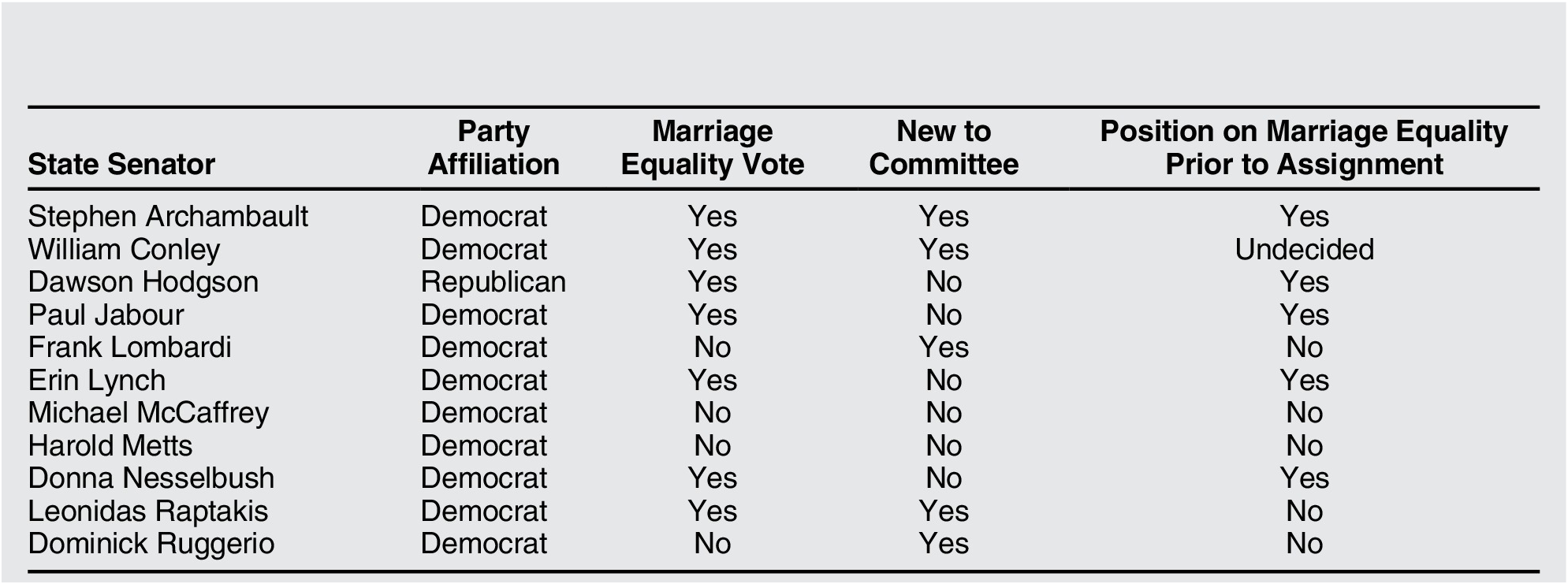
Even in 2013, Weed was too sensitive to the balance of interests in her caucus to give either side a definite majority, but was willing to provide both sides with a realistic chance of persuading legislators in the middle. Once divided evenly, the committee reported marriage equality to the floor in a 7–4 vote when one former opponent and one undecided committee member supported it. As table 1 indicates, chairman McCaffrey and senators Metts and Ruggerio were opposed to marriage equality. Hodgson, Jabour, Lynch, and Nesselbush were supportive. Of the new senators, Lombardi and Raptakis were opposed, Archambault was supportive, and Conley was undecided. In the final vote, Raptakis joined Conley in supporting the marriage equality bill, allowing the bill to pass through the bottleneck committee.
Rhode Island Senate Judiciary Committee

Interest group activists claimed credit for prompting Weed to appoint an evenly divided Judiciary Committee. Of course, interest group activists might be tempted to exaggerate their own role in making the issue salient in interviews. Unsurprisingly, opponents from the Faith Alliance of Rhode Island attributed passage to the legislature “caving in” to pressure groups (Seelye Reference Seelye2013). However, in an interview Weed declined to offer an alternative explanation for why the Judiciary Committee was more evenly balanced in 2013 than 2011. She said that Speaker Fox was a more effective advocate than Senators Rhoda Perry and Joshua Miller, who had been lobbying her for years. But Fox had also been pressing for full marriage equality all along, so something else had to have changed in the two years.Footnote 28 Activists I interviewed in other states were also not in agreement about the decisiveness of their work.
Two days before Fox publicly admitted that he could not pass same-sex marriage in 2011, MERI members replaced their organization’s leadership with activists willing to involve themselves in electoral politics (Gregg, Marcelo, and Edgar Reference Gregg, Marcelo and and2011). OSA president Rosenberg suggested former state representative Ray Sullivan (whom OCA had helped elect). Sullivan canvassed in liberal districts with legislative holdouts and, perhaps more importantly, beat expectations in primary challenges. MERI’s electoral success was underpinned with support from HRC, which sent personnel to the state as soon as Fox said full marriage equality was possible in 2012. Unlike his predecessor, Sullivan accepted money and volunteers from HRC, the Victory Fund, GLAAD New England, and the Gill Action Fund.Footnote 29 HRC demanded that it be in charge of the campaign to pass same-sex marriage in exchange for its support. Rosenberg recalls that “I was driving home from a meeting and got on the phone with Ray. I can’t believe what I’m about to ask. They want to come in with money but they want us to cede control … We needed something to be the game changer."Footnote 30 In the past, HRC’s involvement in state politics generated mixed feelings among local gay rights activists. As a 2001 HRC plan of action summarized the tension, leaders of MERI’s predecessors unfortunately have “very negative feelings about HRC" stemming from “disagreement with some of our endorsements in the state and because HRC sometimes overshadows the work that the Alliance does in Rhode Island."Footnote 31 Older local activists were also being asked to listen to younger national activists.Footnote 32 Nonetheless, Rosenberg and Sullivan agreed to HRC’s request.
National organizations managed to wage a vigorous effort by working under the auspices of local organizations. Despite all of his own coalition building efforts, Reverend Gene Dyszlewski credited HRC as the “star,” bringing in experienced activists who had recently helped to pass same-sex marriage in Maine in 2009, and coaching liberal clergy on media appearances. MERI had few contacts in remote areas of Rhode Island, but liberal church officials trained by HRC could reach those people. At the same time, HRC depended on the contacts and “boots on the ground” that MERI and other groups had built over the past decade. For example, HRC limited their local meeting sizes and one local meeting initially excluded the person who had long been active in organizing supporters in the district. State activists who predated HRC’s participation needed to advise HRC to avoid potential insults.Footnote 33
MERI used canvassing to force legislators to confront supportive members of their district. During the 2012 elections, MERI volunteers went from door to door asking if constituents agreed with same-sex marriage. If they agreed, volunteers provided a cell phone on the spot with their legislator’s number on the speed dial. In one hour, a legislator’s phone might ring dozens of times. MERI told legislators that the callers were their constituents and neighbors, and “if you agree to vote for us, we’ll go away. I can make it stop tomorrow if you’ll just come on board. The 2012 electoral cycle was … the first time you had to talk about your position on marriage."Footnote 34 By moving quickly from neighborhood to neighborhood, they looked more numerous than they really were.Footnote 35 MERI succeeded in part by capitalizing on what legislators did not know about their strength and numbers. In a polity with imperfect information and where most voters are not activists, legislators overestimated MERI’s strength. The National Organization for Marriage campaigned against marriage equality in Rhode Island, but it lacked the staff to keep employees in the state full-time, so their director made appearances in the state and left quickly.
Perhaps more importantly, MERI’s primary challenges to four opponents in the legislature also made marriage equality a salient issue. Only one primary challenger succeeded, but another, Laura Pisaturo, came within 226 votes of unseating the Senate Judiciary chairman Michael McCaffrey. McCaffrey had long prevented same-sex marriage from being raised for a vote. Monteiro managed Pisaturo’s campaign while Rosenberg managed the GOTV effort. “Anyone who was anyone was on her kitchen cabinet,” Rosenberg said. NEARI found it necessary to endorse McCaffrey because of his consistent support on labor issues, but it refrained from actively advertising its support. In addition to primary challenges, MERI claimed credit for electing five new senators and nine of the ten new House members who supported marriage equality (Seelye Reference Seelye2013).
Interest groups were willing to challenge such legislators but colleagues were not. Paralleling research on other states (Baylor Reference Baylor2017, ch. 9), legislators adhered to institutional norms that weighed against threatening other legislators in their own party, even on issues where they disagreed. Sullivan said “That chamber doesn’t want controversy on any issue … They go to dinner, work it out amicably and then close ranks in the Senate. They don’t look favorably on firebrands⸺that’s not how you ingrain yourself in the good graces of the Senate leadership."Footnote 36 Current legislators confirm Sullivan’s assessment. When Laura Pisaturo challenged Senate Judiciary Chair Michael McCaffrey in a primary contest in 2012 on a gay rights platform, openly lesbian state senator Donna Nesselbush did not support the challenge. Though Nesselbush sponsored the marriage equality legislation, she would not oppose her colleagues, saying that “there is a great deal of respect across the board from liberals to social conservatives … I have not seen any organized work to build coalitions or even to affect the outcome of elections … They don’t work against each other even if they’re not in line with their political philosophies. I didn’t support the challenge to McCaffrey despite my interest in the issue.”Footnote 37 Frank Ferri, an openly gay representative, would not openly support Pisaturo but privately served in her kitchen cabinet.Footnote 38
When the new legislature was in session, Weed appointed an evenly-balanced Judiciary Committee, telling journalists that same-sex marriage “was very much an issue in the forefront” and needed a “full hearing in committee” and a floor debate (Gregg, Edgar, and Marcelo Reference Gregg, Edgar and Marcelo2013). Weed announced it would come to a full vote just two hours after the national heads of the United Church of Christ and the Unitarian Church joined local religious groups at a historic church to speak in favor of marriage equality (Nugent Reference Nugent2013). The Judiciary Committee green-lighted the bill for a floor debate by seven to four. State senator Leo Raptakis also changed from opposition to support after intense lobbying. Raptakis said that the Greek Orthodox church was supportive provided that churches were not forced to perform them, which the bill did not require.Footnote 39 Less than a month after marriage became law, he actually officiated at a same-sex wedding.Footnote 40 HRC arranged for prominent national Greek figures to call Raptakis in support of the vote, including the Archbishop of San Francisco’s Metropolis, Representative Nicola Tsongas, and former Democratic presidential nominee Michael Dukakis.Footnote 41 Raptakis voted for the bill with Dyszlewski present in his office on the day of the vote.Footnote 42
Weed had also appointed William Conley, a first term senator from liberal East Providence, to the committee. Conley was known to be an active Catholic and rumored to oppose same-sex marriage, but he had avoided discussing the issue during the campaign. After meeting with lobbyists from both sides, he voted to move the bill out of committee. Illustrating the social pressure Catholic groups in Rhode Island exert, Conley said a diocesan official asked him to resign as a trustee of La Salle Academy and the pastor of his own church denounced him as a “Judas" at a religious service (Stanton Reference Stanton2013).
The Judiciary Committee defeated two separate efforts to obstruct a clean passage. Bishop Tobin pressed for a referendum, which would have forced supporters to raise the money and volunteers for yet another campaign, as well as to counteract advertising from the National Organization for Marriage and other opponents. The committee also defeated an amendment to grant exemptions to religiously affiliated institutions. Both amendments were defeated, though Conley voted in favor of both the original bill and the referendum.
After the Senate passed same-sex marriage by 26–12, the House Judiciary Committee unanimously approved it, the House floor supported an identical version by a 56–15 vote, and Governor Chafee signed it into law. Once released from the Senate committee, passage by the floors of both chambers were foregone conclusions, and the debates added little to the outcome. None of the legislators I interviewed volunteered the change in the national Democratic Party in 2012 as a factor in the bill’s outcome, and one claimed that Rhode Island legislators are not sensitive to national party changes.Footnote 43 Some Senators, including Baptist Judiciary Committee member Harold Metts, quoted from the Bible to justify their opposition. President Weed and the Senate majority leader voted against the bill, but several senators who had not committed themselves to a position joined the same-sex marriage bandwagon. Senate Majority Whip Maryellen Goodwin finally voted for same-sex marriage after years of being neutral, ostensibly because of all of the stories gay couples shared with her. Her family owned a funeral parlor which worked heavily with Catholic churches.Footnote 44 All five Republicans in the state Senate supported marriage equality when it passed⸺the first time a party unanimously approved such a measure in any state. They said it was a vote for “fairness, equality, and civil rights,” helping to convey the impression of momentum and inevitability before the vote.Footnote 45
In summary, the passage of marriage equality in Rhode Island conforms to the predictions made by theories of parties as policy demanders. First, state party politicians preferred to avoid an issue that divided their party. Second, outside groups had to raise the salience of the issue in primary challenges, because legislatures adhered to collegial norms against criticizing members of the same party. Third, public support and openly gay legislators were present in both years, but increased interest group activity was the major difference in interest group strategy in the year in which it succeeded. Legislators and activists who might have attributed the outcome to the national Democratic Party instead conceded the role of a national organization, HRC. If they were apt to exaggerate the influence of activists, they probably would have exaggerated their own rather than national organizations operating at their side. While national politicians like Tsongas and Dukakis helped to persuade State Senator Raptakis, HRC arranged the contact. Other legislators had appealed to Weed to pass a marriage equality bill for many years, but only after 2012 did she appoint a Judiciary Committee that might have recommended it to the floor. To the extent that confrontational politics spurred the changes necessary to report a marriage equality bill out of committee, pressure for marriage equality had to come from interest groups rather than legislators.
Conclusion
According to elite interviews, Rhode Island legislators did not initially pass marriage equality, despite its popularity, because it upset the political and social groups in their party. Marriage equality groups outside of the formal Democratic party organization had to build bridges to sympathetic allies to work for its passage, without the prodding of politicians. These outside coalitions were ineffective when they tried to persuade an undifferentiated public, but successful where they failed in the past by supporting strategic primary challenges, canvassing voters, and lobbying legislators. Unlike state legislators, outside coalitions were unrestricted by norms of collegiality that bound officeholders from seeking policy change by threatening other legislators in elections.
When a party majority in a legislature wants to avoid a divisive issue like marriage equality, outside groups need to change the agenda. As I argue elsewhere, the critical first step to introduce a suppressed issue is for outside groups to establish a functioning coalition to broaden their support. In Rhode Island, groups like teachers’ unions funded and directed such coalition building years ahead of time. Among other forms of assistance, MERI and HRC were able to soften union support for social conservatives like Senate Judiciary chair McCaffrey by developing constructive relationships. HRC was successful because it worked through local groups networked through this coalition, which forced a party to confront divisive issues in primaries.
Once marriage equality became salient, liberal coalitions in Rhode Island deflected potential infighting among member groups and confronted recalcitrant party members in nominations. Policy-demanding coalitions could not rely on officeholders in their party to introduce divisive issues. Speaker Fox commanded great respect in both chambers of the state legislature but could only muster enough votes for civil unions. Democratic legislators in Rhode Island refused to sanction electoral challenges to fellow partisans even when they were passionate about marriage equality. Given the tendency of legislators of the same party to maintain cordial relationships, outside groups unencumbered by collegial norms antagonized reluctant Democrats. Electoral pressure may not be the only way to change public policy, but they proved to be a more effective way than influencing the mass public. Once the politics of nominations was followed by changes in the Senate Judiciary Committee, marriage equality passed. Organized groups had made same-sex marriage possible in 2013 by employing tactics they rejected in 2011.
There are multiple paths to policy change, but marriage equality in Rhode Island cannot be attributed mainly to variation in public opinion alone. Public opinion was at best a necessary condition for marriage equality, not a sufficient condition. What made the difference in 2013 compared with 2011 was the balance of interest group activity among both supporters and opponents. Policy demanders puzzled by the discrepancy of state policies and state public opinion should realize the outsized impact they can have on both state party nominations, and as a consequence, the role they can play in changing state level policy.