Although music historians acknowledge a prominent African American fiddle tradition during the slave era in the United States, scholarly research on this topic has been limited.Footnote 1 Yet, available evidence indicates that fiddling was pervasive for entertainment at family and other social gatherings in many African American communities between the seventeenth and nineteenth centuries, and the fiddle continued to be an important instrument in early-twentieth-century (i.e., pre–World War II) blues and jazz bands. While only occasionally included in late-twentieth-century African American jazz and popular music groups, the fiddle remained integral to some rural black performers of old-time, country, and zydeco music. Failure to examine the role of the fiddle in the performance of these genres has not only resulted in the misrepresentation of African American music, but it has also led to an incomplete view and understanding of musicking among blacks and whites.Footnote 2
Several reasons may account for the non-identification of the fiddle with black culture in the twentieth century. When scholarly research on African American music began during the nineteenth and early twentieth century, music researchers tended to focus on religious music, specifically spirituals, a sacred genre typically accompanied by body percussion. Since most people in the United States during the late 1800s and early 1900s associated fiddling with secular culture, and the fiddle, through the early twentieth century, was often called the devil's instrument, rarely was it used to accompany religious music.Footnote 3
With the exception of works by scholars such as Howard Odum and Thomas W. Talley, early writings on late-nineteenth and early-twentieth-century black secular music focused primarily on blues and jazz because researchers considered these genres to be different, new, and dynamic. Because many folklorists (e.g., Stetson Kennedy of Florida, and John and Alan Lomax of the Library of Congress) believed blues had interesting lyrics that addressed issues and problems confronting blacks, and that the fiddle was a relic of the past identified primarily with whites, they avoided research on traditions in which black fiddlers were dominant. As a result, most folklorists did not begin collecting materials on rural black secular music until the 1930s.Footnote 4
Even record companies of the twenties and thirties segregated music into separate series: one designed for blacks (blues, jazz, religious music, and vaudeville songs) and another for whites (fiddle, banjo, some religious music, and jazz performed by whites). Because the music of African American fiddlers did not fit neatly into either category, few black fiddlers made recordings. A handful of commercial recordings of black fiddling date to the 1920s, and an even smaller number of field recordings by black fiddlers was made beginning only in the early 1940s.Footnote 5
In the second half of the twentieth century, black fiddling and other rural-based musical traditions continued to be ignored because most researchers tended to be music historians who relied almost exclusively on print or sound materials for analyses.Footnote 6 Commenting on the importance of recordings in documenting the history of fiddling in the United States, folklore and music scholar Charles Wolfe writes, “Since these older recordings are often the starting point for modern researchers, a lack of recordings all too often meant a lack of research, and a lack of knowledge.”Footnote 7 Because rural black fiddlers who performed secular music rarely had an opportunity to record and few print data were available on them, much of what we know about black secular music in the twentieth century is based more (or primarily) on how the media and researchers represented African American music than on what was actually created and performed by African Americans.Footnote 8
Representation
Because representation is an important issue in this essay and to explain my use of the concept, we should review its meaning. Most dictionaries include several definitions for “represent.” Yet, the descriptions most relevant for this discussion are:
(1) Represent: to serve as a sign or symbol of; to portray or exhibit in art—depict; to serve as the counterpart or image of—typify.
(2) Misrepresent: to give a false or misleading representation of, usually with an intent to deceive or be unfair.Footnote 9
In explaining the importance of representation to cultural meaning, cultural theorist Stuart Hall writes, “The emphasis on cultural practices is important. It is participants in a culture who give meaning to people, objects and events. . . . In part, we give things meanings by how we represent them—the words we use about them, the stories we tell about them, the images of them we produce, the emotions we associate with them, the ways we classify and conceptualize them, the values we place on them.”Footnote 10 Later in his discussion, Hall raises several questions that are pertinent to understanding representation: “Do things—objects, people, events in the world—carry their own, one, true meaning? Or are meanings constantly shifting as we move from one culture . . . to another? Is it through our systems of representation . . . that meaning is fixed?”Footnote 11 Hall also believes that two systems of representation exist: mental and language. “First, there is the ‘system’ by which all sorts of objects, people and events are correlated with a set of concepts or mental representations which we carry around in our heads. . . . We must also be able to represent or exchange meanings and concepts, and we can only do that when we also have access to a shared language. Language is therefore the second system of representation involved in the overall process of constructing meaning.”Footnote 12
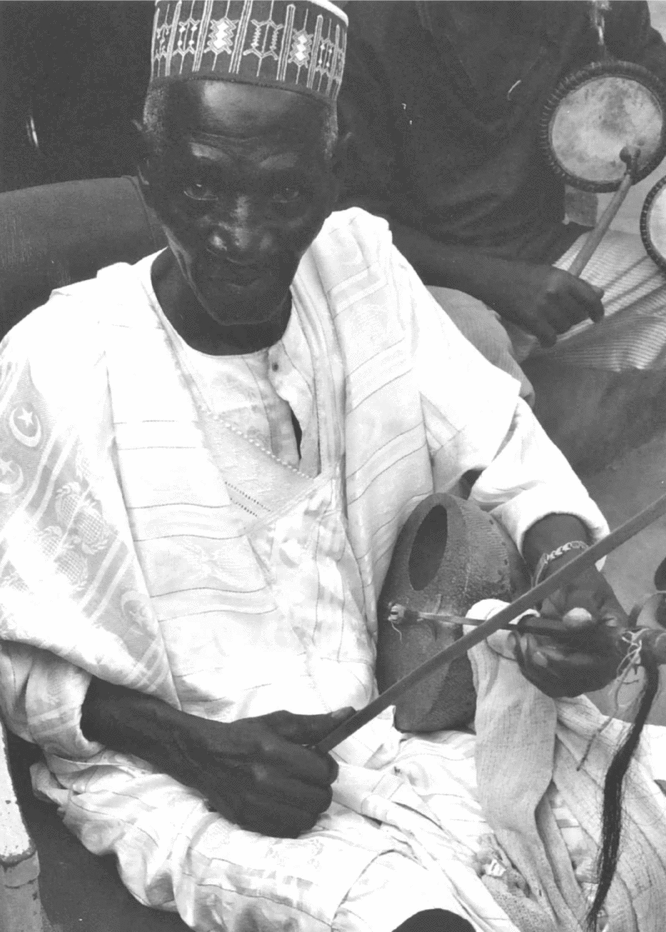
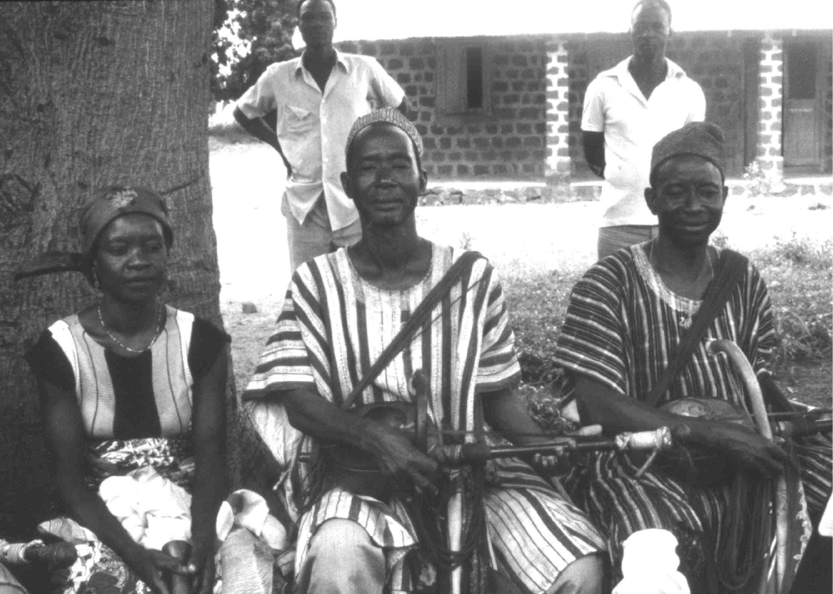
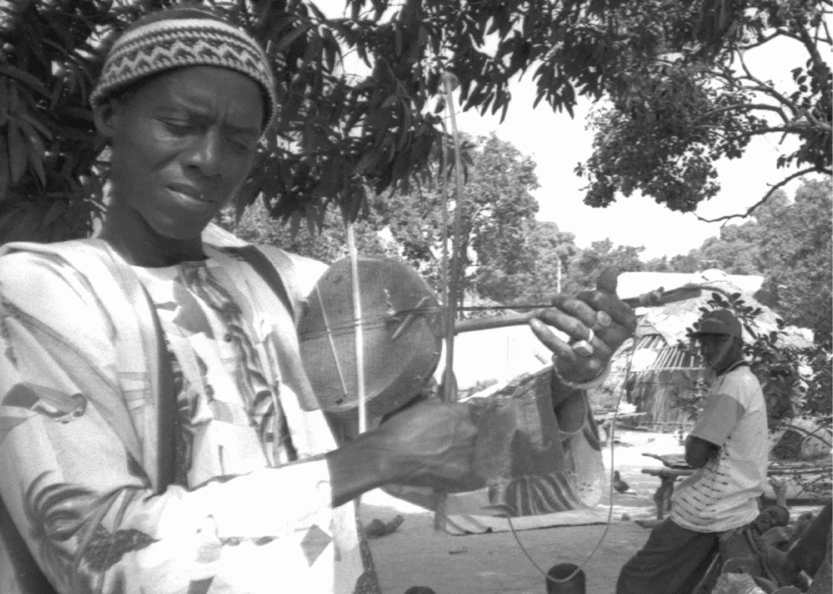
As an object in global culture, the fiddle (or bowed lute) has diverse cultural meanings. Among Arab Bedouins, the bowed lute (called rabab or rebab) continues to be regarded as a folk instrument to accompany poetry and legends. “Among the Chinese, bowed chordophones were at first folk instruments” before their adoption in a different form (e.g., the two-stringed Chinese erhu) as court instruments.Footnote 13 In early Europe, street and court musicians often played the rebec, which is derived from the Arab rabab, before it developed into what we now know as the violin. Cultural meanings for the bowed lute are also diverse among societies in West Africa. Whereas some Hausa people in northern Nigeria use the goge (the Hausa term for the fiddle) to call the spirits in religious worship, the Dagbamba of Ghana and Fulbe of Senegambia regard the gondze and nyanyeru as a symbol of political authority and ethnic identity, respectively (see Figures 1, 2, and 3).Footnote 14
Tamba Kandeh of The Gambia playing the Fulbe nyanyeru. Photo by Jacqueline Cogdell DjeDje, December 1994.
Musa dan Gado Saminaka of Nigeria playing the Hausa goge. Photo by Jacqueline Cogdell DjeDje, July 2003.

Salisu Mahama (center) of Ghana playing the Dagbamba gondze with his son, also on gondze, and his niece holding the gagle rattle. Photo by Jacqueline Cogdell DjeDje, August 1990.
In the United States, the fiddle has been depicted historically as a symbol of European and Anglo culture. When African Americans have been identified with the fiddle (Figure 4),Footnote 15 often it is in the context of emulating or imitating Europeans. These beliefs and attitudes regarding the fiddle resonate in the cultural memory of peoples living in the United States because of the stories they have been told by researchers and those who control the media (see discussion below). Rarely are these conceptualizations or stereotypes questioned because through “systems of representation” the meanings have become fixed.Footnote 16
Joe Thompson, African American fiddler from North Carolina. Photo by Larry Vellani, date unknown. Used by permission of Iris Chapman.
Because we give objects (i.e., musical instruments) meaning by the words, stories, images, emotions, and values we associate with them, the fiddle in the United States serves as an example of misrepresentation. Neglecting to acknowledge fiddling as a tradition identified with blackness, but primarily a product of whiteness, has led to dramatic consequences. Misrepresentation has not only skewed our understanding of African American music, but it has also had an impact on the history and development of black music. In the discussion below, we will examine the consequences of misrepresentation and explore to what extent misleading representation was done “with an intent to deceive or be unfair.”Footnote 17
Although misrepresentation has resulted in many stereotypes and misconceptions that have materialized during the development of African American music, this essay is concerned with two periods in U.S. history: (1) the seventeenth to nineteenth centuries, with special focus on connections with West Africa, slavery, and minstrelsy;Footnote 18 and (2) the early twentieth century (1900s–30s), with attention given to migration, urbanism, and the media. I have chosen these periods not only because they are eras when black fiddling was most prominent, but also because they are moments when there tends to be general agreement among researchers about black music's history and development.Footnote 19 Therefore, several questions or issues will be addressed for both time periods:
a. Why did we identify the fiddle primarily with Europeans and not with Africans or African Americans? The “we” in this question varies; it can mean researchers, the media, or peoples living in the United States.
b. What are the repercussions? How have our actions affected both the development and our understanding of black music in general and black fiddling?
Seventeenth to Nineteenth Centuries: West African Connections, North American Slavery, and Minstrelsy
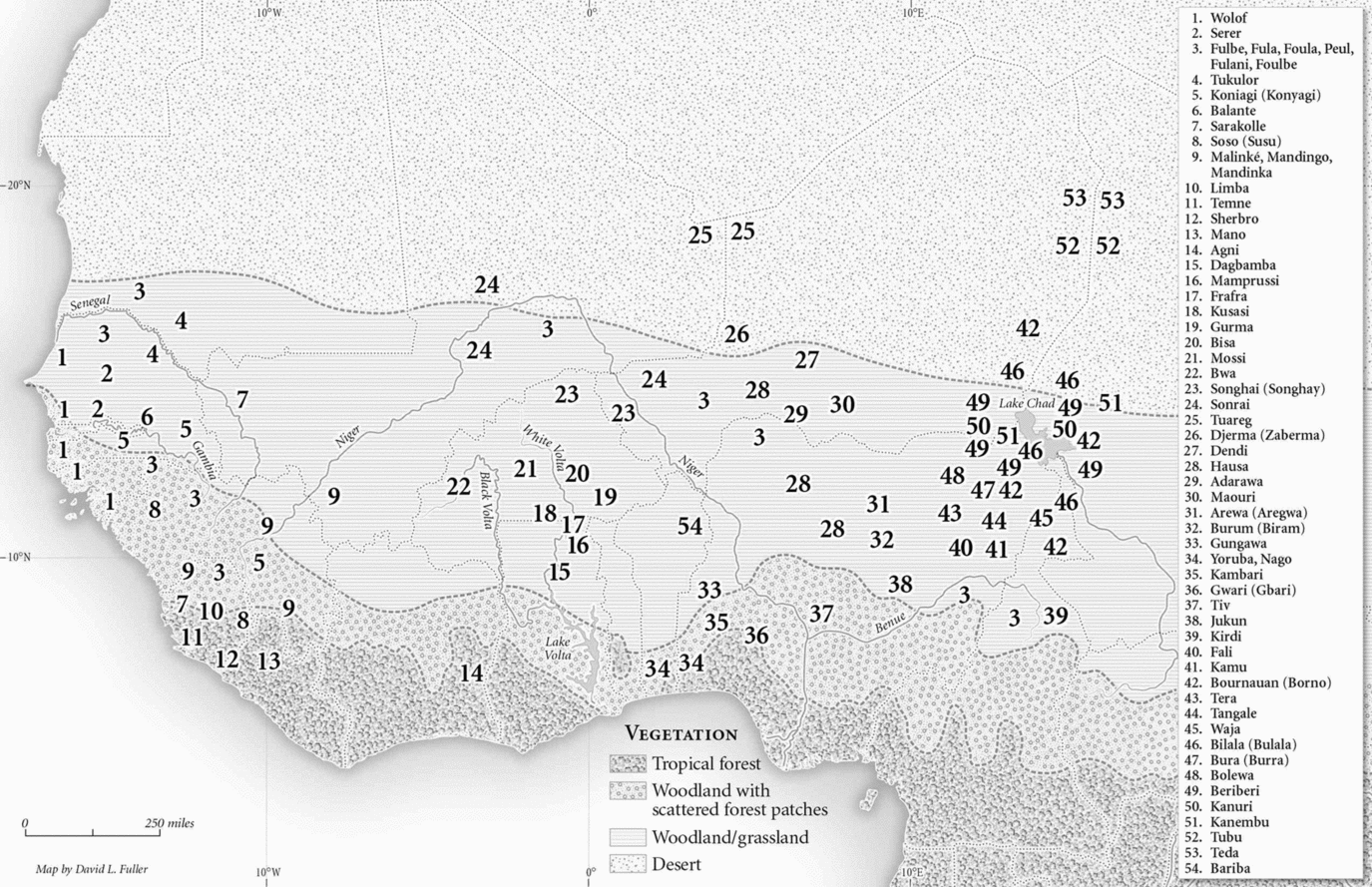
The fiddle or bowed lute in West Africa is dispersed primarily in the savannah or Sudanic region, from Senegal to Lake Chad, including the following countries: Mauritania, Senegal, The Gambia, Guinea-Bissau, Guinea, Mali, and parts of Burkina Faso, Ghana, Togo, Benin, Nigeria, Niger, Cameroon, and Chad (also see map in Figure 5).Footnote 20 Not only is fiddling integral to many musical traditions in savannah West Africa, the use of bowed lutes in some areas dates to the eleventh or twelfth century. As a result of recent research, it has also become apparent that several enslaved groups from West Africa were transported to the Americas from areas in which fiddling was prominent.Footnote 21
Distribution of people in West Africa who use the one-stringed fiddle. Map by David L. Fuller. Based on a map in Jacqueline Cogdell DjeDje, “Distribution of Ethnic Groups in West Africa Using the One String Fiddle,” in Distribution of the One String Fiddle in West Africa (Los Angeles: UCLA Program in Ethnomusicology, Department of Music, 1980), 40–41; and in Fiddling in West Africa: Touching the Spirit (Bloomington: Indiana University Press, 2008), 24.
For example, historical research indicates that Africans transported to the Americas during the transatlantic slave trade were exported from eight principal regions: Senegambia (present-day Senegal and The Gambia); Sierra Leone (which extended along the coasts of present-day Guinea, Guinea-Bissau, and portions of Senegal and Sierra Leone); Windward Coast (mainly Liberia and present-day Côte d’Ivoire, but also portions of Sierra Leone); Gold Coast (roughly the same as present-day Ghana); Bight of Benin (present-day Togo, Benin, and Nigeria); Bight of Biafra (from the Niger-Delta in Nigeria to Cape Lopez in present-day Gabon); and Central and Southeast Africa (Gabon down to the Orange River in present-day Namibia as well as parts of Mozambique and Madagascar).Footnote 22 “Culturally, these regions can be divided into three broad areas: (1) Western Sudan, which includes Senegambia and portions of Sierra Leone; (2) West Africa, which can be divided into three sub-regions—the Bight of Biafra, the Bight of Benin and Gold Coast, the Windward Coast; and (3) Central and Southeast Africa.”Footnote 23 For this discussion, our focus is on the Western Sudan and West Africa.
Africans whose music cultural traditions included fiddling were exported from several locations: Senegambia and Sierra Leone (Fulbe, Serer, Susu, Temne, Tukulor, and Wolof); the Gold Coast (Dagbamba); and the Bights of Benin and Biafra (Bariba, Gbari, Gurma, Hausa, Nago, or Yoruba). Since these are peoples who had resided for hundreds of years in savannah and forest West Africa, their musical traditions (including fiddling) were firmly in place before the transatlantic slave trade began. Because earlier research on slave trading focused on groups living along the Atlantic Coast near ports of embarkation, much of the information about musicking in Africa also emphasized coastal traditions. Although many explanations can be given for researchers’ interest in the music of groups living along the coast or forest West Africa, part of the reason has been the desire to identify linkages and/or retentions between Africans and blacks in the Americas.Footnote 24 Unfortunately, the focus on coastal traditions has caused groups in the interior, the homeland of many enslaved Africans transported to the Americas, to be ignored, which has led to misconceptions about the music and culture of both Africa and African America.Footnote 25
In fact, the place of exportation did not always reflect the ethnicity of those sold into slavery because Africans were often transported from various regions in the interior for trade on the Atlantic Coast. Commenting on how slave traders identified peoples for export, historian Darold D. Wax writes: “Confined to small enclaves of settlement dotting the coast, Europeans had to rely on the assistance and support of the natives, who alone were familiar with the hinterland and possessed of the knowledge that permitted them to make long journeys into the interior, perhaps as long as four or five hundred miles.”Footnote 26 Making a similar argument, historian Colin Palmer states: “The ports from which they embarked are not usually reliable indicators of the ethnicity of the captives, who often came from the interior and comprised many different peoples.”Footnote 27 Paul Oliver's remarks in Savannah Syncopators are also noteworthy: “slaves were drawn not only from . . . the Gold and Slave Coasts, Guinea and Calabar [in present-day Nigeria], but from deeper in the interior, and that these from the savannah regions, from Senegambia and among the Wolof and Mandingo peoples, formed a not inconsiderable number of them. Their culture may have been transplanted to the United States in many forms, including that of music.”Footnote 28 Throughout West Africa, military conflicts between various groups produced war captives who were sold into slavery. For example, several wars took place in savannah West Africa during the period of the transatlantic slave trade. The Fulbe had conflicts with the Mande, Hausa, and rulers of Bornu at different points in time; the Asante also warred with different groups, including those in the northern regions of present-day Ghana. Therefore, just as people shipped from the Gold Coast may have included groups (e.g., the Dagbamba) that lived inland, the Bights of Benin and Biafra served as points of embarkation for people (e.g., the Gurma and the Hausa) who lived in or near the northern parts of present-day Benin and Nigeria.Footnote 29
When discussing the impact of the transatlantic slave trade on the development of black music, few music scholars address the ethnicity and cultural traditions of Africans transported to the Americas. Instead, Africans are presented as a homogenous group with little differentiation. Interestingly, a similar approach is used when discussing Europeans and their interactions with Africans. Commenting on this issue, DjeDje writes, “the richness and diversity of all America's cultural traditions—African, European, African American, and Native American—are overlooked, avoided, or skewed in a misguided effort to show commonalities, similarities and differences.” Generalizations of this nature continue in present-day scholarship, which, in my opinion, accounts for much of the misrepresentation regarding the music making of ethnic and racial groups in the United States.Footnote 30
In spite of the fiddle's association with African Americans, particularly during slavery, few researchers have focused on the instrument's connections with Africa. Because many scholars in earlier years considered fiddling in North America to be a European American tradition, most assumed that African Americans’ use of the fiddle during slavery was due entirely to European influence. In the first and second editions of her classic work, The Music of Black Americans: A History, Eileen Southern attributes the popularity of fiddling among blacks to whites.Footnote 31 Even in the third and final edition, she writes: “the references to slave musicians point out that most often they were violinists and flutists, a phenomenon perhaps to be attributed more to the demands of the white colonists for dance musicians than to mere coincidence or to any preference for these instruments among the black people.”Footnote 32 Probably because more information has become available about the subject matter in recent years, Robert B. Winans not only acknowledges the existence of bowed string instruments in Africa, he also suggests that both blacks and whites probably enjoyed fiddle music in the Americas during the slave era: “the vast majority of eighteenth-century black musicians played the fiddle, which was also the central instrument of the prevailing Anglo-American tradition that surrounded these blacks, although of course bowed instruments similar to fiddles were also known in regions of Africa from which the forebears of these slaves originally came. . . . The advertisements do not provide any information on what music they played, but Anglo fiddling and dance repertory would likely have been at least a part of their repertory, along with specifically African American material.”Footnote 33
Recently, researchers investigating the history of the banjo in the United States have begun exploring West Africa, especially Senegambia and other parts of the region, for evidence of influences and linkages.Footnote 34 Unlike drumming cultures in forest West Africa, in which emphasis is placed on layers of sound produced by percussive instruments (drums, bells, and rattles), the savannah includes sounds that fuse both melodic- and rhythmic-based instruments, with greater emphasis given to melody and melodic ornamentation. Because West African fiddling consisted of performances of the fiddle as a solo instrument, accompanied by percussion (rattle and drums), or in ensembles with drums, wind, and occasionally other string instruments, it is not far-fetched for enslaved Africans to have replicated these performance traditions in the Americas.Footnote 35
In view of the fact that instruments in general have multiple identities that shift due to usage or circumstance, the fiddle has had several cultural meanings both in Africa and the Americas.Footnote 36 Thus, fiddling among enslaved Africans actually reflects both resilience and acculturation. Blacks did not merely adopt the European fiddle because whites preferred it. Rather, the popularity of the fiddle among white Americans allowed some Africans the opportunity to maintain and signify on a tradition that was an important part of their culture prior to contact with Europeans. John Storm Roberts states, “the enthusiasm with which New World blacks took to the fiddle, not only in Brazil but in the United States and Cuba as well, is surely related to the occurrence of fiddle-type instruments in parts of Africa.”Footnote 37
In addition, the manner in which blacks performed on fiddle, combined with ensembles that included percussive instruments, reflects an African aesthetic that did not diminish as a result of contact with European culture. In describing the playing technique or musical sound produced by black fiddlers, critics and writers from the eighteenth through the twentieth centuries often used words such as “rough,” “scraping,” “sawing,” and “jerky,” which was distinct from “smooth,” “clear” or “notey” to describe fiddling identified with whites. Caroline Howard Gilman's description of black musicking—“sawing violins, harsh clarinets, jingling tambarines, crashing triangles, with the occasional climax of a base drum, make up in quantity what is deficient in quality”—on a nineteenth-century South Carolina slave plantation, and R. P. Christeson's comments about the rough, vigorous playing style of Bill Driver (1881–1985), a black Missouri fiddler popular during the early twentieth century, both suggest a preference on the part of African Americans for features common in Africa. Therefore, playing the fiddle in the Americas can be regarded as a reinforcement rather than a diminishment of Africanisms, which led to transformation and the development of new stylistic trends.Footnote 38 In other words, acculturation did not necessarily mean a loss of tradition; rather, it allowed blacks greater flexibility, versatility, and opportunity to be creative in using ideas and material available to them, whether they were derived from African, European, or Native American cultures.Footnote 39
Although immensely popular within black and white communities, fiddling had many critics. In addition to some whites characterizing the activity as evil, sinful, and an act of resistance, many blacks and whites believed fiddling encouraged behavior that was “un-civilized” (i.e., African). Interestingly, the fiddle never reached the stage of being outlawed, like the drum, due to fear of uprisings. Because the fiddle was culturally important to European Americans, and they often used musicking as a means to control and increase the economic productivity of the enslaved, fiddling among African Americans continued unabated in spite of its association with the profane.Footnote 40
Minstrelsy, an entertainment form developed in the early nineteenth century by whites that popularized negative portrayals and stereotyped performances of African Americans, had a major impact on the development of black fiddling. As a European American invention in imitation of African American culture, whites included African or African-derived instruments in minstrel ensembles. The fact that the fiddle as performed by blacks became an important source of entertainment in minstrelsy confirms that, prior to the nineteenth century, the instrument was common in African American culture.Footnote 41 After emancipation, minstrelsy became an important context for black musicking, for it was one of the few opportunities for black fiddlers and other artists to maintain a livelihood as professional musicians.
a. Why did researchers identify the fiddle primarily with Europeans?
Reconstructing the history of enslaved Africans in the Americas is both difficult and complicated, given the paucity of resources.Footnote 42 In earlier studies, confusion may have occurred because historians, when discussing influences from Africa, initially emphasized the place of exportation (which they knew more about) and not the peoples who were exported (for which they knew little because of the difficulty in determining this information). Because details were lacking, misrepresentation may have been unintentional. In discussing the problem of identifying the ethnicity of slave communities in the Americas, some authorities still urge researchers to be cautious with data because “significant cultural mixing between members of different African nations, between Africans and African Americans, and between these groups and Native Americans occurred in every colony.”Footnote 43
Yet, when some researchers emphasize the performance of drums and other percussive instruments in Africa to the exclusion of other musical traditions, the misrepresentation is intentional, not only to mark musical differences between various ethnic groups in the Americas, but also to perpetuate longstanding meanings and practices in the cultural memory of both African and European Americans. Therefore, associating blacks with drumming (an activity banned in the Americas because it had been used to incite revolt) also coincided with perceptions of Africa and Africans as threatening, cruel, and barbarous, which was distinct from the representation of Europe and Europeans, who performed melodic instruments (strings), as genteel, reserved, and respectable.Footnote 44
b. What are the repercussions?
Serious misunderstandings now exist regarding the contributions and musical influences from both Africa and Europe in the development of music in the United States. The belief that Africa contributed rhythm and Europe melody to what became known as “American” fiddle music is too nice and neat because there are many musical traditions in Africa that can be described as melodic just as European culture is not completely devoid of musicking that emphasizes rhythm.Footnote 45 As Olly Wilson explains, “careful examination reveals that it represents a gross over-simplification. . . . [T]his position ignores the fact that it is the combination of many interrelated parameters that defines the Africanness of a musical practice, not the presence of absence of a single one.”Footnote 46
In fact, different interpretations of existing material on European music suggest that alternative explanations need to be explored. For example, in discussing features that affected the music used in blackface minstrelsy,Footnote 47 ethnomusicologist Christopher Goertzen comments on the use of syncopation in playing the banjo: “Although this drone is played off the beat, producing syncopation, a feature that is generally and justly taken to reflect African influence, that a drone is present at all points less to any sub-Saharan African musical tradition than to the Scottish bagpipes and various northern European types of dulcimer.”Footnote 48 Goertzen's point about syncopation and its relationship to drone raises several issues. On one hand, it is noteworthy in that he presents a different interpretation for the use of rhythmic practices in minstrelsy by suggesting Europe, not Africa, as a source. On the other hand, using one element or feature to justify the cultural history or roots of a musical tradition is an example of an approach that we should avoid. Thus the larger issue is the manner in which we discuss the contributions of various music cultures to the development of “American” music. Identifying specific elements or traits can lead to misrepresentation because different characteristics, when examined in isolation, can be found in many cultures.
In the end, more investigation needs to be done on the history and development of music in colonial America to clarify what was contributed and/or maintained by peoples from Africa, Europe, and Native America. Because similar performance practices may have existed prior to contact, some may question whether identifying the origin of specific traits is useful. Nevertheless, as new information becomes available, our analysis and understanding of the histories of specific instruments and musical traditions need to occur to avoid misrepresentation based on outmoded assumptions and stereotypes.
On many levels, minstrelsy has played a significant but complicated role in the history of black fiddling. (1) The prominence of fiddling among minstrel performers provides evidence of the fiddle's association with black culture in the eighteenth century and possibly earlier. (2) Minstrelsy's popularity contributed to the development and growth of fiddling, especially in terms of repertoire and ensemble organization. Songs composed by white and black minstrel performers became favorites among both races. Although the fiddle/banjo ensemble (a combination that allowed the enslaved to fuse two instrumental traditions from the African continent in an innovative manner) started among African Americans during the eighteenth century, most likely it was the minstrel show that popularized the performance tradition during the nineteenth century.Footnote 49 As Winans explains, “Traditional American banjo/fiddle music is as much an Afro-American tradition as an Anglo-American one.”Footnote 50 (3) Because of the emphasis it placed on difference, minstrelsy is one of the primary reasons for the misrepresentation and negative stereotypes associated with blacks in the United States.Footnote 51 Commenting on this issue, ethnomusicologist Ronald Radano writes: “That northern white working-class performers were principally responsible for the latter invention [i.e., blackface minstrelsy] suggests an effort on their part to celebrate blackness in order to distance it (and an emerging African American working class) from their own racial status. As both David Roediger and Eric Lott have suggested, blackface performance played a key formative role in the evolution of whiteness as a racial category.”Footnote 52 (4) Because of its negative portrayal and misrepresentation of black culture, African Americans’ rejection of minstrelsy contributed to the decline of black fiddling (see discussion below).
Early Twentieth Century: Migration, Urbanism, and the Media
Although several factors affected the misrepresentation of the fiddle in African American music during the first half of the twentieth century, in this discussion I focus on migration, urbanism, and the media because of the dramatic changes that resulted from their impact on the black culture. The first few decades of the twentieth century in the United States witnessed major shifts in the location and living patterns of blacks. During the First Great Migration (1915 to 1940), roughly 1.6 million blacks left their homes in the South to escape racism and find employment and a better education in the North. During the Second Migration (1940 to 1970), more than five million blacks relocated to urban areas for the same reasons many had moved in earlier years. Yet the likelihood of obtaining jobs in the defense industry was an additional motivating factor. Whereas Texas, Louisiana, and other states in the south-central region of the United States accounted for large numbers of black migrants to the Midwest and West, blacks in the other fourteen states of the South—especially Georgia, the Carolinas, Alabama, Louisiana, and Mississippi—moved to the Northeast as well as the Midwest.Footnote 53
When black migrants settled in cities, most wanted to forget reminders and associations from the South, especially vestiges of slavery and the racism that emerged to replace it. Behavior that hinted of southern ways (e.g., dress, religious practices, and language) was regarded as backward and country. With the shift from a rural to an urban-based lifestyle, changes also occurred in the types of music performed, the contexts and occasions for performances, and the manner in which musicians expressed themselves. Not only did new genres such as jazz and gospel come into existence, but musicians also changed the old genres to fit new lifestyles. In urban areas, for example, country blues became vaudeville (i.e., classic) blues, city blues, urban blues, jump blues, and rhythm and blues. The string, brass, and jug band ensembles of rural areas became jazz ensembles in urban areas. Instrumentalists also responded to new developments in different ways. Whereas some continued to use the same resources in new contexts (playing the fiddle in jazz ensembles), others discarded the old and developed a totally new sound (replacing the fiddle with the clarinet in jazz ensembles).Footnote 54
Around the same time, the media—primarily record companies, because most radio stations refused to program black musiciansFootnote 55—played a major role in defining what was black and white in terms of sound and eventually influenced the use and performance context for fiddling. Through stories and depictions presented by those who controlled the media, the cultural meanings and practices associated with rural-based fiddle music performed by whites at square dances in the South were distinct from urban-based blues and jazz performed by blacks at nightclubs in the North, Midwest, and West. Someone purchasing a “hillbilly” record expected a certain repertoire and sound (whiteness) that was distinct from what would be expected from a “race” record (blackness). Because musicians were eager to perform and become well known, most did not question the marketing used by record companies.
When record companies began recording southern country music for national audiences in the 1920s, they drew a strict color line and took black musicians out of the emerging mainstream of commercial country music. “Black players and singers had their own segregated ‘race music’ catalogs, almost exclusively jazz, blues, and gospel. The ‘hillbilly’ catalog was the exclusive province for white string and fiddle band music.”Footnote 56 Exceptions include the Memphis and Louisville jug bands, the Mississippi Sheiks, and the Tennessee Chocolate Drops—groups that all incorporated fiddlers. Because some Sheiks’ recordings were so musically “colorless” (i.e., contained few elements that many researchers identify with black music in terms of melody, rhythm, repertoire, and vocal inflections), OKeh, an independent company that began issuing recordings in 1918, placed some of the Sheiks’ recordings in the hillbilly instead of the race series.Footnote 57 That is significant because of OKeh's role in the history and development of black commercial music. When OKeh's recording of African American blues singer Mamie Smith in 1920 became a surprise hit, it resulted in the label becoming a pioneer and leader in cultivating interracial interest in recordings that were originally targeted to the black community.Footnote 58 To increase sales, OKeh used advertisements in black newspapers in cities such as Chicago, Atlanta, and New York where large communities of African Americans resided. On the other hand, it was not until the mid-1920s that the media took an interest in music from rural areas, and then the focus was on rural-based white performers.Footnote 59 For example, when the Tennessee Chocolate Drops, which included fiddler Howard Armstrong and his musical partners (Carl Martin, Roland Martin, and Ted Bogan), made recordings during the 1930s, sometimes they decided to do so under different names to attract a wider more ethnically diverse audience. In his book Red River Blues, music researcher Bruce Bastin explains: “In Knoxville on April 3, 1930, Armstrong and the Martins recorded for Vocalion as the Tennessee Chocolate Drops. Their instrumentals, ‘Knox County Stomp’ and ‘Vine Street Drag,’ were reissued in the white 5000 series, more discretely credited to the Tennessee Trio. The original name was the band's idea, not the record company’s.”Footnote 60
African American violinists who performed jazz in the early twentieth century suffered similar fates as black old time fiddlers.Footnote 61 The violin was seldom featured as the lead instrument of a jazz band, but some black violinists were used as side or accompanying musicians for female blues singers and early groups that played jazz.Footnote 62 Only a few black jazz violinists (e.g., Charles Elgar and Armand Piron) made recordings as featured artists on the race series, and those who did had low record sales, possibly because the record buying public associated jazz with brass, woodwind, piano, and percussion—instrumentation that had been prominently used by musicians and recorded by record companies since jazz's beginnings. With minimal exposure and a sound that was distinct from brass instruments, record buyers probably had little interest in jazz that included the violin. In fact, some researchers have criticized early-twentieth-century black jazz violinists for producing “music sounds without the power and the passion of the blues.”Footnote 63
Black violinists who formally trained in European art music and established careers performing and/or composing in this tradition—e.g., Edmond Dédé (1827–1903), Joseph Douglass (1871–1935), Clarence Cameron White (1880–1960), and Will Marion Cook (1869–1944)—have not been excluded from the African American musical canon to the same degree as fiddlers and violinists discussed heretofore.Footnote 64 Yet when it was performed on or used by these artists, did listeners during the early twentieth century associate the instrument with blackness or whiteness, and what is the situation today? Because we in the United States continue to have misconceptions about the role of the fiddle/violin in African American culture, it may be difficult to give a clear-cut answer to this question. In a recent interview in The Crisis, the official publication of the National Association for the Advancement of Colored People (NAACP), author and cultural critic Mark Anthony Neal introduced the violin as an object into the conversation to explain “legibility,” a concept he defines “as simply being recognizable.” Interviewer Abdul Ali writes:
He [Neal] uses the example . . . of a Black man wearing full athletic gear, bearing the Nike logo, holding a basketball. He says that this is a recognizable image of a Black man. No questions asked. It's an image we can read. However, when a Black violin player replaces the basketball player, a cognitive dissonance takes place. We’re suddenly curious about this Black figure holding a violin.
“That's not something that we see, that's not something that's legible to us, we don't understand that, that's confusing to us and literally creates a whole set of questions that get attached to it,” Neal says. “Why does he have this violin, can he actually play the violin, how can he afford this violin, did he steal the violin?” I mean we can go on and on.Footnote 65
Although Neal uses the violin in a discussion of black masculinity, I believe the argument works well for demonstrating how misrepresentation affects many aspects of culture. Furthermore, it is an excellent example of Stuart Hall's two systems of representation (mental and language). Because of the stories that we have been told, distortion arises when “violin” and “black male” are juxtaposed. Therefore, the questions I raised for the slave era will inform the discussion of fiddling in the early twentieth century.
a. Why did blacks, whites, and record companies in the early decades of the twentieth century not want to identify fiddling with African Americans?
Not only did unintentional factors contribute to the misrepresentation of the fiddle, a number of groups, entities, and culprits were involved, and I believe their actions were intentional. In addition to the fiddle's association with whiteness during the early twentieth century, many in the United States identified the instrument with “hillbillies” and rural life, the antithesis of characteristics associated with the city.Footnote 66 In 1870, roughly 25 percent of the total U.S. population lived in urban areas. By 1916, the figure had reached almost 50 percent. Due to the city's pull on peoples of all races and ethnicities during the early twentieth century, urban life became a topic of interest for researchers curious about changes that would result from urbanization.Footnote 67 When scholars analyzed life in U.S. cities in the early twentieth century, discourse was framed in terms of binaries with a pro-rural and anti-urban bias. The idealized, romanticized picture of rural, agrarian life, “when people were happy, genuine, and spontaneous, . . . was destroyed by the city, which is unnatural, artificial, and inherently evil.” This theme reoccurred in scholarly writings and views of many U.S. residents of the time.Footnote 68 For this reason, attitudes and values about rural and urban as well as the experiences of groups in these different locations belong in discussions of objects such as the fiddle because of its strong association with both historical era (pre-1900s) and place (country). Therefore, if we return to the question of why blacks, whites, and record companies during the early decades of the twentieth century did not want to identify African Americans with fiddling, we need to examine each group separately.Footnote 69
Because of the black migration of the first half of the twentieth century, the views of black city dwellers carry significant weight in answering this question. For urban blacks: (1) fiddling signified the old, country life and backwardness, features contrary to the new, modern, and progressive lifestyle African Americans were attempting to create in cities outside the South. (2) The fiddle symbolized racism and negative images that urban blacks were still experiencing in spite of their move to urban communities. Thus, blacks did not need the fiddle to remind them of their precarious position.Footnote 70
On the whole, some whites nationwide did not recognize the fiddle as a black tradition for other reasons: (1) The fiddle represented southern white rural culture and country life, not urbanity. Thus, whites’ romanticized perceptions of the rural South were in keeping with those described by social scientists. (2) Not only did blacks (in the cultural memory of many whites) fail to represent the ideals associated with fiddling (rural, wholesome, family life), but also the place (urban areas throughout the United States) where both whites and blacks lived did not offer images or representations associated with fiddling. Commenting on the musical tastes of some whites during the 1920s and 1930s, music historian Elijah Wald writes, “Many white Southerners had a fond attachment to the good old days ‘before the war,’ and the nostalgic advertising rubrics were designed to appeal to such feelings. This appeal would remain a commonplace of country-and-western music.”Footnote 71
Record companies did not make recordings of black fiddlers because, as commercial entities, they were interested in profit. Their marketing was based on perceived attitudes within the larger populace, which suggested that: (1) Fiddling was not appealing to blacks living in cities who had the means to buy records. Although black fiddlers were readily available to make recordings (and some did), record company executives also knew that whites would not buy fiddle recordings made by blacks. When record companies made recordings of black fiddlers, they marketed them on the hillbilly label because the market existed in rural areas. (2) Southern blacks who may have been interested in listening to black fiddling did not always have the income to purchase recordings, while others could freely hear fiddling at frolics and square dances in their local communities. So record company executives probably did not believe it was necessary to serve this market.
b. What are the repercussions?
Misrepresenting the fiddle as a white, rural instrument has had an impact on many facets of cultural life in the United States, so much so that the repercussions are too complex to discuss in great detail in this essay. Because of the difficulty in fully addressing this question, my comments will be limited to three areas: how misrepresentation (1) affected the musical preferences and tastes of black musicians, (2) promoted the notion of difference to such a degree that shared features were dismissed or ignored, and (3) contributed to misconceptions that continue to exist in many writings about what we now call U.S. (or American) music. Because early media forms (radio and records) played a significant role in the cultural meanings and practices that exist, much of the following focuses on their impact.
First, what appeared in the media shaped musical tastes. When blacks did not hear themselves playing the fiddle on recordings or the radio, many turned to other instruments (i.e., guitar) and musical genres (blues and jazz instead of old time and country). Commenting on how misrepresentation by the media affected some black musicians, ethnomusicologist Christopher Waterman writes: “Interviews with blues performers who recorded in the 1920s and 1930s suggest that gatekeepers such as producers and recording engineers frequently urged performers to narrow their repertoires in the interest of producing a saleable product. In the late 1920s, when fiddle-led bands were a mainstay of the hillbilly music business, African-American string bands were sometimes turned away from recording sessions.”Footnote 72 Some black popular musicians, like New Orleans–born Lonnie Johnson, stopped playing the fiddle and concentrated on guitar. When Tom Dumas, a black fiddler from the east hills of Mississippi where he had “played country tunes on his fiddle for black square dances” most of his life, moved west to the Mississippi Delta, he was surprised that “blacks had no interest in his music. They considered his fiddle tunes ‘white folks’ music’ and as a result he gave up the music which four generations of his family had played.”Footnote 73
Just as minstrel performers misrepresented black music and performers by creating an “imagined” tradition based on distortions and negative stereotypes of black musicking, the same occurred with recorded sound. The ads and marketing strategies used to promote recordings greatly influenced who would buy a particular product. So when the buying public did not see or hear what they had been programmed to associate with a particular ethnic or cultural group, they were not interested. Gerald Milnes, author of Play of a Fiddle: Traditional Music, Dance, and Folklore in West Virginia, explains how misrepresentation affected the development of both African and European American music:
Having established racial categories, the companies eventually geared their promotional efforts to the white market. Whereas promotional materials for old-time music recordings pictured responsible-looking whites playing, dancing, and being jolly in more dignified settings, throughout the latter half of the nineteenth-century materials depicting African American musicians were caricatured stereotypes. Watermelon patches and lazy African Americans lounging about, sometimes with banjos and in humorous situations, were often shown. . . . This may have instigated the beginning of the end for African American old-time string music. The one-two punch of derisive media and the promotion of race records took effect. Blues was the musical expression of blacks, and old-time music became an expression of whites.Footnote 74
Second, acknowledging fiddling as a black tradition comparable to that created by whites would have challenged and undermined the notion of difference within the United States. The cultural meanings and practices on the issue of difference had been set in the memory of blacks and whites during slavery. Like performers and producers of blackface minstrelsy, those who were in control of the media or had access to its resources did not desire to change the status quo because misrepresentation and perpetuating stereotypes made too much profit. Presenting the reality of what existed would have negatively affected a significant segment of the market. As Karl Hagstrom Miller explains, “By targeting specific groups with their own unique music, companies could draw the attention of untapped consumers to the wonders of the talking machine just as they had done in their international campaigns.”Footnote 75
Placing emphasis on synergy would have led to a more inclusive discussion about black and white contributions to musicking in the United States. The fact that African cultural memory, interaction between the races, and shared performance practices helped to make fiddling in certain parts of the United States, particularly the South, distinct from that in other parts of the world is sometimes noted in scholarly writings but rarely emphasized. In fact, sharing was an essential component of African peoples before their arrival in the Americas. “Prior to contact with Europeans, ethnic groups in Africa regularly interacted with each other through trade, migration, and warfare, which resulted in the borrowing and integration of new traditions into their own. Therefore, it was common for them to create syncretic musical forms and use similar instruments in variant ways. Upon arrival in the New World, Africans used different strategies to survive. Although many maintained African practices, others selectively fused musical features from contrasting parts of Africa and Europe.”Footnote 76 In the Americas, enslaved Africans had to establish a variety of cultural practices and meanings so they could adapt to whatever situation they found themselves in.Footnote 77 In times of oppression, one could use practices to resist or protest; in times of joy, they could be used to celebrate, honor, or pay tribute. When at a crossroad, cultural practices were essential in negotiating a resolution. Whereas whites often used difference to control, for many blacks it instead became a strategy for survival.
When black fiddlers learned the repertoire and performance techniques of Europeans to satisfy the tastes of whites, they fused these elements with African practices to create a performance style that helped distinguish fiddling in the Upper South (Virginia, West Virginia, North Carolina) from that in other parts of the United States and world cultures.Footnote 78 Folklorist and fiddler Alan Jabbour argues that influences from African American culture account for the use of syncopation (i.e., off-beat phrasing) in the bowing styles of both black and white fiddlers in the Upper South. He also believes that this type of bowing began during the late eighteenth and early nineteenth centuries and not in the early twentieth century with the advent of radio and recordings. Furthermore, both white and black musicians attribute the use of slurs, slides, and glides in U.S. fiddle music to black culture.Footnote 79
Finally, due to misrepresentation, the history of both black and white music cultures in the United States contains errors and omissions that need to be reconsidered. At present, for example, our knowledge of twentieth-century African American music is based primarily on traditions developed in urban areas, thereby inferring that all blacks were urban born and urban dwellers. Although large numbers of blacks moved and settled in urban areas, many did not leave the South or rural areas where their ancestors were born, and the U.S. black population did not become predominantly urban until the late 1940s. So what do we know about the music of those who did not migrate? Did they maintain the traditions of their ancestors? Did they create new genres or performance styles? To what extent were they influenced by activities in the city? What role did they play in the development of what is now called African American music?
In conclusion, misrepresenting (i.e., deceiving intentionally or unintentionally) the role of blacks in the development of fiddling in the United States has distorted our understanding of the history and development of both African and European American music in several areas. First, the omission has skewed our knowledge of connections with both Africa and Europe; similar performance practices may have existed and performed by musicians in both areas prior to contact. Second, misrepresentation dismisses the sharing and fusion of concepts, ideas, and performance techniques between blacks and whites, which began in the seventeenth century and continues to present day in a variety of forms. Third, the omission perpetuates stereotypes and misconceptions about black music. Do we really understand the totality or have a holistic view of the different musics African Americans have created and performed, how (and in what contexts) they created the music, and why it was performed? As Stuart Hall states, “it is participants in a culture who give meaning to people, objects, and events.”Footnote 80 Therefore, until we provide a more accurate representation of our cultural products, by critically examining and analyzing who benefits when misrepresentation is framed and marketed in a certain manner, we will never move forward in our research and teaching. More importantly, we need to be more cognizant of traditions that have been marginalized or placed on the periphery of a music culture. As this article demonstrates, research on black fiddling offers an avenue into successful investigation of broader issues such as culture contact, race, the media, and (mis)representation. In the future, these topics and issues should be considered when investigating African American music generally and specifically the development of black fiddling.