Highlights
• Internet-based and wearable-device-assisted tele-rehabilitation significantly enhanced post-discharge recovery in stroke patients.
• The combined intervention improved motor function, balance, cognition and psychological well-being, while reducing caregiver burden.
• This integrated approach offers a scalable, accessible and effective rehabilitation strategy for stroke survivors in real-world settings.
Introduction
Stroke is a leading cause of disability worldwide, with many survivors experiencing persistent impairments in motor function, balance, cognition and psychological well-being. Reference Lanas and Seron1,Reference Katan and Luft2 Effective rehabilitation is essential for improving functional recovery, enhancing quality of life and reducing the long-term burden on patients and caregivers. Reference Dworzynski, Ritchie and Playford3,Reference Kazemi, Azimian, Mafi, Allen and Motalebi4 However, access to rehabilitation services remains a significant challenge for many stroke survivors, limiting their ability to achieve optimal recovery outcomes. Reference Kayola, Mataa and Asukile5
Traditional stroke rehabilitation primarily consists of hospital-based programs, including physical therapy, occupational therapy and speech therapy, which are essential for restoring function and promoting independence. Reference Winstein, Stein and Arena6,Reference Sramka, Lacko, Ruzicky and Masan7 These interventions rely on therapist-supervised exercises and structured training regimens tailored to individual patient needs. While conventional rehabilitation is effective, it has several limitations. The need for frequent in-person visits can be burdensome, especially for patients with mobility restrictions, financial difficulties or those living in remote areas. Reference Chumbler, Quigley and Li8 Additionally, hospital-based rehabilitation may not be sufficient for long-term recovery, as many patients experience a decline in function after discharge due to reduced access to continued therapy and a lack of adherence to home-based rehabilitation programs. Reference Brainin, Teuschl and Kalra9–Reference Tung, Lin, Lee, Lin, Ho and Chou11 These challenges underscore the need for alternative rehabilitation strategies that provide sustained support beyond the hospital setting.
Tele-rehabilitation, which involves remote rehabilitation services delivered through digital platforms, has emerged as a promising solution to overcome accessibility barriers. Internet-based tele-rehabilitation (ITR) programs enable patients to receive therapy sessions, educational support and real-time feedback from healthcare professionals, reducing the need for frequent hospital visits. Reference Barcheus, Ranner, Mansson Lexell, Jacobsson and Larsson-Lund12 Several studies have demonstrated that tele-rehabilitation can effectively improve functional outcomes, promote patient adherence and reduce healthcare costs. Reference Chen, Chou, Hong, Lee and Chang10,Reference Gaboury, Tousignant and Corriveau13,Reference Lazem, Hall, Gomaa, Mansoubi, Lamb and Dawes14 While internet-based interventions facilitate guidance and monitoring, they may not be sufficient for optimizing motor recovery, particularly in stroke patients with severe movement impairments. Reference Nikolaev, Safonicheva and Nikolaev15
Wearable-device-assisted (WDA) rehabilitation is another innovative approach that has gained attention in recent years. Wearable devices, such as functional electrical stimulators, motion sensors and smart exoskeletons, provide real-time feedback and neuromuscular stimulation, promoting neuroplasticity and motor learning. Reference Toh, Fong, Gonzalez and Tang16,Reference Braun and Wittenberg17 These devices have been shown to improve gait, balance and upper limb function in stroke patients by facilitating repetitive, task-specific training. Reference Song, Qin, Suen, Liang, Qin and Zhang18 Despite these advantages, WDA rehabilitation as a standalone intervention may have limitations, as it does not address cognitive and psychological aspects of recovery. Reference Roos and Slavich19,Reference Hickey, Chalmers and Newton20 Combining internet-based and WDA rehabilitation may therefore offer a more comprehensive strategy. Although prior studies have examined each separately, evidence on their combined impact remains limited, underscoring the need to investigate their potential synergy.
This study aims to explore the effectiveness of integrating ITR and WDA rehabilitation in stroke patients after hospital discharge. The findings may support the clinical adoption of comprehensive tele-rehabilitation strategies, providing scalable solutions to enhance stroke recovery and reduce healthcare burden.
Methods
Participants
This randomized controlled trial (RCT) enrolled 160 stroke patients admitted to the Affiliated Rehabilitation Hospital of Chongqing Medical University between November 2022 and September 2023. Patients were diagnosed according to the criteria outlined in the “2018 Chinese Guidelines for the Diagnosis and Treatment of Acute Ischemic Stroke”, Reference Peng, Liu and Cui21 confirmed by cranial CT or MRI. Only first-onset stroke patients who had the ability (self or with family support) to use a smartphone with internet access were included. Eligible patients were in the recovery phase, defined in the Chinese Stroke Rehabilitation Guidelines as 4 weeks to 1 year after onset, ensuring that all participants were clinically stable and beyond the acute phase at the time of enrollment. Reference Peng, Liu and Cui21 All participants were admitted to our hospital for comprehensive inpatient conventional rehabilitation, which typically lasted 3–4 weeks. The baseline assessment was performed at discharge from the rehabilitation hospital, immediately before randomization, marking the start of the 12-week post-discharge home-based intervention phase. In clinical practice, rehabilitation hospital admission typically occurs within 4–8 weeks after stroke, although some patients may enter later (>3 months) due to prolonged acute care, comorbidities or social/family-related delays. At hospital discharge, a random number table was used to randomly assign these patients into four groups to ensure balanced allocation. Each group consisted of 40 participants: the control group receiving conventional rehabilitation; the ITR group receiving remote rehabilitation guidance; the WDA group using wearable technology for training; and the combined intervention (IWT) group receiving both internet-based remote guidance and WDA training. The study was conducted in accordance with ethical guidelines, and written informed consent was obtained from all participants before enrollment. Ethical approval was granted by the Ethics Committee of the Affiliated Rehabilitation Hospital of Chongqing Medical University (Approval No. 2022 Lunshenpi No. 9). This trial was registered in the Chinese Clinical Trial Registry (ChiCTR) under the registration number ChiCTR2500099442 (registration date: 24/Mar/2025; study start date: 11/Nov/2022). The full trial record is available at www.medresman.org.cn.
Inclusion criteria were as follows: (1) age 18–80 years; (2) first-onset stroke (ICD-10 I61.9 or I63.9) confirmed by cranial CT or MRI; (3) recovery phase of stroke (4 weeks–1 year post-onset); (4) clinical stability; (5) absence of severe cognitive impairment; (6) unilateral hemiparesis involving both the upper and lower limbs, with preserved function of the unaffected limbs; and (7) access to the internet at home and the ability (self or with family support) to use a smartphone.
Exclusion criteria were as follows: (1) a history of dementia or significant cognitive impairment before stroke onset; (2) disturbances of consciousness; (3) history of psychiatric disorders; (4) quadriplegia; and (5) implantation of pacemakers, defibrillators, or any electronic or metallic implants, because the wearable low-frequency electronic pulse stimulator used in this study may interfere with such devices and pose safety risks.
Sample size calculation
The trial was powered on the primary endpoint, the 12-week Modified Barthel Index (MBI). Sample size was estimated using a repeated-measures model in GLIMMPSE (v2.2), based on prior work applying MBI in stroke rehabilitation. Reference Nakao, Takata and Uemura22,Reference Kreidler, Muller and Grunwald23 Assumptions included α = 0.05, power = 0.80, four parallel groups, three repeated measurements and an outcome SD of approximately 30. Under these conditions, a total of N = 160 (40 per group) was required to detect a clinically meaningful Group × Time effect and provided adequate power for the 12-week between-group comparison, with allowance for potential attrition.
Intervention methods
Conventional Rehabilitation
All patients received conventional inpatient rehabilitation during hospitalization, focusing on limb dysfunction. Rehabilitation interventions included commonly used techniques such as the Bobath approach, the Brunnstrom method, proprioceptive neuromuscular facilitation and motor relearning techniques. Specific rehabilitation components included (1) proper positioning of affected limbs in various postures (supine, lateral, sitting and wheelchair positioning); (2) passive range-of-motion exercises for affected joints, spastic muscle stretching and Bobath self-initiated activities; (3) bed mobility training, transitions between lying, sitting, and standing positions, hip and knee flexion training, straight leg raises, bridging exercises and balance training; (4) weight-bearing and center-of-gravity shifting exercises for standing balance; (5) gait training, stair climbing and postural correction exercises; and (6) activities of daily living (ADL) training, including brushing teeth, eating, dressing and fine motor exercises for hand dexterity and coordination. Each therapy session lasted 30–40 minutes and was conducted twice daily, 5 days per week. All participants also received standard pharmacological treatment for secondary stroke prevention, including antihypertensive agents, lipid-lowering drugs, glucose-control medications and antiplatelet or anticoagulant therapy when indicated. In line with local rehabilitation practice, neurotrophic agents and cerebral metabolism enhancers were also permitted. Medications for post-stroke complications (e.g., antispasticity agents, antidepressants/anxiolytics, fatigue management and bowel/bladder drugs) were not standardized in the protocol but could be prescribed individually by the treating physician based on clinical need.
Control group
After discharge from the rehabilitation hospital, patients in the control group continued the conventional rehabilitation program as home-based exercises, performed independently or with caregiver assistance.
ITR group
In addition to conventional rehabilitation, patients in this group received remote rehabilitation guidance. Remote services were provided by licensed rehabilitation therapists via a secure mobile platform. The process involved (1) weekly feedback from patients or family members regarding rehabilitation progress; (2) functional assessments conducted by therapists via telecommunication, evaluating motor function, ADL and balance; (3) therapist-led observation of patients performing selected rehabilitation exercises to ensure adherence to standard techniques; (4) modification of home rehabilitation plans based on assessment outcomes, with real-time demonstration of new exercises; and (5) addressing patient and caregiver concerns about rehabilitation. Tele-rehabilitation was provided 2–3 times per week via video consultations (20–30 minutes per session), with additional text/voice feedback as required. Exercises were designed to be practical and integrated into daily life to enhance motivation. Patients and caregivers were instructed to report excessive fatigue following training to allow timely adjustments in rehabilitation plans and exercise intensity.
WDA group
Patients in this group received conventional rehabilitation alongside WDA training. The device used in this study was the XFT-2001E low-frequency electronic pulse stimulator (Shenzhen XFT Medical Co., Ltd), designed for patients with lower limb motor dysfunction or foot drop secondary to hemiparesis. For patients unable to walk independently, the stimulator delivered a fixed stimulation program with the following parameters: frequency 33 Hz, pulse width 200 µs, stimulation duration 1 s, rest interval 2 s and rise/fall time 0.1 s. The stimulation intensity was individually adjusted to the patient’s maximum tolerable level. For ambulatory patients, the device first recorded the anterior and posterior tilt angles of the lower leg during gait. Electrical stimulation was automatically triggered when the anterior tilt reached the preset threshold and was terminated when the posterior tilt threshold was detected. The stimulation parameters were the same (33 Hz frequency, 200 µs pulse width and 0.1 s rise/fall time), and the intensity was adjusted to ensure comfort and effectiveness. Patients used the wearable device twice daily for 20 minutes per session, five days per week.
IWT group
Patients in the combined intervention group received both ITR and WDA training.
The intervention period lasted 12 weeks after hospital discharge. Rehabilitation therapists, with equivalent years of experience, randomly supervised patients and adjusted rehabilitation plans weekly via in-person or video communication.
Outcome measures
The primary outcome of this study was functional independence, evaluated using the MBI at discharge, 4 weeks and 12 weeks post-discharge. The 12-week MBI score was prespecified as the primary endpoint. The MBI assesses ADL across 10 domains, including self-care, continence, transfers and mobility, with a total score ranging from 0 to 100; higher scores indicate greater independence in daily life. Reference Ohura, Hase, Nakajima and Nakayama24
The secondary outcomes encompassed multiple dimensions of post-stroke recovery. Balance was assessed using the Berg Balance Scale (BBS), which consists of 14 tasks evaluating both static and dynamic balance, with total scores ranging from 0 to 56. Reference Kudlac, Sabol, Kaiser, Kane and Phillips25 Lower scores indicate impaired balance, and values below 40 suggest a high risk of falls. Motor function was measured using the simplified Fugl-Meyer Assessment (sFMA), which evaluates voluntary movement, reflexes and coordination in both the upper and lower limbs, with a maximum score of 100; higher scores reflect better motor recovery. Reference Liu, Jiang and Wang26 Psychological status was assessed with two standardized instruments: the Hamilton Depression Scale (HAMD), consisting of 24 items to measure depressive symptoms, Reference Obeid, Azzi and Hallit27 and the Hamilton Anxiety Scale (HAMA), which contains 14 items to evaluate the severity of anxiety symptoms. Reference Rabinowitz, Williams and Hefting28 Higher scores on both scales indicate greater severity of psychological distress. Cognitive function was evaluated using the Mini-Mental State Examination (MMSE), a 30-point test covering orientation, memory, attention, recall and language, where higher scores denote better cognitive performance. Reference Toglia, Fitzgerald, ODell, Mastrogiovanni and Lin29 Finally, caregiver burden was assessed by the Zarit Burden Interview (ZBI), a 22-item questionnaire with a total score ranging from 0 to 88, with higher scores reflecting greater physical, emotional and social strain experienced by caregivers. Reference Hagell, Alvariza, Westergren and Årestedt30
Statistical analysis
Group allocation was concealed from the outcome evaluators, and all assessments were conducted by rehabilitation therapists not involved in the interventions. The statisticians performed analyses after database lock and were not informed of the treatment allocation. All analyses followed the intention-to-treat principle. In the event of loss to follow-up, the last available observation would be carried forward to impute missing outcome data, and additional sensitivity analyses restricted to complete cases were planned to examine the robustness of the results. For patients who died during follow-up, data were included in the safety analysis. For functional and rehabilitation outcomes, deaths were treated as worst-case outcomes (i.e., assigned the lowest possible score) in the primary analysis, with additional sensitivity analyses excluding these patients to verify consistency. Statistical analyses were performed using SPSS 22.0. Continuous variables were tested for normality. Normally distributed data were expressed as mean ± standard deviation (SD), and group comparisons across the four groups were performed using one-way analysis of variance (ANOVA), with Bonferroni-adjusted post hoc tests to compare each intervention group (ITR, WDA and IWT) with the control group. Non-normally distributed data were presented as median (interquartile range) and compared using the Kruskal–Wallis test, with Mann–Whitney U tests for post hoc comparisons conducted in the same pairwise manner. Categorical variables were expressed as n (%) and analyzed using the chi-square test or Fisher’s exact test, as appropriate. A P-value < 0.05 was considered statistically significant.
Results
Baseline characteristics
All patients completed the 12-week follow-up and were included in the final analysis, with no loss to follow-up or deaths during the study period. The baseline characteristics of the four groups are presented in Table 1. No significant differences were observed among the control group, ITR group, WDA group and IWT group in terms of age, sex, marital status, education level or the presence of comorbidities (P > 0.05), indicating that these groups were well balanced at baseline.
Baseline characteristics of the four groups

Note: ITR = internet-based tele-rehabilitation; WDA = wearable-device-assisted; IWT = Internet-Based and Wearable-Device Training.
Comparison of MBI, BBS and sFMA scores among the four groups
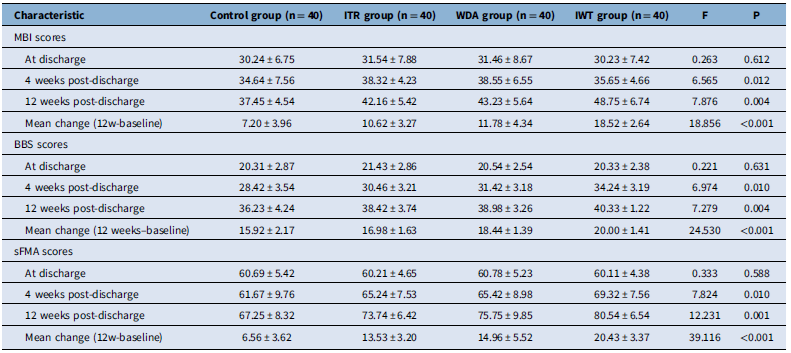
Table 2 shows the comparison of MBI, BBS and sFMA scores across the four groups. At discharge, there were no significant between-group differences (MBI: P = 0.612; BBS: P = 0.631; sFMA: P = 0.588), confirming comparable baseline levels. Within-group analyses showed that all four groups improved significantly from discharge to 12 weeks (all P < 0.05). However, the magnitude of improvement differed across groups. By 4 weeks, the intervention groups (ITR, WDA and IWT) performed significantly better than the control (MBI: P = 0.012; BBS: P = 0.010; sFMA: P = 0.010). By 12 weeks, differences were more pronounced (MBI: P = 0.004; BBS: P = 0.004; sFMA: P = 0.001). In addition, mean change analyses (12 weeks–baseline) showed that the IWT group had the greatest functional gains (MBI: 18.52 ± 2.64; BBS: 20.00 ± 1.41; sFMA: 20.43 ± 3.37), exceeding both WDA and ITR, while the control group showed the smallest improvement (all P < 0.001). The temporal changes in MBI, BBS and sFMA scores across the four groups are presented in Figure 1.
Changes in functional outcomes across the four groups over 12 weeks. (A) Modified Barthel Index (MBI), (B) Berg Balance Scale (BBS) and (C) Simplified Fugl–Meyer Assessment (sFMA) scores measured at discharge, 4 weeks and 12 weeks post-discharge. Data are presented as mean ± SD.

Comparison of MBI, BBS and sFMA scores among the four groups

Note: ITR = internet-based tele-rehabilitation; WDA = wearable-device-assisted; IWT = Internet-Based and Wearable-Device Training; MBI = Modified Barthel Index 2; BBS = Berg Balance Scale; sFMA = simplified Fugl-Meyer Assessment.
P < 0.05 represents statistical significance.
Comparison of HAMA, HAMD and MMSE scores among the four groups
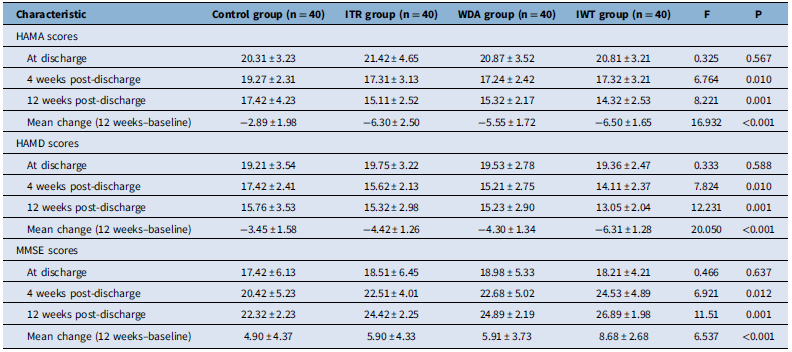
Table 3 presents the comparisons of psychological and cognitive outcomes. At discharge, no significant between-group differences were observed (HAMA: P = 0.567; HAMD: P = 0.588; MMSE: P = 0.637). Within-group analyses showed significant improvements in all groups from discharge to 12 weeks (all P < 0.05). Between-group comparisons demonstrated that by 4 weeks, the intervention groups performed better than the control (HAMA: P = 0.010; HAMD: P = 0.010; MMSE: P = 0.012), and differences became more pronounced at 12 weeks (HAMA: P = 0.001; HAMD: P = 0.001; MMSE: P = 0.001). Additionally, mean change scores confirmed that the IWT group had the largest reduction in HAMA (–6.50 ± 1.65, P < 0.001) and HAMD (–6.31 ± 1.28, P < 0.001), as well as the largest improvement in MMSE (+8.68 ± 2.68, P < 0.001), followed by the WDA and ITR groups, while the control group showed the smallest changes. Figure 2 illustrates the longitudinal trends in HAMA, HAMD and MMSE scores across the four groups.
Changes in psychological and cognitive outcomes over 12 weeks among the four groups. (A) Hamilton Anxiety Scale (HAMA), (B) Hamilton Depression Scale (HAMD) and (C) Mini-Mental State Examination (MMSE) scores measured at discharge, 4 weeks and 12 weeks post-discharge. Data are presented as mean ± SD.

Comparison of HAMA, HAMD and MMSE scores among the four groups

Note: ITR = internet-based tele-rehabilitation; WDA = wearable-device-assisted; IWT = Internet-Based and Wearable-Device Training; HAMA = Hamilton Anxiety Scale; HAMD = Hamilton Depression Scale; MMSE = Mini-Mental State Examination.
P < 0.05 represents statistical significance.
Comparison of ZBI scores for caregiver burden among the four groups
As shown in Table 4, baseline ZBI scores did not differ significantly among the groups (P = 0.423). Within-group analyses revealed that caregiver burden decreased significantly in all groups from discharge to 12 weeks (all P < 0.05). Between-group differences appeared by 4 weeks (P = 0.006) and were more evident at 12 weeks (P = 0.001). Mean change analyses showed that the IWT group achieved the largest reduction in ZBI (–26.94 ± 4.11, P < 0.001), significantly greater than the WDA (–22.78 ± 6.79), ITR (–20.55 ± 2.75) and control (–12.16 ± 3.40) groups. Figure 3 depicts the declining trend in ZBI scores across the four groups throughout the 12-week intervention period.
Changes in caregiver burden over 12 weeks among the four groups. Zarit Burden Interview (ZBI) scores were assessed at discharge, 4 weeks and 12 weeks post-discharge. Data are presented as mean ± SD.

Comparison of ZBI scores for caregiver burden among the four groups

Note: ITR = internet-based tele-rehabilitation; WDA = wearable-device-assisted; IWT = Internet-Based and Wearable-Device Training; ZBI = Zarit Burden Interview.
P < 0.05 represents statistical significance.
Discussion
Stroke is a neurological condition that stands as a leading cause of long-term disability worldwide, affecting motor function, balance, psychological well-being and cognitive abilities. Reference Abd Elsabour, Zakaria and Fahmy31 Our study showed that combining ITR with WDA training led to the most significant improvements in functional recovery, psychological well-being, cognitive function and caregiver burden among stroke patients after hospital discharge.
Functional recovery after stroke is critical for regaining independence in ADL and improving balance and motor function (32). Sarfo et al. have reported that tele-rehabilitation improves motor function, balance and ADL by providing structured, therapist-supervised rehabilitation programs remotely. Reference Sarfo, Ulasavets, Opare-Sem and Ovbiagele33 Additionally, wearable devices, such as functional electrical stimulators and motion sensors, have been shown to enhance motor learning and gait performance. Reference Park, Jung, Lee, Shin, Lee and Lee34,Reference Díaz, Stephenson and Labrador35 Toh et al. Reference Toh, Fong, Gonzalez and Tang16 have found that stroke patients using wearable gait training devices exhibited significant improvements in postural stability and ambulation compared to conventional rehabilitation alone. Our findings align with previous studies on tele-rehabilitation and wearable devices and further demonstrate that integrating both strategies yields greater functional gains, with improvements in the IWT group exceeding established minimally clinically important difference (MCID) thresholds: MBI (Δ18.5 vs. MCID ≈ 9), Reference Ohura, Hase, Nakajima and Nakayama24 BBS (Δ20.0 vs. MCID ≈ 12.5) Reference Mishra, Sudheer, Agarwal, Nilima, Srivastava and Vishnu36 and sFMA (Δ20.4 vs. MCID ≈ 16.4). Reference Mishra, Sudheer, Agarwal, Nilima, Srivastava and Vishnu36 The enhanced outcomes observed in the IWT group may be attributed to the complementary effects of real-time physical feedback from wearable devices and structured rehabilitation guidance from internet-based programs. Reference Burridge, Lee and Turk37,Reference Wang, Liu and Wang38 This dual approach not only optimizes rehabilitation intensity but also ensures patient adherence, which is crucial for achieving functional recovery.
Post-stroke anxiety and depression are common and often negatively impact rehabilitation adherence and patient outcomes. Reference Almhdawi, Alazrai and Kanaan39 Previous research suggests that structured rehabilitation programs incorporating therapist guidance and patient education can help reduce psychological distress. Reference Winstein, Stein and Arena6 Nuara et al. Reference Nuara, Fabbri-Destro, Scalona, Lenzi, Rizzolatti and Avanzini40 have reported that remote rehabilitation programs with interactive components foster patient engagement, enhance motivation and reduce feelings of isolation, which are key factors in alleviating anxiety and depression. Our study found significant reductions in HAMA and HAMD scores across all intervention groups, with the IWT group showing the most pronounced improvements that exceeded MCID thresholds for both HAMA (Δ−6.5 vs. ≈2–3) and HAMD (Δ−6.3 vs. ≈2–3). Reference Leucht, Fennema, Engel, Kaspers–Janssen, Lepping and Szegedi41 The IWT group’s superior psychological outcomes may be due to the interactive and dynamic nature of the intervention, which keeps patients actively involved in their recovery while providing real-time therapist feedback and progress monitoring. Reference Li, Martinez and Aiswarya42 Additionally, our study found significant improvements in cognitive function, with the IWT group showing the greatest MMSE gains (Δ+8.7), which exceeded the published MCID range (≈1–3 points). Reference Lestari, Mistivani, Rumende and Kusumaningsih43 This finding suggests that structured rehabilitation programs incorporating cognitive engagement elements may have neuroprotective effects and enhance cognitive recovery in stroke survivors.
Caregivers play a critical role in supporting stroke survivors, but their burden often increases as patients struggle with functional limitations, psychological distress and cognitive decline. Reference Handayani, Kusumaningrum and Dwidiyanti44 It is reported that tele-rehabilitation not only benefits patients but also alleviates caregiver burden by promoting patient independence and reducing the need for constant supervision. Reference Paul, Thomson and Asibey45 In our trial, the ZBI improvement in the IWT group (Δ−26.9) far exceeded the reported MCID of ≈5–7 points. Reference Hébert, Bravo and Préville46 The finding in our study may be attributed to improvements in patient mobility, psychological well-being and self-care abilities, all of which contribute to reduced dependency on caregivers. Reference Pereira, Greenwood and Jones47,Reference Pierce, Thompson, Govoni and Steiner48 This finding underscores the potential for tele-rehabilitation programs to not only improve patient outcomes but also enhance the well-being of caregivers, ultimately leading to a more sustainable home care environment for stroke survivors.
Despite the promising findings, this study has several limitations. First, the follow-up period was limited to 12 weeks, which may not fully capture the long-term effects of these interventions. Future studies should incorporate extended follow-up assessments to determine whether the observed benefits persist over time. Second, our study population consisted of first-onset stroke patients with stable cognitive function, limiting the generalizability of the findings to patients with recurrent strokes, cognitive impairment or multiple comorbidities. Further research should explore the effectiveness of these interventions in more diverse stroke populations. Third, although demographic and comorbidity data were collected, key clinical variables – including stroke onset time, hospital stay, initial severity and pre-stroke function – were not systematically recorded, limiting adjustment for baseline heterogeneity. Future studies should include these measures to better capture recovery trajectories and intervention effects. Fourth, adherence to the rehabilitation program was not systematically analyzed, making it unclear how patient engagement influenced rehabilitation outcomes. Future studies should incorporate objective adherence tracking to better understand the relationship between intervention compliance and rehabilitation success. Finally, the total rehabilitation time and intensity differed among groups, particularly as the IWT group received both ITR guidance and WDA training. Therefore, it is difficult to fully disentangle whether the superior outcomes observed in the IWT group were attributable to the specific effects of tele-rehabilitation and wearable devices or to the greater overall rehabilitation exposure. Future studies should employ time-matched or dose-controlled intervention designs to clarify these causal relationships.
Conclusion
This study demonstrates that both ITR and WDA rehabilitation significantly improve functional, psychological and cognitive outcomes in stroke patients after hospital discharge, with the combined intervention providing the most substantial benefits. The findings highlight the potential for integrating tele-rehabilitation strategies into post-stroke management, offering a scalable and patient-centered approach to recovery. Future research should focus on optimizing adherence strategies, assessing long-term efficacy and expanding the applicability of these interventions to diverse stroke populations.
Availability of data and material
All data generated or analyzed during this study are included in this article. Further enquiries can be directed to the corresponding author.
Acknowledgments
Not applicable.
Author contributions
CL is responsible for the study design, definition of intellectual content, literature research, clinical studies, experimental studies, data acquisition and analysis, statistical analysis, manuscript preparation, and editing and review; YHX is responsible for the guarantor of integrity of the entire study, study concepts and design, definition of intellectual content, and manuscript review; YJW is responsible for the study design, definition of intellectual content, literature research, clinical studies, experimental studies and data acquisition; HJ is responsible for the clinical studies, experimental studies and data acquisition. All authors read and approved the final manuscript.
Funding statement
This study was funded by the Chongqing Key Project of Technological Innovation and Application Development Special Program (cstc2019jscx-gksbX0023).
Competinginterests
There are no potential conflicts of interest to disclose.
Ethics approval and consent to participate
The study was conducted in accordance with ethical guidelines, and written informed consent was obtained from all participants before enrollment. Ethical approval was granted by the Ethics Committee of the Affiliated Rehabilitation Hospital of Chongqing Medical University (Approval No. 2022 Lunshenpi No. 9). This trial was registered in the Chinese Clinical Trial Registry (ChiCTR) under the registration number ChiCTR2500099442.
Consent for publication
Not applicable.