Implanted cardiac devices decrease cardiac symptoms, improve tolerance to exercise, and lengthen patients’ lives and but despite great advancements in cardiac device technology, long-term consequences of carrying a device especially in the paediatric population remain unknown. As there are fewer paediatric patients than adults with cardiac devices, the literate concerning the psychosocial effects of the device are limited and a majority of the literature has been conducted in the adult population. But differences in the underlying cardiac disease, patient size, the psychosocial aspects of adolescence differentiate paediatric device patients from adults and results from adult studies should not be generaliaed to the paediatric population.
Implanted devices may be a pacemaker or an implantable cardioverter defibrillator. Both devices have the same physical specifications. A battery is placed subcutaneously or submuscular either into the abdomen or left axilla and is connected to the heart with one or more electrodes. These electrodes carry the electric impulse to the heart. Reference Park1 While pacemaker’s deliver impulses continuously to establish a proper cardiac rhythm, implantable cardioverter defibrillator’s monitor the rhythm of the heart and when it senses an abnormal rhythm it delivers high voltage energy to heart in order to abolish arrhythmia. Underlying diseases for device implantation vary in large spectrum. These patients may have an implanted device due to postoperative complete atrioventricular block after congenital heart surgery or a high-risk channelopathy for primary or secondary prevention of sudden death. Reference Epstein, DiMarco and Ellenbogen2 In addition to the implantation procedure, interventions related with the underlying disease is another burden such as expectation of high voltage delivery (shock), changes in life style, avoidance of injury to the device, and regular follow ups and hospital visits that interfere daily activities. Reference Wang, Hay, Clarke and Menahem3–Reference Alkan, Sertcelik, Yalin Sapmaz, Eser and Coskun5
These chronic conditions may lead to mental health problems and disturb quality of life. For the adult population with implantable cardioverter defibrillators or pacemakers, anxiety and depression are well studied pathologies. In a systemic review anxiety and/or depression was reported as 20% in the pacemaker population. Reference Magyar-Russell, Thombs and Cai6 In another study, 22% of all patients with implantable cardioverter defibrillators had at least one psychological problem with adjustment disorder and depression being the most common. Reference Aydemir, Ozmen and Kuey7 Studies have also shown quality of life to be disturbed in both implantable cardioverter defibrillator and pacemaker population, especially in physical quality of life Reference Mlynarska, Mlynarski and Golba8,Reference Barros, Carvalho, Silva and Borges9 but in particular in those receiving shock. Reference Rhodes, Murray, Tichnell, James, Calkins and Sears10
There are very few studies in the paediatric population looking at the psychosocial effects of both pacemakers and implantable cardioverter defibrillators and the results are conflicting. One study showed that children with implantable cardioverter defibrillators have the same levels of anxiety and depression as the healthy population. However, in these patients physical and social functions were found to be worse when compared to the healthy population. Reference DeMaso, Lauretti and Spieth11 Whereas Webster et al reported that patients with implantable cardioverter defibrillators have a higher risk of psychological disease than patients with pacemakers and higher levels of anxiety than the normal population. They also stated that there were no significant changes in depression between those with devices or the healthy controls. Reference Webster, Panek and Labella12
Resilience in these patients remain unknown. Resilience is the ability to cope with stress. Reference Sapienza and Masten13 A resilient person can continue their normal life after a negative situation and have a positive outcome after this. However, establishing resilience can differ within different situations and populations. Higher resilience can have a positive effect on the patient’s life. Because of this, many studies have been conducted to identify levels of resilience in patients with chronic illnesses and ways to establish it. In most of the studies higher levels of resilience have been shown. Reference Masten14–Reference Cicchetti17
The aim of the study was to evaluate quality of life, the presence of psychological pathologies and resilience levels of implantable cardioverter defibrillator and pacemaker bearing children.
Method
A total of 71 patients with an implanted implantable cardioverter defibrillator or pacemaker and a control group consisting of 62 healthy children matched for age and sex were included in the study. Demographics and information concerning the implanted device and the duration of the device, number of procedures and age at implantation were obtained from hospital records. In addition to this data patients school attendance, family size and family education were asked. Pediatric Quality of Life Scale, Connor–Davidson Resilience Scale, Brief Symptom Inventory were applied to parents and patients.
Pediatric Quality of Life Scale is a questionnaire developed by Warni et al in 1999. It was established to evaluate life quality. It also gives additionally information about physical and physicosocial health, emotional, school, and social functioning. Number and type of question depends on the patients age. Questionnaires for four age groups (2–4, 5–7, 8–12, 13–18) have been established. Between ages 2–4 questions can be only answered by parents, whereas for the other age groups it can be completed by either children or the patient. Reference Varni, Seid and Kurtin18,Reference Ravens-Sieberer, Karow, Barthel and Klasen19 The Turkish translation and reliability and validity studies were conducted by Memik et al and Uneri et al. Reference Uneri, Agaoglu, Coskun and Memik20–Reference Memik, Aǧaoǧlu and Coskun22
Connor–Davidson Resilience Scale was developed by Connor and Davidson in 2003 to evaluate resilience in children. It consists of 25 questions each have 5 different answers which has a different point of 0–5. Higher points mean higher resilience. Reference Connor and Davidson23 Turkish translation and reliability and validity studies were conducted by Karaırmak et al. Reference Karairmak24
Brief Symptom Inventory is a simplified version of the Symptom Check List-90. In was developed by Derogatis et al in 1993. From 90 questions, 53 of them were selected during this process. It was shown as a reliable tool to detect psychological problems associated with various medical problems. Answers vary from never to always. Participants were asked to answer these questions according to their last week. Analysis is made in the areas of anger, somatisation, anxiety, depression, and negative sense of self. Reference Derogatis and Melisaratos25 The Turkish translation and reliability and validity studies were conducted by Sahin et al. Reference hisli sahin and Batıgün26
While all three questionnaires were given to participants between ages of 13–18 years and completed by the adolescent, only Pediatric Quality of Life Scale was given to those between the ages of 2–13 years and were completed by the parents. Informed consent was obtained from all participants. During the application of the questionnaires a member of the research group was present. The study was approved by the institutional review board at Hacettepe University (GO 17/477-21).
Statistical analysis was made using SPSS 20 software. Variability of the results was assessed with Kolmogorov–Smirnov test. Numeric variables with a normal distribution were shown as mean and standard variation while numeric variables without a normal distribution were shown as min–max. To evaluate variables associated with different risk groups, T tests and Mann–Whitney U tests were used. In risk categories with three variables, Analysis of Variance and Kruskal–Wallis H tests were used. To evaluate categoric data, Chi-Square Tests were used.
Results
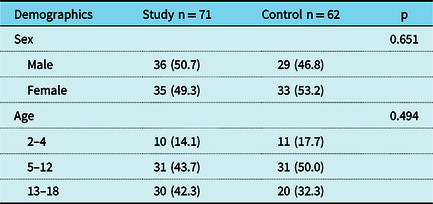
A total of 71 patients (36 male) were enrolled in the study group. There was almost equal distribution between ages of 5–12 years and 13–18 years (31 versus 30), and 10 of these patients were between 2–4 years. Mean age was 11.08 ± 4.86 (2–18). A control group was established with 62 health children whose age and sex was similar to the study group (Table 1).
Distribution of age and sex.

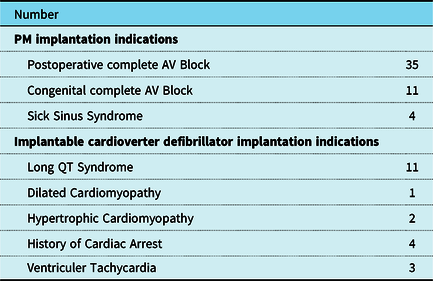
The implanted device was an implantable cardioverter defibrillator in 21 patients (29.5%) and pacemaker in 50 patients (70.5%). Thirty-three of these devices were implanted via the transvenous route and 38 of them were implanted with surgical epicardial route. Eight of the 21 patients who had an implantable cardioverter defibrillator received at least one shock therapy during the last year. Mean number of shocks in the last year was 21.86 ± 28.41 (0–73). Indications of device implantation are shown in Table 2.
Implantation indications for the devices.

Fifty-two patients (73%) attended school. Only 12.6% of them had a sibling who had a heart disease (n = 9) while 4 of them had additional device bearing relatives.
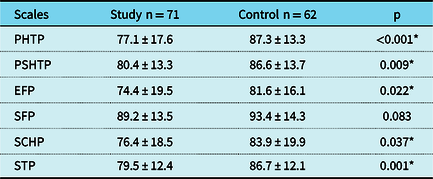
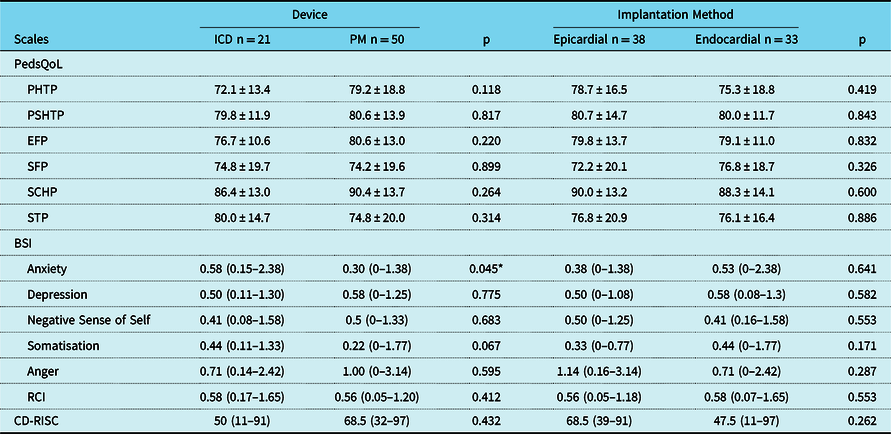
When patients were evaluated with the Pediatric Quality of Life Scale, physical health, psychosocial health, and emotional functioning points were found to be significantly lower than that of the control group (Table 3). Factors effecting quality of life were also studied, these groups were compared in respect of age, gender, health history, family size, and educational level (both parents and family). There was no risk factor leading to lower levels of life quality except carrying the device. Additionally, type of device and implantation had no effect on quality of life (Table 4).
PedQoL results.

EFP: Emotional functioning total point, PHTP: Physical health total point, PSHTP: Phychosocial health total point, SCHP: School functioning total point, SFP: Social functioning total point, STP: Scale total point
Scale results between devices and implantation method

BSI: Brief symptom inventory, CD-RISC: Connor–Davidson Resilience Scale, EFP: emotional functioning total point, ICD: Implantable Cardioverter Defibrillator, PedsQoL: Pediatric Quality of Life Scale, PHTP: Physical health total point, PM: Pacemaker, PSHTP: Psychosocial health total point, SCHP: School functioning total point, SFP: Social functioning total point, STP: Scale total point, RCİ: BSI total point
Nine patients had a sibling who had an implanted device (implantable cardioverter defibrillator or pacemaker), their quality of life measurements and social functioning points were significantly lower than patients who had no sibling with a device (Scale total point 71.2 ± 15.4 versus 80.6 ± 11.6 p = 0.032) (Social functioning point 76.1 ± 23.7 versus 91.1 ± 10.3 p = 0.001).
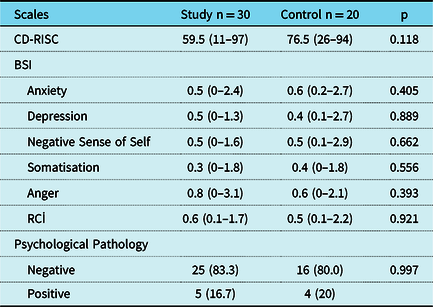
Using the Connor–Davidson Resilience Scale there was no difference when study and control group were compared in respect of resilience. Additionally, no difference in resilience was found between type of device (Tables 4 and 5).
BSİ and CD-RISC results

BSI: Brief symptom inventory, CD-RISC: Connor–Davidson Resilience Scale, RCİ: BSI total point
According to the Brief Symptom Inventory evaluation, the number of patients with symptoms of anxiety, depression, negative sense of self, somatisation, and anger were not different from the control group (Table 5).
We found statistically different levels of anxiety between types of devices. Implantable cardioverter defibrillator patients had a higher mean anxiety score of 0.58 (0.15–2.38) when compared to pacemaker patients who had a mean anxiety score of 0.30 (0–1.38) (p = 0.045). In patients bearing implantable cardioverter defibrillator, 38% of them (n = 8) had at least one shock treatment in the last year. The mean number of shocks received in the last year was 21.86 ± 28.41 (0–73). The Brief Symptom Inventory scores of patients who received shock was compared with those that did not and we found that the somatisation subscale was significantly higher in the shock population (0.17 versus 0.44 p = 0.022).
Discussion
Intracardiac devices are lifesaving therapeutic devices and in spite of their technical advances long-term psychosocial affects in children are less known. The aim of this study was to evaluate life quality, resilience, and psychiatric pathologies in intracardiac device bearing children. The main result of our study was that lower quality of life was observed in device bearing patients irrespective of the type of device and higher levels of anxiety were seen in those with implantable cardiac devices.
The quality of life studies in adults with pacemakers are conflicting. While some studies have shown improvement, some studies have shown deterioration. A study by Barros et al in adults showed that life quality deteriorates after the implantation but emotional and social quality improves. Reference Barros, Carvalho, Silva and Borges9 As we expected, patients in this study had a lower life quality in terms of physical, social, school functioning, and emotional functioning validating concerns with regard to this patient population. Similar to our results, a systemic review looking at quality of life in paediatric-specific intracardiac device bearers also demonstrated lower quality of life compared with healthy controls. Reference Pyngottu, Werner, Lehmann and Balmer27
Research in other chronic cardiac diseases also show the same effect on quality of life. Wilmot et al showed negative effects on emotional and social areas in patients with heart failure. Reference Wilmot, Cephus, Cassedy, Kudel, Marino and Jefferies28 A study by Bratt et al stated that CHD patients who lived through childhood and moved to adult life have a lower quality of life especially in emotional area. They also stated that mild disease means lower decline in quality of life. Reference Bratt, Luyckx, Goossens, Budts and Moons29
Not surprisingly, the quality of life was worse in patients who also had a sibling with a device. This is a comprehensible result as the burden of having more than one child requiring an intracardiac device increases the psychosocial load on the family placing this vulnerable population at greater risk for lower quality of life.
When comparing devices in the present study implantable cardioverter defibrillator bearing patients had higher levels of anxiety than patients bearing pacemakers. Implantable cardioverter defibrillator is a device that transmits shock to the heart when it detects an arrhythmia. This unpredictable shock is painful. So, the constant fear of receiving a shock is common in patients. The systemic review by Pyngottu et al similarly reported pacemaker bearers to have no significant difference with respect to anxiety and depression symptoms, while implantable cardioverter defibrillator patients showed more signs of anxiety than depression. Reference Pyngottu, Werner, Lehmann and Balmer27 Kikkenborg Berg et al and Qintar et al showed that implantable cardioverter defibrillator patients have higher levels of anxiety in adult population. Reference Qintar, George and Panko30,Reference Kikkenborg Berg, Caspar Thygesen, Hastrup Svendsen, Vinggaard Christensen and Zwisler31 These studies also showed that if the patient had received a device shock recently their anxiety level was higher.
We also found higher levels of somatisation with higher numbers of device shock, which to the best of our knowledge was not previously shown. Somatisation is the tendency to experience psychological distress in the form of somatic symptoms. These patients tend to seek medical help for these somatic symptoms. Higher somatisation rates mean higher rates of somatic symptoms due to psychological distress. These unexplained medical symptoms will lead to disability in patients, excess use of medical services, and frustration in both patients and physicians. Reference Al Busaidi32 Again, this result can be expected as studies looking at somatisation in children have shown that in many cases a physical illness or disorder precipitates the somatising disorder. Reference Garralda33 Higher levels of somatisation may be due to the constant fear of receiving device shock, as experiencing this painful experience may lead to psychological distress which in turn may trigger somatisation.
We found no difference in psychological pathologies between the study and control group using Brief Symptom Inventory, which was applied to the adolescent population only. There are few studies in patients with cardiac devices or arrhythmias concerning psychological pathologies. The most commonly studied pathology has been Long QT Syndrome. A majority of studies have shown increased levels of anxiety and anger. Reference Waddell-Smith, Ertresvaag and Li34–Reference Hamang, Eide, Rokne, Nordin, Bjorvatn and Øyen36 Similarly, a study evaluating psychosocial factors in children with implantable cardioverter defibrillators also showed that anxiety and depression were not increased. In their study DeMaso argued that these low scores could reflect a sense of security leading to lower levels of depression and anxiety after receiving the device. Reference DeMaso, Lauretti and Spieth11
To the best of our knowledge, this was the first study to look at resilience in children and adolescents with a cardiac device. Although many studies have shown higher resilience in children with chronic diseases, Reference Evers, Kraaimaat, Geenen, Jacobs and Bijlsma37–Reference Noll, Vannatta, Koontz, Kalinyak, Bukowski and Davies39 we found no difference in resilience compared to the healthy controls. A study looking at resilience in adolescents with CHD compared resilience in a group with mild verses severe disease. They showed that the higher the severity of CHD, the lower the level of resilience. Reference Moon, Song and Huh40
Our patient population had a wide range a device implications ranging from mild to severe cardiac pathologies. Differences in disease severity may have an effect on resilience. Unfortunately, secondary to inadequate sample size, we were unable to make comparisons of resilience between patients with different implications for cardiac devices.
This study has several strengths, primarily it evaluated a cohort of both implantable cardioverter defibrillator and pacemaker bearing children and adds to the paucity of literature regarding this subject. The sample was comprised of children and adolescents with a variety of device indications and therefore more likely to accurately capture a wider range of this vulnerable patient population. However, the study also has certain limitations. Our main limitation was the small number of participants in the study, which may have limited our power to detect differences in levels of depression and anxiety that may have been clinically relevant, as well as limiting generalisability. Although the assessment tools used in this study are well validated and widely used, they were all self-report, which can introduce biases. Furthermore, measures were not collected at the same time after device implantation for each case, as the amount of time that passed after the device was inserted was not standard this may have affected the results. Finally, data was only collected once, evaluating the patient before and after device implantation may show a difference in device-related psychosocial functioning.
In conclusion, our study shows that quality of life is significantly affected in patients with cardiac devices especially in the areas of physical, psychosocial health, emotional, and school functioning. Additionally, patients with implantable cardioverter defibrillators have higher levels of anxiety and higher levels of somatisation with higher numbers of device shock. These findings support the notion that patients with cardiac devices should receive psychosocial support and particular attention should be given to implantable cardioverter defibrillator bearing children and those families when more than one child is affected. Cardiologists working with implantable cardioverter defibrillator bearing children should also be aware of higher levels of somatisation in these patients.
Acknowledgements
None.
Financial support
This research received no specific grant from any funding agency, commercial or not-for-profit sectors.
Conflicts of interest
None.
Ethical standards
The procedure conformed to the guidelines of the local ethical committee. Informed consent was obtained from the parents.