


Significant outcomes
-
∙ Both men and women engaging in extreme or high-risk sports had higher scores of bipolarity, measured by the Mood Disorder Questionnaire, and on most subscales of impulsivity, measured by the Barratt Impulsiveness Scale (BIS-11), than control persons who had declared themselves as not involved into such activities.
Limitations
-
∙ Web-based method, the risk of selection and recall bias, heterogeneity of experimental population.
Introduction
‘Extreme’ or ‘high-risk’ are terms used to describe a wide range of activities, such as parachuting, rock climbing, or mountain biking, since miscalculations or accidents during these activities may result in serious bodily injury or even death (Reference Brymer1). In recent years, the number of persons involved into extreme or high-risk sports has been markedly growing. Theoretical perspectives on extreme sport participation describe important relationship between sport engagement and risk taking. However, recent studies have demonstrated other important factors may underlie motivation to participate in high-risk sports, including goal achievement, overcoming fear, search for freedom, connecting with the natural environment and obtaining pleasurable kinesthetic bodily sensations (Reference Kerr and Mackenzie2,Reference Brymer and Schweitzer3).
Temperament and personality features have been examined in persons that engage in extreme or/and risk taking sports. The excitement- or thrill-seeking associated with risk-taking during these sport activities has been showed to be associated with higher scores in sensation-seeking and arousal-seeking scales (Reference Straub4–Reference Freixanet7). It was also found that personality features of sensation seeking have been linked to biological traits of impulsivity (Reference Nower and Blaszczynski8). Therefore, a possible link between impulsivity and engagement into high-risk or extreme sports has been suggested (Reference Svebak and Kerr9,Reference Young, Eklund, Tenenbaum, Glueckauf and Thompson10). However, the results from these studies have been mixed. While some early research suggests that impulsivity is associated with preference for extreme sports (Reference Svebak and Kerr9), subsequent studies have shown that high-risk sportsmen may be attracted by an increased sense of control over their activities (Reference Llewellyn and Sanchez11). Nevertheless, the label ‘risk-taking behaviour’ encapsulates both deliberate risk-taking (Reference Woodman, Barlow, Bandura, Hill, Kupciw and Macgregor12), and tendency towards engaging in precautionary behaviours, that is in activities minimising such a risk (Reference Young, Eklund, Tenenbaum, Glueckauf and Thompson10).
In recent years, an association between impulsivity and bipolar disorder has been demonstrated. Bipolar patients score higher on impulsivity compared with healthy population and increased impulsivity may be an endophenotype for bipolar I disorder since it remains in remitted patients (Reference Strakowski, Fleck and Delbello13–Reference Lombardo, Bearden and Barrett15). Increased impulsivity in bipolar patients may be connected with risk-taking behaviour. In a paper on the expressions of the bipolar spectrum in daily life, Walsh et al. (Reference Walsh, Royal, Brown, Barrantes-Vidal and Kwapil16) have suggested that disruptive or risky behaviours as well as engaging in exciting activities are closely associated with features of bipolar mood disorder spectrum (bipolarity). Consequently, Hidiroglu et al. (Reference Hidiroglu, Demirci Esen and Tunca17) proposed that risk taking can make an endophenotype for bipolar disorder.
We hypothesised that male and female subjects engaged in extreme or high-risk sports would score higher on the features of both bipolarity and impulsivity. To examine this, we performed a web-based, case-control study comparing the large groups of subjects engaged in extreme or high-risk sports compared with age-matched control subjects who had declared themselves as not involved in such activities.
Subjects and methods
Participants
Following institutional ethical approval by the Bioethics Committee of Jagiellonian University in Cracow, 715 persons (480 cases and 235 controls) were recruited into the study. In the experimental group (extreme or/and high-risk sport subjects) there were 255 males and 225 females, aged 26±6 years. Of them, 58% had higher education and 51% were married or in partnership. The cases were recruited among the subscribers of extreme or high-risk sport social networks and fan pages on the Polish Facebook. They were questioned as to which kind of sports they have been practicing, and for how long. Subjects’ responses for types of extreme or/and high-risk sports were diverse. The most frequent among men was rock climbing, mountaineering, bouldering, diving, free-ride skiing and free-ride biking, snowboarding, windsurfing and mountain biking (downhill and off-road). Among women, the most common were the following: rock climbing, mountaineering, bouldering, snowboarding, mountain biking, parachuting, equestrianism, bungee jumping, diving and free-running. Many subjects were engaging in several extreme or/and high-risk sports, however, at least one sport practicing by our participants met the criteria of the ‘activity of increased risk’. Due to the diversity of the definitions of the extreme/high risk sports, the conceptualisation applied in the study has been supplemented by the list of extreme/high-risk sports relevant to Polish insurance companies (e.g. Ergo Hestia, www.ergohestia.pl). In each participant, the minimal time period for practicing at least one of such sports was 3 years.
In the group of healthy control persons there were 107 males and 128 females, aged 28±9 years. Of them, 58% had higher education and 59% were married or in partnership. The control sample consisted of web users who had declared themselves as not involved into the activities of extreme or high-risk sports. Among them, 54.2% had been practicing some non-extreme or low-risk sports.
The study design
We performed a web-based case-control study. The survey was conducted online using the Google Forms. The responses were collected using the Google Docs spreadsheet, from the cases and the controls, separately. Apart from the socio-demographic questionnaire, the forms included the Mood Disorder Questionnaire (MDQ) (Reference Hirschfeld, Williams and Spitzer18) and the Barratt Impulsiveness Scale (BIS-11) (Reference Patton, Stanford and Barratt19).
Psychometric measures
The MDQ (Reference Hirschfeld, Williams and Spitzer18) was used for the assessment of bipolarity features. The validation of the Polish version of MDQ has been described previously (Reference Kiejna, Pawłowski and Dudek20). The symptomatic part of the MDQ contains 13 hypomanic symptoms, and the cut-off point for bipolarity has been established as the presence of seven or more symptoms. In our present study, we decided to take only the symptomatic parts of these scales into account. The part of scale assessing deficiency of functioning during hypomania is problematic, since the majority of patients do not acknowledge such a deficiency and some even voice an improvement of such functioning.
The BIS-11 (Reference Patton, Stanford and Barratt19) was used in order to assess impulsive behaviours. This self-report questionnaire is composed of 30 items answered on a 4-point Likert scale (Rarely/Never – 1, Occasionally – 2, Often – 3, Almost Always/Always – 4): 4 indicates the most impulsive response, which means the higher summed score for all items or for particular scale, the higher the level of impulsiveness. In order to minimise the risk of response bias, 10 of the items are scored reversely (Rarely/Never – 4, Occasionally – 3, Often – 2, Almost Always/Always – 1). The scale measures the three subtraits of impulsivity: attentional (8 items; inattention and cognitive instability), motor (11 items; motor impulsivity and lack of perseverance), and nonplanning (11 items; lack of self-control and intolerance of cognitive complexity). The BIS-11 has been validated in the Polish population (Reference Grzesiak, Beszłej and Szechinski21).
Statistical methods
All calculations were performed using the Statistica v.10 software. Chi-square test was used to analyse differences between categorical variables, and the differences in the mean MDQ and BIS-11 scores were assessed with the analysis of variance. Correlations between the BIS-11 and the MDQ scores were examined by using the Spearman’s rank analysis. The level of statistical significance was determined at p<0.05.
Results
In Table 1, the mean values of MDQ are given as well as percentage of patients ≥7 points in experimental and control group.
Mean values of MDQ and percentage of subjects ≥7 points in experimental and control group

MDQ, Mood Disorder Questionnaire.
Difference between athletes and controls significant: *p<0.01; **p<0.001 [analysis of variance (ANOVA)]; #p=0.02; ##p<0.001 (χ2).
The mean values of MDQ were significantly higher in experimental group, both in male and in female persons. The athletes had also significantly higher percentages of subjects scoring ≥7 points on the MDQ, suggesting presence of the bipolarity features, and this was observed in total group and male and female subgroups.
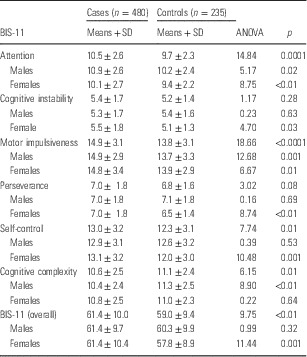
In Table 2, the scores of impulsiveness scales (BIS-11) are presented. The analysis showed that extreme athletes have significantly higher scores on most of the impulsiveness subscales. Such significant difference in the whole group was for attention, motor, self-control, cognitive complexity and the total score. In male patients such difference pertained to attention, motor and cognitive complexity and in females for attention, cognitive instability, motor, perseverance, self control and the total score.
The scores of impulsiveness scales (BIS-11): the values are given as mean±SD

ANOVA, analysis of variance; BIS-11, Barratt Impulsiveness Scale.
Cases: males, n=255; females, n=225; controls: males, n=107; females, n=128.
Correlation analysis performed in the group of extreme athletes revealed significant positive correlations between the MDQ scores and all the BIS-11 subscales, with the exception of cognitive complexity. These differences existed in the total group as well as in both males and females.
Discussion
The results of this study indicate that the positive MDQ scores, indicative for the presence of bipolar features, were more prevalent in the extreme/high-risk athletes of both sexes, as compared to the controls. The cut-off score for a possible bipolarity (≥7 points on MDQ) was obtained in more than 1/3 of both male and female athletes. The prevalence of bipolarity, as measured by the MDQ in our control persons (20%) was similar to the result of 19% obtained in recent study of Korean students (Reference Bae, Kim and Lee22) and to the result of 20% found in our previous research on unipolar depressed patients (Reference Rybakowski, Dudek, Pawlowski, Lojko, Siwek and Kiejna23). However, population studies using the MDQ have demonstrated lower values (Reference Hirschfeld, Calabrese and Weissman24,Reference Carta, Zairo and Saphino25), raising questions about the clinical as a self-report screening scale for bipolar disorder (Reference Zimmerman and Galione26). Nevertheless, the main finding of our study suggest an association between higher bipolarity score and engagement in extreme sports, and this may explain, in part, increased high-risk sport participation in Poland and epidemiological data demonstrating increased bipolar disorder diagnosis in the country (Reference Rybakowski, Suwalska, Lojko, Rymaszewska and Kiejna27).
The extreme or high-risk athletes of both sexes were more likely to exhibit trait impulsivity as suggested by the higher mean total BIS-11 scores. More specifically, they demonstrated more difficulties in focusing attention or concentrating (attention impulsiveness) and planning/thinking carefully (self-control), as well as more likely to act on a ‘spur of the moment’ (motor impulsiveness). There were, however, sex-specific differences between athletes and controls in significantly lower score on cognitive complexity in male subjects and significant higher score on total BIS-11 in female subjects. Overall, these findings confirm our hypothesis linking extreme or high risk sports to high-trait impulsivity.
Finally, the analysis showed that in our experimental group there is a positive correlation between the MDQ scores and all the BIS-11 subscales (except for the factor of cognitive complexity). Such association between bipolarity and impulsivity has previously been observed in clinical populations of bipolar patients (Reference Strakowski, Fleck and Delbello13–Reference Lombardo, Bearden and Barrett15). A lack of correlation between bipolarity and cognitive complexity of the BIS-11 might reflect a differential relationship between sub-traits of BIS-11 impulsivity and cognitive functions (Reference Kam, Dominelli and Carlson28).
The study has important limitations. First, web-based study designs may result in selection biases and residual confounding due to the case-control design. Second, the participant responses to the MDQ and BIS-11 items may have also been affected by recall bias. In the subjects studied, the percentage of those with higher education (58%) was larger than in general Polish population which is about 20% (www.eklandia.pl). Third, the MDQ validity as a diagnostic measure in non-depressed samples is yet to be determined (Reference Carta, Zairo and Saphino25). Fourth, our study samples may not be homogenous, and the experimental group in particular. Importantly, however, at least one sport practicing by our participants met the criteria of increased risk as assessed by Polish insurance companies. Additionally, the minimal time of practicing sport was 3 years, suggesting the activity was well established in experimental subjects and not an intermittent ‘quick thrill’. An important strength of this study is the power to detect differences by including large numbers of participants.
In conclusion, the results of this study strongly indicate that both males and females engaged into extreme or/and high-risk sports have significantly higher scores of bipolarity as measured by the MDQ, and of impulsivity, measured by BIS-11 than age-matched controls.
Acknowledgements
Thanks are due to Dr Judah Weathers, MD, for linguistic consultation of the paper.
Authors contributions: D.D. designed the study and wrote the protocol and the first draft of the manuscript. M.S. designed the study, wrote the protocol and made statistical analyses. K.D., R.J., K.S. and A.C. prepared and managed the database. A.A. prepared the database and made statistical analyses. J.K.R. designed the study and wrote the final version of the manuscript.
Financial Support
None.
Conflicts of Interest
None.
Ethical Standards
The authors assert that all procedures contributing to this work comply with the ethical standards of the relevant national and institutional committees on human experimentation and with the Helsinki Declaration of 1975, as revised in 2008.