INTRODUCTION
Breeding for yield potential and abiotic stress tolerance in tropical maize (Zea mays L.) germplasm is essential to achieve future food security. Breeding in temperate germplasm has nearly doubled grain yields in the past 60 years (Tollenaar & Aguilera Reference Tollenaar and Aguilera1992; Duvick Reference Duvick2005). Tolerance to higher planting densities has contributed to yield increase in temperate germplasm in addition to large genetic gains in yield potential and biotic and abiotic stress tolerance. In the USA, planting densities increased from 3 plants/m2 in 1930 to 8–9 plants/m2 in 2005 (Duvick Reference Duvick2005), in association with yield increases from 2 to 10 t/ha. At the individual plant level, grain yield is typically reduced with increasing planting density as a result of reduced light penetration into the canopy and increased competition for soil resources (Lambert & Johnson Reference Lambert and Johnson1978; Mickelson et al. Reference Mickelson, Stuber, Senior and Kaeppler2002; Ku et al. Reference Ku, Zhao, Zhang, Wu, Wang, Wang, Zhang and Chen2010). Tropical germplasm is generally taller, leafier and has higher leaf area index than temperate germplasm (Johnson et al. Reference Johnson, Fischer, Edmeades and Palmer1986; Lorenz et al. Reference Lorenz, Gustafson, Coors and de Leon2010). As a result of increased inter-plant competition, benefits of higher planting densities might therefore not be the same as in temperate germplasm (Hammer et al. Reference Hammer, Dong, McLean, Doherty, Messina, Schussler, Zinselmeier, Paszkiewicz and Cooper2009). Yamaguchi (Reference Yamaguchi1974) carried out a study with open-pollinated tropical varieties that did not show large changes in grain yield/area when planting density was increased from 2·5 (4·5 t/ha) to 10 plants/m2 (4·96 t/ha). Another more recent study using tropical hybrids and open-pollinated varieties (Monneveux et al. Reference Monneveux, Zaidi and Sanchez2005) showed a decline in grain yield of 4·7 and 10·4% for hybrids and open-pollinated varieties, respectively, when planting density was increased from 5·3 to 10·6 plants/m2. In the years since the development of germplasm, used in these two studies, breeding at the International Maize and Wheat Improvement Center (CIMMYT) has focused (among other traits) on increasing prolificacy (Bolanos et al. Reference Bolanos, Edmeades and Martinez1993), stay green (Banziger et al. Reference Banziger, Edmeades and Lafitte1999), nutrient capture (Banziger et al. Reference Banziger, Edmeades and Lafitte2002) and on reducing shoot dry matter and the interval between anthesis and silking (ASI; Bolanos & Edmeades Reference Bolanos and Edmeades1993). Moreover, line selection was in part carried out under higher planting densities (Bolanos & Edmeades Reference Bolanos and Edmeades1993). It is therefore hypothesized that grain yield could be increased in tropical environments by planting modern tropical hybrids at a planting density higher than the one currently recommended by CIMMYT: for typical tropical germplasm 2–2·2 m tall flowering after 60 days the planting density generally recommended by CIMMYT is 45 000–65 000 plants/ha (as given on the maize doctor website: http://maizedoctor.org/plant-density).
Soil nutrients and water availability largely determine the number of plants that can be supported on a given area of land (Sangoi Reference Sangoi2001; Hammer et al. Reference Hammer, Dong, McLean, Doherty, Messina, Schussler, Zinselmeier, Paszkiewicz and Cooper2009). Optimum planting density is therefore, generally reduced under nitrogen (N) deficient conditions. Several authors (Boomsma et al. Reference Boomsma, Santini, Tollenaar and Vyn2009: average grain yield of 7·8 t/ha; Rossini et al. Reference Rossini, Maddonni and Otegui2011: estimated average grain yield of ~8·4 t/ha) evaluated temperate germplasm under 0 N fertilization at different planting densities typically showing a negative response of grain yield to increased planting density, although soil N levels were not severely depleted as indicated by high average grain yield. To stabilize or even enhance yields in marginal environments or environments with limited fertilizer availability, it will be crucial to know whether grain yield of modern tropical hybrids selected for tolerance to drought and low nutrient availability developed by CIMMYT (Cairns et al. Reference Cairns, Crossa, Zaidi, Grudloyma, Sanchez, Araus, Thaitad, Makumbi, Magorokosho, Banziger, Menkir, Hearne and Atlin2013) show a positive response to increased planting density.
Resources are often limited in the production environments of farmers served by CIMMYT (Banziger et al. Reference Banziger, Setimela, Hodson and Vivek2006) due to lack of fertilizer, either as a result of low income or availability. Therefore, it is often not possible to increase biomass at the plant or the crop level by means of fertilizer inputs to produce higher yields. In environments with limited nutrient availability, harvest index (HI) must be optimized and nutrient use efficiency maximized.
Harvest index the ratio of grain weight to the total above-ground weight, has been taken as a measure of success in partitioning assimilated photosynthate to harvestable product (Sinclair Reference Sinclair1998) and is determined by grain yield and shoot dry weight/unit area. Sufficiently large shoot dry weight acting as a source and the resulting assimilate availability are key for high grain yield. Assimilate availability at flowering and during grain filling will determine the number of ears and kernels formed (Schussler & Westgate Reference Schussler and Westgate1991; Zinselmeier et al. Reference Zinselmeier, Westgate, Schussler and Jones1995; Otegui & Melon Reference Otegui and Melon1997; Edmeades et al. Reference Edmeades, Bolanos, Elings, Ribaut, Banziger, Westgate, Westgate and Boote2000; Otegui & Andrade Reference Otegui, Andrade, Westgate and Boote2000; Boyer & Westgate Reference Boyer and Westgate2004) and determine kernel abortion rate (Cirilo & Andrade Reference Cirilo and Andrade1994; Severini et al. Reference Severini, Borras, Westgate and Cirilo2011), respectively. Adverse environmental conditions (e.g. N deficiency (LN), drought, diseases) limiting source capacity will have detrimental effects on kernel number, kernel weight, ear weight, HI and resulting grain yield (Grassini et al. Reference Grassini, Yang, Irmak, Thorburn, Burr and Cassman2011). Considering limited nutrient availability in CIMMYT's target environments, it is necessary to increase HI towards its eco-physiological limits to maintain yields at limited fertilizer input. Little information is available on HI in tropical germplasm, but previously reported values for tropical landraces ranged from 31 to 39% (Lafitte & Edmeades Reference Lafitte and Edmeades1997), from 14 to 44% for open-pollinated varieties (Yamaguchi Reference Yamaguchi1974; Osaki Reference Osaki1995; Lafitte & Edmeades Reference Lafitte and Edmeades1997) and from 31 to 56% for hybrids (Russell Reference Russell1991; Worku & Zelleke Reference Worku and Zelleke2009). However, it is not known to what levels HI has reached in modern tropical hybrids nor to what extent HI could be improved and contribute to higher grain yield.
Various authors (Yamaguchi Reference Yamaguchi1974; Elings et al. Reference Elings, White and Edmeades1997; Hay & Gilbert Reference Hay and Gilbert2001) have suggested that HI and grain yield in tropical germplasm are sink-limited under optimum conditions. Sink strength could be raised by increasing the number of ears/plant, ear weight or by increasing the number of ears/unit area (Elings et al. Reference Elings, White and Edmeades1997). The number of ears could be improved by increasing planting density. Evaluating lines and hybrids, Liu & Tollenaar (Reference Liu and Tollenaar2009) suggested that in temperate germplasm grain yield increased more strongly than shoot dry weight when planting density was increased from 4 to 12 plants/m2 as a result of heterosis, resulting in higher HI. Moreover Tollenaar & Lee (Reference Tollenaar and Lee2011) showed that HI could be increased in modern temperate germplasm from 52·8 to 53·7% when planting density was increased from 8 to 16 plants/m2. For modern tropical hybrids developed at CIMMYT a similar response to that observed by Tollenaar & Lee (Reference Tollenaar and Lee2011) can be expected, and it can be hypothesized that HI would increase with increasing planting density. To support breeding efforts in tropical maize the current work aimed to (i) assess HI in modern tropical hybrids and (ii) determine the effect of different planting densities on grain yield and HI under well-fertilized (HN) and LN conditions.
MATERIALS AND METHODS
Germplasm evaluated
Twenty-nine tropical elite maize hybrids developed at CIMMYT and five commercial hybrids were evaluated in multi-location trials (Experiment (Expt) 1). In Expt 2, seven tropical hybrids were grown under planting densities of 5, 7, 9 and 11 plants/m2 under HN and LN conditions (Expt 2). Details of the N levels used are given in Table 1. Genotypes included in Expt 2 were: CML247/CML254 (G1; developed in 1995), CML494/CML495 (G2; 2005), CML549/CML550 (G3; 2010), LPSC7F64/CML494 (G4; 2000), LPSC7F64/CML495 (G5; 2000), LPSC7F180/CML495 (G6; 2000) and DTPYC9F74/CML451 (G7; 2000). Of these, G3 is currently recommended for use under LN conditions and known for its high yield potential; G4–G7 are currently recommended for drought-prone areas; and G1 and G2 were recommended for use under drought and LN conditions when they were released in the 1990s.
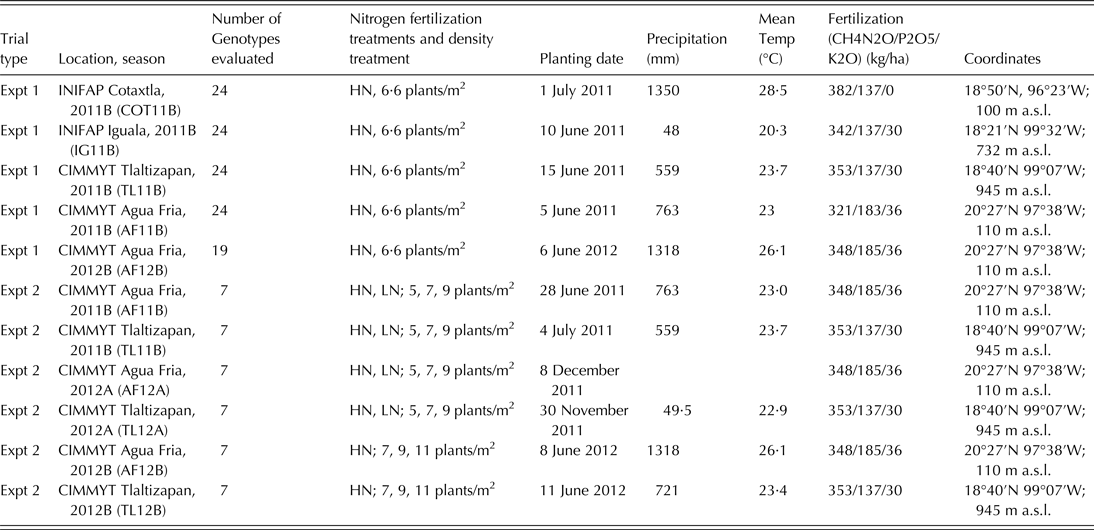
Fertilization, planting date, mean temperature, precipitation and coordinates for 15 experiments (Expt) carried out in summer and winter of 2011/12 at the experimental stations in Cotaxtla (Veracruz, Mexico), Iguala (Guerrero, Mexico), Tlaltizapan (Morelos, Mexico), and Agua Fria (Puebla, Mexico), aiming to assess harvest indices and quantify the effects of planting density on harvest index and other agronomic traits in tropical maize hybrids under well-fertilized (HN) and nitrogen deficient (LN) conditions

Agronomic management
Experiments were carried out at experimental stations of CIMMYT and stations belonging to the Instituto Nacional de Investigaciones Forestales Agrícolas y Pecuarias (INIFAP). Germplasm was evaluated in the summer 2011 at experimental stations in Agua Fria (AF; CIMMYT, Puebla, Mexico, 20°27′N 97°38′W; 110 m asl), Tlaltizapan (TL; CIMMYT, Morelos, Mexico, 18°40′N 99°07′W; 945 m asl), Iguala (IG; INIFAP, Guerrero, Mexico, 18°21′N 99°32′W; 732 m asl) and Cotaxtla (COT; INIFAP, Veracruz, Mexico, 18°50′N, 96°23′W; 100 m asl) as well as in Agua Fria in the summer 2012. A summary of all trials as well as information on planting dates, plot fertilization, average temperature during the growth period and precipitation for each season-by-location combination is provided in Table 1.
Lack of precipitation was compensated for by irrigation. During the summer cycle, 30 l/m2 of water was applied at planting and at flowering using furrow irrigation: at all other times precipitation was sufficient to support the crop's water needs. In TL12A, 50 l/m2 of water was applied on a bi-weekly basis during crop establishment up to ~600 growing degree days (GDD) and again after ~1400 GDD. In between ~600 and ~1400 GDD, 30 l/m2 of water was applied on a weekly basis. In TL12A all irrigations were applied using a drip irrigation system. Reliable meteorological information for the season at AF12A was not available due to failure of the weather station on several occasions. Trials included in Expt 1 were planted at a density of 6·67 plants/m2. Trials included in Expt 2 were carried out during the 2011/12 winter- and summer-cycles in both Agua Fria and Tlaltizapan. Target planting densities for sub-plots in Expt 2 were 5, 7, 9 and 11 plants/m2. The highest planting density was not included in trials carried out under LN conditions. Two seeds were planted/hill, resulting in sowing densities of 10, 14, 18 and 22 (HN only) seeds/m2. Three weeks after emergence plants were thinned to one plant/hill resulting in the target planting density.
Nitrogen (applied as urea (CH4N2O)), phosphorus (P2O5) and potassium (K2O) quantities applied at each site are reported in Table 1. Phosphorus and potassium were all applied at soil preparation. Nitrogen was evenly split and applied in all locations during soil preparation and at 35 days after planting. Fertilizer quantities applied were based on soil analysis and long-term management requirements to maintain soil fertility. Sub-sub-plots assigned to the N deficiency treatment were not fertilized in Tlaltizapan and in Agua Fria for 2012A. However 54 kg CH4N2O/ha were applied in the sub-sub-plots subjected to the N deficiency treatment in Agua Fria 2011B 30 days after planting as plants showed deficiency symptoms too severe to guarantee successful yield formation.
Measurements
During flowering the date at which half the plants within a sub-sub-plot were shedding pollen was recorded as anthesis date. Physiological maturity (R6 according to Hanway & Ritchie Reference Hanway and Ritchie1984) was recorded when grains formed on the ears of three plants/row (six/plot) had formed the black layer in the density trials. Plants used to monitor black layer were chosen randomly within the first five, middle five and last five plants of a row. The duration of grain filling was calculated as the difference between physiological maturity and silking date.
Within a week after physiological maturity, five plants/row were harvested from all season × location combinations and used to estimate shoot dry weight/unit area at harvest and shelled grain weight. Due to limited capacity in the dryer, samples were pre-dried in the sun for 1 week followed by 3 days at 72 °C in a drying oven, after which sample dry weight was measured. It should be noted that grain yield used to calculate HI was based on a sub-sample from each plot while grain yield/area as reported in Tables 2–4 was based on the whole plot area. At harvest, the number of ears, grains/ear and grain weight were determined.
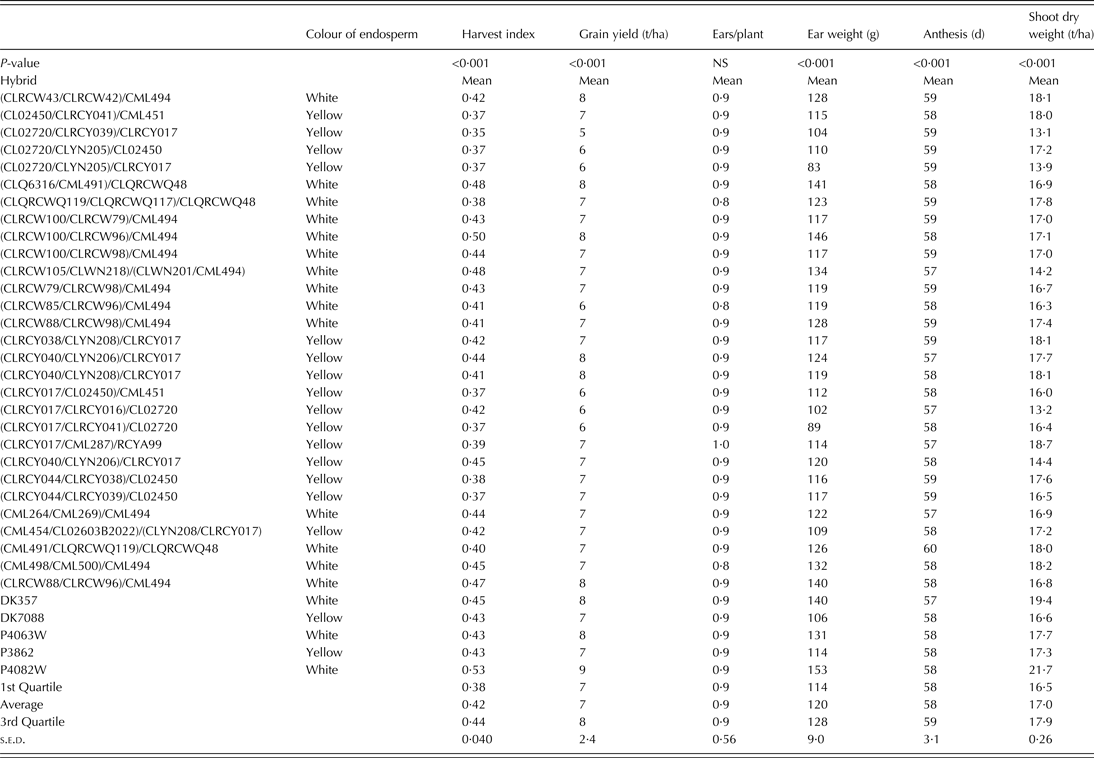
Analysis of variance (ANOVA) table, mean values, 1st and 3rd quartile and standard error of the difference (s.e.d.) for 34 tropical hybrids evaluated in 2011 in Cotaxtla, Agua Fria, Tlaltizapan and Iguala as well as in 2012 in Agua Fria
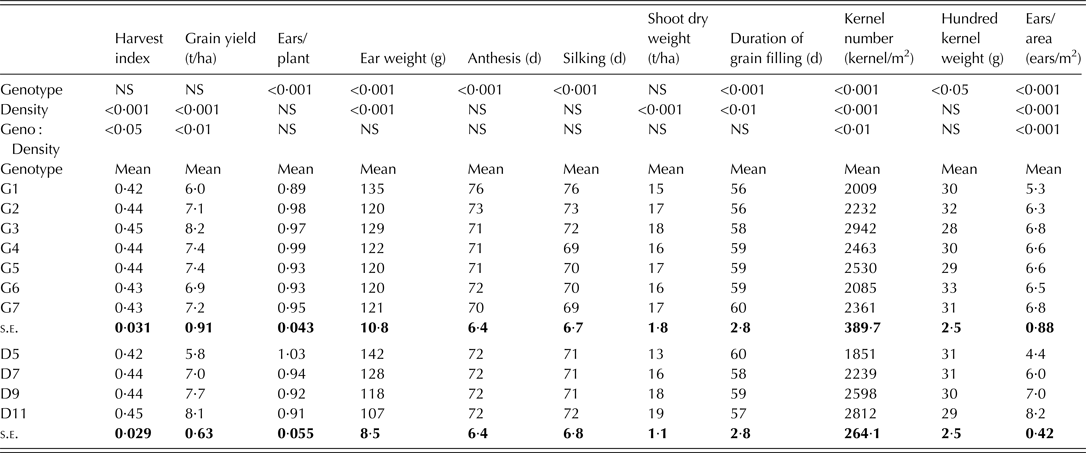
Analysis of variance (ANOVA) table, mean values and standard errors (s.e.) measured in seven genotypes at a planting density of 5, 7, 9 and 11 plants/m2 under well-fertilized conditions in six environments. Interaction plots for traits with significant genotype × planting density interaction are shown in Fig. 1
NS, not significant; D5, 5 plants/m2 D7, 7 plants/m2, D9, 9 plants/m2 11, 11 plants/m2.
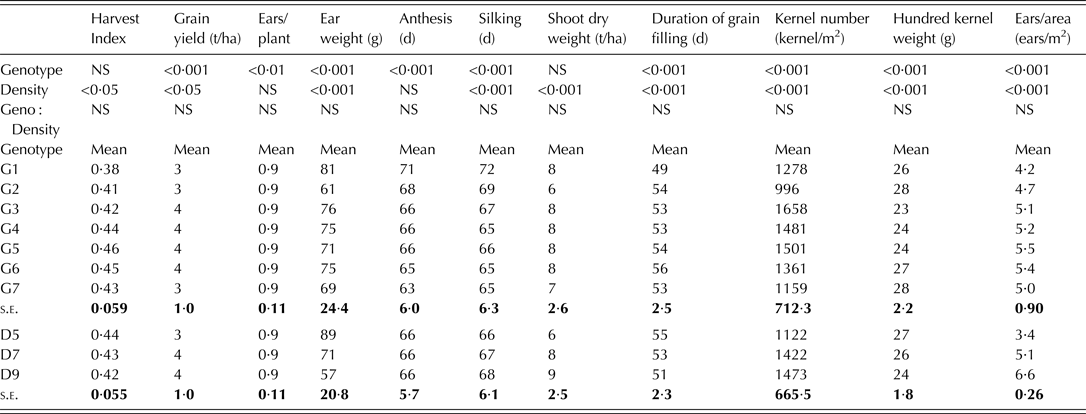
Analysis of variance (ANOVA) table, mean values and standard errors (s.e.) for trait values measured in seven genotypes at a planting density of 5, 7 and 9 plants/m2 under nitrogen deficient conditions measured in four environments. Since no genotype × planting density interactions could be ascertained, data from the nitrogen deficiency treatment is not included in the interaction plots
NS, not significant; D5, 5 plants/m2 D7, 7 plants/m2, D9, 9 plants/m2.
Experimental design
Experiment 1, aiming to measure HI in tropical germplasm, was laid out in an alpha-lattice incomplete block design with three replications at each of the five sites. Experiment 2 aimed at evaluating the effect of different planting densities was set up as a split-split plot design with N-fertilization level as main plot, planting density (randomly assigned) as sub-plot, and genotype within planting density (randomly assigned) as sub-sub-plot; replicated four times within each season × location × treatment combination. Nitrogen fertilization treatments were assigned to main plots for all season-by-location combinations. Low N treatments were included in the trials carried out in AF11B, TL11B, AF12A and TL12A. Sub-plots of different planting density were bordered by two rows (lateral border) planted at the same planting density as the sub-plot. To reduce border effects from neighbouring sub-sub-plots the first two and last two plants within a sub-sub-plot were not harvested, while average plant height measured in individual sub-sub-plots was used as a covariate to correct for potential differences in plant vigour. Sub-sub-plot length was 4·5 m in Agua Fria and 5 m in TL, COT and IG. Sub-sub-plots at all locations were two rows wide.
Statistical analysis
The mixed effect linear model used for the analysis of data measured at physiological maturity and harvest in Expt 1 was:
 $${Y_{hmlk}}\, = \,{\rm \mu} + {{\rm \alpha} _h} + {E_{ml}} + {{\rm \alpha} _h}{E_{ml}} + {r_m}\left( {{E_{ml}}} \right){{\rm \delta} _k} + {\rm} {{\rm e}_{hmlk}}$$
where Y hmlk is the trait value of the hth genotype (h = 34) for the lth environment (l = 5), the mth replication (m = 3); μ denotes the overall mean, αh the main effect of the genotype, E ml the effect of the environment, αhEml the genotype-by-environment interaction, r m(E ml) the replication within environment effect and r m(E ml)δk the effect of blocks within replicates within environments-by-block interaction and the random error term ehmlk. αh was set as a fixed factor; all other factors were set as random factors. Effects for fixed factors are reported in Table 2.
The mixed effect linear model used for the analysis of data measured at physiological maturity and harvest in Expt 2 was:
 $$\eqalign{{Y_{hjlm}}\, = & \,{\rm \mu} + {{\rm \alpha} _h} + {{\rm \lambda} _j} + {{\rm \alpha} _h}{{\rm \lambda} _j} + {\rm} {E_{ml}} + {{\rm \alpha} _h}{E_{ml}} + {{\rm \lambda} _j}{E_{ml}} \cr & + {{\rm \alpha} _h}{{\rm \lambda} _j}{E_{ml}} + {r_m}\left( {{E_{ml}}} \right){\rm} + {r_m}\left( {{E_{ml}}} \right){{\rm \lambda} _j} + {\rm} {{\rm e}_{hjlm}}}$$
where Y hjlmn is the trait value of the hth genotype (h = 7; G1–G7) for the jth planting density (HN: j = 4; 5, 7, 9, 11 plants/m2; LN: j = 3; 5, 7, 9 plants/m2), the lth environment (HN: l = 6; AF11B, TL11B, AF12A, TL12A, AF12B, TL12B; LN: l = 4; AF11B, TL11B, AF12A, TL12A), the mth replication (m = 4; 1,…,4); μ denotes the overall mean, αh the main effect of the genotype, λj the main effect of the planting density, αhλj the genotype-by-planting density effect, Eml the effect of the environment, αhEml the genotype-by-environment interaction, λjEml the environment-by-planting density effect, αhλjEml the genotype-by-planting density-by-environment effect, r m(E ml) the replication within environment interaction effect, r m(E ml)λj the replication within environment-by-density interaction effect and the random error term ehjlm. All factors but r m and E ml were set as fixed. Plant height measured in individual sub-sub-plots was used as a covariate for the analysis of grain yield to account for potential effects of vigour on grain yield.
An initial model additionally including terms for the genotype × N fertilization treatment effects, planting density × N fertilization level effects and genotype × planting density × N fertilization level treatment effects was dropped since it did not show any significant effects for these interactions.
Since it is generally expected that a greater number of plants can be supported under HN conditions, a higher planting density treatment was added to the trials under HN conditions. Consequently, HN and LN treatments were analysed separately although significances could not be ascertained either for the genotype × fertilization level effect or for the planting density × fertilization level effect in the initial model.
Data were fitted using linear mixed effect model in ASReml-R (Gilmour et al. Reference Gilmour, Gogel, Cullis and Thompson2009). The analysis of the data using a mixed model via ASReml-R allows estimation of effects from unbalanced data: i.e. in breeder's trials these models allow estimation of genotypic effects for all genotypes and in the density trials reliable estimation of density effects (although not all densities were present in all season × location × fertilization treatment combinations). Tukey's honest significance test was used to ascertain significant differences between planting densities and genotypes.
In the density trial a quadratic model was used to describe empirical data for grain yield and HI in response to different planting densities. Solving the first derivative yielded the density at which grain yield and HI are maximized under HN and LN conditions.
RESULTS
Ear weight and harvest index explain differences in grain yield
Thirty four tropical genotypes were evaluated in five season-by-location combinations. The grain yield ranged from 5·34 t/ha ((CL02720/CLRY039)/CML451) to 9·32 t/ha (P4082W) with an average yield of 7·06 t/ha (Table 2). Traits most strongly associated with grain yield were grain weight/ear (r = 0·88), HI (r = 0·78) and shoot weight (r = 0·68) while ears/plant (r = 0·22; P = 0·06) only showed a weak association. Plants on average formed 0·82 ((CLRCW85/CLRCW96)/CML494) to 0·97 ears ((CLRCY017/CML287)/RCYA99), each weighing between 82·75 ((CL02720/CLYN205)/CLRCY017) and 153·02 g (P4082). Harvest index ranged from 0·35 ((CL02720/CLRY039)/CLRCY017) to 0·53 (P4082W) at an average of 0·42 (Table 2). The HI for white hybrids (0·44) was higher compared with yellow hybrids (0·39), probably the results of a longer and more intensive selection history in the CIMMYT breeding programme. With the exception of P4082W, which showed the highest values for HI (0·53) and grain yield (9·32 t/ha), CIMMYT hybrids were comparable with their commercial counterparts. P4082W appears to be a breakthrough in terms of HI, and therefore yield potential, in tropical germplasm. Hybrids evaluated were homogeneous with respect to time to flowering, with days to anthesis ranging from 56·5 to 59·6 days after sowing. The negative association of time to flowering with HI (r = −0·48) is indicative of the interrelation between a shorter duration of vegetative growth resulting in a lower plant biomass and potentially higher HI. Shoot dry matter accumulated at harvest ranged from 13·14 t/ha ((CLO02720/CLRCY039)/CLRCY017) to 21·69 t/ha (P4082W).
Grain yield increased by 40.4% when planting density was increased from 5 to 11 plants/m2 under well-fertilized conditions
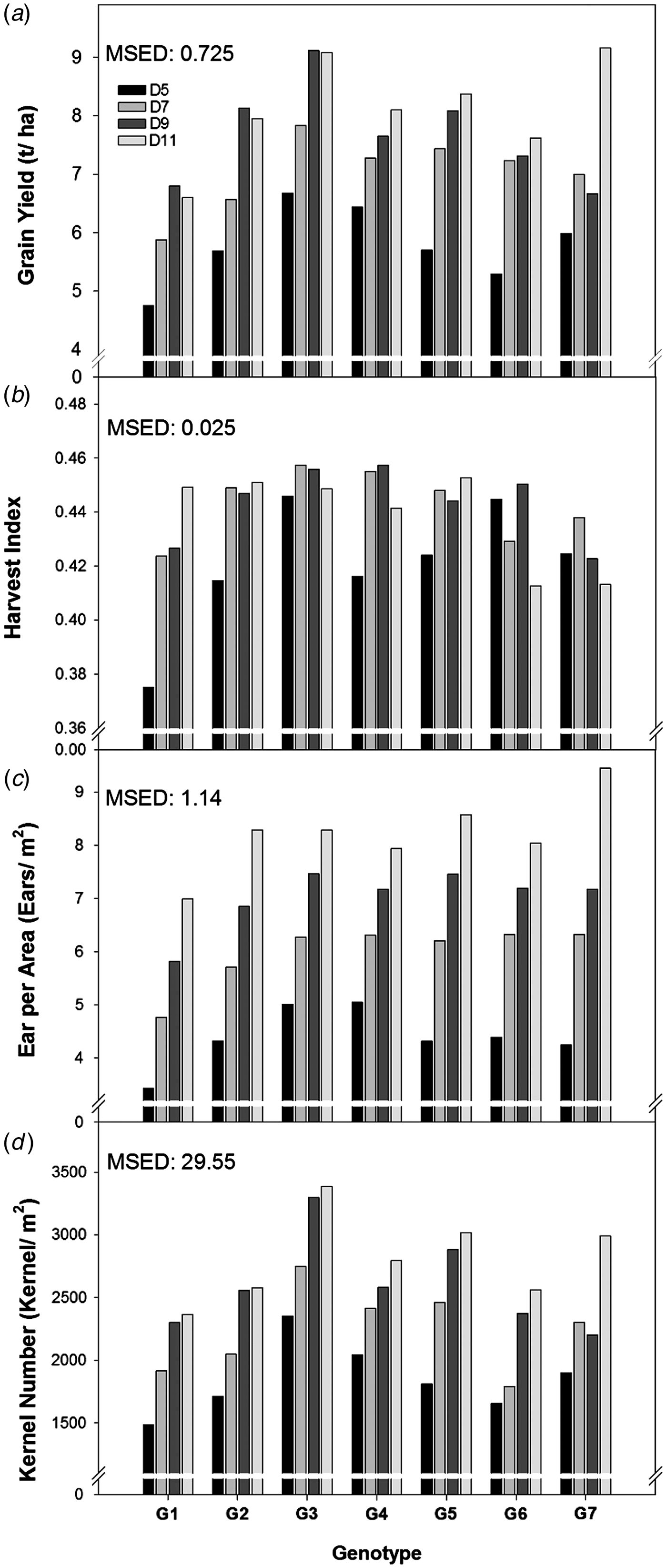
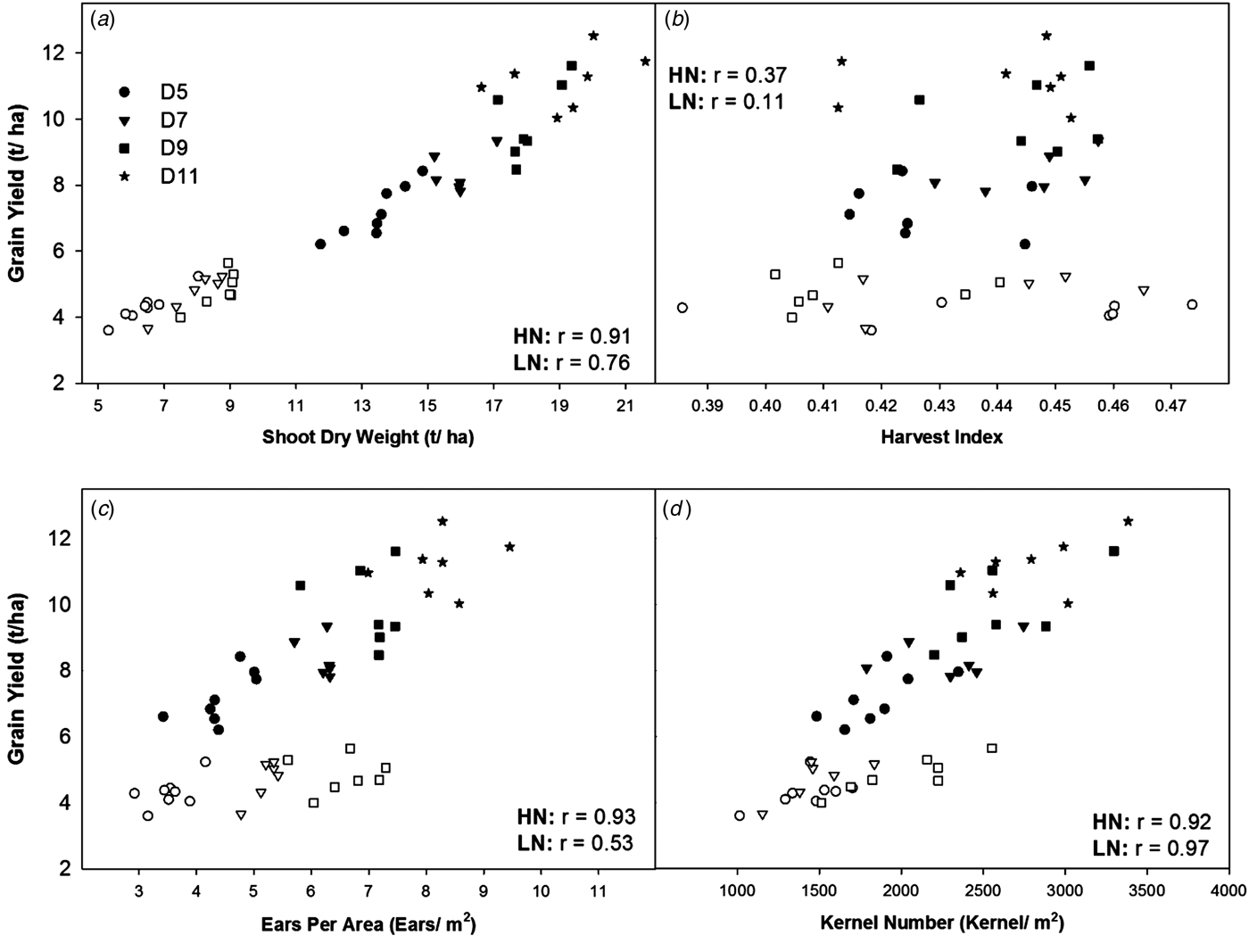
Planting density was modulated in an independent set of seven tropical hybrids evaluated in six season × location combinations at planting densities of 5, 7, 9 and 11 plants/m2. Under HN conditions the factor genotype significantly affected all traits (P < 0·05) investigated except grain yield, shoot weight and HI; the factor planting density significantly affected all traits (P < 0·001) except ears/plant, anthesis, silking and kernel weight. Significant genotype × planting density interactions were observed for grain yield (P < 0·01), HI (P < 0·05), kernel number (P < 0·01) and ears/m2 (P < 0·001; Table 3; Fig. 1). Grain yield generally increased with increasing planting density, reaching highest values at 11 plants/m2 for all genotypes but G2 and G3, which reached their highest grain yield at 9 plants/m2 (Fig. 1). Increases in grain yield between 5 plants/m2 and the density at which the highest grain yield was achieved ranged from 25% (G4) to 53% (G7), reaching 41·7% on average. At 5 plants/m2, grain yield ranged from 4·75 t/ha (G1) to 6·67 t/ha (G3) (average of 5·79 t/ha), while at 11 plants/m2 it ranged from 6·59 t/ha (G6) to 9·16 t/ha (G7) (8·13 t/ha on average). Based on the measured correlations, the traits contributing most strongly to grain yield (Fig. 2) were shoot weight (r = 0·91), HI (r = 0·37), ears/m2 (r = 0·93) and kernel number (r = 0·92). Accordingly, shoot weight and ears/m2 (Table 3) increased by 44·7 and 87·2%, respectively, when planting density was increased from 5 to 11 plants/m2. Since increases in ears/m2 (Fig. 1) were more accentuated than reductions in ear number/plant (−11·6% at D11) and grain weight/ear (−24·6% at D11) at equal kernel weight, kernel number and grain yield increased by 51·9 and 40·4%, respectively, at the highest planting density averaged across all genotypes. Different hybrids responded with different changes in yield components when planting density was increased, as indicated by significant genotype × planting density interactions: G4 (+75·3%) showed the lowest increase in ears/m2, and together with G3 the strongest decrease in ear number/plant (−20%) when planting density was increased from 5 to 11 plants/m2 (Table 3; Fig. 1). The largest increase in kernel number was observed for G5 (+66%) while the smallest increase (+36%) was observed for G4 when planting density was increased from 5 to 11 plants/m2.
Grain yield (a), harvest index (b), ears/area (c) and kernel number (d) as affected by planting densities of 5, 7, 9 and 11 plants/m2 for seven tropical genotypes evaluated in six season × location combinations under well-fertilized conditions. A Tukey's honest significant test was carried out to ascertain differences among genotypes and planting densities. Effects of genotype, density and the interaction between both can be found in Table 3. Data for the nitrogen deficiency treatment were not plotted as no significant genotype × planting density treatment effects could be ascertained. MSED, mean standard error of difference.
Grain yield/area as affected by shoot dry weight/unit area (a), harvest index (b), number of ears/m2 (c) and kernel number (d) for seven genotypes planted at densities of 5 (●), 7 (▲), 9 (■) and 11 plants/m2 (*) under well-fertilized (HN) (full symbols) and nitrogen deficient (LN) (open symbols) conditions.
Harvest index increased by 0.031 when planting density was increased from 5 plants/m2 to the optimum density for each genotype
With increased planting density grain yield generally showed larger increases than shoot weight, resulting in higher HI (for most genotypes) at higher planting density. G1, G2 and G5 reached highest HI at 11 plants/m2 while G4 and G6 reached highest HI at 9 plants/m2. G3 and G7 reached highest HI at plants/m2 (0·44). Increasing planting density from 5 plants/m2 to the planting density at which maximum HI was empirically measured for individual hybrids increased HI by 0·031 on average. Density did not affect anthesis, silking or the interval between them (data not shown). Anthesis ranged from 69·6 days for G8 to 75·7 days for G1. Silking took place on average 0·47 days earlier than anthesis averaged across all planting densities (data not shown). Increasing planting density from 5 to 11 plants/m2 reduced grain filling duration by 2·85 days.
At 7 and 9 plants/m2 grain yield increased by 21.8 and 18.9% under nitrogen deficient conditions relative to D5
Under LN conditions, significant effects of the factor genotype were found for all traits (P < 0·01) except for shoot weight HI and ear number/plant; significant effects for the factor density were found for all traits (P < 0·05) except anthesis, ears/plant and kernel weight; no significant genotype × planting density interaction could be detected under LN conditions (Table 4).
Compared with the optimum conditions grain yield (−52·7%), shoot weight (−54%), HI (−0·011), ear number/plant (−0·06), kernel number (−43%), kernel weight (−4·88 g), ears/m2, (−21·6%) and grain weight/ear (−51·41 g) were on average lower under LN conditions (Tables 3 and 4). Average days to flowering under LN conditions were lower (−5·8 days) relative to well-fertilized conditions, since different season × location combinations were used for both treatments. At the same time the grain filling period was reduced by 5·4 days compared with HN conditions. Under LN conditions grain yield increased with increasing planting density from 2·98 to 3·63 t/ha and 3·56 t/ha as planting density was increased from 5 to 7–9 plants/m2, respectively. No significant genotype × planting density interaction could be ascertained, indicating that all genotypes showed a similar response to increased planting density. Highest grain yield was measured for G3 (3·73 t/ha), while lowest grain yield was measured for G2 (2·74 t/ha). Higher grain yield at higher planting density went along with increases in shoot weight by 40·3 and 90·9% in ears/m2 resulting in 31·3% higher kernel number at D9 relative to D5; reaching shoot weight of 8·70 t/ha2, 6·57 ears/m2 and 1473·1 kernels/m2, respectively at D9. At the same time grain weight/ear and kernel weight were reduced by 35·3 and 9·1% (ns), respectively, while ears/plant remained stable.
Under nitrogen deficient conditions harvest index decreased by 0.0256 with increasing planting density
Since increases in response to increased planting density from D5 to D9 for shoot weight were more accentuated than increases in grain yield, HI was on average reduced from 0·44 at D5, to 0·42 at D9 (Table 4). The strongest associations with grain yield were observed for shoot weight (r = 0·76), ears/m2 (r = 0·5) and kernel number (r = 0·97). Assimilate partitioning to the growing ear, reflected in the weak correlation (r = 0·11 ns) measured between HI and grain yield, was low under LN conditions (Fig. 2). In response to increased planting density, grain fill duration was reduced by 3·78 days (Table 4).
Optimum planting density for grain yield
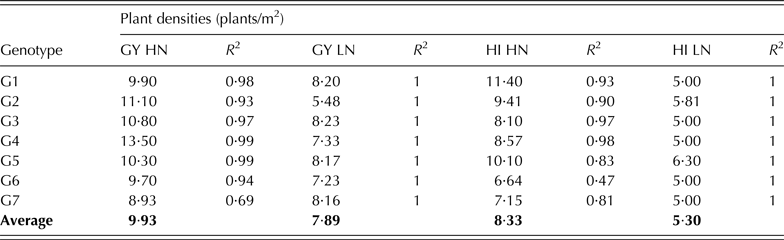
In order to identify optimum planting densities maximizing HI or grain yield, a model describing HI or grain yield in response to planting density was fitted on empirical data for individual genotypes using quadratic equations (Table 5). The R 2 for goodness of model fit were above 0·47 for all genotypes and reached an average of 0·95 (Table 5). Planting densities maximizing grain yield ranged from 9·9 plants/m2 (for G1) to 13·5 plants/m2 (G4) under HN conditions and from 7·23 (G6) to 8·23 plants/m2 (G3) under LN conditions. Planting densities maximizing HI ranged from 6·64 plants/m2 (G6) to 11·4 plants/m2 (G1) under HN conditions and from 5 plants/m2 (G1, G3, G6 and G7) to 6·3 plants/m2 (G5) under LN conditions. Excluding optimum planting densities for individual genotypes outside the density range used in the current study, grain yield and HI can be maximized at a planting density of 9·93 and 8·33 plants/m2 under HN conditions and at 7·89 and 5·33 plants/m2 under LN conditions, respectively.
Planting densities maximizing grain yield and harvest index under well fertilized and nitrogen deficient conditions for seven hybrids evaluated in Experiment 2. R 2 values indicate goodness of model fit for linear models fitted to the data. The overall average does not include computed optimum planting densities outside the density range included in the trials
GY, grain yield; HI, harvest index; HN, well fertilized; LN, nitrogen deficient.
DISCUSSION
Harvest index in tropical germplasm reached 0.42
The aim of the current work was to assess the level of HI in tropical germplasm developed at CIMMYT and determine the effect of different planting densities on HI and grain yield under HN and LN conditions. Modern tropical hybrids on average reached a HI of 0·42 and the range of HI was in line with that previously reported in tropical germplasm: from 0·31 to 0·39 for landraces (Lafitte & Edmeades Reference Lafitte and Edmeades1997), from 0·14 to 0·44 for open-pollinated varieties (Yamaguchi Reference Yamaguchi1974; Osaki Reference Osaki1995; Lafitte & Edmeades Reference Lafitte and Edmeades1997) and from 0·31 to 0·56 for hybrids (Russell Reference Russell1991; Worku & Zelleke Reference Worku and Zelleke2009). A clear trend of increasing HI relative to older studies could not be observed: a direct comparison is difficult, since most of the older studies contained a limited number of entries and were only carried out in few environments. Harvest index measured in tropical germplasm in the current study was ~0·1–0·15 lower compared with HI measured in temperate germplasm (Lorenz et al. Reference Lorenz, Gustafson, Coors and de Leon2010), indicating great potential for improvement in tropical germplasm. Evidence for this is clear: the highest-yielding hybrid, the commercial entry P4082W, had a HI 0·1 higher than the average of the trial, and yielded well over 20% more than the average of the trial.
Grain yield increased by 40.4% under well-fertilized and by 21.8% conditions under nitrogen deficient conditions at higher planting density
Correlations of grain weight/ ear (r = 0·88), HI (r = 0·78) and shoot weight (r = 0·68) with grain yield measured in Expt 1 indicates that sink strength assimilate partitioning and source strength were co-limiting yield formation, as observed previously (Borras et al. Reference Borras, Slafer and Otegui2004). Elings et al. (Reference Elings, White and Edmeades1997) suggested that both source and sink strength could be increased by increasing planting density. In order to evaluate the possibility of increasing kernel number, HI and grain yield on an area basis seven tropical hybrids were evaluated under different planting densities and in well-fertilized and LN conditions. When planting density was increased from 5 to 11 plants/m2 under HN and from 5 to 9 plants/m2 under LN conditions, grain yield increased by 40·4 and 21·8%, respectively. The highest average grain yield of 8·13 t/ha was achieved at D11 under HN and 3·63 t/ha at D7 under LN conditions. Higher grain yield was the result of increased shoot weight, kernel number and HI. Increased planting density corresponded with increases in shoot weight of 44·7 and 40·3% reaching 19·1 and 8·7 t/ha under HN and LN conditions. A higher shoot weight at a higher planting density compared with D5 reflects a faster canopy closure (Tollenaar et al. Reference Tollenaar, Dibo, Aguilera, Weise and Swanton1994; Rossini et al. Reference Rossini, Maddonni and Otegui2011), indicating increased crop growth rate. A faster crop growth rate is indicative of greater assimilate availability potentially resulting in greater prolificacy (Tollenaar & Aguilera Reference Tollenaar and Aguilera1992) and higher ovule fertilization rates (Westgate & Boyer Reference Westgate and Boyer1985). In the current study, an increased amount of assimilates during crop establishment may have allowed plants to form a greater number of ears/m2 (HN: +87%; LN: +90·9), more than offsetting reductions in ears/plant (HN: −12%; LN: not significant) and grain weight/ear (HN: −24%; LN: −9%); ultimately resulting in a greater kernel number (HN: +52%; LN: +31·2%) when planting density was increased.
Harvest index increased under well fertilized conditions
Kernel weight was only reduced marginally in response to increased planting density (non-significant increases in kernel number translated into higher grain yield under both well-fertilized and LN conditions). As a result of greater kernel number at equal kernel weight, grain yield and ultimately HI increased by 0·03 under HN conditions. The negative response of HI to increased planting density under LN conditions can be attributed to severe N limitation during grain fill as indicated by reductions in the duration of grain filling at D9 relative to D5 (−3·78 days) and correlations obtained between grain yield and shoot weight (r = 0·76). Nitrogen had not been limiting (as severely) before flowering, as indicated by a positive response of shoot weight to increased density (+40·3% at D9; similar to HN conditions). Ciampitti et al. (Reference Ciampitti, Zhang, Friedemann and Vyn2012) showed that N uptake into the shoot increased at higher planting densities (5·4–10·4 plants/m2) across N fertilization levels (0–330 kg/ha). It can therefore be speculated that the crop planted at D9 extracted more N from the soil before flowering relative to D5. Severe assimilate shortage and reduced assimilate flux into the growing ear during grain fill would explain reductions in kernel weight (−2·41 g), the early termination of grain fill (−3·78 days) resulting in reduced grain weight/ear and HI as observed at D9 relative to D5.
To the best of our knowledge, this is the first time a positive response of grain yield and HI has been observed when increasing planting density in tropical maize germplasm. Several studies carried out in the past either showed only marginal increases (Yamaguchi Reference Yamaguchi1974; open-pollinated varieties; +10·2% at 2·5 vs. 10 plants/m2) or even decreases (Monneveux et al. Reference Monneveux, Zaidi and Sanchez2005; Hybrids: −5·7%; open-pollinated varieties: −10·4% at 5·3 v. 10·6 plants/m2) when planting density was increased under HN conditions. Similarly, HI was not found to be (positively) affected by increased planting density in temperate germplasm (Meghji et al. Reference Meghji, Dudley, Lambert and Sprague1984; Tollenaar Reference Tollenaar1989). An older study carried out by Yamaguchi (Reference Yamaguchi1974) using tropical open-pollinated varieties even showed a reduction in HI from 0·32 to 0·24 when planting density was increased from 2·5 to 10 plants/m2. To date, a positive response for HI to the increased planting density was only reported in modern temperate germplasm by Tollenaar & Lee (Reference Tollenaar and Lee2011; increases in HI from 0·53 to 0·54 when planting density was increased from 8 to 16 plants/m2), while most other studies have shown that HI remains constant at lower planting densities and starts to decline before the optimum planting density for grain yield is reached (e.g. Yamaguchi Reference Yamaguchi1974; Tollenaar Reference Tollenaar1992; Monneveux et al. Reference Monneveux, Zaidi and Sanchez2005). Contradictions with earlier studies carried out in tropical germplasm (Yamaguchi Reference Yamaguchi1974; Monneveux et al. Reference Monneveux, Zaidi and Sanchez2005), and the differential response for grain yield and HI relative to temperate germplasm may be explained by the type of germplasm used in the current study and its selection history: on the one hand, heterosis increasing grain yield more strongly than total biomass in hybrids, as suggested by Liu & Tollenaar (Reference Liu and Tollenaar2009), might to some extent explain differences compared with older studies using tropical open-pollinated varieties. On the other hand, 20–30 years of selection towards increased prolificacy (Bolanos et al. Reference Bolanos, Edmeades and Martinez1993), stay green (Banziger et al. Reference Banziger, Edmeades and Lafitte1999), improved nutrient capture (Banziger et al. Reference Banziger, Edmeades and Lafitte2002), reductions in shoot dry matter and the interval between anthesis and silking as well as selection under higher planting densities (Bolanos & Edmeades Reference Bolanos and Edmeades1993) may have resulted in a genotype well adapted to the environmental conditions found in the current study. Improved adaptation as a result of selection may also explain why grain yield showed a positive response to increased density under LN conditions, although the only reported study (Boomsma et al. Reference Boomsma, Santini, Tollenaar and Vyn2009) carried out in the absence of N fertilizer in temperate germplasm showed a negative yield response to higher planting density (reduction from 8·4 t/ha at 5·4 plants/m2 to 7 t/ha at 10·4 plants/m2), despite higher residual soil N as indicated by higher average grain yield compared with the current study.
Grain yield in tropical germplasm could be increased at higher planting densities
In the germplasm evaluated in the current study, a maximum grain yield was achieved at 9·93 plants/m2, while HI was maximized at 8·33 plants/m2 under HN conditions. When nutrients are scarce, competition for resources between plants increases (Hammer et al. Reference Hammer, Dong, McLean, Doherty, Messina, Schussler, Zinselmeier, Paszkiewicz and Cooper2009). Since water and nutrient availability determine the amount of plants a soil can support (Sangoi Reference Sangoi2001; Hammer et al. Reference Hammer, Dong, McLean, Doherty, Messina, Schussler, Zinselmeier, Paszkiewicz and Cooper2009), the optimum planting density for both grain yield (7·89 plants/m2) and HI (5·3 plants/m2) in the current study was shifted towards lower values under LN conditions relative to the well-fertilized treatment. Higher average planting densities maximizing grain yield, compared with densities maximizing HI, measured in the current study indicate that higher yield can be achieved at lower resource use efficiency as long as sufficient resources are available. Consequently, planting densities maximizing grain yield or HI should be used in environments with ample and limited nutrients and water availability, respectively.
For typical tropical germplasm 2–2·2 m tall, flowering 65–75 days after planting, the planting density generally recommended by CIMMYT (4·5–6·5 plants/m2) is lower than optimum planting densities calculated for HI and grain yield at both fertilization levels in the current study. Since the sites used to carry out the current work are representative of CIMMYT target environments (Kai Sonder, personal communication), increasing planting densities above those commonly used by smallholder farmers in Latin America and Sub-Saharan Africa today could considerably increase productivity in the presence (+40·4%) or absence (+21·8%) of N fertilizer in CIMMYT's germplasm. It should be noted that yield levels measured in the current study under LN conditions were still relatively high (3·39 t/ha averaged across three planting densities), indicating that plants were only moderately limited by N deficiency. In CIMMYT's target environments (Banziger et al. Reference Banziger, Setimela, Hodson and Vivek2006), germplasm will most likely experience more severe N shortages compared with the conditions under which the current work was carried out. In severely N-depleted fields, higher planting densities will therefore not result in increased grain yield in the absence of adequate N fertilization. However, the current results show that at slightly higher levels of input use, increased plant densities may result in significant yield increases.
CONCLUSIONS
On average, a group of 34 elite tropical hybrids reached a HI of 0·42. Harvest index observed for CIMMYT germplasm was in the range of commercial hybrids except for one unusual commercial tropical hybrid (P4082W) which reached a HI typical of temperate hybrids, and yielded over 10% more than the next highest-yielding hybrid. The fact that HI for CIMMYT germplasm was still ~0·1–0·15 lower than HI in temperate germplasm, indicates a large potential for improvement. Grain yield showed a positive response to increased planting density under both well fertilized (+40·4%) and LN (+21·8%) conditions. Harvest index generally increased under HN conditions, while it was reduced under LN conditions at higher planting density. Theoretical planting densities maximizing HI (HN: 8·33; LN: 5·3 plants/m2) and grain yield (HN: 9·93; 7·89 plants/m2) were higher than CIMMYT's current recommendations on planting density (4·5–6·5 plants/m2), strongly suggesting that grain yield and HI could be increased at higher planting density. Increasing planting densities above current levels of 4–6 plants/m2 would on average increase productivity in the presence (+40·4%) or absence (+21·8%) of N fertilizer in CIMMYTs target environments in Latin America and Sub-Saharan Africa.
The authors would like to thank Oscar Garcia, Sotero Rivas and Doroteo Rivera for technical assistance with the execution of the trials and Miriam Shindler for technical edits.