INTRODUCTION
Host specificity and the factors affecting it are of major interest in ecological parasitology (Poulin, Reference Poulin1998, Reference Poulin2005). The general concepts of principal and auxiliary hosts (Dogiel et al. Reference Dogiel, Petrushevski and Polyanski1961) or required, suitable and unsuitable hosts (Holmes, Reference Holmes and Nickol1979) are mainly discussed with regard to the suitability of the host's physiology, immunology and ecology to endoparasites (Macinnis, Reference Macinnis and Kennedy1976; Poulin, Reference Poulin1992, Reference Poulin1998; Haas, Reference Haas1994; Sukhdeo and Sukhdeo, Reference Sukhdeo and Sukhdeo1994). For ectoparasites, we expect that quality of the surrounding habitat is no less important than the suitability of the host body. Some obligate ectoparasites, like crustaceans parasitic on fish, spend a considerable part of their life as free-living animals (Fryer, Reference Fryer1966; Kabata, Reference Kabata1970) i.e. searching for hosts, mating or laying eggs (Mikheev et al. Reference Mikheev, Mikheev, Pasternak and Valtonen2000; Pasternak et al. Reference Pasternak, Mikheev and Valtonen2000, Reference Pasternak, Mikheev and Valtonen2004).
Some crustacean species ectoparasitic on fish attach to their hosts permanently and lose the ability to move. Others, like some copepods and branchiurans, are not immobile after attachment (Kollatsch, Reference Kollatsch1959; Stammer, Reference Stammer1959; Kabata, Reference Kabata1970). They are able to change not only their position on the host, but also the host individual. Such changes of individual hosts were recorded, for instance, in obligate ectoparasites of fish, Argulus species (Crustacea: Branchiura) (Stammer, Reference Stammer1959; Pasternak et al. Reference Pasternak, Mikheev and Valtonen2000). These changes may occur only occasionally, due to mechanical disturbance or death of the fish, or they may represent common undisturbed parasite behaviour. It has been shown that both Argulus foliaceus and A. coregoni can routinely change between individual hosts (Pasternak et al. Reference Pasternak, Mikheev and Valtonen2000, Reference Pasternak, Mikheev and Valtonen2004).
The smaller of the two branchiurans, A. foliaceus, lives sympatrically with A. coregoni in Finnish lakes. It has a much wider range of potential host species (Herter, Reference Herter1927; Bower-Shore, Reference Bower-Shore1940; Kollatsch, Reference Kollatsch1959; Stammer, Reference Stammer1959; Bauer, Reference Bauer, Dogiel, Petrushevski and Polyanski1970; Pasternak et al. Reference Pasternak, Mikheev and Valtonen2000) than A. coregoni, which occurs predominantly on salmonid fishes (Shimura, Reference Shimura1983; Valtonen et al. Reference Valtonen, Holmes and Koskivaara1997; Mikheev et al. Reference Mikheev, Pasternak and Valtonen2003; Hakalahti and Valtonen, Reference Hakalahti and Valtonen2003). Our main question is: what limits the distribution of A. coregoni among potentially available host species? Is it co-evolution with salmonids or partial segregation between salmonid and non-salmonid fishes within the lakes?
In their early ontogeny, neither Argulus species discriminates between different fish species (Pasternak et al. Reference Pasternak, Mikheev and Valtonen2000; Mikheev et al. Reference Mikheev, Pasternak and Valtonen2004). They attack and attach to both cyprinids and salmonids, preferring fish with higher body reflectivity (Mikheev et al. Reference Mikheev, Valtonen and Rintamäki-Kinnunen1998, Reference Mikheev, Pasternak and Valtonen2004). Argulus foliaceus maintains low host specificity throughout the life-cycle. On the other hand, at the beginning of the reproductive period, A. coregoni switches its preference from cyprinids to salmonids (Mikheev et al. Reference Mikheev, Pasternak and Valtonen2004). We hypothesized (Mikheev et al. Reference Mikheev, Pasternak and Valtonen2004) that this shift to salmonids occurred because the parasites had been habituated to salmonid fish (rainbow trout Oncorhynchus mykiss) from which they were collected for our experiments. In the present study, we aimed to discriminate between acquired and innate preference for salmonids by letting parasites grow on either roach, Rutilus rutilus, or rainbow trout before allowing parasites to chose between salmonid and cyprinid fish. If parasites grown on roach later prefer roach to rainbow trout, this would mean an acquired preference; if they prefer rainbow trout, this would imply a genetically programmed preference for salmonids.
If ambient conditions become unfavourable, argulids can leave the habitat together with the fish host or move away on their own. Oxygen deficiency is an important environmental stressor influencing host-parasite interactions (Jokela et al. Reference Jokela, Taskinen, Mutikainen and Kopp2005; Saarinen and Taskinen, Reference Saarinen and Taskinen2005). Adults of A. coregoni, have a body surface to volume ratio about 2 times lower than adults of A. foliaceus, so we hypothesize that A. coregoni is more sensitive to low oxygen concentration than A. foliaceus. In shallow waters with dense vegetation, oxygen deficiency is common during the summer; oxygen saturation can drop almost to zero at night (Hutchinson, Reference Hutchinson1975; Wetzel, Reference Wetzel1983). Salmonid fishes, being strongly restricted to well-oxygenated waters (Wheeler, Reference Wheeler1969), avoid such habitats, but many other fishes, especially cyprinids, are common residents there (Varley, Reference Varley1967).
In the present study we tested the hypothesis that host specificity in argulid crustaceans is related not only to features of the host, but also to features of the habitat. We expect that larger A. coregoni are better able to search for, find, and attach to hosts, particularly in running waters with large and fast moving fish. However, the lower surface: volume ratio could make larger parasites more vulnerable to hypoxia and restrict their host range to fish species preferring well-oxygenated waters. More specifically, we tested (1) whether A. coregoni is more sensitive to low oxygen than the smaller congeneric, A. foliaceus, and (2) whether the preference of A. coregoni for salmonids is genetically programmed or results from the host-induced phenotypic plasticity.
MATERIALS AND METHODS
Origin and maintenance of parasites and fish
The experiments were carried out at a commercial fish farm in Central Finland during May and July in 2001 and 2002. To obtain newly hatched metanauplii, stones with overwintered egg clutches of Argulus coregoni were collected from a flow-through canal. The stones were placed in shallow white plastic tanks with filtered lake water at 17·8°C and illumination of 400 lux. Hatching of A. coregoni overwintered eggs is mainly triggered by water temperature rising up to 10°C (Hakalahti and Valtonen, Reference Hakalahti and Valtonen2003; Mikheev et al. Reference Mikheev, Pasternak and Valtonen2003). Increased illumination is an additional hatching stimulus (Mikheev et al. Reference Mikheev, Pasternak, Valtonen and Lankinen2001). The next day, A. coregoni started to hatch. Metanauplii were collected with pipettes the day after hatching and kept in filtered water prior to experiments.
Besides metanauplii, 2 groups of older A. coregoni were used in experiments on host preference (1) argulids collected from rainbow trout, Oncorhynchus mykiss (30–40 cm total length) at the fish farm and (2) argulids reared under controlled laboratory conditions either on rainbow trout or on roach (Rutilus rutilus). For the tests on the effect of low oxygen concentration, A. coregoni were collected from rainbow trout and A. foliaceus from cyprinid and percid fishes caught from the same habitat at the fish farm. Prior to the tests, all parasites were starved for a day to increase feeding motivation (Mikheev et al. Reference Mikheev, Mikheev, Pasternak and Valtonen2000).
For rearing parasites on 2 types of hosts, rainbow trout of 15–20 cm total length were taken from the rearing ponds of the farm and roach of 14–20 cm total length were caught from an adjacent canal bringing water to the farm. Prior to the experiments, collected fish were thoroughly checked for the presence of ectoparasites, and, if found, they were removed.
Body length of parasites was measured as the distance between the anterior edge of the carapace and the posterior end of the caudal rami. Total length of the fish host was measured.
Testing host preference
To test the host preference of newly hatched (1 day old) and grown up (4–5 mm body length) parasites, groups of 50 juveniles and 20 grown A. coregoni were released into 15 litre dark brown, low reflectivity plastic tanks filled with filtered lake water. These tanks provide suitable conditions for host searching, while white or transparent tanks cause aberrant swimming behaviour in argulids (Mikheev et al. Reference Mikheev, Valtonen and Rintamäki-Kinnunen1998). Experiments with each size group were replicated 10 times. The illumination was approximately 300 lux and water temperature varied from 15 to 19°C in accordance with ambient conditions. Fifty newly hatched metanauplii without previous contact with fish were tested for initial host preference. Each test tank contained 2 fish of similar size: 1 rainbow trout (a typical host) and 1 roach (a non-typical host). The number of argulids attached to each host was counted after 15 min of exposure. Individual fish were quickly transferred with a hand net into separate white plastic boxes with MS-222 solution. After the hosts were removed from the test tank, the water was checked for unattached parasites. Immobilized fish were thoroughly inspected for the presence of attached parasites. The A. coregoni that detached during manipulations were easily recognized against the white background. For each replicate, fresh parasites and fish were used.
To test whether the ontogenetic variation in the host choice of A. coregoni is genetically programmed or induced by living on particular fish species initially, we assessed host preference in 2 groups of parasites. One group of A. coregoni was reared on a typical salmonid host, Oncorhynchus mykiss, another on a cyprinid fish, Rutilus rutilus. The rearing procedure, growth and development of parasites have been described previously (Pasternak et al. Reference Pasternak, Mikheev and Valtonen2004). Parasite preference for either 1 specimen of O. mykiss or 1 R. rutilus simultaneously presented was tested as described above. The tests were run twice, using parasites after 15 h or 3 weeks of attachment on their hosts. By that time, parasites reached mean body length of 4–5 mm (Pasternak et al. Reference Pasternak, Mikheev and Valtonen2004). In the first test, 50 metanauplii were released into a tank with 2 hosts (1 rainbow trout and 1 roach), and in the second test, 20 larger parasites were used per tank.
Testing sensitivity to low oxygen
To test the hypothesis that A. coregoni is more sensitive to low oxygen concentration than A. foliaceus, we mimicked the conditions of a shallow water habitat with dense bottom vegetation. Forty plastic boxes of 2 l each were filled with lake water (the range of oxygen concentration was 7·2–9·1 mg l−1) and the macrophytes Myriophyllum and Elodea. They were tightly covered with lids and placed in a dark room for 4 h to reduce oxygen levels. After 4 h, a perforated plastic cylinder was introduced into the centre of each box, oxygen concentration was measured (it varied from 0·11 to 0·58 mg l−1 between the boxes), and 10 free-swimming parasites were released into the cylinder. Ten replicates were conducted with both adult males and females of A. coregoni, as well as with both sexes of A. foliaceus. Small holes in the bottom and walls of the cylinders allowed water to penetrate inside, but kept parasites confined and observable. The boxes again were covered with lids and placed in the dark for 1 more hour. After that, oxygen concentration was measured within each cylinder and the numbers of either free-swimming or immobile parasites were counted. By the end of the exposure, oxygen concentration was within the range 0·5 to 0·81 mg l−1. The immobile parasites from each box were transferred into forty 1 litre boxes filled with aerated (85–105% oxygen saturation) water, and after 1 h, the numbers of free-swimming and immobile individuals were counted.
Occurrence of A. foliaceus and A. coregoni on rainbow trout in stagnant and running waters
To check whether the occurrence of A. coregoni on rainbow trout was higher in running waters than that of A. foliaceus, 10 fish were randomly collected from 2 habitats within the same fish farm. One habitat was a canal with water flow at the surface of 0·3–1·1 m/s; the second habitat was several flow-through ponds with current velocity less than 0·1 m/s. The number of parasites of both species was counted from individual fish. Mean body length of fish from the pond (34·5±5·8 cm, mean±s.d.) and the canal (37·0±6·3 cm) (t-test: P=0·517) did not differ.
Host searching efficiency in the dark and light
Searching for and attaching to fish hosts is likely more strenuous in flowing waters. Argulus coregoni inhabiting running and turbulent waters are likely to rely more on visual than on olfactory or hydromechanical cues (Mikheev et al. Reference Mikheev, Pasternak and Valtonen2004). The relative importance of vision could be indirectly assessed by comparing infection rates in dark versus light, conditions, all else being equal.
To compare the searching ability of A. coregoni and A. foliaceus, test groups of 10 adult parasites were released into 15 litre dark brown, low reflectivity plastic tanks filled with filtered lake water. In pilot experiments, no differences in host searching and attachment rate between males and females of either Argulus species were found, so 10 specimens from a random mixture of both sexes were included in each replicate. The illumination in the light treatment was about 300 lux and the water temperature was 20°C. The water temperature was the same in the dark tests. Each test tank contained 1 brown trout, Salmo trutta, of 21±2·3 mm fork length. The number of argulids attached to the host was counted after 15 min of exposure. After exposure fish were quickly transferred with a hand net into a white plastic box with MS-222 solution. Immobilized fish were thoroughly inspected for the presence of attached parasites. After the hosts were removed from the tank, the water was checked for unattached parasites. Twelve replicates for each parasite species were carried out in both dark and light conditions. New animals, both parasites and fish, were used in each replicate.
Data analysis
The effects of A. coregoni acclimation to different fish hosts (rearing of parasites either on roach or on rainbow trout) and type of available fish (roach vs rainbow trout) on intensity of infection in the cross-infection experiment were tested by two-way ANOVA, and differences between groups were analysed with post-hoc Tukey's honestly significant difference (HSD) tests. The same tests were used to analyse the resistance of adult parasites to low oxygen concentration using species (A. coregoni, A. foliaceus) and sex (males, females) as factors. Two-way ANOVAs were also used to compare the abundance of A. coregoni and A. foliaceus on salmonids in running and stagnant waters as well as to compare host attachment rates in light and dark treatments. Data were log10 (x+1) transformed to satisfy ANOVA assumptions. Data for all experiments were checked for normality and homogeneity of variance. Differences in intensity of infection of newly hatched metanauplii A. coregoni on 2 alternative fish hosts were assessed with Mann-Whitney U-test.
RESULTS
Host preference in newly hatched parasites
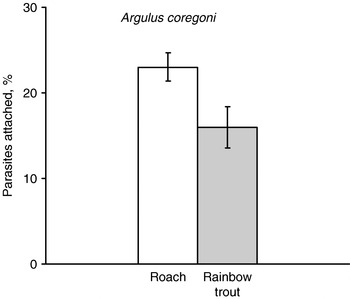
Newly hatched metanauplii of A. coregoni which had no previous contact with any fish preferred roach to rainbow trout when given a choice between these hosts (Fig. 1) (Mann-Whitney U test: Z=−2·6451, P=0·0082).
Host preference in newly hatched metanauplii of Argulus coregoni that had no previous contact with any fish. Fifty A. coregoni were released into a tank with 1 rainbow trout and 1 roach of similar size. White columns: percentage of parasites attached to roach; grey columns: to rainbow trout. s.e. bars are given.

Host preference of A. coregoni reared on different fishes
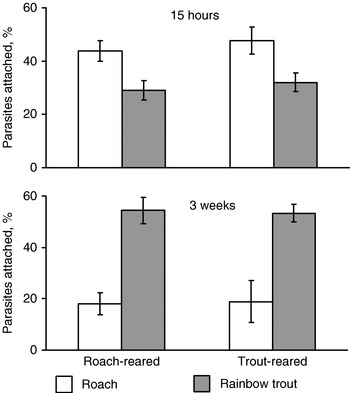
Contact with either cyprinid (roach) or salmonid (rainbow trout) hosts for 15 h did not change the patterns of A. coregoni host preference (Fig. 2). Argulids preferred roach to rainbow trout regardless of the host they were initially attached to (two-way ANOVA: acclimated to roach vs acclimated to trout, F1·36, P=0·2565; preference for roach vs trout, F1·36, P=0·0002) (Tukey's HSD: preference for roach against trout among parasites acclimated to trout, P=0·0291; preference for roach against trout among parasites acclimated to roach, P=0·0222). No interaction between acclimation and preference for alternative hosts was observed (two-way ANOVA: F1·36, P=0·9379). The next test was done when A. coregoni reached 3 weeks age, and the first copulating pairs were observed. In our previous experiments at 18–20°C, A. coregoni adults laid their first egg clutches at the age of 5 weeks (Pasternak et al. Reference Pasternak, Mikheev and Valtonen2004). Regardless of the host they were reared on 3-week-old parasites demonstrated a pronounced preference for the salmonid O. mykiss, provided equal availability of both salmonid and cyprinid hosts (Fig. 2) (two-way ANOVA: reared on roach vs reared on trout, F1·36, P=0·8783; preference for trout vs roach, F1·36, P<0·0001) (Tukey HSD: preference for trout against roach among parasites acclimated to trout, P=0·0002; preference for trout against roach among parasites acclimated to roach, P=0·0002). No interaction between the factors was observed (two-way ANOVA: F1·36, P=0·8575).
Host preference in ‘cross infection’ experiments with Argulus coregoni. Upper panel: newly hatched parasites tested after being attached to fish for 15 h, either roach (left group of bars), or rainbow trout (right group of bars). Lower panel: parasites tested after 3 weeks rearing either on roach (left group of bars), or rainbow trout (right group of bars). White columns: percentage of parasites attached to roach; grey columns: to rainbow trout. s.e. bars are shown.

Sensitivity to hypoxia in A. coregoni and A. foliaceus
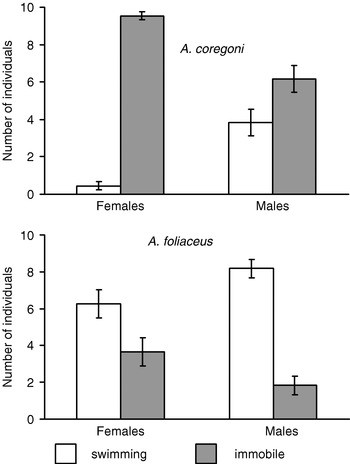
Adults of A. coregoni were much less resistant to low oxygen concentration than A. foliaceus. After 1 h at an oxygen saturation of less than 10%, most A. coregoni were lying immobile on the bottom of the cylinder (Fig. 3), while most A. foliaceus continued swimming (F1,36=119·8, P<0·0001). Females were more sensitive to oxygen deprivation than males (Fig. 3) (F1,36=43·8, P<0·0001). However, a significant difference between the sexes was observed only in A. coregoni (Tukey HSD, A. coregoni: P=0·0002; A. foliaceus: P=0·3675). All the immobile A. foliaceus transferred into well-oxygenated water resumed normal swimming after 1 h, but none of the A. coregoni started to move.
Effect of low oxygen concentration on Argulus coregoni (upper panel) and Argulus foliaceus (lower panel) behaviour. White columns: number of swimming parasites; grey columns: number of immobile parasites after 1 h of exposure to 2–7% oxygen saturation. s.e. bars are shown.

Occurrence of A. foliaceus and A. coregoni on salmonid fishes in stagnant and running waters
Rainbow trout from the canal had higher infection intensities than those from the pond (two-way ANOVA: F1,36=15·64, P=0·0003). Argulus coregoni was significantly more abundant on O. mykiss than A. foliaceus (two-way ANOVA: F1,36=27·35, P<0·0001). A significant interaction was observed (F1,36=38·25, P<0·0001): in the pond, fish were equally infected with both parasite species (Tukey HSD: P=0·905), but in the canal, A. coregoni was much more abundant than A. foliaceus (Tukey HSD: P=0·0002).
Attachment to hosts in the dark and light
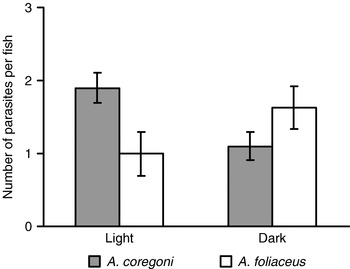
There were no differences in the host attachment rate between the 2 tested parasite species (two-way ANOVA: F1,44=0·093, P=0·7616), or between light and dark conditions (F1,44=0·0020, P=0·9649). However, a significant interaction between factors was observed (F1,44=11·316, P=0·0011; Fig. 4). Post-hoc comparison revealed that A. coregoni had a higher rate of attachment in the light (Tukey HSD: P=0·0101), whereas A. foliaceus had a higher attachment rate in the dark (Tukey HSD: P=0·0408).
Host searching success of Argulus coregoni and Argulus foliaceus in the dark and light as the number of parasites attached to the host during 15 min exposure. Grey columns – A. coregoni, white columns – A. foliaceus. s.e. bars are shown.

DISCUSSION
Our results suggest that habitat features could play a noticeable role in shaping the host specificity of argulid ectoparasites by restricting the range of suitable fishes. Argulus coregoni can spend its entire life on a single host individual (Pasternak et al. Reference Pasternak, Mikheev and Valtonen2004), and young stages can infect a wide range of fish species (Mikheev et al. Reference Mikheev, Pasternak and Valtonen2004). However, low specificity only seems typical of young A. coregoni. At maturation, there is a clear preference for salmonid fishes. Our results support the hypothesis that high sensitivity to oxygen content, not specific characteristics of the host itself, favours parasites that infect fish from well-oxygenated waters, making salmonids suitable hosts. Choosing a ‘wrong’ host, e.g. a cyprinid, does not mean inevitable death of the parasites, but a reduction in fitness is highly probable. Such a host could take egg-carrying females to stagnant oxygen-deficient habitats, which lack suitable substrata for egg laying. Eggs of A. coregoni are laid on hard substrata, preferably stones (Shimura, Reference Shimura1983; Mikheev et al. Reference Mikheev, Pasternak, Valtonen and Lankinen2001; Hakalahti et al. Reference Hakalahti, Pasternak and Valtonen2004), which are rare in typical cyprinid habitats (Varley, Reference Varley1967).
The cross-infections, however, clearly showed that A. coregoni preference for salmonids is innate, and not acquired through habituation to the hosts chosen by newly hatched larvae. Host specificity is low in small metanauplii beginning to look for a host, but host preferences become clear in adult parasites when marked signs of sexual maturation are evident (Pasternak et al. Reference Pasternak, Mikheev and Valtonen2004; Mikheev et al. Reference Mikheev, Pasternak and Valtonen2004). Argulus coregoni of 4–5 mm in length collected from farmed O. mykiss demonstrate a pronounced preference for salmonid fishes (Mikheev et al. Reference Mikheev, Pasternak and Valtonen2004). In the early ontogeny of this obligate parasite, the crucial problem for small and fast growing A. coregoni (Pasternak et al. Reference Pasternak, Mikheev and Valtonen2004) with high-energy demands (Mikheev et al. Reference Mikheev, Mikheev, Pasternak and Valtonen2000) is to locate and attach to a fish host. Early specialization on salmonids would prolong the hard and energy-consuming task of host searching. Newly hatched free-swimming metanauplii can only survive without a host for 2–5 days (Kollatsch, Reference Kollatsch1959; Pasternak et al. Reference Pasternak, Mikheev and Valtonen2000; Hakalahti et al. Reference Hakalahti, Bandilla and Valtonen2005), and, therefore, they cannot be very choosy. By 7–10 days after hatching, free-swimming parasites rely predominantly on visual cues for host finding, preferring fish with higher body reflectivity (Mikheev et al. Reference Mikheev, Pasternak and Valtonen2004). Young A. coregoni, with body length less than 2 mm, readily concentrate over a white disc placed against a dark background; the addition of fish-conditioned water does not influence this behaviour. For larger individuals, trout-conditioned water significantly enhanced this behaviour, but roach-conditioned water had no effect (Mikheev et al. Reference Mikheev, Pasternak and Valtonen2004). The response to host chemical cues was observed at the same developmental stage in which the change of preference from roach towards trout occur (Mikheev et al. Reference Mikheev, Pasternak and Valtonen2004). Despite the initial lack of preference for salmonids, this preference develops later in A. coregoni ontogeny, regardless of the initially chosen host. This supports the hypothesis that the observed ontogenetic shift in A. coregoni host preference towards salmonid fishes is genetically programmed. No pronounced ontogenetic changes in host preference have been observed for A. foliaceus (Mikheev et al. Reference Mikheev, Valtonen and Rintamäki-Kinnunen1998, Reference Mikheev, Mikheev, Pasternak and Valtonen2000; Pasternak et al. Reference Pasternak, Mikheev and Valtonen2000).
The ontogenetic changes in A. coregoni behaviour reflect the shifting challenges faced during parasite development. After hatching, the main task for small, free-swimming A. coregoni is to find a source of food, i.e. a suitable fish host, as soon as possible. Low oxygen content is not so dangerous for young parasites (our unpublished data). As parasites grow, their surface area to body volume ratio decreases, perhaps making respiration more difficult. Sensitivity to oxygen concentration may then become an important factor restricting host preference. The larger size and higher sensitivity to low oxygen of A. coregoni, compared to A. foliaceus, may prevent establishment of the former species into littoral habitats with dense vegetation. On the other hand, the large size of A. coregoni could be beneficial for finding and attaching to large hosts with low population density. This may be the case in rivers and streams, where running, turbulent water deters the use of hydromechanical and chemical stimuli to locate potential hosts (Moore et al. Reference Moore, Weissburg, Parrish, Zimmer-Faust and Gerhardt1994; Bouwma and Hazlett, Reference Bouwma and Hazlett2001; Webster and Weissburg, Reference Webster and Weissburg2001). Vision seems more useful in moving water. Indeed, A. coregoni had a higher infection rate in light conditions. Its smaller congeneric, A. foliaceus, was more efficient in the dark, probably because it efficiently uses its olfaction and hydromechanical sense (Mikheev et al. Reference Mikheev, Mikheev, Pasternak and Valtonen2000). These cues are probably more useful in stagnant waters with relatively high fish population densities. The population density of the two parasites differed between a flow-through canal and pond, as we expected on the basis of the parasites different host finding strategies.
Reproductive value is low for young individuals that have only a low probability of surviving to reproductive maturity, but it increases steadily towards the period of reproduction (Charlesworth, Reference Charlesworth1980). The closer A. coregoni is to egg laying, the more restricted parasites are in their host choice, because failure at this stage is most costly. For adults of A. coregoni, especially for gravid females, it is crucial to be in well-oxygenated habitats with stones suitable for egg laying.
Genetically programmed ontogenetic changes in behaviour and host preference are not exclusive to parasites with complex life-cycles, like many helminths (Price, Reference Price1980; Begon et al. Reference Begon, Harper and Townsend1990). We found that a genetically programmed change in A. coregoni host preference can persist regardless of the first host used by a parasite. Specific habitat requirements of mature A. coregoni bind them with salmonid fishes and likely favour host switching of larger parasites if they initially infect a non-salmonid. The ability of branchiuran ectoparasites to leave the host and locate to another one (Pasternak et al. Reference Pasternak, Mikheev and Valtonen2000, Reference Pasternak, Mikheev and Valtonen2004) provides flexibility in host and habitat choices. The somewhat lower growth and development of A. coregoni on non-salmonid hosts (Pasternak et al. Reference Pasternak, Mikheev and Valtonen2004) could be related to a lower residence time on cyprinids than on salmonids.
Despite the marked ontogenetic shift in host preference, A. coregoni retains an ability to attach and survive on hosts other than salmonids. Although fitness on such ‘supplementary’ hosts is expected to be lower (Pasternak et al. Reference Pasternak, Mikheev and Valtonen2004), these hosts could maintain the parasite population in case of a sudden drop in salmonid populations.
We thank the staff of the farm in Central Finland where the experiments were conducted and the Konnevesi Research Station. This study was supported by the SUNARE research programme from the Academy of Finland and the Russian Foundation for Basic Research (grants 05-04-48693 to V. M. and 07-04-00029 to A. P.). Daniel Benesh has kindly checked the English of the ms. We are grateful to the two anonymous referees for helpful comments and suggestions.