Developmental psychopathology is often grounded in theories of how individual risk factors, such as genetic predispositions or exposure to stress and trauma, promote or protect against the development of mental or behavioral health problems (e.g., Narayan, Cicchetti, Rogosch, & Toth, Reference Narayan, Cicchetti, Rogosch and Toth2015; Trucco, Villafuerte, Heitzeg, Burmeister, & Zucker, Reference Trucco, Villafuerte, Heitzeg, Burmeister and Zucker2016). These approaches have made important contributions to understanding how genetic and environmental factors interact in the development of psychopathology (Belsky & Pluess, Reference Belsky and Pluess2009). Although integrating culture can advance understanding of how psychopathology develops, the role of culture in the genesis of psychopathology is often neglected (Causadias, Reference Causadias2013). To understand individual, parenting, and cultural processes in relation to developmental trajectories of children's externalizing behaviors, we recruited a diverse sample of children and their parents from 12 cultural groups in nine countries: 2 groups in Italy (from different geographic regions), 3 groups in the United States (African American, European American, and Latino American groups), and 1 group each in China, Colombia, Jordan, Kenya, the Philippines, Sweden, and Thailand. These countries were selected because they vary widely in sociodemographic factors, parenting practices, and cultural norms. In examining predictors of developmental trajectories of children's externalizing behaviors, we focused on three types of parenting cognitions because they vary at the individual level as well as the cultural level and encompass at least part of what are sometimes conceptualized as cultural values: endorsement of aggression, attributions regarding uncontrollable success in caregiving situations, and authoritarian attitudes about childrearing. We first consider developmental trajectories of externalizing behavior in cross-cultural context and then review prior research related to each of the three types of parenting cognitions.
Trajectories of Children's Externalizing Behavior
Externalizing behavior includes a range of behaviors often described as “acting out” or undercontrolled behaviors, including aggression, delinquency, lying, cheating, stealing, substance use, and disobedience (Achenbach & Edelbrock, Reference Achenbach and Edelbrock1978). Major theories of the development of externalizing behavior describe trajectories characterized by heightened risk during adolescence compared to earlier or later in development (Moffitt, Reference Moffitt1993; Patterson, Capaldi, & Bank, Reference Patterson, Capaldi, Bank, Pepler and Rubin1991). Developmentally, as children transition from middle childhood to adolescence, their risk of engaging in certain forms of externalizing behaviors, in particular, status violations, increases (Bongers, Koot, van der Ende, & Verhulst, Reference Bongers, Koot, van der Ende and Verhulst2004). As children transition to adolescence, they begin spending more time with peers outside of the direct supervision of parents, which affords more opportunities to engage in externalizing behaviors, such as delinquency and substance use, and peers may model and encourage externalizing behaviors (Glaser, Shelton, & van den Bree, Reference Glaser, Shelton and van den Bree2010). In addition, adolescents may begin experimenting with behaviors that they perceive as being markers of adult status (such as substance use) and may be more motivated than younger children to engage in such behaviors in an effort to fit in with peers (Cooper, Kuntsche, Levitt, Barber, & Wolf, Reference Cooper, Kuntsche, Levitt, Barber, Wolf and Sher2016). Thus, examining trajectories of externalizing behavior from middle childhood to early adolescence provides an opportunity to understand an important developmental transition.
Although heightened risk of externalizing behaviors characterizes adolescents in general, some contexts provide more risks than others (Flouri & Sarmadi, Reference Flouri and Sarmadi2016), and some individuals are at greater risk than others (Kochanska, Brock, Chen, Aksan, & Anderson, Reference Kochanska, Brock, Chen, Aksan and Anderson2015). For example, in an examination of trajectories of externalizing behavior in Canada, New Zealand, and the United States, boys showed more continuity in externalizing behavior from childhood to adolescence than did girls (Broidy et al., Reference Broidy, Tremblay, Brame, Fergusson, Horwood, Laird and Vitaro2003). In addition, cultural factors appear to play a role in trajectories of externalizing behaviors. For example, aggression is more stable from childhood to adulthood in the United States than in Finland, perhaps because Finland offers a wider social safety net that could serve a protective function in disrupting trajectories of aggressive behavior (Kokko et al., Reference Kokko, Simonton, Dubow, Lansford, Olson, Huesmann and Pettit2014). Therefore, it is important to adopt a multilevel perspective in understanding individual, family, and cultural risk factors related to trajectories of externalizing behaviors.
Extant findings suggest nonlinear patterns in growth and diminution of externalizing behaviors (Crone, van Duijvenvoorde, & Peper, Reference Crone, van Duijvenvoorde and Peper2016; Petersen, Bates, Dodge, Lansford, & Pettit, Reference Petersen, Bates, Dodge, Lansford and Pettit2015). There is some evidence to suggest comparable nonlinear developmental trajectories of externalizing across cultures. For example, the age-crime curve shows that engagement in crime increases across adolescence, reaches a peak in late adolescence, and then decreases thereafter (e.g., Farrington, Reference Farrington, Tonry and Morris1986), a finding that appears to be robust across cultures (Hirschi & Gottfredson, Reference Hirschi and Gottfredson1983). In contrast, to the extent that changes in less extreme forms of externalizing behaviors are shaped by parenting and culture, one would expect to find variation in the onset, peak, and offset of developmental trajectories of externalizing that are linked to specific features of parenting and cultural contexts.
Differences in externalizing behavior trajectories may be accounted for by differences between individuals within a given cultural group, differences between cultural groups, or both. Between-culture differences in social orientation and cognition do not necessarily have comparable between-individual differences within a culture (Na et al., Reference Na, Grossmann, Varnum, Kitayama, Gonzalez and Nisbett2010). Using an analytics approach that computed variance estimates at cultural group, person, and within person over time levels, most of the variance in a range of parenting and child adjustment variables was between individuals within cultural groups rather than between cultural groups (Deater-Deckard et al., Reference Deater-Deckard, Godwin, Lansford, Bacchini, Bombi, Bornstein and Al-Hassan2018).
Parenting and Cultural Cognitions
Researchers investigating how different ecological niches contribute to parents’ attitudes, practices, and goals in rearing their children have discovered how these cognitions may be differentially effective depending on their cultural context (Bacchini, Miranda, & Affuso, Reference Bacchini, Miranda and Affuso2011; Bornstein & Lansford, Reference Bornstein, Lansford and Bornstein2010; Garcia-Coll & Magnuson, Reference Garcia-Coll, Magnuson and Masten1999). Culture has been defined in a myriad of ways. Sometimes culture is used as a “social address” defined by ethnicity or country of residence. However, culture implies sets of shared beliefs, values, and practices that may or may not differ by these variables (Raghavan, Harkness, & Super, Reference Raghavan, Harkness and Super2010). For example, a family's religion might shape beliefs, values, and behaviors in a way that transcends ethnicity or country of residence. Examining parenting cognitions is a way of unpacking culture into views of the world that are captured in values, norms, and ideologies; objectively measured behavioral norms that mark the activities and routines of a particular social group; and opportunities and paths that are available to people in a social group (see Goodnow, Reference Goodnow and Bornstein2010). Children develop through their participation in everyday activities that are common in their cultural contexts and by observing their parents and others within their culture engaging in behaviors that are deemed culturally appropriate (Rogoff, Reference Rogoff2003; Rogoff et al., Reference Rogoff, Moore, Najafi, Dexter, Correa-Chávez, Solís, Grusec and Hastings2007). Parents’ cognitions, including attitudes and attributions related to being a parent, likely are related to their own participation in the everyday activities of a cultural group. When a study is conducted in only one culture, it is tempting to overestimate the universality of findings.
Parents in all cultural groups share goals of promoting their children's survival, health, education, happiness, and of socializing their children to be well-functioning members of their respective cultural groups, but parents in different cultural groups have been found to vary in numerous ways with respect to their values related to childrearing and their attitudes and attributions that might be related to children's externalizing behaviors. Cognitions are culturally grounded because they are based not only on personal experiences in individualized settings but also on observations of other parents, advice from local experts, and experiences with children other than one's own (McGillicuddy-DeLisi, Reference McGillicuddy-DeLisi1980; Okagaki & Divecha, Reference Okagaki, Divecha, Luster and Okagaki1993). In addition, culturally based and intergenerationally transmitted folklore (Bornstein et al., Reference Bornstein, Haynes, Azuma, Galperin, Maital, Ogino and Wright1998) and religious and philosophical traditions (Chao & Tseng, Reference Chao, Tseng and Bornstein2002) shape parents’ cognitions. For example, Confucian philosophies related to filial piety may be the root of the importance placed on parental authority in China (Chang, Chen, & Ji, Reference Chang, Chen and Ji2011), and values stemming from the Islamic faith may shape parents’ cognitions in many Arab countries (Ahmed, Reference Ahmed and Bornstein2010; Al-Hassan & Takash, Reference Al-Hassan and Takash2011). Parents’ cognitions are related to, but distinct from, parenting behaviors (Goodnow, Reference Goodnow, Sigel, McGillicuddy-DeLisi and Goodnow1992; Goodnow & Collins, Reference Goodnow and Collins1990; Miller, Reference Miller1988; Murphey, Reference Murphey1992; Okagaki & Divecha, Reference Okagaki, Divecha, Luster and Okagaki1993; Sigel & McGillicuddi-DeLisi, Reference Sigel, McGillicuddy-DeLisi and Bornstein2002). Cognitions shape parents’ perceptions of their children's behavior and what (if anything) parents believe they can do to change children's behavior (Bornstein & Lansford, Reference Bornstein, Lansford and Bornstein2010).
The aspect of cognition that is perhaps most directly related to externalizing behaviors involves social information processing in which social situations and possible responses to social situations are encoded and evaluated (e.g., Crick & Dodge, Reference Crick and Dodge1994). Parents who evaluate aggressive responses to social situations more positively are more likely themselves to use aggression in caregiving situations (Lansford et al., Reference Lansford, Woodlief, Malone, Oburu, Pastorelli, Skinner and Dodge2014) as well as to have children who behave aggressively (Huesmann & Kirwil, Reference Huesmann, Kirwil, Flannery, Vazsonyi and Waldman2007). In part, transmission of values endorsing aggression may occur at an individual level (e.g., if parents who regard aggressive responses more favorably intentionally or unintentionally reinforce their children's aggressive behavior), but endorsement of aggression may also occur at broader cultural levels. For example, “cultures of honor” have been described in which motivation to maintain one's honor and heightened sensitivity to perceived provocations contribute to more aggressive responses in social situations in some cultural groups than others (Nisbett & Cohen, Reference Nisbett and Cohen1996), and cultural groups differ in endorsing aggression in different situations (Ramírez, Fujihara, & van Goozen, Reference Ramírez, Fujihara and van Goozen2001). In addition to parents’ endorsement of aggression predicting children's externalizing behaviors, children's own endorsement of aggression in hypothetical situations predicts how aggressively they behave in real life, particularly as they develop from childhood into adolescence (Fontaine, Yang, Dodge, Pettit, & Bates, Reference Fontaine, Yang, Dodge, Pettit and Bates2009). Children who live in communities that endorse aggression are more likely to behave aggressively (Skinner et al., Reference Skinner, Bacchini, Lansford, Godwin, Sorbring, Tapanya and Pastorelli2014).
Attributions regarding successes and failures in caregiving situations constitute another germane domain of parenting cognitions. When parents interact with children, they make attributions about the reasons that children behave as they do and reasons that parent–child interactions go well or not, taking into account factors such as their own parenting skills, children's temperaments, and features of the situation and context (Dix, Reference Dix1993; Miller Reference Miller1995). Early work on attributions distinguished between internal versus external loci of control (Rotter, Reference Rotter1966) and between stable versus unstable and controllable versus uncontrollable dimensions (Weiner, Reference Weiner1986). If parents attribute a positive caregiving outcome to luck, this attribution would be external (outside of the parent's control), unstable (one could be lucky some days and unlucky others), and uncontrollable (there is nothing the parent can do to replicate the good outcome if it happened through sheer luck). By contrast, if parents attribute a positive caregiving outcome to their own efforts, this attribution would be internal, stable, and controllable. Bugental's theoretical framework of parents’ attributions in caregiving situations emphasizes the balance of power between parents and children in their interactions (i.e., whether parents believe success or failure is caused by themselves, their child, or both) as well as whether the outcome is a success or failure (e.g., Bugental et al., Reference Bugental, Ellerson, Lin, Rainey, Kokotovic and O'Hara2002; Bugental & Happaney, Reference Bugental and Happaney2000, Reference Bugental, Happaney and Bornstein2002; Bugental & Shennum, Reference Bugental and Shennum1984). Previous international research has found differences across countries in parents’ attributions regarding successes and failures in caregiving situations (Bornstein et al., Reference Bornstein, Haynes, Azuma, Galperin, Maital, Ogino and Wright1998; Bornstein, Putnick, & Lansford, Reference Bornstein, Putnick and Lansford2011).
Parents’ attitudes about childrearing constitute another pertinent domain of parenting cognitions. Attitudes are important because they affect parents’ behaviors toward their children as well as the environments that parents select for their children. Parents’ attitudes vary along several dimensions, including authoritarianism. More authoritarian attitudes encompass obedience, respect for authority, and strictness (Dornbusch, Ritter, Liederman, Roberts, & Fraleigh, Reference Dornbusch, Ritter, Leiderman, Roberts and Fraleigh1987), whereas less authoritarian attitudes entail the belief that the parent–child relationship is more democratic so children should be able to think independently, express their ideas, and behave freely (Okagaki & Frensch, Reference Okagaki and Frensch1998). Parents in Asia and Latin America are more likely than European American and Western European parents to value interdependence and collectivism (Chao & Tseng, Reference Chao, Tseng and Bornstein2002; Harwood, Leyendecker, Carlson, Asencio, & Miller, Reference Harwood, Leyendecker, Carlson, Asencio, Miller and Bornstein2002; Tamis-LeMonda & McFadden, Reference Tamis-LeMonda, McFadden and Bornstein2010), so parents in the former cultural groups may hold more authoritarian attitudes than parents in the latter groups, contributing to socialization practices that favor authoritarianism (e.g., Cote & Bornstein, Reference Cote and Bornstein2009; Harkness, Super, & Keefer, Reference Harkness, Super, Keefer, Paul, Shweder, D'Andrade and Strauss1992; Harwood et al., Reference Harwood, Leyendecker, Carlson, Asencio, Miller and Bornstein2002; Richman, Miller, & Solomon, Reference Richman, Miller, Solomon, Damon, LeVine, Miller and West1988). More authoritarian parents are more likely to have children with more externalizing behavior problems than children of less authoritarian parents (Pinquart, Reference Pinquart2017), an association that meta-analyses have demonstrated to be generally consistent across a range of different cultural groups (Pinquart & Kauser, Reference Pinquart and Kauser2018).
In a comparison of mothers’ and fathers’ attributions and attitudes in the nine countries included in the present study, mothers and fathers did not differ in attributions regarding successes and failures in caregiving situations, but fathers held more authoritarian parenting attitudes than did mothers (Bornstein et al., Reference Bornstein, Putnick and Lansford2011). Within a given family, mothers’ and fathers’ attributions and attitudes were moderately correlated. Nevertheless, cultural differences may be found in associations between mothers’ and fathers’ cognitions and the development of children's externalizing behaviors. For example, the Chinese adage “strict father, kind mother” embodies the expectation that fathers will be more authoritarian than mothers (Chao & Tseng, Reference Chao, Tseng and Bornstein2002), which may alter the relation between authoritarian attitudes and child externalizing in mother–child compared to father–child dyads.
The Present Study
This study adopts a multilevel perspective to advance the understanding of individual- and cultural-level parenting cognitions in relation to the development of children's externalizing behavior, providing the important advantage of allowing tests of the limits and generalizability of these developmental patterns. The first goal of this study was to examine whether externalizing behavior trajectories vary across the 12 cultural groups in nine countries as well as across individuals within cultures. The second goal was to examine predictors of individual- and culture-level variation in externalizing behavior trajectories. We addressed two research questions. First, does the average trajectory of externalizing behavior from age 7 to 14 vary across cultures as well as across individuals within cultures? Second, are individual-level and culture-level variation in children's externalizing behavior trajectories predicted by parents’ cognitions (related to endorsement of aggression, attributions for success in caregiving situations, and authoritarian attitudes) and children's own endorsement of aggression? We tested three hypotheses: that variation in externalizing behavior trajectories would be more extensive across individuals within cultures than across cultures; that parents’ and children's greater endorsement of aggression, parents’ attributions favoring uncontrollable success in caregiving, and parents’ authoritarian attitudes would predict elevated child externalizing behavior trajectories as well as more rapid increases or slower decreases in externalizing problems over time; and that prediction from parents’ cognitions to children's externalizing behavior trajectories would be augmented by culture-level cognitive norms (e.g., culture-level endorsement of aggression and authoritarian attitudes) above and beyond individual-level cognitions.
Method
Participants
Beginning in 2008, mothers, fathers, and children (N = 1,336 families) were recruited to participate in the Parenting Across Cultures Project (Lansford, Reference Lansford2011; Lansford et al., Reference Lansford, Bornstein, Deater-Deckard, Dodge, Al-Hassan, Bacchini and Zelli2016) from schools that serve socioeconomically diverse families in 12 groups in nine countries: China (Shanghai), Colombia (Medellín), Italy (Rome and Naples), Jordan (Zarqa), Kenya (Kisumu), the Philippines (Manila), Sweden (Trollhättan), Thailand (Chiang Mai), and the United States (African American, European American, and Latino families in Durham, NC). Children brought home letters describing the study, which parents were asked to sign and return if they were willing to be contacted (in some countries) and contacted by phone to follow up on the letter (in other countries). The only eligibility criteria were that children be in the target age range and attending the schools through which samples were recruited, that parents and children be able to understand the local language(s) in which the interviews were conducted, and that they self-identify as a member of one of the ethnic groups described above. If a family included more than one eligible child, one child was randomly selected to be the target child who completed measures and about whom parents completed measures. Children were sampled from schools serving high-, middle-, and low-income families in the approximate proportion to which these income groups were represented in the local population. These sampling procedures resulted in an economically diverse sample that ranged from low income to high income within each site. Sample sizes ranged from 100 to 121 in each of the 12 groups. These are convenience samples, which despite their limitations in terms of population-wide generalizability, have several advantages in longitudinal, developmental research (Jager, Putnick, & Bornstein, Reference Jager, Putnick and Bornstein2017).
At Time 1, children ranged in age from 7 to 10 years (M = 8.30, SD = 0.66; 51% girls). Eighty-two percent of the parents were married. In the United States, the sample was 35% European American, 33% African American, and 32% Latino. In Kenya, all except two participants were from the Luo ethnic group, which is the third-largest ethnic group in Kenya (13% of the population), after the Kikuyu (22%) and Luhya (14%) ethnic groups (see Oburu, Reference Oburu2011, for a detailed description of the Luos in Kenya). The Luo group was sampled primarily for political and cultural reasons. For example, although the Luhya ethnic group appears larger than the Luo group in official government statistics, the Luhya group comprises over 10 subgroups with distinct cultures and languages and was a group formed for political reasons by the British colonial government in the 1950s rather than an indigenous group (Luhya Tribe, Reference Luhya2018). Although there are ethnic minorities and immigrant families to varying degrees, the samples in the other participating countries identified with the majority cultural group of the country.
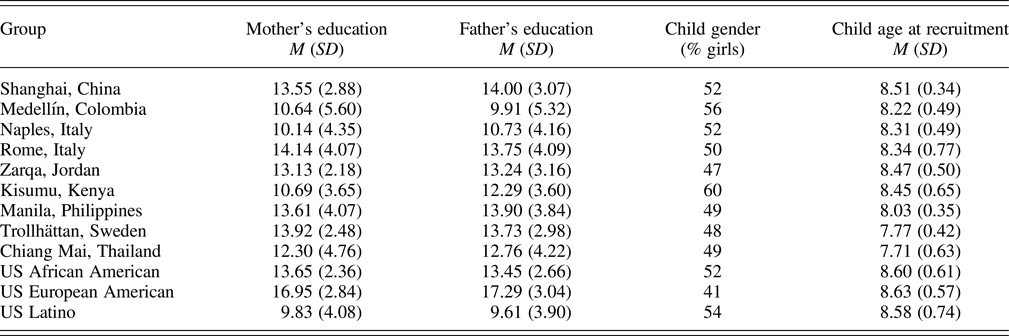
Child gender, χ2 (11, n = 1,294) = 9.65, p = .562, did not differ significantly across the 12 cultural groups (nine countries, with 2 groups in Italy and 3 groups in the United States). However, as shown in Table 1, the groups did differ on child age at the time of recruitment, F (11, 1,282) = 32.98, p < .001, mothers’ education, F (11, 1,270) = 32.00, p < .001, and fathers’ education, F (11, 1,149) = 29.52, p < .001. For the analyses reported here, data were available from six annual waves of data collection, each spaced at approximately 1-year intervals. At Wave 6, 79% of the original families provided data. Compared to the original families who did not provide Wave 6 data, families who provided Wave 6 data did not differ by child age, F (1, 1,292) = 0.003, p = .957, child gender, χ2 (1, n = 1,294) = 1.49, p = .227, or maternal education, F (1, 1,280) = 3.82, p = .051, but fathers in families that provided Wave 6 data were less highly educated than fathers in families that did not provide Wave 6 data, F (1, 1,159) = 7.02, p = .008.
Descriptive statistics for demographics by cultural group

Note: M, mean. SD, standard deviation. Mother's and father's education is the mean number of years of education completed (SD).
Procedures and measures
Data collection was led by a PhD-level faculty member at a university in each site. Prior to launching the Parenting Across Cultures Project, the investigators had met and worked together in different capacities (e.g., as consultants on an evaluation of parenting programs led by UNICEF, through mutual colleagues who had been postdoctoral fellows or visiting scholars in different countries). Prior to data collection, all of the investigators met in person to discuss procedures and measures. The investigators continue to meet annually to review the previous year's data collection, plan the next year's data collection, and discuss issues related to analyses and interpretation of findings (see Skinner et al., Reference Skinner, Sorbring, Gurdal, Lansford, Bornstein, Chang, Bombi and Egloff2017, for additional details regarding the logistics of international collaboration in the Parenting Across Cultures project).
Interviews were conducted by graduate students or paid research assistants in participants’ homes, schools, or at another location chosen by the participants. Interviewers were trained by the local principal investigator in each site using a set of materials that covered the ethical treatment of human subjects, building rapport with participants, and other logistical issues, which were adjusted as needed to address local circumstances. Procedures were approved by local institutional review boards at universities in each participating country. Parents signed statements of informed consent, and children provided assent. Interviews lasted approximately 1.5–2 hr. Depending on the site, parents were given modest financial compensation for their participation or small gifts such as movie tickets or vouchers to bookstores (all sites), families were entered into drawings for prizes (Sweden and United States), or modest financial contributions were made to participating children's schools (China and Sweden).
We use a rigorous procedure of independent forward- and back-translation to ensure the linguistic and conceptual equivalence of measures across languages (Maxwell, Reference Maxwell, Martin and Kelly1996). Each translator is fluent in English and the target language. In addition to forward- and back-translating the measures, translators are asked to (a) note places in the research instruments that do not translate well, are inappropriate for the different groups, or are culturally insensitive; (b) identify words that elicit several meanings in particular contexts; (c) make suggestions for improvements of instruments if they identify problems; and (d) indicate reasons for altering the translated versions if discrepancies are identified and alterations are deemed necessary. Site coordinators and the translators reviewed identified discrepancies and unclear items and made appropriate modifications to the items. An annual cross-site meeting of all investigators and consultants is held to discuss any ambiguities or difficulties with the measures on an item-by-item basis. This annual cross-site meeting and ongoing email exchanges also serve to maintain consistency across sites in procedures for data collection. These substantial efforts are designed to ensure that the measures will be valid in all sites by focusing not only on linguistic equivalence but also on the cultural meanings that are imparted by the measures (Erkut, Reference Erkut2010; Peña, Reference Peña2007). Measures are administered in the following languages: Mandarin Chinese (China), Spanish (Colombia and the United States), Italian (Italy), Arabic (Jordan), Dholuo (Kenya), Filipino (the Philippines), Swedish (Sweden), Thai (Thailand), and English (the United States and the Philippines).
Endorsement of aggression
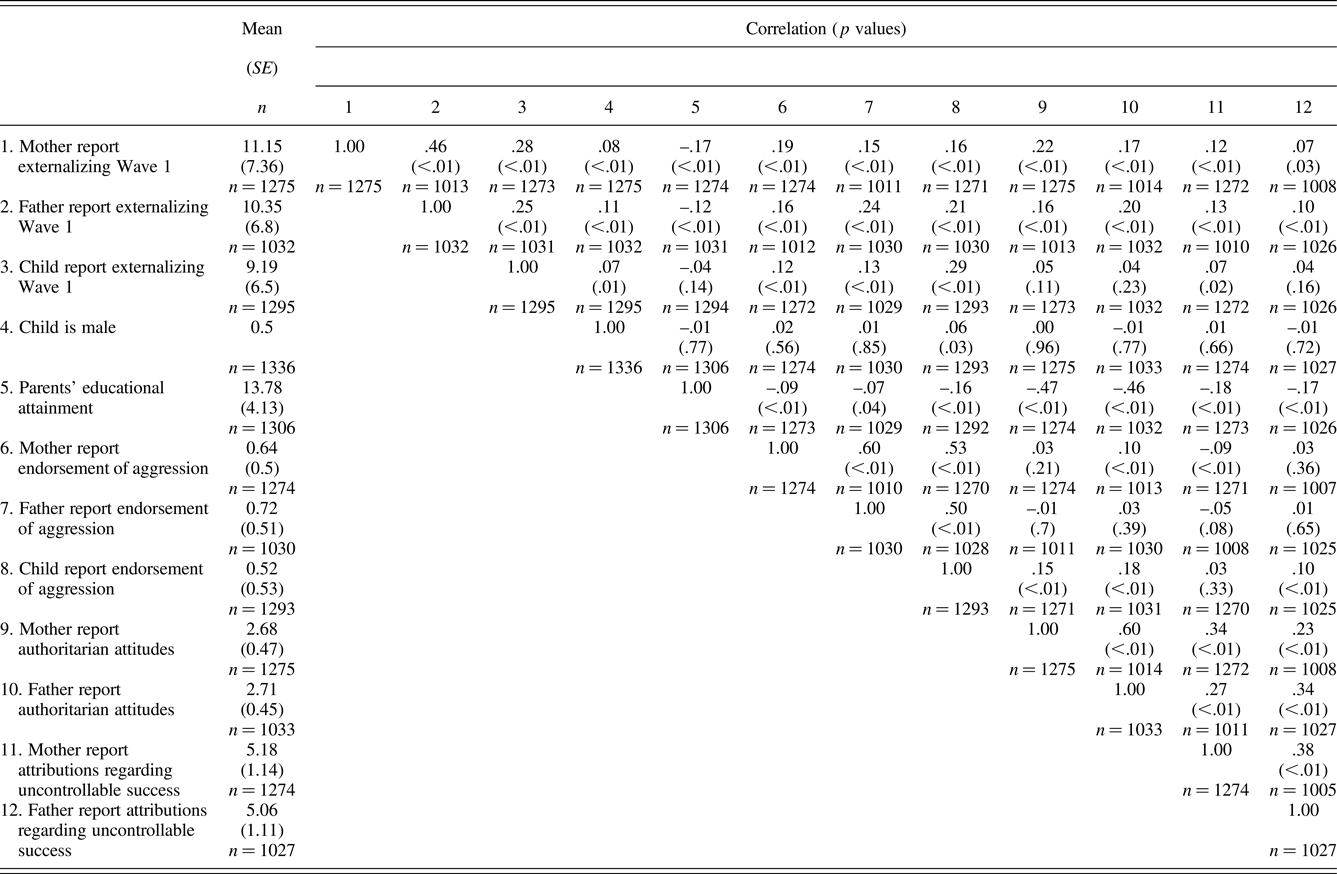
Mothers, fathers, and children completed the Normative Beliefs about Aggression measure in Wave 1 (Huesmann & Guerra, Reference Huesmann and Guerra1997). The measure presents 20 brief hypothetical situations (e.g., a boy hits another boy), and respondents indicate whether an aggressive response is acceptable (e.g., to hit the other child in return) with responses ranging from really wrong (0) to perfectly okay (3). For each reporter, an endorsement of aggression scale is constructed by averaging across the 20 items (for mothers: α = 0.91, for fathers: α = 0.89, for children: α = 0.92). Higher scores indicate stronger beliefs in the appropriateness of aggression. Descriptive statistics and correlations among the variables are provided in Table 2.
Descriptive statistics and correlations among Wave 1 variables

Note: The n varied across measures, largely because of different configurations of family members’ participation. For example, although we tried to collect data from mothers, fathers, and children in all families, in some families only mothers and children participated and in others only fathers and children participated. The n also varies slightly because a given respondent may have had missing data on a particular measure in a given wave.
Authoritarian attitudes
Parents also completed the Parental Modernity Inventory in Wave 1 (Schaefer & Edgerton, Reference Schaefer, Edgerton and Sigel1985), capturing where parents’ childrearing attitudes fall on an authoritarian continuum. Parents rate statements regarding education and childrearing from strongly disagree (1) to strongly agree (4). An authoritarian attitudes scale is constructed by averaging across 22 items (e.g., “The most important thing to teach children is absolute obedience to their parents”) with higher scores indicating more authoritarian attitudes (for mothers α = 0.88; for fathers α = 0.88). The Parental Modernity Inventory has demonstrated good psychometric properties in all nine countries included in the present study (Bornstein et al., Reference Bornstein, Putnick and Lansford2011).
Attributions regarding uncontrollable success
In Wave 1, mothers and fathers also completed the Parent Attribution Test (Bugental & Shennum, Reference Bugental and Shennum1984). This measure presents hypothetical scenarios involving positive and negative interactions with a child. Parents then rate how important factors such as the child's disposition and the parent's behavior are in determining the quality of the interaction. The scale ranges from not at all important (1) to very important (7). An attributions regarding uncontrollable success scale is created by averaging across six items capturing whether successful interactions were due to factors beyond the parent's or child's control (e.g., “how lucky you were in just having everything work out well”). Higher scores indicate stronger belief that success was due to uncontrollable factors (for mothers: α = 0.75, for fathers: α = 0.73). The Parent Attribution Test has demonstrated good psychometric properties in all nine countries included in the present study (Bornstein et al., Reference Bornstein, Putnick and Lansford2011).
Externalizing behavior problems
Finally, using Achenbach's (Reference Achenbach1991) Child Behavior Checklist parents report how often their child enacted a behavior or felt an emotion: never (0), sometimes (1), or often (2). Mothers were interviewed in Waves 1 through 6; fathers were interviewed in Waves 1 through 3 as well as Waves 5 and 6. Children completed the self-report version of the measure (Youth Self-Report) in Waves 1–5. The parent-reported externalizing problem behavior scale sums across 33 items capturing behaviors such as lying, truancy, vandalism, bullying, drug and alcohol use, disobedience, tantrums, sudden mood change, physical violence, use of alcohol and drugs, and being unusually loud (αs for mother reports in Waves 1–6 are 0.86, 0.88, 0.88, 0.89, 0.89, and 0.89, respectively; αs for father reports in Waves 1, 2, 3, 5, and 6 are 0.85, 0.84, 0.86, 0.87, and 0.89, respectively). For child reports, the scale is based on 30 items (αs for Waves 1–5 are 0.81, 0.86, 0.84, 0.83, and 0.87, respectively; in Wave 4, child report data were provided only in Colombia, Italy, and the United States). Higher scores indicate more problematic externalizing behaviors. The Achenbach measures have been translated into at least 69 languages and used with at least 60 cultural groups (Achenbach, Reference Achenbach, Gielen and Roopnarine2004). Aside from the measures’ widespread use in other countries (see Crijnen, Achenbach, & Verhulst, Reference Crijnen, Achenbach and Verhulst1997, for a comparison among 12 countries, including 4 in the present study), several researchers have specifically demonstrated cross-ethnic and cross-language equivalence of the Achenbach measures across cultural groups (e.g., Knight & Hill, Reference Knight, Hill, McLoyd and Steinberg1998; Knight, Virdin, & Roosa, Reference Knight, Virdin and Roosa1994; Rubio-Stipec, Bird, Canino, & Gould, Reference Rubio-Stipec, Bird, Canino and Gould1990; Weisz, Suwanlert, Chaiyasit, & Walter, Reference Weisz, Suwanlert, Chaiyasit and Walter1987).
Analysis plan
The pattern of externalizing behavior from age 7 through 14 (through age 13 for child reports) is estimated using SAS PROC MIXED to estimate multilevel models with occasions (Level 1) nested within individuals (Level 2) nested within cultures (Level 3 with 12 cultural groups; 2 geographic groups in Italy, 3 ethnic groups in the United States, and 1 group each in China, Colombia, Jordan, Kenya, the Philippines, Sweden, and Thailand). Restricted maximum likelihood estimation is used due to the relatively small number of cultures. Using multilevel modeling helps maintain statistical power and the legitimacy of inferences in the presence of missing data. The model treats time as a continuous variable and thus uses all available observations even when a respondent is missing data for one or more time points. This modeling technique also allows for restructuring the outcomes to reflect age at interview rather than study wave. This restructuring leads to unbalanced time (i.e., some respondents have data at ages 7, 9, 10, 12, and 13 whereas others have data at ages 8, 9, 10, 11, and 12). Unbalanced time across respondents can be accommodated by treating time as continuous. Using outcomes by age at interview rather than study wave reduces measurement error and allows the results to be more closely linked to child development theories (Hoffman, Reference Hoffman2015).
The initial model for each outcome includes random intercepts at the individual and culture levels and estimates a cubic model of externalizing behavior change over time by including an intercept, age (centered at 8), age2, and age3. The age term captures whether externalizing behavior increases or decreases over time. The age2 term measures whether that rate of change is accelerating or decelerating over time. Finally, the age3 term captures whether the acceleration or deceleration captured by the age2 term is increasing or decreasing over time. For example, a negative age term, positive age2 term, and negative age3 term indicates that externalizing behavior is decreasing as children get older but the rate of decrease slows over time, and the rate of deceleration also slows over time. That is, the decrease in externalizing behavior between age 7 and 9 is larger than the decrease between age 9 and 11, which is larger than the decrease between ages 11 and 13. The inclusion of random slope variances (for age, age2, and age3) at each level is determined iteratively. Linear slope variance is added at the individual level, and model fit is compared to the initial model using a likelihood ratio test. The likelihood ratio statistic is calculated by subtracting the –2loglikelihood value from the model with more estimated parameters from the –2loglikelihood value from the model with fewer parameters. This difference follows a chi square distribution with degrees of freedom equal to the difference in number of parameters estimated (referred to as –2ΔLL). If the test reveals statistically significant improvement in fit, a quadratic slope variance at the individual level is added to the model and tested against the previous model. If the test reveals statistically significant improvement in fit, a cubic slope variance at the individual level is added and tested. After completing this process for the individual-level slope variances, the process is repeated for the culture-level slope variances (Hoffman, Reference Hoffman2015).
Next, the model is estimated with predictors, entering Wave 1 measures that are assumed to be time invariant: highest educational attainment among parents, endorsement of aggression, attributions regarding uncontrollable success, and authoritarian parenting attitudes. For each of these measures both a within-culture predictor (measured by the individual's deviation from the within-culture mean) and a between-culture predictor (measured by the deviation of the culture mean from the grand mean; Enders & Tofighi, Reference Enders and Tofighi2007) are included in the model. This coding structure creates separate estimates of both the total within-culture, between-individual effect and the total between-culture effect. SAS ESTIMATE statements are then used to test whether the within- and between-culture effects are statistically different. Child's gender is also included as an individual-level covariate. Although samples were recruited with a goal of equal gender representation, there is some variation in the gender balance across sites; therefore, the proportion of males is included as a culture-level variable (centered at .5). Given the coding of the culture-level gender predictor, it measures the additional effect of the proportion of males at the culture level beyond the within-culture effect of gender (the SAS ESTIMATE statement is not required). For each predictor, the main effects are included as well as the interactions with age, age2, and age3. Because children did not complete the measures used to create attributions regarding uncontrollable success and authoritarian parenting attitudes, the child-reported externalizing behavior model with predictors is estimated twice: once with mother-reported predictors and once with father-reported predictors. The detailed results for the demographic predictors are available in the tables; however, they are not discussed in the text due to space constraints. We reran the models using the aggression subscale rather than the full externalizing behavior scale. The substantive findings remained unchanged, so the results reported reflect the full externalizing behavior scale.
Effect sizes for predictors are calculated by estimating the percentage by which the variance (within culture or between culture, depending on the predictor) is reduced when a predictor is included in the model, denoted as the pseudo-R 2 (Hoffman, Reference Hoffman2015; Hox, Reference Hox2010; Raudenbush & Bryk, Reference Raudenbush and Bryk2002). For example, the pseudo-R 2 for within-culture endorsement of aggression is calculated by first subtracting the estimated individual-level intercept variance when the within- and between-culture endorsement of aggression predictors are included in the model from the estimated individual-level intercept variance from the model without any predictors. This difference is then divided by the estimated individual-level intercept variance from the model without any predictors. A similar formula is used for calculating the pseudo-R 2 for the between-culture endorsement of aggression predictor where the between-culture variances are used rather than the within-culture variances.
Results
Preliminary analyses
Initially, empty three-level models are estimated for each outcome to assess the distribution of variance across levels. For mother-reported externalizing behavior, the individual-level intraclass correlation indicates that 64.6% of the variance is between individuals (p < .001, based on comparing the model fit of a single level model to a two-level model ignoring culture), –2ΔLL (1) = 3,674.90. The culture-level intraclass correlation indicates that culture accounts for 13.3% of that between-individual variance in mother-reported externalizing behavior (intraclass correlation = .133, with p < .001 based on comparing the model fit of two-level and three-level models): –2ΔLL (1) = 125.40. Similarly, 57.2% of the variance in father-reported externalizing behavior is between individuals (p < .001), –2ΔLL (1) = 1,697.80, with culture accounting for 14.2% of that between-individual variance (p < .001), –2ΔLL (1) = 108.60. Finally, 46.2% of the variance in child-reported externalizing behavior is between individuals (p < .001), –2ΔLL (1) = 1,243.80, with culture accounting for 12.7% of that between-individual variance (p < .001), –2ΔLL (1) = 97.20.
Mother-reported externalizing behavior
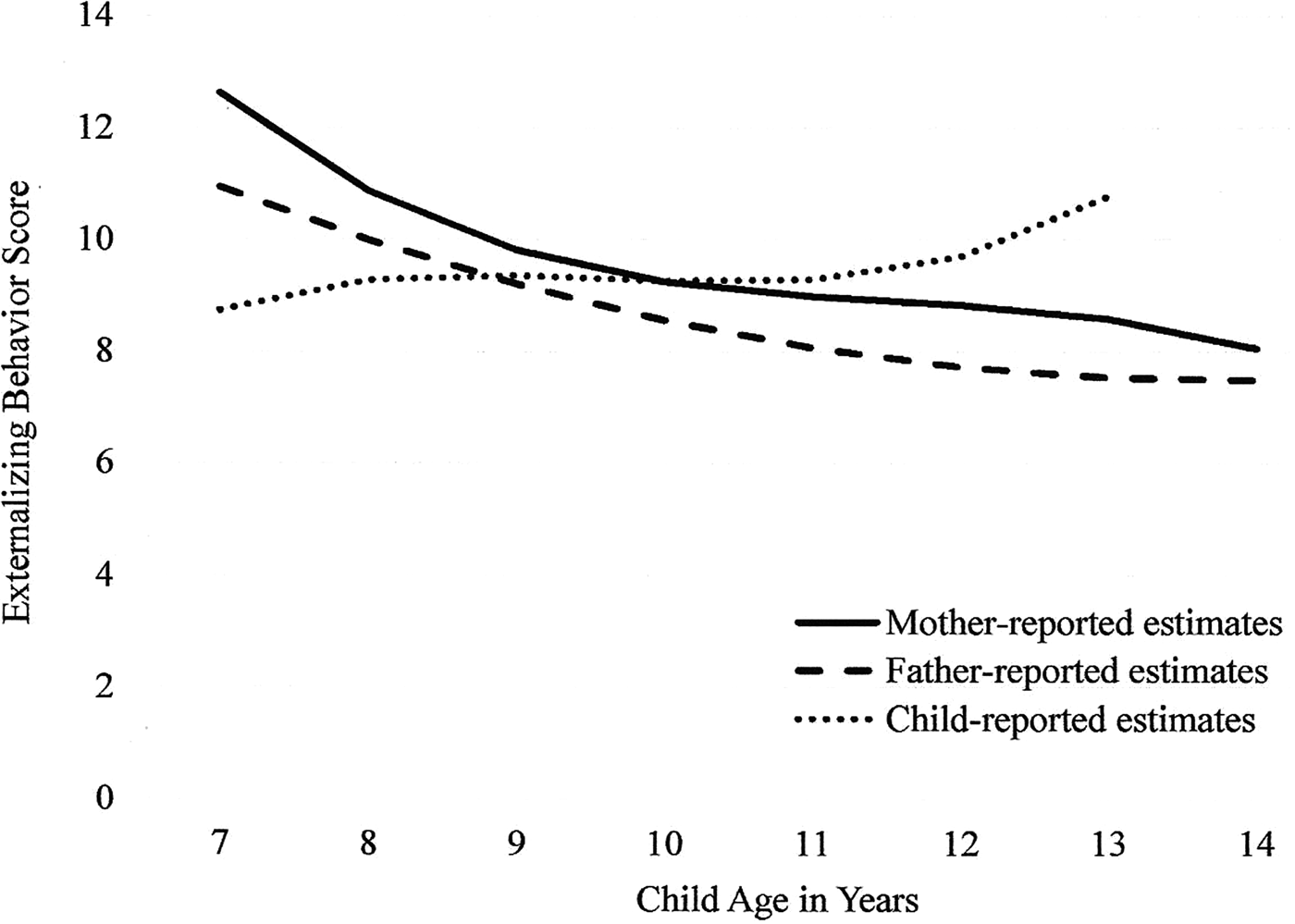
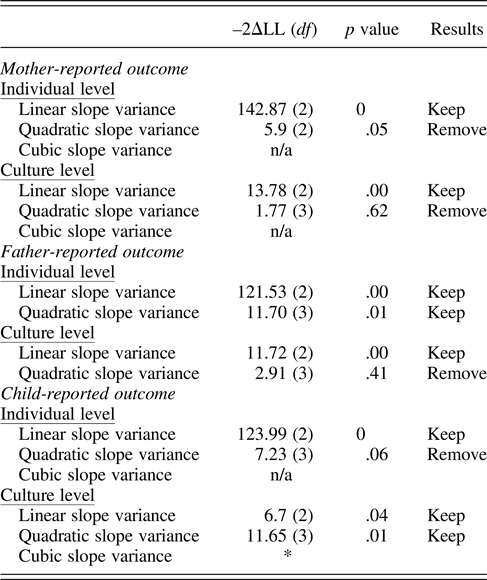
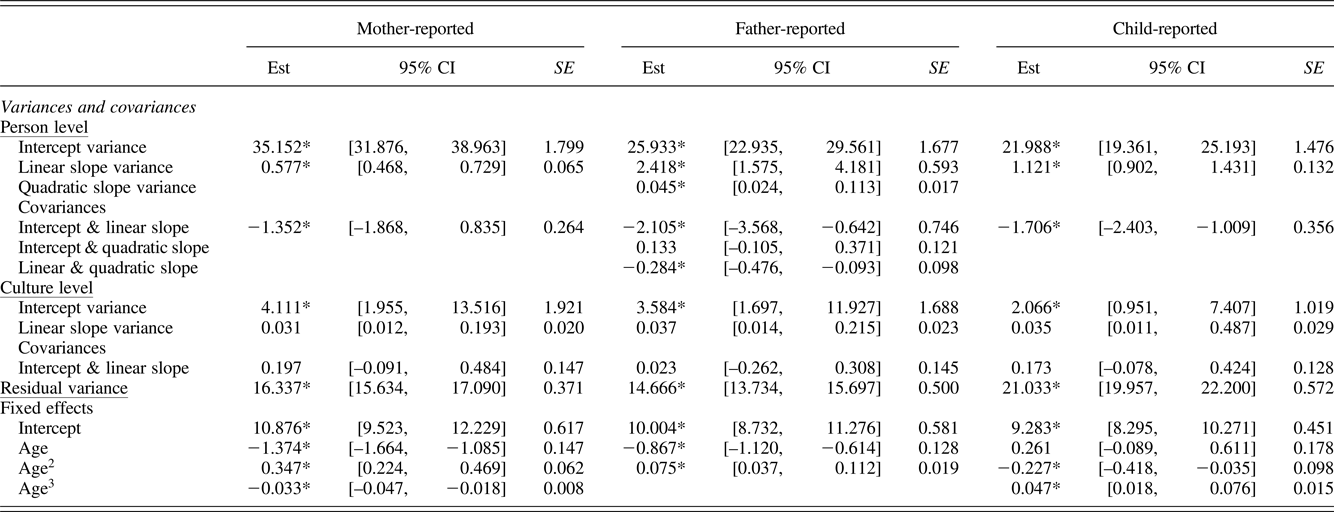
To address our first hypothesis, that variation in mother-reported externalizing behavior trajectories is more extensive across individuals within cultures than across cultures, we estimated a multilevel model with a cubic age trajectory and examined the variances for the intercept and age parameters at the individual and culture levels. The likelihood ratio tests assessing model fit after iteratively adding additional slope variances support a model for mother-reported externalizing behavior that includes random intercept and linear slope variances at the individual and culture levels (Table 3 displays the likelihood ratio tests supporting this final model specification). The estimated variances and average fixed effects for the age trajectory of mother-reported externalizing behavior are displayed in Table 4. The model estimates an average externalizing behavior at age 8 of 10.876 (95% confidence interval; CI [9.523, 12.229], SE = 0.617, p < .001) with a decelerating negative trajectory (linear slope = –1.374, 95% CI [–1.664, –1.085], SE = 0.147, p < .001; quadratic slope = 0.347, CI [0.224, 0.469], SE = 0.062, p < .001), and that deceleration slows over time as indicated by a negative cubic term (est = –0.033, 95% CI [–0.047, –0.018], SE = 0.008, p < .001). To better understand this particular cubic trajectory, Figure 1 provides a visual depiction of the estimated, average trajectory of mother-reported externalizing problems across all cultures. The estimated variances reveal significant individual- and culture-level intercept variance (individual: est = 35.152, 95% CI [31.876, 38.963], SE = 1.799, p < .001; culture: est = 4.111, 95% CI [1.955, 13.516], SE = 1.921, p = .016). In addition, there is evidence of a significant individual-level linear slope variance (est = 0.577, 95% CI [0.468, 0.729], SE = 0.065, p < .001), but the culture-level linear slope variance is not significant (est = 0.031, CI [0.012, 0.193], SE = 0.020, p = .059). The intercept and slope variance intraclass correlations reveal that 10.5% of the intercept variance is accounted for by culture, and 5.1% of the linear slope variance is attributable to culture. These results support our first hypothesis, that variation in mother-reported externalizing behavior trajectory is more extensive across individuals within cultures than across cultures.
Estimated average externalizing problem behavior trajectories across all cultures. Cubic trajectories of mother-, father-, and child-reported externalizing problems over time and across all cultures are depicted.

Likelihood ratio test results used to determine the random slope variances included at each level

Note: n/a indicates the previous random variance parameter was removed; therefore, additional random parameters were not tested. *indicates that this model did not converge.
Multilevel model results without predictors for externalizing problem behavior

Note: Cells for variances and covariances are empty when the model did not support the inclusion of random quadratic or cubic slope variances. Age3 was not included in the model estimating father-reported outcomes. Est, unstandardized estimate. 95% CI, 95% confidence interval. SE, standard error. *Denotes estimates that are significant at the p < .05 level.
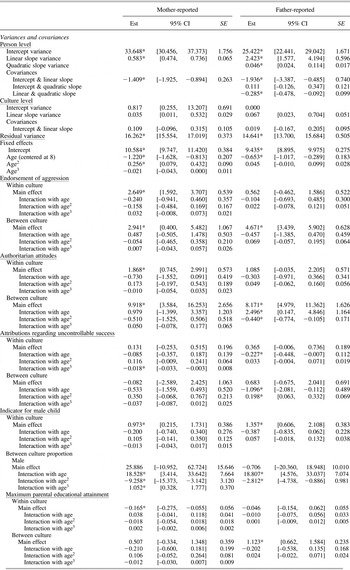
Table 5 provides the results when all of the predictors are included in the model. After adding the predictors, the individual-level intercept and linear slope variances remain significant (intercept: est = 33.648, 95% CI [30.456, 37.373], SE = 1.756, p < .001; linear slope: est = 0.583, 95% CI [0.474, 0.736], SE = 0.065, p < .001). These significant variances indicate that there is still unexplained between-individual, within-culture variation in the mother-reported externalizing behavior trajectory, but two of our within-culture predictors are significant. A 1 unit increase in endorsement of aggression above the culture mean is associated with a 2.649 increase in mother-reported child externalizing behavior at age 8 (95% CI [1.592, 3.707], SE = 0.539, p < .0001). The pseudo-R 2 indicates that within-culture differences in endorsement of aggression explain 1.5% of the individual-level random intercept variance. Similarly, a 1 unit increase in authoritarian attitudes above the culture mean is associated with a 1.868 increase in mother-reported child externalizing behavior at age 8 (95% CI [0.745, 2.991], SE = 0.573, p = .001). The pseudo-R 2 indicates that within-culture differences in authoritarian attitudes explain 1.8% of the individual-level random intercept variance. These results address our second hypothesis, that greater parental endorsement of aggression and authoritarian attitudes would predict elevated child externalizing behavior trajectories over time.
Multilevel model results with predictors for mother- and father-reported externalizing problem behavior

Note: Cells for variances and covariances are empty when the model did not support the inclusion of random quadratic or cubic slope variances. Age3 was not included in the model estimating father-reported outcomes. Est, unstandardized estimate. 95% CI, 95% confidence interval. SE, standard error. *Denotes estimates that are significant at the p < .05 level.
Neither the culture-level intercept variance (est = 0.817, 95% CI [0.255, 13.207], SE = 0.691, p = .119) nor the linear slope variance (est = 0.035, 95% CI [0.011, 0.532], SE = 0.029, p = .115) is statistically significant, suggesting that the culture differences in both the intercept and linear slope coefficients have been explained by the between-culture predictors. The effects of the culture-level predictors address our third hypothesis: prediction from parents’ cognitions to children's externalizing behavior trajectories would be augmented by culture-level cognitive norms (e.g., culture-level endorsement of aggression and authoritarian attitudes) above and beyond individual-level cognitions. The main effects of both the between-culture effects of endorsement of aggression (est = 2.941, 95% CI [0.400, 5.482], SE = 1.067, p = .029) and authoritarian attitudes (est = 9.918, 95% CI [3.584, 16.253], SE = 2.656, p = .008) on the intercept are statistically significant. In cultures in which mothers, on average, report higher endorsement of aggression than the grand mean, mothers also report higher levels of child externalizing behavior at age 8, on average. The pseudo-R 2 indicates that between-culture differences in endorsement of aggression explain 5.2% of the culture-level random intercept variance. This effect, however, is not statistically different from the within-culture effect described above (difference = 0.292, 95% CI [–2.359, 2.934] SE = 1.196, p = .812). Similarly, in cultures in which mothers, on average, report higher authoritarian attitudes than the grand mean, mothers also report higher levels of child externalizing behavior at age 8, on average. The pseudo-R 2 indicates that between-culture differences in authoritarian attitudes explain 39.1% of the culture-level random intercept variance. This effect is statistically different from the within-culture effect described above (difference = 8.050, 95% CI [1.687, 14.413], SE = 2.718, p = .020), supporting our third hypothesis regarding the augmentation of prediction of externalizing trajectories by culture-level norms, above and beyond individual-level cognitions.
Father-reported externalizing behavior
To address our first hypothesis, that the variation in father-reported externalizing behavior trajectories is greater across individuals within cultures than across cultures, we examined the intercept and age parameters variances at the individual and culture levels from the multilevel model. Although the initial father-reported outcome model specified a cubic trajectory, the estimated coefficient on age3 is very small and not significant, so a quadratic trajectory specification is modeled instead. The likelihood ratio tests assessing model fit support a model for father-reported externalizing behavior that includes random intercepts and linear slope variances at the individual and culture levels as well as a random quadratic slope at the individual level. Table 3 provides the likelihood ratio test results. As seen in Table 4, the model estimates an average father-reported externalizing behavior at age 8 of 10.004 (95% CI [8.732, 11.276], SE = 0.581, p < .001) with a decelerating negative trajectory (linear slope = –0.867, 95% CI [–1.120, –0.614], SE = 0.128, p < .001; quadratic slope = 0.075, 95% CI [0.037, 0.112], SE = 0.019, p < .001). Figure 1 provides a visual depiction of the estimated average trajectory of father-reported externalizing problems across all cultures. The estimated variances reveal significant individual- and culture-level intercept variances (individual: 25.933, 95% CI [22.935, 29.561], SE = 1.677, p < .0001; culture: 3.584, 95% CI [1.697, 11.927], SE = 1.688, p = .017). In addition, there is evidence of a significant individual-level linear slope variance (est = 2.418, 95% CI [1.575, 4.181], SE = 0.593, p < .0001), but the culture-level linear slope variance is not significant (est = 0.037, 95% CI [0.014, 0.215], SE = 0.023, p = .055). There is also evidence of significant individual-level quadratic slope variance (est = 0.045, 95% CI [0.024, 0.113], SE = 0.017, p = .005). The intraclass correlations reveal that only 12.1% of the intercept variance is accounted for by culture, and 1.5% of the linear slope variance is attributable to culture. These results support our first hypothesis, that variation in father-reported externalizing behavior trajectories is more extensive across individuals within cultures than across cultures.
Table 5 provides the results when all of the predictors are included in the model. After adding the predictors, the individual-level intercept as well as the linear and quadratic slope variances remain significant (intercept: est = 25.422, 95% CI [22.441, 29.042], SE = 1.671, p < .001; linear slope: est = 2.423, 95% CI [1.577, 4.194], SE = 0.596, p < .001; quadratic: est = 0.046, 95% CI [0.024, 0.114], SE = 0.017, p = .004). These significant variances provide evidence that there is still unexplained between-person within-culture variance in the trajectory of father-reported externalizing behavior. Only one of the predictors of interest has a significant coefficient providing insight into our second hypothesis regarding the relations between parental social cognitions and child externalizing behavior trajectories. The coefficient on the interaction between age and within-culture attributions regarding uncontrollable success is statistically significant (est = –0.227, 95% CI [–0.448, –0.007], SE = 0.112, p = .044), indicating that fathers who more strongly attribute caregiving success to uncontrollable factors report steeper declines in externalizing trajectories over time. However, the pseudo-R 2 for this covariate is negative (–.005), indicating that random individual-level linear slope variance increases when this interaction is added to the model rather than decreases. This negative value is a by-product of the fact that the pseudo-R 2 is based on interdependent approximations (Hoffman, Reference Hoffman2015), making the pseudo-R 2 difficult to interpret in this case.
After including the predictors, the estimated culture-level intercept variance is zero, and the linear slope variance is not significant (est = 0.067, 95% CI [0.023, 0.704], SE = 0.051, p = .094), providing evidence that the culture-level predictors explain the culture-level variance in the intercept and slope. The main effects of both the between-culture effects of endorsement of aggression (est = 4.671, 95% CI [3.439, 5.902], SE = 0.628, p < .001) and authoritarian attitudes (est = 8.171, 95% CI [4.979, 11.362], SE = 1.626, p < .001) are significant. These results provide insights into our third hypothesis: prediction from parents’ cognitions to children's externalizing behavior trajectories are augmented by culture-level cognitive norms (e.g., culture-level endorsement of aggression and authoritarian attitudes) above and beyond individual-level cognitions. On average, in cultures in which fathers report average endorsement of aggression scores higher than the grand mean, fathers also report higher child externalizing behavior at age 8. The pseudo-R 2 indicates that between-culture differences in endorsement of aggression explain 24% of the culture-level random intercept variance. This effect is statistically different from the nonsignificant within-culture effect of endorsement of aggression (difference = 4.109, 95% CI [2.507, 5.711], SE = 0.816, p < .001). Similarly, on average, in cultures in which fathers report average authoritarian attitudes higher than the grand mean, fathers also report higher child externalizing behavior at age 8. The pseudo-R 2 indicates that between-culture differences in authoritarian attitudes explain 20% of the culture-level random intercept variance. This effect is statistically different from the nonsignificant within-culture effect (difference = 7.086, 95% CI [3.711, 10.461], SE = 1.720, p < .001).
In addition, there is evidence that between-culture differences in father-reported authoritarian attitudes impact the age and age2 parameters of the father-reported trajectories of externalizing behavior. In cultures in which fathers, on average, have stronger authoritarian attitudes than the grand mean across cultures, fathers also report less steep declines in externalizing behavior over time (Authoritarian Attitudes × Age est = 2.496, 95% CI [4.846, 0.038], SE = 1.164, p = .038), and the deceleration of the decline is faster over time (Authoritarian Attitudes × Age2 est = –0.440, 95% CI [–0.774, –0.105], SE = 0.171, p = .010). The pseudo-R 2 for Authoritarian Attitudes × Age is negative (–.126), indicating that random culture-level slope variance increases when this interaction is added to the model rather than decreases. This result, however, is a by-product of the fact that the pseudo-R 2 is based on interdependent approximations (Hoffman Reference Hoffman2015), making the pseudo-R 2 difficult to interpret in this case. This effect is statistically different from the nonsignificant within-culture interaction (difference = 2.799, 95% CI [0.368, 5.230], SE = 1.209, p = .025). The pseudo-R 2 statistic for Authoritarian Attitudes × Age2 cannot be calculated because the model did not support a random culture-level quadratic slope parameter; however, this effect is statistically different from the nonsignificant within-culture interaction (difference = –0.489, 95% CI [–0.840, –0.137], SE = 0.179, p = .007).
In contrast, there is evidence that between-culture differences in father-reported attributions regarding uncontrollable success impact the age and age2 parameters of the father-reported trajectories of externalizing behavior. In cultures in which father-reported attributions regarding uncontrollable success are greater than the grand mean, fathers also reported steeper declines in externalizing behavior over time (Attributions Regarding Uncontrollable Success × Age est = –1.096, 95% CI [–2.081, –0.112], SE = 0.489, p = .030), and the deceleration of the decline was slower over time (Attributions Regarding Uncontrollable Success × Age2 est = 0.198, 95% CI [0.063, 0.332], SE = 0.069, p = .004). The pseudo-R 2 indicates between-culture differences in Attributions Regarding Uncontrollable Success × Age explain 4.2% of the culture-level random linear slope variance. This effect is not statistically different from the within-culture interaction discussed earlier (difference = –0.869, 95% CI [–1.878, 0.139], SE = 0.503, p = .090). The pseudo-R 2 statistic for Attributions Regarding Uncontrollable Success × Age2 cannot be calculated because the model did not support a random culture-level quadratic slope parameter; however, this effect is statistically different from the nonsignificant within-culture interaction (difference = 0.164, 95% CI [0.024, 0.305], SE = 0.072, p = .022).
Child-reported externalizing behavior
To address our first hypothesis, that variation in child-reported externalizing behavior trajectories is more extensive across individuals within cultures than across cultures, we estimated a multilevel model with a cubic age trajectory and examined the slope variances for the intercept and age parameters at the individual and culture levels. The likelihood ratio tests assessing model fit suggest that the final model for child-reported externalizing behavior includes random intercepts and random linear slope variances at the individual and culture levels. Although the likelihood ratio tests suggest that the quadratic slope variance at the culture level should be random, this estimated variance is very small and not significant, so it was dropped from the final model. Table 3 provides the likelihood ratio test results. As seen in Table 4, the model estimates an average child-reported externalizing behavior at age 8 of 9.283 (95% CI [8.295, 10.271], SE = 0.451, p < .001) with a decelerating positive trajectory (linear slope = 0.261, 95% CI [–0.089, 0.611], SE = 0.178, p = .143; quadratic slope = –0.227, 95% CI [–0.418, –0.035], SE = 0.098, p = .020) with that deceleration diminishing over time as indicated by the positive cubic term (est = 0.047, 95% CI [0.018, 0.076], SE = 0.015, p = .002). To better understand this particular cubic trajectory, Figure 1 provides a visual depiction of the estimated average trajectory of child-reported externalizing problems across all cultures. The estimated variances reveal significant individual- and culture-level intercept variance (individual: 21.988, 95% CI [19.361, 25.193], SE = 1.476, p < .001; culture: 2.066, 95% CI [0.951, 7.407], SE = 1.019, p = .021). In addition, there is evidence of a significant individual-level linear slope variance (est = 1.141, 95% CI [0.921, 1.451], SE = 0.132, p < .0001), but the culture-level linear and quadratic slope variance is not significant (linear: est = 1.121, 95% CI [0.902, 1.431], SE = 0.132, p < .001; quadratic: 0.035, 95% CI [0.011, 0.487], SE = 0.029, p = .111). The intraclass correlations reveal that 8.6% of the intercept variance is accounted for by culture, and 3.0% of the linear slope variance is attributable to culture, supporting our first hypothesis, that variation in child-reported externalizing behavior trajectories is more extensive across individuals within cultures than across cultures.
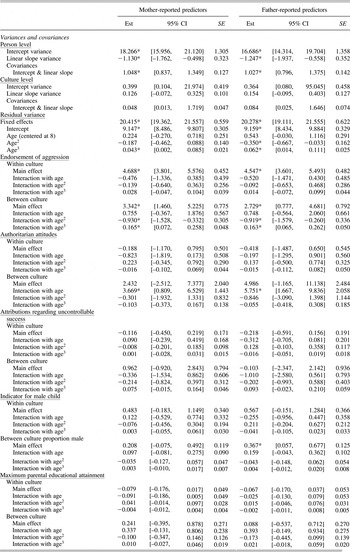
Given that the attributions regarding uncontrollable success and authoritarian attitudes predictors are only reported by parents, the model is estimated twice: once for predictors from each parent. The first three columns of Table 6 provide the results when child- and mother-reported predictors are included in the model. After adding the predictors, the individual-level intercept and linear slope variances remain significant (intercept: est = 18.266, 95% CI [15.956, 21.120], SE = 1.305, p < .001; linear slope: est = 1.048, 95% CI [0.837, 1.349], SE = 0.127, p < .001). A 1 unit increase in child-reported endorsement of aggression above the culture mean is associated with a 4.688 increase in child-reported child externalizing behavior at age 8 (95% CI [3.801, 5.576], SE = 0.452, p < .0001), providing support for our second hypothesis, that children's greater endorsement of aggression would predict elevated child externalizing behavior trajectories. The pseudo-R 2 indicates that within-culture differences in endorsement of aggression explain 16.7% of the individual-level random intercept variance.
Multilevel model results with predictors for child-reported externalizing problem behavior

Note: Est, unstandardized estimate. 95% CI, 95% confidence interval. SE, standard error. *Denotes estimates that are significant at the p < .05 level.
After adding predictors, neither the culture-level intercept variance (est = 0.399, 95% CI [0.104, 21.974], SE = 0.419, p = .171) nor the linear slope variance (est = 0.048, 95% CI [0.013, 1.719], SE = 0.047, p = .155) is statistically significant, providing evidence that the culture-level predictors explain the culture-level variance in the intercept and slope. There are several significant culture-level predictors that provide insights into our third hypothesis, that prediction from parents’ and children's cognitions to children's externalizing behavior trajectories would be augmented by culture-level cognitive norms above and beyond individual-level cognitions. In cultures in which children, on average, report higher endorsement of aggression than the grand mean, children also report higher levels of externalizing behavior at age 8, on average (est = 3.342, 95% CI [1.460, 5.225], SE = 0.775, p = .005). The pseudo-R 2 indicates that between-culture differences in endorsement of aggression explain 29.0% of the between-culture random intercept variance. This effect, however, is not statistically different from the within-culture effect described above (difference = –1.346, 95% CI [–3.321, 0.629], SE = 0.899, p = .162).
In addition, the interaction between mother-reported authoritarian attitudes and age is significant, indicating that the estimated rate of increase in child-reported externalizing behavior over time is higher in cultures in which mean mother-reported authoritarian attitudes is higher than the grand mean (est = 3.669, 95% CI [0.809, 6.529], SE = 1.443, p = .012). The pseudo-R 2 for this interaction, however, is negative (–.164), indicating that its inclusion increases the between-culture linear slope variance rather than decreases it. This unexpected result is due to the interdependent approximations used to create this statistic (Hoffman, Reference Hoffman2015). This effect is statistically different from the nonsignificant within-culture interaction between mother-reported authoritarian attitudes and age (difference = 4.492, 95% CI [1.475, 7.509], SE = 1.526, p = .004). Finally, there is evidence that between-culture differences in child-reported endorsement of aggression impact the age2 and age3 parameters of the child-reported trajectory of externalizing behavior. In cultures in which child-reported endorsement of aggression is stronger than the grand mean, the deceleration of the increasing externalizing behavior trajectory is more pronounced (Endorsement of Aggression × Age2 est = –0.930, 95% CI [–1.528, –0.332], SE = 0.305, p = .002), and that deceleration weakens faster over time (Endorsement of Aggression × Age3 est = 0.165, 95% CI [–0.072, 0.258], SE = 0.048, p = .001). These effects are statistically different from the nonsignificant within-culture interactions (Endorsement of Aggression × Age2 difference = –0.792, 95% CI [–1.560, –0.023], SE = 0.392, p = .043; Endorsement of Aggression × Age3 difference = 0.137, 95% CI [0.018, 0.256], SE = 0.061, p = .024). The pseudo-R 2 statistics cannot be calculated because the model did not support random culture-level quadratic or cubic slope parameters.
The last three columns of Table 6 provide the results when father-reported predictors are included in the model rather than mother reports. The pattern of results for the predictors of interest and their implications for the hypotheses are identical to those when mother-reported predictors are included. These results are, therefore, not discussed in detail here.
Discussion
Using a sample of children followed longitudinally from age 7 to 14 and their mothers and fathers from 12 cultural groups in nine countries, we examined individual- and culture-level variation in trajectories of children's externalizing behaviors as well as parenting cognition predictors of the trajectories. We found that the average trajectory of externalizing behavior from age 7 to 14 varies more across individuals within cultures than between cultures. In addition, we found that within-culture differences in parents’ and children's endorsement of aggression and parents’ authoritarian attitudes predicted trajectories of externalizing behavior over time. Furthermore, between-culture differences in endorsement of aggression and authoritarian attitudes augmented prediction of externalizing trajectories above and beyond within-culture differences in endorsement of aggression and authoritarian attitudes.
With respect to our first research hypothesis, we found that the intercept and linear slope of children's externalizing behavior trajectories varied both across individuals within cultures and across cultural groups, and that the variance was larger at the individual level than at the culture level. Nevertheless, 10.5%, 12.1%, and 8.6% of the intercept variance and 5.1%, 1.5%, and 3.0% of the linear slope variance in mother, father, and child reports of child externalizing, respectively, were accounted for by culture. These findings are consistent with evidence from previous research regarding cross-cultural consistency in extreme forms of externalizing behavior demonstrated in the age-crime curve (Hirschi & Gottfredson, Reference Hirschi and Gottfredson1983), as well as analyses parsing variance in a range of parenting and child adjustment variables that found more variance at the within- than the between-culture level (Deater-Deckard et al., Reference Deater-Deckard, Godwin, Lansford, Bacchini, Bombi, Bornstein and Al-Hassan2018). Externalizing trajectories entail both aggression and delinquency. Commonalities across cultures in aggression and delinquency may be a function of susceptibility to peer influence and a desire to enact adultlike behaviors that might increase during the developmental transition from age 7 to 14 (Moffitt, Reference Moffitt1993). The child-reported externalizing trajectory increased over this developmental period across cultures in the present study, perhaps reflecting this developmental phenomenon.
Part of the explanation for the greater variability within than between cultures might also be accounted for as a methodological artifact of the rating scale used in the Child Behavior Checklist and Youth Self-Report, which was the measure of externalizing behavior in this study. That is, when parents and children report whether each item is not true, sometimes true, or often true of the child, parents and children are likely making implicit comparisons to a culturally based standard for how children should behave or how they regard the child's or their own behavior in relation to their local peers. In one cultural group, it is possible that arguing or being disobedient once a week would be considered “often,” whereas in another cultural group, arguing or disobedience would have to occur daily to be considered “often.” Thus, rating scales that reflect concrete time frames, such as once a day, once a week, or once a month, might show larger differences between cultural groups than rating scales that have more subjective interpretation embedded in them.
With respect to our second hypothesis, we found that mothers’ and children's endorsement of aggression as well as mothers’ authoritarian attitudes predicted higher age 8 intercepts of child externalizing behaviors. Among fathers, greater attributions regarding uncontrollable success in caregiving situations were associated with steeper declines in externalizing over time. Mothers’ and children's endorsement of aggression in hypothetical situations maps onto the construct of response evaluation in social information processing models of aggression (Crick & Dodge, Reference Crick and Dodge1994). Individuals who positively evaluate aggressive responses have been theorized and empirically found to engage in more aggressive behavior than individuals who negatively evaluate aggressive responses (Fontaine et al., Reference Fontaine, Yang, Dodge, Pettit and Bates2009). Our findings that children's endorsement of aggression predict their externalizing behavior trajectories are consistent with these social information processing models. In addition, our findings extend beyond social information processing models (Crick & Dodge, Reference Crick and Dodge1994), which focus on how individuals’ cognitions are related to their own behavior, to demonstrate that mothers’ cognitions also are related to their children's behavior. This suggests that mothers who hold beliefs that are more endorsing of aggression intentionally or unintentionally communicate these beliefs to their children. For example, if mothers believe that it is acceptable to retaliate with aggression if someone else acts verbally or physically aggressive, then mothers may be less likely to respond unfavorably if their child gets in a fight with another child and may be less likely to discuss alternative responses to aggression with their children. Mothers who endorse aggressive responding may even explicitly socialize their children to behave aggressively in certain situations.
With respect to our third hypothesis, prediction from individual-level authoritarian attitudes to more child externalizing behaviors was augmented by prediction from cultural-level authoritarian attitudes. That is, beyond the individual-level effect of authoritarian attitudes, cultures in which mothers and fathers report higher authoritarian attitudes, on average, also reported that their child engaged in more externalizing behaviors at age 8 on average. In addition, cultures with higher authoritarian attitudes among mothers also report steeper increases in child-reported externalizing behavior over time, and cultures with higher authoritarian attitudes among fathers also report less steep declines in father-reported externalizing behavior over time, and the deceleration of the decline is faster over time. Early research on authoritarian attitudes suggested that whereas parents’ authoritative parenting was related to optimal development for European American children, authoritarian parenting could be more adaptive for the development of African American children (Baumrind, Reference Baumrind1972), a finding that has been replicated in some studies (e.g., Brody & Flor, Reference Brody and Flor1998) but not others (see Tamis-LeMonda, Briggs, McClowry, & Snow, Reference Tamis-LeMonda, Briggs, McClowry and Snow2008). Likewise, in early examinations of authoritarian parenting in China, some research suggested that authoritarian parenting could be more adaptive in Chinese than in European American families in which the construct was originally developed (Chao, Reference Chao1994). However, subsequent research has called those early findings into question and suggested that authoritative parenting, compared to authoritarian parenting, is related to better school performance in China as in the United States (McBride-Chang & Chang, Reference McBride-Chang and Chang1998; Pong, Johnston, & Chen, Reference Pong, Johnston and Chen2010). Our findings that parents with more authoritarian attitudes than the within-culture mean as well as cultural groups higher in authoritarian attitudes than the grand mean across cultures were more likely to have children with elevated externalizing behavior trajectories are consistent with meta-analytic findings that more authoritarian attitudes are related to more child externalizing behavior in a range of cultural groups (Pinquart & Kauser, Reference Pinquart and Kauser2018).
Patterns of findings with mother- and father-reported child externalizing problems were quite similar. Trajectories themselves looked different for child-reported externalizing compared to parent-reported externalizing, with an increasing slope of externalizing behavior based on children's own reports but decreasing slopes based on parents’ reports. These reporter differences in the pattern of trajectories may reflect developmental shifts that occur over the period from the age of 7 to 14. In particular, as children move into adolescence, externalizing behaviors may become less visible to parents (e.g., if adolescents engage in problem behaviors in covert ways, in the presence of peers rather than parents, and do not disclose to parents). However, despite the differences in the trajectories themselves based on parent versus child report, the predictors of the trajectories were similar across mother, father, and child reports. That is, mothers’ and children's endorsement of aggression in hypothetical situations that was higher than their culture mean was related to elevated trajectories of children's externalizing behavior problems.
Limitations
Our modeling strategy parsed variance into individual- and cultural-level components, but we did not make group comparisons that would indicate, for example, that children in one country were higher or lower on externalizing behavior scores than children in another. Two analytic approaches that are most appropriate for handling families nested within cultures are multilevel models (the approach we adopted here) and multigroup structural equation models. The structural equation model framework estimates group-specific growth parameters. Differences in the parameters between groups can be tested for statistical significance, and different group trajectories can be graphed. These features are not available for multilevel models, but the multilevel model framework allowed us to investigate the cultural-level variables that explain the variation in growth parameters in child externalizing behaviors across sites, which was an important goal in our analyses.
Our analyses focused on a broadband externalizing behavior scale as reported by mothers, fathers, and children. A direction for future research will be to disentangle different types of externalizing behaviors, an exercise that might reveal stronger culture-level effects than were found using the broadband scales. The sample in the present study was 14 years old at the end of the study period, too young to have experienced many of the health-compromising and risky behaviors, such as substance use and unprotected intercourse, that become more common later in adolescence. Health-compromising risk taking may be affected by particular parenting and cultural contexts because it depends on adolescents having the opportunity to engage in the risky behavior. For example, adolescents’ opportunity to engage in unprotected sex is likely a function of parents’ monitoring and supervision, cultural norms regarding adolescents’ sexual behaviors, norms regarding how much unstructured and unsupervised time adolescents have, and the availability of condoms (Durex Network, 2005; Jernigan, Reference Jernigan2001). Likewise, if alcohol, cigarettes, and other drugs are unavailable in a given culture or are shunned for religious or other cultural reasons (Haddad, Shotar, Umlauf, & Al-Zyoud, Reference Haddad, Shotar, Umlauf and Al-Zyoud2010), then adolescents will have limited opportunity or desire to use them. In contrast, other risk taking is likely to be less parenting and culture specific because behaviors, such as aggression and stealing, can occur anywhere and are not as highly dependent on access to opportunity. Thus, broadband externalizing that is heavily weighted toward aggressive behavior, as in the present study, may be more cross-culturally generalizable than specific forms of health-compromising risky behaviors.
Just as extending examinations of externalizing trajectories beyond the age of 14 years would be developmentally informative, so too would extending examinations of externalizing trajectories earlier than age 7. Clearly, by the time of our first assessment, many parenting and cultural factors had already set in motion externalizing trajectories, and children's temperaments and earlier externalizing behaviors would have elicited particular reactions from parents. Although we treated parents’ highest educational attainment, endorsement of aggression, attributions regarding uncontrollable success, and authoritarian parenting attitudes assessed at Wave 1 as time invariant, we recognize that they may have changed over time. The reciprocal and transactional relations between children's externalizing behaviors and parents’ attitudes and attributions cannot be disentangled from the data presented in this study. It is developmentally plausible that children who display more externalizing behaviors, for example, might alter their parents’ attitudes and attributions such that in the face of high levels of externalizing, parents may be more likely to attribute success in caregiving situations to factors outside of their control or adopt more authoritarian attitudes to try to reign in their children's externalizing problems.
We focused on the development of externalizing behavior trajectories without also considering internalizing behavior trajectories. Externalizing and internalizing behaviors are often comorbid (Angold, Costello, & Erkanli, Reference Angold, Costello and Erkanli1999), so externalizing and internalizing trajectories may show similarities. However, some children have externalizing problems in the absence of internalizing problems or vice versa (Fanti & Henrich, Reference Fanti and Henrich2010), so examining internalizing as well as externalizing trajectories will be necessary for a more complete understanding of the development of psychopathology. Furthermore, different cultural groups may regard externalizing problems or internalizing problems as more concerning than other cultural groups (Weisz, Sigman, Weiss, & Mosk, Reference Weisz, Sigman, Weiss and Mosk1993), making it important to consider cultural differences in trajectories of internalizing as well as externalizing behaviors.
Implications for the development and implementation of evidence-based interventions
Without intervention, externalizing behavior problems are highly stable over time. For example, over the course of 10 years, aggression had a stability correlation of .60 in a review of 16 longitudinal studies (Olweus, Reference Olweus1979). Similarly, at age 30, the most aggressive individuals in a prospective longitudinal study were the individuals who had been most aggressive at age 8, with stability coefficients over the 22-year period of .50 and .35 for boys and girls, respectively (Huesmann, Eron, Lefkowitz, & Walder, Reference Huesmann, Eron, Lefkowitz and Walder1984). Social cognition is less stable over time than aggression (Lansford, Malone, Dodge, Pettit, & Bates, Reference Lansford, Malone, Dodge, Pettit and Bates2010), making social cognition a promising intervention target in efforts to reduce externalizing behavior problems. Cognition becomes a better predictor of behavior as children develop from early to later childhood (Davis-Kean et al., Reference Davis-Kean, Huesmann, Jager, Collins, Bates and Lansford2008), suggesting that early intervention with children could disrupt the development of externalizing behavior trajectories.
Several social and cognitive skills training programs have been developed for implementation in school settings. For example, the Promoting Alternative Thinking Strategies (PATHS) curriculum and the Second Step program aim to reduce aggression by changing children's social cognition. In randomized control trials, the PATHS intervention decreased children's externalizing behavior problems by improving their social problem-solving skills (e.g., Greenberg, Kusche, Cook, & Quamma, Reference Greenberg, Kusche, Cook and Quamma1995). Similarly, children in schools randomized to participate in Second Step show better social problem-solving skills and less aggression than children in control schools (Espelage, Low, Polanin, & Brown, Reference Espelage, Low, Polanin and Brown2013; Low, Cook, Smolkowski, & Buntain-Ricklefs, Reference Low, Cook, Smolkowski and Buntain-Ricklefs2015).
Our findings that children's own endorsements of aggression were related to trajectories of their externalizing behavior problems and that parents’ endorsement of aggression and authoritarian attitudes also were related to children's externalizing trajectories suggest that interventions targeting parents’ cognitions might also be promising. Changing parents’ beliefs and attitudes is often incorporated in parent training programs that are ultimately trying to change parents’ and children's behavior (Holden, Brown, Baldwin, & Croft Caderao, Reference Holden, Brown, Baldwin and Croft Caderao2014).
Less common, but potentially also effective, are community-wide interventions designed to change culture-level beliefs and attitudes. Such interventions can be accomplished through efforts such as the “Safe to Sleep” (formerly “Back-to-Sleep”) public awareness campaign that effectively changed American parents’ beliefs about how to place their infants to sleep safely such that the percentage of infants placed to sleep on their back increased from 17% in 1993 (the year before the campaign started) to 73% in 2010, with a correspondingly high drop in rates of sudden infant death (American Academy of Pediatrics, 2018), suggesting that community-wide efforts to change parents’ beliefs have the potential to effect change on a large scale. Changes in laws, such as outlawing corporal punishment in the 53 countries that have done so as of July 2018 (http://www.endcorporalpunishment.org/), are also sometimes intended as public instantiations of cultural beliefs about the appropriateness (or not) of particular parenting behaviors (Zolotor & Puzia, Reference Zolotor and Puzia2010).
Because previous public awareness campaigns, such as “Safe to Sleep,” have been effective in changing community-level beliefs and behaviors related to parenting, future interventions that focus on promoting changes in parents’ and children's cultural attitudes and beliefs as a way to prevent the development of externalizing problems hold promise. Individuals who live in “cultures of honor” (Nisbett & Cohen, Reference Nisbett and Cohen1996) are more likely to react to provocation with aggression than are individuals who live in cultures that are less accepting of aggressive responding. Our findings suggest that reducing parents’ authoritarian attitudes and parents’ and children's endorsement of aggression could alter trajectories of children's externalizing behaviors not only at the level of individual children but also at a cultural level.
Conclusions and future directions
In addition to disentangling different forms of externalizing behavior, future research should attend to mechanisms by which parents’ cognitions affect their behaviors and, in turn, children's developmental trajectories (Bornstein, Putnick, & Suwalsky, Reference Bornstein, Putnick and Suwalsky2018). Although beliefs and behaviors are not always well aligned (Lansford & Deater-Deckard, Reference Lansford and Deater-Deckard2012), a primary reason that parents’ attributions and attitudes would be expected to relate to children's externalizing behavior is that parents’ cognitions in theory should affect parenting practices and the types of environments that parents supply. For example, if parents endorse aggression, they might be less likely to punish their children for behaving aggressively, more likely to use aggression in caregiving situations (e.g., corporal punishment rather than verbal reasoning), and more likely to convey to children their belief in the acceptability of aggression, thereby socializing more aggressive behaviors in their children. If parents attribute success in caregiving situations to factors outside of their control, then they may be less likely to intervene to try to change their children's behavior if problems arise, believing child behavior to be uncontrollable. Future research could model specific pathways from parents’ cognition to parents’ behavior to children's behavior, using multilevel models to account for individual- as well as culture-level norms about beliefs and behaviors.
Future research also will benefit from tests of how biological and socializing forces act in conjunction with one another to shape trajectories of child externalizing behavior. Specifically, the increase in risk-taking behavior that occurs at puberty may be more biologically driven (Steinberg, Reference Steinberg2008), whereas the diminution of risk-taking behavior in later adolescence may be more dependent on parenting behaviors and cultural contexts. In a cross-sectional sample of 10- to 30-year-olds from 11 countries (including the 9 in the present study), propensity for risk taking in lab-based tasks as well as reported risk taking in the real world followed an inverted U-shaped curve that increased in adolescence and decreased in early adulthood; differences across countries were more pronounced in real-world risk taking than lab-based propensity for risk taking (Duell et al., Reference Duell, Steinberg, Icenogle, Chein, Al-Hassan, Takash and Alampay2018). These findings suggest the need to continue unpacking culture-level factors such as values, beliefs, and opportunities that might moderate patterns of development of externalizing behaviors.
In 12 diverse cultural groups in nine countries, we found that the development of externalizing behaviors from age 7 to 14 followed a curvilinear trajectory according to mothers’, fathers’, and children's reports. Mothers and fathers had similar perspectives in regarding their children's externalizing behaviors as declining over this age period, whereas children regarded themselves as increasing in externalizing behaviors over this same developmental period. The cross-cultural similarity in the pattern of trajectories was notable. At the same time, culture-level as well as individual-level authoritarian parenting attitudes and endorsement of aggression predicted mean levels of externalizing behaviors and developmental change over time. These findings imply that mechanisms linking authoritarian attitudes and cognitions endorsing aggression are cross-culturally generalizable, as are developmental trajectories of externalizing behaviors themselves.
Attending to cultural-level as well as individual-level factors is a new frontier in developmental psychopathology (Causadias, Reference Causadias2013). In nine diverse countries, culture-level endorsement of aggression and authoritarian parenting attitudes augmented the prediction of mothers’, fathers’, and children's reports of children's externalizing behavior trajectories from age 7 to 14, above and beyond individual-level endorsement of aggression and authoritarian attitudes. Understanding cultural-level as well as individual-level correlates of children's externalizing behavior offers potential insights into prevention and intervention efforts that can be targeted not only at individual children and parents but also at cultural norms that increase the risk of externalizing behavior.