1. Introduction
It has been proposed by van der Hulst (Reference van der Hulst, van der Hulst, Goedemans and van Zanten2010) that it may be expedient to hypothesize that all languages have some (lexical) stress/accent property. He provides a number of potential manifestations of accented syllables, beyond the usual acoustic properties (e.g. duration, fundamental frequency (f0)), including such phenomena as phonotactic patterns and effects on morphological processes, which may be overlooked, and thus the apparent absence of accent in some languages could be due to the fact that the relevant phenomena have not been found (van der Hulst Reference van der Hulst, van der Hulst, Goedemans and van Zanten2010: 8).
It is philosophically problematic to prove the non-existence of a phenomenon,Footnote 2 and stress is particularly interesting in this regard. As linguists, we are quite comfortable saying that Arabic lacks a phoneme /p/, or that English lacks front rounded vowels, or tones; however, we find ourselves in a quandary when it comes to stress. We cannot rely on the absence of a contrast in a language, since stress does not have to be contrastive (e.g. fixed initial stress in Hungarian).Footnote 3 As we could in principle examine all of the words in Arabic, and determine that there are no instances of /p/, we could examine all of the words of a language like Indonesian; however, we would still not be able to determine with similar conviction that there is no stress in the language. To some extent the problem can be attributed to the fact that stress may be manifested in different ways, involving a number of acoustic properties, so it is not always clear what should be considered stress (e.g. Beckman Reference Beckman1986, Beckman & Edwards Reference Beckman, Edwards and Keating1994). In addition, the properties associated with stress tend to be particularly subject to alteration by multiple types of other linguistic and extra-linguistic phenomena (e.g. grammatical and information structure, pragmatics, individual differences, etc.).
Despite the challenges of determining the absence of stress, some languages have been considered to lack lexical stress.Footnote 4 In this paper, we investigate such a language, Standard Indonesian (as spoken in Jakarta), and seek – with both descriptive and statistical analyses – acoustic patterns that might be considered evidence of stress. Since none of our analyses reveals the presence of lexical stress, we cannot support the ‘expedient’ approach of assuming that all languages have such stress, at least as defined by specific acoustic properties. Our findings thus corroborate those of other recent studies that have argued that lexical stress is absent from Standard Indonesian – when a host of potentially confounding phenomena (e.g. substrate language/s of speakers) are controlled for (e.g. Goedemans & van Zanten Reference Goedemans, van Zanten, van Heuven and van Zanten2007).
The present large-scale acoustic investigation also serves to complement the findings of a number of previous studies where the focus tended to be more on stress perception. Thus, even if we cannot prove the non-existence of stress, we conclude that the converging results from the different types of methodologies constitute strong evidence that Indonesian is indeed stressless, and from a typological perspective, such a language category that has no stress, tone, or pitch-accent at the word level must be recognized. Moreover, although we do not find acoustic patterns that provide support for a lexical level prominence, we do find evidence of a broader prosodic pattern, which we suggest is consistent with the manifestation of focus, which in a language that has no lexical prominence is manifested as a boundary tone.
In the following sections, we discuss previous research on Indonesian (Section 2) and we present our study (Sections 3 and 4) and results (Section 5). Discussion of our findings (Section 6) and general conclusions follow (Section 7).
2. Previous studies of Indonesian stress
Since there is a good deal of variation across Indonesian dialects, we limit our attention to the literature pertaining to the standard Indonesian variety studied here or varieties with similar prosody. Discussion of other varieties is included where relevant to the present investigation. Various studies use different terms to refer to lexical prominence; to avoid confusion, we consistently use the term ‘stress’, unless otherwise noted.
2.1 Conflicting claims
Given the observation that in the StressTyp database, 67% of the Austronesian languages exhibit fixed stress, and 28% exhibit a right-bounded stress system (van Zanten & Goedemans Reference van Zanten, Goedemans, van Heuven and van Zanten2007), we could expect Indonesian to be a stress language. Van Zanten & Goedemans (Reference van Zanten, Goedemans, van Heuven and van Zanten2007) caution, however, that such numbers may not be accurate due to errors in the sources consulted for the database. In fact, such errors may be especially prevalent in Austronesian languages, where stress is frequently characterized as weak, or difficult to distinguish (van Zanten, Stoel & Remijsen Reference van Zanten, Stoel, Remijsen, Goedemans, van der Hulst and van Zanten2010). Indeed, various studies of word-level prominence, or stress, in Indonesian have claimed either that it does not exist, or that it does exist, but in the latter case, there is controversy with respect to where it falls. That is, proposals include the possibility that stress is final, penultimate or variable.Footnote 5
Some of the variability in the claims appears to be due to different views of the role of schwa in the language. While some researchers argue that a penultimate syllable with a schwa cannot be stressed, causing stress to be shifted to the final position (Halim Reference Halim1974, Reference Halim1981; Cohn Reference Cohn1989), others argue that such a syllable can be stressed (Laksman Reference Laksman, Odé, van Heuven and van Zanten1994), although the stress may optionally shift to the final position (as reported in Roosman Reference Roosman, van Heuven and van Zanten2007 for several early studies). As seen in the following overview of the main findings of recent perception and production studies, additional sources of variability likely underlie not only the schwa issue, but the overall lack of agreement regarding stress in Indonesian.
2.2 Perception studies
Given the problems posed by demonstrating the absence of stress, most recent research on Indonesian prosody addresses the issue indirectly by investigating the perception of stress. In these studies, Indonesian speakers are tasked with perceiving stress in (i) their own non-stress language (van Heuven & van Zanten Reference van Heuven and van Zanten1997; van Zanten & van Heuven Reference van Zanten and van Heuven1998, Reference van Zanten and van Heuven2004; van Zanten, Goedemans & Pacilly Reference van Zanten, Goedemans, Pacilly, van de Weijer, van Heuven and van der Hulst2003; van Zanten & Goedemans Reference van Zanten, Goedemans, van Heuven and van Zanten2007, Reference van Zanten and Goedemans2009), (ii) another variety of Indonesian that has stress (e.g. Indonesian with Toba Batak substrate, see van Zanten et al. Reference van Zanten, Goedemans, Pacilly, van de Weijer, van Heuven and van der Hulst2003; van Zanten & Goedemans Reference Goedemans, van Zanten, van Heuven and van Zanten2007, Reference van Zanten and Goedemans2009), (iii) a different L2 with stress (e.g. Dutch, see van Heuven & Faust Reference van Heuven and Faust2009), or (iv) nonce words (Rahmani, Rietveld & Gussenhoven Reference Rahmani, Rietveld and Gussenhoven2015).
The reasoning is that if speakers of a language do not reliably distinguish pairs like pápa vs. papá, while speakers of some other variety or another language do, one may deduce that the first language does not have stress. In the absence of an (underlying) phonological category of stress, speakers are unable to systematically recognize and represent its properties, resulting in their ‘stress deafness’. Thus, the fact that speakers of varieties of Indonesian such as Javanese, are not sensitive to differences in stress position (i.e. they accept words stressed in any position as equally good), is taken as an indication that these varieties are stressless, like Standard (Jakarta) Indonesian. By contrast, the fact that speakers of Toba Batak Indonesian perceive stress and can produce the requisite acoustic properties in different positions, is taken as an indication that this variety does have an underlying stress category (e.g. Goedemans & van Zanten Reference Goedemans, van Zanten, van Heuven and van Zanten2007, van Zanten & Goedemans Reference van Zanten and Goedemans2009).
Such demonstrations of prosodic differences between varieties of Indonesian shed light on many discrepancies found in earlier research, where the participants may have had different substrate dialects and languages (see Prentice Reference Prentice, Dutton and Tryon1994, van Heuven & van Zanten Reference van Heuven and van Zanten2007), including some with stress and tones (e.g. Remijsen Reference Remijsen, van Heuven and van Zanten2007).Footnote 6 It is thus clear that the findings of earlier studies without substrate controls cannot be taken as evidence for any position regarding Indonesian stress; and moreover, in order for any investigation to produce reliable prosodic information, it must carefully control for the linguistic substrate of the speakers.
More generally, however, caution must be exercised in assessing the presence of stress in a language based solely on speakers’ perceptual behavior. While it seems reasonable to conclude that speakers who consistently perceive stress have stress in their language or language variety, it has also been found that speakers of some stressless languages, for example Mandarin, also perceive stress, where their behavior may be attributable to a different category that often has similar acoustic properties, in this case tone (e.g. Altmann Reference Altmann2006). Moreover, it is not the case that speakers of all languages with stress are able to perceive it. To the contrary, the best known cases of ‘stress deafness’ have been observed in speakers of stress languages, specifically ones with predictable stress such as Hungarian, French and Turkish (e.g. Peperkamp & Dupoux Reference Peperkamp, Dupoux, Gussenhoven and Warner2002, Altmann Reference Altmann2006, Peperkamp, Vendelin & Dupoux Reference Peperkamp, Vendelin and Dupoux2010, Rahmani et al. Reference Rahmani, Rietveld and Gussenhoven2015).Footnote 7 Thus, in order to accurately interpret speakers’ ability or inability to perceive stress, it is imperative that speech production patterns be considered as well.
2.3 Production studies
Several recent production studies of Indonesian stress have carefully controlled for the linguistic substrate of the speakers and other structural factors. Although these studies examine different varieties of Indonesian (i.e. Javanese Indonesian, Betawi Malay, Ambonese Malay), their findings are relevant to the present study since, like Standard (Jakarta) Indonesian, they are considered to lack stress.
One of the first studies to systematically control for the substrate language of the participants is that of Goedemans & van Zanten (Reference Goedemans, van Zanten, van Heuven and van Zanten2007), which uses the same data reported in van Zanten et al. (Reference van Zanten, Goedemans, Pacilly, van de Weijer, van Heuven and van der Hulst2003), as does van Zanten & Goedemans (Reference van Zanten and Goedemans2009). Crucially, a comparison is made between speakers of Javanese Indonesian, with a stressless substrate, and speakers of Toba Batak Indonesian, with a substrate with variable (penultimate or final) stress. Since the main focus of Goedemans & van Zanten (Reference Goedemans, van Zanten, van Heuven and van Zanten2007) was perception, the production data consist only of the speech recorded for the purposes of the perception study: six four-syllable words produced in focus and non-focus conditions, repeated twice, by one speaker of each variety (= 24 words per speaker). Although the corpus is relatively small, it is noteworthy since it was designed to permit a comparison of word prosody in contexts with and without focus, as illustrated in (1). There is a potential problem, however, in interpreting the findings since the target ‘X’ in the focus condition is also utterance-final, and may thus exhibit utterance-boundary properties along with those of stress and focus. This means that the acoustic properties measured in (1) are not just stress properties but also focus and utterance-boundary properties. In this and other examples, the focus element is in bold.

Differences were nevertheless observed between the two varieties of Indonesian examined based on measurements of each target for: the duration of each segment, the intensity peak of each vowel and the f0 and timing of several pivotal points in the pitch contour. As expected, clear evidence of penultimate stress (increased duration and loudness) emerged in the Toba Batak Indonesian speech sample; in the focus condition, a pitch difference was also noted. By contrast, and as might be expected, none of the properties measured in either focus condition yielded a pattern that could be interpreted as stress in the Javanese Indonesian speech. There was, however, evidence in both conditions of a pitch movement towards the right edge of the word (on or near the penultimate syllable), consistent with the signaling of a higher-level prominence. In the non-focus context, the pitch movement consisted of a rise on the penultimate syllable, while in the focus (and sentence-final) context, it was a fall between the last two syllables.
Analogous results are reported in another carefully controlled study, Roosman (Reference Roosman, van Heuven and van Zanten2007), which examined the same data reported in Roosman (Reference Roosman2006), and subsequently also in van Heuven, Roosman & van Zanten (Reference van Heuven, Roosman and van Zanten2008). This study compared Toba Batak, a stress language, with Betawi Malay, which has essentially the same prosodic system as Standard Indonesian (Roosman Reference Roosman, van Heuven and van Zanten2007). For each language, in addition to manipulating the focus context of the target word, Roosman (Reference Roosman, van Heuven and van Zanten2007) also manipulated the position of the word in the utterance and the presence of a schwa in the penultimate syllable. The corpus contained data from four speakers of each language. The speakers produced eight two- or three-syllable words in both utterance-medial and final positions, in focus and non-focus contexts primed by different questions, and repeated three times (= 96 tokens per speaker). The carriers for Betawi Malay are shown in (2).Footnote 9

Since the study focused on the pitch properties of the words, there is not as much information about other acoustic properties. With regard to the pitch alignment in the four conditions, Roosman (Reference Roosman, van Heuven and van Zanten2007) found that Toba Batak clearly exhibits stress on the penultimate syllable, signaled with a H*L pitch contour, in both focus contexts. Betawi Malay was also found to exhibit a H*L pitch contour, however, it was only observed under focus, and its alignment was not limited to the penultimate syllable, but varied between the last two syllables. Roosman (Reference Roosman, van Heuven and van Zanten2007) thus proposes that in Betawi Malay the penultimate syllable is the default position for the pitch contour (referred to as accent), but the contour may shift to the final syllable under certain circumstances: when the penultimate syllable contains a schwa, or when the word appears at the end of an utterance.
In another recent study of the production of word level prosody that controlled for the substrate language of the participants, Maskikit-Essed & Gussenhoven (Reference Maskikit-Essed and Gussenhoven2016), examined Ambonese Malay, another stressless variety of Indonesian, in comparison with Dutch, a stress language. Possible discourse effects were tested in the comparison of declarative, polar interrogative, and continuative declarative contexts. The effects of position in the Intonational Phrase (IP) (medial vs. final) and focus (target focused or post-focal) were also tested. The corpus consisted of data from four native speakers of Ambonese Malay who produced eight words (seven disyllabic, one trisyllabic) in different short dialogues such that the target appeared in utterance-medial or final position in three distinct discourse contexts, and in sentence-final position (in two sentences) with focus or post-focally (= 80 items per speaker). It may be noted that a potential problem arises in this last comparison, since the target is always utterance-final, as shown in the Q(uestion)–A(nswer) dialogues in (3). (The focused word is in bold; the target word is underlined.)

Aside from the fact that the target always appears at the end of a sentence, the fact that it appears following the focused element in the non-focus context also introduces the possibility of post-focal compression, the reduction of pitch and amplitude differences in the words following a focused item (for discussion of post-focal compression see Xu Reference Xu2011, Xu, Chen & Wang Reference Xu, Chen and Wang2012). Maskikit-Essed & Gussenhoven (Reference Maskikit-Essed and Gussenhoven2016), however, report that no compression was observed.
While this study only included four speakers and eight target words, it is more comprehensive in its conditions and analyses than the previous two studies. It is thus noteworthy that Maskikit-Essed & Gussenhoven (Reference Maskikit-Essed and Gussenhoven2016) also found no acoustic evidence of stress, although they did observe certain duration and spectral balance patterns consistent with a (intonational) pitch accent towards the right end of the word. Since it was found that the pitch accent properties could not be consistently associated with a specific syllable, as they would be in a stress language such as Dutch, it was proposed that this variable alignment is a general characteristic of the language, as opposed to being due to an optional, but specific, ‘accent’ shift process that may apply in the presence of schwa or in utterance-final position (Roosman Reference Roosman, van Heuven and van Zanten2007). While Maskikit-Essed & Gussenhoven’s (Reference Maskikit-Essed and Gussenhoven2016) findings mostly accorded with previous findings, there was a difference in focus, specifically, the absence of any pitch or durational differences between the focus and non-focus contexts. While at first glance this is somewhat surprising, since the items in the non-focus context follow the focused word, it may be related to the absence of post-focal compression noted by the authors, a possibility that merits further examination.
Overall, the picture that emerges from these recent production studies is that there is a clear distinction between (i) languages and language varieties in Indonesia that exhibit stress (e.g. Toba Batak Indonesian, like the substrate language Toba Batak) and (ii) others that show no acoustic pattern that could be interpreted as stress (e.g. Javanese Indonesian, Betawi Malay, Ambonese Malay). While duration and intensity are the properties associated with stress in the stress varieties of Indonesian, they do not play a consistent role in the stressless varieties, which at best exhibit some final lengthening. In all varieties, however, pitch is an important property, since a pitch contour occurs towards the end of words, aligning with the stressed syllable in the stress varieties, or someplace within the last two syllables in the stressless varieties. The nature of the pitch pattern remains somewhat controversial, being considered a pitch accent (H*L) aligned with a specific syllable by Goedemans & van Zanten (Reference Goedemans, van Zanten, van Heuven and van Zanten2007) and Roosman (Reference Roosman, van Heuven and van Zanten2007), but a floating boundary tone (H%L%) not associated with any specific syllable by Maskikit-Essed & Gussenhoven (Reference Maskikit-Essed and Gussenhoven2016). Finally, it also remains unclear whether the presence of focus results in a change in the word prosody in the stressless varieties: according to Goedemans & van Zanten (Reference Goedemans, van Zanten, van Heuven and van Zanten2007) and Roosman (Reference Roosman, van Heuven and van Zanten2007), focus does have an effect, but a similar effect is not observed by Maskikit-Essed & Gussenhoven (Reference Maskikit-Essed and Gussenhoven2016). Further investigation is needed to determine whether the discrepancies are due to the language varieties examined, the experimental conditions, or other methodological differences.
2.4 Methodological differences across studies
Given the complexity of the linguistic situation of Indonesia, failing to properly control for substrate differences has undoubtedly led to some of the controversy surrounding the issue of stress in Indonesian. There are also several more general methodological practices that have introduced complications and confounds into the majority of earlier stress production studies across languages, including Indonesian, raising questions about their findings.Footnote 10 For example, in many studies, especially the older ones, measurements are pooled across speakers without normalization, and thus may be distorted due to speaker differences such as speech rate and pitch range. In many cases, too, the corpora are rather small, with limited numbers of stimuli and/or speakers. In fact, none of the previous studies of Indonesian mentioned above had more than four speakers or more than eight target words (i.e. one speaker per variety, six words in Goedemans & van Zanten Reference Goedemans, van Zanten, van Heuven and van Zanten2007; four speakers, eight words in both Roosman Reference Roosman, van Heuven and van Zanten2007 and Maskikit-Essed & Gussenhoven Reference Maskikit-Essed and Gussenhoven2016), although, as noted, this may be attributed to different research goals, for example, the focus on stress perception in Goedemans & van Zanten (Reference Goedemans, van Zanten, van Heuven and van Zanten2007).
Aside from the size of the corpora, another general challenge in stress production studies is the avoidance of prosodic confounds, that is the co-occurrence of different prosodic properties, e.g. of stress and focus or of stress and utterance-final position. While it is difficult, if not impossible, to isolate a single prosodic phenomenon from all others, since multiple prosodic levels and structures often overlap, it is crucial to minimize such overlapping. Otherwise, confounds may arise in the data making it unclear if a particular pattern is due to the presence of stress, focus or some other factor, a concern raised specifically regarding stress in Indonesian Austronesian languages by Himmelmann (Reference Himmelmann, Riesberg, Shiohara and Utsumi2018: 356). Although the more recent studies of Indonesian have been careful to avoid lists of words produced in isolation, the placement of targets in certain types of carrier sentences may introduce other complications. For example, in some cases, the target words appeared at the end of a carrier sentence (see (1a), (2a, c), (3a, b) above), where the stress measurements could comprise additional prosodic properties. In fact, subsequent studies designed to examine the effect of a word’s position in an utterance on its prosody have shown that the position does have an effect, and may affect the measurements in both stressless and stress varieties of Indonesian (e.g. van Heuven et al. Reference van Heuven, Roosman and van Zanten2008, Maskikit-Essed & Gussenhoven Reference Maskikit-Essed and Gussenhoven2016).
A somewhat less obvious, but equally serious, problem may arise when the target word is placed in the middle of a carrier sentence (e.g. The word X is correct, as in (1b)) precisely to avoid the problems associated with utterance-final position. In such cases, the target is in a position of (narrow) focus, where the effects of stress cannot be distinguished from those of focus. Furthermore, if the target is considered to be in contrast with the other targets, more specific contrastive focus properties may be merged with those of stress. Even in studies designed to remove potential focus confounds, other complications may arise. For example, in Maskikit-Essed & Gussenhoven (Reference Maskikit-Essed and Gussenhoven2016), as seen in (3b) above, the non-focused targets appear in a post-focal position (e.g. No, they [and not she] want to keep a dog ), where there could be additional compression effects (see Sluijter & van Heuven Reference Sluijter and van Heuven1996, van Zanten et al. Reference van Zanten, Goedemans, Pacilly, van de Weijer, van Heuven and van der Hulst2003, Goedemans & van Zanten Reference Goedemans, van Zanten, van Heuven and van Zanten2007). Although compression was not observed in this study, it is possible that its effect was over-ridden by additional utterance-final properties. As is clear from this review of previous studies (see also Himmelmann Reference Himmelmann, Riesberg, Shiohara and Utsumi2018), it is particularly challenging to identify the properties of stress without other prosodic influences, although this is what must be done, to the extent possible, in order to determine if a language, or specific variety, does or does not have stress.
3. Present study: Acoustic investigation of prominence in Indonesian
To avoid the drawbacks of some earlier studies, we introduce a number of controls in the present study. First, we limit the participants to speakers with a similar linguistic background, including any substrate languages. In addition, we base our results on a large corpus both in terms of stimuli and speakers, even in comparison with the more recent studies. Finally, our method of eliciting the targets in different focus conditions is designed to avoid unintentional confounds of multiple prosodic properties to the extent possible, permitting the separate assessment of word-level and sentence-level prosody.
Based on the findings of the previous research summarized above, we can identify four possible outcomes of the present investigation of Indonesian stress: (i) the penultimate syllable is stressed, (ii) the final syllable is stressed, (iii) stress is variable between the penultimate and final syllables, and (iv) there is no stress. The potential variability (iii) seems to arise in relation to a schwa in the penultimate syllable of a word, so this option is not evaluated here since schwa is not one of the target vowels we examine. In fact, we have intentionally avoided stimuli with a schwa in their penultimate and final syllables to avoid potential confounds due to its presence. We thus test the three competing hypotheses shown in (4). For these hypotheses, we examine stress in the absence of (narrow) focus, to avoid a potential confound of the properties of the two phenomena.

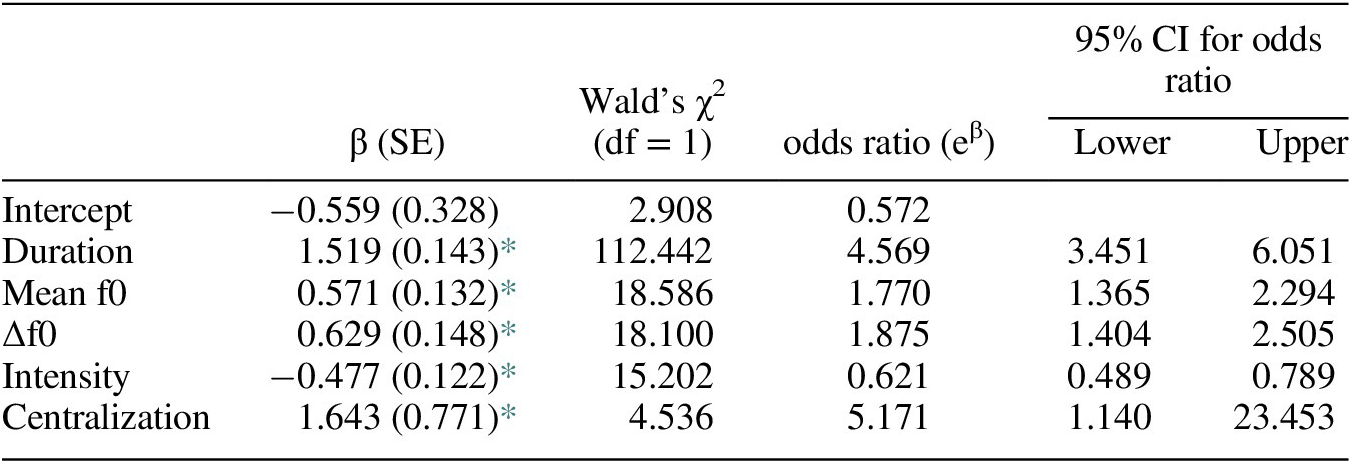
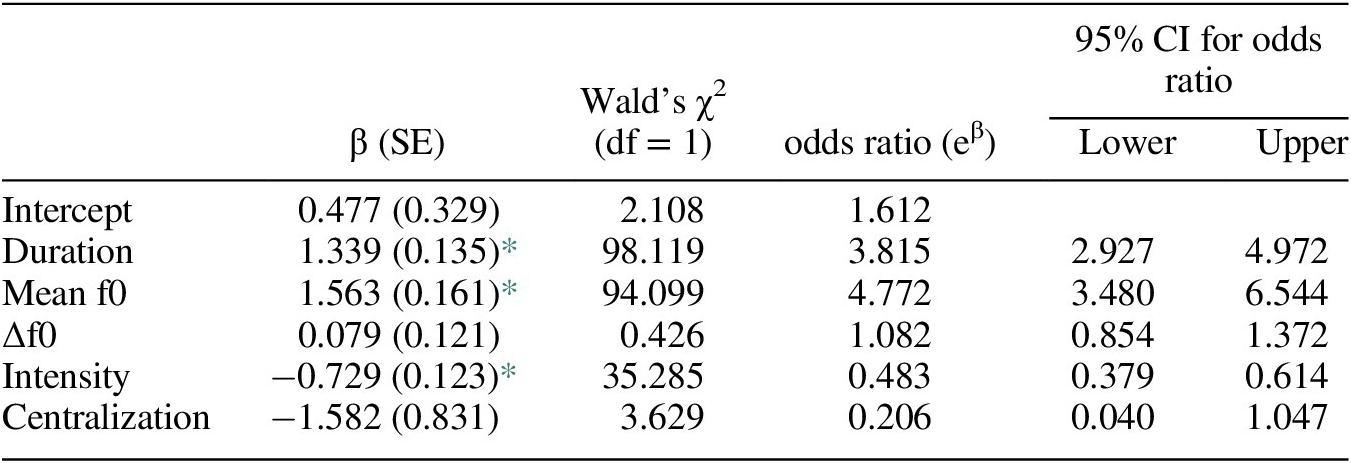
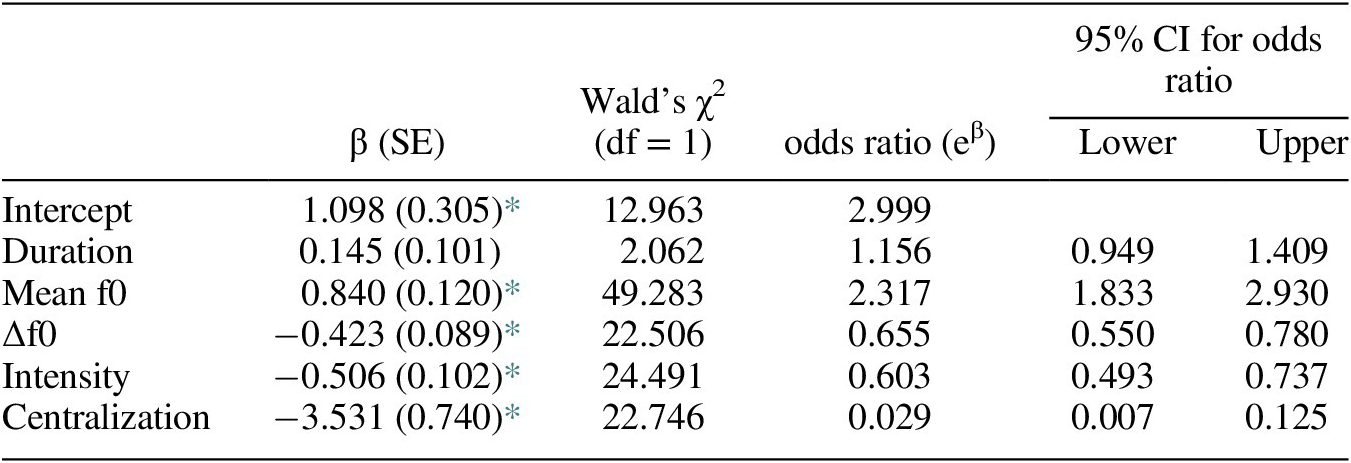
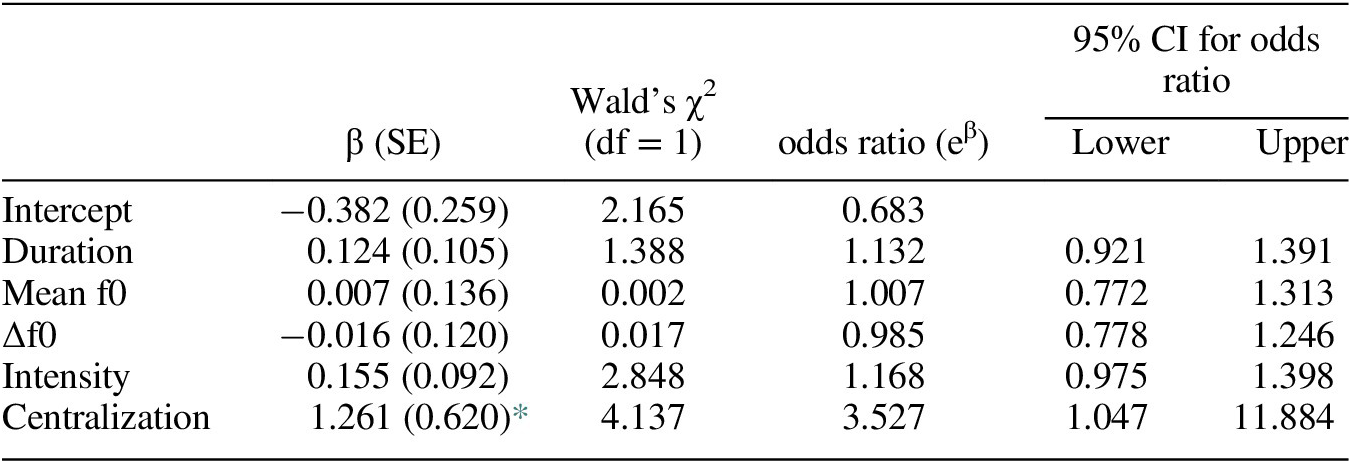
On the basis of our acoustic measurements, we will conclude that stress is present on the penultimate syllable (Hypothesis 1) or on the final syllable (Hypothesis 2) if either of these syllables consistently exhibits one or more of the main acoustic properties associated with prominence (i.e. increased duration, intensity, f0, and clearer (more peripheral) vowel quality). Hypothesis 3 will be confirmed, instead, if neither of the other hypotheses is confirmed. We do not have a specific hypothesis about stress on the initial syllable since this option is not suggested in previous research; however, our data and analyses allow us to consider the properties of the first syllable, and we thus include these findings as well. The distribution of the various acoustic properties is assessed using Binary Logistic Regression Analyses (BLRAs) to test whether the acoustic properties serve to differentiate one syllable from the others (see Section 4.5 below).
With regard to sentence-level prominence, focus here, the investigation of Indonesian is of particular interest since the main manifestation of focus is commonly observed as an enhancement of the acoustic properties of the stressed syllable of a word (Pierrehumbert & Hirschberg Reference Pierrehumbert, Hirschberg, Cohen, Morgan and Pollack1990, Ladd Reference Ladd1996), posing a conundrum if stress is absent.Footnote 11 We thus test three additional hypotheses shown in (5), paralleling those in (4), to examine the properties of the targets in a focus context, in comparison with their properties in a non-focus context.

We will conclude that a syllable is stressed if, under focus, it exhibits more enhancement, or a greater increase, of one or more of the acoustic properties associated with prominence, than is observed on the other syllables (Hypotheses 4 and 5). Even if a syllable does not manifest stress in the absence of focus, confirming Hypothesis 3, we may still find that focus preferentially enhances one of the syllables. In this case, the prominence pattern could be taken as indirect evidence of stress on that syllable, on the general assumption that the main manifestation of focus appears on the stressed syllable of a word. Hypothesis 6 is confirmed if none of the syllables is enhanced under focus.
4. Design
Our study of Indonesian is included in a broader cross-linguistic investigation of the acoustic properties of lexical and sentential prominence (stress and focus).Footnote 12 We thus adhere to the same strict requirements in all of the languages with regard to the construction of the stimuli and focus conditions, the presentation of the experiments and the selection of the participants, as discussed below. While this means that for any given language there are undoubtedly other interesting items, structures and phenomena that we do not investigate, the similarity of structures and methods makes it possible to ultimately compare the results from different languages. Moreover, the findings from the basic structures we investigate can serve as a baseline for further studies that probe additional properties or varieties of a language.
4.1 Speakers
We tested 10 (females = 6) university students or recent graduates between the ages of 19 and 24 years. All were speakers of the standard variety of Indonesian spoken in Jakarta, where they were born and raised; and they did not regularly speak other substrate languages. It was also required that the parents of the participants be from Jakarta, and speak the same variety of Indonesian. Moreover, to avoid influences from other languages and potential language attrition, the participants must not have lived outside their home country for more than six months. They were tested in Jakarta by a native speaker of the same Indonesian variety.
4.2 Procedure
The experimental materials were all in Indonesian, and were presented in three parts: (i) introduction and instructions, (ii) practice items, and (iii) actual experiment. In the actual experiment, each participant saw one of two versions of a PowerPoint presentation, differing in the order of presentation of the target stimuli. The targets appeared in short question–answer dialogues that primed the appropriate focus condition in the answer. The dialogue slides alternated with filler slides (i.e. pictures the participant had to name) and no more than two dialogues with the same focus condition appeared in sequence to reduce the possibility of the prosody of one target influencing the next. The participants were tested individually in a quiet room, where the recordings were made with an external microphone connected directly to the same computer on which the experiment was presented. A session lasted approximately 25 minutes.
4.3 Stimuli
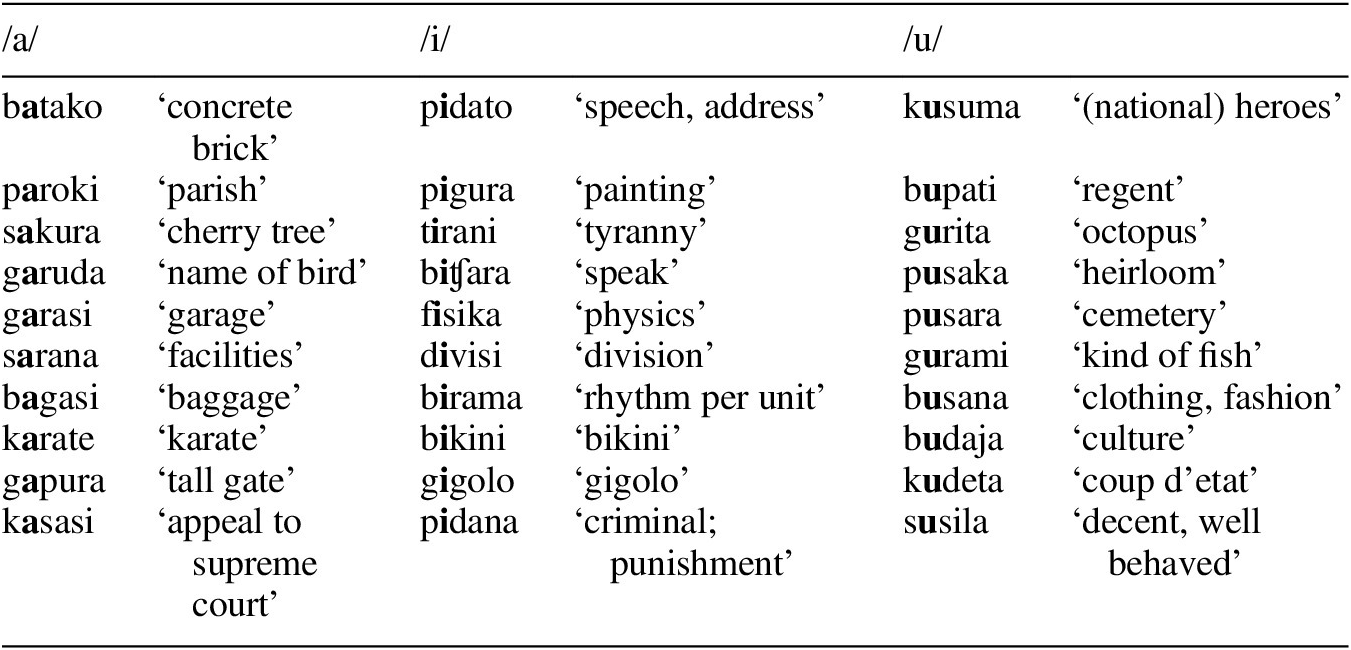
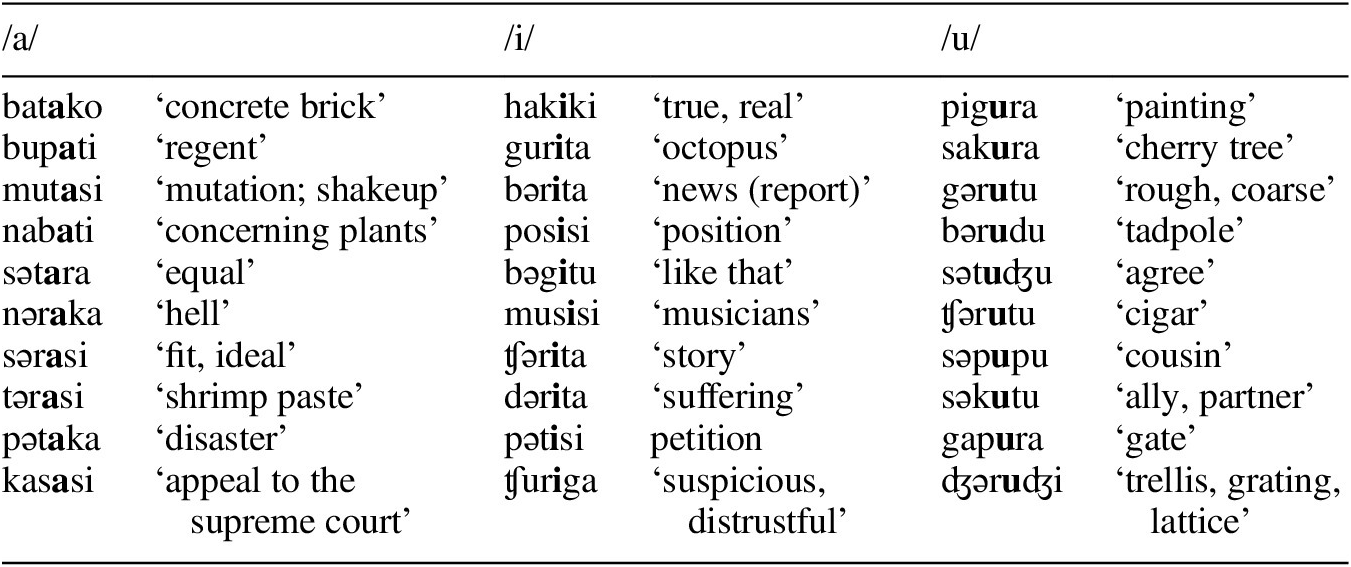
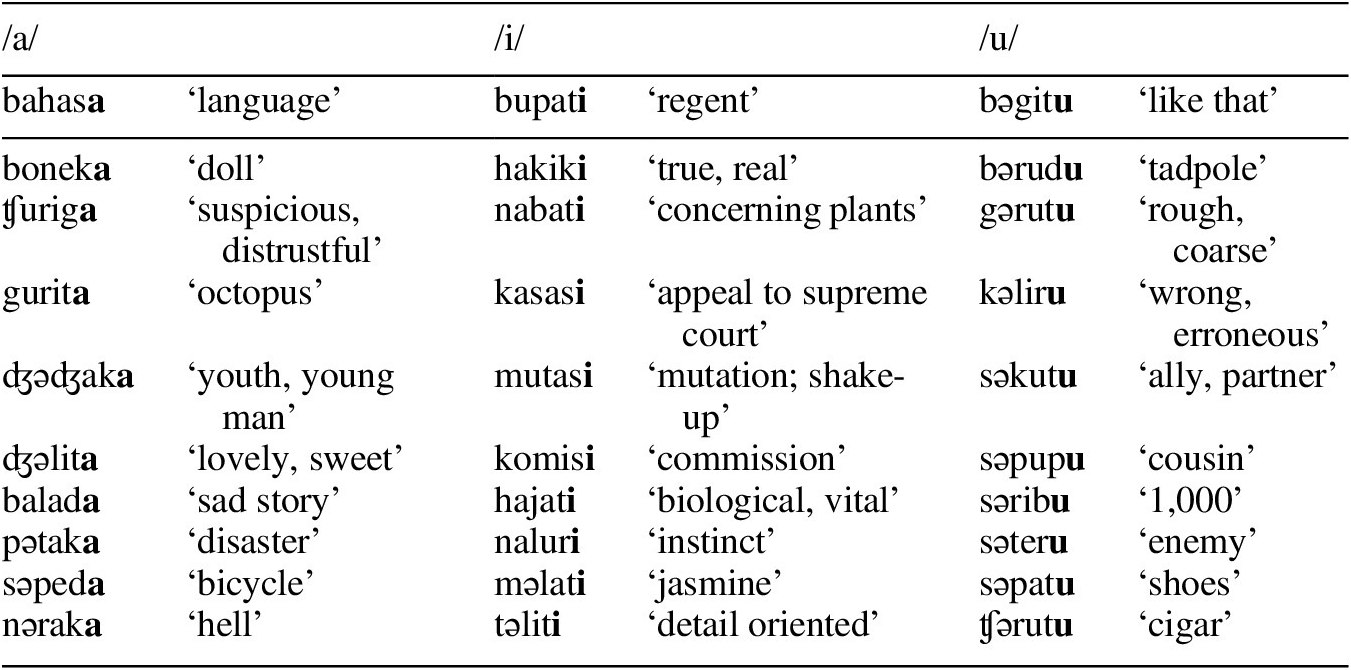
Real three-syllable words known by the average speaker were used for stimuli. We limit our attention to the vowels /i u a/ in CV syllables since these are most likely to be found in any language; codas may appear in non-target syllables. The target vowels appear in all three syllables. We avoided schwas in non-target syllables to the extent possible, but they appear in some first syllables. Examples of the stimuli are shown in Table 1; see Appendix A for the full list.Footnote 13
Examples of Indonesian stimuli; the target vowel is bolded.

Each of the three target vowels appears in ten words for each of the three syllable positions, giving a total of 90 stimulus vowels. In some cases, multiple vowels may be measured in a single word if the appropriate contexts are present. For example, batako ‘concrete brick’ serves as the source for /a/ measurements in both the first and the second syllables. In all cases, each stimulus word appears once in a focused and once in a non-focused context, described in the next section, yielding a total of 1800 target vowels (180 per speaker).
4.4 Carrier structures
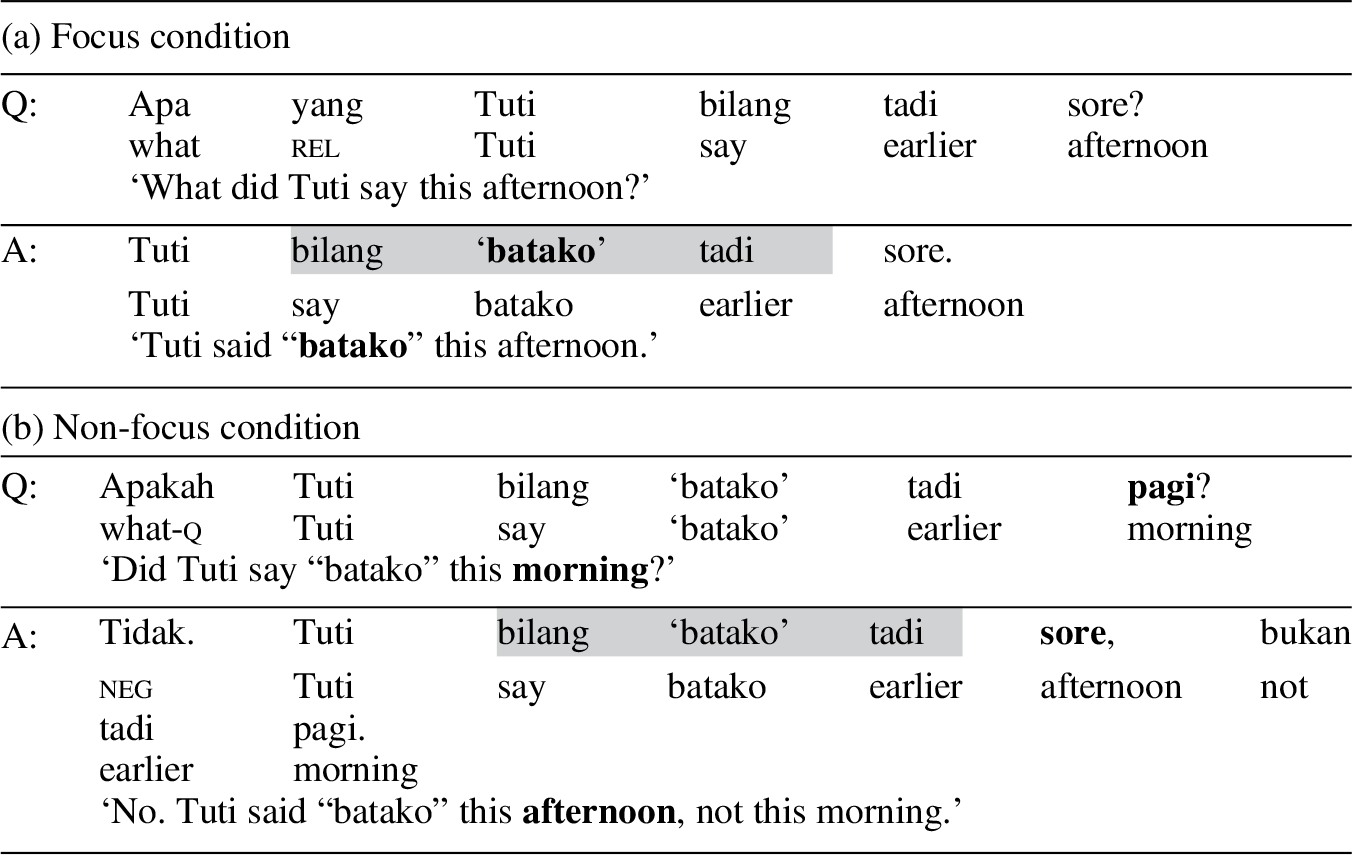
As noted above, previous studies intended to identify the acoustic properties of stress in Indonesian, as well as other languages, have frequently examined data in which it is not possible to separate the properties of stress from those of focus or other potential prosodic influences (e.g. list intonation, sentence-final position). We therefore use two types of dialogues (Table 2) to elicit the targets: (i) without focus, to examine just the stress properties in stress languages, and in Indonesian, to attempt to locate a possible stress position; and (ii) with narrow focus, to identify any properties altered or introduced in this condition. While it is not possible to examine a particular prosodic phenomenon in a vacuum, without any other prosodic information associated with a sentence, the intention is to prime two distinct prosodic structures, and to maximally reduce the interference of other phenomena that are commonly associated with distinctive prosodic patterns.
Carrier structures for the two focus conditions; bold indicates focus.

In the first dialogue (Table 2a), the target is in a position of narrow focus in the answer, a context similar to the one used in much previous research intended to study stress. In the second dialogue (Table 2b), focus is removed from the target in the answer. That is, the target is given information, and a word following the target is instead focused. While some languages may exhibit pre-focal compression, post-focal compression is more common across languages, and its effects seem to be more extensive (e.g. Xu Reference Xu2011, Xu et al. Reference Xu, Chen and Wang2012). The non-focus condition places the target before the focused word to avoid possible effects of post-focal reduction or compression. Note that the targets appear in identical contexts in the answers of both types of dialogue.
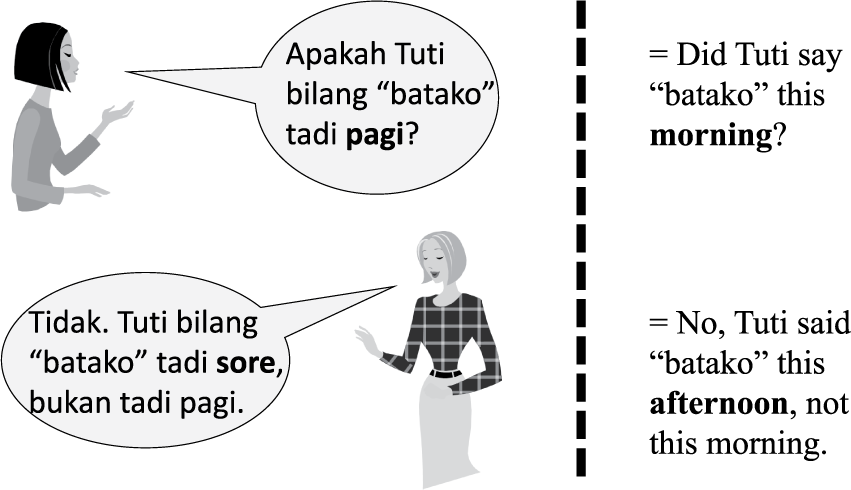
To encourage the speakers to use a natural speech style, the dialogues were presented as conversations between two people, as illustrated in Figure 1 (the translations did not appear in the experimental slides). The participants read both parts of the dialogues to set up the intended focus conditions in the answers; however, only the targets in the answers were used for the acoustic measurements.
Illustration of the non-focus trial for the target word batako ‘concrete brick’.

4.5 Analysis
Since our intention was to determine whether any evidence of stress would emerge from our corpus, we could not single out a specific syllable to examine for stress properties, but instead compared the properties of the vowels in all three syllables of the targets, in both the non-focus and focus conditions.
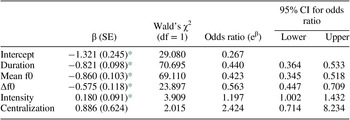
The recordings were analyzed using Praat (Boersma & Weenink Reference Boersma and Weenink2016), with measurements made of the mean duration, f0,Footnote 14 and intensity of the entire vowel. Additionally measurements were made of the f0 change (Δf0 = the mean f0 of the last quarter minus the mean f0 of the first quarter of the vowel), and for the mean F1 and F2 in the second quarter of the vowel. The two formant measurements were used to calculate vowel centralization as the Euclidean distance from the center of the vowel space.Footnote 15 Vowel centralization was calculated after normalizing the F1 and F2 values according to the method described in Winn et al. (Reference Winn, Blodgett, Bauman, Bowles, Charters, Rytting and Shamoo2008). The other measurements were also normalized to allow them to be combined despite speaker differences (e.g. speech rate and different f0 ranges in females and males) and inherent vowel differences (e.g. f0 and duration differences in high vs. low vowels). Specifically, for the duration, f0, and intensity measurements, we calculated z-scores for the different properties using the mean and standard deviation of the values for each speaker and each vowel group (see Lobanov Reference Lobanov1971, Adank, Smits & van Hout Reference Adank, Smits and van Hout2004). The duration and f0 measurements were log-transformed prior to z-transformation (intensity in dB is already logarithmic). The z-scores were used for the statistical analyses.
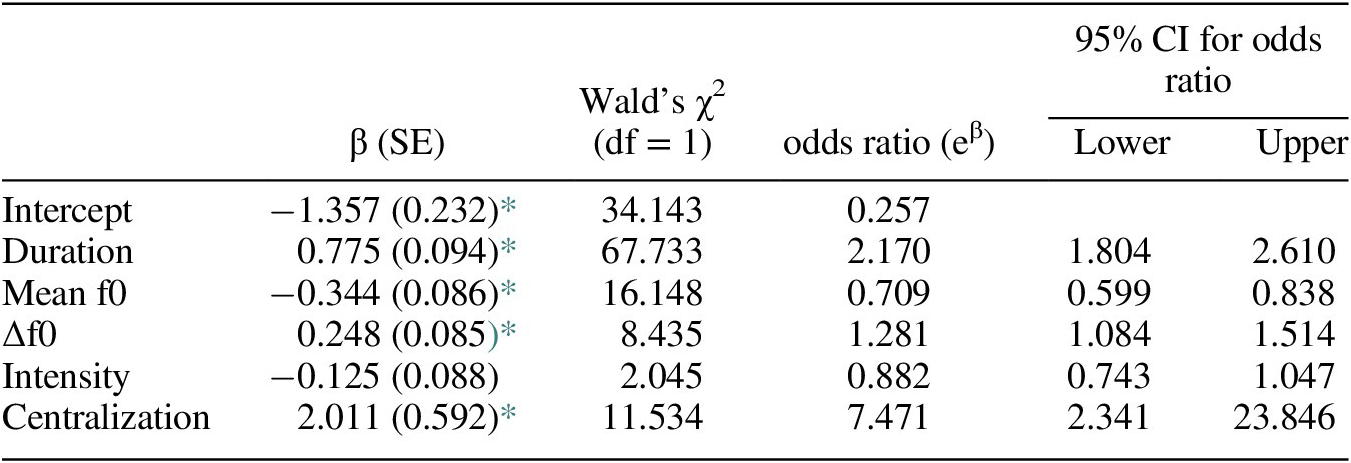
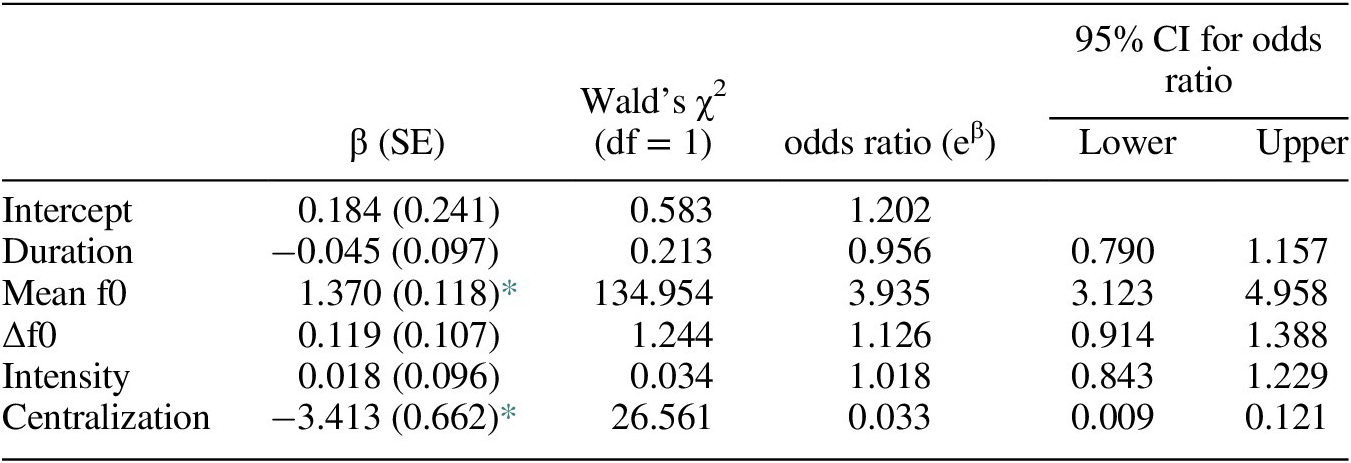
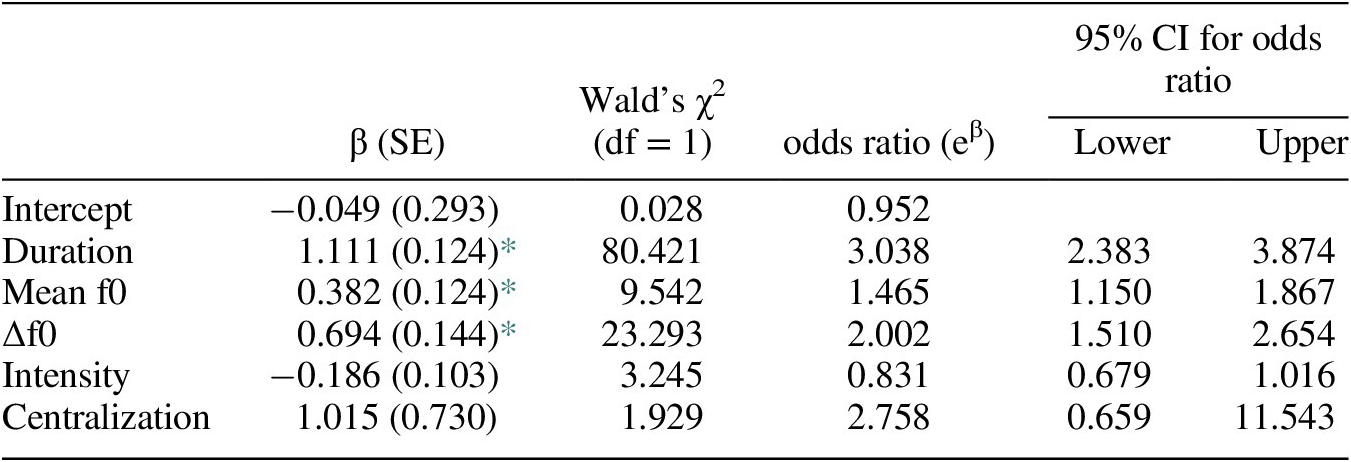
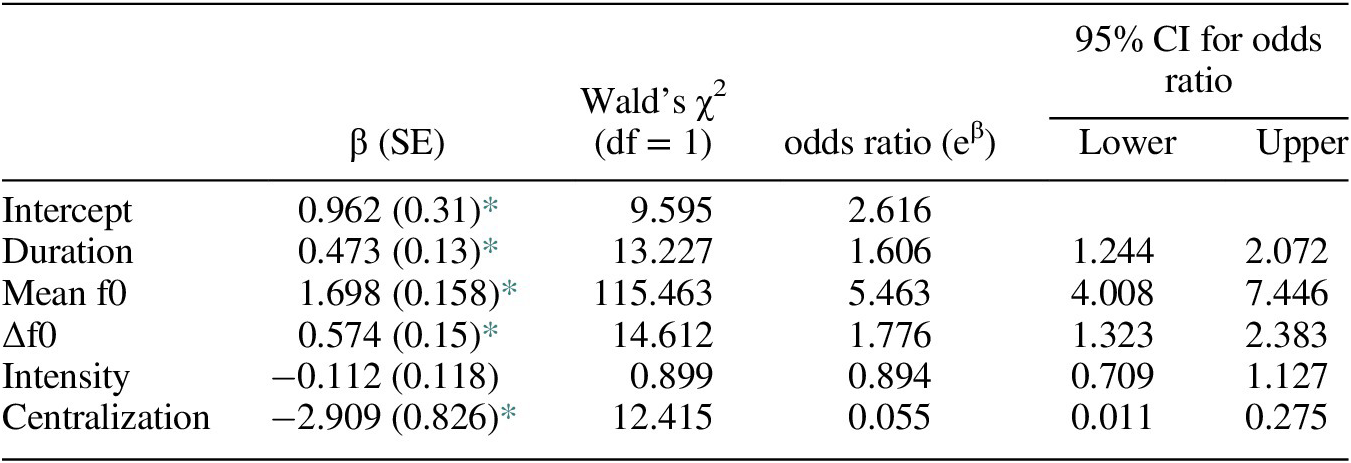
While much can be determined by statistically significant differences (or absence of significant differences) in the acoustic measurements, the question remains as to how much each property contributes to speakers’ perception of prominence. Since conducting additional perception studies, along the lines of those reported in Goedemans & van Zanten (Reference Goedemans, van Zanten, van Heuven and van Zanten2007) would constitute a distinct line of research, and the focus here is on the acoustic properties of prominence, we use Binary Logistic Regression Analyses (BLRAs) to statistically quantify the contributions made by the various acoustic properties to the distinctions among the vowels in the different contexts.Footnote 16 Specifically, the BLRAs make use of the acoustic properties we measured to classify the stimuli in predefined categories such as syllable position (e.g. Syllable 1 vs. Syllable 2), focus context (e.g. focused vs. non-focused), etc. Classifications are first carried out with the full set of properties to determine how distinct the different categories are, as well as which of the properties contribute (statistically) significantly to that distinction. Subsequently, classifications are carried out separately with each of the significant properties to determine how well they make the same distinction when used as the sole classifying property.
The results of the BLRAs yield information about the roles of the various phonetic properties in identifying the different categories within the stimuli, but they do not provide information about the values of the acoustic characteristics themselves. In principle, it would be possible for a classification to be statistically significant even if the magnitude of the difference is too small to be readily perceptible. We thus performed an additional analysis to examine the acoustic properties of the vowels in the different contexts. This was done on the basis of a re-conversion of the normalized data (z-scores) back to the relevant units of each property (ms, Hz, and dB). Specifically, we converted the mean z-score for each of the six categories (3 syllable positions × 2 focus contexts) from all of the speakers into the appropriate units for each property with the formula (Z*SD)+M using the mean (M) and standard deviation (SD) of one of the speakers, arbitrarily Speaker 1 (a female). This allows us to see the acoustic differences in the relevant units, and to evaluate how meaningful they are without compromising the validity of the data, since the results are derived from the normalized values of all the speakers. They are thus representative of the general patterns in the data, and not those of any one speaker.
5. Results
5.1 Binary logistic regression analyses
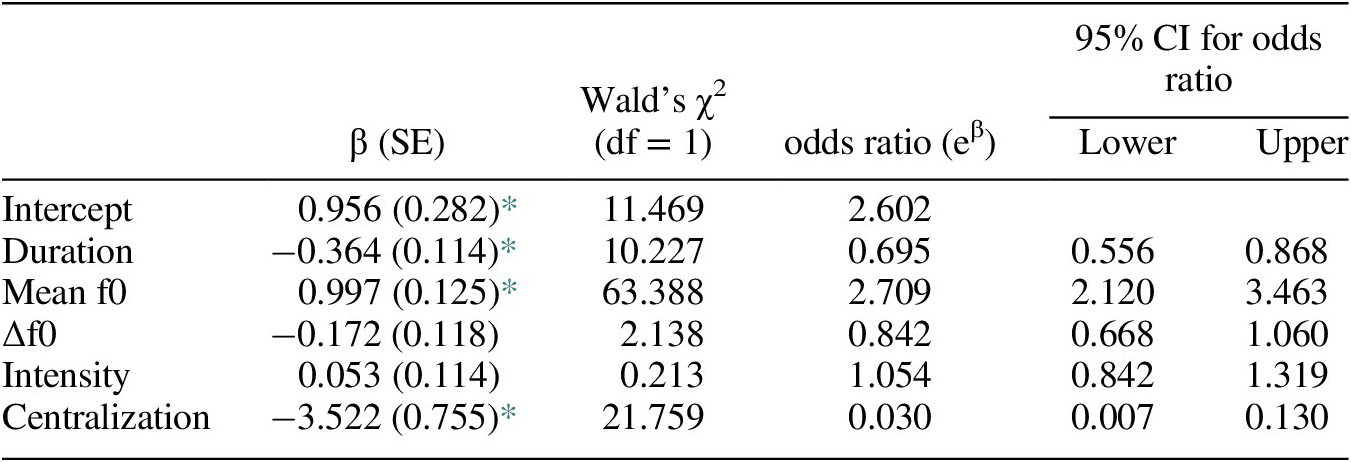
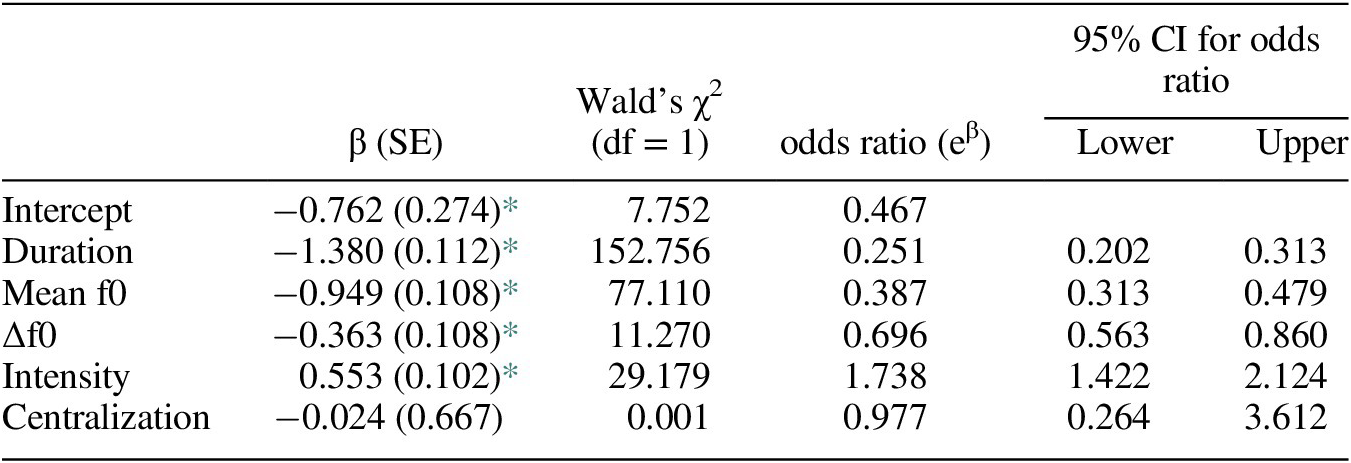
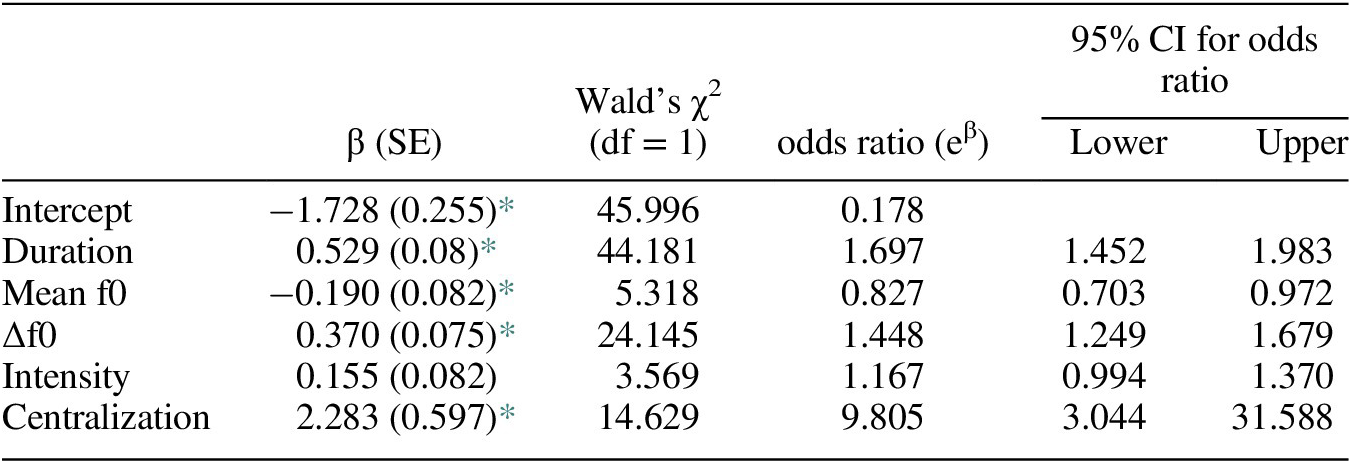
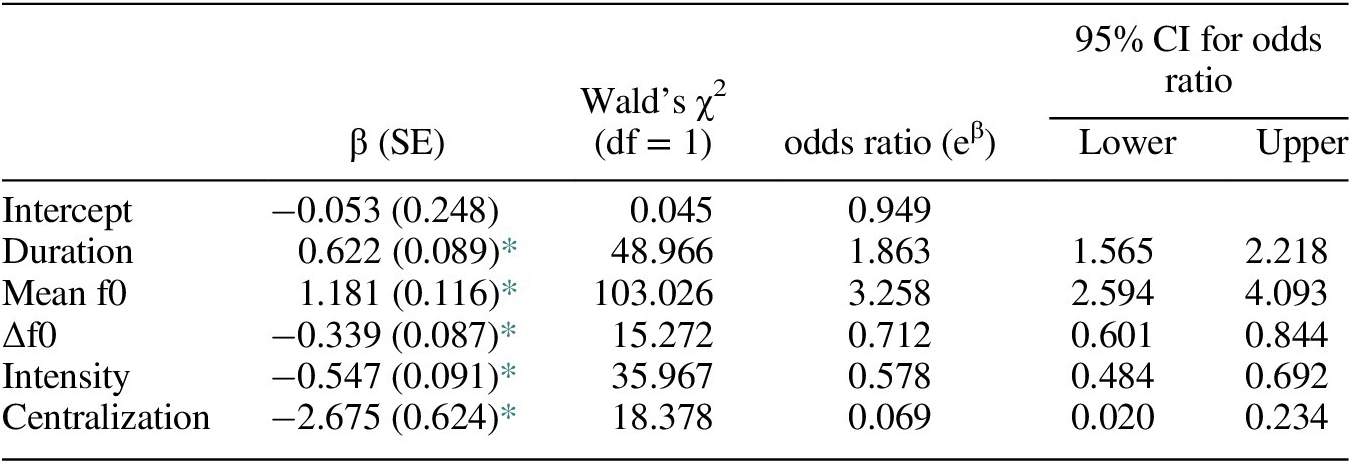
We first carried out the Binary Logistic Regression Analyses (BLRAs) in the non-focus context to avoid the confound of focus properties with (potential) stress properties, and thus to provide a baseline against which to assess the properties contributed by focus. In the initial BLRA classification, we used all five properties measured (i.e. mean f0, f0 change, intensity, duration, and vowel centralization) to statistically determine whether any of the three syllable positions was more accurately identified than the others (Hypotheses 1–3). If a substantially greater classification rate of one of the syllables in the non-focus context was observed, this would indicate that the syllable in question is more distinct than the others, and this in turn, would suggest the presence of stress on that syllable. Additional classifications were run for each of the individual acoustic properties found to be significant in the first classification to determine the extent to which these properties classify the data on their own. We subsequently conducted BLRAs to examine the effect of focus on the acoustic properties of the stimuli (Hypotheses 4–6). Since focus commonly enhances the stressed syllable of a word, if a particular syllable exhibits consistent enhancement, this could (indirectly) signal that the syllable is prominent, or stressed, at some lower phonological level, possibly in an underlying metrical structure. Note that Goedemans & van Zanten (Reference Goedemans, van Zanten, van Heuven and van Zanten2007: 11) make a similar argument for locating a potential stressed syllable, especially in relation to their perception experiments. Next, we consider only the statistically significant results; see Appendix B for the full BLRA results.
5.1.1 Syllable comparison in the non-focus context
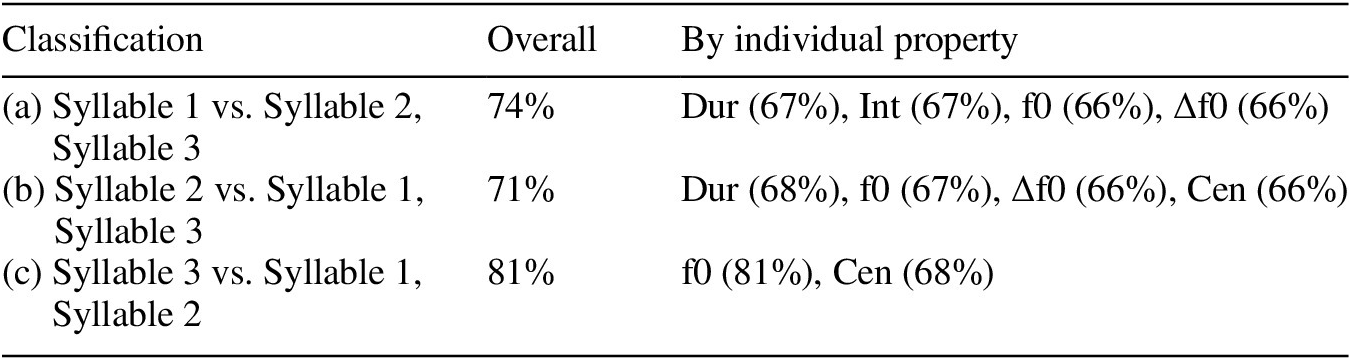
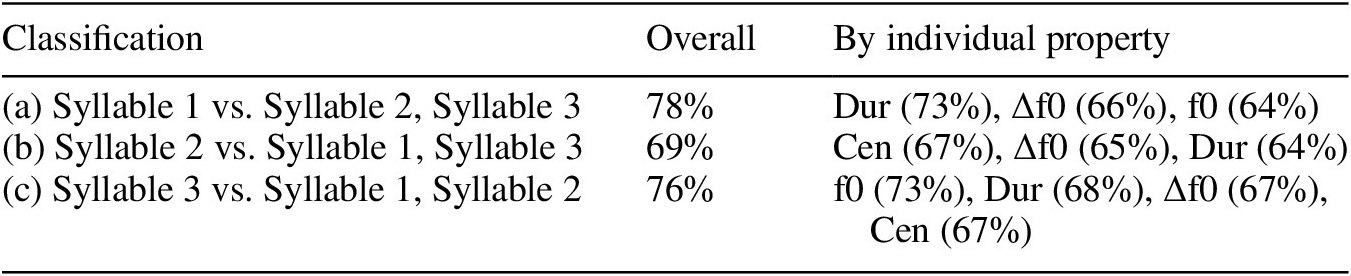
Since our goal was to identify any possible patterns that could indicate prominence on a particular syllable, we ran two types of comparisons. The first type compares each syllable to the other two syllables combined. Table 3 shows the overall classification rate of the comparison, as well as the classification rates of the individual properties that were statistically significant in the BLRA with all of the predictors. Since we are comparing the classification of a single syllable versus two others, chance is 67%. The second type of comparison, shown in Table 4, was conducted as an additional attempt to identify any evidence that might indicate that one syllable stands out in comparison to either of the others. In this case, each syllable was compared with each of the others separately, so chance is 50%.
BLRA classifications of each syllable position vs. the other two positions in the non-focus context; chance = 67%.

f0 = mean f0, Δf0 = f0 change, Int = mean intensity, Dur = duration, Cen = vowel centralization
BLRA classifications of each syllable position vs. each of the other two positions individually in the non-focus context; chance = 50%.

f0 = mean f0, Δf0 = f0 change, Dur = duration, Cen = vowel centralization
Although at first glance, the results of the two types of syllable comparisons appear rather different, closer examination shows that the general patterns they present are in fact quite similar. In the first type of comparison (Table 3), when all five properties are taken together, the most successful classification (overall) is that of Syllable 3 vs. the other two syllables, with a success rate of 81%. This rate is largely due to f0, which on its own also yields 81% classification accuracy. By contrast, the two other comparisons have lower overall classification rates, and each individual property on its own yields a classification rate close to chance.
Similarly, in the second type of comparison (Table 4), the most successful classifications involve Syllable 3, being distinguished from Syllable 1 with 82% accuracy, and from Syllable 2 with 74% accuracy. In both cases, the strongest individual classifier is f0, with 81% and 76% accuracy in the first and second comparisons, respectively. In the other classifications, the individual properties’ rates were lower, closer to chance.
The general pattern that emerges is that if any syllable is more distinct from the others, it is Syllable 3. While this might suggest final stress, the fact that the most substantial differences involve comparisons with the first syllable makes this interpretation less plausible, since the first and third syllables may also reflect word-edge properties, a possibility that is considered further in Section 5.2 below.
5.1.2 Syllable comparison in the focus context
The next classifications, shown in Tables 5 and 6, are similar to those just considered, but they are carried out in the focus context; again, chance is 67% in the first comparison and 50% in the second comparison. Here too, the most successful classifications in both types of comparison involve a distinction between Syllable 3 and Syllable 1. This is seen in Table 5 in both (a) and (c), with 78% and 76% classification rates, respectively. In Table 6, the relevant comparison is (b), where the direct comparison of Syllable 1 vs. Syllable 3 yields the best success rate (80%). As in the non-focus context, f0 is a main classifier in the focus context, although duration also plays a noteworthy role. Foreshadowing the descriptive analysis, it will be seen that the duration effect is due to the shorter duration of the first syllable, rather than an enhancement (lengthening) of a particular syllable. Some of the other properties are also significant; however, they yield only lower rates, and they do not present any particular patterns.
BLRA classifications of each syllable position vs. the other two positions in the focus context; chance = 67%.

f0 = mean f0, Δf0 = f0 change, Dur = duration, Cen = vowel centralization
BLRA classifications of each syllable position vs. each of the other two positions individually in the focus context; chance = 50%.

f0 = mean f0, Δf0 = f0 change, Int = mean intensity, Dur = duration, Cen = vowel centralization
5.1.3 Focus vs. non-focus context in each syllable position
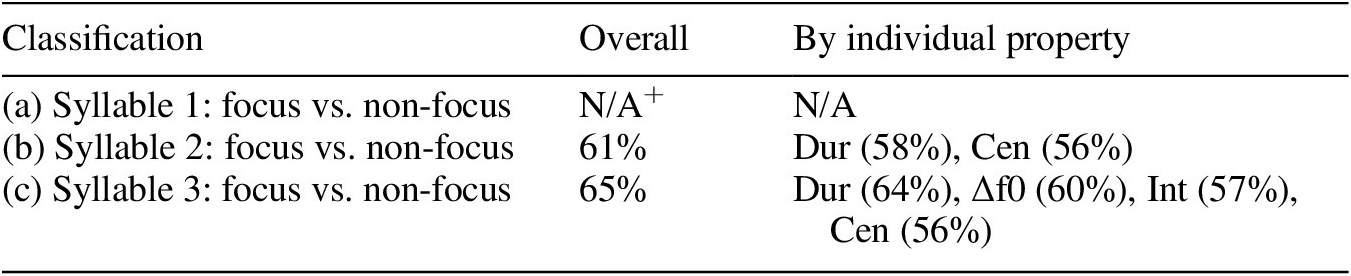
Finally, we considered the possibility that prosodic enhancement may emerge on a particular syllable when it is focused, even if this syllable is not prominent at the word level (without focus). Table 7 presents the direct comparisons of the acoustic properties present in the focus vs. non-focus conditions for each syllable. Focus and non-focus properties do not statistically differ in Syllable 1, so it cannot be considered a locus of focus enhancement. Syllable 3 again shows the best classification rate, although 65% is not a strong result, with chance at 50%.Footnote 17 While duration is the strongest classifier for Syllable 3 (64%), Δf0 is quite similar (60%) and both are close to chance.
BLRA classifications of focused vs. non-focused targets in each syllable position; chance = 50%.

ΔF0 = f0 change, Int = mean intensity, Dur = duration, Cen = vowel centralization; + not statistically significant
In sum, the results of the different BLRA classifications do not provide any indication of prominence on the penultimate syllable (Syllable 2 here). Moreover, while some distinction is made on the final syllable (Syllable 3), suggesting that it may at some level be stress-bearing, the descriptive results presented in the next section show that such a conclusion is not warranted.
5.2 Descriptive results
As pointed out above, while the BLRA results indicate the ability of the various acoustic properties to statistically distinguish different conditions within our corpus, they do not provide information about the actual values associated with the properties. Thus, we consider here whether the various differences are likely to be perceptible or meaningful to an average listener. To this end, we examine the values in the appropriate units for specific properties determined by the re-conversion of the z-scores. See Appendix B for the mean z-score and standard error for each measurement. Only those measures that were seen to be relevant in the BLRAs are discussed here. Further information on other properties (i.e. ones that were essentially at chance, such as centralization) is provided in Appendix C.
5.2.1 Mean f0
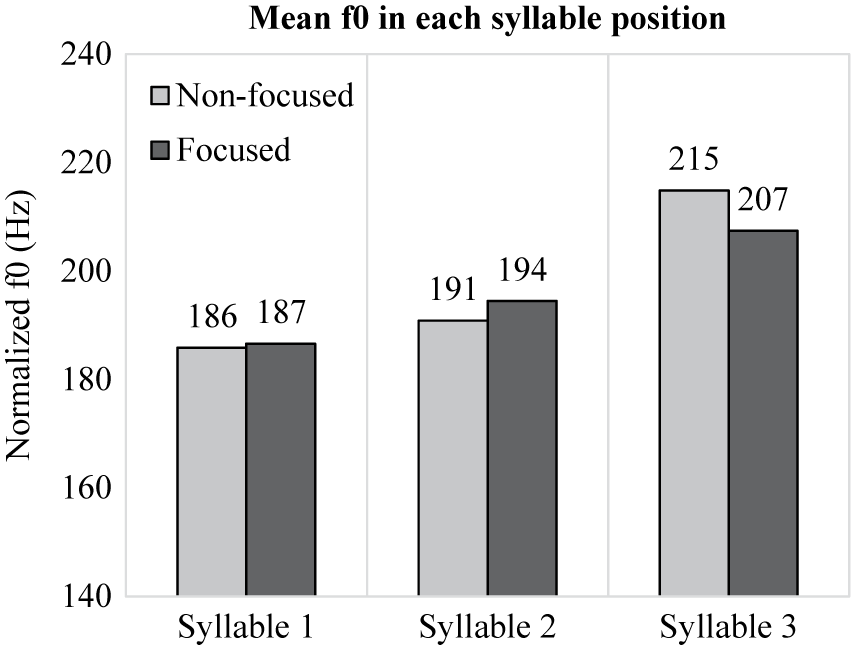
Figure 2 presents the values for mean f0, the property that appeared most frequently as the main individual classifier in the BLRAs, particularly in the classifications involving Syllable 3 (Tables 4 and 6 above). F0 change is considered separately in the more detailed discussion of the pitch contours in Section 6. Considering first the non-focus condition, without the confound of focus properties, it can be seen that Syllable 3 has a higher mean f0 than the other syllables. At first glance, this might suggest enhancement, and thus that the final syllable is stressed; however, comparison with the f0 result in the focus condition reveals a conflicting pattern. That is, although Syllable 3 has the highest mean f0 in the focus context too, its value is actually lower in the focus than the non-focus context. If raised f0 is the acoustic manifestation of lexical stress, reducing f0 under focus would tend to obscure the stress, contrary to the expectation that a stressed syllable would show enhancement when focused. Thus, the decrease in f0 does not support a stress interpretation, a point we return to in Section 6.
Mean f0 of each syllable position in non-focus and focus contexts.

5.2.2 Duration
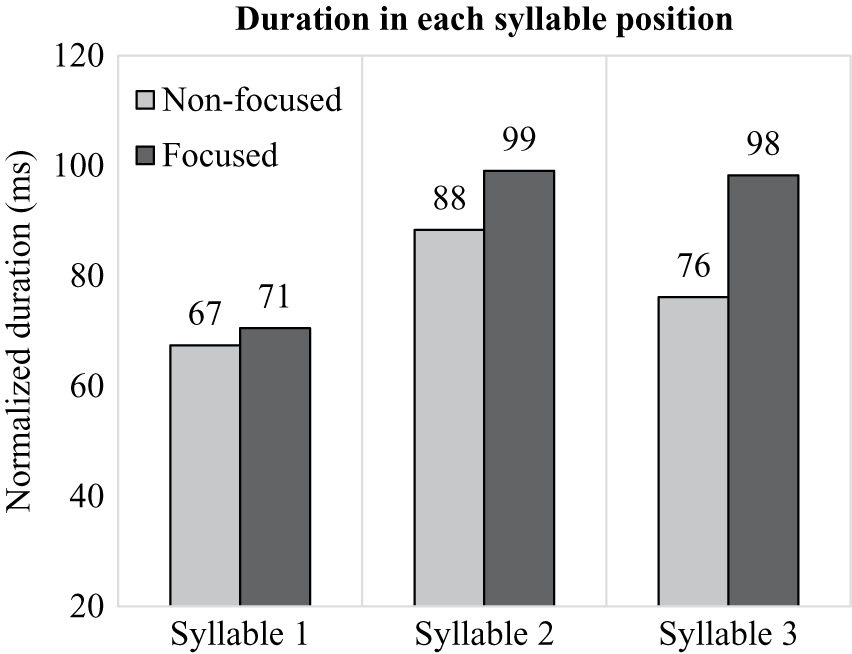
Duration also appeared as a main classifier in the BLRAs, but only for Syllable 1 (see Tables 4 and 6); the corresponding values in milliseconds are given in Figure 3. Although duration was significant in the BLRA classification of Syllable 1, Figure 3 reveals that this is due to substantially shorter values in this position, a pattern that is not consistent with stress on the first syllable. It was also seen that duration was a significant property in other BLRA classifications, although not the main one. This is reflected in Figure 3, where Syllable 2 is longer than the others in the non-focus context. While it might be appealing to interpret this as support for penultimate stress, closer examination reveals that Syllable 2 is only 12 ms (16%) longer than the next longest syllable, Syllable 3, and thus likely to be indistinguishable by native speakers. Moreover, the focus pattern also fails to reveal substantial enhancement of the penultimate syllable, as would be expected if this syllable were stressed; the duration increase under focus is only 11 ms (13%). Finally, with regard to Syllable 3, it can be seen that the greatest increase in duration occurs when this syllable is focused (i.e. 22 ms = 29%); however, despite this lengthening, the duration of Syllable 3 (98 ms) is essentially the same as that of Syllable 2 (99 ms). This means that Syllable 3 does not stand out as the most prominent syllable in the word, and we must thus conclude again that there is no evidence of final stress in our data.
Duration of each syllable position in non-focus and focus contexts.

6. Discussion: Stress in Indonesian?
Both the statistical and descriptive findings in our investigation fail to provide consistent evidence of stress on any of the syllable positions in Indonesian. This was true in the direct tests for stress enhancement in the non-focus condition in our experiment, as well as in the indirect tests that sought evidence of enhancement of a particular syllable in the focus condition. Thus, the only hypothesis that was confirmed is Hypothesis 3 – that there is no evidence of stress on any syllable; Hypotheses 1 and 2, that there is penultimate or final stress, respectively, were both disconfirmed. Although we found that the penultimate syllable is somewhat longer than the other two syllables, we also found that the final syllable has a somewhat higher f0 than the others. These two patterns conflict with each other as indicators of stress, and thus fail to make a case for either penultimate or final stress. Indeed, as a JL referee points out, such patterns may have contributed to the lack of consistency in the assessment of stress in earlier impressionistic studies.Footnote 18
The indirect tests for stress, i.e. enhancement under focus, Hypotheses 4–6, also failed to support the presence of stress since the changes in the acoustic properties observed under focus did not consistently enhance a particular syllable. Both the penultimate and final syllables showed lengthening, resulting in essentially the same durations. The increase in duration of the final syllable is greater than that of the penultimate syllable, since the final syllable was shorter in the absence of focus; however, the lower mean f0 of the final syllable is inconsistent with enhancement. In fact, this pattern is consistent with Himmelmann’s (Reference Himmelmann, Riesberg, Shiohara and Utsumi2018: 356) observation that the absence of lexical stress (lexically encoded prominence differences) may be responsible for the fact that information structure is not primarily expressed by prosody in many Austronesian languages of Indonesia.
Although our findings cannot prove that Indonesian lacks stress, the fact that they converge with the findings of other studies, using a range of different methodologies including both perception and production tasks, strongly supports previous claims that Indonesian is a (lexically) stressless language. We thus maintain that Indonesian constitutes strong support for a category of stressless languages as one of the options in a typology of word prosodic systems – as long as we define stress in terms of a specific set of acoustic properties.
If we consider van der Hulst’s (Reference van der Hulst, van der Hulst, Goedemans and van Zanten2010) broader characterization of lexical prominence, however, we may ask whether there could be some other type of pattern that provides evidence for an underlying prominence structure, the black swan that has not yet appeared. Or even more generally, we may ask whether there could be some abstract accent property that contributes a type of ‘structural organization’ to the words of Indonesian, and all languages, even if it exhibits no overt manifestation (van der Hulst Reference van der Hulst, van der Hulst, Goedemans and van Zanten2010: 26). These are fundamental issues for phonological theory; however, they are somewhat orthogonal when stress is defined in terms of a particular set of acoustic properties.
6.1 Focus as a boundary phenomenon
Continuing to consider the overt acoustic properties of prominence, we see that the prosodic patterns that emerged in the focus condition of our experiment did not provide evidence of stress, but we did observe some consistent differences between the acoustic properties of the focus and non-focus conditions. Since we see both increased duration and decreased f0 on the final syllable in the focus condition, we propose that this combination of properties is a manifestation of a global prosodic pattern that signals a strong prosodic boundary, not (word) stress, in Indonesian. (For other languages, see also Féry Reference Féry2013, Himmelmann Reference Himmelmann, Riesberg, Shiohara and Utsumi2018, among others.)
Let us consider our carrier sentences (Table 2 above), shown again in their English translation in (6), where ]PW indicates a Phonological Word boundary, and ]B a stronger, higher level boundary (unidentified at this point). The right edge of the target word in both contexts coincides with a Phonological Word (PW) boundary; and if there is any additional boundary (e.g. Phonological Phrase) after batako in (6a), we can assume it is also present in (6b). What is crucial, is the additional boundary (B) in (6b).Footnote 19

Within an intonation-based prosodic structure (e.g. Jun Reference Jun2005, Reference Jun2014), the additional boundary would be identified as an Intonational Phrase (IP) boundary, which is typically manifested by a fall in pitch and increased duration – precisely the pattern we found in our Indonesian data. Sometimes IP boundaries also exhibit decreased intensity, although this was not observed in our study. It is noteworthy that Nespor & Vogel (1986/Reference Nespor and Vogel2007) originally pointed out that focus often introduces an Intonational Phrase constituent boundary, generally similar to the intonation-based IP boundary, following a focused word, an observation that has been corroborated across various languages (e.g. Basque: Gussenhoven Reference Gussenhoven2004; Japanese: Pierrehumbert & Beckman Reference Pierrehumbert and Beckman1988).Footnote 20 That is, whether or not there would normally be an IP boundary in a particular position, the presence of focus on a word ensures that it will be followed by such a boundary.Footnote 21
Since the combination of increased duration and decreased f0 has been independently identified with an IP boundary, we may interpret the presence of precisely this pattern in our focus condition as evidence that the focused word is, indeed, followed by such a boundary. Thus, although our data do not provide evidence to support stress in Indonesian, they do provide evidence of a higher level of phrasal prominence associated with focus.
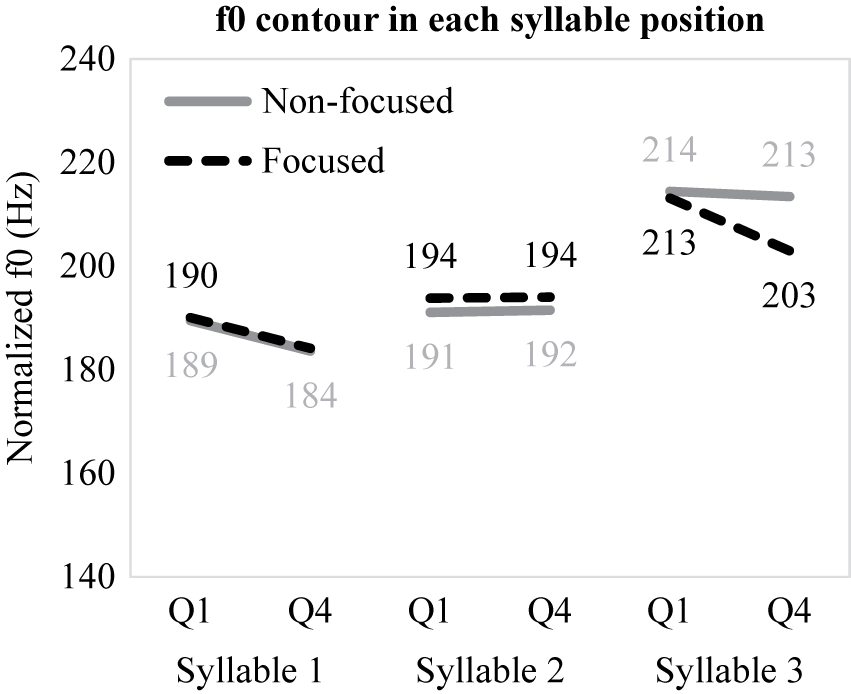
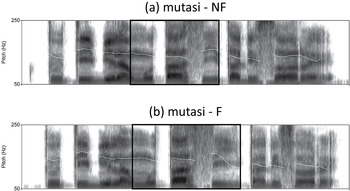
The interpretation of the acoustic patterns as a manifestation of focus structure is further supported by a closer examination of the f0 contours in our data. The measurement we used to represent the f0 contour, Δf0 (= f0 change from the beginning to the end of a vowel), provides a means of quantifying the contour for the statistical BLRA analyses, and for comparison of the f0 contours of different components of our corpus. (See Appendix D for sample pitch tracks.) Figure 4 shows the f0 contours associated with the different syllable positions and focus conditions. The initial and final points of the contours correspond to the means of the first (Q1) and fourth quarter (Q4) of the target vowels. The f0 contours in the focus and non-focus conditions are essentially identical throughout the first two syllables and at the beginning of Syllable 3. Thus, up to that point, there is no evidence of a prosodic manifestation of focus. The patterns diverge after the beginning of Syllable 3. While the f0 remains high in the non-focus context, possibly signaling the continuation of the sentence (e.g. Chen Reference Chen2003, Reference Chen, Gussenhoven and Riad2009), it falls in the focus context, indicating instead, the presence of a strong prosodic boundary. This means that the word-final syllable aligns with (at least) a Phonological Word boundary when it is not focused, but it aligns with an additional IP boundary when it is in focus.
F0 contour across three syllables in non-focus and focus contexts (Q1 = first vowel quarter, Q4 = fourth vowel quarter).

Overall, the acoustic patterns we observe here do not identify a (lexically) stressed syllable, but rather phrasal prominence, specifically focus. Moreover, only the right edge of the focused element is signaled acoustically, differently from other languages that signal the left edge, or possibly both edges. That is, if we consider the f0 of Syllable 1, which we assume corresponds to the left edge of the IP established by mapping procedures from syntactic structure (e.g. Nespor & Vogel Reference Nespor and Vogel1986, and more recent approaches), we observe that: (i) the f0 is virtually identical in the non-focus and focus contexts and (ii) the f0 of the initial syllable is not more prominent than that of the following syllable(s). This was also noted in the statistical analysis (Table 7 above), where no significant difference between the two focus contexts was found for Syllable 1.
Viewing our findings in the context of other recent studies of Indonesian prosody (e.g. Goedemans & van Zanten Reference Goedemans, van Zanten, van Heuven and van Zanten2007, Roosman Reference Roosman, van Heuven and van Zanten2007, Maskikit-Essed & Gussenhoven Reference Maskikit-Essed and Gussenhoven2016), we observe overall similarities and certain differences. In particular, a raised f0 followed by a falling contour (HL), similar to our contour on the final syllable under focus, has been observed at the right edge of a word in other studies, but it has been analyzed in different ways. Goedemans & van Zanten (Reference Goedemans, van Zanten, van Heuven and van Zanten2007) and Roosman (Reference Roosman, van Heuven and van Zanten2007) analyze it as a (word level) pitch accent, whereas Maskikit-Essed & Gussenhoven (Reference Maskikit-Essed and Gussenhoven2016) consider it a boundary tone, more similar to the present analysis. It must be noted, however, that while Goedemans & van Zanten (Reference Goedemans, van Zanten, van Heuven and van Zanten2007) and Roosman (Reference Roosman, van Heuven and van Zanten2007) found pitch patterns specifically correlating with focus, as we did, it is somewhat difficult to interpret their findings since the experimental design placed the targets in a context where they may have also included utterance-final properties. Maskikit-Essed & Gussenhoven (Reference Maskikit-Essed and Gussenhoven2016), by contrast, did not find that the f0 contour was specifically associated with focus, but rather more generally with phrase- or utterance-final position. Interestingly, they also did not find a duration difference corresponding to focus. Since the targets in both the focus and non-focus contexts were utterance-final, however, it is possible that duration differences may have been obscured by the prosodic properties associated with their position. This may also account for the fact that Maskikit-Essed & Gussenhoven (Reference Maskikit-Essed and Gussenhoven2016) did not find evidence of post-focal compression; if the utterance-final properties superseded other prosodic properties, the evidence of compression may have been less noticeable. Alternatively, there may have been some other methological differences (e.g. broader age range of participants: 19–55 years) that resulted in their somewhat different focus findings.
6.2 Prosody in the absence of stress
Returning to the basic issue underlying the present study, the presence of stress in Indonesian, we have seen that the results of all of the recent investigations, including this one, converge on the position that Indonesian is indeed a stressless language. Recognizing the possibility of stressless languages, however, introduces an additional question with regard to the manifestation of phrasal prominence more generally. That is, since this prominence is usually assumed to align with, and be primarily exhibited on the stressed syllable of the word constituting the phrasal head (see Pierrehumbert & Hirschberg Reference Pierrehumbert, Hirschberg, Cohen, Morgan and Pollack1990, Ladd Reference Ladd1996), we must ask what happens if there is no stress for the accent to align to. In answer to this question, we propose, like Goedemans & van Zanten (Reference Goedemans, van Zanten, van Heuven and van Zanten2007), that in languages such as Indonesian the manifestation of sentence prominence (‘accent’ in Goedeman & van Zanten Reference Goedemans, van Zanten, van Heuven and van Zanten2007) is more closely associated with boundary marking, as opposed to enhancement of a particular syllable (see also Himmelmann Reference Himmelmann, Riesberg, Shiohara and Utsumi2018). That is, the acoustic cues of phrasal prominence align with the relevant boundary, for example an IP edge, instead of with the stressed syllable of a phrasal head. These boundary phenomena, in turn, provide the cues to information structure that may otherwise have been expressed on stressed syllables. A similar point is made by Arvaniti, Ladd & Mennen (Reference Arvaniti, Ladd and Mennen2006), who propose that where specific tone-bearing units (stresses here) are not available, phrasal accents and boundary tones may not be distinguished, and the phrasal edge thus serves as the locus of the accent properties.Footnote 22 More generally, in Jun’s (Reference Jun2005, Reference Jun2014) prosodic typology, languages like Indonesian that lack a lexically specified head (e.g. stressed syllable) are categorized as edge-prominence languages, as opposed to those that do have such a head and are thus categorized as head-prominence languages, either with or without a distinct edge prominence property.Footnote 23
Finally, it was seen in regard to the alignment of the boundary properties in Indonesian that there are some differences in the analyses presented in the different investigations. While Roosman (Reference Roosman, van Heuven and van Zanten2007) views the boundary position as following from accent shifting processes in certain contexts, Maskikit-Essed & Gussenhoven (Reference Maskikit-Essed and Gussenhoven2016) provide evidence that the conditions in question (i.e. schwa in the penultimate syllable or utterance-final position) cannot be responsible for the observed accent shifts. Nevertheless, they also observe some variability in the alignment of the boundary properties (which they encode with a floating tone), as do van Zanten & van Heuven (Reference van Zanten and van Heuven2004) and Goedemans & van Zanten (Reference Goedemans, van Zanten, van Heuven and van Zanten2007). While it is possible that there is some flexibility in the alignment of the acoustic cues in our data, such variability was not investigated here, given our goal of identifying the overarching or basic patterns of Indonesian prominence that may serve as a baseline against which to compare other structures and other dialects or languages. In the meantime, we may speculate that the type of flexibility in the alignment of pitch contours in Indonesian, if it is not a language-specific schwa phenomenon, could turn out to be a diagnostic property of stressless languages more generally, consistent with the observations of Arvaniti et al. (Reference Arvaniti, Ladd and Mennen2006) and Goedemans & van Zanten (Reference Goedemans, van Zanten, van Heuven and van Zanten2007). See also Roettger, Bruggeman & Grice’s (Reference Roettger, Bruggeman and Grice2015) analysis of Berber. As such, the vacillation in alignment of boundary phenomena would constitute a measurable property of stressless languages, and thus provide a means of positively identifying them, as opposed to relying on the (technically unprovable) absence of other properties.
7. Conclusions
The present investigation brings a substantial corpus of production data to the discussion of whether (Standard) Indonesian has lexical stress, and if it does, which syllable bears this stress, issues that have been debated in previous studies of Indonesian prosody. In addition to controlling for the substrate of our speakers, demonstrated in previous (recent) research to be crucial, we have avoided potential confounds with other prosodic structures by placing our target words sentence-medially, and clearly distinguishing focus and non-focus contexts. This permits us to address the question of Indonesian stress in two ways, seeking both direct evidence of stress, as the enhancement of a particular syllable in the absence focus, and indirect evidence, as the enhancement of a particular syllable serving as the main locus of focus enhancement. Our investigation thus contributes to recent studies of Indonesian word prosody, which have been primarily concerned with perception and / or have tended to use smaller corpora. It may thus serve as a type of baseline for further prosodic research addressing such issues as comparisons with other dialects, other prosodic structures, heritage speakers, etc.
Although it may not be possible to actually prove that a phenomenon does not exist in a language, given the controls in our experimental design, the size of our corpus, and both the statistical and descriptive analyses we use to assess our data, we conclude that there is still no positive evidence of word level stress in Indonesian, a finding that generally accords with other recent studies. Finally, it was proposed that the constellation of properties observed in our data, while not consistent with final (or penultimate) stress, are, however, consistent with a higher level prosodic boundary following the target in the focus condition: increased duration and a pitch drop. In other words, while Indonesian fails to exhibit word level stress, it nevertheless appears to have a clear means of prosodically indicating the information structure of a sentence, in particular the position of a focused element, a phenomenon that has been observed in some other languages as well. Finally, although our investigation did not examine the possibility of flexibility in aligning the boundary properties, a pattern noted in other studies of Indonesian, we suggest that such flexibility may serve as a means of positively identifying the category of stressless languages, and distinguishing them from stress languages, where such flexibility is not available.
APPENDIX A
Full set of Indonesian stimuli
Target words for Syllable 1 target vowels (bolded).

Target words for Syllable 2 target vowels (bolded).

Target words for Syllable 3 target vowels (bolded).

APPENDIX B
Statistical analyses
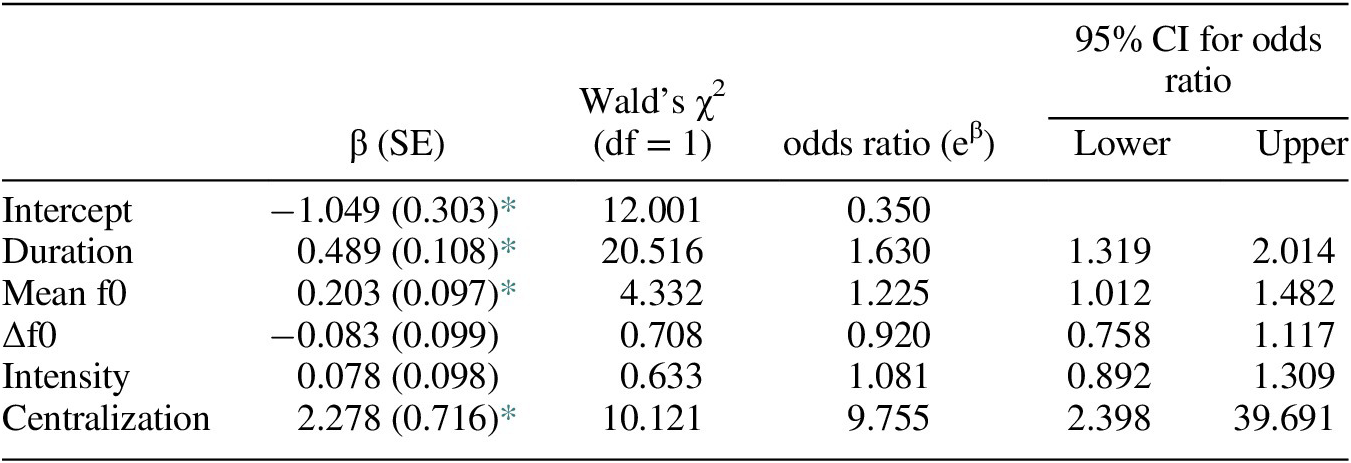
Mean z-score (Standard Error in parentheses) for each measurement.

Classification of Syllable 1 vs. Syllable 2 + Syllable 3 in non-focus condition.

Classification of Syllable 2 vs. Syllable 1 + Syllable 3 in non-focus condition.

Classification of Syllable 3 vs. Syllable 1 + Syllable 2 in non-focus condition.

Classification of Syllable 1 vs. Syllable 2 in non-focus condition.

Classification of Syllable 1 vs. Syllable 3 in non-focus condition.

Classification of Syllable 2 vs. Syllable 3 in non-focus condition.

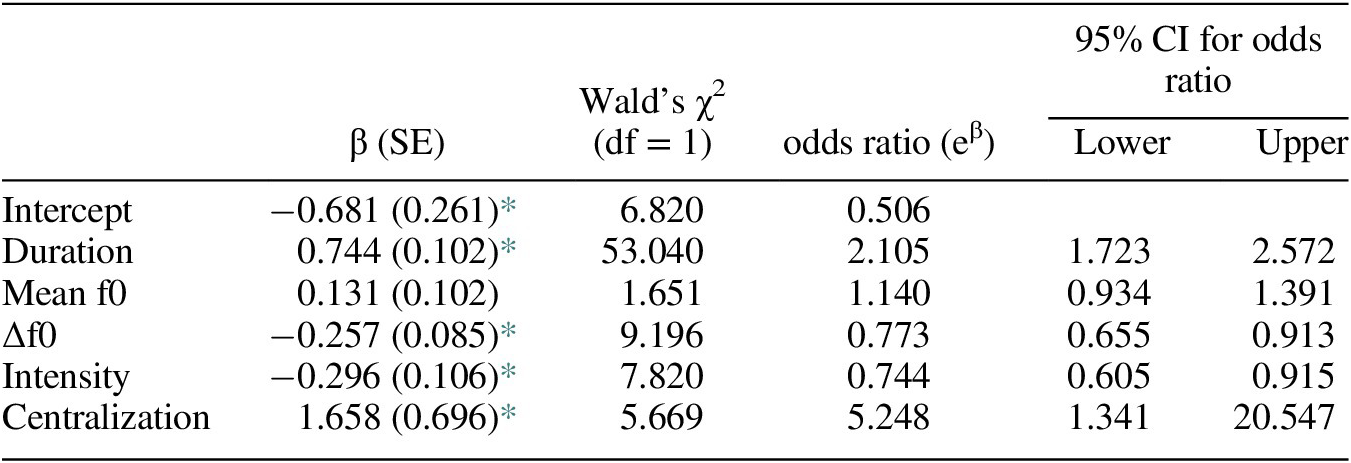
Classification of Syllable 1 vs. Syllable 2 + Syllable 3 in focus condition.

Classification of Syllable 2 vs. Syllable 1 + Syllable 3 in focus condition.

Classification of Syllable 3 vs. Syllable 1 + Syllable 2 in focus condition.

Classification of Syllable 1 vs. Syllable 2 in focus condition.

Classification of Syllable 1 vs. Syllable 3 in focus condition.

Classification of Syllable 2 vs. Syllable 3 in focus condition.

Classification of focus vs. non-focus in Syllable 1.

Classification of focus vs. non-focus in Syllable 2.

Classification of focus vs. non-focus in Syllable 3.

APPENDIX C
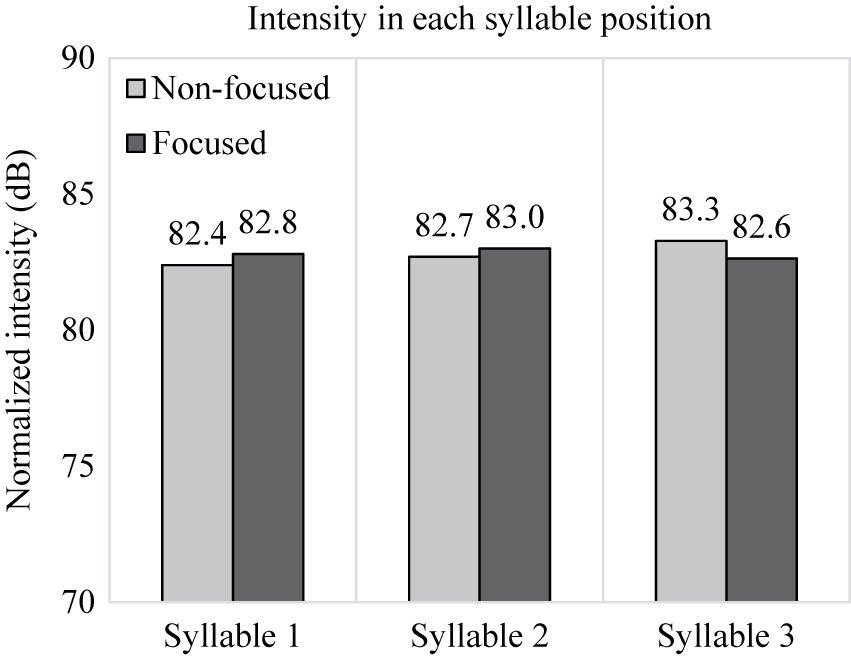
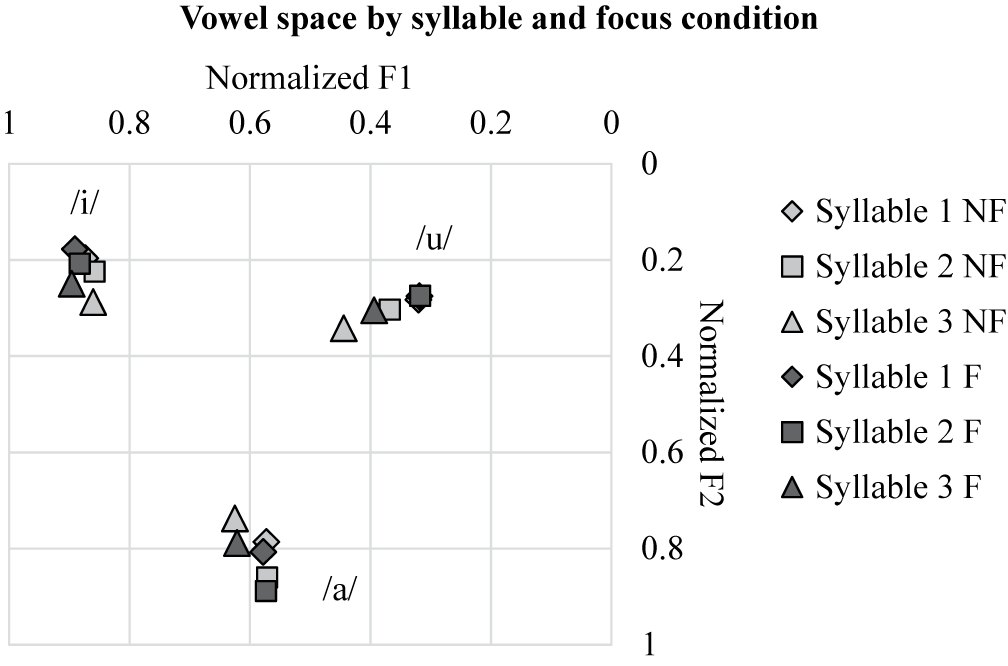
Intensity and vowel centralization graphs
Mean intensity of each syllable in non-focus and focus contexts.

Vowel centralization in vowel space (NF = non-focus; F = focus).

APPENDIX D
Pitch track examples
Pitch track examples for the target word mutasi ‘mutation; shakeup’ in (a) non-focused (NF) and (b) focused (F) contexts. The productions are from a male speaker.