Introduction
Extant scholarship has consistently shown a positive correlation between protest and voting.Footnote 1 The link is intuitive: participating in protests increases activists’ interest in politics and motivates them to also participate in elections.Footnote 2 Conversely, the kind of political socialisation that leads to electoral participation (hereafter EP) may predispose people to participate in protest politics on some issues. Whatever the direction of the causation is – an issue we do not tackle here – the relationship between participation in protests and elections is different in the case of Chile. Several studies show that since the mid-2000s, the country has experienced an increase in non-electoral political participation (hereafter NEP), especially in protest activities.Footnote 3 But this has not gone hand in hand with participation in electoral politics. On the contrary, over the past few decades, Chile has experienced a growing sense of disillusionment with electoral politics, particularly among the younger generation, which further intensified with the implementation of voluntary voting in 2012. By the mid-2010s, almost one-third of Chileans who reported engaging in NEP refrained from voting.Footnote 4 Until 2020, the country had one of the lowest EP rates in Western democracies and the Americas.Footnote 5
Chile's political culture may be changing because of the massive protests of 2019 (commonly referred to as the ‘social outburst’),Footnote 6 the constituent process that they triggered, the election of leftist leader Gabriel Boric as president, and the reintroduction of compulsory voting in 2022. This article, however, addresses the period from the transition to democracy up to the critical juncture of the social outburst, with particular attention given to the decade of voluntary voting in Chile (2012–22). We seek to explain why Chile, a country that became politicised and has seen an unprecedented increase in collective protest over the last decade, nevertheless failed to move voters to the ballots.
We argue that, in general, one powerful reason why protest is correlated with voting relates to the importance of social-movement organisations (SMOs). Traditionally, these play a dual role. On the one hand, they are responsible for providing the necessary resources, mainly civic skills,Footnote 7 to carry out NEP. On the other hand, these organisations contribute to create a context that shapes electoral preferences and makes people more likely to express them at the ballot box.Footnote 8 Recent empirical studies have confirmed that civil associations play a pivotal role in connecting the two dimensions of political participation (EP and NEP).Footnote 9 Consequently, civil associations are considered a traditional bridge that links these two dimensions, underscoring their importance in facilitating political participation.
Can SMOs provide citizens with the necessary resources for participating in protests but fail to create a context that stimulates social predispositions towards voting? This article argues that such a rupture is possible when there is an effective distancing between SMOs and institutional politics. Effective distancing means that SMOs are ideologically distant from party politics and have autonomy in terms of resources. The particularity of the Chilean case, and what makes it an interesting case to test this argument, is that the distancing of SMOs has not been homogeneous but varies across social movements. Although there is a general malaise in the population towards party politics, the main trade-union federations have maintained a dependent relationship with political parties, especially regarding their resources. This dependency stands in contrast with most student organisations, which have remained autonomous and in open rejection of the traditional parties.
Although the student movement in Chile has garnered most scholarly attention for its political impact, since the mid-2000s various other social movements have arisen and have also wielded significant influence on public discourse and policy without relying on political parties. For example, the environmental movement effectively obstructed initiatives such as Patagonia sin Represas (Patagonia without Dams).Footnote 10 Additionally, the No Más Administradoras de Fondos de Pensiones (No More Pension Fund Administrators, No + AFP) movement, an independent citizen initiative that opposed the existing pension system, orchestrated extensive protests across the country in 2016 that continue to be prominent in public discourse despite the lack of action taken to address the system's inadequacies.Footnote 11 In May 2018, feminist university students, primarily organised within local organisations, staged a series of protests that brought the education system to a standstill and led to modifications in university protocols.Footnote 12 As a result, recent protests in Chile have successfully pressured the government to respond to various public-policy demands. However, a crucial aspect of these protests has been the inability of political parties to co-opt them and present themselves as representatives of the people's demands. Hence, the student movement is a more accurate depiction of the Chilean social-movement landscape than the labour movement. Taking the student movement as a fairly representative case of the field of social movements in Chile and the labour movement as a rather exceptional case, our argument is that these different relationships between SMOs and politics produce dissimilar behaviours toward electoral politics.
To test this argument, we employ a mixed-methods research design. In the first section, we conduct a comparative analysis of Chile's political-participation landscape, highlighting the fragmentation between its electoral and non-electoral aspects. Utilising cross-sectional data from the World Values Survey (henceforth WVS), we establish that the relationship between voting and protest in Chile over the past decade can be considered a deviant case (details in the following section). In the second section, we conduct interviews with leaders from student and trade-union organisations to elucidate the factors influencing their promotion of EP. We then explore whether activists affiliated with the labour and student movements, which differ in their levels of engagement with institutional politics, exhibit diverse electoral behaviours. For this purpose, we utilise surveys conducted with individuals who participated in protests as part of the ‘Caught in the Act of Protest: Contextualising Contestation’ (henceforth CCC) project. These surveys employed a systematic sampling procedure and covered various topics, including questions about participants’ electoral involvement. Additionally, the dataset incorporates surveys conducted during a march organised by human-rights organisations and another by the LGBT movement. These cases serve as comparative references to enhance the external validity of our argument, with the LGBT-movement march representing more similarities to the student movement and the human-rights march aligning closer with the labour movement. Finally, we discuss our results in the concluding section.
Our findings suggest that student-movement organisations encounter specific challenges in mobilising their members for engagement in electoral politics. These challenges stem from their relative detachment from political parties and their independence in terms of material and ideological resources. This is less true for labour organisations, which are typically more closely aligned with political parties and have greater access to resources that can be used to promote EP. In contrast to student SMOs, labour organisations may be more likely to encourage their members to participate in electoral politics, recognising the potential benefits of EP for advancing their interests and achieving policy goals.
Although we focus on Chile, our argument has important implications for other Latin American countries where social movements have become increasingly distanced from institutional politics. Even leftist governments, traditionally closer to – or even originating from – movements, have been challenged by them, as illustrated by the cases of Evo Morales in Bolivia and Lula da Silva in Brazil. Recent popular protests in Colombia (2019–21), Ecuador (2019) and Peru (2022–3) have discredited large chunks of the political elite, threatening to further disconnect the citizenry from the political parties. And, while Latin American progressive movements generally have democratic credentials, by challenging the political status quo they may increase citizen disaffection in ways that endanger democracy. This is a relevant issue since citizen support for democracy in the region has decreased from 68 per cent in 2004 to 61 per cent in 2021, according to the Latin American Public Opinion Project (LAPOP).Footnote 13 Likewise, the global level of liberal democracy in the region, according to Varieties of Democracy (V-Dem), has been decreasing during the last decade,Footnote 14 with eight countries becoming more autocratic and only three becoming more democratic.Footnote 15 As many Latin American parties resemble electoral machines more than vehicles for democratic representation,Footnote 16 social movements lack incentives for building ties with them, exacerbating the crisis of representation and discomfort with the functioning of democracy. Thus, the Chilean case provides valuable insights into broader regional trends.
Different Approaches to Institutional Politics: The Case of Chile
Chile's transition to democracy was characterised by the progressive demobilisation and depoliticisation of civil society.Footnote 17 Elements such as the binominal system,Footnote 18 problems of the legitimacy of the democratic institutions inherited from the dictatorship,Footnote 19 and the co-optation of civil-society organisations by traditional political parties that responded to the interests of the elite,Footnote 20 have been the most recurrent arguments. The role played by politicians in this depoliticisation process is controversial. Some authors argue that the Concertación de Partidos por la Democracia (henceforth Concertación), the coalition of centre-left parties that governed between 1990 and 2010, disconnected from the protest movements of the mid-1980s, abandoned former allies and took a more conservative centrist turn.Footnote 21 Another argument is that protest movements were waiting for governments to engage in the promised reforms to the neoliberal model. Both arguments help explain why the 1990s are characterised as a decade of low social-movement activity.
At the beginning of the 2000s, several authors noted the worrying distancing between civil society and political parties.Footnote 22 Arguably, an exception to this trend was the Communist Party. The Communists opposed the elite-driven transition to democracy in the 1980s. Once democracy was regained, the party was left out of the Concertación and played a marginal role in institutional politics. In the context of a binominal electoral system that sought to foster the creation of broad coalitions, the Communist Party struggled to gain parliamentary representation. Instead, with the Partido Humanista and other smaller left-wing political forces, it formed the ‘extra-parliamentary’ Left. The party's efforts were concentrated in gaining influence in SMOs, which partly explains why the party kept its linkages with both students’Footnote 23 and workers’ organisations.Footnote 24
Besides the exceptional case of the Communist Party and its ability to maintain its roots in SMOs, overall, extant evidence shows that Chileans are less affiliated and have less sympathy for political parties.Footnote 25 There is also a decline in the interest in politicsFootnote 26 and EP.Footnote 27 As a result, depoliticisation, especially among young people, was for a long time regarded as part of the new political culture in Chile.
Yet, NEP, especially in the form of collective protest, has seen a dizzying growth since the mid-2000s.Footnote 28 Actions such as raising petitions, participating in demonstrations, deploying public performances and contacting politicians, among other activities, have become widespread repertoires of contention, shaping public policies and public opinion across many issues such as education, pensions, gender equality and sexual diversity. This growth in collective protest has gone hand in hand with the consolidation of important social movements, which include the secondary-student movement,Footnote 29 the university-student movement,Footnote 30 the No + AFP movement against the pension system,Footnote 31 the contractor workers’ movementFootnote 32 and the feminist movement,Footnote 33 to mention the most massive ones.
This growing effervescence for NEP contrasts with declining EP. Among the world's democracies, at least until 2020, Chile had one of the lowest percentages of voters.Footnote 34 The decline had already become evident in the 1990s, especially among younger people. But after the law of voluntary voting and automatic registration in 2012, voting rates plummeted below 50 per cent.Footnote 35 The persistently low voter turnout finally prompted the political establishment to reintroduce compulsory voting in 2022, after a decade of voluntary voting (2012–22).Footnote 36
Especially during the decade of voluntary voting in Chile, the two dimensions of political participation (EP and NEP) were highly fragmented. This situation locates Chile as a deviation from the leading theories on political participation, which shows that EP and NEP are positively correlated based on data from Europe and the United States.Footnote 37
Figure 1 shows the polychoric correlation between voting and participation in non-violent protest tactics for various countries in wave 6 (2012) and wave 7 (2018) of the WVS. The figure only shows the countries with advanced democracies in each wave (scores above 70 on the Freedom House index) for comparison purposes. Since the WVS responses for both vote and protest are ordinal, we computed polychoric correlations between vote and protest.Footnote 38 Given the cross-sectional nature of the data, we do not assert causality in any direction.
Correlation between Voting and Protest: Wave 6 (2012) and Wave 7 (2018)
Source: Authors’ elaboration based on WVS, waves 6 and 7.

Consistent with previous studies, which assert a complementarity between voting and protest, the wave 6 data in Figure 1 highlights that European countries and the United States tend to show a positive and significant correlation between both forms of political participation. At the bottom of Figure 1, Chile is the only one with a negative and significant correlation between voting and protest. Figure 1 shows very similar results for wave 7 of the WVS. Although in wave 7 the association is not significantly different from zero, it maintains a substantially equivalent association, which ratifies the atypical nature of the Chilean case compared to other countries. More specifically, we claim that Chile is exceptional not because the correlation between vote and protest is different from zero but because it is different from that of most other countries. The confidence intervals in Figure 1 show that, for wave 6 of the WVS, the size of the correlation in Chile is significantly lower than that of all other 20 countries except Slovenia. For wave 7, Chile differs from 12 countries – the only exceptions being Korea, Greece, Peru and Argentina. Additionally, Figure 1 shows that the fragmented relationship between EP and NEP in the case of Chile is a relatively stable pattern. That is, going against all expectations and different from most other countries, in Chile the relationship between voting and protest at the individual level has been either negative or not significant for the last decade.
Methodology
Given Chile's particularity, ours is a deviant case study,Footnote 39 characterised by showing a value far from the expectation. To explain this theoretical anomaly, we resort to a mixed methodology that combines different data-collection techniques.Footnote 40 To identify how, why and to what extent SMOs distance themselves from political parties, we provide evidence from 24 semi-structured interviews with student and trade-union leaders (12 student leaders and 12 union leaders). Table 1 provides a description of the interviewees. The sampling of interviews was intentional and sought to represent as much as possible the diversity of student organisations (private/public and location) and union organisations linked to the Central Unitaria de Trabajadores (Central Workers’ Union, CUT), the main workers’ federation.
List of Interviews

Note: All interviews with student-movement leaders were conducted between June and December 2014. The interviews with union leaders were conducted between June and December 2015.
Source: Compiled by authors.
It is important to note that while our explanation of Chile's exceptionality goes back to the 1990s at least, we collected our primary data at specific time points – the surveys of demonstrators date from 2016 and 2017, and the interviews with activists date from 2014 (students) and 2015 (workers). Thus, we also rely on secondary literature about Chilean social movements and political parties to make our argument. The socio-political dynamics over three decades, of course, are very complex. While our story begins with the transition, our empirical focus is on the last decade.
Distance from Political Parties: Differences between Students and Workers
The Student Movement: Ideological Detachment
The student movement and the partisan youth formed an active part of the political process that preceded the military coup of 1973. For this reason, the military dictatorship dismantled student-movement organisations and persecuted their foremost leaders. In the anti-authoritarian protest wave of the 1980s, the student movement once again took an active role in politics. However, this reactivation was subordinated to the strategy adopted by the political parties on the centre-left at the time.Footnote 41
Once democracy was restored, the student movement faced great difficulties in building an agenda of demands with public resonance and did not stray too far from the policies implemented by the Concertación governments. As previously noted, the Communist Party and its youth branch were active in student politics, both at the high-school and university levels, and played a central role in the reconstruction of the student movement. While in the early years of the return to democracy the Concertación parties sought to contain mobilisation efforts to show their capacity to govern and maintain stability, the Communist Youth identified a political void in which it could recoup.Footnote 42 In the sporadic student protests that followed in the late 1990s and early 2000s, the Communist Party, along with other emerging left-wing forces such as the SurDA mobilised around issues related to the funding of public education in the neoliberal model.Footnote 43
These mobilisation experiences and elaboration of an agenda in the 1990s were central to the construction of the student movement's identity and autonomy from the political parties of the Centre-Left.Footnote 44 The growing ideological distancing from traditional political parties was also present among secondary-student organisations. The protests of 2001 and 2006, in particular, produced a critical rupture with the parties of the Concertación due to how parties channelled these conflicts institutionally. Both times, high-school students had faced governments led by the Socialist Party. President Michelle Bachelet, who in 2005 had campaigned promising to listen to civil society when governing, created a presidential advisory commission to address the concerns of the high-school students. After months of discussion, the commission issued a report that inspired a government bill that sought to replace the constitutional law of education left by the military regime. During the parliamentary discussion, however, this bill was significantly watered down. While it introduced more regulation to ensure the provision of quality education, it did not overhaul the neoliberal logic of the education system and failed to privilege public education.
According to interviews with student leaders, the dissatisfaction with the results of these waves of protest generated distrust among students. Consider the words of the former president of the Universidad Católica de Valparaíso student federation and member of the political movement Izquierda Autónoma:
I believe that the relationship is one of distrust […] what the dictatorship did and what the Concertación also successfully achieved in these 20 years was to separate the political from the social. Understanding this as the resolution of public affairs, the interest in the public sphere was only the work of these professionals for the more political, and therefore the social movements or the empowered, organised citizenry had no possibility of dissent.
Such a view is quite widespread within the student leadership. It alludes to the abandonment by left-wing parties. There were strong ties between students and left-wing political parties before the military dictatorship (1973–90) and during the dictatorship.Footnote 45 From 1990 onwards, the ruling parties’ links with student organisations were still quite strong, which allowed them to have important party leaderships spearheading the movement.Footnote 46 However, this situation began to change in the late 1990s, when the Concertación parties started to give ground to other parties such as the Communist Party and other emerging political movements such as the SurDA,Footnote 47 which stressed the need to achieve autonomy from political parties.Footnote 48
While most university federations were still headed by leaders linked to the Concertación parties at the beginning of the democratic era, by the mid-2000s, these parties had lost influence in the main student federations.Footnote 49 The secretary of the University of Valparaíso student federation is assertive in this regard: ‘Look, in general, the same as at the national level, I think that when they [the students] say party, they say no, I don't want anything to do with parties. The parties are like AIDS. Before, everyone wanted them: now no one wants political parties.’
Instead of the traditional political parties in the leadership of the student movement, different party-autonomous local movements – the so-called colectivos sociales – gained predominance.Footnote 50 By organising in these colectivos, students could surpass the old traditional party leadership.Footnote 51 Hence, a large part of the identity of the collectives was determined by their anti-traditional-party stance. In the words of the former secretary of the Law Student Centre of the Universidad Central, and member of the student collective La Voz: ‘We defined ourselves as anti-Concertación par excellence, so the truth is that we were not very interested in generating any kind of contact with the people in Parliament at that time and yes, well, with our authorities, the relationship was also complex.’
It is important to note that increasing autonomy does not mean students lose influence over institutional politics and public policies. In fact, through massive mobilisations across the country, the student movement has possibly had the most significant impact on the political agenda in recent years.Footnote 52 The movement has sought to exert this influence by directly targeting the executive branch, hoping that the government in power will respond to its demands through direct action, not through parties’ mediation. Even though, for the 2013 elections, former student leaders were elected deputies, student SMOs have maintained a critical discourse against parties. The creation of the Frente Amplio (Broad Front) in 2017 – a coalition of emerging political movements and parties, many of them coming from the student movement – has generated tensions with this discourse. These difficulties have been particularly evident since 2022, when former student leader and Frente Amplio founder Boric won the presidential election. To secure governability and advance his government programme, he has needed to make concessions that include integrating many former Concertación figures. After the constituent process triggered by the social outburst culminated in a plebiscite in which Chileans rejected the proposed constitution – a major setback to the Boric government – the role of the traditional centre-left parties has become even more important. Nevertheless, the mere fact that former student leaders decided to create new political parties and founded the Frente Amplio as an electoral vehicle to dispute power with the political parties of the former Concertación shows that distrust towards traditional parties has constituted a driving force.
The Student Movement: Resource Autonomy
Student movements’ influence on the political agenda, despite their anti-party stance, has been made possible by their independence from the resources offered by political parties. Autonomy can hardly be a purely discursive phenomenon, and it must have a material basis to sustain itself; this is where the functioning of student SMOs becomes vitally important.
To gather more information about student movements’ funding sources, we conducted interviews with student leaders representing different generations, including those from historically significant student movements at both the Universidad de Chile and the Pontificia Universidad Católica. Our interviews revealed that their primary forms of financing are self-management and the contributions that the federations and student councils receive directly from the universities. This information was also confirmed to the authors by administrators and professors from both universities. This financial autonomy allows student federations to maintain a degree of independence from political parties, which can make it difficult to mobilise their members for EP. Furthermore, student leaders may promote a critical stance towards party politics and encourage protest activity instead, as a way to advance their goals and maintain their autonomy.
Students have two organisational structures at different levels that are key for assuring self-management. First, there are the student federations, which bring together the entire student body of each university; second, there are the political student organisations, which operate as collectives at the faculty level. The student federations usually have an annual budget, made up of the universities’ funds. But there are also activities that the student federations carry out, such as parties, seminars and donation campaigns. The grassroots student organisations at the faculty level are basically financed by contributions from members of the organisations, where each one contributes regularly.
When it comes to organising specific protest campaigns, the self-management capacity of student groups is central. Much of the resources are based on interpersonal networks (family, friends or acquaintances), which makes the mobilisation possible without the resources of political parties.
For the electoral campaigns for student positions, the contribution of family members was also mentioned in the interviews. Likewise, interviewees also highlight the direct contributions that student federations receive from the faculties or the university. The particularity of these contributions is that they do not jeopardise the autonomy of student organisations. There is a marked inequality in the size of resources available to the different federations. The student federations of the Universidad de Chile (FECH) and the Pontificia Universidad Católica de Chile (FEUC) are the most resourceful ones. Therefore, these federations finance most of the activities when there are monetary costs associated with them.Footnote 53
In addition to economic resources, student SMOs are also autonomous from both cultural resources and the expertise of the political parties. This autonomy is possible because of the very nature of the movement's composition. For example, student leaders regularly attend parliamentary committees to present their demands. Likewise, their cultural resources are also evidenced in the intensive use of digital social networks,Footnote 54 strengthening their autonomy and self-management capacity. Furthermore, many students make their professional expertise available to their organisations or movements. For example, during or after student protests, nursing and medicine students take care of the injured students, law students defend their fellows arrested by the police, and theatre and music students deploy their creativity in the movement.Footnote 55 Taken together, these capacities have boosted the student movement's autonomy, allowing them to articulate an identity firmly rooted in a critique of the dominant parties.
The Labour Movement: Closeness to Centre-Left Parties
In contrast to the student movement, the labour organisations linked to the CUT, the main union confederation in Chile, do not show marked resource autonomy or a significant ideology and identity distance from the dominant parties. The labour organisations’ greater attachment to parties has historical roots. From the 1930s until the coup d’état in 1973, trade unions in Chile were closely attached to political parties.Footnote 56 In this period, the CUT mediated between institutional politics and trade unionism while seeking to represent the demands of the working class as a whole.
The military regime reshaped labour relations in significant ways. In addition to the brutal persecution of union leaders during the dictatorship, a new labour code was introduced in 1979, which is still in place at the time of writing this article (2022). The labour code heavily shapes the functioning at the union level in the private sector. The essential characteristics of this code are the establishment of extreme flexibility and deregulation at the individual company level and hyper-regulation at the collective level.Footnote 57 Therefore, the functioning of this legal regulation has consequently involved a marked process of demobilising organised workers.Footnote 58
The end of the dictatorship in 1989 opened the possibility of re-establishing a large part of the rights that workers had lost. The old model, based on a close link between the trade-union world and the political parties, was emulated with the re-founding of the CUT in 1988,Footnote 59 which was indeed a political agreement between the parties of the newly created Concertación. Hence, from its origins, the new CUT sought to be a trade-union extension of the new centre-left Concertación pact and not an instrument of broader worker demands as it had been in the 1960s.Footnote 60 The revitalised Agrupación Nacional de Empleados Fiscales (National Association of Public Employees, ANEF), the public-sector confederation that had managed to survive the dictatorship, also joined the CUT.
The fact that the new CUT originated from the parties that led the transition was decisive because its approach was much more reformist than transformative.Footnote 61 During the first decade of the democratic transition, instead of pushing the Concertación to draft a new labour code, the CUT prioritised its alliance with the centre-left coalition.Footnote 62 While the Communist Party, still very influential in the CUT, elaborated a more marked anti-neoliberal discourse from the late 1990s onwards, this alliance was still regarded as necessary.Footnote 63 The cost of the proximity to the Concertación was the internal division of the Chilean labour movement. Recent studies show that there is a social cleavage in Chilean unionism, which has, on the one hand, the main federations (mainly the CUT and the ANEF), primarily represented by public-sector unionism; and on the other, an independent unionism, distanced from the CUT and political parties, and represented mainly by private-sector unionism.Footnote 64
This division between one unionism linked to the CUT and another independent unionism was very present in the interviews with leaders of unions affiliated to the main federations. In the interviews, union leaders recognise the importance of political parties in the CUT, which some criticise to a certain extent. In the words of a leader of the Colegio de Profesores, one of the closest union associations to the CUT:
We believe that the CUT, in some way, represents the old style of trade unionism. This style is very party-managed, with little autonomy from political power, where, in some way, the trade-union movement is put at the service of the parties. We expect something like the opposite of that, where the social movement has so much strength that it makes the parties put themselves at the service of the social movement, which seems to us to be much more representative of the genuine needs of society.
Others support the role of the CUT and the ANEF, but not necessarily their leadership, as pointed out by a leader of the Asociación de Fiscalizadores de Servicios Impuestos Internos de Chile (Association of Internal Tax Auditors of Chile, AFIICH):
The CUT is the biggest thing, I don't know if the leaders … They [the leaders] are the tools that workers in Chile have to advance their demands. There are no others. We don't have the economic power, we don't have the weapons, we don't have the government, we don't have the Congress. We have the CUT and the ANEF to advance labour demands. I don't know if that explains how important the CUT and the ANEF are.
Other leaders even more openly acknowledge their distance from the leadership of the CUT and the ANEF. Even so, they boast of always being available to the confederation. As a leader of the Gustavo Fricke Hospital, linked to the Federación Nacional de Trabajadores de la Salud (National Federation of Health Workers, FENATS), points out, ‘We accept all the CUT's calls, even though we take issue with its leadership because the leadership is not very democratically directed, but we accept the CUT's mandates. I think that the CUT should be more democratic. One person, one vote. Not this weighted vote that they think.’
While there are nuances, all the union-leader interviewees acknowledged that the CUT is a key support for them. As a leader of the Asociación de Gendarmes de Chile (Chilean Gendarmerie Association, AGECH) points out: ‘We have contacts, and we have people we know in the CUT. Therefore, I believe that they will not refuse if we ask them for support in any march or labour strike that we have to organise.’
Thus, despite moderate criticism, union leaders recognise that the CUT has been there for them when they need it and stress that they are also available when the federation calls on them.
The Labour Movement: Resource Dependency
As we reviewed in the previous section, the labour movement linked to the main federations is one of the few mobilised sectors in Chile that has remained close to the parties in recent decades. Primarily, the public-sector unions have maintained an indirect relationship – through the CUT – with the centre-left political parties that governed in five of the seven presidential administrations from 1990 to date (2022). During the 1990s, the CUT had low levels of mobilisation, mainly because it subordinated its demands to the partisan objective of consolidating the transition to democracy. However, it has seen a growth in its mobilisation capacity in recent decades.Footnote 65
The CUT has called seven general strikes since the return to democracy, mobilising thousands of workers, especially from the public sector.Footnote 66 The most prominent example of mobilisation capacity is the public sector's yearly stoppage, which has become Chile's largest (informal) collective-bargaining stance. In this informal institution, the public-sector unions negotiate directly with the government on labour readjustments. Unlike the loneliness of private-sector unionism, the main federations, such as the CUT and the ANEF, are always present. Given their closeness to political parties, their support is crucial for the negotiations with the Ministry of Finance.Footnote 67
These party networks are therefore fundamental to the federations’ capacity. All the presidents of the CUT have belonged to the political parties of the Concertación or Nueva Mayoría (a new political coalition established in 2014, which includes the former Concertación plus the Communist Party). Thus, the unions linked to the federations have been building a relationship of dependence: a direct reliance on the resources of the federations and indirect dependency on the parties’ political support. Specifically, federations provide fundamental technical resources for negotiation, such as legal and economic advisers, but they also mobilise the necessary political influences to pressure the governments in office and advance their demands.Footnote 68
Consistent with this, the interviewed trade-union leaders indicate that the links with the trade-union confederations are particularly important for negotiating wage increases. The federations offer concrete resources such as legal advice, which is essential for negotiation processes. Referring to the federations’ support to local unions, a leader from the Federación Nacional de Profesionales Universitarios de los Servicios de Salud (National Federation of University Professionals in the Health Service, FENPRUSS) points out: ‘The Federation offers the Hospital Carlos Van Buren union legal advice. We have a lawyer who advises on issues of administrative law, and administrative statute. Therefore, we offer a permanent contribution for any decision-making they need.’
In addition to legal advice, the federations also offer communication support to make labour demands visible and generate empathy with the broader public. During periods of mobilisation, the resources and contacts of the confederations are vital to gaining access to the press. As a leader of the Asociación Nacional de Funcionarios Penitenciarios (National Association of Prison Officers, ANFUP) commented in reference to a recent strike: ‘For us the strike (…) that we did last year, without press coverage would not have been known by the public opinion. We needed a lot of press. And the ANEF brought us the networks.’
The other federation, the ANEF, closely related to the CUT and the parties, is also mentioned by union leaders as essential support regarding the resources it provides for their mobilisations. As a union leader of the Servicio Nacional de Menores (National Children's Service, SENAME) points out:
Look, we deal with the ANEF for their support. The one who came at that time [during a strike] was the president of the ANEF. Communications are with them, and they can provide us with logistical support [… as well as] advice, support, presence, and talking to the people, because the president of ANEF is also there and talks and explains our demands. In the future [future mobilisations to come], we need the support of the ANEF because it will be more complicated.
Thus, these unions need the federations, and the federations have good reasons to maintain a close relationship with political parties. Through the mediating role of federations, parties provide workers with key resources for successful mobilisation. This external support may be the key to understanding why partisan politics can be relevant for unions, as the support and resources offered by the federations (and indirectly by political parties) are also permanently at stake in the electoral arena.
Hypotheses Derived from the Qualitative Section
The main argument of this article is that SMOs’ orientations towards parties are vital for deciding whether protest and voter turnout go together at the individual level (as in most countries: see Figure 1) or not (as in Chile). As the literature suggests, these organisations usually fulfil a double function: on the one hand, they provide the necessary resources for protest. On the other hand, they provide a context that stimulates the development of the electoral preferences essential to voting.
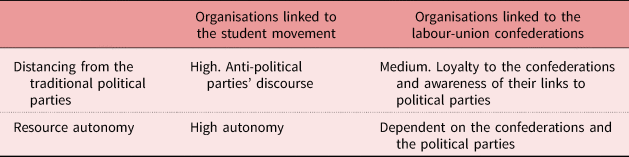
However, the Chilean case shows that participation in protests and elections might not go hand in hand, despite activists’ membership in SMOs. For this rupture to occur, these organisations must deploy a discourse that does not stimulate the development of electoral preferences among their participants. These contradictory stimuli for political participation happen when there is an effective distancing between citizen organisations and political parties. An effective distancing implies that activists feel uncomfortable toward parties and politicians. Yet, this is not enough. Organised activists must also be able to mobilise independently from political parties’ dictates. Table 2 summarises this argument as applied to the two cases in Chile reviewed above.
Key Differences between Student and Labour Organisations in Chile

Source: Authors’ own elaboration.
Based on the preceding argument and the qualitative analyses, we will test two hypotheses by resorting to surveys of participants in student and labour demonstrations:
-
Hypothesis 1 (hereafter H1): In demonstrations called by the labour movement linked to trade-union federations, participants are more likely to vote [or to integrate EP and NEP] than those who participate in demonstrations called by the student movement.
-
Hypothesis 2 (hereafter H2): Among the participants of both demonstrations, the effect of belonging to one of the convening organisations on the probability of voting will be positive and significant in the labour-movement demonstrations, yet not significant in student demonstrations.
In addition to the two cases analysed in depth in the previous section (students and labour), we include two shadow cases, namely a demonstration organised by human-rights organisations and another march organised by LGBT organisations. Based on existing literature, we expect a strong separation between grassroots and party politics in the case of LGBT demonstrators,Footnote 69 and more closeness in the case of the human-rights movement.Footnote 70
Social Mobilisation and Electoral Participation: Explaining the Contrast between Workers and Students
Testing the above hypotheses requires knowing whether or not those who protested were linked to SMOs and whether they voted or not in the last elections. This analysis is difficult to undertake based on public-opinion polls, which typically lack information about protest participation and the social movements that convoked such protests. Therefore, this section uses a dataset of surveys of participants in Chilean demonstrations. The methodology follows the international CCC project. This survey seeks to represent those who attend large demonstrations based on a systematic selection of respondents. We convened a group of pollsters and a group of ‘pointers’ for each demonstration. The pointers oversee the pollsters, who select the people to be surveyed according to the sampling methodology that counts the rows of participants and their location across the marching column. While not a simple random sampling, this systematic procedure gives a varied and reliable representation of the participants.Footnote 71
The questionnaire includes various topics related to the protest and its demands, political and ideological attitudes, previous history of activism, and socio-demographic information. From these surveys, we can know the extent to which those who are called to protest by different social movements are also affiliated with the convening organisations and turn out to vote or not. The survey was applied in a march called by students of higher and secondary education (although only those over 18 years of age, thus being eligible to vote), and another one called by the CUT and the ANEF.
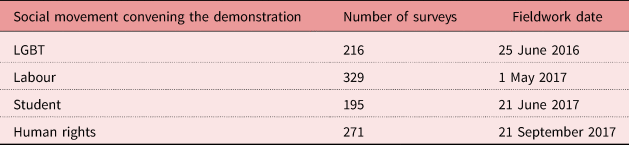
In addition to the primary cases analysed in this study, namely the student and labour demonstrations, we also conducted surveys with participants of a demonstration organised by human-rights organisations and another march led by LGBT organisations. These supplementary cases were incorporated as shadow cases in our analysis, as previously discussed in the preceding section. Table 3 provides details about each demonstration.
Characteristics of Surveys of Demonstration Participants

Source: Authors’ elaboration based on CCC surveys.
A great strength of this database for testing our argument is that it indicates whether participants have links or not to the organisations convening the demonstration. To do this, the questionnaire asks whether participants belong to the convening organisation and whether they feel ‘strongly identified’ with the convening organisation or not. If the answer to any of the above questions is positive, we assume that the activist has links with the organisation. If SMOs do foster turnout, those who belong to the organisation calling the demonstration should vote more than those who do not.
Descriptive Results
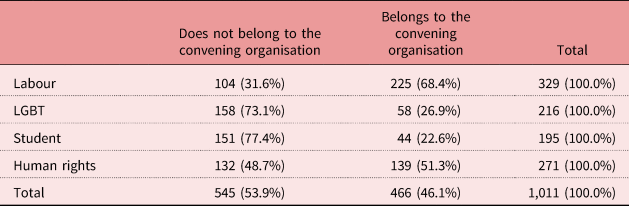
To test our hypotheses about the importance of SMOs for EP, we first assess whether the surveys capture a considerable number of organised activists at each demonstration. Table 4 shows, for each demonstration, the distribution between those belonging and those not belonging to the convening organisations. There is a reasonable presence of activists linked to such organisations in the four demonstrations, but this varies considerably across them – from a high of 68 per cent for labour to a low of 23 per cent for student demonstrations.
Number of Activists Organised in Each March.

Source: Authors’ elaboration based on CCC surveys.
It remains to be seen if the marches have differences in terms of the average vote of their activists and in the effect of belonging to the convening organisations on turnout. For this, however, we need to go beyond descriptive results and control for demographic variables across demonstrations. For example, we know that young people vote much less than older people,Footnote 72 so participation in student versus labour demonstrations can have an age bias. Also, the level of education could be biasing the results since we know that higher levels of education boost voting.Footnote 73 Finally, we need to rule out the possibility that contact networks and variables associated with political ideology are associated with the results. To address these considerations, the following section presents two binomial logistic regression models.
Multivariate Results
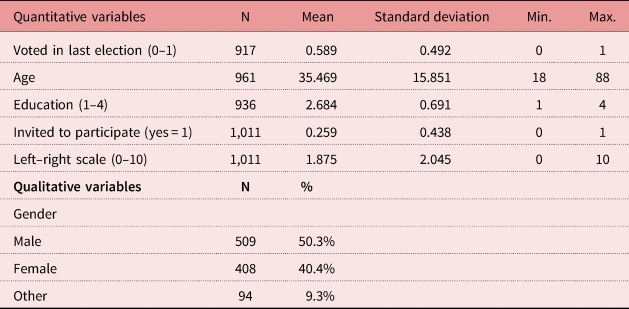
Our models utilise a binary dependent variable representing whether participants voted in the most recent national election (coded as 1) or did not vote (coded as 0). To account for potential influences on voting behaviour, we include several control variables, namely gender, age and education, the latter two recognised as significant predictors of voting patterns. Additionally, we incorporate a microstructural element by including a dichotomous variable indicating whether the participant has received an invitation to participate (coded as yes = 1, no = 0). Furthermore, we control for political ideology by employing a scale ranging from 1 (indicating a strong left-wing orientation) to 10 (indicating a strong right-wing orientation). Descriptive statistics for these variables are presented in Table 5.
Descriptive Statistics

Source: Authors’ elaboration based on CCC surveys.
Do those who participate in a demonstration organised by the labour movement linked to the federations vote more than those who attend demonstrations organised by other movements? From the qualitative section, we derived H1: participants in protests organised by the student movement will be less likely to vote than activists attending protests organised by the labour movement. We also emphasised the effect of SMOs. We expect that the effect of belonging to one of the convening organisations on the probability of voting will be positive and significant in labour protests, yet not significant in student demonstrations.
Table 6 provides the results of two binomial logistic regression models employed to examine the hypotheses put forth. Both models utilise the same dependent variable, namely whether the participant voted or not, and incorporate socio-demographic variables as control variables. In Model 1, we introduce the type of demonstration (student, labour, LGBT or human rights) and membership in convening organisations as individual predictors. To further investigate potential interaction effects, Model 2 includes an interaction term between the type of demonstration and membership in the convening organisation.
Explaining the Probability of Voting: Binomial Logistic Regression

Notes: Standard errors in parentheses, ap < 0.001, bp < 0.01, cp < 0.05
Source: Authors’ elaboration based on CCC surveys.
Before describing the variables of interest, we present some general comments about the control variables. In both models, age and education have significant effects and are in the expected direction. Younger people vote significantly less than older people, and higher levels of education positively impact voting. The variable of ‘having been invited to a demonstration' is irrelevant for explaining why activists vote, the same as the left–right scale.
Regarding the central variables for our hypotheses, the findings from Model 1 (see Table 6) demonstrate that, even after accounting for demographic factors and other variables, the type of demonstration exhibits a significant effect. Specifically, labour demonstrators display higher voting rates compared to student, LGBT and human-rights demonstrators (p < 0.01). In terms of odds ratio, labour demonstrators are about 3.5 times more likely to vote than student demonstrators. These results provide support for H1 and align with our expectations.
Furthermore, organisational membership has an independent and significant effect (p < 0.01), which increases the probability of voting. However, we must be cautious when interpreting this variable since it could be due to the strength of one specific movement's call to the polls. Therefore, the right way to see if this effect holds is to perform an interaction between organisational membership and the type of demonstration (see Model 2 in Table 6).
Model 2 presents the interaction results between organisational membership and type of demonstration, using the same variables as in the previous model. Because the reference category for the type of demonstration is the labour protest, the interacted coefficient of organisational membership is interpreted exclusively for the labour demonstration. The transformation to odds ratios indicates that in labour demonstrations, organisation members are 2.786 more likely to vote than those who do not have those organisational ties, with a significant coefficient (p < 0.001). When leaving students as the reference category, the coefficient of organisational membership interacted with the type of protest becomes negative and ceases to be significant (results on request). This means that the effect that membership in SMOs has on voting is conditional on the type of call: in labour demonstrations, being organised significantly increases EP, but in student demonstrations, the effect of SMOs becomes null. This is consistent with H2.
The interaction coefficient of Model 2 (see Table 6) shows that the comparison between the labour and student movements is significant (p < 0.001). This interaction is strong evidence that being organised in a labour-movement protest versus being organised in a student protest generates very different effects on the probability of voting.
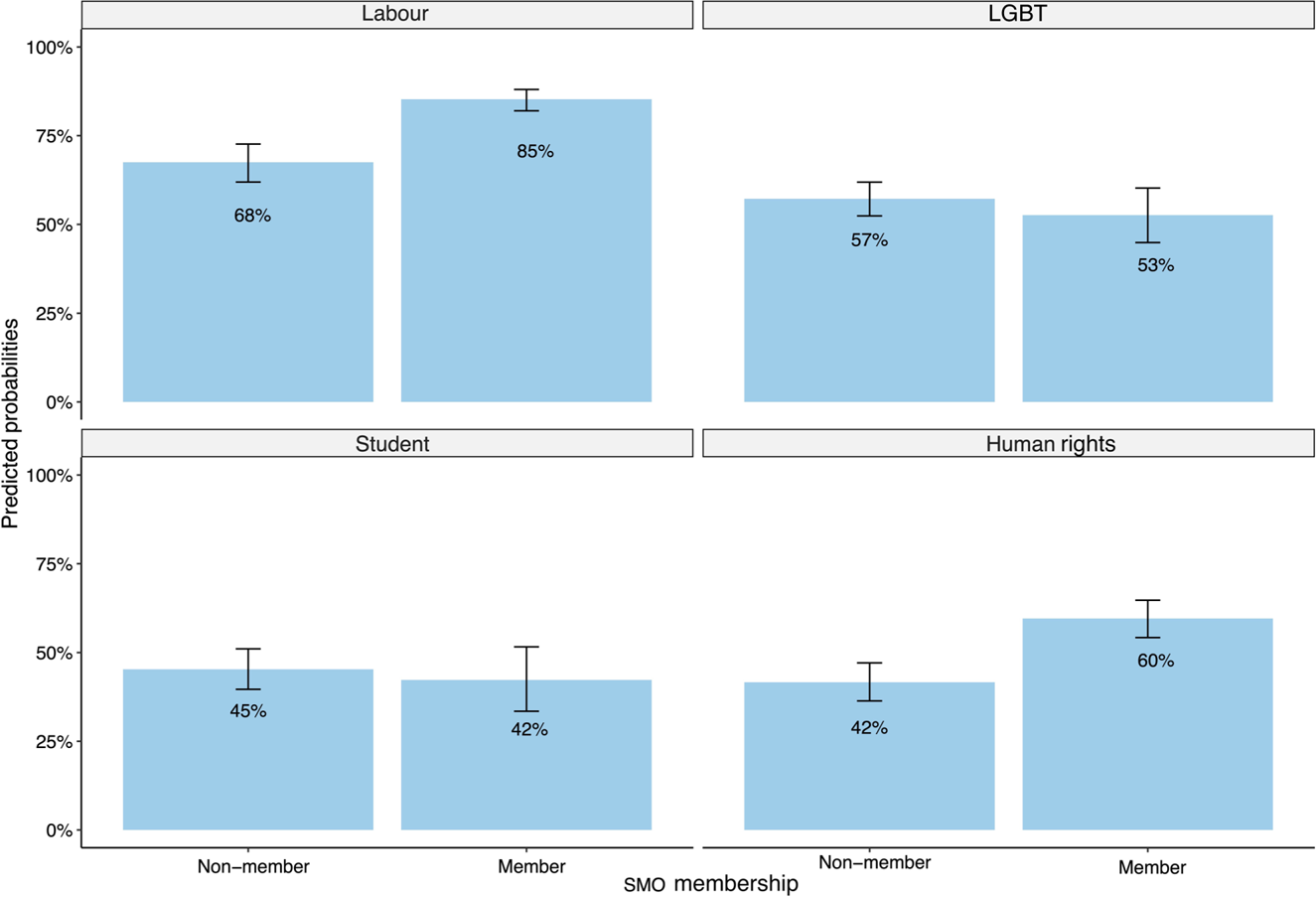
To better visualise how the call for demonstrations moderates the effect of organisational membership on the vote, Figure 2 shows a graph with the predicted probabilities of the interaction from Model 2 (in Table 6). The first general observation is that those who participated in the demonstration called by the labour movement voted more than those who participated in other demonstrations. Regarding the main contrast (labour versus student movement), the majority of those who participated in the demonstration called by the CUT voted, while the majority of those who participated in the demonstration called by the students abstained. These results give important support to H1. As for the shadow cases (LGBT and human rights), we can see that the probability of voting for both demonstrations is higher than for students but much lower than for the labour movement.
Interaction between Membership in Organisations and Public Demonstration on the Probability of Voting (Predicted Probabilities)
Source: Authors’ elaboration based on CCC surveys.

Secondly, considering the results of Model 2 (see Table 6) and Figure 2, we note that, even controlling for socio-demographic factors, being in a labour organisation linked to the federations significantly increases the probability of voting. On the other hand, among participants in student demonstrations, the effect of being or not being organised does not generate statistically relevant differences, which supports H2. Specifically, within the labour movement, those who are not organised vote much less (68 per cent) than those who are organised (85 per cent), a statistically significant difference (p < 0.001). In contrast, the situation is very different in the case of the student movement, where those who are not organised (45 per cent) vote even more than those who are organised (42 per cent), although these differences are not statistically relevant if we look at the confidence intervals. Regarding the two additional demonstrations, the findings align with our expectations. Organisational linkages had a substantial and statistically significant impact on the percentage of votes in the human-rights demonstration, elevating it from 42 per cent to 60 per cent. In contrast, in the case of the LGBT demonstration, the impact of organisational linkages on voting percentage was minor, leading to a decrease from 57 per cent to 53 per cent, although this difference was not statistically significant.
Finally, after accounting for demographic factors, the variations in the likelihood of voting among unorganised activists were not substantial. The crucial differences are among organised activists, where organised workers have an 85 per cent probability of voting versus 42 per cent of organised students. These differences are statistically significant, supporting H2.
Conclusions
Chile's recent re-politicisation has not been accompanied, during the last decade, by a rapprochement with political parties, political institutions and, above all, the ballot box. The country is an atypical case at the comparative level: Chile is the only country where voting and protest have a negative correlation among the 22 countries previously analysed in this article. According to the literature on political participation, we argued that civil organisations are fundamental for integrating NEP with EP.Footnote 74 They are the ones that allow their members to develop the civic skills necessary to embark on non-electoral activities like protest demonstrations. Yet, in the process, they also generate a discursive context that allows electoral preferences to develop, driving their members to the polls. However, it is unknown why in certain cases, such as in Chile, they may cease to do so. The Chilean case seeks to explain this route towards fragmentation, delving into two social movements with different relationships with political parties: student organisations and public-sector labour organisations.
The first part of the article offered qualitative evidence to understand in depth two social movements in their closeness to the dominant political parties: student organisations linked to the student movement and labour organisations linked to the main federations. From an analysis of secondary literature and interview material, we found that both sectors of organised civil society have dissimilar distancing toward institutional politics. The labour movement is linked to and highly dependent on political parties and trade-union federations (which are controlled by political parties). On the other hand, the student movement is very distant from parties and has a great deal of autonomy in managing its resources.
A relevant conclusion suggested by the qualitative analysis, that NEP culturally articulated outside of, and in some cases even against, partisan politics, does not imply electoral abstentionism. We argued that the decisive issue is whether the organisations behind non-electoral collective actions, such as strikes or marches, can mobilise without the resources of institutional politics; and whether they also generate an anti-party discursive context that inhibits EP, as in the case of the student movement. However, when the link between SMOs and institutional politics is one of dependency, the members of these organisations see parties and politicians as relevant allies, as in the case of the labour movement linked to the federations. In such a case, members are more likely to find incentives to go to the polls on election day.
To test this argument, we employed a survey of demonstrators to compare those attending protests organised by student organisations and by trade-union federations. We added two shadow cases: a demonstration called by sexual minorities and another for human rights. The results of descriptive and multivariate analyses show that the participants of labour demonstrations vote more than the rest, especially more than students. Likewise, the role played by the organisations is very different. In the case of the labour movement, having organisational membership (or not) is relevant to the activists’ probability of integrating their NEP with voting. But the above finding does not extend to the student demonstration, where the organisational affiliation of activists does not significantly increase the probability of voting.
If we look at the two shadow cases, we find a similar logic to the contrast between labour and student movements. In the case of the LGBT movement, the organisations were not relevant, while in the case of the human-rights movement, organisational membership significantly led activists to the polls. Based on the literature on these two movements, the results of the two shadow cases rhyme a lot with the mechanisms we found for the labour and student movement. The LGBT movement has shown an autonomous functioning structure and a distance discourse towards political parties,Footnote 75 which originates in the transition to democracy. But the opposite has happened with the human-rights movement, which has always relied on the parties and their resources; in fact, the primary victims of the dictatorship were members of the traditional left-wing parties.
The reality of Chilean society is better represented by the student and the LGBT movement than by the labour and human-rights movement. The consequence of this is that the SMOs, in general, do not drive their members to vote. Thus, the traditional integrating role of organisations, which is taken for granted in studies on political participation, evaporates.
We believe our findings for Chile have broader implications for Latin America. In Chile, the material and ideological detachment of social movements from political parties – especially the student movement from leftist and centrist parties – provoked a decade of almost continuous contention in the streets. This paved the way for a renewal of the political arena through the emergence of successful new political coalitions.Footnote 76 Yet the delegitimation of traditional parties also set the stage for disruptive actions, as shown in the 2019 massive protests, and opened an opportunity for populist entrepreneurs like José Antonio Kast and Franco Parisi. In sum, the Chilean case suggests that the long-term consequences of a growing movement–party gap can be manifold and unpredictable.
This opens interesting questions for Latin American scholars. Specifically, we hint that Latin American political arenas have two typical-ideal ways of channelling party–movement schisms. In a ‘productive’ scenario, the new, detached challengers originated from a discontented civil society organise as parties that address abandoned societal demands, garner electoral support and increase overall democratic representation, ultimately contributing to a realignment between society and politics. In the other, ‘unproductive’ scenario, the new space after the delegitimation of established forces cannot be filled by new democratic forces originating from civil society. Instead, it is filled by undemocratic or ambiguously democratic leaders that resort to messianic promises, intimidation of opponents, and fake news (e.g. Bolsonaro in Brazil). Such leaders may deepen the gap between civil society and political institutions. Further studies could take these two paths – or others – to examine the consequences of party–movement detachment and their implications for democracy quality.
The assorted empirical materials of this article offer cues to build a theory about the mechanisms that link NEP, organisations and voting. Future research could embark on this task. Another task we leave for the future is a thorough analysis of the role of age and birth cohorts in shaping protest and EP. Previous studiesFootnote 77 suggest that these cohorts shape EP in Chile in non-linear ways, and many studies indicate that youngsters are more likely to protest – in ChileFootnote 78 and internationally. Yet it remains to be seen whether these relations change across time and why, and, more specifically, whether they vary across participation in different social movements. Finally, the political development since the 2019 social outburst will undoubtedly have longstanding effects on the relationship between SMOs and political parties that still require analysis.
Acknowledgements
This research was supported by the Agencia Nacional de Investigación y Desarrollo (ANID) of Chile via four FONDECYT grants (Nos. 11220613, 1200190, 1160308 and 11121147). On behalf of all authors, the corresponding author states that there is no conflict of interest.