Introduction
Porina Müll. Arg. nom. cons. is among the largest and most cosmopolitan genera of pyrenocarpous lichens with a trentepohlioid photobiont. Together with the less diverse and predominantly foliicolous Trichothelium Müll. Arg., it forms the family Porinaceae (McCarthy & Malcolm Reference McCarthy and Malcolm1997; Lücking Reference Lücking2008; McCarthy Reference McCarthy2013). Although its phylogenetic position is comparatively unambiguous (McCarthy Reference McCarthy1993; Grube et al. Reference Grube, Baloch and Lumbsch2004a ), alternative generic divisions have been proposed (Hafellner & Kalb Reference Hafellner and Kalb1995; Harris Reference Harris1995; McCarthy & Malcolm Reference McCarthy and Malcolm1997). The genus is especially diverse in the tropics and humid-subtropics, with a few species in the boreal zonobiome and in subarid and hot-arid areas of the world, being absent only from continental Antarctica (McCarthy Reference McCarthy2013).
Porina, in its traditional delimitation, is characterized by the presence of a hamathecium of simple or sparingly branched paraphyses, thin-walled unitunicate asci eventually with a chitinoid apical ring, mostly transversely euseptate, fusiform to elongate-cylindrical ascospores, and microconidia growing vertically from the apices of conidiophores (McCarthy Reference McCarthy1993). Thalline propagules are formed by a few species, and in some cases they have been interpreted as rampant growth by the photobiont (McCarthy Reference McCarthy1993). Among the 37 European taxa (data from McCarthy Reference McCarthy2013), isidia are reported from only four species (Orange et al. Reference Orange, Purvis, James, Smith, Aptroot, Coppins, Fletcher, Gilbert, James and Wolseley2009), namely P. atlantica (Erichs.) P. M. Jørg. (Sérusiaux et al. Reference Sérusiaux, Berger, Brand and van den Boom2007), P. coralloidea P. James (James Reference James1971; Rose & Roux Reference Rose and Roux1982; Roux & Bricaud Reference Roux and Bricaud1991), P. hibernica P. James & Swinscow (Swinscow Reference Swinscow1962) and P. rosei Sérus. (Sérusiaux Reference Sérusiaux1991). These isidia range from truly (P. atlantica) to inconspicuously corticated (P. hibernica), and on a single thallus they can vary from absent (P. atlantica) to invariably present, occasionally forming mounds of congested branches that obscure the thallus surface (P. coralloidea, P. hibernica).
In 2008, an epiphytic isidiate Porina was collected in a coniferous-broadleaved mixed wood in the montane belt of the Pura Pass (Carnic Alps, NE Italy). In the field, it was thought to be an addition to the local, comparatively well-documented lichen flora, and it remained in the unprocessed collections of the author. Only recently could the material be studied in comprehensive detail. Distinctive spores, compared with other isidiate taxa, and the striking similarities with P. hibernica, led to a comparison with specimens of the latter from Central Europe and the Atlantic-Mediterranean regions, from where P. hibernica was originally described (Swinscow Reference Swinscow1962) and where fertile thalli are rather frequent (Orange et al. Reference Orange, Purvis, James, Smith, Aptroot, Coppins, Fletcher, Gilbert, James and Wolseley2009). The Central European samples proved to be closely related to, but not conspecific with, P. hibernica s. str., and since they also differ from other non-isidiate taxa, a new species, P. pseudohibernica, is described here.
Materials and Methods
Specimens collected by the author (in TSB), and additional material obtained on loan from E and GZU, were studied (acronyms of herbaria according to Holmgren et al. Reference Holmgren, Holmgren and Barnett1990). Measurements were made of hand-cut sections and squash preparations mounted in glycerine or in water, at ×1000 magnification, and are given as: (min−) [mean-SD] – mean – [mean+SD] (−max.), where SD is the standard deviation. Permanent slides, mounted in glycerine or lactophenol-aniline blue (Volkmann-Kohlmeyer & Kohlmeyer Reference Volkmann-Kohlmeyer and Kohlmeyer1996), are retained by the author. A Zeiss Axioplan compound microscope was used for micrographs of squashes and hand-cut sections of ascomata, and a stereomicroscope Leica MZ16 was used for habit photographs. The amyloid reaction of hymenial elements was tested with Lugol's reagent (Merck 9261). Chitinoid ring structure of ascus tips was studied in Congo Red (Sigma C-6767). Sections and squash preparations were not pretreated with KOH, unless otherwise stated. Colour reactions of acetone-insoluble perithecial pigments were examined in water-mounted hand-cut sections adding a drop of concentrated KOH, 70% H2SO4, or 70% HNO3; the specimens used for these observations are marked with the symbol § in the following list. The standardized method of thin-layer chromatography (TLC) (Culberson & Ammann Reference Culberson and Ammann1979) was employed to detect lichen substances; three solvent systems (A, C, and G) were used. Nomenclature follows McCarthy (Reference McCarthy2013) and Nimis & Martellos (Reference Nimis and Martellos2003).
Selected specimens examined. Porina aenea (Wallr.) Zahlbr.: Italy: Marche: Pesaro Province, Cinisco Valley, road from Frontone to Mt Acuto, 600 m, 1996, Nimis & Tretiach (TSB 24254§).
Porina borreri (Trevis.) D. Hawskw. & P. James: Italy: Sicily: Palermo Province, Bisacquino, S. Maria in Bosco, c. 800 m, on Fraxinus ornus, 1991, Tretiach (TSB 15163).
Porina cestrensis (Michener) Müll. Arg.: USA: California: Channel Islands, Santa Rosa, just SE of Black Mountain, 240–320 m, on oaks, 1994, Nimis & Tretiach (TSB 18264§); ibid., upper part of Cherry Canyon, 75 m, 1994, Nimis & Tretiach (TSB 18261).
Porina coralloidea P. James: France: Provence: Hyères Islands, not far from Argentea Beach, 20 m, 1982, Roux [Vězda, Lich. Sel. Exsicc. no. 2127] (TSB 9926§).—Italy: Latium: Rome Province, Castelporziano Presidential Estate, on Quercus ilex, c. 20 m, 1991, Poelt & Tretiach (TSB 15325§).
Porina hibernica P. James & Swinscow: Great Britain: England: V.C.70, Cumberland: Seatoller, Low Stile Wood, on Ulmus, 1990, Coppins [13745] (E). V.C.11, Hampshire: New Forest, Hollands Wood, on Quercus, 1984, Coppins [10148] (E); ibid., Barmshaw Wood, on Quercus, 1986, James (E). V.C.4, North Devon: Bideford, Clovelly Park, 0–95 m, on Quercus, 1994, Coppins [16472, 16506, 16535] & O'Dare (E); ibid., 55 m, on Quercus, 2005, Coppins [22041] & Coppins (E), Coppins [22032] & Hope (E).—Ireland: Kerry: Brandon Lodge, on Quercus, 1977, Topham (E).—Italy: Sicily: Trapani Province, Egadi Islands, Marettimo, below Pizzo delle Fragole, c. 500 m, on Quercus ilex, 1991, Nimis (TSB 15811§).
Porina linearis (Leight.) Zahlbr.: Italy: Marche: Ascoli Province, Infernaccio Gorge, 800 m, on shaded limestone, 1996, Nimis & Tretiach (TSB 24219§).
Strigula stigmatella (Ach.) R. C. Harris: Italy: Friuli: Udine Province, Lake of Sauris, between Bosco della Stua and Bosco Bertone, c. 1100 m, on mosses on Fagus, 1987, Nimis & Tretiach (TSB 9741). Emilia-Romagna: Parma Province, Lago Lagoni above Corniglio, c. 1450 m, on mosses on Fagus, 2001, Nimis & Tretiach (TSB 34821).
Porina pseudohibernica Tretiach sp. nov.
MycoBank No.: MB 807718
Thallus epiphloeodes, effusus, isidiatus, ecorticatus, lividofuscus, in herbario aurantiaco-brunneus. Isidia teretiuscula, ramiformia, c. 27–32–37(–45) µm diam., ad c. 0·7 mm alta. Algae ad Trentepohliam pertinentes, cellulae 13–15–17(–20) µm diam. Perithecia rara, subglobosa, partim in substrato immersa, solitaria, picea, c. 0·34–0·37–0·40(–0·43) mm diametro. Involucrellum dimidiatum, ad basi excipuli exclusum, castaneo-brunneum vel nigrum, in kalio atroazulinum vel atrocyaneum, in acido sulphurico purpurascens, in acido nitrico cinnamomeum vel glandaceum. Excipulum cum periphysibus circa ostiolum. Hymenium cum paraphysibus persistentibus, simplicex vel raro ramosum. Asci octospori, 150–165×13–15 µm lati, I−, cytoplasma I+ pardo, apice rotundato annuloque chitinoideo indistincto. Ascosporae hyalinae, (6–)7–8(–9)-septatae, fusiformes vel caudato-fusiformes, 34–38–43(–53)×7–8–9(–10) µm, longitudinis/amplitudinis ratione (3·4–)4·0–4·9–5·8(–7·7). Pycnidia non visa.
Typus: Italy, Friuli, Udine Province, Carnic Alps, Pura Pass, 46°25′28·37″N, 12°44′26·69″E, 1430 m alt., in Abieti-Fagetum, on bark of Fagus sylvatica, 3 August 2008, M. Tretiach (TSB 40922—holotypus; CANB, E, GZU, TSB 40923—isotypi).
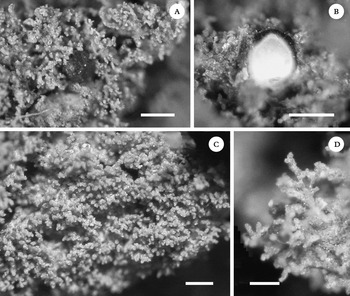
Porina pseudohibernica (holotype). A, isidiate thallus with one semi-immersed perithecium partially covered by isidia; B, cross-sectioned perithecium in lateral view; C, clump of isidia; D, closer view of coralloid isidia. Scales: A–C=0·4 mm; D=0·1 mm.

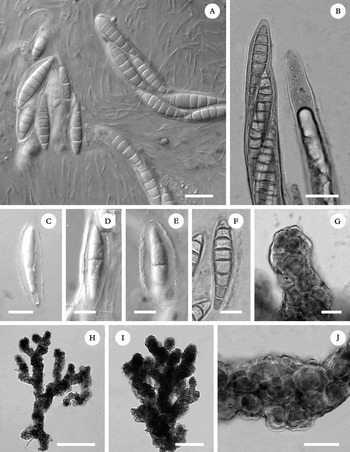
Porina pseudohibernica (holotype). A, mature ascospores with simple paraphyses (squash); B, apical portion of two asci, the one on the right immature (squash); C–F, ascospores in different developmental stages, covered by a gelatinous sheath; G, tip of isidium; H & I, branched isidia; J, closer view of mycobiont hyphae appressed to the Trentepohlia cells in an isidium. A & C–E: differential interference contrast; B, F, G–J: transmitted light. B: Congo Red; G–J: lactophenol-aniline blue. Scales: A, B & J=15 µm; C–G=10 µm; H & I=80 µm.

Thallus corticolous or overgrowing epiphytic mosses and liverworts, superficial, well-developed, isidiate (Fig. 1A), pale orange-brown, with an olive-green tinge when dry and fresh, fading to ochre or pale brown in the herbarium. Prothallus not apparent. Isidia often crowded (Fig. 1C), terete, branched and coralloid (Figs 1D, 2H & I), fragile, to 0·7 mm high, branches c. 27–32–37(–45) µm thick [n=64], ecorticate or with a thin, inconspicuous cortex (Fig. 2G & J). Alga Trentepohlia, in well-developed filaments; cells with maximum diam. 13–15–17(–20) µm [n=42].
Ascomata perithecia, occasional, subglobose, black, semi-immersed in the thallus and substratum but not covered by a thalline layer, solitary (Fig. 1A & B), 0·34–0·37–0·40(–0·43) mm diam. [n=11]; surface matt. Ostiole white in fertile perithecia due to a distinct, persistent crown of periphyses protruding slightly from the pore. Involucrellum contiguous with the excipulum and extending to excipulum-base level, dull brown to black, in section dull reddish brown to blackish, K+ greenish to blackish blue, H2SO4+ purple-red, HNO3+ gold to reddish brown. Excipulum colourless. Subhymenium 25–30 µm thick. Hamathecium composed of simple, filiform paraphyses, numerous and persistent, c. 1 µm thick, not constricted at septa, obscurely branched at the tips. Hymenium inspersed. Asci thin-walled, 8-spored, 150–165×13–15 µm, with a more or less truncate apex and without an apical chitinoid ring (Fig. 2B), I−, cytoplasm I+ yellow. Ascospores hyaline, thin-walled, 7–8(–9)-septate, fusiform or caudate-fusiform, with acute ends (Fig. 2A & F), 34–38–43(–53)×7–8–9(–10) µm, length/breadth ratio 4·0–4·9–5·8(–7·7) [n=42, 10 perithecia examined]; immature spores with a well-developed gelatinous perispore (Fig. 2C–E).
Conidiomata not observed.
Chemistry
No lichen substances detected by TLC.
Etymology
The epithet pseudohibernica was selected because the species is apparently closely related to, but not conspecific with, P. hibernica; from the Greek pseudes (false).
Habitat and distribution
The species is known from scattered sites in central and south-eastern Europe. All fertile specimens were collected on the north-exposed side of the Pura Pass, within a coniferous-broadleaved mixed wood with beech (dominant), fir (co-dominant), spruce and sycamore, on three nearby beeches, c. 80–100 years old. The Pura Pass has a typical humid climate with cold season [type X (VI) of Walter & Lieth Reference Walter and Lieth1960] and high rainfall (mean annual precipitation: 1580 mm, for 114 rainy days per year, see Nimis Reference Nimis1981), with frequent persistence of fog banks. The nearby area, well studied from a botanical point of view due to the presence of a summer station (Nimis et al. Reference Nimis, Moro and Martellos2013), has a highly diversified lichen flora (see e.g. Tretiach Reference Tretiach1993, Reference Tretiach2004; Tretiach & Carvalho Reference Tretiach and Carvalho1995; Nimis & Martellos Reference Nimis and Martellos2012), including many rare or extremely rare species with cool-oceanic affinities (“Northern subatlantic” sensu Nimis & Tretiach Reference Nimis and Tretiach1995).
The specimens from the Šumava Mts (W Bohemia), the western part of Transcarpathian Ukraine, and the Snežnik-Javorniki area (Slovenia), cited respectively as P. hibernica by Coppins et al. (Reference Coppins, Kondratyuk, Khodosovtsev, Zelenko, Coppins, Wolseley, Virchenko, Kondratyuk and Coppins1998), Palice (Reference Palice1999), and Mayrhofer & Coppins (Reference Mayrhofer and Coppins2013), were collected on beech and sycamore in the montane belt (1000–1200 m alt.), with a single exception (Coppins 17634). These specimens are sterile, but they match perfectly the specimens from the Carnic Alps in the shape and thickness of the terete, branched lobules. The specimens from Switzerland mentioned by Scheidegger et al. (Reference Scheidegger, Clerc, Dietrich, Frei, Groner, Keller, Roth, Stofer and Vust2002) under Zamenhofia hibernica might also belong here, although these have not been examined.
Associated lichens observed in the herbarium collections of P. pseudohibernica are Ochrolechia androgyna, Pannaria conoplea and Strigula stigmatella. Most of the thalli of P. pseudohibernica overgrow epiphytic mosses and liverworts, often starting as a continuous, greenish brown, dull crust.
Additional specimens examined. Czech Republic: Bohemia: Šumava Mts, Železná Ruda, Černé Jezero, 1227 m, on Acer pseudoplatanus, 1995, Palice (E).—Slovenia: Snežnik-Javorniki, Forest Reserve Ždrocle, 1380 m, MTB 0452/2, y=5459250 / x=5047800, on Fagus, 1998, Prügger & Surina (GZU).—Ukraine: Zakarpattia Oblast: Velyky Berezny district, Novostuzhytzia Forest, Mt Cheremkha, 1060 m, on Fagus, 1997, Kondratyuk, Coppins [17688, 17711], Coppins, Khodosovtsev, Zelenko & Wolseley (E); ibid., at bottom of the valley, stream Semeniv-Sokoliv, c. 470 m, on Carpinus, 1997, Kondratyuk, Coppins [17634] & Wolseley (E).
Discussion
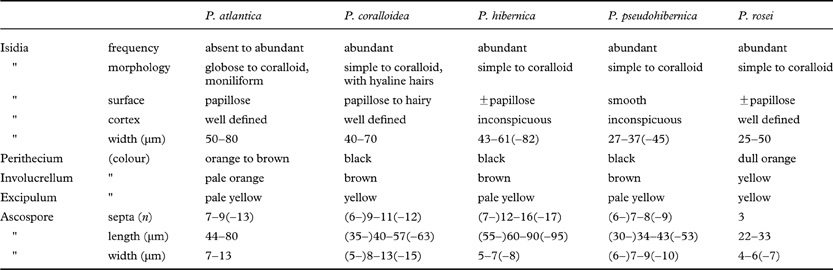
This distinctive lichen is characterized by a richly isidiate thallus, blackish perithecia with periphyses, and 7–8(–9)-septate ascospores that are 7–8–9(–10) µm wide. The isidiate Porinas reported so far from Europe, P. atlantica, P. coralloidea, P. hibernica and P. rosei, are mostly restricted to the evergreen and deciduous oak belts, growing on sheltered trunks in ancient woodland. Porina atlantica and P. rosei can be readily distinguished from P. pseudohibernica by the colour and pigmentation of the perithecia, these being pale dull orange, with Porina-yellow pigment in the walls of the peridial cells. Furthermore, P. atlantica has larger ascospores, and the isidia are globose to cylindrical, sometimes forming coralloid proliferations on the thallus surface, and they have a papillose surface. Porina rosei has smaller, 3-septate ascospores and isidia with a well-defined cortex (Table 1).
Comparison of morphological and anatomical characters of isidiate Porina species from Europe.
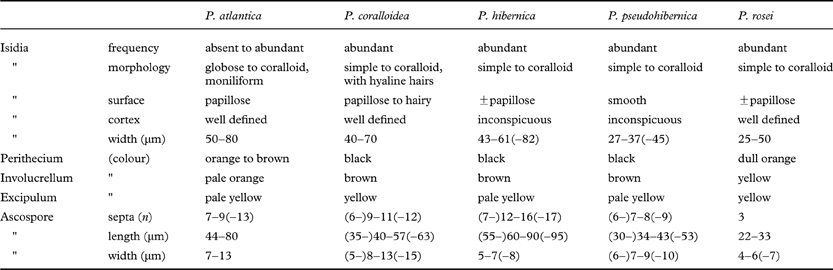
Porina coralloidea and P. hibernica are apparently more closely related to the new species; their fruiting bodies have the same dull brown to black colour in section, and they contain the same pigment in the peridium (see below). Furthermore, the shape of the ascospores is similar, although there is a trend of increasing size from P. pseudohibernica (with smaller ascospores, rarely with more than 8 septa) to P. hibernica (with longer ascospores, and up to 16–17 septa). The isidia shape in the three species also differs. Those of P. coralloidea are generally simple or sparingly branched, and they typically have a tuft of colourless filamentous apical hyphae that gives a hairy appearance to the dull dark grey thallus. In contrast, the isidia of Porina hibernica are very similar to those of P. pseudohibernica, being ecorticate or with only a thin, inconspicuous cortex, and forming nodular-coralloid mats of terete lobules which often obscure the perithecia. However, the isidia of P. hibernica s. str. are rather robust, up to 60–80 µm in diameter, with short branches, whereas those of P. pseudohibernica are more slender, up to 37–45 µm in diameter (Table 1), with clearly elongate branches.
Some authors have argued that the coralloid proliferations observed on the thallus surface of some species of Porinaceae (e.g. P. atlantica, P. ocoteae, “Clathroporina” isidiifera) are caused by abnormal outgrowth of the photobiont, possibly as an adaptation to a stressful environment (McCarthy Reference McCarthy1993; Grube et al. Reference Grube, Lücking and Umaña-Tenorio2004b ; Sérusiaux et al. Reference Sérusiaux, Berger, Brand and van den Boom2007). However, since these structures always contain fungal hyphae, they cannot be just rampant growth of the photobiont. They are more likely an adaptation to increase the thallus surface area, making it de facto microfruticulose, with facilitation of hydration and gas exchange under certain ecological conditions, as demonstrated in several macrolichens (Valladares et al. Reference Valladares, Wierzchos and Ascaso1993; Rikkinen Reference Rikkinen1997; Tretiach et al. Reference Tretiach, Crisafulli, Pittao, Rinino, Roccotiello and Modenesi2005). Since the development of isidia might be environmentally induced, P. pseudohibernica was also compared with non-isidiate species. The most similar is Porina borreri, which colonizes the rough bark of several deciduous trees (including beech), and is also known to occur in the montane belt of Central Europe [see e.g. Poelt & Vezda (Reference Poelt and Vězda1977) and McCarthy (Reference McCarthy2013)]. However, it differs from P. pseudohibernica in having much narrower ascospores [3·0–5·0(–5·5) µm, see Sérusiaux et al. (Reference Sérusiaux, Berger, Brand and van den Boom2007); Orange et al. (Reference Orange, Purvis, James, Smith, Aptroot, Coppins, Fletcher, Gilbert, James and Wolseley2009); our personal observations], in its peridial pigments (it lacks the H2SO4+ purple-red reaction, see below), and in ascus structure (it has the chitinoid ring typical of Porina s. str.) (Hafellner & Kalb Reference Hafellner and Kalb1995).
The new species was also compared with P. cestrensis, a granular to obscurely isidiate species whose peridial wall also reacts H2SO4+ purple-red. This lichen has a pan-temperate distribution, but it is not known from Europe (McCarthy Reference McCarthy2013). With respect to P. pseudohibernica, P. cestrensis can be distinguished by its longer and narrower ascospores, c. 45–50(–70)×3·5–4·5(–6·0) µm, the absence of a gelatinous sheath, and a dimidiate involucrellum (Aptroot Reference Aptroot, Nash, Ryan, Gries and Bungartz2001; McCarthy Reference McCarthy2003).
In one isotype (TSB 40923), a poorly fertile thallus overgrows an abundantly fertile Strigula stigmatella, and in some parts the development of small, simple isidia can be observed adjacent to perithecia that are partly covered by a thin thalline layer, whereas other portions are covered by the nodular-coralloid mats of branched isidia described above. This specimen initially caused some confusion. Strigula stigmatella has fissitunicate asci, with an ocular chamber and a short-stalked, more or less bilobed base, but also ascospores that are 7–8(–9)-septate, like those of the new Porina, and largely overlapping in size [c. 26·0–36·5(–40·5)×5·5–7·0 µm, see Coppins & Orange (Reference Coppins, Orange, Smith, Aptroot, Coppins, Fletcher, Gilbert, James and Wolseley2009)]. A closer examination revealed further subtle spore differences that allow a ready separation of the two species. The spores of S. stigmatella are in fact slightly constricted at the central euseptum, the two cells divided by this euseptum are of equal size (and usually are the largest of the whole ascospore), and some septa are oblique. In contrast, the spores of P. pseudohibernica are never constricted at the septa, there is one cell larger than the others (this is typically the third or, more rarely, the second cell from one end), and the septa are perpendicular to the long axis of the spore. From examination of this sample, it can be inferred that P. pseudohibernica can utilize the photobiont cells from well-established thalli of other lichens. This phenomenon was previously observed in the epiphyllous P. rubentior, which apparently contacts already lichenized Phycopeltis cells within young thalli of Phyllophiale sp. (Sanders & Lücking Reference Sanders and Lücking2002).
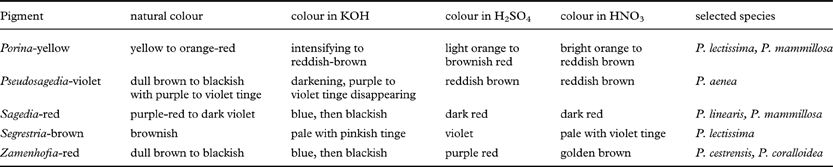
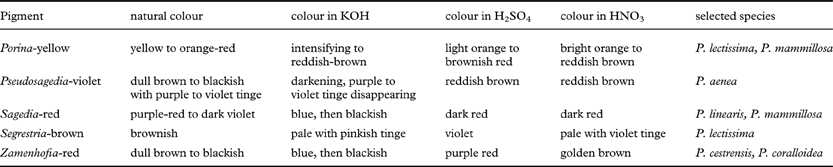
Final remarks concern the systematic position of the species formerly segregated in the genus Zamenhofia, which was introduced by Clauzade & Roux (Reference Clauzade and Roux1985) for a single species, Z. coralloidea, on account of its distinctive hairy isidia, long ascospores, and the presence of periphyses. Subsequently, further species (P. hibernica, P. rosei) were added to the genus, although this arrangement did not find general acceptance (see e.g. Aptroot Reference Aptroot, Nash, Ryan, Gries and Bungartz2001; McCarthy Reference McCarthy2003), and has been abandoned in the most recent floras (see e.g. Orange et al. Reference Orange, Purvis, James, Smith, Aptroot, Coppins, Fletcher, Gilbert, James and Wolseley2009). According to Hafellner & Kalb (Reference Hafellner and Kalb1995), the characters supporting the segregation of Zamenhofia from Porina are the absence of an external ring structure in the asci, and the absence of perithecial pigments typical of the Porinaceae (as Trichotheliaceae), more than the development of isidia, a character that cannot be used for generic delimitation. However, as noted by McCarthy (Reference McCarthy1993) and McCarthy & Malcom (Reference McCarthy and Malcolm1997), asci without a ring structure and periphyses are also known in other representatives of Porina s. str., whereas the absence of pigments in the peridial wall was an error caused by the paucity of material available for study (J. Hafellner, pers. comm.). The type species of Zamenhofia has an excipulum and peridial wall containing a pigment that gives a vivid purple reaction to concentrated sulphuric acid, whereas in concentrated nitric acid it turns gold to golden brown (Table 2). Since these reactions differ from those described by Hafellner & Kalb (Reference Hafellner and Kalb1995) for the Sagedia-red of Bachman (Reference Bachmann1890), it is proposed here to call this pigment “Zamenhofia-red”. To date, it has also been detected in P. cestrensis, P. hibernica, P. peregrina and P. pseudohibernica. This species group might actually form a natural evolutionary unit within Porina s. str., a hypothesis that certainly deserves to be tested by molecular analyses.
Colour reactions of acetone-insoluble perithecial hyphal pigments in selected species of Porina (modified from Hafellner & Kalb Reference Hafellner and Kalb1995).
Helmut Mayrhofer and Walter Obermayer (Graz), and Louise Olley (Edinburgh) are warmly thanked for sending material in their care. Brian Coppins (Edinburgh) is acknowledged for critical suggestions, Josef Hafellner (Graz) for comments on the Porina pigments, and Patrick McCarthy (Canberra) for critically reading the text. An anonymous referee is also thanked for critical remarks on the ecological significance of isidia.