Implications
Chicory is regarded as a valuable forage due to its resistance to dry conditions, high palatability, feeding value and ruminant performances. Our results showed that mixing ryegrass and chicory in equal proportions does not affect digestibility but stimulates the motivation to eat, total intake and ruminal outflow, and reduces nitrogen (N) losses compared with pure ryegrass. This highlights the potential of chicory to conciliate economic and environmental performances in addition to its adaptability to climate change.
Introduction
There is an increasing urgency for developing effective adaptation strategies to climate change in the livestock sector (Howden et al., Reference Howden, Soussana, Tubiello, Chhetri, Dunlop and Meinke2007). One of the crucial issues is a heat-stress-related reduction in productivity due to the negative impact of elevated temperature or drought events on forage production and quality in different climatic areas (Gilgen and Buchmann, Reference Gilgen and Buchmann2009; Dumont et al., Reference Dumont, Andueza, Niderkorn, Lüscher, Porqueddu and Picon‐Cochard2015) and the reduction in water availability for agriculture (Arnell, 2004). A coping strategy is the use of forage species with morphological specificities that make them enable to be better adapted to water scarcity, while keeping the beneficial attributes expected by the farmers in terms of agronomy and animal nutrition.
Chicory is a perennial deep-rooted herb used for foraging especially in New Zealand and is known to be fast-regrowing and productive under dry summer conditions and thus overcome the lack of production during warm season (Li and Kemp, Reference Li and Kemp2005). As feed for ruminants, chicory was shown to have an excellent nutritive and feeding value and to contain high mineral and trace element concentrations (Barry, Reference Barry1998). Forage chicory may be sown alone or with legumes or grasses, but the associative effects between species within mixtures containing chicory on voluntary intake and digestive parameters are unknown. To gain understanding of potential interactions between these plants would be helpful to determine the proportion of chicory at which the maximal benefits can be reached in terms of animal performances and minimisation of nutrient losses and pollutant emissions.
The objective of this study was to evaluate the effect of adding chicory to ryegrass or to a ryegrass–white clover mixture on feeding behaviour, digestive efficiency and pollutant emissions under the form of N and methane (CH4) in sheep. A large number of parameters related to intake and digestion were simultaneously measured in controlled conditions to find out the underlying mechanisms leading to potential synergies between chicory and the other forage species.
Material and methods
Experimental design
The trial was conducted according to a repeated 4×4 Latin square design. In total, two groups of four sheep were fed indoors with the following four forage diets on a dry matter (DM) basis: (i) 100% ryegrass, (ii) 50% ryegrass–25% white clover–25% chicory, (iii) 50% ryegrass–50% chicory and (iv) 100% chicory. The experimentation proceeded over four periods composed each one of an 8-day adaptation phase in individual pens and a 6-day measuring phase in metabolic crates during which intake and digestive parameters were determined. The two groups of sheep were fed in parallel, and for each group the experimental periods were carried out in a sequential way.
Plant materials and sward management
Two swards of perennial ryegrass (Lolium perenne L., cv. AberAvon) and white clover (Trifolium repens, cv. Merwi) established in September 2009 and one sward of chicory (Cichorium intybus, cv. Puna II) established in May 2011 at the INRA Auvergne-Rhône-Alpes centre (France, latitude 45°43′N, longitude 03°01′E and 850 m above sea level) were used for this experiment. Swards were all fertilised with phosphorus (P) and potassium (K) at a rate of 100 kg P/ha and 150 kg K/ha, respectively. In addition, the sward of ryegrass was fertilised with N at a rate of 60 kg N/ha at establishment and 40 kg N/ha after each cut, and the sward of chicory was fertilised with N at a rate of 50 kg N/ha at establishment and 40 kg N/ha after each cut. The experiment was carried out from 7 May to 5 July 2012. To ensure a homogeneous plant material throughout the experiment, forages were harvested at a constant vegetative stage after 4 weeks of regrowth. For this purpose, each sward was subdivided into four plots and each plot was assigned to 1 week of experimentation. Each day at 1000 h, 200 m2 of ryegrass, 150 m2 of chicory and 50 m2 of white clover were cut 5 cm above soil level, chopped to a length of 6 cm and stored at 4°C until use for the meals of the afternoon and the next morning.
Animals and feeding
In total, eight 1-year-old castrated Texel sheep (initial BW of 56.3±3.4 kg, final BW of 61.6±3.7 kg) surgically fitted with a rumen cannula were separated into two homogeneous groups of four animals according to their BW. Forage diets were prepared and mixtures were thoroughly prepared before feeding to avoid selection by animals. Diets were offered in equal proportions at 0900 and 1700 h. To ensure ad libitum intake, offered quantities of forage were adjusted daily based on the DM ingested the day before by each animal, targeting 15% refusal of forage offered. Animals had free access to fresh water and salt block supplement (Sel’Pur, Salins, Paris, France).
Sampling and measurements
Representative samples of harvested ryegrass, white clover and chicory were collected daily and oven dried at 60°C for 72 h to determine DM. In all, three dried samples of offered and refused feed were composited by week and ground through a 1-mm sieve before analysis for organic matter (OM), CP, NDF, ADF and ADL. Voluntary intake and intake behaviour were measured daily during the measuring period as described by Baumont et al. (Reference Baumont, Chenost and Demarquilly2004). In brief, the daily pattern of feed intake and the time spent eating and ruminating were monitored individually using an automated system. The trough was continuously weighed by sensors fitted with strain gauges wired up to a data processing system, enabling the recording of intake over the day on 1-min timescale. Jaw movements were recorded by a polyurethane-foam-filled balloon placed in the submandibular space and connected to the microcomputer via a pressure transducer. For each 1-min interval, chewing activity was assessed as follows: (i) if the weight of the trough had changed from the previous interval and jaw movements were recorded, then the animal was considered to be eating; (ii) if jaw movements were detected for at least 5 min without the trough showing weight change, the animal was considered to be ruminating; (iii) otherwise, the animal was considered to be neither eating nor ruminating. The number of meals was assessed considering a meal as a continuous sequence of eating activity without any interruption longer than 5 min. To determine nutrients digestibility and N balance, the sheep were housed in individual stalls allowing the total collection of faeces in a tray and total urine collection in a 5-l flask. The urine collection flask contained 50 ml of 300 g/l H2SO4 to ensure a pH enough low to prevent ammonia (NH3) losses. Samples of faeces and urine were composited by sheep and week from samples taken daily. Samples of faeces were oven dried, grounded and analysed in the same way as offered and refused forages. Acidified urine samples were conserved at −20°C before N analysis. On days 1 to 4 of each measurement period, CH4 emissions were measured using the sulphur hexafluoride (SF6) tracer technique as described in Martin et al. (Reference Martin, Rouel, Jouany, Doreau and Chilliard2008). Brass permeation tubes were loaded with about 600 mg of SF6 at liquid N2 temperature (−196°C) and calibrated by regular weighing (twice a week) for an 8-week period while immersed in a water bath at 39°C. For this experiment, permeation rate of tubes averaged 1.104±0.130 mg/day. Representative breath samples from each animal were sampled in pre-evacuated yoke-shaped polyvinyl chloride collection canisters by means of capillary and Teflon tubing fitted to a halter. The reliability of the SF6 technique on rumen-cannulated sheep had been validated (data not shown) to ensure that potential non-uniform leakage of the different gasses (SF6 and CH4) via the cannula does not bias the results. On day 5, 2 h before morning feeding, animals were given a dose of Cr-EDTA (300 ml, 2.77 g/l Cr diluted fourfold in water) through the rumen cannula to determine liquid dilution rate in the rumen. Samples of ruminal fluid were taken at 2, 4, 6, 8, 24, 26, 28 and 30 h following marker administration, and pH was immediately measured with a SevenEasy S20 pH meter (Mettler-Toledo GmbH, Schwerzenbach, Switzerland). For subsequent analysis of volatile fatty acids (VFA), 0.8 ml of ruminal fluid was mixed with 0.5 ml of a 0.5 N HCl solution containing 20 g/l metaphosphoric acid and 4 g/l crotonic acid. For analysis of NH3, 5 ml of ruminal fluid were mixed with 0.5 ml of 50 g/l orthophosphoric acid. Prepared samples were stored at −20°C until analysis. An aliquot of 3 ml of ruminal fluid taken just before morning feeding was mixed with an equal volume of methyl green, formalin saline solution and preserved from light until protozoa counting.
Analytical methods
Forages were analysed for OM by ashing at 550°C for 6 h in a muffle furnace. Fibres (NDF, ADF and ADL) were determined according to Van Soest et al. (Reference Van Soest, Robertson and Lewis1991) using a Fibersac analyser (Ankom Technology Corporation, Fairport, NY, USA). Total CP was determined by the Dumas combustion method (Association of Official Analytical Chemists, Reference Arnell1995) using a Leco-FP428 N analyser (Leco Corp., St. Joseph, MI, USA). Concentrations of SF6 and CH4 in animal breath were determined as described by Martin et al. (Reference Martin, Rouel, Jouany, Doreau and Chilliard2008) using a gas chromatograph (CP-9003; Varian-Chrompack, Les Ulis, France) fitted with an electron capture detector (Autosystem XL; Perkin Elmer Instruments, Courtaboeuf, France) or a flame ionisation detector (Thermo Finnigan, Les Ulis, France), respectively. The VFA concentration in ruminal fluid was determined by GLC (Clarus 580 gas chromatograph; Perkin Elmer, Waltham, MA, USA) using crotonic acid as internal standard (Morgavi et al., Reference Morgavi, Boudra, Jouany and Graviou2003). For NH3, thawed samples were centrifuged at 10 000×g at room temperature for 10 min, and NH3 concentration in the supernatant was determined using the Berthelot reaction (Weatherburn, Reference Weatherburn1967). The Cr concentration in ruminal fluid was measured using a flame atomic absorption spectrophotometer (model AA-400; Perkin Elmer, USA). Liquid passage rate (%/h) was calculated from the slope of the natural log of the ruminal concentrations of Cr regressed against hour as reported by Niderkorn et al. (Reference Niderkorn, Martin, Le Morvan, Rochette, Awad and Baumont2015). Protozoa counts in ruminal fluid were done microscopically using a Neubaeur counting chamber.
Statistical analysis
Data relative to chemical composition of individual forages were analysed by ANOVA using the GLM procedure of SAS Enterprise Guide 5.1 (SAS, 2013). Data relative to voluntary intake, feeding behaviour, digestive parameters, N balance and CH4 emissions were analysed as a repeated Latin square design using the PROC MIXED procedure. The statistical unit was the individual sheep. The diet, the experimental period and their interaction were considered as fixed effects and sheep as a random effect. The Tukey–Kramer test was used to compare means. The REPEATED statement with the most desirable covariance structure was used to analyse the kinetics of fermentation end-products concentrations in the rumen fluid. Normality of data distribution was evaluated using PROC UNIVARIATE procedure. Non-significant interactions (P>0.05) were removed from the initial model. Orthogonal contrasts were used to test linear and quadratic effect and highlight potential interactions between ryegrass and chicory. For this analysis, only data from pure ryegrass, pure chicory and the binary mixture 50% ryegrass–50% chicory were used, and the quadratic responses may have to be considered with caution as based on only three points. Statistical differences between treatment means were declared to be significant at P<0.05.
Results
Chemical composition of forages
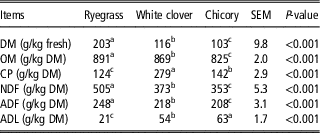
The chemical composition of forages was contrasted (Table 1). The averaged values of DM, OM, NDF and ADF were greater for ryegrass than for white clover and greater for white clover than for chicory (P<0.001). Inversely, the averaged value of ADL was greater for chicory than for white clover which was greater than for ryegrass (P<0.001). The CP content in white clover was greater than for chicory which was greater than for ryegrass (P<0.001).
Chemical composition of forages (n=24) fed to the sheep

DM=dry matter; OM=organic matter.
a,b,cValues within a row with different superscript letters differ significantly at P<0.05.
Feeding behaviour
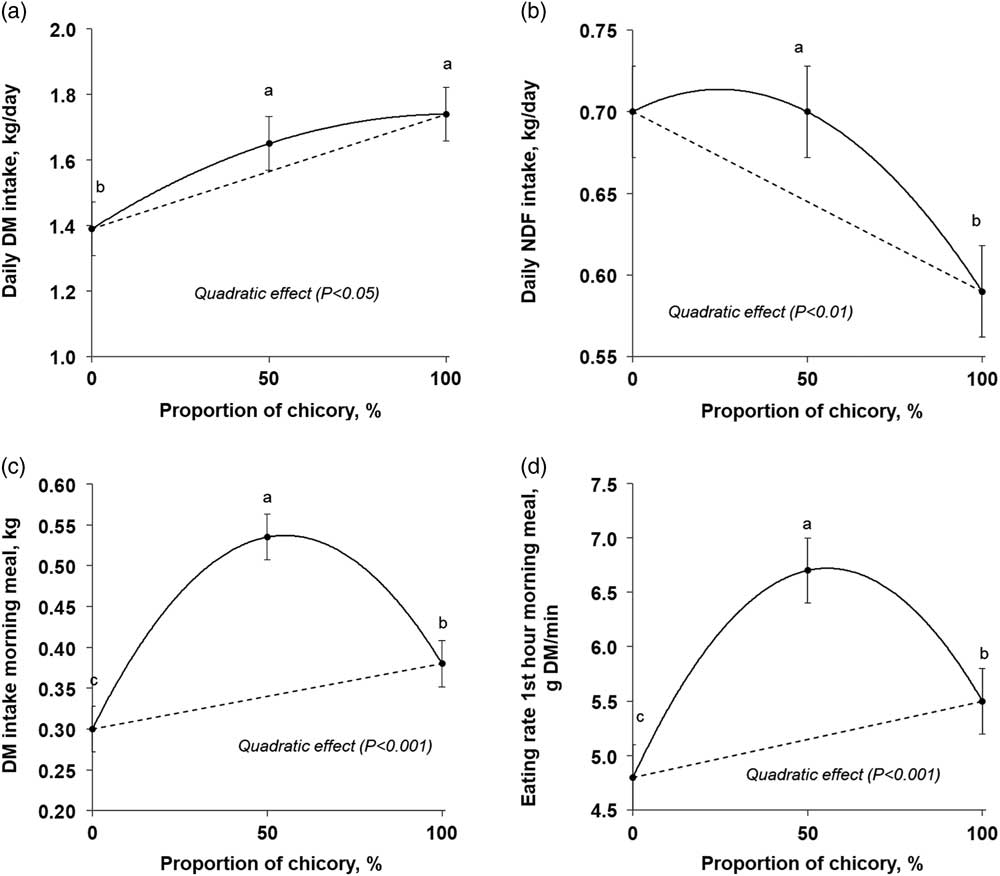
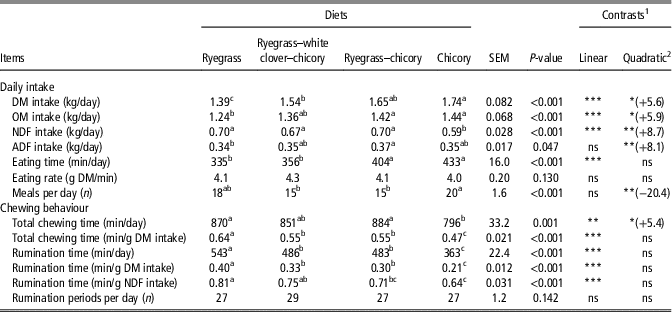
Results on feeding behaviour are shown in Table 2. The daily voluntary DM and OM intake was lower for pure ryegrass than for diets containing chicory (P<0.001) and increased quadratically with increasing proportion of chicory (P<0.05, Figure 1a). Inversely, the daily NDF intake was lower for pure chicory than for the other diets, but a positive quadratic effect was again detected (P<0.01, Figure 1b). Daily eating time was higher when the proportion of chicory reached 50%, whereas daily eating rate was similar among treatments (Table 2). Examining the feeding behaviour during the main meals taken just after morning and afternoon feeding, huge positive quadratic effects were observed (P<0.001). During the main morning meal, the percentage differences between the observed values for the mixture ryegrass–chicory and the mean values calculated from pure ryegrass and pure chicory on DM intake, eating time and 1st hour eating rate reached +57% (Figure 1c), +37% and +30% (Figure 1d), respectively. A similar response was observed during the main afternoon meal (data not shown). The daily chewing time was greater for pure ryegrass and the mixture ryegrass–chicory than for pure chicory (P<0.001, Table 2), and a significant positive quadratic effect was observed between ryegrass and chicory (P<0.05). The rumination activity decreased linearly with increasing the proportion of chicory (P<0.001).
Daily dry matter (DM) (a) and NDF (b) intake, DM intake during the main morning meal (c) and eating rate during the 1st hour of the morning meal (d) in sheep fed with pure ryegrass, pure chicory and mixture ryegrass–chicory (50%–50%). a,b,cThe points on the graph with different lowercase letters differ significantly at P<0.05.

Voluntary intake and feeding behaviour in sheep fed with pure ryegrass, pure chicory, the mixture ryegrass–chicory (50%–50%) and the mixture ryegrass–white clover–chicory (50%–25%–25%)

DM=dry matter; OM=organic matter; ns=not significant.
1 Levels of significance of orthogonal contrasts determined using data from ryegrass, the mixture ryegrass–chicory and chicory: *P<0.05; **P<0.01; ***P<0.001.
2 The figures in brackets are the percentages of difference between the observed values for the mixture ryegrass–chicory (50%–50%) and the mean values calculated from pure ryegrass and pure chicory.
a,b,cValues within a row with different superscript letters differ significantly at P<0.05. The P-value described the effect of diet.
Digestibility and nitrogen balance
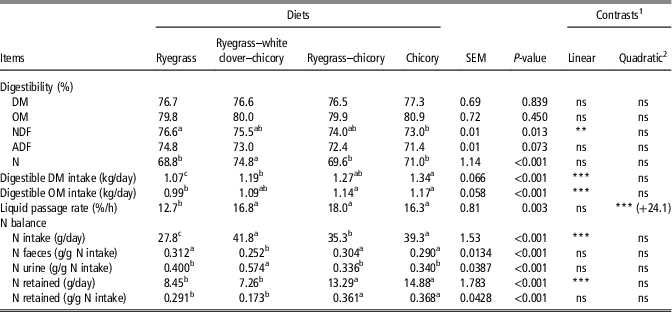
The DM, OM and ADF digestibility was similar among all treatments, whereas NDF digestibility of pure ryegrass was slightly greater than pure chicory (P=0.013, Table 3) and N digestibility of the ryegrass–white clover–chicory mixture was greater than that of the other diets (P<0.001). As a consequence of results observed on voluntary intake, digestible DM and OM intake increased linearly with increasing proportion of chicory (P<0.001). A strong positive quadratic effect was observed on the liquid passage rate with a difference of +24% between the observed value for the ryegrass–chicory mixture and the theoretical value calculated from pure plants (P<0.001).
Digestibility, digestible dry matter (DM) and organic matter (OM) intake, liquid passage rate and nitrogen (N) balance in sheep fed with pure ryegrass, pure chicory, the mixture ryegrass–chicory (50%–50%) and the mixture ryegrass–white clover–chicory (50%–25%–25%)

ns=not significant.
1 Levels of significance of orthogonal contrasts determined using data from ryegrass, the mixture ryegrass–chicory and chicory: **P<0.01; ***P<0.001.
2 The figure in brackets is the percentage of difference between the observed value for the mixture ryegrass–chicory (50–50%) and the mean value calculated from pure ryegrass and pure chicory.
a,b,cValues within a row with different superscript letters differ significantly at P<0.05. The P-value described the effect of diet.
Feeding animals with the ryegrass–white clover–chicory mixture resulted in lower excreted N in faeces and higher excreted N in urine both expressed per g N intake than for the other treatments (P<0.001, Table 3). Retained N by animals expressed per day or per g N intake was greater when the proportion of chicory was at least 50% (P<0.001), and was ~40% higher than for pure ryegrass and the mixture ryegrass–white clover–chicory.
Methane emissions and rumen fermentation characteristics
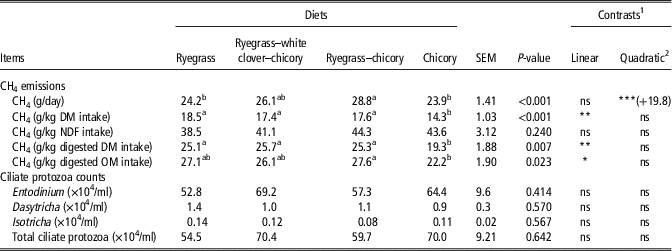
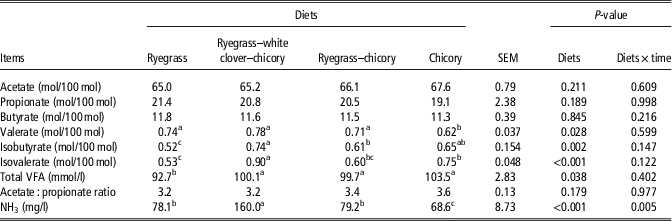
A quadratic effect was detected on daily CH4 emissions (+19.8%, P<0.001) similar to the results showed on voluntary intake (Table 4). When emissions were expressed per g DM intake or digested DM intake, they were lower for pure chicory than for the other treatments (P<0.001 and P=0.007, respectively). No significant difference was observed among treatments on ciliate protozoa counts. The type of diet affected the ruminal VFA profiles through a lower concentration of total VFA for pure ryegrass (P=0.038) and a higher concentration of valerate and isoacids for the mixture containing white clover (P<0.05) (Table 5). For the latter, the ruminal concentration of NH3 was also much higher than for the other diets whereas the chicory had the lowest value (P<0.001), and the interaction between the diet and sampling time was significant for this parameter (P=0.005).
Methane (CH4) emissions and rumen protozoal pattern in sheep fed with pure ryegrass, pure chicory, the mixture ryegrass–chicory (50%–50%) and the mixture ryegrass–white clover–chicory (50%–25%–25%)

DM=dry matter; OM=organic matter; ns=not significant.
1 Levels of significance of orthogonal contrasts determined using data from ryegrass, the mixture ryegrass–chicory and chicory: *P<0.05; **P<0.01; ***P<0.001.
2 The figure in brackets is the percentage of difference between the observed value for the mixture ryegrass–chicory (50%–50%) and the mean value calculated from pure ryegrass and pure chicory.
a,bValues within a row with different superscripts differ significantly at P<0.05. The P-value described the effect of diet.
Rumen volatile fatty acids (VFA) and ammonia (NH3) in sheep fed with pure ryegrass, pure chicory, the mixture ryegrass–chicory (50%–50%) and the mixture ryegrass–white clover–chicory (50%–25%–25%)

a,b,cValues within a row with different superscript letters differ significantly at P<0.05.
Discussion
Overall, the chemical composition of the three species used in this trial was stable throughout the experiment. This temporal homogeneity over the four experimental periods was important to minimise the period effect and to validate the Latin square design. By analysing the botanical composition of the refusals, we also validated our feeding methodology, that is chopping and thorough mixing of forage, for ensuring that sheep were not able to sort out and select between the species when fed with mixtures.
Comparison of pure ryegrass and pure chicory
In this study, DM intake was 25% (350 g/day) greater in sheep fed with pure chicory than for pure ryegrass. We observed that eating time was greater for chicory than for ryegrass, whereas chewing time per g DM intake was lower, indicating that chicory is more easily chewable, likely due to a much lower NDF content. It is worth to note that NDF intake was lower for chicory than for ryegrass, though this parameter is generally known to be relatively constant as the main predictor of rumen fill and voluntary intake (Mertens, Reference Mertens1987). Similar results have been reported in red deer for which DM intake of chicory was 10% greater than for ryegrass (Kusmartono and Barry, Reference Kusmartono and Barry1997). These authors have shown that the greater level of intake of chicory was associated with lower rumination time, faster degradation rate of most constituents in the rumen, faster outflow rate from the rumen and greater apparent digestibility. Such type of chewing activity has been also demonstrated in dairy cows (Gregorini et al., Reference Gregorini, Minnee, Griffiths and Lee2013). As rumination time per g DM intake was twice higher for ryegrass than for chicory and liquid passage rate 30% lower, we can presume that faster clearance of forage from the rumen played an important role in greater voluntary intake of chicory.
The DM and OM digestibility were similar between ryegrass and chicory, whereas NDF digestibility was slightly lower for chicory. This could be due to the higher lignin content in chicory or its higher passage rate leading to a reduction of the retention time in the rumen and finally a reduction of fibre degradation. Because of different voluntary intake and similar OM digestibility, the digestible OM intake, which can be considered as a predictor of animal performance, was greater for chicory than for ryegrass. In sheep, digestible OM intake requirement for maintenance is estimated at 23 g/kg BW0.75 (Jarrige, Reference Jarrige1978). Both ryegrass and chicory made it possible to meet this requirement but it can be underlined that pure chicory allowed to reach 36% more than for ryegrass, what is important in the context of reduction of feeding cost and optimisation of forage use. In addition, our results suggest that the high water content in chicory, which is known to limit DM intake (Estrada et al., Reference Estrada, Delagarde, Faverdin and Peyraud2004), is more than compensated by its low NDF content, allowing to reach the high level of intake and to cover a large part of water requirements, what is particularly interesting during summer or drought periods.
Regarding N balance, we observed a greater N intake for chicory due to its greater N content and DM intake compared with ryegrass. Besides, no statistical difference was detected on N digestibility and N excreted per g N intake, whereas N retained expressed daily or per g N intake was much greater for chicory than for ryegrass.
One explanation for better N use efficiency with chicory could be increased N to the intestine as the increased rumen liquid passage rate in animals fed chicory could be expected to increase the rumen outflow of dietary protein (Barry, Reference Barry1998). The high ratio of readily fermentable: structural carbohydrate in chicory compared with ryegrass (Kusmartono and Barry, Reference Kusmartono and Barry1997) could also have provided more energy for microbial protein synthesis. This hypothesis is reinforced by the lower NH3 concentration in the rumen with chicory compared with ryegrass in spite of greater N intake. A study has also shown that higher lamb growth rate on chicory over a grass was related to a more efficient capture of dietary N and a higher non-NH3 N supply at the duodenum relative to digested OM intake, indicating a better balance of nutrient supply (protein : energy) and a higher efficiency of metabolisable energy use for lamb growth on chicory (Komolong, Reference Komolong1994).
The daily CH4 emissions were similar for pure chicory and pure ryegrass but 23% lower with chicory when expressed per kg DM intake. This result is consistent with those reported by several authors (Waghorn et al., Reference Waghorn, Tavendale and Woodfield2002; Swainson et al., Reference Swainson, Hoskin, Clark and Brookes2008) whereas other authors did not detect significant differences on CH4 yield (Sun et al., Reference Sun, Hoskin, Zhang, Molano, Muetzel, Pinares-Patiño, Clark and Pacheco2012). In our study, the lower emissions did not seem to be due to the intensity of digestion as the CH4 emissions per kg digested DM intake remained lower for chicory. The type of fermentation pathway was also unlikely involved as no significant difference was observed on the acetate : propionate ratio, nor even on protozoa counts. Instead, the faster rumen liquid passage rate could have played an important role as a relationship between the retention time in the rumen and CH4 emissions has been previously reported by several authors (Pinares-Patiño et al., Reference Pinares-Patiño, Baumont and Martin2003; Hegarty, Reference Hegarty2004). An explanation would be that an increase in rumen passage rate could be accompanied by a leaching effect on archaea methanogens, leading to a reduction of CH4 emissions.
Associative effects between ryegrass and chicory
Using the data collected with pure ryegrass, pure chicory and the mixture ryegrass–chicory, the analysis or orthogonal contrasts allowed us to measure quantitatively the associative effects (synergism, antagonism) between ryegrass and chicory on intake and digestive parameters (Niderkorn et al., Reference Niderkorn, Baumont, Le Morvan and Macheboeuf2011). Positive quadratic effects were observed on voluntary intake of the different fractions. The percentage of difference between the observed values for the mixture ryegrass–chicory and values calculated from values observed with pure species were +6% to 7% for DM and OM intake and +8% to 9% for NDF and ADF intake. It is interesting to highlight that we have measured similar DM intake with the mixture and pure chicory (highest value for DM intake) and similar NDF intake with the mixture and pure ryegrass (highest value for NDF intake). This synergy between ryegrass and chicory on intake was accompanied by a strong positive associative effect (+24%) on liquid passage rate indicating that chicory considerably accelerated the rumen clearance of ryegrass in the mixture. In addition, by analysing the feeding behaviour just after the distribution of diets in the morning and in the afternoon, we detected highly significant positive quadratic effects on DM intake, eating time and eating rate suggesting that sheep were more motivated to eat the mixture compared with pure forages. We already observed such changes in feeding behaviour with other forage mixtures, namely silages of cocksfoot and red clover (Niderkorn et al., Reference Niderkorn, Martin, Le Morvan, Rochette, Awad and Baumont2015) and fresh ryegrass and white clover (Niderkorn et al., Reference Niderkorn, Martin, Rochette, Julien and Baumont2017), confirming that sheep have higher motivation to eat mixtures than pure forages.
In terms of CH4 yield and N balance, no associative effect was detected between ryegrass and chicory. The CH4 emissions per g DM intake were similar to those observed with pure ryegrass indicating that mixing chicory with ryegrass did not provide any benefit regarding the reduction of CH4 production. In the other hand, our results indicate that mixing chicory with ryegrass could have positive effects on N use efficiency, as N retained by animals expressed daily and per g N intake was similar to that measured with pure chicory. This result highlights the high complementarity of ryegrass and chicory, which have contrasted NDF and N contents.
Effect of incorporating chicory in a ryegrass–white clover mixture
Substituting 25% of chicory by white clover in the ryegrass–chicory mixture did not improve voluntary intake, as DM intake was intermediary between pure ryegrass and pure chicory. Thus, in this study, increasing the number of species from two to three seemed not to increase the sheep motivation to eat. However, the total and the digestible DM intake remained greater for the ternary mixture than for pure ryegrass, leaving with the expectation of enhanced animal performances. Several authors have reported that inclusion of chicory in forage mixtures can increase milk production in dairy cows (Totty et al., Reference Totty, Greenwood, Bryant and Edwards2013; Roca-Fernández et al., Reference Roca-Fernández, Peyraud, Delaby and Delagarde2016) or live weight gain in lambs (Hutton et al., Reference Hutton, Kenyon, Bedi, Kemp, Stafford, West and Morris2011), whereas some other authors have only reported no detrimental effect on performances in grazing beef steers (Marley et al., Reference Marley, Fychan, Davies, Scollan, Richardson, Theobald, Genever, Forbes and Sanderson2014).
As the protein content was much higher in white clover than in ryegrass and chicory, N intake was higher for the ternary mixture than for the other treatments. The N digestibility for this mixture was also greater and faecal N lower but a significant part of N seems to have been lost via urine indicating that the rumen protein degradation excessed the capacity of microbial growth, what is supported by the much higher NH3 content compared with the other treatments. Finally, N retained by animal was much lower for the ternary mixture compared with the ryegrass–chicory mixture and pure chicory. Although the liquid passage rate was similar to pure chicory and the binary mixture, no positive effect of chicory on CH4 emissions was observed with the ternary mixture.
Conclusion
The feeding trial aiming to measure the effect of increasing the proportion of chicory on intake behaviour and digestion parameters has shown that mixing ryegrass and chicory in equal part lead to greater voluntary intake and an improved N use efficiency compared with pure ryegrass. These effects were likely due to an optimised energy–protein balance, a faster ruminal particle breakdown and an increased motivation to eat. Results obtained with pure chicory highlighted its high palatability and its potential to produce low CH4 emissions even if this effect was no longer observed with mixtures. The inclusion of white clover in the ryegrass–chicory mixture did not improve voluntary intake and led to more N losses. The beneficial associative effects of chicory in grass-based diet still remain to be validated under production conditions.
Acknowledgements
The research leading to these results has received funding from the European Community’s Seventh Framework Programme (FP7/2007-2013) under the agreement no. FP7-244983. The authors would like to thank the staff of INRA experimental facilities who participate at this trial and the New Zealand based company PGG Wrightson Seeds for providing commercial chicory seeds.
Declaration of interest
The authors declare no conflicts of interest.
Ethics statement
All procedures were conducted in accordance with French guidelines for the use of experimental animals. V. N. is authorised to experiment on live animals (no. 63-210) and the UE1354 Experimental Unit of INRA Auvergne-Rhône-Alpes was authorised by the French ethical committee under the number CE10-09.
Software and data repository resources
None of the data were deposited in an official repository.