In the last decade or so, staged palliative surgical treatment of infants with hypoplastic left heart syndrome has resulted in a dramatic survival improvement in centers around the world.
The haemodynamic parameters which are taken into account include pulmonary arterial pressure, pulmonary vascular resistance, and the size of the pulmonary arteries. Frequently, the treatment method of choice is an intervention involving implantation of a stent into a hypoplastic segment of a pulmonary artery. Rare complications, such as fracture or embolisation of the stent, can sometimes be observed subsequent to the procedure. Although there are reports of such fractured stents,Reference McElhinney, Bergersen and Marshall1, Reference Knirsch, Haas, Lewin and Uhlemann2 little has been published regarding interventional treatment of this complication.
Traumatic fractures are a significantly less well-known problem associated with stents. Instances have been reported of fractures produced by local stress in the wall of the stent, its length and proximity to the aorta, or the effect of local injury and deficiencies in the manufacture of the prosthesis. As it is difficult to establish the exact time of fracture, it is often difficult precisely to ascertain its cause.Reference McElhinney, Bergersen and Marshall1, Reference Nazzal, Abbas, Nazzal, Afridi and Ritter3, Reference Scheinert, Scheinert and Sax4 With these aspects in mind, we present an instance of successful interventional treatment by placing an additional stent within a fractured stent embolizing to the distal left pulmonary artery. The fracture occurred one week after the initial deployment, in all probability during reanimation with cardiac massage.
Case report
Our patient was an 8-month-old male with hypoplastic left heart syndrome. After construction of a bi-directional Glenn procedure, subsequent to initial creation of a left-sided Blalock-Taussig shunt, the patient developed critical stenosis of the left pulmonary artery. In the light of the high systemic venous pressures and low saturations of oxygen, we implanted a Palmaz-Genesis stent of 7 by 24 millimetres, using the nominal pressure of the balloon, into the stenotic segment of the left pulmonary artery. Subsequent to placement of the stent, we noted occlusion of the Blalock-Taussig shunt, along with a decrease in systemic venous pressure. After the catheterization, the patient remained in good condition, but one week later, during preparations for extubation, the infant suddenly developed bradycardia and became asystolic. Resuscitation with cardiac massage proved successful, but we then observed symptoms of a significant increase in systemic venous pressure.
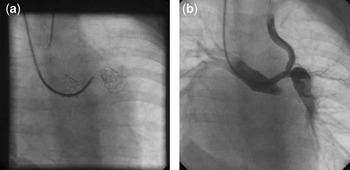
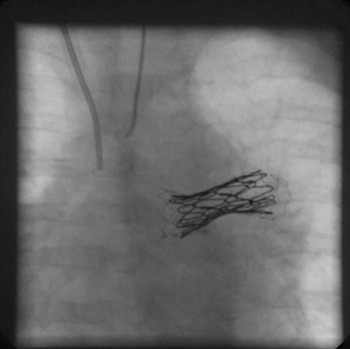
Radiographic examination revealed that the stent was broken in two and dislocated (Fig. 1). Through repeated catheterization, we gently passed through the distal part of the broken stent using a low-pressure Tyshak balloon, pulling it back together with the distal part of the stent. We then implanted a very resistant CP stent, typically used in the treatment of aortic coarctation, into the two separated parts of the broken stent (Fig. 2). The CP stent was manually crimped onto a high pressure balloon of 8 millimetres length, permitting us to stabilize and connect the parts of the broken stent. We also obtained good results in dealing with the occluded Blalock-Taussig shunt, noting a decrease in systemic venous pressures with no changes in levels of oxygenation. Currently, the patient has been extubated, and is in stable condition with adequate oxygenation.
Fluoroscopy (a) shows dislocation of the distal part of the broken stent. Angiography (b) shows patency of the Blalock-Taussig shunt.

The result of the successful stent-in-stent maneuver.

Discussion
Reports of hypoplasia and stenosis of the branches of the pulmonary arteries subsequent to an initial Norwood operation may be associated with an increased risk of the next operation, and a poorer prognosis. The use of metallic stents in the treatment of such stenoses is now a recognized method of treatment. Apart from discrete stenoses, for which balloon angioplasty may have some success, stents can also be used for treating patients in whom balloon angioplasty has been shown to be ineffective. Although there have been numerous reports of stents fracturing a few years after their implantation into pulmonary arteries, fractures combined with dislocation of the fractured parts, as occurred in our patient, are rare.Reference McElhinney, Bergersen and Marshall1 Understandably, we cannot exactly establish precisely the time of the fracture, although the evidence points to the cardiac massage as being causative. Factors other than trauma could have played a role, but most of such known factors usually occur over the long-term, such as the length of the stent, local stress, the pressure of decompression, and aortic proximity. In our case, we also observed a very specific symptom of the dislocation, namely occlusion of the Blalock-Taussig shunt, which occurred after the implantation of the initial stent, with its subsequent relief after a cardiac massage. This fact, in our opinion, confirms at least that the cardiac massage was the direct cause of the shift of the distal fragment. The short period of time between implantation and fracture also indicates that, in our opinion, the fracture itself was caused by mechanical injury during application of pressure to the chest.
During the subsequent catheterization, we were able to move the distal fragment back in order to bring the fractured parts closer together. We then had the opportunity to deploy an additional stent inside the separated parts. We suggest that this method is preferable to the alternative option of decompressing the distal fragment and deploying a second stent in the proximal part of the broken stent.Reference Knirsch, Haas, Lewin and Uhlemann2 Connecting the fragments with a newly implanted stent prevented restenosis occurring between the broken parts, and simultaneously allowed us to avoid dislocation. Our chosen method of stabilizing the broken parts, a stent-in-stent maneuver, may prove to be an effective treatment in similarly atypical situations, especially should the alternative be surgical treatment with extracorporeal oxygenation, this carrying a high risk if performed directly after reanimation.
Acknowledgement
Special thanks for Pawel Dryżek, Jadwiga A. Moll, and Jacek J. Moll for assistance and comments which proved very useful in improving the quality of the final version of our report.