Introduction
Exposure to traumatic events is common in life (Eastel et al., Reference Eastel, Lam, Lee, Lok, Tsang, Pei and Wong2019; Kilpatrick et al., Reference Kilpatrick, Resnick, Milanak, Miller, Keyes and Friedman2013). While most individuals recover following trauma exposure, a substantial subset develops adverse posttraumatic neuropsychiatric sequelae such as posttraumatic stress symptoms (PTSS). PTSS can cause tremendous suffering, functional impairment, disability, and high health care costs (Bleich & Solomon, Reference Bleich and Solomon2004; Dobie et al., Reference Dobie, Kivlahan, Maynard, Bush, Davis and Bradley2004; Gaskin & Richard, Reference Gaskin and Richard2012; Haskell et al., Reference Haskell, Gordon, Mattocks, Duggal, Erdos, Justice and Brandt2010; Kessler, Reference Kessler2000; Lew et al., Reference Lew, Otis, Tun, Kerns, Clark and Cifu2009; McNally & Frueh, Reference McNally and Frueh2013; Outcalt et al., Reference Outcalt, Kroenke, Krebs, Chumbler, Wu, Yu and Bair2015; Stewart, Ricci, Chee, Hahn, & Morganstein, Reference Stewart, Ricci, Chee, Hahn and Morganstein2003; Surís & Lind, Reference Surís and Lind2008). Even though individuals who develop PTSS often present for emergency care or other health care in the immediate/early aftermath of an inciting event, no risk prediction tools are in regular use and the development of such tools is still at an early stage. Continued development of such tools is valuable because preventive interventions delivered in the early aftermath of trauma might be the most efficacious (Fritz et al., Reference Fritz, Magel, McFadden, Asche, Thackeray, Meier and Brennan2015; Kearns, Ressler, Zatzick, & Rothbaum, Reference Kearns, Ressler, Zatzick and Rothbaum2012; Litz, Gray, Bryant, & Adler, Reference Litz, Gray, Bryant and Adler2002; Shalev et al., Reference Shalev, Ankri, Gilad, Israeli-Shalev, Adessky, Qian and Freedman2016).
A number of high-quality studies have successfully identified survey or biological characteristics that predict PTSS, either as individual predictors or sets of items identified via ensemble machine learning-based methodologies (Freedman, Brandes, Peri, & Shalev, Reference Freedman, Brandes, Peri and Shalev1999; Galatzer-Levy, Karstoft, Statnikov, & Shalev, Reference Galatzer-Levy, Karstoft, Statnikov and Shalev2014; Karstoft, Statnikov, Andersen, Madsen, & Galatzer-Levy, Reference Karstoft, Statnikov, Andersen, Madsen and Galatzer-Levy2015b; Kessler et al., Reference Kessler, Rose, Koenen, Karam, Stang, Stein and McLaughlin2014; Kleim, Ehlers, & Glucksman, Reference Kleim, Ehlers and Glucksman2007; Linnstaedt et al., Reference Linnstaedt, Rueckeis, Riker, Pan, Wu, Yu and McLean2019a; Linnstaedt, Zannas, McLean, Koenen, & Ressler, Reference Linnstaedt, Zannas, McLean, Koenen and Ressler2019b; Powers et al., Reference Powers, Warren, Rosenfield, Roden-Foreman, Bennett, Reynolds and Smits2014; Rosellini, Dussaillant, Zubizarreta, Kessler, & Rose, Reference Rosellini, Dussaillant, Zubizarreta, Kessler and Rose2018; Schultebraucks et al., Reference Schultebraucks, Shalev, Michopoulos, Grudzen, Shin, Stevens and Galatzer-Levy2020; Shalev et al., Reference Shalev, Gevonden, Ratanatharathorn, Laska, van der Mei and Qi2019; Symes, Maddoux, McFarlane, & Pennings, Reference Symes, Maddoux, McFarlane and Pennings2016; Ziobrowski et al., Reference Ziobrowski, Kennedy, Ustun, House, Beaudoin, An and van Rooij2021). Identified characteristics have generally come from sociodemographic (Galatzer-Levy et al., Reference Galatzer-Levy, Karstoft, Statnikov and Shalev2014; Karstoft, Galatzer-Levy, Statnikov, Li, & Shalev, Reference Karstoft, Galatzer-Levy, Statnikov, Li and Shalev2015a; Kessler et al., Reference Kessler, Rose, Koenen, Karam, Stang, Stein and McLaughlin2014; Powers et al., Reference Powers, Warren, Rosenfield, Roden-Foreman, Bennett, Reynolds and Smits2014), prior trauma (Karstoft et al., Reference Karstoft, Statnikov, Andersen, Madsen and Galatzer-Levy2015b; Kessler et al., Reference Kessler, Rose, Koenen, Karam, Stang, Stein and McLaughlin2014; Symes et al., Reference Symes, Maddoux, McFarlane and Pennings2016), blood biomarker (Linnstaedt et al., Reference Linnstaedt, Rueckeis, Riker, Pan, Wu, Yu and McLean2019a, Reference Linnstaedt, Zannas, McLean, Koenen and Ressler2019b; Schultebraucks et al., Reference Schultebraucks, Shalev, Michopoulos, Grudzen, Shin, Stevens and Galatzer-Levy2020), and psychological or cognitive domains (Freedman et al., Reference Freedman, Brandes, Peri and Shalev1999; Galatzer-Levy et al., Reference Galatzer-Levy, Karstoft, Statnikov and Shalev2014; Karstoft et al., Reference Karstoft, Galatzer-Levy, Statnikov, Li and Shalev2015a, Reference Karstoft, Statnikov, Andersen, Madsen and Galatzer-Levy2015b; Kleim et al., Reference Kleim, Ehlers and Glucksman2007; Powers et al., Reference Powers, Warren, Rosenfield, Roden-Foreman, Bennett, Reynolds and Smits2014; Symes et al., Reference Symes, Maddoux, McFarlane and Pennings2016). Specifically, examples of previously identified predictors of PTSS include feelings of worthlessness, peritraumatic stress, nightmares, worrying, racing heart, blood cell counts, gender, and preexisting depression (Galatzer-Levy et al., Reference Galatzer-Levy, Karstoft, Statnikov and Shalev2014; Karstoft et al., Reference Karstoft, Statnikov, Andersen, Madsen and Galatzer-Levy2015b; Kessler et al., Reference Kessler, Rose, Koenen, Karam, Stang, Stein and McLaughlin2014; Powers et al., Reference Powers, Warren, Rosenfield, Roden-Foreman, Bennett, Reynolds and Smits2014; Schultebraucks et al., Reference Schultebraucks, Shalev, Michopoulos, Grudzen, Shin, Stevens and Galatzer-Levy2020; Ziobrowski et al., Reference Ziobrowski, Kennedy, Ustun, House, Beaudoin, An and van Rooij2021). The continued development and exposition of predictive factors and tools is important for several reasons. First, an array of tools is needed because the optimal tool may vary greatly depending on the timing related to trauma, trauma type, patient population, type of intervention (e.g. affecting optimal sensitivity/specificity trade-off), time/resources available to administer the tool, and types of screening questions that can be asked (e.g. even if highly predictive within a tool, childhood trauma history might be a viable assessment in a therapist's office but not an emergency or primary care waiting room). In addition, different datasets invariably contain information regarding different types of patient characteristics, and therefore the evaluation of the most influential predictors using a variety of large, high-quality datasets allows the continued surfacing of promising predictors and tools.
In the current study, we sought to contribute the continued development and exposition of predictive factors and tools for PTSS by identifying the optimal set of survey items that, at the time of emergency department (ED) evaluation after motor vehicle collision (MVC) trauma, predict substantial PTSS at 6 months. We utilized data from two longitudinal studies of MVC survivors [n = 776 Black Americans (Linnstaedt et al., Reference Linnstaedt, Hu, Liu, Soward, Bollen, Wang and Velilla2016) and n = 770 White Americans (Platts-Mills et al., Reference Platts-Mills, Ballina, Bortsov, Soward, Swor, Jones and Rathlev2011)] that were performed by a common research team, with nearly identical methods and high follow-up rates (Linnstaedt et al., Reference Linnstaedt, Hu, Liu, Soward, Bollen, Wang and Velilla2016; Platts-Mills et al., Reference Platts-Mills, Ballina, Bortsov, Soward, Swor, Jones and Rathlev2011). Available candidate predictors assessed in the ED included sociodemographic, trauma, reported pre-MVC health status, and peritraumatic pain and psychological symptom domains. The optimal set of predictors was derived using ensemble learning methods and validation was performed using data from a hold-out subsample of ED sites.
Methods
Cohorts
Data used in the current study were collected as part of two longitudinal cohort studies of MVC trauma survivors. These two studies enrolled individuals at one of 16 ED sites in the immediate aftermath of MVC and followed study participants over the course of 1 year. MVC trauma is one of the most common civilian traumatic stress exposures in industrialized nations, and similar to other forms of trauma, adverse posttraumatic neuropsychiatric sequelae are common (McLean et al., Reference McLean, Ressler, Koenen, Neylan, Germine, Jovanovic and Kessler2019). The first of the two studies enrolled only self-reporting White American individuals (June 2011 and June 2014) and the second study enrolled only self-reporting Black American individuals (between July 2012 and July 2015). These two racial groups were enrolled separately to avoid population stratification effects in each individual cohort. Both sister studies shared the common goal of understanding recovery v. development of adverse posttraumatic neuropsychiatric sequelae following trauma exposure. They have been described thoroughly previously (Linnstaedt et al., Reference Linnstaedt, Hu, Liu, Soward, Bollen, Wang and Velilla2016; Platts-Mills et al., Reference Platts-Mills, Ballina, Bortsov, Soward, Swor, Jones and Rathlev2011) and details are provided below. The studies were approved by Institutional Review Boards (IRBs) at all collaborating institutions and all participants provided written informed consent after receiving a complete description of the study. Trained research assistants at each ED site used web-based screeners and questionnaires to determine eligibility and perform assessments (described below).
Study design and population
Study design
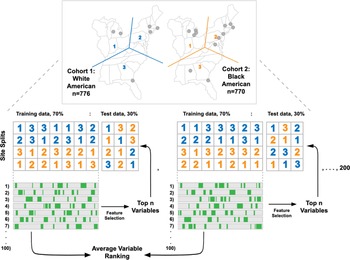
We adopted a study design that leveraged the multiple study sites enrolling participants in the two studies. This study design is illustrated in Fig. 1 and is described in the ‘Site split study design’ section. In brief, enrollment sites were grouped into three geographic regions in each cohort [cohort 1: n = 361, 361, and 54, for geographic regions 1 (Michigan study sites), 2 (Northeastern US study sites), and 3 (Southeastern US study sites), respectively; cohort 2: n = 304, 152, and 314 for geographic regions 1, 2, and 3]. Participant data were then partitioned into training (70% of the data) and test sets (30% of data, data from different study sites than training data). The training dataset had equal numbers of participants from each cohort and equal representation from each geographical region while, to increase rigor, the test dataset included participant data that were shuffled randomly (i.e. potential non-equal race, sex, age, etc., representation). Two hundred permutations of these training and test sets were used to determine external validation metrics. Within the training set, feature selection was performed using 100 rounds of Monte Carlo cross-validation that identified the top 30 variables based on average rankings across internal validation metrics. The selection of 30 variables was determined via the one standard error rule (Chan, Pristach, Welte, & Russell, Reference Chan, Pristach, Welte and Russell1993). This rule indicated that the most parsimonious subset of variables with the least error (up to one standard error) is 30 variables (online Supplementary Fig. S2; mean error and standard error for 30 variables: 0.17 ± 0.003). These 30 variables were then used to assess AUC, accuracy, sensitivity, specificity, negative predictive values (NPVs), and positive predictive values (PPVs) in the hold out test dataset.
Schematic of the study design employed in the current study to achieve rigorous training and test sets for machine learning algorithms. Participant data were derived from two longitudinal studies of motor vehicle collision trauma survivors. Enrollment occurred across 16 emergency department (ED) sites in the Eastern United States (gray dots top panel). Geographic locations of these ED enrollment sites were grouped into three broad areas as defined by blue numbers for cohort 1, the White America cohort (Platts-Mills et al., Reference Platts-Mills, Ballina, Bortsov, Soward, Swor, Jones and Rathlev2011) and orange numbers for cohort 2, the Black American cohort (Linnstaedt et al., Reference Linnstaedt, Hu, Liu, Soward, Bollen, Wang and Velilla2016). Participant data from each of these three geographic locations were then used to generate ‘site splits’ for training datasets (70% of the combined Black and White cohorts) and test datasets (30% of the combined cohort). As shown in the middle panel, training datasets were balanced across races and geographic locations. Within each training data site split, 100 rounds of Monte Carlo cross-validation were performed (represented by gray and green bars, bottom panel) to estimate variable selection probabilities and conduct feature selection. Using this methodology, average variable rankings were calculated, and the top variables were used for external validation within test datasets that were not constrained for race, sex, or geographic locations.

Motor vehicle collision study, cohort 1
The details of the first of our two MVC studies have been reported previously (Platts-Mills et al., Reference Platts-Mills, Ballina, Bortsov, Soward, Swor, Jones and Rathlev2011). In brief, individuals ⩾18 and ⩽65 years of age presenting to one of eight EDs in four no-fault insurance states (i.e. states that restrict ones right to seek compensation for pain or suffering that is associated with MVC: Michigan, Massachusetts, New York, and Florida) within 24 h of MVC and who did not have fracture other than finger or toe, other injury requiring hospital admission, were enrolled between June 2011 and June 2014. Additionally, to be enrolled, patients had to provide a telephone number for follow-up contact. Patients who were not alert and oriented per the treating clinician were excluded, as were pregnant patients, prisoners, patients unable to read and understand English, substantial soft tissue injury, passengers on a bus, or patients taking opioids above a total daily dose of 30 mg of oral morphine or equivalent. In addition, enrollment was limited to self-identifying non-Hispanic White Americans. Informed consent was obtained from all participants and IRB approval was obtained at all study sites.
Motor vehicle collision study, cohort 2
The details of the second of our two MVC studies have also been reported previously (Linnstaedt et al., Reference Linnstaedt, Hu, Liu, Soward, Bollen, Wang and Velilla2016). This prospective longitudinal study enrolled self-identifying Black American individuals ⩾18 and ⩽65 years of age who presented within 24 h of MVC to one of 11 EDs in six states/districts (Michigan, Pennsylvania, Florida, Alabama, Massachusetts, and Washington DC) between July 2012 and July 2015. In brief, individuals who did not have a fracture or other injury requiring hospital admission were screened for eligibility. Patients who were not alert and oriented were excluded, as were patients who did not self-identify as Black American, were pregnant, prisoners, unable to read and understand English, or taking opioids above a total daily dose of 30 mg of oral morphine or equivalent. Furthermore, only non-Hispanic Black Americans were enrolled in the study. The study was approved by the IRB of all participating hospitals. Each participant provided written informed consent before enrollment.
Assessments collected at the time of trauma exposure (i.e. potential predictors)
All variables included as potential predictors are presented in online Supplementary Table S1. Descriptions of these assessments are provided in online Supplementary Methods.
Data cleaning, imputation, and variable reduction
The two MVC cohort datasets were cleaned and imputed separately and then merged into a final dataset. Cleaning, variable reduction, and imputation steps were adapted from previously published protocols (Kuhn & Johnson, Reference Kuhn and Johnson2013; Stekhoven & Bühlmann, Reference Stekhoven and Bühlmann2012) and are summarized in online Supplementary Fig. S1. Briefly, we first removed variables with >10% missingness, and participants with >50% missing data. This resulted in a total of 966 variables in cohort 1 and 958 variables in cohort 2 (of these variables, >97% of them contained less than 5% missing data). We then used missForest, a random forest-based non-parametric method, to impute variables with missing values. Compared to other methods like MICE that individually fit data types, missForest can leverage all available data during imputation. Without imputation, many variables would be removed, thus harming data quality (e.g. there could be potential overconfidence in results and induced bias). Using these complete data, we then scaled continuous covariates [(0,1) range], removed variables with zero or low variance (i.e. those variables in which the fraction of unique values over the sample size was 10% and the ratio of the frequency of the most prevalent value to the frequency of the second most prevalent value was 19), and removed one of any pair of variables in high correlation with each other (i.e. |r| > 0.75) (e.g. number of alcoholic drinks consumed per week was correlated with alcohol consumed per day, therefore one of these variables was removed). Finally, variables not present in both cohorts (i.e. because a questionnaire was used in one cohort but not the other) were removed. A total of 160 variables remained and are provided in online Supplementary Table S1. All cleaning steps were performed using RStudio (version 4.0.0).
Site split study design
Instead of using our two datasets as separate discovery and validation datasets and given the nearly identical study design of the two studies and that they were comprised of self-identifying Blacks and Whites, respectively, we opted to combine them into one large final dataset and then hold out a subset of study sites as external validation sites (test data), with the rest of the sites used as our training data. This enabled us to include self-identified race as a candidate predictor, increasing generalizability of the study. Further, we opted to not evaluate using only one train-test (or hold out) split, but instead evaluate test performance over several train-test splits. In this way, we can better assess the generalizability of the models rather than rely on a single, potentially sensitive estimate.
To generate our train-test splits, we generated all possible combinations of study site splits that could fulfill a 70:30 split between internal training and external test data. Within the training data, we constrained the possible combinations of study sites by three metrics: ratio of self-identifying Black Americans to self-identifying White Americans was between 0.45 and 0.55, the ratio of women to men was between 0.45 and 0.55 and every training set had to have at least one study site from each major geographical location (defined as Michigan area, Northern east coast, and Southern east coast). These constraints resulted in 605 different combinations of possible training sets. Due to computational costs of running our machine learning pipelines on all 605 combinations, we randomly selected 200 of these splits on which to evaluate performance.
Machine learning methods
K-nearest neighbors
K-nearest neighbors is a non-parametric supervised learning method for classification. Given a new input to classify, it looks for the majority class among the k-nearest data points in the training set, and chooses that majority class as the output (Kramer, Reference Kramer and Kramer2013). It has been applied extensively in medical research (Ali, Neagu, & Trundle, Reference Ali, Neagu and Trundle2019; Gallego, Pertusa, & Calvo-Zaragoza, Reference Gallego, Pertusa and Calvo-Zaragoza2018; Li et al., Reference Li, Zhang, Zhang, Pang, Lam, Hui and Zhang2012; Shouman, Turner, & Stocker, Reference Shouman, Turner and Stocker2012; Xing & Bei, Reference Xing and Bei2020; Zhuang, Cai, Wang, Zhang, & Zheng, Reference Zhuang, Cai, Wang, Zhang and Zheng2020).
Regularized regression
Regularized regression is least squares regression with either an L1 penalty (lasso regression), L2 penalty (ridge regression), or a combination of both (Elastic Net). Using regression allows for interpretable models, making it popular in the biomedical community, while still allowing for robust performance via regularization (Austin, Pan, & Shen, Reference Austin, Pan and Shen2013; de Vlaming & Groenen, Reference de Vlaming and Groenen2015; Kessler et al., Reference Kessler, Hwang, Hoffmire, McCarthy, Petukhova, Rosellini and Bossarte2017; Lund et al., Reference Lund, Kuo, Brookhart, Meyer, Dalton, Kistler and Lewis2019; Marafino, Boscardin, & Dudley, Reference Marafino, Boscardin and Dudley2015; Odgers, Tellis, Hall, & Dumontier, Reference Odgers, Tellis, Hall and Dumontier2016; Parker et al., Reference Parker, Mullins, Cheang, Leung, Voduc, Vickery and Hu2009; Pavlou, Ambler, Seaman, De Iorio, & Omar, Reference Pavlou, Ambler, Seaman, De Iorio and Omar2016; Privé, Aschard, & Blum, Reference Privé, Aschard and Blum2019).
Random forest
Random forest is an ensemble non-parametric method that aggregates over several decision trees to make predictions. Random forests are popular for its ability to model complex and non-linear interactions of effects. Random forests have also proven successful in the biomedical community (Antoniadi, Galvin, Heverin, Hardiman, & Mooney, Reference Antoniadi, Galvin, Heverin, Hardiman and Mooney2021; Bayramli et al., Reference Bayramli, Castro, Barak-Corren, Madsen, Nock, Smoller and Reis2021; Chen & Ishwaran, Reference Chen and Ishwaran2012; Hu & Steingrimsson, Reference Hu and Steingrimsson2018; Kim, Yoo, Oh, & Kim, Reference Kim, Yoo, Oh and Kim2013; Wongvibulsin, Wu, & Zeger, Reference Wongvibulsin, Wu and Zeger2019).
Support vector machines
Support vector machine (SVM) for classification works by finding the optimal ‘separating hyperplane’ among the classes. Radial kernels were explored for our prediction task, but linear SVMs were the most performant. SVMs have also shown success in biomedical classification (Byun & Lee, Reference Byun and Lee2002; Georgoulas, Stylios, & Groumpos, Reference Georgoulas, Stylios and Groumpos2006; Kim et al., Reference Kim, Yoo, Oh and Kim2013; Mittag et al., Reference Mittag, Büchel, Saad, Jahn, Schulte, Bochdanovits and Sharma2012; Yokota, Endo, & Ohe, Reference Yokota, Endo and Ohe2017).
Neural networks
Neural networks are mathematical models inspired by the brain. Information is transmitted across the network by taking a linear combination of inputs (with weights, as in regression analysis) and applying non-linear functions. This design allows for powerful approximations (Bishop, Reference Bishop1995; Cybenko, Reference Cybenko1989). Here, we used a simplified version of published methods, i.e. a single-layer neural network within an ensemble, to guard against overfitting.
SuperLearner
SuperLearner is an ensemble method that finds the optimal weighting among methods of interest; the authors showed that asymptotically, it is as optimal as the best possible prediction algorithm tested (Gruber et al., Reference Gruber, Krakower, Menchaca, Hsu, Hawrusik, Maro and Klompas2020; Petersen et al., Reference Petersen, LeDell, Schwab, Sarovar, Gross, Reynolds and Bangsberg2015; Polley & Van Der Laan, Reference Polley and Van Der Laan2010; Torquati et al., Reference Torquati, Mendis, Xu, Myneni, Noyes, Hoffman and Becerra2022; Wyss et al., Reference Wyss, Schneeweiss, van der Laan, Lendle, Ju and Franklin2018). SuperLearner has been employed in a variety of biomedical applications.
Feature selection and assessment of model performance
For a given study site split (which specifies a train and test dataset), we built machine learning models to perform binary classification of PTSS. We compared the performance of regularized logistic regression (Brennstuhl, Tarquinio, & Montel, Reference Brennstuhl, Tarquinio and Montel2015; Maddoux, McFarlane, Symes, Fredland, & Feder, Reference Maddoux, McFarlane, Symes, Fredland and Feder2018), random forests (Nash, Ponto, Townsend, Nelson, & Bretz, Reference Nash, Ponto, Townsend, Nelson and Bretz2013), linear SVM (Defrin et al., Reference Defrin, Ginzburg, Solomon, Polad, Bloch, Govezensky and Schreiber2008), and SuperLearner (Creamer, Bell, & Failla, Reference Creamer, Bell and Failla2003) [where an ensemble of these methods, with k-nearest neighbors (Johansen, Wahl, Eilertsen, & Weisaeth, Reference Johansen, Wahl, Eilertsen and Weisaeth2007) and single-layer neural network (Zlomuzica, Preusser, Schneider, & Margraf, Reference Zlomuzica, Preusser, Schneider and Margraf2015), was used]. In our pipeline, we considered the number of top covariates to use in the model, k, as a hyperparameter to cross-validate on with model-specific hyperparameters, α. These parameters are selected in a nested CV-like approach using the training data. For a fixed k, α is selected by evaluating several αi (from a grid), using Monte Carlo cross-validation. Then, the final (k, α) hyperparameter is selected using the one-standard error rule. To determine the top k covariates, we implemented stability selection from Shah and Samsworth (Kind & Buckingham, Reference Kind and Buckingham2018), which utilizes several rounds of Monte Carlo cross-validation in order to robustly estimate the probability of variable selection. In our procedure, if the support of covariate i was non-zero according to Lasso, then i was considered a signal variable. Once the relevant model hyperparameters were chosen from the training set, we trained the model then calculated the mean and standard error for a variety of performance metrics on the test set. The pipeline was repeated for each machine learning method considered.
Results
Participants
Participants included in the current study were only those participants who completed 6-month follow-up questionnaires assessing PTSS outcomes (i.e. n = 1546). These individuals comprise >85% of enrolled individuals (88% of enrolled individuals in cohort 1 and 83% of enrolled individuals in cohort 2). Baseline characteristics of participants are shown in Table 1, and a comparison of individuals included in the current study analyses v. those individuals who were lost to follow-up is shown in online Supplementary Table S2. In both cohort 1 and cohort 2, most individuals were female and in their mid-30s. Education levels were higher in cohort 1, with 39% (n = 303/776) having received college or post-college education. This contrasts with cohort 2, where only 18% (n = 140/770) had college or post-college education. Collision characteristics were similar between the two groups. BMI was slightly higher in cohort 2. Twenty-five percent (n = 394/1547) of all participants reported PTSS 6 months following MVC (15% of White Americans and 36% of Black Americans).
Baseline characteristics of study participants from two longitudinal studies of motor vehicle collision trauma survivors (n = 1546)

s.d., standard deviation; HS, high school; BMI, body mass index.
Feature selection and internal validation
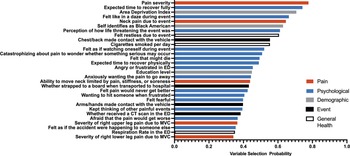
Variable importance, determined by calculating mean variable selection probability from 200 randomly selected internal site splits, was used to rank the top 30 predictors of substantial PTSS 6 months after MVC (Fig. 2). The most influential predictors of substantial PTSS included acute pain, psychological, and somatic symptoms, self-reported race, and cognitions and expectations regarding symptoms/recovery. As shown in Table 2, average AUCs for internal validation ranged from 0.83 ± 0.003 (random forest, SVM, SuperLearner) to 0.85 ± 0.002 (regularized regression). Additionally, the top 30 variables were included in a linear regression model to determine the direction of effect of each predictor. Regression coefficients from these linear regression models are presented in online Supplementary Table S3.
The top 30 characteristics that predict 6-month posttraumatic stress symptom (PTSS) outcomes following motor vehicle collision (MVC) trauma exposure. These data were collected via patient self-report in the early peritraumatic period during emergency department (ED) assessment and enrollment into the two current longitudinal studies. Variables are listed in order of the most predictive (top, predictive probability = 0.78) to the least predictive (bottom, predictive probability = 0.34). For ease of interpretation, predictor characteristics were grouped into the broad category of pain (red), psychological symptoms (blue), sociodemographic characteristics (gray), details about the MVC event (black), and general health of the participant (white).

Prediction of 6-month posttraumatic stress symptoms (PTSS) using demographic and questionnaire data collected in the emergency department following motor vehicle collision trauma (n = 1546)

Results presented are the average metrics calculated based on 200 stratified splits of the two cohorts into discovery and validation subsets (70% training and 30% test) based on enrollment study site (mean ± s.e.) as diagrammed in Fig. 1.
a Linear support vector machines.
External validation and model performance
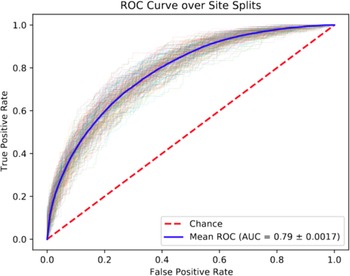
Following selection of the top 30 variables, we then used our hold out sample (30% of the full dataset) to assess performance via external validation procedures. We found that regularized regression methods showed the strongest performance, with an average AUC of 0.79 ± 0.002 (Table 2 and Fig. 3).
ROC curves showing the mean (blue line) and standard error (gray lines) associated with 200 iterations of external validation in the current study. These data represent the most performative methodology, i.e. regularized regression, and indicates an AUC of 0.79 ± 0.002 for top variables predicting 6-month posttraumatic stress symptoms following motor vehicle collision trauma.

Discussion
Findings from this study add to a growing body of literature (Freedman et al., Reference Freedman, Brandes, Peri and Shalev1999; Galatzer-Levy et al., Reference Galatzer-Levy, Karstoft, Statnikov and Shalev2014; Karstoft et al., Reference Karstoft, Galatzer-Levy, Statnikov, Li and Shalev2015a, Reference Karstoft, Statnikov, Andersen, Madsen and Galatzer-Levy2015b; Kessler et al., Reference Kessler, Rose, Koenen, Karam, Stang, Stein and McLaughlin2014; Kleim et al., Reference Kleim, Ehlers and Glucksman2007; Linnstaedt et al., Reference Linnstaedt, Rueckeis, Riker, Pan, Wu, Yu and McLean2019a, Reference Linnstaedt, Zannas, McLean, Koenen and Ressler2019b; Powers et al., Reference Powers, Warren, Rosenfield, Roden-Foreman, Bennett, Reynolds and Smits2014; Rosellini et al., Reference Rosellini, Dussaillant, Zubizarreta, Kessler and Rose2018; Schultebraucks et al., Reference Schultebraucks, Shalev, Michopoulos, Grudzen, Shin, Stevens and Galatzer-Levy2020; Shalev et al., Reference Shalev, Gevonden, Ratanatharathorn, Laska, van der Mei and Qi2019; Symes et al., Reference Symes, Maddoux, McFarlane and Pennings2016; Ziobrowski et al., Reference Ziobrowski, Kennedy, Ustun, House, Beaudoin, An and van Rooij2021) indicating that characteristics obtainable in the early aftermath of trauma exposure identify vulnerability to substantial persistent PTSS. The 30 characteristics identified in these datasets together showed good internal (AUC = 0.85 ± 0.002) and external validated prediction accuracy (AUC = 0.79 ± 0.002) for substantial PTSS at 6-month follow-up. Influential predictive domains in these datasets included peritraumatic pain and psychological symptoms, expectations of recovery and cognitions about pain, self-identified race, neighborhood socioeconomic status (Area Deprivation Index), and other sociodemographic characteristics.
The individual predictive characteristics identified in this study provide new insights for potential highly influential predictive factors for the development of substantial chronic PTSS. First, it remains poorly appreciated that peritraumatic pain and somatic symptoms are highly predictive for PTSS. The fact that few studies have evaluated such factors for inclusion in predictive tools for PTSS is consistent with the traditionally siloed approach to the study of adverse posttraumatic neuropsychiatric sequelae such as PTSS, pain, somatic symptoms, and depression, despite the fact that these outcomes are highly co-morbid and that vulnerability to these disorders is shared (Feinberg et al., Reference Feinberg, Hu, Weaver, Fillingim, Swor, Peak and McLean2017; McLean, Clauw, Abelson, & Liberzon, Reference McLean, Clauw, Abelson and Liberzon2005; McLean et al., Reference McLean, Ressler, Koenen, Neylan, Germine, Jovanovic and Kessler2019; Short et al., Reference Short, Tungate, Bollen, Sullivan, D'Anza, Lechner and McLean2022). This literature, and our study findings, supports the inclusion of peritraumatic pain and somatic symptoms in future studies interested in identifying/validating characteristics that individually or collectively best predict substantial chronic PTSS. In addition, this finding suggests the potential value of acute pain treatment to reduce the development of substantial PTSS, which has been identified in several studies (Holbrook, Galarneau, Dye, Quinn, & Dougherty, Reference Holbrook, Galarneau, Dye, Quinn and Dougherty2010; Saxe et al., Reference Saxe, Stoddard, Courtney, Cunningham, Chawla, Sheridan and King2001).
Interestingly, an individual's expectations of recovery – expected time to recover fully, and to recovery physically – were also among the most powerful predictive factors. This finding has several implications. First, expectations of recovery are simple to assess and should be considered when trying to develop predictive tools for use in acute post-traumatic settings. Second, while expectations of time to physical recovery are no doubt influenced by individual circumstance (e.g. age 80 v. 18), self-efficacy (i.e. belief in one's capacity to implement behaviors necessary to attain an outcome) is an important driver of recovery expectations and is associated with more rapid fear extinction (Zlomuzica et al., Reference Zlomuzica, Preusser, Schneider and Margraf2015). Secondary preventive cognitive-behavioral interventions targeting self-efficacy (Nash et al., Reference Nash, Ponto, Townsend, Nelson and Bretz2013) could improve outcomes for at-risk individuals.
To our knowledge, this study is the first to identify neighborhood socioeconomic status (SES) as a leading peritraumatic predictor of substantial PTSS symptoms. These findings are consistent with increasing appreciation that neighborhood SES has wide-ranging effects on health [e.g. via influences on stress system function (Do et al., Reference Do, Diez Roux, Hajat, Auchincloss, Merkin, Ranjit and Seeman2011; Karb, Elliott, Dowd, & Morenoff, Reference Karb, Elliott, Dowd and Morenoff2012), diet (Shahar, Shai, Vardi, Shahar, & Fraser, Reference Shahar, Shai, Vardi, Shahar and Fraser2005), and educational and employment opportunities (Saifi & Mehmood, Reference Saifi and Mehmood2011; Vergunst et al., Reference Vergunst, Tremblay, Nagin, Algan, Beasley, Park and Côté2019)]. Because of its protean influences on health status and barriers to health improvement, neighborhood SES has been proposed as valuable to include in the medical record (Adler & Stead, Reference Adler and Stead2015). Such inclusion would facilitate the examination of neighborhood SES as a predictor of adverse health outcomes and as a potential use in bedside clinical decision tools.
In contrast to neighborhood SES, Black v. White self-identified race has been identified as an important peritraumatic predictor of substantial PTSS in previous studies (Alegría et al., Reference Alegría, Fortuna, Lin, Norris, Gao, Takeuchi and Valentine2013). That this construct is a top predictor of PTSS underscores the need to include diverse racial and ethnic groups in future longitudinal studies assessing predictors of PTSS. It also highlights the need to identify racial/ethnic specific predictors [e.g. those related to discrimination (Brooks Holliday et al., Reference Brooks Holliday, Dubowitz, Haas, Ghosh-Dastidar, DeSantis and Troxel2020) and identity with one's race (Khaylis, Waelde, & Bruce, Reference Khaylis, Waelde and Bruce2007)], as they might contribute substantial predictive power for identifying adverse outcomes of trauma in specific racial groups.
Strengths of this study include the inclusion of self-identified Black and White women and men, focus on a single homogeneous type of trauma exposure, identical study design between the two studies from which participant data were derived, high follow-up rates, and a diverse set of variables included as potential predictors in our models. Several limitations should also be noted when interpreting study results. First, self-identifying racial groups besides self-identifying Black and White Americans were not included. Therefore, the generalizability of our findings to other self-identifying racial groups is currently unknown. Second, despite the inclusion of a diverse set of predictors into the pool of candidate predictors, certain characteristics that have been shown to predict PTSS previously, such as previous trauma exposure (Adams et al., Reference Adams, Sumner, Danielson, McCauley, Resnick, Grös and Ruggiero2014; Ehring, Razik, & Emmelkamp, Reference Ehring, Razik and Emmelkamp2011; Karstoft et al., Reference Karstoft, Statnikov, Andersen, Madsen and Galatzer-Levy2015b; Kessler et al., Reference Kessler, Rose, Koenen, Karam, Stang, Stein and McLaughlin2014), were not included. This is because these data were not collected from self-identifying White participants (those individuals in cohort 1). Third, despite high follow-up rates in both studies (though lower in the Black American cohort), bias could have been introduced via statistically significant differences in sex, age, and education of those who followed up v. those who were lost to follow-up. Fourth, while NPVs were high in all learning methods assessed, PPVs were low. This discrepancy could be due to the low prevalence (25%) of PTSS in this cohort, as low outcome prevalence often favors NPV (Steinberg, Fine, & Chappell, Reference Steinberg, Fine and Chappell2009). While low PPVs are not ideal, in the case of predicting PTSS, one could argue that testing positive while truly negative is less detrimental to treatment decisions than testing negative when truly positive.
Future studies should continue to refine optimal, parsimonious sets of PTSS predictors, leveraging data from studies performed to date. Optimal sets of PTSS predictors will very likely differ based on trauma type, assessment timing in relation to trauma exposure, setting, and/or patient population, and may include biological characteristics and/or utilizing tiering/targeting methods (e.g. utilize additional information only in individuals who cannot be risk stratified using a briefer set of predictors). Ultimately, the goal of this prediction work is to identify individual and collective predictors of PTSS and other adverse posttraumatic neuropsychiatric sequelae, both to gain understanding of potential risk factors and to aide in the development of decision support tools. Such tools will differ according to the factors influencing optimal predictors (e.g. trauma type, time from trauma, setting), and the optimal cut-off for such tools will also differ depending on the risks/benefits of the specific clinical decision the tool is intended to aide (e.g. risks/benefits of a specific secondary preventive intervention).
In conclusion, we identified promising individual predictors and a set of characteristics that effectively stratify individuals for risk of substantial PTSS 6 months following MVC. If further validated, these predictors could improve clinical efforts to identify vulnerable individuals at the time of ED presentation for secondary preventative interventions.
Supplementary material
The supplementary material for this article can be found at https://doi.org/10.1017/S003329172200191X
Acknowledgements
We would like to thank the study participants for taking part in these studies.
Financial support
Research reported in this publication was supported by the National Institute of Arthritis and Musculoskeletal and Skin Diseases (NIAMS) of the National Institutes of Health (NIH) under Award Number R01AR060852 (McLean), R01AR056328 (McLean), K01AR071504 (Linnstaedt), by the Rita Allen Foundation (Linnstaedt), and by the National Institute of Neurological Disorders and Stroke (NINDS) of the NIH under Award Number R01NS118563 (Linnstaedt and McLean). The content is solely the responsibility of the authors and does not necessarily represent the views of these funding agencies.
Conflict of interest
None.