Introduction
Sepiolids comprise the third largest group of Decapodiformes after cuttlefishes and oegopsid squids (Allcock et al., Reference Allcock, Lindgren and Strugnell2014). Bobtail squids of the subfamily Sepiolinae Appellöf, Reference Appellöf1898, including Euprymna Steenstrup, 1887 are small nektobenthic cephalopods that typically inhabit shallow coastal waters of the Indo-West Pacific, the East Atlantic coast, and the Mediterranean Sea (Reid and Jereb, Reference Reid, Jereb, Jereb and Roper2005; Bello, Reference Bello2020; Sanchez et al., Reference Sanchez, Fernández-Álvarez, Taite, Sugimoto, Jolly, Simakov, Marlétaz, Allcock and Rokhsar2021). Bobtail squid lacks a ‘true’ sepion (cuttlebone), and the gladius (pen) is chitinous, reduced, and generally absent (Reid and Jereb, Reference Reid, Jereb, Jereb and Roper2005) which are widely used for age and growth studies (Arkhipkin et al., Reference Arkhipkin, Bizikov, Doubleday, Laptikhovsky, Lishchenko, Parales-Raya and Hollyman2018), although sepiolids Rossia glaucopis (Kristensen, Reference Kristensen1980), Rossia pacifica (Arkhipkin, Reference Arkhipkin1995), and Sepietta oweniana (Czudaj et al., Reference Czudaj, Pereira, Moreno, Costa, Saint-Paul and Rosa2012) demonstrated clearly defined growth increments in statoliths and suggest life-span of 5–6 months. Due to their small size and ease of culturing in captivity, species of Euprymna are becoming a popular model animal for a range of biological studies on Cephalopoda (McAnulty and Nyholm, Reference Mcanulty and Nyholm2017; Belcaid et al., Reference Belcaid, Casaburi, Mcanulty, Schmidbaur, Suria, Moriano-Gutierrez, Pankey, Oakley, Kremer, Koch, Collins, Nguyen, Lek, Goncharenko-Foster, Minx, Sodergren, Weinstock, Rokhsar, Mcfall-Ngai, Simakov, Foster and Nyholm2019).
The Thai bobtail squid, Euprymna hyllebergi Nateewathana, Reference Nateewathana1997, is associated with tropical waters down to a depth of 74 m. Its spatial distribution ranges from the Gulf of Thailand (in the Pacific) (Nateewathana et al., Reference Nateewathana, Nabhitabhata and Nilphat2001), to the Andaman Sea (Nateewathana, Reference Nateewathana1997), the Arabian Sea (Venkatesan et al., Reference Venkatesan, Sajikumar, Jeena, Rahuman, Alloycious, Jestin Joy, Mohamed and Sasikumar2023), and the Persian Gulf (Khatami et al., Reference Khatami, Sareban, Valinassab, Esmailzadeh and Tavakoli-Kolour2014). Although this species is of no interest to fisheries currently (Reid and Jereb, Reference Reid, Jereb, Jereb and Roper2005), several sepiolid species caught as bycatch along the Thai coast are considered to have significant commercial value (Supongpan, Reference Supongpan and Nabhitabhata1995; Nateewathana, Reference Nateewathana1997). It was classified as ‘data deficient’ in the IUCN Red List of threatened species, so further research is necessary to determine its population trends and life history patterns (Barratt and Allcock, Reference Barratt and Allcock2012). Several previous studies have described attempts to rear E. hyllebergi (Nilaphat, Reference Nilaphat2001), successfully culturing it through three generations (Nabhitabhata et al., Reference Nabhitabhata, Nilaphat, Promboon and Jaroongpattananon2005) revealing that it has a short lifespan, with a maximum recorded age of 122 days (Nabhitabhata et al., Reference Nabhitabhata, Nilaphat, Promboon and Jaroongpattananon2005; Nabhitabhata and Nishiguchi, Reference Nabhitabhata, Nishiguchi, Iglesias, Fuentes and Villanueva2014).
Cephalopod statoliths grow incrementally, and their use in age estimations is well established (Arkhipkin and Shcherbich, Reference Arkhipkin and Shcherbich2012; Arkhipkin et al., Reference Arkhipkin, Bizikov, Doubleday, Laptikhovsky, Lishchenko, Parales-Raya and Hollyman2018). Daily growth increment deposition has been validated in several species (for a review, see Jackson, Reference Jackson2004; Hoving and Robison, Reference Hoving and Robison2017), though not E. hyllebergi. Venkatesan et al. (Reference Venkatesan, Sajikumar, Jeena, Rahuman, Alloycious, Jestin Joy, Mohamed and Sasikumar2023) emphasized the importance of investigating the lifecycle and ecological significance of under studied species from the Arabian Sea. Therefore, the present study was undertaken to describe the statoliths and their modification in ontogenesis, to estimate the age based on statolith increments, to calculate the growth rate, and to assess the weight–length relationship.
Materials and methods
Sample collection
A total of 154 Euprymna hyllebergi were captured in April and May 2018, and in May 2019 from the nearshore waters off Kollam, Kerala (southwest coast of India). All individuals were caught as bycatch by commercial trawlers (20 m overall length ) operating in nearshore waters of 20–70 m deep and identified visually with reference to Nateewathana (Reference Nateewathana1997). The specimens were preserved chilled (iced) immediately after capture, transported to a laboratory, where they were stored frozen at −20°C. The dorsal mantle length (DML) and wet body weight (BW) of each thawed specimen were measured to the nearest 0.1 mm and 0.01 g, respectively. The sex was determined, and a maturity stage was assigned according to Lipinski and Underhill, (Reference Lipinski and Underhill1995). There were 89 females (DML 10–50 mm) and 65 males (DML 8–46 mm).
Length–weight relationship
The relationship between BW and DML was modelled using the power function: BW = a × DMLb. Separate non-linear regressions were performed for males and females to estimate the parameters a and b. The possibility of pooling data from both sexes to model the overall BW–DML relationship was examined using an analysis of covariance (ANCOVA) (Snedecor and Cochran, Reference Snedecor and Cochran1967). The model included BW as the dependent variable, DML as the covariate, and sex as the factor along with the interaction term (DML × Sex) to test for homogeneity of slopes. The assumptions of homoscedasticity and normality were evaluated using Levene's test and Shapiro–Wilk test. A significant Shapiro–Wilk test result (P < 0.05) suggested that the residuals were not normally distributed, indicating a violation of the normality assumption. Levene's test for homogeneity of variances was conducted to evaluate whether the variances of BW were equal across males and females. The test indicated that the assumption of equal variances was violated (P < 0.05). As both assumptions were violated, a square root transformation was applied to the dependent variable (BW) to stabilise variance and approximate normality. The ANCOVA was subsequently performed on the transformed data. The interaction term in the model was not statistically significant (P > 0.05), indicating no significant difference in slopes between males and females. Given the non-significant interaction, data from both sexes were pooled to model the overall BW–DML relationship. The combined dataset was subjected to a non-linear model to estimate parameters a and b. To compare the calculated regression coefficient (b) with the theoretical value of 3 (Ricker, Reference Ricker1973), a Student's t-test was performed. All statistical analyses were conducted using R software (version 4.4.1, R Core Team, 2024).
Statolith analysis
Age determination was successfully performed on 80 individuals selected at random: 56 females and 24 males. Statolith extraction and preparation for counting growth increments were carried out according to the methods of Arkhipkin and Shcherbich (Reference Arkhipkin and Shcherbich2012). Terminology and measurements of statoliths followed Clarke (Reference Clarke1978). Total statolith length (TSL) was measured to the nearest micrometre from the end of the dorsal dome to the rostrum tip using a stereo zoom microscope (Nikon SMZ25, Tokyo) and NIS-Elements microscope imaging software. Statolith microstructure was examined at high magnification under a light microscope (Nikon Eclipse 80i), growth increments were counted by taking the mean of increment counts by three investigators, and the coefficient of variation (CV) was calculated to assess the reliability of the counts among them (Campana et al., Reference Campana, Annand and McMillan1995):

where N = number of squids aged, R = number of readings, Xij = ith age determination of the jth squid, and Xj = mean age of the jth squid.
TSL measurements were compared by expressing them as a percentage of DML:

where DML = dorsal mantle length (mm) and TSL = total statolith length (mm).
Increments were counted from the first check (presumed hatching ring) to the edge of the lateral dome, where increments were most clearly visible (Dawe et al., Reference Dawe, O'dor, O'dense and Hurley1985; Villanueva, Reference Villanueva1992).
Daily deposition of growth increments has been proven for the statolith of many squid species (Jackson, Reference Jackson1989, Reference Jackson2004; Hoving and Robison, Reference Hoving and Robison2017), and following the conclusions of Czudaj et al. (Reference Czudaj, Pereira, Moreno, Costa, Saint-Paul and Rosa2012) the putative age estimates derived from increment counts of common bobtail squid Sepietta oweniana (Orbigny, 1839–1841) was assumed here for E. hyllebergi. Daily growth rate (DGR) was calculated using the equation of Jackson et al. (Reference Jackson, Forsythe, Hixon and Hanlon1997):

where HDML = hatchling dorsal mantle length (2.2 mm; Nabhitabhata et al., Reference Nabhitabhata, Nilaphat, Promboon and Jaroongpattananon2005); IN = increment number (age in days); and in terms of weight:

where BW = body weight and HW = hatchling weight (0.004 g) (Nabhitabhata et al., Reference Nabhitabhata, Nilaphat, Promboon and Jaroongpattananon2005).
The relationships between DML and TSL were assessed by analysing the data for each sex separately using linear, exponential, logarithmic, logistic, and power models. The model with the highest coefficient of determination (R 2) was selected.
Results
The DML and BW of sampled individuals ranged from 8 to 50 mm (males = 8–37 mm and females = 10–50 mm) and 0.45 to 47.8 g (males = 0.45–22.7 g; females = 0.86–47.8 g), respectively.
The non-linear regression analysis of BW as a function of DML for males yielded the following model: ${\rm B}{\rm W}_{\rm M} = 0.9021 \times {\rm DML}_{\rm M}^{2.3506}$ . Both parameters are statistically significant, with P < 0.001, indicating a strong relationship between BW and DML. The residual standard error was 2.804, suggesting that the model accounts for a substantial portion of the variability in BW. In females, the fitted non-linear model was ${\rm B}{\rm W}_{\rm F} = 0.6892 \times {\rm DML}_{\rm F}^{2.561}$
 . The high significance of both parameters a and b suggests that DML is a strong predictor of BW.
The ANCOVA results for BW as a function of DML, sex, and their interaction indicates that DML has a substantial impact (P < 0.01) on BW. In contrast, the non-significant effect of sex (P = 0.6964) suggests that sex does not significantly influence BW. However, the significant DML:Sex interaction (P < 0.001) implies that the relationship between DML and BW differs between sexes. But the normality assumption was violated, as indicated by a significant result in the Shapiro–Wilk test (P < 0.05) for both sexes, suggesting that the residuals were not normally distributed. Levene's test for homogeneity of variances was conducted to evaluate whether the variances of BW were equal across males and females. The initial test was significant (P < 0.05), suggesting that the assumption of equal variances was violated. Hence, a square root transformation was applied to the BW to make it normally distributed. The linear regression model was performed to predict the square root of BW based on DML and sex. The results of ANCOVA indicate that the intercept is significantly different from zero (P < 0.001), and DML is a highly significant predictor (P < 0.05) of the square root of BW, with a positive relationship.
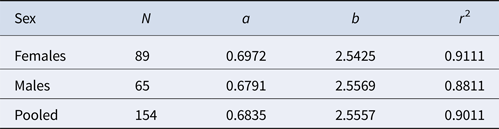
However, the variable sex was not significant (P = 0.935), suggesting that there is no meaningful difference in BW between males and females after adjusting for DML. The Shapiro–Wilk test was performed on the residuals of the transformed model (W = 0.986, P = 0.1238), showing that the residuals were approximately normally distributed, as the P-value exceeded 0.05. This confirms that the normality assumption was met for the transformed data. The data were then subjected to another run of Levene's test, which produced an F-statistic of 1.0548 and a P-value of 0.306, suggesting that there was no significant difference in the variances between males and females. Thus, there was no violation of the homogeneity of variances assumption. Further, the residuals are plotted against the fitted values to evaluate the linearity assumption in the regression model. The residuals are randomly scattered around zero with no obvious pattern, suggests that relationship between the DML and the BW appears to be linear. Further, the interaction term is not significant. Given the non-significant interaction, data from both sexes were pooled to model the overall BW–DML relationship. The parameters a and b are estimated through non-linear regression analysis, providing insights into the growth patterns of the species. The yielded model was BWF = 0.7628 × DML2.4847. Both parameters are statistically significant, with P-values less than 0.001, indicating a strong relationship between BW and DML. The allometric coefficient (b) values for males, females, and combined data were 2.3506, 2.561, and 2.4847, respectively (Table 1). Furthermore, a one-sample t-test was performed to compare the estimated b values against the theoretical value 3. The b values are significantly lower than 3, with a very small P-value (<0.001), indicating a negative allometry for males, females, and combined data.
Estimated parameters of length–weight relationship of Euprymna hyllebergi from the Arabian Sea

Growth increments were visible in all statoliths studied (Figure 1). The paralarvae and early juvenile (8–15 mm DML) statolith sizes ranged from 328 to 495 μm. Paralarvae statolith has an oval shape, with a blunt rostrum, the dorsal and lateral domes are not distinguishable from each other, and the wing is less developed (Figure 2A).
Light micrographs of (A) the statolith of an adult Euprymna hyllebergi (40 mm DML); and (B) enlarged view of increments. W, wing; R, rostrum; LD, lateral dome; DD, dorsal dome; N, nucleus, inside the hatch ring (black circle). Scale bar = 200 μm. The black line shows the plane of increment counting.

Changes in statolith morphology during the development of Euprymna hyllebergi from the Arabian Sea: (A) paralarvae (8 mm DML), (B) juveniles (20 mm DML), and (C) adult (45 mm DML). Scale bar = 200 μm.

In juveniles (18–25 mm DML), statolith size ranged from 498 to 692 μm. The rostrum increased in length in relation to DML. The dorsal dome is noticeably prominent with a well-developed wing and medial fissure (Figure 2B).
The adult statolith size (25–50 mm DML) ranged from 645 to 836 μm. The rostrum is pointed. The dorsal dome is distinctly separated from the lateral dome. The wing is broad and well-developed, with a prominent fissure (Figure 2C).
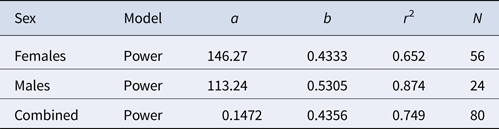
The statoliths of E. hyllebergi were reasonably large, and the size of the statolith (% of DML) decreased from 3.5 to 1.5% in females and 4.1 to 1.9% in males with increasing DML. The relationship between TSL and DML was best described by a power equation (Table 2) for both males and females.
Relationships between TSL and DML in mm of Euprymna hyllebergi from the Arabian Sea

There was high consistency (<5%) among readings for both males (CV = 1.62%) and females (CV = 0.08%).
The smallest female (10 mm DML; 0.86 g BW) had a total of 33 increments; the smallest male (8 mm DML; 0.05 g BW) had 25 increments (Figure 3A and B). The maximum number of increments in females (44 mm DML, 30.8 g BW) was 92, which was similar to 91 increments in males (37 mm DML, 22.7 g BW) (Figure 3A and B). The DGR of the individuals ranged from 0.23 to 0.59 (mean = 0.47) mm DML day−1 for females and from 0.20 to 0.49 (mean = 0.39) mm DML day−1 for males (Figure 3A). The BW DGR ranged from 0.02 to 0.46 (mean = 0.25) g BW day−1 for females, whereas the male BW DGR ranged from 0.01 to 0.25 (mean = 0.12) g BW day−1 (Figure 3B).
Relationship between size (DML) and age and weight of Euprymna hyllebergi (A), DML vs age (B) DML vs BW from the Arabian Sea (yellow circles, males; red circles, females).

Discussion
There are 18 species of Euprymna reported from the Indo-Pacific and Australian waters (Reid and Jereb, Reference Reid, Jereb, Jereb and Roper2005; MolluscaBase, 2024). Three of which have been reported from the coastal waters of India: Euprymna berryi, Euprymna morsei (Raj and Kalyani, Reference Raj and Kalyani1971; Sreeja, Reference Sreeja2013) and Euprymna hyllebergi (Venkatesan et al., Reference Venkatesan, Sajikumar, Jeena, Rahuman, Alloycious, Jestin Joy, Mohamed and Sasikumar2023). The Thai bobtail squid E. hyllebergi was observed on the west coast during April and May (pre-monsoon) at a depth of 20–30 m. In general, Sepiolidae have benthic or neritic habitat (Reid and Jereb, Reference Reid, Jereb, Jereb and Roper2005). However, the cogener E. berryi occurs upper sublittoral and pelagic in warm temperate waters; depth up to 107 m (Reid and Jereb, Reference Reid, Jereb, Jereb and Roper2005).
The DML–BW relationship of both male and female E. hyllebergi follow the negative allometry also reported for the same species from the Gulf of Thailand (Nabhitabhata and Nishiguchi, Reference Nabhitabhata, Nishiguchi, Iglesias, Fuentes and Villanueva2014). The length–weight relationship of six species of sepiolids was reported as negatively allometric for four species Rossia macrosoma, Rondeletiola minor, Sepiola intermedia, and Sepietta oweniana and isometric for two others (Sepiola robusta and Sepiola steenstrupiana; Önsoy and Salman, Reference Önsoy and Salman2022). Negative allometric relationships have been reported for many cephalopods (Sasikumar et al., Reference Sasikumar, Mohamed and Bhat2013; Önsoy and Salman, Reference Önsoy and Salman2022; Peter and Chembian, Reference Peter and Chembian2022). A variety of biological and environmental factors, including habitat, season, sex, maturity, developmental phase, and size range could be the cause of the variations in the b value (Jackson and Moltschaniwskyj, Reference Jackson and Moltschaniwskyj2001; Moltschaniwskyj and Pecl, Reference Moltschaniwskyj and Pecl2003; Boyle and Rodhouse, Reference Boyle and Rodhouse2005).
It is well known that the lifespan is about 4 months for the bobtail squid E. hyllebergi and Euprymna tasmanica based on rearing studies (Nabhitabhata and Nishiguchi, Reference Nabhitabhata, Nishiguchi, Iglesias, Fuentes and Villanueva2014). Therefore, additionally, their growth data was analysed based on the statolith-based ageing method provided.
The statolith growth increments of E. hyllebergi were well resolved, unambiguous as in many species of squid (Czudaj et al., Reference Czudaj, Pereira, Moreno, Costa, Saint-Paul and Rosa2012). The statolith shape of E. hyllebergi is specific and different from nearshore squids (Teuthoidea) from the Arabian Sea (Sajikumar et al., Reference Sajikumar, Sasikumar, Jayasankar, Bharti, Venkatesan, Jestin Joy, Alloycious and Mohamed2022a). The most distinguishing characters are a short rostrum and a broad wing region. The development of the statolith also has some peculiar features. In the early stages, there is no distinct rostrum or domes; they develop during the juvenile stage. Earlier, the pattern of statolith microstructure and the development of paralarvae of gonatid squid (Oegopsida) from the western Bering Sea were characterised by the presence of a large droplet-shaped nucleus and a bipartite post-nuclear zone divided into two (Arkhipkin and Bizikov, Reference Arkhipkin and Bizikov1997) and completion of development coincided with development of the tentacular club. The relative size of the statolith of E. hyllebergi was larger than that reported for squids in the families Loliginidae (Sajikumar et al., Reference Sajikumar, Sasikumar, Jayasankar, Bharti, Venkatesan, Jestin Joy, Alloycious and Mohamed2022a), Enoploteuthidae (Sajikumar et al., Reference Sajikumar, Sasikumar, Venkatesan, Jestin Joy and Mohamed2022b), and Ommastriphidae (Arkhipkin and Mikheev, Reference Arkhipkin and Mikheev1992). The statolith of E. hyllebergi juveniles was relatively large (4.1% DML) but, owing to negative allometric growth, their size was relatively small in adults (1.9% DML). Negative allometric growth of the statolith seems to be a characteristic of all cephalopods (Arkhipkin, Reference Arkhipkin1997a).
The Thai bobtail squid, E. hyllebergi, seems to be the smallest and most rapidly maturing cephalopod in the Arabian Sea. The total lifespan is about 3 months and shows a similar longevity with rapid growth and maturation to the small tropical Idiosepida Idiosepius pygmaeus from North Queensland, Australia (Jackson, Reference Jackson1989), and the micronektonic squid Pterygioteuthis gemmata from the central East Atlantic (Arkhipkin, Reference Arkhipkin1997b).
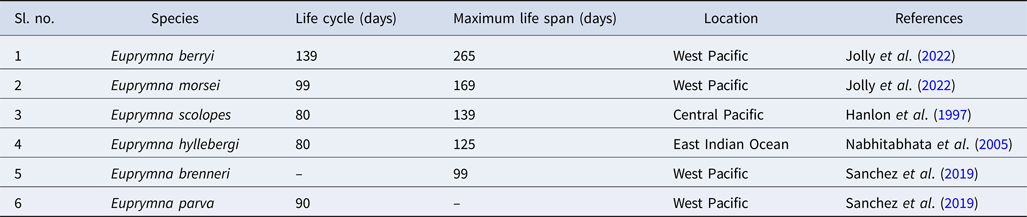
Culture studies of E. hyllebergi from the Gulf of Thailand show that they can reach 7 mm DML and 0.26 g BW in the first month (Nabhitabhata and Nishiguchi, Reference Nabhitabhata, Nishiguchi, Iglesias, Fuentes and Villanueva2014). Laboratory-based studies prove that for E. hyllebergi the lifespan is on average 99 days, with a maximum observed age of 125 days, with spawning occurring between 66 and 115 (mean = 93) days after hatching (Nilaphat, Reference Nilaphat2001). The overall lifespan of the four cultured species (E. berryi, Euprymna scolopes, E. tasmanica, and E. hyllebergi) is similar (Hanlon et al., Reference Hanlon, Claes, Ashcraft and Dunlap1997; Nilaphat, Reference Nilaphat2001; cf. this study, Table 3).
Comparison of lifecycle and life span of Euprymna spp. based on laboratory rearing studies

Based on rearing studies, mating is first observed at 66 days of age and spawning occurs 2–3 days after mating (Nabhitabhata and Nishiguchi, Reference Nabhitabhata, Nishiguchi, Iglesias, Fuentes and Villanueva2014). Both E. berryi and E. morsei demonstrated intermittent terminal spawning and spawned separate clutches continually once reaching sexual maturity (Jolly et al., Reference Jolly, Hasegawa, Sugimoto, Zhang, Kawaura, Sanchez, Gavriouchkina, Marlétaz and Rokhsar2022). It is assumed that the oldest individuals of E. hyllebergi in the present study are nearly at the end of their lifecycle. There is a similarity in studies of both growth and lifespan between rearing studies and statolith-based studies, ensuring the statolith-based method can be useful for Sepiolidae species as well. The distinctive statolith shape of the species, moreover, can be useful for identification of the species in the predators gut content. Therefore, in the future, additional studies are recommended to validate statolith increment periodicity, thereby improving our understanding of growth patterns in this species within tropical waters.
Data
Data and any available visuals, such as figures and tables, will be provided upon reasonable request to the corresponding author. Any codes created to assist in data analysis and/or any software application utilised in the current study will be provided upon reasonable request submitted to the corresponding author.
Acknowledgements
We would like to acknowledge Dr A. Gopalakrishnan, Director, CMFRI for the facilities. We are indebted to the fishermen for providing the specimens with geolocations. We thank Sangita S. and Priyanka V. for their assistance with statistical analysis. We are grateful to Dr Ian G. Gleadall, Consultant Professor, Tokyo, Japan for the constructive suggestions on the earlier draft of the manuscript. We also extend our gratitude to the anonymous reviewers for their constructive comments on the draft manuscript.
Author contributions
K. K. S. wrote the manuscript along with K. S. M., M. K. G., and G. S. K. K. S., K. M. J., V. V., and R. V. performed field sample collection and laboratory analysis. G. S., P. L., and K. S. M. contributed to the conception and design of the study and K. S. M. was responsible for funding acquisition and project administration. K. S. M. and G. S. revised and edited subsequent drafts of the manuscript. M. K. G. contributed to statistical analysis. All authors contributed to data interpretation and discussions and have read and approved the final manuscript.
Financial support
This work was funded by ICAR under the project ‘Development of Fishery Management Plans for Sustaining Marine Fisheries of Kerala and Lakshadweep’ (Project Code: FISHCMFRISIL201200300003).
Competing interests
None.